doi:10.1016/j.egypro.2014.07.050
Volume 52, 2014, Pages 18–25
2013 International Conference on Alternative Energy in Developing Countries and
Emerging Economies (2013 AEDCEE)
Open Access
Performance of Biocarbon based Electrodes for Electrochemical Capacitor ☆
Nirwan Syarif , Show more
Under a Creative Commons license
Abstract
We examined bio-carbon electrodes-based electrochemical capacitor. The electrodes were produced from gelam wood activated carbon. Six types of carbon electrodes in separator – electrodes assemblies were tested using galvanostatic charging – discharging (GCD) and electrochemical impedance spectroscopy (EIS) instrumentation. Eight types of aqueous solution from acid, base and salt were used as electrolytes. Three of six electrodes were prepared from carbon pelletsand others were prepared from powdered carbons. Carbon pellets were shaped and sized into electrode monoliths, and therefore those pellets were becoming binder-less. The powdered carbon were compacted along with binder and surfactant into 20 mm in diameter electrodes. The GCD and EIS measurements clearly indicated that both binderless and binderized carbon electrodes (CE) in electrochemical capacitor (EC) have 0.01 – 28 Fg-1 and 0.001 – 2.8 Fg-1 of specific capacitance, respectively. Performance tests of EC measured with EIS and GCD methods respectively have 0.001 – 0.15 F and 0.001 – 0.203 F of capacitance.
Keywords
gelam wood; electrochemical capacitors; carbon electrodes; galvanostatic charging-discharging; electrochemical impedance spectroscopy
References
Z.S. Lu, R.Z. Wang, L.W. Wang, C.J. Chen
Performance analysis of an adsorption refrigerator using activated carbon in a compound adsorbent Carbon, 44
(2006), pp. 747–752
Article | PDF (292 K) | View Record in Scopus | Citing articles (43) S.S. Lam, H.A. Chase
Review: A Review on Waste to Energy Processes Using Microwave Pyrolysis Energies, 5 (2012), pp. 4209–4232
View Record in Scopus | Full Text via CrossRef | Citing articles (19) L. Li, S. Liu, T. Zhu
Application of activated carbon derived from scrap tires for adsorption of Rhodamine B Journal of Environmental Sciences, 22 (8) (2010), pp. 1273–1280
Article | PDF (447 K) | View Record in Scopus | Full Text via CrossRef | Citing articles (40) Y.T. Ong, A.L. Ahmad, S.H.S. Zein, S.H. Tan
A Review on Carbon Nanotubes in An Environmental Protection and Green Engineering Perspective Brazilian
Journal of Chemical Engineering, 27 (02) (2010), pp. 227–242
View Record in Scopus | Citing articles (24)
C. Apetrei, I.M. Apetrei, J.A.D. Saja, M.L. Rodriguez-Mendez
Carbon Paste Electrodes Made from Different Carbonaceous Materials: Application in the Study of Antioxidants Sensors, 11 (2011), pp. 1328–1344
View Record in Scopus | Full Text via CrossRef | Citing articles (22)
Get rights and content
This article belongs to a special issue
2013 International Conference on Alternative Energy in Developing Countries and Emerging Economies (2013 AEDCEE)
Edited By Sompong O-Thong and Jompob Waewsak
Other articles from this special issue
Improvement Vortex Cooling Capacity
Strategy for Energy Efficient Buildings
Wind Energy Projection for the Philippi
View more articles »
… Waraporn Rattanongphisat, Krairin Thun… more
… Waraporn Rattanongphisat, Wathanyoo … more
… Angeli Silang, Sherdon Niño Uy, Julie M… more
Recommended articles
Citing articles (0)
Related book content Advanced search
Download full text in PDF Export
Journals Books Shopping cart Sign in Help
[6]
About ScienceDirect Contact and support Information for advertisers Z.J. Lin, X.B. Hu, Y.J. Huai, Z.H. deng
Preparation and Characterization of a New Carbonaceous Material for Electrochemical Systems
J. Serb. Chem. Soc., 75 (2) (2010), pp. 271–282
View Record in Scopus | Full Text via CrossRef | Citing articles (2) B.L. Ellis, K.T. Lee, L.F. Nazar
Positive Electrode Materials for Li-Ion and Li-Batteries
Chem. Mater., 22 (2010), pp. 691–714
View Record in Scopus | Full Text via CrossRef | Citing articles (556)
A. Magasinski, B. Zdyrko, I. Kovalenko, B. Hertzberg, R. Burtovyy, C.F. Huebner, T.F. Fuller, I. Luzinov, G. Yushin
Toward Efficient Binders for Li-Ion Battery Si-Based Anodes: Polyacrylic Acid
Applied Materials & Interfaces, 2 (11) (2010), pp. 3004–3010
View Record in Scopus | Full Text via CrossRef | Citing articles (127) C. Du, N. Pan
Supercapacitors using carbon nanotubes films by electrophoretic deposition Journal of Power Sources, 160 (2006), pp. 1487–1494
Article | PDF (644 K) | View Record in Scopus | Citing articles (115) S. Mitali, D. Soma, D. Monica
A Study of Effect of Electrolytes on the Capacitive Properties of Mustard Soot Containing Multiwalled Carbon Nanotubes
Res.J. Chem.Sci., 1 (3) (2011), pp. 109–113
View Record in Scopus | Citing articles (4) W. Lu, R. Hartman, L. Qu, L. Dai
Nanocomposite Electrodes for High-Performance Supercapacitors J Phys. Chem. Lett., 2 (2011), pp. 655–660
View Record in Scopus | Full Text via CrossRef | Citing articles (53) S. Sopcic, M.K. Rokovic, Z. Mandic
Preparation and characterization of RuO2/polyaniline/polymer binder composite electrodes for supercapacitor applications J
Electrochem. Sci. Eng., 2 (1) (2012), pp. 41–52
View Record in Scopus | Citing articles (4) M.D. Stoller, R.S. Ruoff
Best practice methods for determining an electrode material's performance for ultracapacitors
Energy Environ. Sci., 3 (2010), pp. 1294–1301
View Record in Scopus | Full Text via CrossRef | Citing articles (382) B.E. Conway, W.G. Pell
Power limitations of supercapacitor operation associated with resistance and capacitance distribution in porous electrode devices
Journal of Power Sources, 105 (2002), pp. 169–181
View Record in Scopus | Citing articles (93) B.H. Ka, S.M. Oh
Electrochemical Activation of Expanded Graphite Electrode for Electrochemical Capacitor Journal of The Electrochemical Society, 155 (9) (2008), pp. A685–A692
View Record in Scopus | Full Text via CrossRef | Citing articles (26) D.-W. Wang, F. Li, M. Liu, G.Q. Lu, H.-M. Cheng
3D Aperiodic Hierarchical Porous Graphitic Carbon Material for High-Rate Electrochemical Capacitive Energy Storage
Angew. Chem. Int. Ed., 47 (2008), pp. 373–376
View Record in Scopus | Full Text via CrossRef | Citing articles (621)
Selection and peer-review under responsibility of the Organizing Committee of 2013 AEDCEE. Corresponding author. Phone: +62 711 580269.
Copyright © 2014 Elsevier Ltd.
Terms and conditions Privacy policy
Copyright © 2014 Elsevier B.V. except certain content provided by third parties. ScienceDirect® is a registered trademark of Elsevier B.V.
Cookies are used by this site. To decline or learn more, visit our Cookies page
Energy Procedia 52 ( 2014 ) 18 – 25
Available online at www.sciencedirect.com
ScienceDirect
1876-6102 © 2014 Elsevier Ltd. This is an open access article under the CC BY-NC-ND license (http://creativecommons.org/licenses/by-nc-nd/3.0/).
Selection and peer-review under responsibility of the Organizing Committee of 2013 AEDCEE doi: 10.1016/j.egypro.2014.07.050
Phone: +62 711 580269. email: [email protected]
2013 International Conference on Alternative Energy in Developing Countries and
Emerging Economies
Performance of Biocarbon Based Electrodes for
Electrochemical Capacitor
Nirwan Syarif*
Department of Chemistry, Faculty of Mathematics and Natural Sciences, Sriwijaya University (Indonesia)
Abstract
We examined bio-carbon electrodes-based electrochemical capacitor. The electrodes were produced from gelam wood activated carbon. Six types of carbon electrodes in separator – electrodes assemblies were tested using galvanostatic charging – discharging (GCD) and electrochemical impedance spectroscopy (EIS) instrumentation. Eight types of aqueous solution from acid, base and salt were used as electrolytes. Three of six electrodes were prepared from carbon pelletsand others were prepared from powdered carbons. Carbon pellets were shaped and sized into electrode monoliths, and therefore those pellets were becoming binder-less. The powdered carbon were compacted along with binder and surfactant into 20 mm in diameter electrodes. The GCD and EIS measurements clearly indicated that both binderless and binderized carbon electrodes (CE) in electrochemical capacitor (EC) have 0.01 – 28 Fg-1 and 0.001 – 2.8 Fg-1 of specific capacitance, respectively. Performance tests of EC measured with EIS and GCD methods respectively have 0.001 – 0.15 F and 0.001 – 0.203 F of capacitance.
© 2013 Published by Elsevier Ltd. Selection and/or peer-review under responsibility of the Research Center in Energy and Environment, Thaksin University.
Keywords:gelam wood; electrochemical capacitors;carbon electrodes; galvanostatic charging-discharging; electrochemical impedance spectroscopy
1.Introduction
Activated carbon is a porous material which has high surface area and exhibits good adsorptive capacities [1]. It can classified into sustainable material because it reuses the byproduct of pyrolysis process of biomass, including forest residues such as bark, sawdust, shavings [2, 3]. It is nontoxic [4] and will not harm soil when it is disposed. Organic-based carbonaceous materials or biochar are amongst the most widely used as starting or precursor materials for electrodes [5, 6] because they are relatively inexpensive
© 2014 Elsevier Ltd. This is an open access article under the CC BY-NC-ND license (http://creativecommons.org/licenses/by-nc-nd/3.0/).
Nirwan Syarif / Energy Procedia 52 ( 2014 ) 18 – 25 19
[7] and easy to fabricate. The biochar electrodes can be used in a wide array of energy-needing things, like hybrid car batteries or home solar panels. The demand for clean, sustainable energy sources is very high. The facts are biocarbon is cheap and its availability, make the perfect substitute for polymer-based carbon electrodes in supercapacitors.
2.Experimental
Carbon electrodes (CE) were placed in the separator – electrodes assembly that consists of two pieces
of 20 mm diameter carbon electrode, a thin plate of metal titanium as current collectors, separator material i.e. Polytetrafluoroethylene (PTFE) - glass fabric with a thickness of 0.8 mm, the applicator was made of stainless steel rods. The houses were made of PTFE cylinder. The EC was made by covering a separator material with carbon electrodes on both sides and flanked by current collector plates as illustrated in Figure 1.
Fig.1 The structure of electrochemical capacitor
ECs were tested on two different systems, i.e. galvanostatic charging-discharging and electrochemical impedance spectroscopy. The two measurement systems will yield information relevant to the performance of CE, the specific capacitance, potential window, charging-discharging stability, life time, and electrical resistance.
Electrode, Carbon
Electrode, Carbon
Current Collector
Separator
Aplicator Aplicator
20 Nirwan Syarif / Energy Procedia 52 ( 2014 ) 18 – 25
3.Results
3.1.Electrochemical Impedance Spectroscopy Profiles
Electrochemical impedance spectroscopy (EIS) was used not just to study CE’s performance but also to
determine the resistance and electrode capacitance of all components that built EC, in response to frequency. One of many factors that affects the stability of voltage in EC is electrolyte[8]. This factor makes performance and life cycles limitation in ECs.
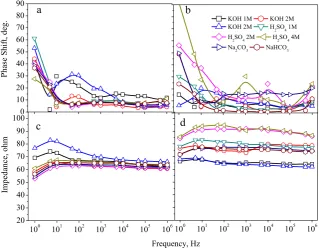
Fig. 2 Bode plot (phase shift and impedance) of EC using binderless electrode (a and c), binderized electrode (b and d) and electrolyte H2SO4, KOH, Na2CO3 and NaHCO3
Phase shifts of two ECs in various frequencies are given in Fig. 2 a – b. The results show capacitance
values ECs drastically reduced when operated at high frequencies. At low frequencies most ECs show the phase shift relatively close to 90. It can be said that the EC works relatively ideal as supercapacitor at low
frequencies [9]. The results are shown in Fig. 2c – d. Both types of ECs have relatively the same impedance
ranging from 50 – 100 ohm. EC with binderized CE shows reduction in impedance value lower than 10Hz
Nirwan Syarif / Energy Procedia 52 ( 2014 ) 18 – 25 21
Fig. 3 Bode plot (phase shift, capacitance and impedance) of ECs using PTFE (a, c and e), epoxy resin (b, d and f) as CE binder and electrolyte H2SO4, KOH, Na2CO3 and NaHCO3
The presence of binder that affects the mobility of ion in the electrode matrices has been reported by
several researchers [11, 12]. Fig. 3 (a – f) give the ideas of the mobility that affects the performance of ECs.
It can be shown in Fig. 3 that the use of epoxy resin as binder in carbon electrode relatively more stable in impedance compared with the electrode with PTFE. Furthermore, capacitance values can be calculated
using impedance – frequency relationship in equation (1).
1 log 2 C
Z Sf
(1)
The application of higher frequencies to ECs only slightly affects the capacitance in Fig. 3 (c and d), i.e.
0.01mF – 10 mF. At low frequencies, the capacitance of ECs with epoxy resin binding electrodes (60mF)
is relatively higher than CEs with PTFE (50mF) binding electrodes, but it is lower than the binderless CEs, i.e. 150mF (not shown).
22 Nirwan Syarif / Energy Procedia 52 ( 2014 ) 18 – 25
3.2.Galvanostatic Charging Discharging Profiles
Galvanostatic charging – discharging (GCD) is one of the methods that widely used for examining the
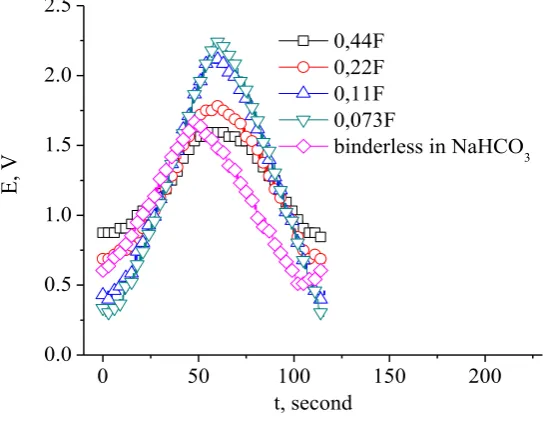
result of capacitance measurement which can easily connected with the load applied to the CE for an application[13]. GCD profiles in Figure 4 shows some of the characteristics associated with the application
of the EC. EC with binderless electrodes in the NaHCO3 (CCP/NaHCO3) electrolyte has a relatively the
same height with 0.22 F curve but with area approximately ¾ times of the area of 0.22 F.
Fig. 5 Some GCD profiles of commercial CE (0.073 – 0.44F) and binderless electrode in NaHCO3
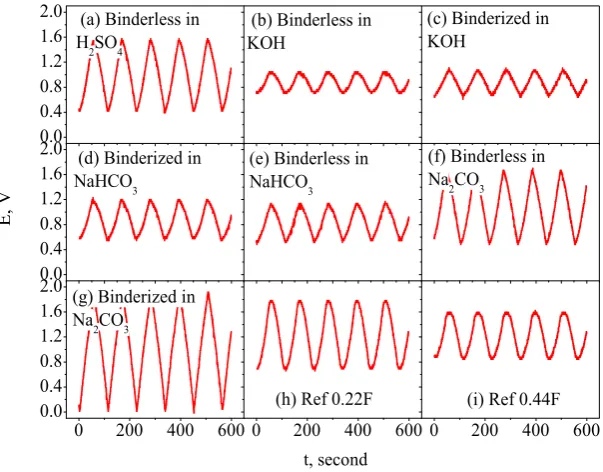
More details for GCD profiles which was made in this study are shown in Fig. 6. Two benchmark profiles (Fig.6(h) and (i)) showed the relationship between capacitance with voltage measured as a function of time. Some binderless and binderized CEs (Fig.6 (d) and (e)) showed a curve that is relatively equals to the references. Some of them showed the smaller curve indicating that CEs have higher capacitance values. It can be seen that despite having the same capacitance or even larger, but CE product has relatively low working voltage (1.2V). Reference CEs have working voltages of 1.6V.
Graphical analyses were applied to quantify the capacitance of EC methods such those used by other
researchers [13]. Calculating the slope of both curve in charging – discharging of ECs with binderless and
binderized electrodes (Fig. 6 (d) and (e)) and reference (Fig 6 (i)) had approximately the same values. The reference EC has 0.22F of capacitance. By using the equation (2), the capacitance of CE with binderless electrode can be calculated, i.e.
0.0052382 0.02604 0.203
i
C F
dV dt
(2)
Two of ECs in Fig. 6 (b and c) showed relatively smaller curves indicating greater capacitance values. The others (Fig. 6(a), (f) and (g)) showed inversely.
0 50 100 150 200
0.0 0.5 1.0 1.5 2.0 2.5
E
, V
t, second 0,44F 0,22F 0,11F 0,073F
Nirwan Syarif / Energy Procedia 52 ( 2014 ) 18 – 25 23
The evolution cycles of capacitance in charging – discharging term of ECs were studied using the same
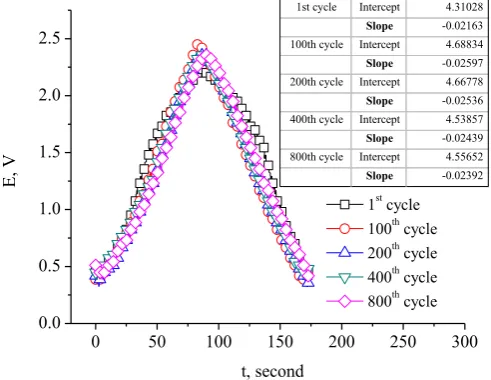
approximation. The results of the capacitance binderized electrodes are shown in the Fig. 8. It can be interpreted from the slope value (Fig. 7, panel) that capacitance only decreased in the first 50 cycles, followed by increasing value of the slope approaching the initial value indicating the existence of non-linearity in both of the charging and discharging direction.The same tendencies are shown in ECs with binder-less electrodes.
Fig. 6 GCD profiles of ECs vary with electrodes and electrolyte. Also benchmark profiles (Ref0.22F and Ref0.44F). Data was taken after fiftieth cycle of ECs charging – discharging
Fig. 7 GCD Profiles of EC with binderized electrodes in the first cycles and thereafter. In panes are intercepts and slope values from linear regression calculations
24 Nirwan Syarif / Energy Procedia 52 ( 2014 ) 18 – 25
The transition at the beginning of the charging – discharging cycle occurred at the first used is shown in
Figure 7 and 8. The difference between the earlier cycle and subsequent cycle is related to the distribution and arrangement of dislocations at the molecular scale [14]. An arrangement phenomenon can be detected by dilatometer as expanding and contracting of electrode matrices[15]. Electrode would inflate when electrical load was filled and shrunk when charge was drawn. Steady state will be reached after 11 or 12 cycles, and CEs will be fully worked there after.
Fig. 8 GCD Profiles of EC with binderless electrodes in the first cycles and thereafter. In panes are intercepts and slope values from linear regression calculations.
Furthermore, wetting process for electrode body by water which combined with the cycle of charging –
discharging will cause a reduction of internal resistance [16]. Reduced resistance causes displacement of electrons in microcrystalline much better and have impact on the increasing of the value of the capacitance.
4.Conclusion
Performance tests conducted using the EIS method gave the capacitance range from 0.01 to 0.150 F, with the highest value was obtained from ECs with binderless electrodes.The application of higher
frequencies to ECs only slightly affects the capacitance, i.e. 0.001mF – 10 mF. At low frequencies, the
capacitance of ECs with epoxy resin binder (60mF) is relatively higher than ECs with PTFE (50mF), but it is lower than the binderless ECs, i.e. 150mF. Performance tests conducted using the GCD method gave the capacitance range from 0.01 to 0.203 F. The highest value was obtained from ECs with binderless electrodes.
Acknowledgements
The financial supports for this research which are provided by the Rector of Sriwijaya University and DRPM University of Indonesia are gratefully acknowledged for the financial supports for doctoral study.
0 50 100 150 200 250 300
0.0 0.5 1.0 1.5 2.0 2.5
1st cycle Intercept 4.31028
Slope -0.02163
100th cycle Intercept 4.68834
Slope -0.02597
200th cycle Intercept 4.66778
Slope -0.02536
400th cycle Intercept 4.53857
Slope -0.02439
800th cycle Intercept 4.55652
Slope -0.02392
E
, V
t, second
Nirwan Syarif / Energy Procedia 52 ( 2014 ) 18 – 25 25
References
[1] Lu, Z.S., R.Z. Wang, L.W. Wang, and C.J. Chen, Performance analysis of an adsorption refrigerator using activated carbon in a compound adsorbent Carbon 2006. 44: p. 747-752
[2] Lam, S.S. and H.A. Chase, Review: A Review on Waste to Energy Processes Using Microwave Pyrolysis. Energies, 2012. 5: p. 4209 - 4232.
[3] Li, L., S. Liu, and T. Zhu, Application of activated carbon derived from scrap tires for adsorption of Rhodamine B. Journal of Environmental Sciences, 2010. 22(8): p. 1273-1280.
[4] Ong, Y.T., A.L. Ahmad, S.H.S. Zein, and S.H. Tan, A Review on Carbon Nanotubes in An Environmental Protection and Green Engineering Perspective Brazilian Journal of Chemical Engineering 2010. 27(02): p. 227 - 242.
[5] Apetrei, C., I.M. Apetrei, J.A.D. Saja, and M.L. Rodriguez-Mendez, Carbon Paste Electrodes Made from Different Carbonaceous Materials: Application in the Study of Antioxidants Sensors, 2011. 11: p. 1328-1344.
[6] Lin, Z.J., X.B. Hu, Y.J. Huai, and Z.H. deng, Preparation and Characterization of a New Carbonaceous Material for Electrochemical Systems. J. Serb. Chem. Soc., 2010. 75(2): p. 271-282.
[7] Ellis, B.L., K.T. Lee, and L.F. Nazar, Positive Electrode Materials for Li-Ion and Li-Batteries. Chem. Mater., 2010. 22: p. 691-714.
[8] Magasinski, A., B. Zdyrko, I. Kovalenko, B. Hertzberg, R. Burtovyy, C.F. Huebner, T.F. Fuller, I. Luzinov, and G. Yushin,
Toward Efficient Binders for Li-Ion Battery Si-Based Anodes: Polyacrylic Acid. Applied Materials & Interfaces, 2010. 2(11): p. 3004-3010.
[9] Du, C. and N. Pan, Supercapacitors using carbon nanotubes films by electrophoretic deposition. Journal of Power Sources, 2006. 160: p. 1487-1494.
[10] Mitali, S., D. Soma, and D. Monica, A Study of Effect of Electrolytes on the Capacitive Properties of Mustard Soot Containing Multiwalled Carbon Nanotubes. Res.J.Chem.Sci., 2011. 1(3): p. 109-113.
[11] Lu, W., R. Hartman, L. Qu, and L. Dai, Nanocomposite Electrodes for High-Performance Supercapacitors J. Phys. Chem. Lett. , 2011. 2: p. 655-660.
[12] Sopcic, S., M.K. Rokovic, and Z. Mandic, Preparation and characterization of RuO2/polyaniline/polymer binder composite electrodes for supercapacitor applications J. Electrochem. Sci. Eng., 2012. 2(1): p. 41-52.
[13] Stoller, M.D. and R.S. Ruoff, Best practice methods for determining an electrode material’s performance for ultracapacitors.
Energy Environ. Sci., 2010. 3: p. 1294-1301.
[14] Conway, B.E. and W.G. Pell, Power limitations of supercapacitor operation associated with resistance and capacitance distribution in porous electrode devices. Journal of Power Sources, 2002. 105: p. 169-181.
[15] Ka, B.H. and S.M. Oh, Electrochemical Activation of Expanded Graphite Electrode for Electrochemical Capacitor. Journal of The Electrochemical Society, 2008. 155(9): p. A685-A692.