Transfer Prices: A Financial Perspective
Nilufer Usmen
Department of Economics and Finance, Montclair State University, Montclair, NJ, 04043 e-mail: [email protected]
Abstract
The arguments for and against transfer pricing schemes so far have focused on profit-seeking approaches based on tax differentials, or on evasion of government enforced goods and fund flow restrictions. This article shifts to a value-seeking framework where transfer prices act as strategic tools that may enhance value for the multinational with a foreign affiliate by exploiting financial and/or tax arbitrage that also lead to owner-ship arbitrage. The results show that there is an optimal level of transfer price depend-ing on the specific exchange rate distribution when the cost structure allows for a penalty for overcharging. Moreover, this article introduces a new form of tax arbitrage benefit of transfer prices that is based on present value of tax shields.
1. Introduction
Within a multinational firm, it is not uncommon to transfer goods, services and loanable funds between the parent and an affiliate or between any two of its alliances. The transfer prices1 attached to these flows can be adjusted by the parent following certain methods that are supervised by the tax jurisdictions and other government authorities where the companies are incorporated. It is well documented that due to tax differences, import duties, quotas imposed by host countries and/or exchange restrictions or restrictions on ownership, it may be in the best interest of profit maximization to assign a higher/lower price to the transferred goods, services or funds than arm’s length.2In prac-tice, multinationals do have the schemes in place to charge prices that are legitimate and that can be substantiated but also that may vary from their true values. The degree of arbitrariness in setting transfer prices depends on whether these products or services are traded in the open market. Even with traded products and services, it is possible to vary the transfer price by using different credit terms. Therefore, we may assume that the MNCs have considerable leeway to adjust the level of transfer prices charged to their affiliates.
The arguments for and against transfer price schemes thus far have focused on profit maximization within regulations imposed by government authorities. The analyses have shown how to regulate
transfer prices to increase after-tax profits for the parent company in the presence of differential taxes, import duties, partial ownership, deferred repatriation of income and different dividend pay-out ratios. In these past analyses, the uncertainty about exchange rates has been often overlooked notwithstanding the fact that most transfer pricing situations involve cross-border cash flows. Moreover, there has been a decline in the interest for doing research in this area in financial economics even though the role played by transfer prices has become more significant as a result of globalization of busi-nesses and corresponding increase in intra-firm trade and fund flows across borders.3
This article will explore the role played by transfer prices in multinational financial decision making within an intertemporal value-seeking framework, in the sense that input decisions are made now while the revenues occur in the future. In this framework, the future uncertain revenues will further be impacted by exchange rate volatility. To my best knowledge, this article will be the first in transfer pricing literature to account for both cash flow and exchange rate uncertain-ties and their interactions simultaneously. It will view transfer prices as a scheme that can create or destroy value for the firm as it shifts revenues within the network of alliances and the parent.
There are four features of the model developed in this study. One is market segmentation that leads to financial arbitrage, the second is the covariance between exchange rates and foreign currency cash flows and the third is the tax differential that leads to tax arbitrage. The fourth is the transfer price/cost structure that allows for transfer price to differ from cost but also limits the deviation by a penalty brought by government authorities. These four features, one by one or jointly affect the incentives to set the transfer price that will enhance the value of the multinational parent.
Specifically, in the present analysis, transfer prices will be presented as a strategic tool that can be used to exploit the benefits of financial and tax arbitrage which lead together to ownership arbitrage to increase the value of a multinational. Financial arbitrage is prevalent in a world where capital markets are effectively segmented due to direct and indirect investment barriers, as evidenced in previous research.4 It is documented that direct barriers, such as taxes or restrictions on foreign ownership of domestic securities, as well as indirect barriers, such as differences in information, accounting state-ments, investor preferences or political risk, result in segmentation of
international capital markets. The asset-valuation implication of seg-mented markets is that each market assigns a different premium to the same risk leading to different valuations of the same cash flows in two markets. If the markets were integrated, assets with equal risk located in different countries would yield the same expected returns in a common currency. This article will also note that although finan-cial arbitrage, a product of market segmentation, is partially caused by tax differences, tax differences are not the only reason to have dif-ferent valuations in different countries. This article, hence, will pres-ent a base case where taxes are assumed away but value differpres-entials and financial arbitrage opportunities are still possible due to other barriers in international capital markets. The impact of tax differences on value will be introduced later and termed as tax arbitrage. Whether the value gain is due to financial or tax arbitrage or both, there will be a resulting ownership arbitrage as to who should own the subsidiary.
This article begins with a definition of financial arbitrage (owner-ship arbitrage) in international capital markets in a state-preference framework, and under risk neutrality. This hinges on the covariance between foreign cash flows and exchange rates. The next section will show that although the above definition of segmented capital markets requires that different risk premiums be attached to the same risk; a finer description of segmentation and financial arbitrage reveals that the same cash flows can still have different valuations under risk neu-trality due to the covariance term. Based on this definition, the differ-ential value of a foreign affiliate to a parent financed by equity is derived. This is the value difference of the foreign affiliate’s cash flows between the foreign and domestic capital markets that are partially segmented. In this value differential equation, transfer prices become a decision variable that determines the value gain to the parent. Hence, the multinational should set the total transfer prices charged to its affiliate as to increase this value differential whenever positive. This article proceeds to introduce differential taxes for the countries that host the parent and the affiliate. The impact of the tax differences on differential values and the interactions between the two sources of arbitrage opportunities, namely financial and tax arbitrage are explored.
The model uses a cost structure where profits from intra-firm trade and fund flows resulting from setting transfer prices above production cost are allowed, but there is also a penalty for unsubstantiated high
transfer prices charged to the affiliate that would trigger scrutiny from the government authorities. Hence, the profit potential of increasing transfer prices are offset by this countervailing cost such that the par-ent may seek an optimal level of transfer price that should be charged to the affiliate to maximize the differential value whenever positive. Note that this value gain is independent of tax differentials or financial arbitrage. Hence, the overall value gain for the parent depends on the combined impact of financial arbitrage, tax arbitrage and profits to be made on intra-firm trade and fund flows. This article will trace each component of value gain to its roots and look at their interactions as well.
The model developed in this paper is an easy optimization problem where the optimal levels of transfer prices to be charged to the affiliate are jointly determined with who should own the affiliate which is termed as ownership arbitrage. In short, the parent has to decide whether it is worthwhile to maintain the ownership of the affiliate along with what transfer price to charge to maximize its gains. As sta-ted above, the source of value gains for the parent equity holders are financial arbitrage, tax arbitrage, and profits to be made from charging the affiliate for the goods, services and funds transferred above their production cost. Furthermore, the framework of the model is con-strained to the totally owned affiliates with 100 per cent repatriation of dividends with no tax deferral but with allowance of full tax credit. As noted in previous research, tax avoidance policies that prescribe shift of income to low tax jurisdictions will not be applicable in this set-up. Nevertheless, this article finds a new source of tax arbitrage when the home and host countries have different taxes based on present value of tax shields. This result favors increasing transfer prices for affiliates in countries with higher tax rates.
The numerical simulations of the model reveal a number of results. In a base case where taxes are assumed away, the covariance of cash flows and exchange rates determines whether the parent should main-tain the ownership of the affiliate. This covariance becomes sole deter-mining factor for country of ownership in segmented markets where financial arbitrage is possible for risky assets but not for risk-free ones. Whenever this covariance is strongly positive, parent should own the particular affiliate otherwise the affiliate should be carved off and sold to host country investors. Hence, the decision to set the transfer prices and ownership of the affiliate are determined simultaneously by the affiliate cash flows and exchange rates. In this base case where only
financial arbitrage is possible, transfer prices play a role in increasing value to the parent only if uncovered interest rate parity (UIRP) is vio-lated for risk-free assets of the two countries and favors parent owner-ship. Whenever the value differential is positive and parent ownership is supported, the optimal transfer price is determined at a level that is above the expected trigger price. This finding results from the cost structure developed in this article.
When tax arbitrage is also considered, ownership decision may be reversed in the case of strong negative covariance between affiliate cash flows and exchange rates that would have otherwise indicated host country ownership. Specifically, for high tax rates in host country that allows for tax arbitrage gains of our model to be significant, parent ownership becomes optimal. Once again, under the cost structure of this article high transfer prices increase profits and hence value beyond the impact of financial and tax arbitrage, but a penalty on transfer prices set above a reasonable limit offsets this advantage. The optimal transfer prices obtained when taxes are considered, however, are lower for affiliates in higher tax rate countries but higher for lower tax rate countries compared to the base case.
The numerical simulations demonstrate how a manager of a multi-national can easily implement the model and obtain an optimal level of transfer price by using cash flow and exchange rate distributions and estimated values of parameters such as its profit margin.
2. Financial Arbitrage
Financial arbitrage will be modeled in a state-preference framework.5 Suppose there is an asset that generates state contingent cash flows, R (s), in foreign currency, and there is also a domestic substitute with cash flows, [R(s)e(s)], where e(s) are the state contingent exchange rates. A domestic investor can sell the foreign asset and convert the proceeds to domestic currency at e0, the spot exchange rate, to buy the
domestic perfect substitute. To avoid arbitrage the following must hold:
e0½RsRðsÞbðsÞ ¼RsRðsÞeðsÞaðsÞ ð1Þ
In the above expression, a(s) and b(s) are the state contingent risk adjustment factors (pricing vectors, state contingent discount rates) in the domestic and foreign markets, respectively.
Sufficient conditions for (1) to hold are
hðsÞ ¼eðsÞaðsÞ e0bðsÞ ¼0 for everys ð2Þ
However, in a fully integrated market where all securities should be priced the same in the two markets the condition in (2) is necessary, too. However, given that in reality capital markets around the world are somewhat segmented, it is more likely that
hðsÞ 6¼0 for some s ð3Þ
Condition (3) furnishes a formal description of market segmentation in a state-preference framework which is consistent with the standard definition and empirical evidence. The validity of this condition rests upon the fact that in an imperfect world capital market, arbitrage can-not take place instantaneously and effectively, especially for longer maturities and for arbitrage opportunities that demand high volume of funds. Hence, h(s) represent the financial arbitrage opportunities pres-ent in the market. If h(s) is positive, the same unit of income in foreign currency will have a higher value in the domestic market in that state. If the reverse is true and h(s) is negative, then the foreign market places a higher value for the same unit of income in foreign currency in state s.
It is also well-known that
1
RsaðsÞ
¼ra and 1
RsbðsÞ
¼rb ð4Þ
where ra and rb are one plus the risk-free interest rates in the two countries.
Under risk neutrality, a(s) and b(s) become p(s)/ra and p(s)/rb
respectively where p(s) are state probabilities that are assumed to be
the same for both set of investors. In this case, to avoid arbitrage
RRðsÞ eðsÞ ra
e0
rb
pðsÞ ¼0 ð5Þ
The above can be simplified to
EðRÞEðhÞ þCovðR;eÞ=ra ¼0 ð6Þ
where
EðhÞ ¼ EðeÞ ra
e0
rb
Expressions in (5) and (6) are descriptions of the UIRP relationship under risk neutrality. Note that for risky assets with cash flows R(s), E(h) =0 is not sufficient for arbitrage to disappear totally. For these
assets, Cov(R,e) will still lead to value discrepancies in segmented capi-tal markets. The above expression implies that even if arbitrage is not possible on the average and for risk-free assets whenever E(h) = 0,
deviations can still occur in specifich(s). These deviations are captured by the covariance term. It should be noted that this covariance term would not exist if the two capital markets were perfectly integrated and financial arbitrage could take place in every state for every risky asset. If it exists, it may also be interpreted as a nonlinear impact of exchange rates on value.
3. The Valuation Model: Base Case
In this article, there is a parent with an affiliate in a foreign country. The parent is all equity financed and the affiliate will also be financed by equity alone. The affiliate will be wholly owned by the parent in the sense that the parent will not share decision-making control with any other shareholder in the host country as would have been the case with a joint venture.6 However, the ownership of the affiliate by parent is not automatic and will depend on market valuations. For strategic rea-sons, the parent would like to retain the ownership whenever optimal.
The affiliate generates state contingent cash flows, R(s), in foreign currency net of costs that are not associated with intra-company trans-fers. The parent company charges to the affiliate a lump sum price C in foreign currency for intra-company transfer of goods, services and funds. The transfer price may be denominated in the foreign currency for purposes of natural hedging or for other operational reason.7 Although in practice it may be wiser to show a detailed list of specific items charged to the affiliate to make it easier to substantiate the prices to the local government authorities, for the purposes of this article a single price C will be used. This price may cover physical goods and services transferred to the subsidiary, corporate overhead, royalties, licensing fees and interest payments on inter-company loans. Once the
total level of C is determined by the parent, the parent will have lati-tude to assign individual prices to each item that is charged. C is a contractual price that is determined by the parent today and that is to be charged to the affiliate at a future date.
The real known cost of producing this portfolio of goods, services and funds to parent will be fixed atC*in home currency of the parent.
Moreover, a countervailing cost will be introduced where there will be a penalty to parent if C is increased to a level that will trigger authori-ties to intervene in setting the transfer price. In particular, if C is raised beyond a level that exceeds the standard profit margin of the parent, the additional profits will be penalized by athat is>1. In other
words, if C* is the true cost and p is a mark-up that is slightly above
the profit margin that the parent earns on its similar business with third parties, the parent will be penalized whenever Ce(s) >C*(1 + p),
the trigger price. The penalty will be the loss of abnormal profits, as Ce(s) will be forced to a lower level within the reasonable range [C* C*(1 + p)], and some more as penalty and litigation costs; hence
a >1. Basically, this countervailing cost structure is based on the
premise that government authorities have reasonable diligence and penalize the firm when transfer prices are set significantly above arm’s length price.
Initially, to rid the results of this article from potential gains of tax arbitrage and import tariff/duty avoidance, we exclude taxes, tariffs and duties to arrive at a base case.
If the affiliate was valued by host country investors, it would have a value of
Vb¼ ðEðRÞ CÞ=rb ð7Þ
If instead, it was valued by the parent country investors, the value of the affiliate would be
Va¼X
s
½RðsÞ CeðsÞpðsÞ=raþ
X
s
ðCeðsÞ CÞpðsÞ=ra
a
X
D
ðCeðsÞ Cð1þpÞÞpðsÞÞ=ra
where
D¼ fs:Ce(s)>Cð1þpÞg ð8Þ
In (8), e(s) are the state contingent exchange rates, and p(s)/r
a and
p(s)/rbare state contingent discount factors as noted before.
The condition under which the ownership of the affiliate should be maintained by parent is
DV¼Va e0Vb >0 ð9Þ
where e0 is the spot exchange rate. If DV is negative, the affiliate
should be carved off and sold to investors in the host country.8
DVin (9) can be expressed as:
DV¼ ðEðRÞ CÞEðhÞ þ fCovðR;eÞ þ ðCEðeÞ CÞ
a
X
D
ðCðeÞ Cð1þpÞÞpðsÞg=ra ð10Þ
This result can be interpreted as ownership arbitrage and it partially stems from the covariance term and states that the firm may want to sell the foreign entity to foreign owners facing a different covariance structure. However, it should also be noted that the covariance term appears in the first place due to existence of risky financial arbitrage.
C is bounded by zero on the lower end, meaning only the cases where the parent is charging the affiliate a positive C will be relevant. Moreover, the model allows forC values to exceedR(s) values in some states. This implies that the parent ex ante is willing to absorb losses from the affiliate in some contingencies if that is going to increase value today. As there are no outside claimants, this is a reasonable assumption.
There is also an assumption in the model that exchange rate fluctua-tions do not have an impact on the cash flows and value of domestic operations. Otherwise, the multinational may want to sell the domestic entity to foreigners. It will suffice to assume that exchange rate uncer-tainty has a greater impact on the value of the foreign subsidiary than on parent.
The goal of the parent is to set Csuch thatDVhas the largest posi-tive value. If DV were negative, the optimal decision for the firm would be to spin-off and sell the affiliate to foreign investors and col-lect cash. In determining maximum positive DV, however, C remains as a crucial decision variable to exploit the benefits of financial arbi-trage (ownership arbiarbi-trage) embedded in market conditions, as well as to boost profits from intra-firm trade and fund flows.
There may be two interpretations of the case where deviations from UIRP are observed. One is when nominal interest rate differential does not predict the nominal exchange rate changes. This may be exploited by means of traditional financial arbitrage whereby country-ainvestors move funds but continue to value at country-a discount rate. Second is real interest rate differentials do not predict real exchange rate changes which can only be exploited by means of arbitrage of real assets. The firm can move production between the domestic and the foreign entity in response to real deviations. This may be called pro-duction arbitrage. As we do not observe much ownership arbitrage such a response may be more realistic and tells us that the multina-tional has other ways of achieving the same. The model accounts for both interpretations.9
In particular, if risk-free arbitrage is possible and E(h)< 0,
increas-ing C would increase value to the parent and guarantee parent own-ership as well. Otherwise, parent should set C low to increase this differential value to make it conducive to parent ownership. Another term that results from segmented markets paradigm of this article is the covariance term between affiliate cash flows and exchange rates. This term is independent of the level of C. Hence, for financial arbi-trage gains C is a decision factor only for cases where UIRP for risk-free assets is violated under risk neutrality. When risk-risk-free arbitrage is not possible but risky arbitrage is still prevalent, the covariance structure of cash flows and exchange rates lead to ownership arbi-trage.
Hence, if we further assume E(h) =0, and that arbitrage is only
possible for risky assets but not for risk-free ones, we obtain
DV¼ fCovðR;eÞ þ ðCEðeÞ CÞ aEDðCeðsÞ Cð1þpÞÞg=ra ð11Þ
The first term is what is left of the impact of market segmentation on dividends repatriated which is independent of C, and hence parent can no longer use C to exploit risk-free financial arbitrage. However, risky financial arbitrage is still a significant factor in determining the ownership of the affiliate due to the covariance term. The other two terms appear as a result of the cost structure of the model. The second term shows the increase in value to parent by raising C to the highest possible level; the third term is the penalty if C is increased beyond a reasonable level to government authorities. In those states where Ce(s) exceeds the trigger price there will be a loss of a per cent of value.
Hence,
@DVR
@C ¼
EðeðsÞÞ ra
aEDeðsÞ
ra
ð12Þ
and an optimalC is reached when
EðeðsÞÞ ¼aEDeðsÞ ð13Þ
Note that the distribution of e(s) over states and its nonlinearity on value is crucial to this result. The right hand term is the expected exchange rate restricted to the states where the set transfer price exceeds the trigger price. The optimal C is reached when this condi-tional expected value in D equals the unconditional expected value of the exchange rate distribution.
4. Numerical Example and Results: Base Case
This section will investigate the relationships characterized by the model between C that is determined by the parent, the cash flows of the affiliate and the exchange rates.
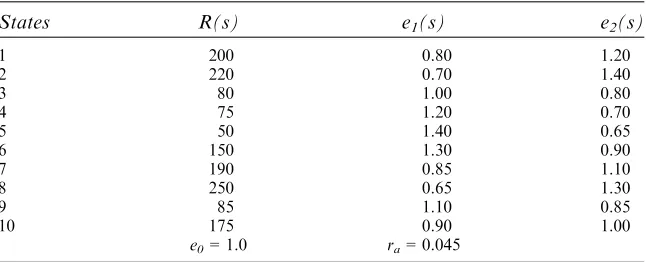
Table 1 below presents the hypothetical data created to fit the model descriptions.
The data represents an example of values these variables can take given the desired relationships in the mathematical model. They neither are empirical data nor are they random (ad hoc) selections, but plausi-ble representations of the behavior of these variaplausi-bles in real life. For example, exchange rate values were based on a normalization of an exchange rate distribution where today’s spot rate is one and the “b” currency can appreciate or depreciate within a 35–40 per cent band. This is a reasonable representation of exchange rate behavior for many currencies. Cash flows of the example can be scaled up or down with no loss of generality as long as they correlate to exchange rates in the prescribed manner. Variations of the example in Table 1 were also tried but did not change the results in any substantial way. The numer-ical exercises illustrate the mathematnumer-ical relationships of the model and the results seem to be robust to variations in inputs.
Based on the values in Table 1 and assuming uniform probabilities,
p(s) = 1/N, we find that Cov(R,e
1) = 15.1389 and Cov(R,e2) = +17.00. The data in fact shows strong correlations for cash flows and
exchange rates as would be the case with import-based and export-oriented affiliates. Also E(e1) = E(e2) = 0.99. The two exchange rate
variables have same means, although their variations over states are different. As e0 = 1, both e(s) variables do not show any significant
expected change in exchange rates over time. These exchange rate dis-tributions were chosen as such to free the results of the numerical example from a bias in expected exchange rate depreciation or appreci-ation. The parameter values chosen are ra= 1.045, p= .25 and
a =1.05. These pand avalues may vary for different firms. Obviously,
as p increase the negative impact of the penalty term will be lessened and as a increases the same impact will strengthen. Also, without loss
of generality, we assume that ra= rbsuch that E(h) = 0.
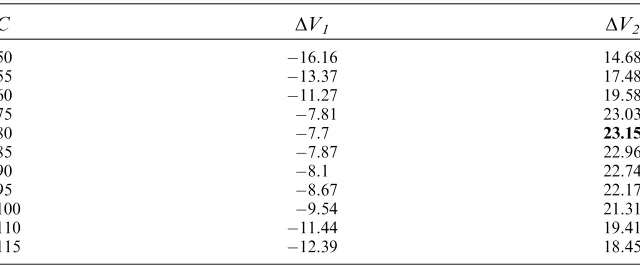
Table 2 tabulates the differential values computed by varying C and using the data in Table 1. Note that CE(s) >C*, meaning sensible
corporate policy is to set the expected income to the parent from transferring goods and services at the minimum to equal to the cost of producing the goods and services and funds charged to the affiliate. Hence, letting C* = 50 in home currency, C =50/0.99= 50.5 is chosen
to be the minimum transfer price that may be set by the parent. Simulation results in Table 2 show that when cash flows and exchange rates are strongly negatively correlated as would be the case for an export-oriented affiliate, there is not much room for the parent to maintain the ownership of the affiliate by manipulating transfer prices in the absence of tax arbitrage. Note that this result may change
Table 1. Data on Model Specifications: An example
States R(s) e1(s) e2(s)
1 200 0.80 1.20
2 220 0.70 1.40
3 80 1.00 0.80
4 75 1.20 0.70
5 50 1.40 0.65
6 150 1.30 0.90
7 190 0.85 1.10
8 250 0.65 1.30
9 85 1.10 0.85
10 175 0.90 1.00
e0=1.0 ra=0.045
Notes: R(s) is state contingent cash flows of the affiliate;e1(s) is an example of state
contin-gent exchange rates that are negatively correlated toR(s);e2(s) is an example of state
contin-gent exchange rates that are positively correlated toR(s);e0is the spot exchange rate andra
is the risk-free interest rates in the home market.
if the negative correlation is weak or E(h) is not equal to 0. Every par-ent should design its transfer pricing policy based on the UIRP condi-tions in the market and its affiliate’s cash flows. In the other case where cash flows and exchange rates are strongly positively correlated, as would be the case with an import-based affiliate, the affiliate’s own-ership should be maintained by the parent and the optimal C should be set at 80 which is above the trigger price based on expected e(s), e.g., (50(1 + 0.25))/0.99 =63. Given the uncertainty in the set D,
the set of states where Ce(s) > C*(1 +p), the parent must choose a
transfer price C that is above the expected trigger price, ex ante, to maximize value.
5. The Valuation Model with Differential Corporate Taxes
Differences in corporate tax rates between the parent’s home country and the host country of the affiliate are a major consideration in set-ting transfer prices. The profit maximization rule says that transfer prices should be set to maximize taxable income in the country with the relatively lower corporate tax rate. For example, if the tax rate in host country is higher, the parent should set transfer prices high to reduce the taxable income under that jurisdiction and vice versa. This rule does not work, however, when the parent company gives full tax credit for taxes paid in the foreign country, and 100 per cent of profits are repatriated with zero deferral of taxable income as in the frame-work of this paper.10
Table 2. Differential Values Without Taxes
C ∆V1 ∆V2
50 16.16 14.68
55 13.37 17.48
60 11.27 19.58
75 7.81 23.03
80 7.7 23.15
85 7.87 22.96
90 8.1 22.74
95 8.67 22.17
100 9.54 21.31
110 11.44 19.41
115 12.39 18.45
Notes:∆V1, differential value based on R(s) ande1(s);∆V2, differential value based onR(s)
ande2(s). The bold values indicate local maxims.
In this section, the differential value model developed in (10) will be extended to include differential corporate taxes. As in the base case, 100 per cent ownership by the parent and 100 per cent payout of divi-dends are targeted. Foreign dividend withholding tax is zero. There are no tariffs/duties and the parent country allows for full foreign tax credit for taxes paid in the host country and tax deferral is not allowed. The parent has enough income from other sources to use the tax credits in full.
Let ta equal the corporate tax rate in the home (parent) country, and tb equal the corporate tax rate in the host country of the affiliate. Then, the after-tax value of the affiliate is
VTb¼ X
s
ðRðsÞ CÞð1 tbÞpðsÞ=rb ð14Þ
whereas the affiliate has an after-tax value, VTa, in the home country represented by,
VTa ¼X
s
ðRðsÞ CÞð1 taÞeðsÞpðsÞ=ra
þX
s
ðCeðsÞ CÞð1 taÞpðsÞ=ra
a
X
D
ðCeðsÞ Cð1þpÞÞð1 taÞpðsÞ=ra
ð15Þ
Note that with full foreign tax credit, the effective tax rate at home is equal to the home corporate tax rate ta and it seems as if there is no tax advantage to maximize taxable income in the home/host country even iftb6¼ ta.
The differential value of the affiliate after taxes is
DVT¼VTa e0VTb;
which can be represented by,
DVT¼ ð1 taÞDV fðta tbÞðEðRÞ CÞEðeðsÞÞg=ra ð16Þ
It is surprising that, in spite of the assumptions of full tax credit and 100 per cent repatriation of dividends, there is still tax arbitrage gains possible as is captured by the second term in (16). As noted
before, under these conditions, the previous research had shown that there would be no tax arbitrage opportunity.11
When corporate taxes are considered the differential value in (16) depends not only on how the host tax rate tb differs from the home tax rate ta, but also on how that difference weighs on the market valu-ations of cash flows transferred to parent. The first term in DVT is a tax reduced version of DV of the base case and stands for ownership arbitrage. As discussed previously, the source of value discrepancy in this term or ownership arbitrage are the financial arbitrage opportuni-ties as represented by E(h) and Cov(R,e), as well as the cost structure of the model. The second term in DVT is due to tax differences between the two countries and therefore may be attributed to tax arbi-trage. This second term tells us that DVT can be increased or decreased beyond that of financial arbitrage and pricing gains/losses and the impact comes about by the market value of the cash flows to the domestic shareholders iftadoes not equal to tb. Roughly speaking, if tb >ta, every additional unit of C will result in a value loss to domestic shareholders. However, if tb <ta, the domestic shareholders may increase their differential value by the difference (ta tb) by increasing C. Here, tax arbitrage suggests that if the host tax rate is higher (lower), maximize (minimize) taxable income in that country by setting transfer prices lower (higher). The implications of this result are contrary to conventional practice, and hence may seem counterintui-tive. However, the finding is a complimentary source of tax arbitrage benefit and may still exist where the standard tax minimization rule does not apply as explained above. From standard corporate finance theory dating back to Modigliani and Miller (MM) with taxes, we know that a firm can increase its after-tax value beyond a base case by increasing the present value of tax shields. In the classical MM propo-sitions, tax shields were due to tax deductibility of debt whereas in this article they are due to deductibility of transfer prices as cost. The sec-ond term in (16) can be interpreted in terms of the present value of tax shields to the parent due to deductibility of transfer prices. Specifically, this term can be separated into two parts and one of those parts is (ta tb)CEe(s)/ra. This is the difference in the present value of tax shields due to the deductibility of transfer pricesC, in the host country with a tax rate oftbversus the present value of that tax shield whenta, home country tax rate is applied. In other words, the tax shields are earned at the rate tb but are used at the rate ta, the effective tax rate for the parent. It implies that when tb > ta, the parent should set C
low to be taxed maximum at the higher rate to end up with the higher present value of tax shields. As the tax credits earned in the host coun-try can be used against tax deficits on other income of the parent, they are valuable and increase the value to the parent. The underlying assumption is that the parent can earn excess foreign tax credits in one country and can use them against tax deficits from another country when consolidating foreign income at home. This mechanism becomes the source of tax arbitrage in this article. The size of tax arbitrage apparently hinges on the tax codes that allow or restrict companies to use tax credit earned on foreign income fully at home. If the tax codes put limitations on usage of excess foreign tax credits, tax arbitrage opportunities would be bounded.12
These implications will be discussed below with a numerical example. Table 3 will also use the data presented in Table 1 along with various tax rates in potential host countries.
Looking at ∆VT1 values, we can see that favorable tax advantage
can change the outcome of the base case. This type of an affiliate whose cash flows are strongly negatively correlated with exchange rates should have been carved off and sold to host country investors in the absence of tax arbitrage as was shown in the base case. This result is enhanced whenever tb <ta such that the impact on value of tax arbi-trage is negative and there is no advantage from the lower tax rates in the host country. However, whentbexceeds taand tax advantage turns to be favorable, it becomes feasible to maintain the ownership of the affiliate. However, in this case, the optimal C is lower at 60 or 75. As ta < tb for these cases the weight put on penalty (1 ta) is greater than the weight put on profits (1 tb), the negative impact of penalty dominates resulting in lowerC values, (see footnote 2).
The ∆VT2values are almost all positive and are pointing to the fact that tax arbitrage, favorable or unfavorable, would not alter the out-come that the affiliate should be totally owned by the parent if cash flows and exchange rates are strongly positively correlated. It is not surprising that in cases where tb >ta a lower C value than 80 is opti-mal as explained above, whereas C needs to be raised above 80 to maximize value gains whentb< taand tax arbitrage is unfavorable.
This numerical example demonstrates that finding the optimal C is an easy optimization problem for managers. The only inputs needed are cash flow and exchange rate distributions and estimates of p and a
and interest rates. Using these inputs covariances and expected values can be readily estimated and differential values are computed. Hence,
the model is operational and can easily be put to practice by the man-agers of the multinationals.
6. Conclusion
Multinationals have long used transfer pricing mechanisms to circum-vent market imperfections brought about by government authorities such as tariffs, duties, exchange controls and blocked funds. Another well-known use of transfer price schemes is to exploit tax arbitrage opportunities. The previous arguments on the benefits of moving income from one jurisdiction to another using transfer prices were based on profit-seeking incentives and implied that the taxable income in a high tax rate country should be minimized to minimize global tax
Table 3. Differential Values with Corporate Taxes
tb 0.15 0.20 0.25 0.30 0.35 0.40 0.45 C ∆VT1 ∆VT1 ∆VT1 ∆VT1 ∆VT1 ∆VT1 ∆VT1
50 25.21 20.58 15.94 11.31 6.68 2.05 2.58
55 22.54 18.15 13.75 9.36 4.96 0.57 3.83
60 20.36 16.20 12.04 7.89 3.73 0.43 4.58
75 15.80 12.36 8.91 5.47 2.02 1.42 4.86
80 15.01 11.80 8.59 5.39 2.20 1.03 4.23
85 14.42 11.44 8.48 5.51 2.54 0.43 3.40
90 13.86 11.13 8.40 5.67 2.94 0.21 2.53
95 13.55 11.10 8.57 6.10 3.58 1.10 1.41
100 13.45 11.19 8.93 6.68 4.42 2.16 0.09
110 13.35 11.57 9.79 8.01 6.22 4.44 2.66
115 13.30 11.76 10.22 8.67 7.13 5.58 4.04
tb 0.15 0.20 0.25 0.30 0.35 0.40 0.45 C ∆VT2 ∆VT2 ∆VT2 ∆VT2 ∆VT2 ∆VT2 ∆VT2
50 3.62 1.01 5.65 10.28 14.91 19.54 24.17
55 0.95 3.44 7.84 12.23 16.63 21.02 25.42
60 1.23 5.39 9.55 13.70 17.86 22.02 26.17
75 5.79 9.23 12.68 16.12 19.57 23.01 26.46
80 6.58 9.79 12.99 16.20 19.41 22.62 25.82
85 7.18 10.14 13.11 16.08 19.05 22.02 24.99
90 7.73 10.46 13.19 15.92 18.65 21.38 24.12
95 8.04 10.53 13.02 15.52 18.01 20.51 23.00
100 8.14 10.40 12.66 14.91 17.17 19.43 21.68
110 8.24 10.02 11.80 13.58 15.36 17.15 18.93
115 8.29 9.83 11.37 12.92 14.46 16.00 17.55
Notes:∆VT1, differential value with corporate taxes based onR(s) ande1(s);∆VT2,
differen-tial value with corporate taxes based onR(s) ande2(s);ta=0.30 andtbis the corporate tax
rate in host country. The bold values indicate local maxims.
liability. Minimization of global tax liability would be achieved by charging high transfer prices in the countries with high tax rates. How-ever, this type of tax arbitrage benefit disappears whenever dividends are fully repatriated, there is no tax deferral and full tax credit is allowed by home tax authorities.
This article presents a value-seeking framework under risk neutrality where transfer prices are used to exploit tax arbitrage as well as finan-cial arbitrage opportunities that are present in segmented international capital markets. By shifting the focus from profit seeking to value-seeking approach, the paper offers a new framework for setting trans-fer prices based on the impact on value of financial and tax arbitrage. However, for a parent to use transfer pricing schemes as a strategic tool, it has to have a market valuation that would support its owner-ship of the affiliate. In other words, financial and/or tax arbitrage may lead to ownership arbitrage for the firm.
This article also develops a cost structure for transfer pricing schemes where profits on intra-firm trade and fund flows are allowed along with a penalty for transfer prices charged above a trigger level. This value gain is treated independently of any financial or tax arbi-trage effects. This value gain will exist even if there is no tax arbiarbi-trage opportunity and capital markets are totally integrated. Subsequently, an optimization framework is obtained where a value-maximizing level of transfer price can be determined that takes into account favorable and unfavorable impacts of financial and tax arbitrage along with profit opportunities from transfer of any products, services or funds.
First, in a base case where taxes are assumed away, it argues that in the presence of financial arbitrage alone, and in a case where cash flows of the subsidiary are positively correlated to exchange rates as in import-based affiliates, the parent should own the affiliate and set transfer prices at a level higher than its expected trigger price to maxi-mize value. This is not true for export-based affiliates where cash flows and exchange rates are strongly negatively correlated. It is best to carve off these affiliates and sell them to host country investors after charging themC for the funds and services already transferred.
Exploring the extended model with tax differentials between the par-ent and the host country reveals some surprising reversals to the impli-cations of the profit-seeking rule and to the conventional practice. The maxim that whenever the tax rate in the host country is lower/higher than that of the parent transfer prices should be set low/high is no longer valid because the framework of this article allows for full tax
credit and total repatriation of dividends with no deferral. However, another form of tax arbitrage emerges where the level of transfer prices determine the present value of tax shields based on transfer prices in each country. The tax advantage of transfer prices depend on the size of tax differences and how they interact with financial arbitrage oppor-tunities in the market. When tax differences are large enough and tax arbitrage effect is dominant, higher taxes in the host country becomes a factor that increases the present value of tax shields. This gain is due to tax code allowances that allow excess tax credits earned from one affiliate to be applied against tax deficits from another affiliate. This impact may interact with that of financial arbitrage and make it possi-ble for the parent to own the affiliate in cases where financial arbitrage alone would have prohibited it to happen. The optimal levels of trans-fer prices differ from that of the base case and are lower/higher for unfavorable/favorable tax arbitrage.
A set of testable propositions emerge from the findings of this study. First, with segmented capital markets where UIRP holds for risk-free assets, parent ownership tends to be more prevalent for affili-ates whose cash flows are strongly positively correlated by exchange rates and/or when host country tax rates are significantly higher than home. Second, multinationals that set their transfer price higher than the expected trigger price should have higher values compared to their peers that do not. Accordingly, transfer prices should be set higher for industries that have higher profit margins and lower penalties. The third proposition of this article is that transfer prices should be higher/ lower than the expected trigger price for affiliates in countries with higher/lower tax rates. This proposition stands in sharp contrast to predictions of conventional profit maximization dictum that says the parent has an incentive to charge high transfer prices in high tax envi-ronments to shift profits to low tax locations.
A couple of caveats are in order while testing the above hypothesis. The predictions of this article are valid for affiliates that are wholly owned and that operate in environments where import duties are insignificant. Moreover, the parent transfers 100 per cent of dividends and full tax credit is allowed for foreign tax liability with no deferral. This kind of environment may not exactly describe the institutional practices at present but recent tax proposals by the U.S. administra-tion is a step in that direcadministra-tion.13 Even if tax differences matter in the conventional sense, this article shows that there is a mitigating factor that should be balanced against the predictions of the well-known tax
minimization rule. Also, the empirical investigation should show evi-dence of the effect on firm value of the choice of transfer pricing pol-icy. Empirical results that show correlations between the level of transfer prices and tax rates will not be conclusive. Those correlations would simply show evidence of the practices followed by the decision makers in firms but would fail to show if those practices are value enhancing. Another restriction in testing the propositions of this arti-cle is that the model overlooks agency costs.14 While the direct effect of choosing low/high transfer prices is to increase the after-tax value of the parent, these effects may be potentially offset in poorly gov-erned firms by increased opportunities for managers to manipulate income. Therefore, the results should be tested for firms with high-quality governance.
In summary, this article develops a value-seeking framework to ana-lyze the benefits of transfer price schemes in the presence of financial arbitrage and tax arbitrage in segmented international capital markets that lead to ownership arbitrage. The model is flexible enough and can easily be expanded to include the effects of import duties, partial own-ership, variable dividend payout ratios, deferral of income repatriation, and agency costs that may also affect the value of a multinational. Furthermore, more complex financing structures like borrowing at home or in the foreign country or hedging can also be handled by the model. However, it is important to note that any of these new ele-ments that may be included in the model should be viewed in terms of their effects on value. The optimization model to be used by any par-ticular company to set their optimal transfer price should modify the present model to fit their business practices to allow them to draw their own conclusions.
Notes
1. In this article, transfer prices are used synonymously with internal prices used within a corporation that differs from arm’s length.
2. Horst (1971), Arpan (1972), Fowler (1978), Collins and Frankel (1985), and Kant (1988), for example.
3. A recent article by Curtis (2008) argues that transfer pricing has been often framed as a tax issue but it has repercussions much beyond that for a multinational treasurer. As noted by Curtis, transfer pricing is closely knitted with the efficiency of many financial management functions in the multinational. This article is a step into that kind of inquiry.
4. Stulz (1981), Eun and Janakiramanan (1986), Hietala (1989), Bonser-Neal et al. (1990), and Nishiotis (2004).
5. This framework was developed in Thomadakis and Usmen (1991) and Usmen (1994).
6. Desai et al. (2004) show empirical evidence from the past twenty years that there is a trend away from joint ventures to majority and whole ownership of the affiliates by U.S. MNCs. They argue that this trend can be explained by the increased burden of joint ventures for the MNC who would like to make decisions freely about selling and financing to minimize worldwide costs. Especially, when the local partners have a stake in local profits alone, the MNC cannot set transfer prices in a way that would minimize global tax liability.
7. The cost of the resources transferred to the subsidiary could also be charged in domestic currency units. In that case, cash flows of the foreign subsidiary would have a cost of C/e(s) and the impact of exchange rate uncertainty still be captured in the
model. However, the present model chargesCin foreign currency for reasons of
natu-ral hedging.
8. This type of modeling is also used in Thomadakis and Usmen (1991) and Usmen (1994). The hypothetical valuation of the cash flows in the host country are relevant because the parent should remain the owner if it can create a value beyond the alterna-tive of selling the affiliate upfront to host country investors after charging them Cfor the products, services and funds already transferred. One should not be confused by thinking that there are no foreign owners to value the cash flows that differs from the parent and therefore this value differential is contradictory.
9. We thank an anonymous referee for pointing this to us. 10. See for example, Clausing (2003).
11. Based on (16), the optimalCis obtained whereð1 tbÞEðeðsÞÞ ¼ ð1 taÞaEDeðsÞ.
Again, the covariance between tax shields and exchange rates come into play. It is the nonlinearity with respect to exchange rates on value that explains why the tax differen-tial matters.
12. For example, the U.S. tax code allows foreign tax credits derived from one source against foreign tax liabilities from another source provided they are based on same type of income. This practice is known as tax averaging. However, total tax cred-itable in any 1 year is limited by a formula based on foreign versus total taxable income of the multinational.
13. Financial Times, Wednesday, May 6, 2009 issue reported that Obama Adminis-tration is cracking down on tax avoidance loopholes that allow U.S. multinationals to report disproportionately high profits in low tax countries and to delay paying U.S. taxes by deferring repatriation of these profits.
14. Value-maximization runs into obstacles in the presence of agency costs. See, for example, Jensen (2001).
References
Arpan, J.S.,International Intracorporate Pricing(New York: Praeger, 1972).
Bonser-Neal, G., G. Brauer, R. Neal and S. Wheatley, “International Investment
Restriction and Closed-End Country Fund Prices,” Journal of Finance 45 (1990),
pp. 523–548.
Clausing, K.A., “Tax-Motivated Transfer Pricing and US Intrafirm Trade Prices,”
Journal of Public Economics87 (2003), pp. 2007–2223.
Collins, J.M. and A. Frankel, “International Cash Management Practices of Large U.S. Firms,”Journal of Cash Management5 (1985), pp. 42–48.
Curtis, S.L., “Transfer Pricing for Corporate Treasury in the Multinational Enterprise,”
Journal of Applied Corporate Finance20 (2008), pp. 97–112.
Desai, M.A., C.F. Foley and J.R. Hines Jr., “The Costs of Shared Ownership: Evidence from International Joint Ventures,”Journal of Financial Economics73 (2004), pp. 323– 374.
Eun, C.S. and S. Janakiramanan, “A Model of International Asset Pricing with a Con-straint on the Foreign Equity Ownership,”Journal of Finance41 (1986), pp. 897–914. Financial Times, Wednesday, May 6, (2009), pgs 3, 8 and 9.
Fowler, D.J., “Transfer Prices and Profit Maximization in Multinational Enterprise Organizations,”Journal of International Business Studies9 (1978), pp. 9–26.
Hietala, P., “Asset Pricing in Partially Segmented Markets: Evidence from the Finish Market,”Journal of Finance41 (1989), pp. 603–613.
Horst, T., “The Theory of the Multinational Firm: Optimal Behavior Under Different Tariff and Tax Rates,”Journal of Political Economy79 (1971), pp. 1059–1072. Jensen, M.C., “Value Maximization, Stakeholder Theory, and the Corporate Objective
Function,”European Financial Management7 (2001), pp. 297–317.
Kant, C., “Foreign Subsidiary, Transfer Pricing and Tariffs,”Southern Economic
Jour-nal55 (1988), pp. 162–170.
Nishiotis, G.P., “Do Indirect Investment Barriers Contribute to Capital Market Seg-mentation?,”Journal of Financial and Quantitative Analysis39 (2004), pp. 613–630.
Stulz, R.M., “On the Effects of Barriers to International Investment,” Journal of
Finance36 (1981), pp. 923–934.
Thomadakis, S.B. and N. Usmen, “Foreign Project Financing in Segmented Capital Markets: Equity Versus Debt,”Financial Management20 (1991), pp. 42–53.
Usmen, N., “Currency Swaps, Financial Arbitrage, and Default Risk,” Financial
Man-agement23 (1994), pp. 43–57.