commit to user
TEACHERS’ PERCEPTIONS TOWARD THE USE OF
ENGLISH TEXTBOOKS
(A Case Study of English Teachers at the Twelfth Grade of SMAN 3 Surakarta in the Academic Year of 2014/2015)
A THESIS
BY:
ELVIRA ROSYIDA M. R.
S891308045
Written as a Partial Fulfilment of the Requirements for Graduate Education Degree of English Language Teaching
ENGLISH EDUCATION OF GRADUATE PROGRAM
TEACHER TRAINING AND EDUCATION FACULTY
SEBELAS MARET UNIVERSITY
SURAKARTA
2015
commit to user
iv
PRONOUNCEMENT
This is to certify that I myself write this thesis entitled “Teachers’
Perceptions toward the Use of English Textbook” (A Case Study of English
Teachers at the Twelfth Grade of SMAN 3 Surakarta in the Academic Year of
2014/ 2015). It is not plagiarism or made by others. Anything related to others’
works is written in quotation, the sources of which are listed on the list of
references.
If the pronouncement proves wrong, I am ready to accept any academic
punishment, including the withdrawal or cancellation of my academic degree.
Surakarta, 2015
commit to user
v ABSTRACT
Elvira Rosyida M. R. S891308045. 2015. Teachers’ Perceptions toward the
Use of English Textbooks. Supervisor I: Dr. Ngadiso, M.Pd, Supervisor II: Prof.
Dr. Sri Samiati Tarjana, English Education Department of Graduate Program, Teacher Training and Education Faculty, Sebelas Maret University Surakarta.
This study is aimed at: (1) investigating teachers’ perceptions toward the use of English textbooks; (2) identifying factors that affect teachers’ perceptions toward the use of English textbooks; (3) investigating teachers’ experience in selecting, analyzing, organizing, interpreting, and integrating English textbooks; and (4) identifying problems arising while teachers select, analyze, organize, interpret, and integrate English textbooks.
This study is a qualitative case study conducted in state senior high school 3 Surakarta. The samples chosen are two English teachers who teach the twelfth grade. Data of the study were collected through questionnaire, interview, and observation and were analyzed by using interactive model proposed by Miles and Huberman.
Findings of this study are: (1) teachers believe that they have to consider some considerations to check the quality of textbooks. They also reveal that textbook analysis is needed to analyze what is actually contained in the textbooks and to know to what extent the quality of the textbooks they use. They do not always follow all sequences of materials and activities suggested by the textbook authors, but based on the students’ needs. They believe that textbooks should go hand in hand with supplementary teaching materials to serve students’ needs even though they are relatively satisfied with the textbooks choice; (2) teachers’ perceptions toward the use of English textbooks are influenced by some factors such as experience, needs, situation, students’ interest, students’ ability, workshop/training, and references; (3) teachers take part in each step of the procedure for the textbook selection. Then, they analyze and describe each component in the textbook. Teachers organize materials and activities in each unit of the textbook based on the lesson plan they made and their students’ need. The latter, supplementary materials are designed based on pre-existing materials and objective of the lesson; and (4) deficient time and different views among teachers are two major problems faced by teachers when conducting textbook selection.
It is therefore recommended that the school provides sufficient time for teachers to conduct textbook selection. The teachers have to actively participate in any training or course about teaching materials and have more cooperation with their colleagues to ease the burden, exchange information, and expand teaching repertoire. They should also increase their ability and knowledge of making supplementary materials and adapting materials. This may help teachers know the way to solve the problems or weaknesses that they face in using textbooks.
Keywords: teachers’ perception, the use of English textbook, teachers’
commit to user
vi MOTTO
“Don’t say you cannot before you try. Sometimes things are really impossible.
But when you involve God, it becomes possible.”
commit to user
vii
DEDICATION
By offering my praise and gratitude to Allah SWT for the abundant blessing to me
and my Prophet Muhammad SAW, I’d proudly dedicate this piece of work to:
My beloved parents,
Drs. H. Makmun Rasyid and Hj. Lili Handayani
My beloved sister and brother,
Meilya Kartika M. R. and M. Masdar Habibi M. R.
My bestfriend, my partner, my half,
Faisal Rachmad S.
My friends
commit to user
viii
ACKNOWLEDGEMENT
Praise be Allah the Almighty, because of His blessing this research has been
finished for the requisite of English education graduate program of Sebelas
Maret University. May mercy, blessing of Allah always be on Prophet
Muhammad SAW and peace be upon him. The researcher is deeply indebted for
the very invaluable help, guidance, and support so that she would like to extend
this gratitude to:
1. Dean of Teacher Training and Education Faculty of Sebelas Maret University
Surakarta for the facilities and the admission for conducting this research.
2. Head of English Education Department of Graduate Program of Teacher
Training and Education Faculty of Sebelas Maret University Surakarta for the
chances and facility.
3. Dr. Ngadiso, M.Pd, the first consultant, for all guidance, advice, motivation,
criticism, and patience.
4. Prof. Dr. Sri Samiati Tajana, the second consultant, for all guidance, advice,
support, and patience.
5. All the lecturers of English Education of Graduate Program of Sebelas Maret
University Surakarta for the invaluable knowledge and guidance.
6. Head of SMAN 3 Surakarta for the support and admission to conduct this
research.
7. The English teachers at twelfth grade of SMAN 3 Surakarta for help,
cooperation, and time, so that this research is accomplished.
I acknowledge any imperfections in this thesis as it is far from being perfect. I
welcome constructive criticism and suggestions and hope this work may be
useful for all readers.
Surakarta, 2015
commit to user
x
3. Advantages and Disadvantages of
the Use of Textbooks ... 19
CHAPTER IV. RESEARCH FINDINGS AND DISCUSSION A. Research Findings ... 53
B. Discussion ... 87
C. Research Weaknesses ... 110
CHAPTER V. CONCLUSION, IMPLICATION, AND SUGGESTION A. Conclusion ... 111
B. Implication ... 114
C. Suggestion ... 114
BIBLIOGRAPHY ... 117
commit to user
xi
LIST OF TABLES
Page
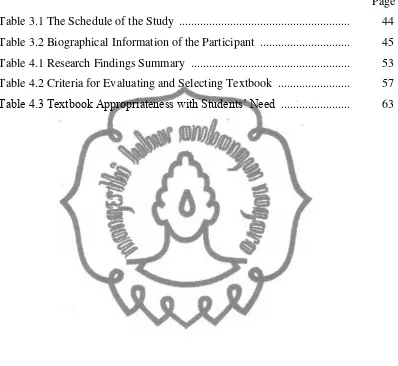
Table 3.1 The Schedule of the Study ... 44
Table 3.2 Biographical Information of the Participant ... 45
Table 4.1 Research Findings Summary ... 53
Table 4.2 Criteria for Evaluating and Selecting Textbook ... 57
commit to user
xii
LIST OF FIGURES
Page
Figure 2.1 Options for Using the Textbook ... 34
commit to user
xiii
LIST OF ABBREVIATION
1. BSNP Badan Standar Nasional Pendidikan
2. MGMP Musyawarah Guru Mata Pelajaran
3. T1 Teacher 1 (First Participant in the study)
commit to user
xiv
LIST OF APPENDICES
Page
Appendix 1. Interview Transcription ... 125
Appendix 2. Questionnaire ... 141
Appendix 3. Field Note ... 147
Appendix 4. Picture ... 156
Appendix 5. Surat Ijin Penelitian ... 159