Phonological Transfer: Banjarese Language into English Language
Nur Alfa Rahmah, [email protected]; Afifah Linda Sari, [email protected];
IAIN Antasari Banjarmasin
Abstract:
Orang Banjar, sebagai bagian integral dari Indonesia kini memasuki era
Masyarakat Ekonomi ASEAN dimana kompetensi berbahasa menjadi salah satu syarat untuk bisa bertahan dalam persaingan global. Kebutuhan akan penguasaan bahasa Inggris sebagai bahasa internasional menjadi hal penting yang perlu diperhatikan mengingat hampir semua lini, baik itu teknologi, transaksi perdagangan, hingga pendidikan menjadikan bahasa Inggris sebagai medium utama dalam berinteraksi antar negara. Dalam praktik penguasaan bahasa Inggris, Orang Banjar dituntut untuk bisa beradaptasi secara linguistik-kultural dalam berbicara bahasa Inggris yang baik dan benar. Tidak bisa dipungkiri, pada proses adaptasi ini, akan ada kendala bahasa dalam bentuk transfer bahasa dari bahasa Banjar ke bahasa Inggris yang akan mempengaruhi kualitas pengucapan. Tulisan ini mencoba menjembatani perbedaan antara bahasa Inggris dan bahasa Banjar secaralinguistik ditinjau dari aspek fonologis.Penulis melakukan komparasi fonologi bahasa Banjar dengan bahasa Inggris dari segi konsep maupun fakta empirik dari penutur bahasa Banjar asli.
Kata Kunci: fonologi bahasa Banjar, transfer bahasa, bahasa Inggris.
Introduction
English has fascinatingly spread all over the world, far beyondits original countries, United States and Great Britain. In Asia, approximately 350 million people speak English, a number which is close enough to the populations of the United States and Great Britaincombined together (Honna, 2005). Facing AEC (ASEAN Economic Community) in 2016, opportunities and challenges lie ahead of us to have communicative competence necessary to survive the global market (Hidayat,2015). One of the utmost importance isEnglish proficiency.
Meanwhile, a research by Education First (EF English Proficiency Index) on English proficiency conducted in 2015 on 910.000 adultsin 70 countries placed Indonesia in the 32nd positionbelow Malaysia, Singapore and Vietnam (Jong, 2015). This circumstance demands us to struggle even more in mastering English.It is commonly known that learning second language, English in particular, is not an easy stuff for many non-native speakers in Asia, including Indonesia. This is especially because the linguistic systems between Asian
learners’ first languages and the target language are different.
most obvious (Jenkins 2000; Ortega, 2008; Odlin, 1989; Kenworthy,
1988).Different sound systems between English language and native language of the learners can lead to phonological errors as the learners tend to substitute the English features with what is familiar in their native language during oral communication.
Indonesia is a country that have many local languages which are acquired first by the citizens before the national language.Banjarese is one of these local languages,which is spoken by approximately 5,9people spread in South
Kalimantan, CentralKalimantan, West Kalimantan, and also in Malay(Fauzi, Iwan. 2008). There are two main dialects of Banjarese identified, namely Bahasa Banjar Kualaand Bahasa Banjar Hulu(Hapip, 1976: v).Although these two dialects are identical, there are some traits that makes them unique and distinct from each other.
This paper, however, focuses mainly on discussing Bahasa Banjar Hulu, which is spoken mainly by people living in Kabupaten Tapin, Hulu Sungai Selatan, Hulu Sungai Tengah, Hulu Sungai Utara, and Tabalong, and its difference from English (American English) in terms of phonological system. This paper also discusses phonological transfer or the influence that Bahasa Banjar Hulu has on the English oral production during communication based on a case study in Pondok Pesantren Modern Darul Istiqomah Putri, Barabai, Hulu Sungai Tengah regency, in which the researchers investigated English utterances of 15 female studentsranging from eighth graders to twelfth graders. The data was collected using interview then analyzed through six steps introduced by Creswell (2007: 151) which covers (1) data managing, (2) reading and memoing, (3) describing, (4) classifying, (5) interpreting, and (6) representing and visualizing. For data trustworthiness, the researcher uses prolonged engagement, persistent observation, and triangulation (methodological and data triangulation).
Phonological Differences between Bahasa Banjar Hulu and English Language
Bahasa Banjar Hulu and English language are very different from each other both in segmental and suprasegmental features. Segmental features consist of vowels, diphthongs, consonants, and clusters while suprasegmental features consist of stress, tone, juncture, and sentence intonation.
Differences in Segmental Features
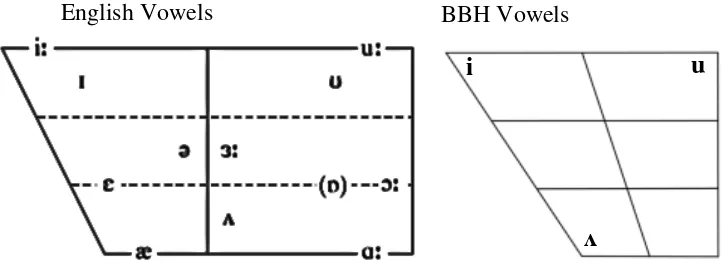
English Vowels BBH Vowels
Chart 1. Comparison between General American English Vowels and BBH Vowels (see McMahon, 2002: 75; adapted from Departemen Pendidikan Nasional Pusat Bahasa, 2008: xii)
Therefore, we can only find three kinds of vowel sounds in the lexicons of BahasaBanjar Hulu, such as barapa/bʌrʌpʌ/ (how much), dimapa/dimʌpʌ/ (how), mutur/mutur/ (car), sapatu/sʌpʌtu/ (shoes), mangiau /maŋiʌu/ (to call), and kuriak/kuriʌk/ (to yell) which are pronounced exactly like how they are written. English language, on the other hand, is rich with vowel sound in their lexicons, which mostly are pronounced differently from their alphabetic writing. Below is the comparison between the two languages in terms of vowels in lexicons.
Table 1. Between the BBH Vowels and English Vowels in Lexicons Banjarese
vowels
Banjarese vowels in words.
English vowels English vowels in words.
/ʌ/ barapa /bʌrʌpʌ/ /ɪ/ this /ðɪs/ /i/ dimapa /dimʌpʌ/ /ɛ/ hair /hɛr/ /u/ sapatu /sʌpʌtu /æ/ mad /mæd/
/ʌ/ lux /lʌks/ /ɒ/ /hɒrər/ /ʊ/ look /lʊk/ /i:/ feet /fiːt/ /ɑ:/ long /lɑːŋ/ /ɔ:/ door /dɔːr/ /u:/ root /ruːt/
/ɜ/ her /hɜr/ /ə/ terrain /təˈreɪn/
The diphthongs of Bahasa Banjar Huluare also limited, only consists of /aʊ/, /uɪ/, and /aɪ/, not as much asGeneral American (GE) English which
recognizes five diphthongs, /eɪ/, /aɪ/, /ɔɪ/, /oʊ/, and /aʊ/ (McMahon: 2002; Marsono; 1986: 53).
ʌ
English Diphthongs Bahasa Banjar Hulu’s Diphthongs
Chart 2. Comparison between General American English Diphthongs and Bahasa BanjarHulu’s Diphthongs (see: McMahon, 2002; adapted from Marsono, 1986: 53).
All English diphthongs and Banjarese diphthongs share the characteristics as close diphthongs. The table below shows the use of the diphthongs in Bahasa Banjar Hulu and their distribution in words.
Table 2. The Distribution and Allophones of Bahasa Banjar Hulu’s Diphthongs
Banjarese words
Diphthongs Allophone used
Distribution Pronunciation Meaning
“aur” /au/ [ʌ:u] front /a:ur/ busy
“layau” /au/ [au] back /lajau/ overwhelming
“caur” /au/ [ʌ:u] middle /ʧʌ:ur/ to mix
“kubui” /ui/ [ui] back /kubui/ to pour on
“wadai” /ai/ [ai] back /wadai/ cake
From the table above, we can see that both Banjarese and English have /aɪ/ and /aʊ/; Banjarese diphthongs, nevertheless, do not have /eɪ/, /ɔɪ/ and /oʊ/.
In terms of consonants. compared to English which possesses 24
consonants, /p/, /b/, /t/, /d/, /k/, /g/, /f/, /v/, /θ/, /ð/, /s/, /z/, /ʃ/, /ʒ/, /ʧ/, /dʒ/, /m/, /n/,
/ŋ/, /r/, /l/, /h/, /w/, and /j/, Bahasa Banjar Hulu only consists of 18 consonants, /p/, /b/, /t/, /d/, /k/, /g/, /s/, /ʧ/, /dʒ/, /m/, /n/, /ŋ/, /ŋ/, /r/, /l/, /h/, /w/, and /j/ ((Roach, 2008: ix; Departemen Pendidikan Nasional Pusat Bahasa: 2008:xii). The table below shows clear comparisons between the two.
Table 3. Comparison between English Consonants and Banjarese Consonants English
Bilabial
Labio-dental Dental
(Blade) Alveolar
Post-
alveolar Palatal Velar Glottal
less ed less ed less ed less ed less ed less ed less ed less ed
Plosive p b t d k g ?
Nasal m n ŋ
Lateral l
Fricative f v θ ð s z ʃ ʒ h
Affricative t ʃ dʒ
Approximant w r j
Bahasa Banjar Hulu
a
ɪ u
Bilabial
Labio-dental Dental
(Blade) Alveolar
Post-
alveolar Palatal Velar Glottal
less ed less ed less ed less ed less ed less ed less ed less ed
Plosive p b t d t ʃ dʒ k g ?
Nasal m n ɲ ŋ
Trill r
Lateral l
Fricative s h
Affricative
Approximant w j
(Adapted from Roach, 2008; McMahon, 2002; Departemen Pendidikan Nasional Pusat Bahasa: 2008: xii; and Muslich; 2012).
We can conclude from the chart and table above that there are differences in the number of phonemes between the two languages. Bahasa Banjar Huludoes not have the vowels /ɪ/, /ɛ/, /æ/, /ɒ/, /ʊ/, /ɑ:/, /ɔ:/, /ɜ/, and /ə/; the diphthongs /eɪ/, /ɔɪ/, and /oʊ/; and the consonants /f/, /v/, /θ/, /ð/, /z/, /ʃ/, and /ʒ/. Judging from these differences, language transfer will most likely to occur during the production of English language by Bahasa Banjar Hulu speakers. They might unconsciously substitute the phonemes they barely recognize in the target language with the ones they have in their native language during the oral production.
Another difference between these two language also occurs in consonant clusters. In English, consonants clusters are commonly found and can occur in any word position. Banjarese words on the other hand, contains no cluster; each consonant always stand side by side with vowel in any word, such as in words kurihing /kurihiŋ/ (to smile), kandaraan /kʌndʌrʌ’ʌn/ (motorcycle), and balanja /bʌlʌndʒʌ/ (to shop). Therefore, it might be difficult for Banjarese speakers to produce English words that have consonant in it, such as: speaker, bright, knight, and portrait.
Differences in Suprasegmental Features
The interference from the first language is also likely to cause errors not only in segmental features but also in suprasegmental features. Suprasegmentals refer to such features as stress, tone, length, intonation, and other features that always follows the production of segmental features (Ramelan, 1985: 22).
Unlike many other languages, English words contain syllables which are stressed and destressed. In other words, some syllables need to be stressed more than the others. There are four different things an English speaker should pay attention to in producing stress: (1) loudness, (2) length of syllable, (3) pitch, and (4) quality difference of a vowel among the neighboring vowels (Roach, 2008: 94). English stress is a complex one and rather difficult to predict. The importance of putting the stress on the right syllable in English words, however, cannot be underestimated. Zhang and Yin, 2009: 143 states: “putting stress on the wrong syllable is more likely to make a word unintelligible than is mispronouncing one
and different meanings, such as 'record (v) and re'cord (n), or 'desert (n) and de'sert (v).
Stress in English language is significant while in Bahasa Banjar Hulu (BBH) is not that significant. The stress in BBH has different functions from that of English language. In BBH, stress is not meant to distinguish meaning in a sentence, but only to emphasize the message of a speaker. Therefore, BBHcan put stress anywhere they feel it is appropriate; and putting stress in any words will not really change the meaning of certain words or utterance.
Tone and intonation in BBHis unlike those of English. The position of tone and intonation does not make any difference in meaning in BBH except in a few circumstances like to differentiate interrogative sentences and
non-interrogative sentences. Even when the speaker is speaking with a rhythmic tone like singing, the meaning is still the same. As a matter of fact, tones in Banjarese language is rather arbitrary; the choice of giving tone to words in sentences most usually cannot be really explained. Most of the time, the word toning is just adjusting to the local dialect in certain town where the speaker lives. English tone and intonation system, on the other hand, is much more complex and complicated than that of Banjarese. It is not only to express emotion, but also to express meaning, which might be hard for BBH speakers to grasp.
Beside stress and tones, there is alsoBBH juncture which is very distinct from that of English. Juncture in BBH happens between syllables, words, phrases, and between sentences with different lengths. Juncture between syllables is much shorter than juncture between words; juncture between words is much shorter than it is between phrases; and juncture between words or phrases is shorter than juncture between sentences.Unlike English words, the words in Banjarese connected speech are not linked one another. In other words, Banjarese does not continue the last phoneme of preceding word to phoneme of the word that comes after; therefore, assimilation and elision are not likely to happen in Banjarese language.
Language Transfer ofBahasa Banjar Huluin the English Utterances of Banjarese Speakers
There are at least three conditions that might result in language transfer. First, it is the existence of a given sound in the target language, which is not found in the native language. Second, both languages have the same phonetic features but they are different in their distribution, such as when and where they may occur in an utterance. Third, both languages have similar sounds but have different
variants or allophones (Mu’in & Kamal, 2006: 63-64). The finding discussion about language transfer in this research is divided into segmental and
suprasegmental features.
Language Transfer in Segmental Features
Bahasa Banjar Hulu and English language have the same /i/ and /u/ with those of English. However, Banjarese /u/ and /i/, whether they are pronounced in long or short duration, it does not make any difference in meaning. English, on the other hand, distinguishes between long vowel and short vowel. The phoneme /ɪ/ and /i:/, for example,might result in different meaning as in the words “sheep” and
meanings as in words “could” and “cooed”. Banjarese speakers, nevertheless, usually are not aware of the difference, which is why they tend to shorten the long /i:/ in /spi:k/ and lengthen the short /ɪ/ in /slɪp/. Such mispronunciation can be misunderstood as “spik” instead of “speak” and as “sleep” instead of “slip”.
The English vowels which does not exist in Banjarese is /ɑ:/, which occurs as a back vowel that is quite close to /ɔ/, yet, as the low vowel, it is also close to /ʌ/. Pronouncing it as an /ʌ/ in this case, is easier to BBH speakers, since it is more familiar in their mother tongue, which consequently lead them to pronounce
“want”, “large”, “chalk”, “hard”, and “card” with /ʌ/, becoming /wan/, /lʌrdʒ/, /tʃʌlk/, /hʌrd/, and /kʌrd/. The researcher’s investigation on the students of
Pondok Pesantren Modern Darul Istiqomah Putri pointed out that only four out of the fifteen students who pronounced those words correctly with /ɑ:/; the rest failed in producing several or most of the words.
Even though the students do not find any /ɛ/ in their native language but they can find it in the language they acquired earlier before English, which is Indonesian language; that is why they have no trouble in producing the sound /ɛ/. Another problem, however, arises when they faced the sound close to /ɛ/, namely
the vowel /æ/, which is not familiar to their acquisition. The sounds “bet” and “bat”, “head” and “had”, and “bed” and “bad”, hence, may sound alike to them.
Since /ɛ/ is the only recognizable phoneme to them, they tended to substitute /æ/ with /ɛ/ such as in words “happy” and “have” which they pronounced as /hɛpi/ instead of /hæpi:/. The substitution did not always occur though. In fact, they somehow could not tell the difference between /ɛ/ and /æ/ and did not realize if
they had produced the words “practice” and “accent” with /æ/ correctly although these two words, compared to the other two, are less familiar.
The students’ second language, Indonesian, also has the phoneme /ɘ/ which makes the students easier to adapt to the English /ɘ/, albeit it does not appear in BBH. Indonesian language, nevertheless, just like Bahasa Banjar Hulu, does not have any rule about the duration of vowel; whether the vowel is
produced with length or not, it still results in the same meaning. Therefore, for the students, /ɜ:/ and /ɘ/ sound the same; which is why they sometimes pronounce
“girl” as /gɘrl/ instead of /gɜ:rl/, “bird” as /bɘrd/ instead of /bɜ:rd/, and “verse” as /vɘrs/ instead of /vɜ:rs/. As long as the other phonemes—besides /ɜ:/—of these words are produced correctly, communication breakdown might possibly not arise, since confusion in /ɜ:/ and /ɘ/ durations only is not likely to result in different meanings.
Table 4. Comparison between the English Correct Pronunciation and BBH Speakers’ Pronunciation of Vowels.
Words Correct Pronunciation Students’ Pronunciation
speak spi:k spik
want wɑːnt wan
large lɑːrdʒ lʌrdʒ
chalk tʃɑːk tʃʌlk
hard hɑːrd hʌrd
card kɑːrd kʌrd
happy hæpi: hɛpi
girl gɜ:rl gɘrl
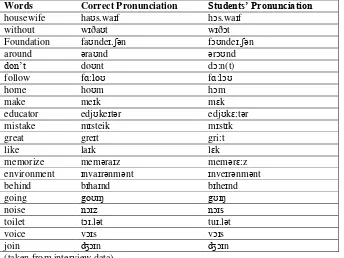
As it is predicted, the students have difficulties dealing with diphthongs not recognized in their native language, such as diphthongs /ɔu/ and /eɪ/. Towards diphthong /ɔʊ/, the students tended to take the substitution from the vowel /ɔ:/ of the second language they acquired after Banjarese, that is Indonesian. Towards diphthong /eɪ/, the students were likely to have many alternatives of substitution, some of which are pure vowels found in their native language and some other are pure vowels found in their Indonesian language, i.e. /ɛ/, /ɛ:/, /ɪ/, and /i:/. Towards the diphthong /oɪ/, however, the students were likely to show no significant
problem in the pronunciation as they can produce the words “voice”, “join”, “noise” correctly, except for the word “toilet”.
Table 5 Comparison between the English Correct Pronunciation and the Students’ Pronunciation of Diphtongs
Words Correct Pronunciation Students’ Pronunciation
housewife haʊs.waɪf hɔs.waɪf
without wɪðaʊt wɪðɔt
Foundation faʊndeɪ.ʃən fɔʊndeɪ.ʃən
around əraʊnd ərɔʊnd
don’t doʊnt dɔ:n(t)
follow fɑ:loʊ fɑ:lɔʊ
home hoʊm hɔm
make meɪk mɛk
educator edjʊkeɪtər edjʊkɛ:tər
mistake mɪsteik mɪstɪk
great greɪt gri:t
like laɪk lɛk
memorize meməraɪz memərɛ:z environment ɪnvaɪrənmənt ɪnveɪrənmənt
behind bɪhaɪnd bɪheɪnd
going goʊɪŋ gʊɪŋ
noise nɔɪz nɔɪs
toilet tɔɪ.lət tuɪ.lət
voice vɔɪs vɔɪs
join ʤɔɪn ʤɔɪn
(taken from interview data)
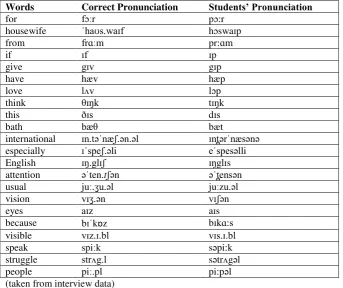
English consonants are different from Banjarese consonants. Keshavarz (2012 in Sharif, 2013) states when a mother tongue lacks certain phonemes in the target language, phonological errors tend to occur. Particular sounds that do not exist in the native language can make it difficult for second language learners to produce which later drives them to try to substitute those sounds with the similar one in their mother tongue (Zhang & Yin, 2009: 142). The English consonants that are missing in Bahasa Banjar Hulu are /f/, /v/, /θ/, /ð/, /ʃ/, and /ʒ/.
Most students fail in producing /f/ because they cannot find any of it in their mother tongue. The phoneme /f/ actually exists in Indonesian and Arabic and the students can pronounce it well especially during reading the Al-Qur’an aloud. Nevertheless, when it comes to the regional daily communication, they are used to
adapting it into their native linguistic tradition such as from “efektif” into
/ɛfɛktip/, “fardlu” into /pʌrdu/, “kifayah” into /kipayʌh/, “fotokopi” into
/pɔtɔkɔpi/, and “film” into “pilim”. This habit is carried out by the students into
“housewife”, “fox”, “from”, and “if” are pronounced as /pɔ:r/, /hɔswaɪp/, /pr:ɑm/,
/pɔks/ and /ɪp/. Such erroneous pronunciation can cause communication
breakdown where the words “for” may be misinterpreted as “pore”, “wife” as “wipe”, “fox” as “pox”, and “from” as “prom”.
Just like /f/, phoneme /v/ is also often mispronounced as /p/ by the students, such as in /gɪp/ (give), /hæp/ (have), and /lɔp/ (love). In addition, since /v/ is completely a new phoneme found only in English language among all the second languages the students have learnt, it is likely to be considered as alien, henceforth the students often confused it with /f/ which is more familiar. Besides, /f/ comes from the same place and manner of articulation as /v/: both of them are fricative labiodental. Thereby, they sometimes pronounced /v/ as /f/ and /f/ as /v/.
For example, they pronounce “for” as /vɔr/ instead of /fɔ:r/, “favorite” as
/veɪvərɪt/ instead of /feɪvərɪt/, “five” as /faɪf/ instead of /faɪv/, and “very” as /fɛri/ instead of /vɛri/, which can cause misinterpretation, in which “very”, for instance, may be understood as “ferry”.
Besides /f/ and /v/, phoneme /θ/ and /ð/ are also not found in Bahasa Banjar Hulu. In fact, BBH does not have any fricative aside from /s/ and /h/. Based on the research data, it is discovered that the students usually substitute
English /θ/ with /t/ dental, and /ð/ with d alveolar, which potentially lead to
communication breakdown, such as in words “think”, “this”, “birth” and “bath” which may be misinterpreted as “tink”, “diss”, “bird”, and “bat”.
Another English phoneme which does not exist in Bahasa Banjar Hulu is /ʃ/. When it comes to producing this sound, the students tend to substitute it with /s/.The words such as “international”, “especially”, “English”, “pronunciation”,
“punish”, “attention”, “organization”, and “conscious”, then, are sometimes
pronounced as /ɪnt̪ərˈnæsənə/, /eˈspesəlli/, / ɪŋglɪs/, /prəˌnʌnsiːˈeɪsən/, /pʌnɪs/, /əˈt̪ensən/, /ɔːrganɪˈzesən/ and /ˈkɑːnsiəs/.
The English fricative post-alveolar /ʒ/ is a totally new sound for Banjarese learners of English; it does not appear in Banjarese consonant system nor any other languages the students have learnt beside English, such as Indonesian or Arabic. The sound like this is often perceived as alien, which is why the students cannot produce it correctly and cannot really tell the difference between /z/ and /ʒ/; while at the same time, /ʒ/ sounds similar to /ʃ/ too. In the interview, the researcher found out that inthirty-five productions of the word “usual”, the
phonemes /ʒ/ and /z/ were used equally. The researcher also discovered that some students once mispronounced /ʒ/ in “vision” into /ʃ/. The equal amount of usage between /ʒ/ and /z/ in the word “usual” and the substitution of /ʒ/ with /ʃ/ in the
word “vision” hints at the confusion of the students with the difference among the
three phonemes.
The English /z/ is the last missing phoneme from Bahasa Banjar Hulu
sound systems after /f/, /v/, /θ/, /ð/, and /ʃ/. However, because he existence of this phoneme in both Indonesian and Arabic languages spoken by the students, they can produce /z/ correctlyas long as the /z/ is written with alphabet “z”, such as in
words “zip”, “amazing”, and “zoo”. Nevertheless, when the alphabetic writing of the words does not have the /z/ in it, they might mispronounce “because” as /bɪkɑ:s/, “eyes” as /aɪs/, and “visible” as /vɪsɪbɘl/.
between English /dʒ/ and /ʧ/ which are affricative (post) alveolar and Banjarese /dʒ/ and /ʧ/ which are plosive (post) alveolar. English /t/ is plosive alveolar while Banjarese /t/ is plosive dental; and English /ɹ/ is approximant (post) alveolar while Banjarese /r/ is trilled (blade) alveolar. Such difference is what usually initiates the erroneous substitution to happen too. Another sounds, the affricative /ʧ/ and /dʒ/, are complex consonants. They begin as plosive and end as fricative, making a hissing sound at the end (Roach, 2008: 48). Banjarese /dʒ/ and /ʧ/ are different; they do not end up in hissing sound since they are plosive consonants. When Banjarese produce these phonemes without hissing sound in the end,
miscommunication probably will not occur, only that they sound strange to English native speakers.
Just like /ʧ/ and /dʒ/, English /t/ and /ɹ/ are different from the ones that appear in Bahasa Banjar Hulu. English /t/ demands the tongue blade to be pressed against the alveolar ridge while in Banjarese /t/, the tip of the tongue is pressed against the top front teeth, normally like it is found in many languages (Roach; 2008: 32). English /ɹ/ is also different from Banjarese /r/. In English /ɹ/, the tip of the tongue is slightly curled backwards with the tip raised (retroflex) approaching the post-alveolar area; since it is an approximant consonants, “the articulators approach each other but do not get sufficiently close to each other to produce a
complete consonants” (Roach, 2008: 62). Banjarese /r/, on the contrary, is trill; the
tip of the tongue is raised against the blade-alveolar, quickly stopped and released several time, forming a trilling effect (Marsono, 1986: 93). Having not knowing the clear differences between these phonemes, most of the time, the students failed in producing the standard English /ɹ/ and /t/; these differences in the articulation, fortunately, does not cause misinterpretation.
Unlike Banjarese /c/, /j/, /t/ and /r/ which have different places and
manners of articulation from that of English, Banjarese /p/, /k/, /b/, /d/, and /g/, on the other hand, totally share the same phonetic features with English. However, English /p/, /t/, and /k/ are voicelesswhile Banjarese /p/, /t/, and /k/ are voiced.
Without aspiration, the word “class” /klæs/ will sound like “glass”/glæs/, “tied”
/taɪd/ will sound like “died” /daɪd/, and “park” /pɑ:rk/ will sound like “bark”
/bɑ:rk/. Furthermore, since /b/, /d/, and /g/ never occur at the final position in
original Banjarese vocabularies, the students tend to replace the final /b/, /d/, and /g/ with /p/, /t/, and /k/. Prior to that, they are also used to pronouncing borrowed
words in Banjarese like “abad” as /abat/, “sebab” as /sabap/, and “gudeg” as
/gudek/ by substituting /b/, /d/, and /g/ with /p/, /t/, and /k/. English words such as
“robe”, “bad”, and “bag” will sound as “rope”, bat and “back”.
From all consonants, English and Banjarese consonants that share the
same manners and places of articulation and distribution in words are /m/, /n/, /ŋ/,
/s/, /h/, w/, and /j/. That is why most of the time, the students succeeded in producing them.
Dealing with English clusters, however, because Bahasa Banjar Hulu does not have any cluster, the students were sometimes tempted to insert a schwa /ə/ between them to ease the pronunciation. The word, “speak”, for instance, they pronounced as /səpi:k/ instead of /spi:k/; “people” was pronounced as /pi:pəl/
instead of /p:pl/; and “struggle” was pronounced as /sətrʌgəl / instead of /strʌgl ̩/. Furthermore, when the cluster arises in the end of words, such as in words “want’,
them as /wɑn/, /θɪŋ/, and /mʌs/. To be pronounced so, these words can be
misunderstood as “wan”, “ting”, and “muss”.
Table 5 Comparison between the English Correct Pronunciation and the Students’ Pronunciation of Consonants
Words Correct Pronunciation Students’ Pronunciation
for fɔːr pɔ:r
housewife ˈhaʊs.waɪf hɔswaɪp
from frɑːm pr:ɑm
if ɪf ɪp
give gɪv gɪp
have hæv hæp
love lʌv lɔp
think θɪŋk tɪŋk
this ðɪs dɪs
bath bæθ bæt
international ɪn.təˈnæʃ.ən.əl ɪnt̪ərˈnæsənə especially ɪˈspeʃ.əli eˈspesəlli
English ɪŋ.glɪʃ ɪŋglɪs
attention əˈten.tʃən əˈt̪ensən
usual juː.ʒu.əl juːzu.əl
vision vɪʒ.ən vɪʃən
eyes aɪz aɪs
because bɪˈkɒz bɪkɑ:s
visible vɪz.ɪ.bl vɪs.ɪ.bl
speak spiːk səpi:k
struggle strʌg.l sətrʌgəl
people piː.pl pi:pəl
(taken from interview data)
Language Transfer in Suprasegmental Features
Having been very deeply influenced by the mother tongue’s segmental habit, when the students were speaking in English language, they tended to
associate English stress with that Bahasa Banjar Hulu. This is to say, they transfer the L1 accent as a guideline in giving stress to English utterances such as in the following words: pronun'cia'tion, bro'ther, fa'ther, im'por'tent, eng'lish, yester'dai, exam'ple, lang'uage, and peo'ple instead of pronunci'ation, 'brother, 'father, im'portent, 'english, 'yesterdai, ex'ample, 'language, and 'people.
Driven bythe native linguistic habit, the students tend to use Banjarese tone and intonation system as the main prior knowledge they use during English communication—not only in English actually, but also in any other second languages, such as Indonesian and Arabic. Although English language has certain rules than can be learnt in terms of intonation, according to Roach (2008: 153) however, learners of English who do not talk regularly with native speakers of English, or who do not at least to listen regularly to colloquial English, tend not to
learn English intonation, “although they may learn very good pronunciation of the segments and use stress correctly”.
Transferred to English, the students tend to produce words in sentences as separate units placed next to each other in sequence without linking in the way of
/pʰ'hæps/, and sentence such as “good night” assimilated to be /gʊn naɪt/, then, may create certain problem for the students to grasp and will bring about some trouble when they have to deal with the authentic English utterance from English native speakers.
Conclusion and Suggestion
Phonological transfer of native language can be a reason why sometimes communication breakdown happens. Language transfer is inevitable in second language learning, especially for English beginning learners. This study
discovered thatBahasa Banjar Hulu has different phonological system from that of English language. It is also found that there are influences of Banjarese language which occur in both segmental and suprasegmental features. In segmental features, phonological errors takes place in vowels, diphthongs, consonants, and clusters; while in suprasegmental features, Banjarese influence arises in stress, tone, juncture, and sentence intonation. The result of this study is expected to provide valuable information to English language teaching, especially among Banjarese speakers. The information hopefully can bridge the gap between the two phonological systems so that Banjarese learners of English are able to overcome obstacles caused by their mother tongue influence in mastering English pronunciation.
REFERENCES
Creswell, J.W. 2007. Qualitative Inquiry and Research Design. Choosing Among Five Approaches (2nd edition). London: Sage.
Cenoz, J. 2001. The Effect of Linguistic Distance, L2 Status And Age On Cross-Linguistic Influence In Third Language Acquisition. In Jasone Cenoz, Britta Hufeisen and Ulrike Jessner (Eds.), Cross-linguistic Influence in Third Language Acquisition: Psycholinguistic Perspectives(pp: 8-20). Clevedon, UK: Multilingual Matters. From Google Books, (Online), (http://books.google. com), accessed on March 31, 2013.
Departemen Pendidikan Nasional Pusat Bahasa. 2008. Kamus Bahasa Banjar Dialek Hulu Indonesia. Banjarmasin: Balai Bahasa.
Dewaele, J-M. 1998. Lexical inventions: French interlanguage as L2 versus L3. Applied Linguistics, (Online), 19: 471-490,
(http://applij.oxfordjournals.org), accessed on March 25, 2013.
Durasid, Durdje and Kawi, Djantera. 1978. Bahasa Banjar Hulu. Pembinaan dan Pengembangan Bahasa Departemen Pendidikan dan Kebudayaan. Jakarta: Pusat.
Fauzi, Iwan. 2008. Pemertahanan Bahasa Banjar pada Komunitas Perkampungan Dayak. Dialek Pribumi Warisan Keterampilan Jati Diri (pp. 435-443). Seminar Antarabangsa Dialek-dialek Antronesia di Nusantara III. Brunei: Jabatan Bahasa dan Melayu Linguistik Fakulti Sastera dan Sains Sosial. (https://archive.org/details/ERIC_ED461294, accessed on July 30, 2016). Hidayat, Ferry. 2015. Catat, Kompetensi Bahasa Inggris Dibutuhkan untuk
Hadapi MEA. (Online),
Hapip,A.D. 2008.Kamus Banjar-Indonesia. Banjarmasin: Rahmat Hafiz Al-Mubaraq.
Honna, N. (2005). English as a Multicultural Language in Asia and Intercultural Literacy.Intercultural Communication Studies XIV, 2, 73-89
Jenkins, J. 2000. The Phonology of English as an International Language. New York: Oxford University Press.
Jong,Hans Nicholas. 2015. RI Suffers Setback in English Proficiency. (Online), (http://www.thejakartapost.com/news/2015/11/06/ri-suffers-setback-english-proficiency.html, accessed on July 20, 2016).
Kenworthy, J. 1988. Teaching English Pronunciation. New York: Longman. Liu, S. 2001. Studies on Transfer in Second Language Acquisition. Guangxi
Normal University Journal, (Online), 3:1-29, (http://www.gxnu. edu.cn), accessed on May 5, 2013.
Major, R. C. 2008. Transfer in Second Language Phonology: A Review. In Jette G. Hansen Edwards and Mary L. Zampini (Eds), Phonology and Second Language Acquisition (pp. 63-94). Amsterdam: John Benjamin.
Muslich, M. 2012. Fonologi Bahasa Indonesia, Tinjauan Deskriptif Sistem Bunyi Bahasa Indonesia. Jakarta: Bumi Aksara.
Marsono. 1986.Fonetik. Yogyakarta: Gajah Mada University Press. McMahon, A. 2002. An Introduction to English Phonology. Edinburgh:
Edinburgh University Press.
Mu’in, F., & Kamal, S. 2006. Sociolinguistics: An Introduction. Banjarmasin: PBS FKIP Universitas Lambung Mangkurat.
Odlin, T. 1989. Language Transfer: Cross-Linguistic Influence in Language Learning. Cambridge: Cambridge University Press. From Google Books, (Online), (http://books.google.com), accessed on March 25, 2013.
Ortega, M. 2008. Cross-Linguistic Influence in Multilingual Language
Acquisition: The Role of L1 and Non-native Languages in English and Catalan Oral Production. Íkala, Revista de Lenguaje y Cultura, (Online),13 (19): 121-142, (http://www.redalyc.org), October 28, 2012.
Ramelan.1985. English Phonetics. Semarang: IKIP Semarang Press. Roach, P. 2008. English Phonetics and Phonology (13th
edition). Cambridge: Cambridge University Press.
Sharif,B R. 2013. Phonetic and Phonological Transfer. (Online),
(http://brwasharif.blogspot.com/2013_02_14_archive.html), accessed on June 5, 2013.
Torrijos, M. M.R. 2009. Effects of Cross-Linguistic Influences on Second Language Acquisition: a Corpus-based Study of semantic Transfer in Written Production.Revista de Lingüística y Lenguas Aplicadas. (Online), 4: 147-159, (http://ojs.upv.es), accessed on October 12, 2012.
Tremblay, M-C. 2006. Cross-Linguistic Influence in Third Language Acquisition: The Role of L2 Proficiency and L2 Exposure.Cahiers Linguistiques
d’Ottawa. (Online), 34: 109-119, (http://eprint.ncl.ac.uk), accessed on October 27, 2012.