UDC 811.111'367.635=111 811.111'367.625=111 Original scientific article Received on 07.01. 2015 Accepted for publication on 10.06. 2015
Milada Walková
Technical University of Košice
English aspectual particles are of two types
The paper presents a corpus-based study of English aspectual particle verbs. The standard view (Brinton 1985) is that particles mark telicity; a more recent account ar-gues that particles are comparative and/or resultative (Cappelle & Chauvin 2010). However, neither account applies to all particles. Therefore I propose that there are two types of aspectual particles, which differ in aspect-marking. As corpus data show, the two types of particles also differ in other aspectually relevant properties, namely the type of verb root with which particles combine, transitivity and type of direct ob-jects the respective particle verbs license. In particular, particles with a continuative meaning (about, along, around, on) combine with manner verbs rather than resultverbs. They form intransitive particle verbs, or else transitive particle verbs with an unaffected direct object. Particles which mark telicity (down, off, out, over, through, up)typically combine with result verb roots. They form particle verbs which are
ei-ther intransitive or transitive, with eiei-ther an affected or unaffected direct object.
Key words: particle verbs; telicity; phrasal verbs; aspect; argument structure.
1. Introduction
Particle verbs are combinations of a verb root and a particle, e.g. sit down, eat up, walk on, put off ‘postpone’. The particle may contribute various kinds of meaning, including directional, e.g. walk off ‘leave’ and fall down ‘fall on the ground’, idio-matic, e.g. blow up ‘become angry’ and give up ‘surrender’, and aspectual mean-ings, e.g. chat on ‘continue chatting’ and warm up ‘make warm(er)’. As I will show, English aspectual particles have not yet received a satisfactory analysis. In this paper I argue that there are two different types of aspectual particles, which differ not only in aspect marking but also in other aspectually relevant properties,
such as transitivity and type of verb root and type of direct object. I aim to prove the existence of the two types in a corpus-based study of particle verbs. The results are vitally relevant for any future study of English aspectual particle verbs: In order to avoid arriving at conclusions which are only partially true, the existence of both types of particles needs to be taken into account.
The particle in aspectual particle verbs contributes an aspectual meaning to the verb root (e.g. Celce-Murcia & Larsen-Freeman 1999; Jackendoff 2002). This as-pectual meaning may involve various notions, such as aimless behaviour (e.g. play around), persistent action (e.g. work away), endurance (e.g. last out), and comple-tion (e.g. drink up), as suggested by Quirk et al. (1985: 1162–1163), or inception (e.g. start up), continuation (e.g. play along), iteration (e.g. write over), and com-pletion (e.g. cut off), as proposed by Celce-Murcia & Larsen-Freeman (1999: 432– 433).
In a quest for an overarching account of various aspectual meanings of particles, Brinton (1985) argues that particles mark telicity on the verb root, e.g. eat (atelic) – eat up (telic). Telicity is the aspectual notion of an inherent endpoint, goal, or bound which is necessary for the event to be realized and beyond which the event cannot continue (Comrie 1976: 45). Telic predicates can combine with in-time ad-verbial phrases and atelic predicates with for-time adverbial phrases, but not vice versa (Dowty 1979: 56–58):
(1) We talked for/*in two hours.1 (atelic)
(2) John built a house *for/in two months. (telic)
Brinton’s (1985) paper has proved very influential and the view that particles are markers of telicity forms the standard view of aspectual particles today, appearing in e.g. Keyser & Roeper (1992: 118), Tenny (1994: 150), van Hout (1996/1998; 1998), Jeschull (2003: 120), and Bikicki & Jerković (2011: 18), among others. The view is taken for granted in spite of the fact that Brinton (1985: 165–166) herself acknowledges that particles on, along and away mark continuation or iteration, not telicity. Giddings (2001) and Glođović (2013) tested and confirmed Brinton’s hy-pothesis that particles mark telicity. However, both studies were limited to a small set of particles, namely down and out in Giddings (2001) and down, out, off and up in Glođović (2013). Thus these studied did not consider continuation-marking par-ticles, such as on, along and away.
1 Ingressive reading is ignored in the
In a more recent account of aspectual particles, Cappelle & Chauvin (2010) treat particles as comparative and/or resultative: Particles are comparative when the change expressed by the particle verb is gradual, e.g. (anger) build up ‘become greater, stronger, or larger in number’, and resultative when there is an attainment of result or a change of condition, e.g. team up ‘form a team’. As Cappelle & Chauvin point out, some particle verbs are ambiguous, allowing for both interpreta-tions, e.g. brighten up ‘make brighter’ (comparative)/‘make bright’ (resultative). However, their account fails to cover the very same particles that the telicity-marking approach does not apply to, i.e. continuation-telicity-marking particles: Particle verbs such as drive on/along, work away (at the problem), babble on (about the campaign) are neither comparative nor resultative.
Continuation-marking particles receive some attention from Jackendoff (2002), who characterizes the meaning of the respective particle verbs as approximating the meaning of ‘keep on V-ing.’ He (2002: 77) also notes that particle verbs with con-tinuative aspectual particles cannot license a direct object, e.g. *Dave drank scotch away/on. On the basis of this observation, McIntyre (2001; 2004) distinguishes two types of particle uses – atransitive and non-atransitive (i.e. intransitive and transi-tive), e.g. play (*a silly game) around/about – think out a plan, dream up a solu-tion. McIntyre (2001) notes that while transitive particles form telic particle verbs, intransitive particles, which have a durative or ingressive meaning, form atelic par-ticle verbs. It is important to stress, though, that McIntyre (2001: 136–137) rejects a direct correlation between transitivity and telicity for the following reasons: First, verb roots without intransitive particles, unlike the respective particle verbs, are compatible with direct objects, e.g. play a silly game, and second, intransitive par-ticles block all kinds of direct object rather than telicizing direct objects only, e.g. he played (*his guitar) along/on/away/around.
In sum, the research suggests that there are two types of particles. These two types, I argue, differ in aspect-marking and transitivity. One type is telicity-marking particles which license direct objects, namely down, off, out, over, up, and through.2 The other type is continuation-marking particles, whose meaning indi-cates continuation and/or absence of goal and their particle verbs cannot license a direct object. I include in this group, apart from on, along and away as proposed by
2 Although Celce-Murcia & Larsen-Freeman (1999: 432) list aspectual
through among continuative
particles, I consider it a telicity-marking particle different from continuation-marking particles: No-tice that particle verbs with through license direct objects, e.g. read a book through ‘read the whole
book’, and their meaning is not ‘keep on V-ing’ but ‘V from beginning to end’ (cf. Celce-Murcia & Larsen-Freeman 1999; Jackendoff 2002).
Brinton (1985), also about and around, as they are similar to the other continua-tion-marking particles in meaning and object licensing.
The rest of the paper will show evidence for the existence of the two types of particles, reporting on a corpus-based study of English aspectual particle verbs. It is organized as follows. Section 2 reviews the factors which play a decisive role in determining telicity, namely transitivity, type of direct object and type of verb root. These factors will be employed in the analysis of the data in Section 3. The results are discussed in Section 4. The last section draws conclusions.
2. The role of direct objects and verb roots in determining telicity
As particles do not appear in isolation, it is vital to consider the context in which they appear. After all, telicity concerns predicates rather than just verbs (e.g. Verkuyl 1972, 1989, 2005), e.g. (3) below. In particular, one needs to take into ac-count the type of verb root with which the particle combines, the transitivity of the particle verb and the type of the direct object. This section shows why these notions are relevant in determining the telicity of a predicate. Section 3 will then discuss these notions in the light of the data.
2.1.
Transitivity and type of direct object
It has long been known in aspectual literature (e.g. Verkuyl 1972, 1989, 2005; Krifka 1992, 1998) that certain types of direct object turn atelic predicates into telic ones (3).
(3) a. Rebecca ate. (atelic)
b. Rebecca ate an apple. (telic)
The direct object plays an important role in telicity also with particle verbs: While Giddings’ (2001) corpus study of particle verbs with particles down and out con-firms Brinton’s (1985) hypothesis that particles mark telicity, Giddings (2001) notes that the change in telicity is typically accompanied with a change in transitiv-ity, e.g. I hunted (intransitive verb root; atelic) – I hunted down the fox (transitive particle verb; telic). It follows that the ability of a particle verb to license a direct object is crucial for its ability to mark telicity. We may therefore expect that telici-ty-marking particles, in contrast to continuation-marking ones, will form transitive particle verbs.
(4) Bill pushed the cart for/*in two minutes. (atelic)
To account for this fact, Tenny (1994) distinguishes two types of direct object, af-fected and unafaf-fected, depending on how the denoted event participant is involved in the action. She (1994: 11) defines an affected event participant as undergoing a “necessary internal motion or change”, e.g. the direct object in eat an apple. In con-trast, the direct object in (4) does not undergo an internal change or motion – only the object as a whole is moved. The distinction between the two types of direct ob-ject is aspectually relevant: According to Tenny, affected direct obob-jects appear in telic predicates only (3b). Unaffected direct objects occur in atelic predicates (4). Therefore, if the two types of particles differ in their ability to mark telicity, as suggested by Brinton (1985), we may expect that affected direct objects will be li-censed only by particle verbs with telicity-marking particles. The present study therefore considers the kind of direct objects (if any) the particles in my corpus sample license. It has to be noted, though, that I considered the direct objects that actually appeared in the sample rather than a whole range of direct objects with which a particle can possibly combine.
2.2.
Type of verb root: manner/result complementarity
Another aspectually relevant distinction is the manner/result complementarity in verb roots: While some verbs specify a manner of action (e.g. sweep, scrub, wipe), others denote a result (e.g. break, clean, clear) (Levin & Rappaport Hovav 1991; 2013; Rappaport Hovav & Levin 1998; 2010). While atelicity is typically associat-ed with a manner of action, telicity tends to be associatassociat-ed with a result of action (Rappaport Hovav & Levin 1998). Nevertheless, as Rappaport Hovav & Levin (2010) point out, the manner/result distinction does not neatly overlap with atel-ic/telic complementarity, mainly because telicity is compositional (i.e. determined by the verb as well as its arguments), and also because some verbs allow both an atelic and a telic reading, e.g. cool (result verb; atelic/telic).
The manner/result distinction originated as the path and manner of motion com-plementarity in motion verbs known from Talmy (1985), e.g. enter (path verb) – swim (manner of motion verb); however, Levin and Rappaport Hovav in their work (Levin & Rappaport Hovav 1991; 2013; Rappaport Hovav & Levin 1998; 2010) apply the notions more broadly, i.e. also to non-motion verbs. According to them, result verbs denote a result and do not specify the manner in which the result is achieved. For instance, one can clean a bathtub by scrubbing or wiping, etc. In con-trast, manner verbs do not specify what kind of result, or whether any result at all,
has been achieved; for instance, when one scrubs or wipes a bathtub, it does not necessarily become clean. The semantic distinction has also syntactic reflexes. Manner verbs are more flexible in what kind of direct object they can appear with, cf. Leslie swept; Cinderella scrubbed her fingers to the bone; The child rubbed the tiredness out of his eyes (manner verbs) but *Kelly broke; *The clumsy child broke his knuckles to the bone; *The clumsy child broke the beauty out of the vase (result verbs). While Levin and Rappaport Hovav argue for the complementarity of the manner/result distinction, they acknowledge that some verbs have uses of both types, e.g. clean ‘make clean’ (result verb) – clean ‘do housework’ (manner verb). Beavers & Koontz-Garboden (2012) develop a set of the following diagnostic tests for manner and result verbs without presupposing a strict complementarity.3 First, as result verbs imply an occurrence of result, they are, unlike manner verbs, incompatible with a denial of result, e.g. #Shane just broke the vase, but it is not broken (result) – Tracy just swept the floor, but nothing is different about it (man-ner). Second, in contrast to manner verbs, monotransitive result verbs resist object drop, e.g. Kim broke *(the vase) last night (result) – Kim scrubbed (the floor)last night (manner), and are rather restricted in forming resultative constructions, e.g. We dimmed the room *empty (result) – Cinderella scrubbed the table clean (man-ner). Third, manner verbs typically disallow inanimates and natural forces as sub-jects, while result verbs allow them, e.g. #The stiff brush wiped the floor (manner; acceptable in personification) – The hammer broke the vase (result). Fourth, man-ner verbs, unlike result verbs, resist denial of action and reinterpretation into ‘cause by negligence’, e.g. #Jim ran, but didn’t move a muscle (manner) – Kim broke my DVD player, but didn’t move a muscle – rather, when I let her borrow it a disc was spinning in it, and she just let it run until the rotor gave out! (result). Lastly, man-ner verbs are always durative, e.g. John spent five minutes running (manner) – *John spent five minutes breaking the vase (result). In the present study I rely largely on these characteristics to examine the type of verb roots with which the particles in my sample combine.
3 Beavers & Koontz-Garboden (2012) argue that some verbs (manner of killing verbs, e.g.
guillo-tine, crucify, drown; ditransitive ballistic motion verbs as throw, toss; and manner of cooking verbs
as fry, microwave) pattern as both manner verbs and result verbs and thus form a third type,
3. Study
3.1.
Data collection
The data were extracted from the spoken conversation sub-corpus of The British National Corpus (BNC).4 The spoken conversation sub-corpus was chosen because it was believed to represent the typical usage of particle verbs, due to their high frequency in conversations (Biber et al. 1999: 408) and rather informal nature (Cel-ce-Murcia & Larsen-Freeman 1999: 434). The study aimed to cover a large number of particles. Starting with Darwin & Gray’s (1999) list of 19 particles, I established the following criteria that a particle had to meet in order to be included in the sam-ple for the present study:
1. The particle had to be tagged as an adverb particle or adverb particle but maybe preposition in the BNC. This criterion eliminated aside, away, forth and into.
2. The particle had to combine with enough verb roots to form at least 10 types of aspectual particle verbs. This criterion eliminated particles across (no hits), by (16 hits including only 5 types of particle verbs), and under (29 hits, contain-ing not a scontain-ingle aspectual particle verb).
3. The particle had to have a clear aspectual meaning. This criterion eliminated particles in and back, which can be said to have a semi-aspectual meaning at most (cf. Cappelle 2005: 433–436 for a discussion of back), e.g. fill in a form, kiss a woman back.
The study therefore includes the following ten particles:
(5) about, along, around, down, off, on, out, over, up, through
The search in the corpus was performed as a search for particles, tagged either as adverb particle or as probably adverb particle but maybe preposition. All instances which were not aspectual particle verbs were eliminated, including combinations of verb and adverb or preposition, as well as literal and idiomatic particle verbs. To check for the particle-verb-hood, I used the where-test from Darwin & Gray (1999). As aspectual particle verbs I considered compositional particle verbs whose particle contributes a non-directional meaning and whose verb root expresses a
4 Data cited herein have been extracted from the British National Corpus (BNC), distributed by Ox-ford University Computing Services on behalf of the BNC Consortium. All rights in the texts cited are reserved.
kind of action denoted in the whole particle verb (cf. Celce-Murcia & Larsen-Freeman 1999; Giddings 2001; Jackendoff 2002).
For each of the particles in (5), ten types (not tokens) of aspectual particle verbs were randomly collected. The sample thus includes 100 aspectual particle verbs (N = 100) with 10 different particles, see Table 1 (particles are ordered in such a way that the table be easily compared to the tables in the following section).
Table 1: The list of aspectual particle verbs from a sample from the BNC
PARTICLE VERB ROOTS
about carry, fly, follow,lark, play, roam, swap, trundle, walk, wander along bring, carry,come, drive, trot, fiddle, flow, go, take, walk around carry, get, look, shop, push, rush, spread, swim, walk, wander on chat,come, go, keep, move, pass, sally, struggle, try, walk down close, come, hold, lay, lock, pass, settle, slow, trim, write off chop, copy, cut, finish, kill, pay, peel, sand, send, start out clean, clear, let, point, read, sell, send, set, start, try
over change, check, come, cover, go, hand, join, send, swap, wipe
through air, come, cut, get, hoover, leak‘sprout’, , patch, pour ‘flow’, shoot take
up add, bring, come, end, grow, join, link, pack, save, use
3.2.
Data analysis
The particle verbs from the sample were then classified according to the aspectual-ly relevant criteria, as discussed in §2: transitivity and type of direct object (§3.2.1), and type of verb root (§3.2.2).
3.2.1.
Transitivity and type of direct object
I examined the transitivity of the particle verbs as appearing in the corpus, classify-ing them as either transitively or intransitively used. As transitive I coded particle verbs appearing in the sample with a direct object, e.g. sand it off, brought up in-vestigation, and also particle verbs with a relational pronoun in a post-modifier phrase (6a) or a passive transformation (6b-c). Particle verbs appearing in the sam-ple without a direct object, e.g. they’re shooting through, we started outin convoy,
including particle verbs with an unaccusative subject (7), were coded as intransi-tive.
(6) a. There is no blueprint that one could lay down... (BNC KB0 966)5 (tran-sitive)
b. Erm oh well maybe yours can be saved up for another time? (BNC KB0 1491) (transitive)
c. If I want it spread around. (BNC KB7 12922) (transitive) (7) The Polyripple peels off though Zoe. (BNC KB6 566) (intransitive)
The direct objects of transitive particle verbs in the sample were then classified as either affected, i.e. one that undergoes a “necessary internal motion or change” (Tenny 1994: 11), or unaffected. Tenny (1994: 127, note 22) makes explicit that objects moving in space, e.g. the train crossed the border, do not undergo an inter-nal but an exterinter-nal motion, and as such are not affected event participants. In a sim-ilar vein, I distinguish between an affected object and an effected object, the latter denoting a participant that comes into being by the result of the action, e.g. build a house. Accordingly, I do not consider effected direct objects as a kind of affected direct objects. Therefore, I classified e.g. clear the fireplace out, closehis business down (the participants denoted by the direct objects undergo a change in a proper-ty) as affected direct objects, while e.g. carryhorsesaround (an external change of location), the ones you’ve written down (effected participant), read that thing out were classified asunaffected.
3.2.2.
Manner and result verb roots
On the basis of the characteristics of manner and result verbs from Levin & Rap-paport Hovav (1991; 2013), RapRap-paport Hovav & Levin (1998; 2010) and Beavers & Koontz-Garboden (2012) as given in §2.2, as well as of the description of verbs in Levin (1993), I classified the verb roots in the sample, as used in the particular context in the corpus, as either manner or result verbs, e.g. (8-9).
(8) walk – manner verb root
a. meaning ‘go on foot’ denotes manner of action, does not denote the re-sult of action (such as arriving somewhere)
5 The data drawn from the BNC are identified with a code starting with BNC. The rest of the code is a text identifier and a sentence number.
b. compatible with denial of result: Debra walked to the kitchen but she stopped midway.
c. direct object alternations: Debra walked., Debra walked the soles of her shoes bare.
d. incompatible with an inanimate subject: #The shoes walked to the kitch-en.
e. incompatible with denial of action: #Debra walked, but didn’t move a muscle.
f. durative: Debra spent an hour walking. (9) cut – result verb root
a. meaning ‘penetrate with a sharp instrument’ denotes a result of action, does not specify a manner of action (such as by slicing, sawing, bisect-ing)
b. incompatible with denial of result: #Ted cut his finger, but nothing is different about it.
c. direct object alternations: *Ted cut., Ted cut his finger to the bone. d. compatible with an inanimate subject: The saw cut his finger.
e. compatible with denial of action: Ted cut his finger, but didn’t move a muscle – he was relaxing in a sofa when the window shattered and the glass fell on his hand.
f. non-durative: ?Ted spent five minutes cutting his finger. (acceptable in iterative reading)
4. Results and discussion
4.1. Sample of particle verbs
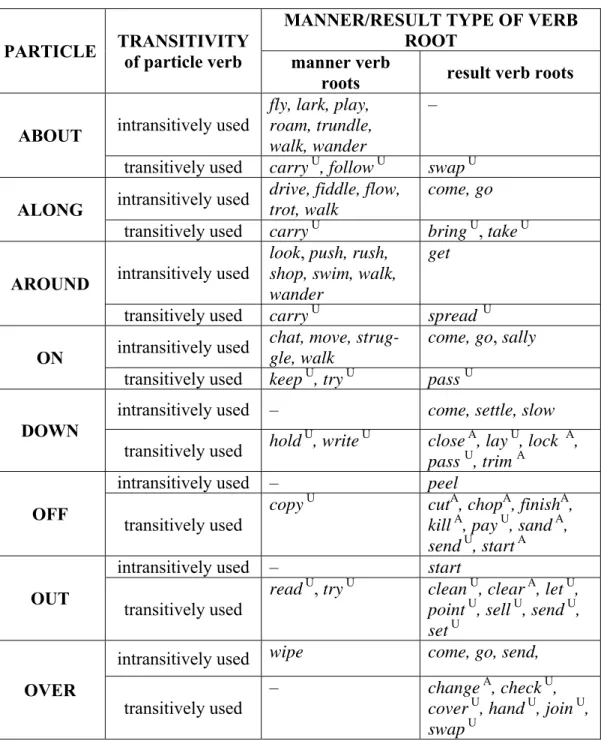
Table 2 lists all the particle verbs from the sample by type of verb root, transitivity of particle verb, and type of direct object: Transitively used particle verbs are la-belled with either U or A to distinguish between unaffected and affected direct
Table 2: Aspectual particle verbs from the sample by transitivity and manner/result type of the verb root
PARTICLE TRANSITIVITY of particle verb
MANNER/RESULT TYPE OF VERB ROOT
manner verb
roots result verb roots ABOUT intransitively used
fly, lark, play, roam, trundle, walk, wander
–
transitively used carryU, followU swapU
ALONG intransitively used
drive, fiddle, flow, trot, walk
come, go transitively used carryU bringU, takeU
AROUND intransitively used
look, push, rush, shop, swim, walk, wander
get
transitively used carryU spread U
ON intransitively used
chat,move, strug-gle, walk
come, go, sally transitively used keepU, tryU pass U
DOWN
intransitively used – come, settle, slow transitively used holdU, writeU closeA, lay U, lock A,
pass U, trim A
OFF
intransitively used – peel transitively used
copyU cutA, chopA, finishA, kill A, pay U, sand A, send U, start A
OUT
intransitively used – start transitively used
readU, tryU cleanU, clear A, let U, point U, sell U, send U, set U
OVER
intransitively used wipe come, go, send, transitively used
– changeA, check U, cover U, hand U, join U, swap U
THROUGH intransitively used
hoover, leak, pour ‘flow’
come, get, patch, shoot ‘sprout’ transitively used airA cutA, take U
UP
intransitively used – come, end, grow, join, link
transitively used – addU, bring U, pack U, save U, use A
The results for individual criteria are presented in the following sections, together with statistical information (using Fisher’s chi-square two-tailed statistical test).
4.2.
Transitivity and type of direct object
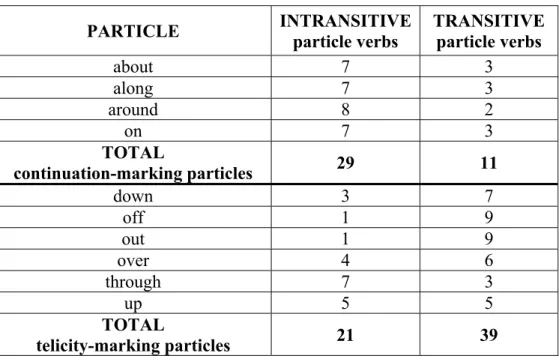
The results for transitivity and type of direct object are given in Tables 3 and 4, re-spectively.6 Out of 40 particle verbs with continuation-marking particles, 29 were intransitive (72.5%) and 11 were transitive (27.5%). All the 11 transitive particle verbs licensed an unaffected direct object (100%). In contrast, out of 60 particle verbs with telicity-marking particles, 21 were intransitive (35%) and 39 were tran-sitive (65%). Of the 39 trantran-sitive particle verbs, 25 licensed unaffected direct object (64.1%) and 14 licensed affected direct object (35.9%). The distinction between the two types of particles is statistically significant regarding both transitivity (p = 0.0004) and the type of direct object (p = 0.0221).
In sum, continuation-marking particles (about, along, around and on) mostly form intransitive particle verbs. When they form transitive particle verbs, their di-rect objects are always unaffected. Telicity-marking particles (down, off, out, over, through and up) form either intransitive particle verbs or transitive particle verbs with either unaffected or affected direct objects. So, rather than showing inverse behaviour, the two types of particles differ in the range of behaviour that they show: One type is more restricted than the other in transitivity and the type of di-rect object.
6 In Tables 3–5 the two types of particles are separated by a thick line. The rows in bold give the to-tal numbers for each type of particles.
Table 3: The number of intransitive and transitive particle verbs in the sample PARTICLE INTRANSITIVEparticle verbs TRANSITIVE particle verbs
about 7 3 along 7 3 around 8 2 on 7 3 TOTAL continuation-marking particles 29 11 down 3 7 off 1 9 out 1 9 over 4 6 through 7 3 up 5 5 TOTAL telicity-marking particles 21 39
Table 4: The number of unaffected and affected direct objects of transitive particle verbs in the sample
PARTICLE UNAFFECT-ED direct objects AFFECTED direct objects about 3 0 along 3 0 around 2 0 on 3 0 TOTAL continuation-marking particles 11 0 down 4 3 off 3 6 out 8 1 over 5 1 through 1 2 up 4 1 TOTAL telicity-marking particles 25 14
4.3.
Manner and result verb roots
The results for the type of verb root are presented in Table 5. Out of 40 verb roots which combined with continuation-marking particles, 29 were manner verbs (72.5%) and 11 were result verbs (27.5%). In contrast, out of 60 verb roots which combined with telicity-marking particles, only 10 were manner verbs (16.7%) and as many as 50 were result verbs (83.3%). The distinction between the two types of particles is statistically significant (p < 0.0001), suggesting that the two types of particles differ in what kind of verb roots they combine with. While continuation-marking particles about, along, around and on tend to combine with manner verb roots, telicity-marking particles down, off, out, over and up typically combine with result verb roots.
Table 5: The number of manner and result verb roots of the particle verbs in the sample
PARTICLE MANNER verb roots verb roots RESULT
about 9 1 along 6 4 around 8 2 on 6 4 TOTAL continuation-marking particles 29 11 down 2 8 off 1 9 out 2 8 over 1 9 through 4 6 up 0 10 TOTAL telicity-marking particles 10 50
4.4.
Factors affecting telicity
The paper has examined several factors which were found by previous research to determine the telicity of a predicate: the direct object (Verkuyl 1972; 1989; 2005; Krifka 1992; 1998), affectedness of an event participant (Tenny 1994), and denota-tion of a result state (Dowty 1979). I will now discuss how the nodenota-tions of
man-ner/result complementarity, transitivity and affectedness relate to one another and to telicity and I will try to explain why none of them directly corresponds to telici-ty. First, note that the affectedness of event participants does not correspond to the resultativeness of the verb. While Tenny’s (1994) affectedness concerns only inter-nal motion or change, result verbs concern also a change of location and change of possession. Now consider transitivity. Certain types of direct object7 can turn an atelic predicate into a telic one, yet only a direct object denoting an affected event participant can do so, e.g. Ian ate (atelic) – Ian ate an apple (affected, telic) – Ian pushed a cart (unaffected, atelic). On the other hand, an affected event participant can be realized not only as a surface direct object of transitive verbs but also as the subject of intransitive unaccusative verbs (Tenny 1994), e.g. I melted the butter – The butter melted. Jackendoff (1996) points out that telic predicates may as well lack the denotation of an affected entity, e.g. Ian pushed a cart to New York (unaf-fected direct object, telic). In sum, it is typically a combination of these factors that is needed for the telic reading to occur. This fact points out that telicity is an issue more complex than previously assumed.
4.5.
Implications
This paper has made two main claims, which are closely related. First, aspectual particles in English are not a homogenous group: Instead, they are of two types with distinct properties associated with aspect. These properties are the type of verb root (manner/result), its transitivity, and the type of direct object it licenses (affect-ed/unaffected). Second, the very same properties all participate on determining the overall aspectual value (telic/atelic) of the predicate.
Since particles of one type (continuative particles) typically yield atelic particle verbs, and since the telicity of a predicate is determined also by factors other than the particle, such as the verb root and the direct object, it follows that claiming that English aspectual particles are markers of telicity is an over-statement. Therefore, one cannot make generalizations about aspectual particles based on a few telicity-marking particles, as done by both Giddings (2001) and Glođović (2013). In fact, this paper hopes to counteract the myth that all aspectual particles in English mark telicity. I argue instead that any future study of the aspect of English particle verbs
7 The direct object telicizes the predicate when it is quantized, i.e. when it refers to a bounded amount of an entity, e.g. eat an apple, eat the apples. In contrast, non-bounded quantities are
denot-ed by cumulative direct objects, such as bare mass and bare plural noun phrases, e.g. drink wine, eat apples. See e.g. Krifka (1992; 1998), Tenny (1994) and Jackendoff (1996) for details.
should take into account the existence of two types of particles and consider exam-ples of both types.
The proposal that aspectual particles are of two types does not, however, contra-dict the existing semantic classifications, such as those by Quirk et al. (1985: 1162– 1163) and Celce-Murcia & Larsen-Freeman (1999: 432–433) (see §1). Rather, their classifications are based on detailed lexical semantic descriptions, whereas Brin-ton’s (1985) and the present account try to clarify the role of particles in terms of aspect. In other words, the meanings of continuation, persistent action, and pur-poseless action are denoted by continuation-marking particles, whereas telicity-marking particles carry the meaning of completion, inception, endurance, and itera-tion.
5. Conclusion
This paper has analyzed a sample of 100 aspectual particle verbs containing 10 dif-ferent particles that was compiled from the BNC corpus of spoken conversation. The data provide support for the claim that aspectual particles are of two types. I have shown that the distinction goes beyond the ability to mark telicity, as suggest-ed by Brinton (1985), in that it also concerns the type of verb root with which the particles combine (manner or result verbs), transitivity of the respective particle verbs and type of direct (affected or unaffected) object licensed by them.
Continuation-marking particles (about, along, around, on) tend to combine with manner verbs more frequently than with result verbs. Their particle verbs are fre-quently intransitive, or else the direct object is not affected. Telicity-marking parti-cles (down, off, out, over, through, up) typically combine with result verb roots. The particle verbs they form are either intransitive or transitive, with either an af-fected or unafaf-fected direct object.
Acknowledgements
I would like to thank Angeliek van Hout, Jack Hoeksema, and two anonymous re-viewers for their comments on earlier versions of the paper. All remaining short-comings are mine.
Abbreviations
BNC British National Corpus
References
Beavers, John & Koontz-Garboden, Andrew. 2012. Manner and result in the roots of ver-bal meaning. Linguistic Inquiry 43. 331–369.
Biber, Douglas & Johansson, Stig & Leech, Geoffrey & Conrad, Susan & Finegan, Edward. 1999. Longman grammar of spoken and written English. London: Lon-gman.
Bikicki, Nataša, & Jerković, Jelena. 2011. The perception of telicity in transparent phrasal verbs. In Ɖurić Paunović, Ivana & Marković, Maja (eds.), English language and Anglophone literatures today, 18–30.Novi Sad: Filozofski fakultet u Novom Sadu. Brinton, Laurel J. 1985. Verb particles in English: Aspect or aktionsart? Studia Linguistica
39. 157–168.
The British National Corpus, version 3 (BNC XML Edition). 2007. Distributed by Oxford University Computing Services on behalf of the BNC Consortium.
Cappelle, Bert. 2005. Particle patterns in English: A comprehensive coverage. Leuven: Katholieke Universiteit Leuven. (Unpublished doctoral dissertation.)
Cappelle, Bert & Chauvin, Catherine. 2010. Interprétations aspectuelles des verbes à parti-cule en anglais: Téliques, comparatifs, résultatifs. In Hadermann, Pascale & Inkova, Olga & Pierrard, Michel & Van Raemdonck, Dan (eds.), Approches de la scalarité, 249–281.Genève: Droz.
Celce-Murcia, Marianne & Larsen-Freeman, Diane. 1999. The grammar book: An ESL/EFL teacher’s course. Boston: Heinle and Heinle.
Comrie, Bernard. 1976. Aspect. Cambridge: Cambridge University Press.
Darwin, Clayton M. & Gray, Loretta S. 1999. Going after the particle verb: An alternative approach to classification. TESOL Quarterly 33. 65–83.
Dowty, David R. 1979. Word meaning and Montague grammar. The semantics of verbs and times in generative semantics and in Montague’s PTQ. Dodrecht: D. Reidel Publishing Company.
Giddings, Catherine. 2001. What it means to be DOWN and OUT: The semantics of particles
in English. In Georgiafentis, Michalis & Kerswill, Paul & Varlokosta, Spyridoula (eds.), Reading Working Papers in Linguistics 5, 155–173. Reading: University of Reading.
Glođović, Anica. 2013. Aspectual and/or aktionsart function of adverbial particles in Eng-lish phrasal verbs. Facta Universitatis, Series: Linguistics and Literature 11. 119– 131.
Jackendoff, Ray. 1996. The proper treatment of measuring out, telicity, and perhaps even quantification in English. Natural Language and Linguistic Theory 14. 305–354. Jackendoff, Ray. 2002. English particle constructions, the lexicon, and the autonomy of
syntax. In Dehé, Nicole & Jackendoff, Ray & McIntyre, Andrew & Urban, Silke (eds.), Verb-particle explorations, 67–94. Berlin: Mouton de Gruyter.
Jeschull, Liane. 2003. What particle verbs have to do with grammatical aspect in early child English. In Bittner, Dagmar & Gagarina, Natalia (eds.), Acquisition of aspect (ZAS Papers in Linguistics 29), 119–131. Berlin: Zentrum für Allgemeine Sprach-wissenschaft.
Keyser, Samuel Jay & Roeper, Thomas. 1992. Re: The abstract clitic hypothesis. Linguis-tic Inquiry 23. 89–125.
Krifka, Manfred. 1992. Thematic relations as links between nominal reference and tem-poral constitution. In Sag, Ivan A. & Szabolcsi, Anna (eds.), Lexical matters, 29–53. Chicago: Chicago University Press.
Krifka, Manfred. 1998. The origins of telicity. In Rothstein, Susan (ed.), Events and grammar, 197–235. Dordrecht: Kluwer.
Levin, Beth. 1993. English verb classes and alternations: A preliminary investigation. Chicago: University of Chicago Press.
Levin, Beth & Rappaport Hovav, Malka. 1991. Wiping the slate clean: A lexical semantic exploration. Cognition 41. 123–151.
Levin, Beth & Rappaport Hovav, Malka. 2013. Lexicalized meaning and manner/result complementarity. In Arsenijević, Boban & Gehrke, Berit & Marín, Rafael (eds.), Studies in the composition and decomposition of event predicates, 49–70. Dor-drecht: Springer.
McIntyre, Andrew. 2001. Argument blockages induced by verb particles in English and German: Event modification and secondary predication. In Dehé, Nicole & Wanner, Anja (eds.), Structural aspects of semantically complex verbs, 131–164. Berlin: Pe-ter Lang.
McIntyre, Andrew. 2004. Event paths, conflation, argument structure and VP shells. Lin-guistics 42. 523–571.
Quirk, Randolph & Greenbaum, Sidney & Leech, Geoffrey & Svartvik, Jan. 1985. A com-prehensive grammar of the English language. London: Longman.
Rappaport Hovav, Malka & Levin, Beth. 1998. Building verb meanings. In Butt, Miriam & Geuder, Wilhelm (eds.), The projection of arguments: Lexical and compositional factors, 97–134. Stanford: Center for the Study of Language and Information Press. Rappaport Hovav, Malka & Levin, Beth. 2010. Reflections on manner/result complemen-tarity. In Rappaport Hovav, Malka & Doron, Edit & Sichel, Ivy (eds.), Syntax, lexi-cal semantics, and event structure, 21–38. Oxford: Oxford University Press.
Talmy, Leonard. 1985. Lexicalization patterns: Semantic structure in lexical forms. In Shopen, Timothy (ed.), Language typology and syntactic description, vol. 3 (Gram-matical categories and the lexicon), 57–149. Cambridge: Cambridge University Press.
Tenny, Carol. 1994. Aspectual roles and the syntax-semantics interface. Dordrecht: Kluwer.
van Hout, Angeliek. 1996/1998. Event semantics of verb frame alternations. A case study of Dutch and its acquisition. Tilburg: Tilburg University. (Doctoral dissertation. Published in 1998. New York: Garland Publishing.)
van Hout, Angeliek. 1998. On the role of direct objects and particles in learning telicity in Dutch and English. In Greenhill, Annabel & Hughes, Mary & Littlefield, Heather & Walsh, Hugh (eds.), Proceedings of the Annual Boston University conference on language development (BUCLD) 22(2), 397–408. Boston: Boston University.
Verkuyl, Henk J. 1972. On the compositional nature of the aspects. Dordrecht: D. Reidel. Verkuyl, Henk J. 1989. Aspectual classes and aspectual composition. Linguistics and
Phi-losophy 12. 39–94.
Verkuyl, Henk J. 2005. Aspectual composition: Surveying the ingredients. In Verkuyl, Henk J. & de Swart, Henriette & van Hout, Angeliek (eds.), Perspectives on aspect, 19–39. Dordrecht: Springer.
Author’s address:
Department of Languages Technical University of Košice Vysokoškolská 4
042 00 Košice Slovakia
E-mail: [email protected] [email protected]
DVA SU TIPA ASPEKTUALNIH ČESTICA U ENGLESKOME JEZIKU
Radom se studijom utemeljenom na korpusu obrađuju engleski glagoli koji uključuju as-pektualne čestice. Standardni pristup (Brinton 1985) drži da čestice izražavaju teličnost. Noviji pristup tvrdi da su čestice komparative i/ili rezultativne (Cappelle & Chauvin 2010). Međutim, nijedan od tih pristupa nije primjenjiv na sve čestice. Stoga predlažem da postoje dva tipa čestica koji se razlikuju u tome kako obilježavaju kategoriju vida. Po podatcima iz korpusa, ta dva tipa čestica razlikuju se i u drugim osobinama važnima za vid, kao što su tip korijena glagola s kojim se kombiniraju čestice, prijelaznost i tip direktnih objekata ko-je zahtiko-jevaju ti glagoli s česticama. Čestice s kontinuativnim značenjem (about, along,
around, on) osobito se češće kombiniraju s načinskim glagolima nego s rezultativnima.
One čine neprijelazne čestične glagole, ili pak prijelazne čestične glagole s neaficiranim direktnim glagolom. Čestice kojima se označava teličnost (down, off, out, over, through, up) obično se kombiniraju s korijenima rezultativnih glagola. Tvore čestične glagole koji
su ili prijezlazni ili neprijelazni, s bilo aficiranim ili neaficiranim direktnim objektom.
Ključne riječi: čestični glagoli; teličnost; frazalni glagoli; glagolski vid; argumentna struktura.