CITATION: Cardiol Croat. 2017;12(5-6):191-199. | https://doi.org/10.15836/ccar2017.191
*ADDRESS FOR CORRESPONDENCE: Ottavio Alfieri, Department of Cardiac Surgery, San Raffaele University Hospi-tal, Via Olgettina 60, Milan 20132, Italy. / Phone: +390226437102; Fax: +390226437125 / E-mail: [email protected] COPYRIGHT: Alfieri O, Vahanian A. The year in cardiology 2016: valvular heart disease. Eur Heart J. 2017 Mar 1;38(9):628-633. https://doi.org/10.1093/eurheartj/ehw636
Published on behalf of the European Society of Cardiology. All rights reserved. © The Author. For permissions please email: [email protected]
DRUG AND MATERIAL DISCLAIMER: The mention of trade names, commercial products organizations, and the inclusion of advertisements in the journal does not imply endorsement by the European Heart Journal, the editors, the editorial board, Oxford University Press or the organization to which the authors are affiliated. The editors and publis-hers have taken all reasonable precautions to verify drug names and doses, the results of experimental work and clinical findings published in the journal. The ultimate responsibility for the use and dosage of drugs mentioned in the journal and in interpretation of published material lies with the medical practitioner, and the editors and publisher cannot accept liability for damages arising from any error or omissions in the journal. Please inform the editors of any errors. The opinions expressed in the European Heart Journal are those of the authors and contributors, and do not necessa-rily reflect those of the European Society of Cardiology, the editors, the editorial board, Oxford University Press or the organization to which the authors are affiliated.
OUP and the ESC are not responsible or in any way liable for the accuracy of the translation, for any errors, omissions or inaccuracies, or for any consequences arising therefore. Ivo Planinc is solely responsible for the translation published in this reprint. Translation edited by: Mario Ivanuša. Language editing: Tomislav Salopek.
Uvod
Od kongresa Europskoga kardiološkog društva odr-žanog 2015. godine do sada objavljen je velik broj istraživanja o dijagnostici i liječenju bolesti srčanih zalistaka.
U doba brzog razvoja terapijskih mogućnosti i tehnologije velik broj znanstvenih doprinosa pove-zan je sa sve širom ulogom perkutanih intervenci-ja. Novi podatci dobiveni istraživanjima utvrđuju valjanost transkateterskoga pristupa u različitim podgrupama bolesnika, što otvara nove perspekti-ve i strategije u liječenju bolesnika.
Najvažniji su članci odabrani za ovaj pregled li-terature.
Epidemiologija
Poznato je kako je starenje opće populacije pove-zano sa sve višom prevalencijom bolesti srčanih zalistaka.
Preamble
A large number of studies addressing various aspects of the diagnosis and treatment of val-vular heart disease (VHD) have been published since the ESC Annual congress in 2015.
As expected in this era of rapidly evolving therapeutic modalities and technologies, many scientific contributions are related to the ex-panded role of percutaneous interventions. New data are now available, consolidating the valid-ity of the transcatheter approach in a variety of subsets of patients and therefore offering new strategies and perspectives in management.
The most relevant articles have been selected for this review.
Epidemiology
It is well known that ageing of the population is associated with a higher prevalence of VHD.
Godina 2016. u kardiologiji: bolesti srčanih zalistaka
The year in cardiology 2016: valvular heart disease
RECEIVED: February 27, 2017 ACCEPTED: February 28, 2017 Ottavio Alfieri1*, Alec Vahanian2 1San Raffaele University
Hospital, Milan, Italy 2Bichat University Hospital
& University Paris VII, Paris, France
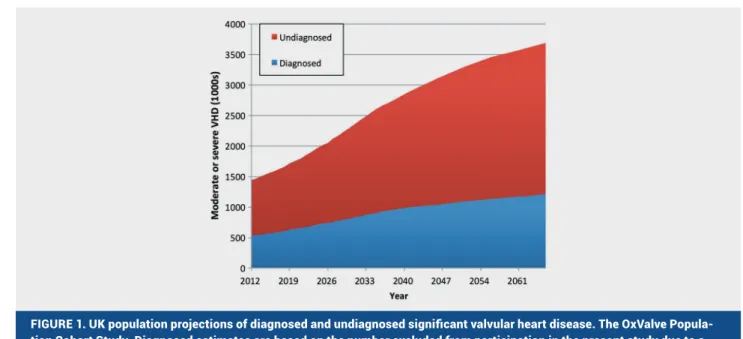
Jedna od objavljenih studija rezultat je velikoga ehokardio-grafskoga probira osoba s još nedijagnosticiranim bolestima srčanih zalistaka, a koja je uključila 2500 osoba starijih od 65 godina (Slika 1).1 Klinički bitna, no još nedijagnosticirana bolest srčanih zalistaka (umjerenoga ili teškoga stupnja) utvrđena je u 6,4 % osoba. U navedenoj kohorti 4,9 % osoba imalo je već poznatu bolest srčanih zalistaka (ukupna prevalencija 11,3 %). Prevalencija klinički bitnih bolesti srčanih zalistaka mogla bi se do 2050. godine udvostručiti. Jedinstveni podatci iz ove studije upućuju na veličinu problema rastuće epidemije bolesti srčanih zalistaka, s dalekosežnim implikacijama za liječnike i zdrav-stvene sustave. S obzirom na predominantno stariju populaciju zahvaćenu klinički bitnim bolestima srčanih zalistaka, očekuje se da će najvažniju ulogu u zbrinjavanju bolesnika imati upravo perkutani modaliteti liječenja.
Aortna stenoza
Istraživanjem procesa kalcificiranja i stvaranja stenoze aor-tnog zalistka utvrđena je povezanost stupnja/ kalcifikacije spomenutog zalistka i sadržaja željeza u njemu kao posljedice mikrokrvarenja u listiće zalistaka.2 Proliferacija i remodelacija izvanstaničnog matriksa koje uzrokuju kalcifikaciju i progresiv-no suženje aortprogresiv-nog ušća, posljedica su uprogresiv-nosa željeza u intersti-cijske stanice zalistka. Ovi rezultati ističu patofiziološku ulogu mikrokrvarenja u zalistke te se prijenosnici željeza navode kao mogući novi terapijski ciljevi usporivanja hemodinamske pro-gresije aortne stenoze.
Neke podgrupe bolesnika s aortnom stenozom zahtijevaju po-seban pristup i različite oblike liječenja.
Analiza ehokardiografske baze podataka Duke Echocardio-graphic Database utvrdila je znatnu smrtnost bolesnika s umje-renom/teškom aortnom stenozom i disfunkcijom lijeve klijetke te je utvrđena dobrobit kirurške zamjene aortnog zalistka i u bolesnika s umjerenom aortnom stenozom (srednji gradijent >25 i <40 mmHg)3. U budućnosti bi prikladna metoda zbrinjavanja
A large-scale echocardiographic screening involving 2500 individuals aged > 65 years was conducted to detect undi-agnosed VHD (Figure 1).1 Clinically significant (moderate or
severe) undiagnosed VHD was identified in 6.4%. In addition, 4.9% of the cohort had pre-existing VHD (a total prevalence of 11.3%). Projecting these findings using population data, the prevalence of clinically significant VHD is estimated to double before 2050. The unique data of this study confirm the scale of the emerging epidemic of VHD, with widespread im-plications for clinicians and healthcare resources. In this sce-nario of predominantly elderly people affected by significant VHD, percutaneous modalities of treatment are expected to play a major role.
Aortic stenosis
The mechanisms responsible for aortic valve calcification and development of aortic stenosis (AS) have been explored, and an association between valvular iron resulting from intraleaf-let haemorrhage and the degree of aortic valve calcification has been demonstrated.2 Iron uptake by valvular interstitial
cells produces proliferation and extracellular matrix remod-elling leading to calcification and progressive narrowing of the valve. These findings emphasize the pathophysiological role of valvular haemorrhages and suggest iron transporters as a novel potential therapeutic target to slow the haemody-namic progression of AS.
Some subsets of patients with AS deserve special consid-eration and may require different patterns of treatment.
An analysis of the Duke Echocardiographic Database re-vealed that in patients with moderate/severe AS and left ven-tricular dysfunction mortality was definitely substantial and aortic valve surgery was associated with a significant sur-vival benefit even in the presence of only moderate AS (mean gradient >25 and <40 mmHg).3 In this high-risk cohort
tran-scatheter aortic valve implantation (TAVI) rather than aortic
FIGURE 1. UK population projections of diagnosed and undiagnosed significant valvular heart disease. The OxValve Popula-tion Cohort Study. Diagnosed estimates are based on the number excluded from participaPopula-tion in the present study due to a prior diagnosis of valvular heart disease. Undiagnosed estimates are based on the number with newly diagnosed significant valvular heart disease in OxVALVE-PCS.
Reproduced with permission from D’Arcy JL et al.1
bolesnika u skupini visokog rizika mogla biti transkateterska implantancija aortnog zalistka (TAVI) umjesto kardiokiruške zamjene aortnog zalistka (AVR).
Asimptomatski bolesnici s teškom kombiniranom greškom aortnog zalistka moraju se kontrolirati svakih 6 mjeseci jer je dokazano kako će se u 50 % takvih bolesnika razviti simptomi i zahtijevat će zamjenu aortnog zalistka unutar jedne godine od utvrđivanja dijagnoze4. Zbog toga se u bolesnika s kombinira-nim greškama aortnog zalistka preporučuje ranije upućivanje na njegovu zamjenu.
Liječenje bolesnika s aortnom stenozom dramatično se mije-nja razvojem transkateterskih metoda zamjene aortnog zalistka te u budućnosti očekujemo nove perspektive u pristupu liječe-nju.
Transkateterska zamjena aortnog zalistka trenutačno se smatra metodom izbora za neoperabilne bolesnike te kao prefe-rirana alternativa u bolesnika s visokim rizikom.
Dugoročno praćenje bolesnika s visokim rizikom nedavno je ponovno pokazalo superiornost TAVI-ja5. Objavljena je studi-ja kostudi-ja je obuhvatila 750 bolesnika randomiziranih na TAVI sa samoekspandirajućim zalistkom (Core Valve) ili na kardiokirur-ško liječenje primjenom AVR-a. Nakon tri godine praćenja, bo-lesnici nakon TAVI-ja imali su mnogo manji ukupni mortalitet ili pojavnost moždanog udara (37,3 % prema 46,7 %; p = 0,006), uz istodobno bolje hemodinamske parametre u usporedbi s bole-snicima koji su liječeni primjenom AVR-a.
Nedavno su objavljeni podatci koji upućuju na neinferiornost TAVI-ja u usporedbi s klasičnom kirurgijom u starijih bolesnika s umjerenim rizikom.
U randomiziranome kliničkom ispitivanju PARTNER26 1011 bolesnika s umjerenim rizikom randomizirano je na TAVI (SAPI-EN XT; Edwards Life sciences), a 1021 bolesnik na kardiokirurško liječenje AVR-om. Nakon dvije godine praćenja nisu utvrđene znatne razlike u primarnom ishodu ukupne smrtnosti ili pojav-nosti moždanog udara. Kohorta bolesnika s transfemoralnim TAVI-jem imala je mnogo nižu ukupnu smrtnost ili pojavnost moždanog udara u usporedbi s klasičnim AVR-om.
U sličnoj studiji7 posljednja generacija SAPIEN3 zalistka (Edwards Life sciences) ispitivana je u 1077 bolesnika s umje-renim rizikom. Tehnikom uparivanja grupa prema sličnostima, uzimajući u obzir inherentna ograničenja metode, ishodi ove populacije uspoređeni su s ishodima bolesnika s umjerenim rizikom liječenih AVR-om u studiji PARTNER2. Nakon jedno-godišnjega praćenja bolesnika s implantiranim SAPIEN3 za-listkom ishodi su bili ovakvi: ukupni mortalitet 7,4 %, pojavnost moždanog udara 2 %, potreba za reintervencijom na aortnom zalistku 1 % i umjerena ili teška paravalvularna regurgitacija 2 %. U usporedbi s kirurškom grupom, TAVI učinjen sa SAPIEN3 zalistkom bio je superioran kirurškom zahvatu u zajedničko-me primarnom ishodu (mortalitet, moždani udar, reintervencija i umjerene ili teške paravalvularne regurgitacije) godinu dana nakon izvedenog zahvata.
Ovi podatci podupiru proširenje indikacija za TAVI na stari-je bolesnike s teškom aortnom stenozom i umstari-jerenim rizikom. Daljnje proširenje indikacije prema grupama bolesnika s niskim rizikom očekuje se nakon odgovarajućih randomiziranih kli-ničkih ispitivanja: PARTNER3 i Evolut Low Risk.
Nedavnom metaanalizom svih dosadašnjih randomiziranih kliničkih ispitivanja koja su uspoređivala sigurnost i učinko-vitost TAVI-ja s AVR-om kod različitih skupina bolesnika s
ob-valve replacement (AVR) may well be a convenient option in the future.
Asymptomatic patients with severe mixed aortic valve disease should be evaluated at least every 6 months because half of them will become symptomatic and require AVR with-in 1 year.4 Therefore, more liberal indication criteria for AVR
should be adopted in the mixed aortic valve disease popula-tion.
Following the advent of TAVI, the treatment of AS has changed dramatically, and new perspectives are expected in the future.
Transcatheter aortic valve implantation is currently con-sidered the treatment of choice for inoperable patients and the preferred alternative for high-risk patients.
The long-term superiority of TAVI in high-risk patients has been recently reemphasized.5 A total of 750 patients were
ran-domly assigned to, and underwent, TAVI with a self-expand-able device (CoreValve) or surgical AVR. After 3 years, TAVI was associated with significantly reduced all-cause mortal-ity or stroke (37.3% vs 46.7%: P = 0.006) and better aortic valve haemodynamics compared with surgery.
Recently, scientific evidence has been provided to support the idea that TAVI is non-inferior to surgery in elderly patients at intermediate-risk patients.
In the PARTNER 2 randomized trial,6 1011 intermediate-risk
patients were assigned to TAVI (SAPIEN XT; Edwards Lifes-ciences) and 1021 to surgical AVR. At 2 years no significant differences were observed between the two groups in the primary end point of all-cause mortality or stroke. Of note, in the cohort of patients who received transfemoral implanta-tion, TAVI was associated with a significantly lower rate of all-cause death or disabling stroke compared with surgical AVR.
In another study,7 the latest generation SAPIEN 3 device
(Edwards Lifesciences) was evaluated in 1077 intermediate-risk patients. Using a propensity score analysis, with the inherent limitations of this method, the outcomes in this population were compared with those observed in interme-diate-risk patients treated with surgical AVR in the PARTNER 2 trial. At 1 year follow-up, inpatients treated with the SAPIEN 3, all-cause mortality was 7.4%, the occurrence of disabling stroke 2%, aortic valve re-intervention 1%, and moderate or severe paravalvular regurgitation 2%. Comparison with the surgical group revealed that for the primary composite end-point of mortality, strokes, re-interventions and moderate or severe aortic regurgitation at 1 year, TAVI with SAPIEN 3 was superior to surgical AVR.
These findings support the extension of the clinical indica-tions of TAVI to elderly patients at intermediate risk with se-vere AS. A further extension of the indications of TAVI toward low risk patient is to be studied in a dedicated RCT: PARTNER 3 and Evolut low risk.
A recent meta-analysis of all available randomized trials comparing the safety and efficacy of TAVI vs surgical AVR across the spectrum of risk and in different subgroups reveals that TAVI was associated with a significant survival benefit throughout 2 years of follow-up (Figure 2).8 Importantly, the
superiority was observed irrespective of the TAVI device across the spectrum of intermediate and high-risk patients, and was particularly pronounced among patients undergoing transfemoral TAVI and in females.
zirom na rizik od zahvata i druge varijable zaključeno je da su bolesnici liječeni TAVI-jem imali mnogo bolje preživljenje nakon dvogodišnjega praćenja (Slika 2)8. Važno je istaknuti kako je su-periornost metode dokazana bez obzira na proizvođača zalistka i stupanj rizika. Superiornost je posebno izražena u bolesnika s TAVI-jem učinjenim transfemoralnim putem i u ženskih osoba.
Iz velikog registra bolesnika FRANCE-2 dobivene su važne informacije o dugoročnim ishodima liječenja te upućuju na sta-bilnu funkciju zalistka s vremenom i kako je kasni mortalitet većinom povezan s nekardiološkim uzrocima9. Ipak, malo je podataka o trajnosti bioloških zalistaka koji se rabe u TAVI-ju.
U 10 % transkateterskih aortnih zalistaka koji se balonski ek-spandiraju opisani su rano zadebljanje listića i smanjenje njiho-ve pokretljivosti. Nanjiho-vedene promjene nisu simptomatske, iako se povremeno opisuje povišenje transvalvularnoga gradijenta tlaka. Antikoagulacijsko liječenje dovodi do gotovo potpunog povlačenja promjena (Sika 3).10
Prediktori endokarditisa nakon TAVI-ja dobiveni su analizom drugoga velikog multicentričnog registra te je dokazano kako bolesnici s endokarditisom imaju visoku stopu ranog/unutar-bolničkog i srednjoročnog mortaliteta.11
I na kraju, ROPAC je veliki međunarodni registar Europskoga kardiološkoga društva, a uključuje trudnice s kardiovaskular-nim bolestima. Ukupni je mortalitet trudnica s umjerenom ili teškom aortnom stenozom mali. Ipak, teška aortna stenoza nosi visoki rizik od zatajivanja srca, što je u konačnici povezano s ve-likim brojem hospitalizacija i upućuje na važnost savjetovanja i praćenja bolesnica prije trudnoće.12
Important information on the long-term outcome after TAVI was reported in the large FRANCE-2 registry9 showing
that valve performance remains stable over time and late mortality is largely related to non-cardiac causes. However, information regarding the durability of bioprostheses used in TAVI is still limited.
Early leaflet thickening with reduced motion has been doc-umented in 10% of the balloon-expandable transcatheter aor-tic valves. These changes were not associated with clinical symptoms, although an increase in transvalvular pressure gradients was occasionally detected. Full anticoagulation led to almost complete resolution of the problem (Figure 3).10
A large multicentric registry identified predictors of endo-carditis after TAVI and showed that patients who developed endocarditis had high rates of in-hospital mid-term mortality.11
Finally, a large international registry initiated by the ESC: ROPAC on pregnancy in patients with cardiac disease, showed that the overall fatality rate in pregnant women with moderate or severe AS is low. However, the presence of severe symptomatic AS carries a substantial risk of heart failure and is associated with high rates of hospitalization which high-lights the importance of appropriate patient evaluation and counselling prior to conception.12
Aortic regurgitation
Aortic regurgitation (AR) can result from degeneration of a previously implanted bioprosthesis. This situation in
high-FIGURE 2. Random-effects meta-analysis of transcatheter aortic valve implantation vs. surgical aortic valve replacement for the primary outcome of death from any cause. Forest plots showing the results of meta-analysis of transcatheter aortic valve implantation vs. surgical aortic valve replacement for the primary outcome of death from any cause at 2 years of follow-up. Hazard ratio estimates according to intention-to-treat principle were retrieved from three trials (PARTNER 1A, NOTION, and PARTNER 2A); whereas one trial (US CoreValve High Risk) contributed with the estimated risk ratio by using the events provi-ded in as-treated populations. The proviprovi-ded number of events and total trial population in each arm correspond to intention-to-treat or as-treated populations, according to the available information in each trial. Boxes and horizontal lines represent the respective hazard ratio and 95% confidence interval for each trial. The vertical solid line on the plot represents the point estimate of hazard ratio = 1. The vertical dashed line on plot represents the point estimate of overall hazard ratio. The size of each box is proportional to weight of that trial result. Diamonds represent the 95% confidence interval for pooled estimates of the effect and are centred on pooled hazard ratios. Heterogeneity estimate of τ2 accompanies the summary estimate. Values of τ2 around 0.04 are considered to indicate low heterogeneity.
TAVI = transcatheter aortic valve implantation; SAVR = surgical aortic valve replacement; HR = hazard ratio; CI =confidence interval. Reproduced with permission from Siontis GC et al.8
Aortna regurgitacija
Aortna regurgitacija može biti posljedica degeneracije implanti-ranoga biološkog aortnog zalistka. Bolesnici s visokim rizikom mogu se uspješno liječiti transkateterskom implantacijom zalis-tka u zalistak. Ohrabrujuće je osmogodišnje iskustvo centra s velikim brojem zahvata u bolesnika s disfunkcijom biološkoga aortnog zalistka.13
Nakon zamjene aortnog zalistka moguća je hemodinamski znatna aortna regurgitacija zbog mlaza regurgitirajuće krvi uz sam zalistak (paravalvularna regurgitacija). Posljedice su zataji-vanje srca, hemoliza i povišeni rizik od endokarditisa. U bolesni-ka s visokim rizikom može se razmotriti perkutano zatvaranje okluderima, što poboljšava prognozu te je potencijalno povezano s manjim mortalitetom i morbiditetom u usporedbi s reoperaci-jom.14
Mitralna regurgitacija
Ponovna pojava mitralne regurgitacije (MR) analizirana je tije-kom 10 godina na velikoj skupini bolesnika upućenih na primar-ni popravak mitralnog zalistka zbog izolirane degenerativne
risk patients can be conveniently treated with transcatheter aortic valve-in-valve implantation. An encouraging 8-year single-centre experience with this procedure has been re-cently reported in a large number of patients with failed aortic bioprosthesis.13
Haemodynamically significant AR due to paravalvular leak is occasionally observed after aortic valve replacement. It can lead to heart failure and haemolysis, and may increase the risk of endocarditis. Percutaneous closure with plugs im-proves patient prognosis, is potentially associated with less mortality and morbidity than reoperation, and may be consid-ered in selected high-risk patients.14
Mitral regurgitation
A large series of patients submitted to primary mitral repair for isolated degenerative mitral regurgitation (MR) over 1 dec-ade was analysed and the effect of recurrent MR was evalu-ated.15 The 15-year incidence of recurrent moderate or greater
MR was 13.3%, and the incidence of mitral reoperation was 6.9%. Important determinants of recurrent MR were: age, mild
FIGURE 3. Hypo attenuated thickening of valve leaflets after Transcatheter valve implantation. Reconstructions of a con-trast-enhanced retrospectively electrocardiogram-gated post-transcatheter aortic valve implantation computed tomography angiography of an 80 year-old female (A and B) revealing subtle early hypo-attenuated thickening of the acoronary leaflet of an SAPIEN 3 prosthesis. Due to the clinical circumstances, the patient was only continued on single-antiplatelet therapy with aspirin. After 3-month follow-up computed tomography angiography revealed progression with up to 5 mm thickening of the non-coronary and additionally the right coronary cusp with restricted leaflet motion. The patient received a modified therapy with a combination of clopidogrel and phenprocoumon. Following further 3-month repeat computed tomography angiography showed almost complete disappearance of the hypo-attenuated thickening and resolution of leaflet rigidity.
Reproduced with permission from Pache G et al.10
MR.15 Petnaestogodišnja incidencija ponovne pojave MR-a umje-renoga ili višega stupnja bila je 13,3 %, a incidencija reoperacije 6,9 %. Važne odrednice ponovne pojave MR-a jesu dob bolesnika, blaga rezidualna intraoperacijska MR, prolaps prednjeg listića zalistka, prolaps obaju listića zalistka i izostanak anuloplastike. Ponovni razvoj MR-a umjerenoga ili višega stupnja povezan je s remodelacijom lijeve klijetke i uz povećani mortalitet.
Niz je publiciranih znanstvenih radova o sekundarnom MR-u. Sistolička funkcija lijeve klijetke (koristeći se ejekcijskom frakcijom i global longitudinal strain) procijenjena je na velikoj skupini bolesnika s neishemijskom dilatacijskom kardiomiopa-tijom, s teškom sekundarnom mitralnom regurgitacijom ili bez nje.16 Bolesnici s teškom sekundarnom MR u usporedbi s onima bez teške MR imali su, prema global longitudinal strain, lošiju intrinzičnu funkciju miokarda unatoč jednakoj ejekcijskoj frak-ciji.
Objavljeni su dvogodišnji ishodi randomiziranoga klinič-kog ispitivanja koje je u bolesnika s teškom ishemijskom MR usporedilo popravak mitralnog zalistka sa zamjenom mitralno-ga zalistka uz očuvanje cijelomitralno-ga subvalvularnog aparata.17 Nisu utvrđene bitne razlike u reverznoj remodelaciji ili preživljenju. Stopa ponovne pojave umjerene ili teške MR nakon dvije godi-ne bila je veća u skupini bolesnika koji su podvrgnuti popravku mitralnoga zalistka (58,8 % prema 3,8 % u bolesnika koji su pod-vrgnuti zamjeni mitralnoga zalistka; p < 0,001). U skladu s time, bolesnici u toj skupini imali su više ozbiljnih neželjenih događa-ja povezanih sa zatajivanjem srca (p = 0,05) i veći broj hospitali-zacija zbog kardiovaskularnih razloga (p = 0,01).
Objavljeni su i dvogodišnji ishodi drugoga randomiziranoga kliničkog ispitivanja koje je u bolesnika s umjerenom ishemij-skom MR usporedilo izolirano aortokoronarno premoštenje ili aortokoronarno premoštenje u kombinaciji s popravkom mitral-nog zalistka.18 Prosječni volumski indeks lijeve klijetke na kra-ju sistole nije se znatno razlikovao između skupina bolesnika. Mortalitet je također bio sličan (10,6 prema 10 %; p = 0,78). Kombi-nirani kirurški zahvat povezan je s boljom stopom umjerene ili teške ostatne MR (11,2 prema 32,3 %; p < 0,001), ali i višom stopom supraventrikularnih aritmija i neuroloških događaja.
Zbog starenja populacije treba očekivati daljnji porast incidencije hemodinamski značajne MR te će u skladu s time uloga transkateterskih metoda liječenja biti sve važnija. Trenu-tačno najčešće primjenjivani perkutani zahvat korekcije MR-a jest popravak od ruba do ruba listića uređajem MitraClip, u ana-tomski pogodnih bolesnika s visokim rizikom ili u inoperabil-nih bolesnika.
Petogodišnji rezultati randomiziranoga kliničkog ispitiva-nja EVEREST II upućuju na nižu stopu kombiniranoga ciljnog ishoda koji se sastoji od odsutnosti smrtnog ishoda, potrebe za kirurškim zahvatom ili pojave MR-a stupnja 3+ ili 4+ u skupini bolesnika nakon perkutanoga popravka mitralnog zalistka (44,2 %) u usporedbi sa skupinom bolesnika nakon konvencionalnoga kirurškog zahvata (64,3 %; p = 0,01).19 Razlika je između skupi-na skupi-najviše rezultat više stope pojavnosti MR-a stupnja 3+ ili 4+ i stoga potrebe za kirurškim zahvatom u skupini bolesnika nakon perkutanog zahvata. Nakon perkutanih zahvata 78 % nužnih re-operacija učinjeno je unutar prvih 6 mjeseci. Nakon prvih šest mjeseci stopa reoperacije i umjerene do teške MR ne razlikuje se među skupina. Također nema znatne razlike u petogodišnjem mortalitetu (20,8 prema 26,8 %; p = 0,4).
intraoperative residual MR, anterior leaflet prolapse, bileaflet prolapse and lack of annuloplasty. Recurrence of moderate or greater MR was associated with adverse left ventricular re-modelling and increased likelihood of death.
A number of important scientific contributions dealing with secondary MR have been published.
Left ventricular systolic function has been assessed in a large series of patients with non-ischaemic dilated cardio-myopathy, with or without severe secondary MR, using left ventricular ejection fraction and speckle tracking global lon-gitudinal strain.16 This latter methodology revealed a more
deteriorated intrinsic myocardial function in patients with severe secondary MR, compared with patients without sig-nificant MR, in spite of equivalent ejection fraction.
The 2-year outcomes of a randomized trial comparing mitral valve repair with mitral valve replacement with preservation of the whole subvalvular apparatus, in patients with severe is-chaemic MR have been reported.17 No significant difference in
left ventricular reverse remodelling or survival was observed. The rate of recurrence of moderate or severe MR at 2 years was higher in the repair group than in the replacement group (58.8% vs 3.8%, P< 0.001). As a consequence, patients in the repair group had more serious adverse events related to heart failure (P = 0.05) and more cardiovascular readmissions (P = 0.01).
The 2-year outcomes of another randomized trial compar-ing coronary artery by-pass graftcompar-ing (CABG) alone with CABG plus mitral valve repair in patients with moderate ischaemic MR have been reported.18 After 2 years, the mean left
ventric-ular end-systolic volume index was not significantly differ-ent between the two groups. Mortality was also similar (10.6% vs 10.0%, P = 0.78). Combined surgery was associated with improvement in the rate of moderate or severe residual MR (11.2% vs 32.3%, P < 0.001), but also with a higher rate of neuro-logical events and supraventricular arrhythmias.
As the population continues to age, the incidence of hemo-dynamically significant MR is expected to rise, and tran-scatheter interventions will play an expanded role. Edge to edge repair with the MitraClip device is currently by far the most commonly used percutaneous procedure to correct MR in anatomically suitable high-risk or inoperable patients.
The 5-year results of the EVEREST II randomized trial com-paring the percutaneous edge to edge repair technique with conventional surgery have been reported.19 At 5 years, the rate
of the composite endpoint of freedom from death, surgery, or 3+ or 4+ MR was 44.2% in the percutaneous repair group and 64.3% in the surgical group (P = 0.01). The difference was driven by increased rates of 3+ or 4+ MR and need for surgery in the percutaneous repair group. Following the percutane-ous procedure, 78% of surgeries occurred within the first 6 months. Beyond 6 months, rates of surgery and moderate-to-severe MR were equivalent between groups. Five-year mortal-ity was not significantly different for percutaneous repair and surgery, respectively 20.8% and 26.8% (P = 0.4).
The German transcatheter mitral valve interventions (TRAMI) registry prospectively enrolled 828 patients sub-mitted to MitraClip therapy (median age 76 years, and me-dian logistic EuroSCORE I: 20.0%). One-year outcomes, avail-able in 90.5% of the entire registry population, have been published.20 One year mortality was 20.3%. By multivariate
U njemački TRAMI registar (registar transkateterskih mi-tralnih interrvencija) prospektivno je uključeno 828 bolesnika podvrgnutih liječenju MitraClipom (medijan dobi 76 godina, medijan logističkog Euro SCORE I: 20,0 %).20 Objavljeni su jedno-godišnji ishodi bolesnika, koji su dostupni za 90,5 % uključenih bolesnika. Jednogodišnji mortalitet iznosi 20,3 %. Multivarijat-nom analizom utvrđeni su prediktori jednogodišnjeg mortali-teta: funkcijski status IV. stupanj prema NYHA, anemija, ana-mneza intervencije na aortnom zalistku, serumski kreatinin >133µmol/L, periferna arterijska bolest, ejekcijska frakcija lijeve klijetke <30 %, teška trikuspidna regurgitacija i neuspjeh samog zahvata. Kvaliteta je života znatno porasla u bolesnika nakon implantacije MitraClipa. Važno je naglasiti kako je veliki udio bolesnika kojima je zahvatom omogućeno potpuno neovisno brinuti se o vlastitim svakodnevnim potrebama.
Učinak perkutanog popravka mitralnog zalistka i njegov utje-caj na prirodni tijek bolesti jako ovisi o stupnju akutne redukcije MR-a. Rezidualni MR stupnja 2+ neposredno nakon perkutanog zahvata MitraClipom ima nepovoljnije ishode (lošije preživlje-nje, slabije olakšanje simptoma i ponovna pojava MR-a) u uspo-redbi s rezidualnim MR-om stupnja 1+ ili manjeg.21
Postavlja se pitanje trajnosti učinka perkutanog zahvata Mi-traClipom s obzirom na nemogućnost istodobne anuloplastike. Nadalje, neki bolesnici upravo zbog preizražene dilatacije anulu-sa nisu kandidati za MitraClip. U odabranih bolesnika izolirana anuloplastika može potpuno eliminirati ili barem znatno sma-njiti MR. S obzirom na navedeno, pouzdani perkutani sustav za anuloplastiku definitivno bi proširio mogućnosti transkateter-skih intervencija na mitralnom zalistku.
Objavljeni su rani rezultati izravnog i prilagodljivog sustava za anuloplastiku pod nazivom Cardioband, i to u 31 bolesnika s umjerenom do teškom ili teškom sekundarnom MR.22 Nakon postavljanja sustava Cardioband (uspješno u 29 od 31 bolesnika), 6 bolesnika (21 %) nije više imalo MR ili je on bio samo u tragu, blagi MR registriran je u 21 (72 %), dok su dva bolesnika imala umjereni MR (7 %). Sam zahvat nije imao fatalnih komplikacija, a dva su bolesnika umrla prije otpusta iz bolnice (smrtni ishodi nisu bili povezani sa zahvatom ili samim uređajem).
Mitralign je sustav za izravnu perkutanu anuloplastiku koji je ispitan u 71 bolesnika s visokim rizikom uz umjereni do teški sekundarni MR.23 Zahvat se doima izvedivim i sigurnim te su utvrđeni reverzna remodelacija i znatno kliničko poboljšanje ti-jekom šestomjesečnoga praćenja.
Transkateterska zamjena mitralnog zalistka u bolestima na-tivnih mitralnih zalistaka jest područje velikog interesa u kardi-ologiji te se brzo postiže znatan napredak.
Ohrabrujuća su rana klinička iskustva s različitim uređajima i sustavima te u skorijoj budućnosti očekujemo objavljivanje konzistentnih rezultata iz većih kliničkih serija.. Primjena ra-zličitih slikovnih metoda jedan je od ključnih koraka u odabiru i pripremi bolesnika za prije spomenute zahvate.24
Mitralna stenoza
Prema rezultatima velikih serija bolesnika operiranih zbog ste-noze mitralnoga zalistka, nalaz prijeoperacijske plućne hiper-tenzije povezan je s lošim dugoročnim ishodima.25
Desetogodišnje preživljenje nakon kirurškog liječenja mitral-ne valvule mnogo je niže u skupini bolesnika s umjerenom do teškom plućnom hipertenzijom u usporedbi s bolesnicima bez plućne hipertenzije (58 prema 83 %; p = 0,001). Prema navedenom,
class IV, anaemia, previous aortic valve intervention, serum creatinine >1.5 mg/dL, peripheral artery disease, left ventricu-lar ejection fraction <30%, severe tricuspid regurgitation and procedural failure. Quality of life improved remarkably after MitraClip implantation. Importantly, a significant proportion of patients regained complete independence in self-care.
The efficacy of percutaneous edge to edge repair, as well as its impact on the natural history, is strongly dependent on the acute reduction of MR. Residual 2+ MR immediately after MitraClip implantation is associated with more unfavourable outcomes (survival, symptom relief, and recurrence of MR) during follow-up compared with residual 1+ or less MR.21
The absence of mitral valve annuloplasty is a concern re-garding the durability of MitraClip treatment. Furthermore, some patients are not eligible for MitraClip therapy due to ex-cessive annular dilatation. In well-selected patients, annulo-plasty alone can completely eliminate or at least remarkably reduce MR. Therefore, the introduction of a reliable annulo-plasty device into the percutaneous armamentarium of mi-tral valve repair definitely offers new perspectives in the field of transcatheter mitral interventions.
Early results obtained with the Cardioband system, a direct, adjustable annuloplasty device, in 31 high-risk patients with moderate-to-severe or severe secondary MR have been re-ported.22 Following Cardioband adjustment (29 of 31 patients),
MR was none or trace in six patients (21%), mild in 21 (72%), and moderate in 2 (7%). Procedural mortality was zero and in-hospital death (neither procedure nor device-related) oc-curred in two patients.
Another method of direct percutaneous annuloplasty, per-formed with the Mitralign system, has been investigated in 71 high-risk patients with moderate to severe secondary MR.23
The procedure appeared to be feasible and safe.
In addition, left ventricular reverse remodelling and signifi-cant clinical improvement have been documented during a 6-month follow-up.
Transcatheter mitral valve replacement in native mitral valve disease represents a rapidly moving field of great inter-est for the cardiological community.
Encouraging early clinical experiences with different devices are presently ongoing worldwide, and results in consistent clini-cal series are expected to be published in the near future. The importance of multimodality imaging will also be a key factor for the selection of patients and planning of the procedure.24
Mitral stenosis
Pre-operative pulmonary hypertension has been shown to af-fect the long-term outcome in a large series of patients oper-ated on for mitral stenosis (MS).25
Ten-year survival after mitral valve surgery was signifi-cantly lower in the moderate-severe pulmonary hypertension group, compared with the normal pulmonary artery pressure-mild pulmonary hypertension group (58% vs 83%; P = 0.001). Ac-cording to this finding, patients with MS and mild pulmonary hypertension should be considered for mitral valve surgery.
A multicentre retrospective review of clinical outcomes of 64 patients with MS and severe mitral annular calcification sub-mitted to transcatheter mitral valve replacement using
balloon-svakog bolesnika s mitralnom stenozom i blagom plućnom hi-pertenzijom potrebno je razmotriti radi kirurškog liječenja.
Objavljen je multicentrični retrospektivni pregled kliničkih ishoda 64 bolesnika s mitralnom stenozom i teško kalcificira-nim mitralkalcificira-nim prstenom u kojih je izvedena transkateterska zamjena mitralnoga zalistka uporabom zalistaka koji se šire balonom, a inače se rabe u TAVI zahvatima.26Transatrijski je pri-stup je primijenjen u 15,6 % bolesnika, transapikalni u 43,8 % i transseptalni u 40,6 %.
Ova, preliminarna iskustva upućuju na znatan broj neželje-nih događaja s ukupnim 30-dnevnim mortalitetom od 29,7 %. Ovakvim terapijskim pristupom potrebno je koristiti se samo u vrlo pomno odabranih bolesnika s vrlo izraženim simptomima, a bez drugih, preostalih opcija u liječenju.
Trikuspidna regurgitacija
Prema europskim i američkim smjernicama za liječenje bolesti srčanih zalistaka, bolesnike s trikuspidnom regurgitacijom (TR) potrebno je rano liječiti kako bi se spriječio nastanak desnostra-nog popuštanja srca.
U bolesnika koji su podvrgnuti popravku mitralnog zalistka, a imaju umjerenu TR ili dilataciju trikuspidnog anulusa, konkomi-tantna trikuspidna anuloplastika pridonosi dugoročnoj desno-stranoj remodelaciji te je siguran i učinkovit zahvat.27
Trikuspidna anuloplastika izvodi se postavljanjem šavova ili prstena. Prednost jedne metode u usporedbi s drugom je kon-troverzna. Nema razlike u preživljenju bolesnika, kasnijemu funkcijskom statusu, progresiji TR-a ili reoperaciji trikuspidnog zalistka između spomenutih dviju metode na temelju nedavno-ga retrospektivnog ispitivanja.28Obje tehnike pokazuju dobre rezultate. Anuloplastika postavljanjem šavova brža je i jeftinija metoda.
Kirurški je rizik visok u bolesnika s izoliranom teškom tri-kuspidnom regurgitacijom u kontekstu desnostranog popušta-nja srca ili ako se razvije kasno nakon lijevostranoga kirurškog zahvata. U takvim slučajevima postoji sve veća potreba za per-kutanim terapijskim opcijama popravka TV-a ili barem smanje-nja stupsmanje-nja TR-a. Iako su rezultati novih zahvata preliminarni, važni su dosadašnji doprinosi razvoju metode.
TriCinch uređaj služi za transfemoralno učvršćivanje vijka u trikuspidni anulus u području anteroposteriorne komisure. Na-kon postavljanja samoekspandirajućeg nitinol stenta u donju šuplju venu on se poveže s prije postavljenim vijkom i na taj se način „povlači“ anulus, što dovodi do smanjenja anteroposterior-nog promjera uz bolju koaptaciju zalistka.29
U perkutanom liječenju bolesnika s TR-om može se rabiti i MitraClip.30
FORMA System još je jedan od uređaja za smanjenje stupnja TR-a. Riječ je o posebnom balonu koji se postavi u trikuspidno ušće i na taj način stvara podlogu za koaptaciju nativnih listića trikuspidnog zalistka.31
Izvodljivost i sigurnost spomenutih zahvata već je utvrđena, no još uvijek nedostaje kliničkog iskustva te su potrebni dodatni podatci iz kliničkih ispitivanja.
Općenito gledano, tijekom prošle godine mnogo je novosti u domeni bolesti srčanih zalistaka te se očekuje njihovo uvrštenje u nadolazeće smjernice ESC/EACTS koje bi trebale biti objavlje-ne iduće godiobjavlje-ne.
expandable TAVI valves was performed.26 Access was
transa-trial in 15.6%, transapical in 43.8% and transseptal in 40.6%. In this preliminary experience, the procedure was associ-ated with significant adverse events, and 30-day all-cause mortality was 29.7%. Obviously, only very symptomatic pa-tients with limited therapeutic options should be considered for this modality of treatment at this stage.
Tricuspid regurgitation
Following the recommendations of the European and Ameri-can Guidelines for the management of VHD, tricuspid regurgi-tation (TR) should be addressed early in the disease process to prevent the development of right-sided heart failure.
A recent study showed that in patients with moderate TR or tricuspid annular dilatation undergoing mitral valve repair, concomitant tricuspid annuloplasty was safe, effective and as-sociated with improved long-term right-sided remodelling.27
Tricuspid annuloplasty can either be carried out with su-turing techniques or with the implantation of prosthetic rings. Controversy remains regarding the effectiveness of one method compared with the other. No difference in patient survival, late functional status, progression of TR or tricuspid valve reoperations has been found in a recent retrospective study comparing patients treated with suture annuloplasty and those submitted to ring annuloplasty.28 Both techniques
have been shown to yield good results. Suture annuloplasty can be performed easily and rapidly with a lower cost com-pared with ring annuloplasty which requires a commercially available prosthetic device.
When isolated severe TR occurs in a context of right heart failure or develops late following left-sided valve surgery, the surgical risk is generally high. In these settings percutaneous therapeutic options to correct or at least reduce TR are badly needed. Although the clinical experiences with new proce-dures and devices are quite preliminary, some important at-tempts and contributions in this field have to be recognized.
The TriCinch device allows transfemoral fixation of a cork-screw in the annulus of the tricuspid valve in proximity to the antero-posterior commissure. Following deployment of a self-expandable nitinol stent in the inferior vena cava, appropriate traction is exerted and the antero-posterior diameter of the valve is reduced with improvement of leaflet coaptation.29
Tricuspid regurgitation can also be treated with edge-to-edge repair using the MitraClip system.30
Another device used to reduce TR is the FORMA System, which is a valve spacer/occluder positioned within the tricus-pid orifice, creating a platform for native leaflet coaptation to reduce the regurgitant jet.31
Feasibility and safety of these procedures have been dem-onstrated, but the experience is limited and more data are necessary to assess their efficacy.
In total there was a lot of new evidence in the domain of VHD during the past year and it is expected that it will be in-corporated into the upcoming ESC/EACTS on VHD to be pub-lished next year.
CONFLICT OF INTEREST: Prof. Alfieri has no conflicts of interest to declare. Prof. Vahanian declares the following conflict of interest — Con-sultancy for Edwards Lifesciences, Abbott Vascular and Valtech Cardio.
LITERATURE
1. d’Arcy JL, Coffey S, Loudon MA, Kennedy A, Pearson-Stuttard J, Birks J, et al. Large-scale community echocardiographic screening reveals a major burden of undiagnosed valvular heart disease in older people: the OxVALVE Population Cohort Study. Eur Heart J. 2016;37:3515-3522. https://doi.org/10.1093/eurheartj/ehw229
2. Laguna-Fernandez A, Carracedo M, Jeanson G, Nagy E, Eriksson P, Caligiuri G, et al. Iron alters valvular interstitial cell function and is associated with calcification in aortic stenosis. Eur Heart J. 2016;37:3532-3535. https://doi.org/10.1093/eurheartj/ehw122
3. Samad Z, Vora AN, Dunning A, Schulte PJ, Shaw LK, Al-Enezi F, et al. Aortic valve surgery and survival in patients with moderate or severeaortic stenosis and left ventricular dysfunc-tion. Eur Heart J. 2016;37:2276-2286. https://doi.org/10.1093/eurheartj/ehv701
4. Egbe AC, Poterucha JT, Warnes CA. Mixed aortic valve disease: midterm outcomeand predictors of adverse events. Eur Heart J. 2016;37:2671-2678.
https://doi.org/10.1093/eurheartj/ehw079
5. Deeb GM, Reardon MJ, Chetcuti S, Patel HJ, Grossman PM, Yakubov SJ, et al CoreValve US Clinical Investigators. 3-year outcomes in high-risk patients who underwent surgical or transcatheter aortic valve replacement. J Am Coll Cardiol. 2016;67:2565-2574. https://doi.org/10.1016/j.jacc.2016.03.506
6. Leon MB, Smith CR, Mack MJ, Makkar RR, Svensson LG, Kodali SK, et al; PARTNER 2 Investigators. Transcatheter or Surgical Aortic- Valve Replacement in Intermediate-Risk Patients. N Engl J Med. 2016;374:1609-1620. https://doi.org/10.1056/NEJMoa1514616
7. Thourani VH, Kodali S, Makkar RR, Herrmann HC, Williams M, Babaliaros V, et al. Transcatheter aortic valve replacement versus surgical valve replacement in intermediate-risk patients: a propensity score analysis. Lancet. 2016;387:2218-2225. https://doi.org/10.1016/S0140-6736(16)30073-3
8. Siontis GC, Praz F, Pilgrim T, Mavridis D, Verma S, Salanti G, et al. Transcatheter aortic valve implantation vs. surgical aortic valve replacement for treatment of severe aortic stenosis: a meta-analysis of randomized trials. Eur Heart J. 2016;37:3503-3512. https://doi.org/10.1093/eurheartj/ehw225
9. Gilard M, Eltchaninoff H, Donzeau-Gouge P, Chevreul K, Fajadet J, Leprince P, et al; FRANCE 2 Investigators. Late outcomes of transcatheter aortic valve replacement in high-risk patients: the FRANCE-2 Registry. J Am Coll Cardiol. 2016;68:1637-1647. https://doi.org/10.1016/j.jacc.2016.07.747
10. Pache G, Schoechlin S, Blanke P, Dorfs S, Jander N, Arepalli CD, et al. Early hypo-attenuated leaflet thickening in balloon-expandable transcatheter aortic heart valves. Eur Heart J. 2016;37:2263-2271. https://doi.org/10.1093/eurheartj/ehv526
11. Regueiro A, Linke A, Latib A, Ihlemann N, Urena M, Walther T, et al. Association Between Transcatheter Aortic Valve Replacement and Subsequent Infective Endocarditis and In-Hospital Death. JAMA. 2016;316:1083-1092. https://doi.org/10.1001/jama.2016.12347
12. Orwat S, Diller GP, van Hagen IM, Schmidt R, Tobler D, Greutmann M, et al; ROPAC Investigators. Risk of pregnancy in moderate and severe aortic stenosis: from the multinational ROPAC Registry. J Am Coll Cardiol. 2016;68:1727-1737. https://doi.org/10.1016/j.jacc.2016.07.750
13. Ye J, Cheung A, Yamashita M, Wood D, Peng D, Gao M, et al. Transcatheter aortic and mitral valve-in-valve implantation for failed surgical bioprosthetic valves: an 8-year single-center experience. JACC Cardiovasc Interv. 2015;8:1735-1744. https://doi.org/10.1016/j.jcin.2015.08.012
14. Nietlispach F, Maisano F, Sorajja P, Leon MB, Rihal C, Feldman T. Percutaneous paravalvular leak closure: chasing the chameleon. Eur Heart J. 2016;37:3495-3502.
https://doi.org/10.1093/eurheartj/ehw165
15. Suri RM, Clavel MA, Schaff HV, Michelena HI, Huebner M, Nishimura RA, et al. Effect of recurrent mitral regurgitation following degenerative mitral valve repair: long-term analysis of competing outcomes. J Am Coll Cardiol. 2016;67:488-498. https://doi.org/10.1016/j.jacc.2015.10.098
16. Kamperidis V, Marsan NA, Delgado V, Bax JJ. Left ventricular systolic function assessment in secondary mitral regurgitation: left ventricular ejection fraction vs. speckle tracking global longitudinal strain. Eur Heart J. 2016;37:811-816. https://doi.org/10.1093/eurheartj/ehv680
17. Goldstein D, Moskowitz AJ, Gelijns AC, Ailawadi G, Parides MK, Perrault LP, et al; CTSN. Two-year outcomes of surgical treatment of severe ischemic mitral regurgitation. N Engl J Med. 2016;374:344-353. https://doi.org/10.1056/NEJMoa1512913
18. Michler RE, Smith PK, Parides MK, Ailawadi G, Thourani V, Moskowitz AJ, et al; CTSN. Two-year outcomes of surgical treatment of moderate ischemic mitral regurgitation. N Engl J Med. 2016;374:1932-1941. https://doi.org/10.1056/NEJMoa1602003
19. Feldman T, Kar S, Elmariah S, Smart SC, Trento A, Siegel RJ, et al; EVEREST II Investigators. Randomized comparison of percutaneous repair and surgery for mitral regurgitation: 5-year results of EVEREST II. J Am Coll Cardiol. 2015;66:2844-2854. https://doi.org/10.1016/j.jacc.2015.10.018
20. Puls M, Lubos E, Boekstegers P, von Bardeleben RS, Ouarrak T, Butter C, et al. One-year outcomes and predictors of mortality after MitraClip therapy in contemporary clinical practice: results from the German transcatheter mitral valve interventions registry. Eur Heart J. 2016;37:703-712. https://doi.org/10.1093/eurheartj/ehv627
21. Buzzatti N, De Bonis M, Denti P, Barili F, Schiavi D, Di Giannuario G, et al. What is a “good” result after transcatheter mitral repair? Impact of 2+ residual mitral regurgitation. J Thorac Cardiovasc Surg. 2016;151:88-96. https://doi.org/10.1016/j.jtcvs.2015.09.099
22. Maisano F, Taramasso M, Nickenig G, Hammerstingl C, Vahanian A, Messika-Zeitoun D, et al. Cardioband, a transcatheter surgical-like direct mitral valve annuloplasty system: early results of the feasibility trial. Eur Heart J. 2016;37:817-825. https://doi.org/10.1093/eurheartj/ehv603
23. Nickenig G, Schueler R, Dager A, Martinez Clark P, Abizaid A, Siminiak T, et al. Treatment of chronic functional mitral valve regurgitation with a percutaneous annuloplasty system. J Am Coll Cardiol. 2016;67:2927-2936. https://doi.org/10.1016/j.jacc.2016.03.591
24. Thériault-Lauzier P, Dorfmeister M, Mylotte D, Andalib A, Spaziano M, Blanke P, Martucci G, Lange R, Leipsic J, Bilodeau L, Piazza N. Quantitative multi-slice computed tomography as-sessment of the mitral valvular complex for transcatheter mitral valve interventions part 2: geometrical measurements in patients with functional mitral regurgitation. EuroInterven-tion. 2016;12:e1021-e1030. https://doi.org/10.4244/EIJY15M11_10
25. Yang B, DeBenedictus C, Watt T, Farley S, Salita A, Hornsby W, et al. The impact of concomitant pulmonary hypertension on early and late outcomes following surgery for mitral stenosis. J Thorac Cardiovasc Surg. 2016;152:394-400.e1. https://doi.org/10.1016/j.jtcvs.2016.02.038
26. Guerrero M, Dvir D, Himbert D, Urena M, Eleid M, Wang DD, et al. Transcatheter mitral valve replacement in native mitral valve disease with severe mitral annular calcification: results from the first multicenter global registry. JACC Cardiovasc Interv. 2016;9:1361-1371. https://doi.org/10.1016/j.jcin.2016.04.022
27. Chikwe J, Itagaki S, Anyanwu A, Adams DH. Impact of concomitant tricuspid annuloplasty on tricuspid regurgitation, right ventricular function, and pulmonary artery hypertension after repair of mitral valve prolapse. J Am Coll Cardiol. 2015;65:1931-1938. https://doi.org/10.1016/j.jacc.2015.01.059
28. Shinn SH, Dayan V, Schaff HV, Dearani JA, Joyce LD, Lahr B, et al. Outcomes of ring versus suture annuloplasty for tricuspid valve repair in patients undergoing mitral valve surgery. J Thorac Cardiovasc Surg. 2016;152:406-415.e3. https://doi.org/10.1016/j.jtcvs.2016.04.068
29. Latib A, Agricola E, Pozzoli A, Denti P, Taramasso M, Spagnolo P, et al. First-in-man implantation of a tricuspid annular remodeling device for functional tricuspid regurgitation. JACC Cardiovasc Interv. 2015;8:e211-e214. https://doi.org/10.1016/j.jcin.2015.06.028
30. Hammerstingl C, Schueler R, Malasa M, Werner N, Nickenig G. Transcatheter treatment of severe tricuspid regurgitation with the MitraClip system. Eur Heart J. 2016;37:849-853.
https://doi.org/10.1093/eurheartj/ehv710
31. Campelo-Parada F, Perlman G, Philippon F, Ye J, Thompson C, Bédard E, et al. First-in-man experience of a novel transcatheter repair system for treating severe tricuspid regurgita-tion. J Am Coll Cardiol. 2015;66:2475-2483. https://doi.org/10.1016/j.jacc.2015.09.068