This report highlights the main indings of a benchmarking exercise to rate the standing of U.S. chemical research relative to other regions or countries, key factors that inluence U.S. perfor-mance in chemical research, and near- and longer-term projections of research leadership.
C
hemistry plays a key role in conquering diseases, solving energy problems, address-ing environmental problems, providaddress-ing the discoveries that lead to new industries, and developing new materials and technologies for national defense and homeland security. However, the ield is currently facing a crucial time of change and is struggling to position itself to meet the needs of the future as it expands beyond its traditional core toward areas related to biology, materials science, and nanotechnology. Additionally, there has been growing concern by the Presi-dent, Congress, and American public about U.S. competitiveness and the ability to lead the world in innovation and job creation. At the request of the National Science Foundation and the U.S. Department of Energy, the National Research Council conducted an in-depth benchmarking analysis to gauge the current standing of the U.S. chemistry ield in the world. This report highlights the main indings of the benchmarking exercise.Today, chemistry research in the United States is stronger than in any other single country, but competition from Europe and Asia is rapidly increasing.
In 2003, the United States published about 19 percent of the world’s chemistry papers, down from 23 percent in 1988. Although the United States published a larger percentage of any single nation, it is about four percent less than all of Western Europe. Although U.S. chemists have been publishing at a steady rate of about 15,000 chemistry papers per year, chemists from other nations are increasing their rate of publication.
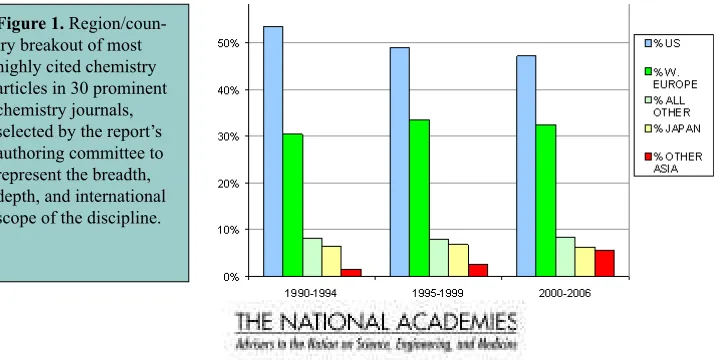
More importantly, U.S. chemists lead in the quality of their publications, with about 50% of total citations in 30 prominent chemistry journals over the last 16 years as shown in Figure 1. When all of the journals indexed in the ISI Essential Science Indicators between January 1996 and November 2006 are considered, U.S. chemistry citations account for 28 percent of total citations compared to the next two ranked countries of Japan and Germany, both with 9 percent. The United States also leads in the number of citations per paper. In addition, U.S. chemists are the most proliic authors in high-proile journals such as Science and Nature. U.S. chemists contributed to
The Future of U.S. Chemistry Research:
Benchmarks and Challenges
This brief was prepared by the National Research Council based on a report by the Committee on Benchmarking the Research Competitiveness of the United States in Chemistry. The report was sponsored by the National Science Foundation ahd the U.S. Department of Energy. For more information, contact the Board on Chemical Sciences and Technology at (202) 334-2156 or visit http://dels.nas.edu/bcst. Copies of The Future of U.S. Chemistry Research: Benchmarks and Challenges are available from the National Academies Press, 500 Fifth Street, NW, Washington, D.C. 20001; (800) 624-6242; www.nap.edu.
50 percent of the 100 most frequently cited chemistry papers, while Western Europe contributed 41 percent. Finally, 50 percent of the world’s most frequently cited chemists are from the United States.
In a further effort to characterize chemistry leader-ship, experts from the United States and abroad were asked to identify the “best of the best” in chemistry who they would invite to an international conference. The national makeup of these “virtual congresses” provides another indicator of U.S. leadership in chemistry by the strong predominance of U.S. speakers (ranging from about 40 to 70 percent for the different areas of chemis -try) selected for virtual world congresses. U.S. chemistry is particularly strong in emerging cross-disciplinary areas such as nanochemistry, biological chemistry, and materi-als chemistry.
Chemistry research in the United States is projected to remain stronger in the next decade than in any other single country, but competition is increasing.
In the near future, U.S. chemistry is projected to be the leader or among world leaders in all areas, but not in all subareas. For example, virtual congress data showed that the United States has a very strong, perhaps even dominant, position in nanocrystal and cluster science, but revealed strong competition in self-assembly science from Europe, Israel, and Japan. Because of the advance of chemistry in other nations, competition is increasing and the lead of U.S. chemistry will shrink. There will be increasing competition from European competitors such as the European Union, Japan, and other Asian countries, particularly China and India. Also, U.S. leadership in chemistry publications will continue to diminish. As U.S. publication rates remain steady, the number and quality of papers from other countries are increasing.
Key Determinants of Chemistry Leadership
U.S. research leadership in chemistry is attribut-able to a combination of factors. They include the wide range of funding sources supporting academic chemistry research (including industry, multiple federal agencies, state initiatives, universities, and private foundations), a scientiic culture with strong professional societies, cross-sector collaborations and international partnerships, early independence of investigators, and mobility across
academic institutions, major centers and facilities that pro-vide research infrastructure, and a steady supply of Ph.D. chemistry graduates, many of them foreign-born.
U.S. chemistry will be particularly strong in emerging areas.
Areas such as nanoscience, biological chemistry, and materials chemistry continue to attract new fund-ing initiatives. Even in these areas, the U.S. leadership position may erode due to growing competition. At the same time, the growth in applications-oriented research has been accompanied by a decrease in funding for basic research in some fundamental core areas like physical, inorganic, and organic chemistry.
U.S. chemistry leadership will diminish in core areas. Fundamental aspects of core research areas, such as in physical chemistry and organic chemistry, are likely to continue to struggle for research support. Japan and Europe maintain more balanced support between core and emerging areas of chemistry. In some core subareas, such as main group chemistry and nuclear and radio-chemistry, the U.S. position has already diminished based on publication and citation rates and the virtual congress results.
The sustainability of the supply of U.S. chemists may be in jeopardy.
It is likely that the number of U.S. citizens receiving chemistry Ph.D.s will continue to decrease. At the same time, U.S. chemistry may ind it increasingly dificult to attract and retain outstanding international graduate students and postdoctoral research associates as chemistry and other opportunities in other nations improve.
U.S. funding of chemistry research and infrastructure will remain under stress.
U.S. funding of chemistry is projected to continue to barely keep up with inlation and to be concentrated in emerging and interdisciplinary areas. Core research areas of chemistry, which underlie advances in the emerging areas of science, will not be as well funded. Support for a diverse range of facilities to support leading-edge research in chemistry will be equally stretched thin.
Permission granted to reproduce this document with no additions or deletions.