Application of Electrochemistry in Sensor and Separation
Suyanta*)
1) and Indah W
1)
*)[email protected]
1
)Universitas Negeri Yogyakarta
The fabrication of electrochemical sensor and the use of swimming pool water treatment were investigated in this study. Electrochemical sensor was successfully performed for determination of La3+ ion using voltammetry method and Cl− ion using potentiometry method. The modified CPE with
MBTH was evaluated for the determination of voltammetric measurement of La3+ ion in monazite
sand samples. The modified CPE with MBTH achieved a good linear operation in the examined concentration range of 1.0 pM ̶ 70.0 pM La3+ with a detection limit of 1.0 pM. Meanwhile, the
chloride ISE exhibited a good analytical performance in measurement of Cl− ion with a linear range that spans from 10 µM to 0.1M and detection limit of 1.23 µM. This study also developed the alternative swimming pool water treatment using electrocoagulation (EC) process. The effect of operating conditions such as electric current, time, and total dissolved solid (TDS) were investigated. The EC process using aluminium and graphite electrodes was carried out to accumulate the pollutants from swimming pool water. The optimum EC process on time and voltage was found to be 24 hours and 10 volt. Removal efficiency of pollutant expressed as final pH 6.8 and TDS 230 ppm.
Keywords: electrochemical sensor, electrocoagulation, swimming pool, water treatment
1. Introduction
Electrochemical methods have been attracted enormous interest over the past decades. More specifically, electrochemical sensor and electrochemical water treatment specifically play a crucial role in clinical analysis, environmental, and industrial monitoring. Among chemical sensors, electrochemical sensors have already proven to be powerful analytical device [1-3]. They possess high sensitivity, high selectivity and low detection limit. Moreover, they have been used to sense numerous small molecules including heavy metal ions, biomolecules, and other analytes.
organic ligand contained N- and S-based complexing center which can coordinate selectively with transition and heavy metal [9]. Therefore, we was developed an effective, simple, and sensitive differential adsorptive stripping voltammetry for the determination of La(III) using modified CPE.
The need of chloride ion determination in environmental monitoring has led to a number of analytical measurements. Many conventional methods, such as volumetric and coulometric titrimetry are used to determine chloride ion. However, they are time consuming and require the use of reagents [10]. Numerous studies of potentiometric sensors, especially ion selective electrodes (ISEs) have been reported in many designs and constructions. They have simplicity, short analysis time, and good analytical performance. Therefore, a solid membrane electrode Ag/AgCl coated wire and composite system were developed to determine chloride ion in water samples [11].
In recent years, electrochemical technology has been applied in the treatment of water and wastewater. Due to its environmental compatibility, high removal efficiency, and potential cost effectiveness, electrochemical technology such as electrocoagulation, electrodeposition, electrooxidation, electrodisinfection, electrofenton, electroflotation, and electrosorption has attracted great attention. Among those technology, electrocoagulation has a great potential in the treatment of dringking water, waste water, swimming pool, and industrial water. Electrocoagulation has been successfully used to eliminate a variety of pollutants in wastewater [12-14], tannery water [15], and drinking water [16-18]. In electrocoagulation, various pollutants are removed by coagulant and hydrogen from sacrificial of anode and cathode [19]. Hence, we reported the application of electrochemistry methods in electrochemical sensor and separation in swimming pool water treatment using electrocoagulation process.
2. Electrochemical Sensor for Determination of Lanthanum
Figure 1. Differential adsorptive stripping voltammograms of unmodified CPE and modified CPE with MBTH towards 1.0 × 10⁻¹¹ M La(III) in the presence of 0.5 M KCl, at pH of 7.32 and scan rate 50 mVs-1.
We could find that the current response of modified CPE larger than that of unmodified CPE obviously. This may because the formation of complexation between La3+ and MBTH ligand made mass transfer and electronic transmission possible.
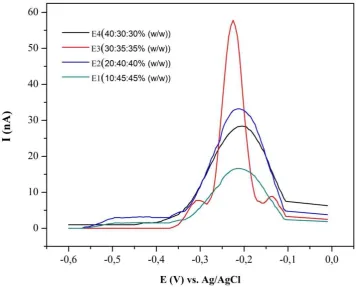
The optimum experimental conditions such as electrode composition and pH were investigated by differential adsorptive stripping measurement of 1.0 × 10⁻¹¹ M La3+ at various conditions. The amount of MBTH ligand in carbon paste had a significant influence on sensitivity of the electrode. The maximum anodic peak current was obtained with 30% (w/w) of MBTH in the carbon paste with a well defined peak current (E3) as shown in Figure 2. The decrease in anodic current was observed when the amount of MBTH was higher than 30%. This was presumably due to the reduction of conductive area at the electrode surface. The subsequent experiments were conducted at pH 7.32 and scan rate 50 mVs-1.
Figure 2. Differential adsorptive stripping voltammograms obtained using four different composition of modified CPE with MBTH in 1.0 × 10⁻¹¹ M La(III), 0.5 M KCl, at pH of 7.32 and scan rate 50 mV s-1.
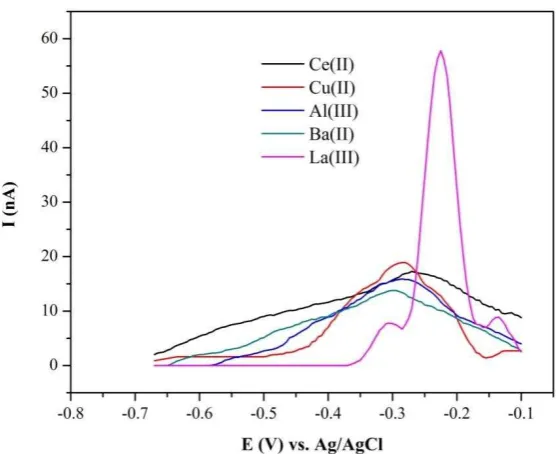
good selectivity for La3+ over other metal ions such as Ba2+, Al3+, Ce2+, and Cu2+, as shown in Figure 4.
Figure 3. Adsorptive stripping voltammogram and calibration curve for La3+ on modified CPE with MBTH.
Figure 4. Influence of the presence of interfering ions on determination of La3+ by adsorptive stripping voltammetry. The measurements were performed in 0.5 M KCl, pH 7,32, scan rate 50 mV s-1
under the optimal conditions. Table 1 shows that the results obtained by the proposed sensor and that of ICP-OES. The quantity of La(III) in the sand samples by the proposed agreed well with those found by ICP-OES. Therefore, this proposed method could be sufficient for determination of La(III) in real samples.
Table 1. Determination of La(III) ion in sand samples using developed electrode and ICP-OES.
Method
Samples
Sample 1 Sample 2 Sample 3
Proposed method (ppm) 1.06 1.27 1.47
ICP-OES (ppm) 1.43 1.52 1.88
3. Electrochemical Sensor for Determination of Chloride
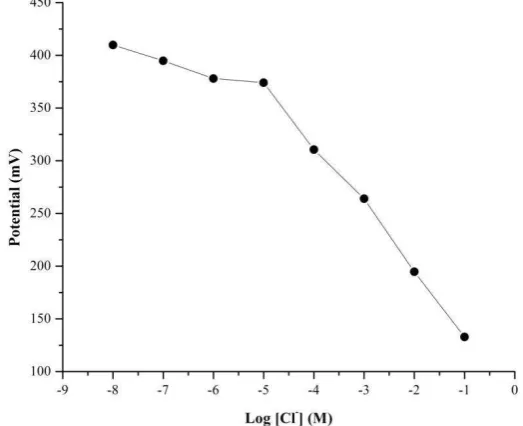
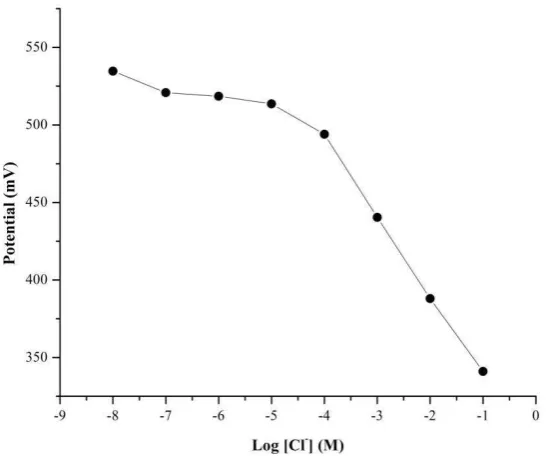
The ion selective electrode (ISE) to detect chloride was prepared based Ag/AgCl electrode with coated wire and composite system. As previously reported [11], the potential responses of electrodes were measured and the results are shown in Figure 5. The coated wire chloride ISE exhibited a linear potential response over concentration range from 10 µM to 0.1 M with a slope of 59.83 mV/decade and detection limit of 12.3 µM. Meanwhile, the composite chloride ISE obtained linear range of 100 µM to 0.1 M with a slope of 51.14 mV/decade and detection limit of 51.3 µM (Figure 6).
Figure 6. Potential response of composite system chloride ISE to various concentration of chloride ion
The potential response of the electrode was monitored in the presence of interfering ions to assess the chloride ISE’s selectivity. From the results showed in Table 1 and 2, it can be seen that the proposed electrode is characterized by a high selectivity towards Cl− with respect to Br− ion and I− ion.
Table 2. Selectivity coefficient of the coated wire chloride ISE of Br− ion and I− ion
C (M) � , �Iˉ � , � Brˉ
10-1 1.09 × 10⁻⁶ 3.05 × 10⁻³
10-2 1.03 × 10⁻⁶ 3.19 × 10⁻³
10-3 1.75 × 10⁻⁶ 6.72 × 10⁻³
10-4 2.09 × 10⁻³ 0.36 × 10⁻³
10-5 2.33 × 10⁻³ 3.09 × 10⁻³
Table 3. Selectivity coefficient of the composite system chloride ISE for of Br− ion and I− ion
C ion (M) � , �Iˉ � , � Iˉ
10-1 3.21 × 10⁻³ 0.19
10-2 1.53 × 10⁻³ 0.16
10-3 4.63 × 10⁻⁴ 0.13
4. Electrocoagulation (EC) Process for Swimming Pool Water Treatment
This study started by treating swimming pool water through an electrochemical method. A batch of EC process contained graphite electrode as cathode and aluminium electrode as anode. The EC process was carried out to accumulate pollutants from the water. The operating experimental conditions covered intensity of electric current, time, and total dissolved solid (TDS). The anodic dissolution of aluminium electrode used at the anode promotes the generation of Al3+ and the cathode generates the basic media to produce the Al(OH)3 floccules. The pH in the solution changes towards more basic with electrolysis time
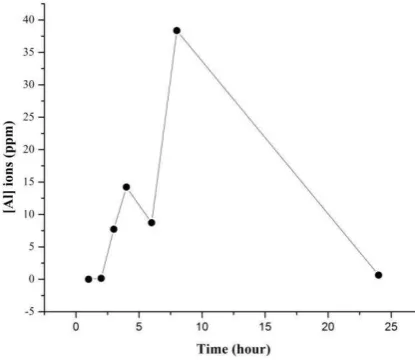
(Figure 6). As indicated water reduction in cathode generates OH− ions to the solution resulting in pH increase during electrolysis. The optimum EC process on intensity of electric current was found to be 10 volt. The aluminium quantification was performed after experiment (figure 7). After 24 hours, the result indicate that the amount of Al ions that generate by EC process have adsorbed the pollutants efficiently.
Figure 7. Increment of the pH as a function of treatment time
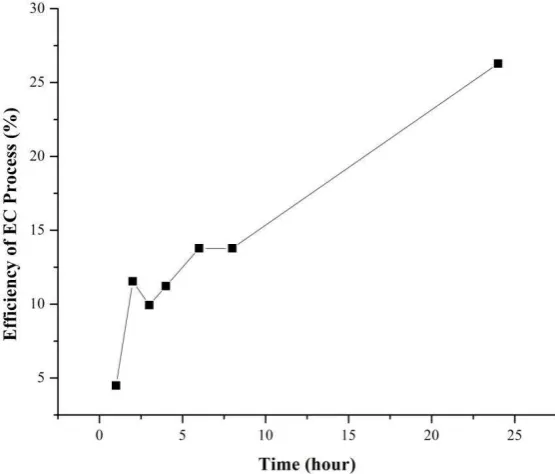
The total dissolved solid (TDS) was investigated before and after the experiment. Figure 8 shows the efficiency of EC process for treatment of swimming pool water.
Figure 9. The efficiency of EC process during electrolysis time
The efficiency of EC process for treatment of swimming pool water achieved the intensity of electric current 10 V and electrolysis time 24 hours. Removal efficiency of pollutant expressed as final pH 6.8 and TDS 230 ppm.
5. Conclusion
As discussed above, electrochemical sensors have been successfully applied for detection of La3+ and Cl− ion. The modified CPE with MBTH as sensor of La3+ ion exhibited very low
References
1. Windmiller, J. R.; Wang, J. Electroanalysis, 2013, 25, 29.
2. Yuan, D.; Chen, S.; Yuan, R.; Zhang, J.; Liu, X. Sen. Actuators B: Chem., 2014, 191, 415.
3. Chen, A.; Chatterjee, S.; Nanomaterials. Chem. Soc. Rev., 2013, 42, 5425.
4. Kiatkittipong, W.; Tagawa, T.; Goto, S.; Assabumrungrat, S.; Praserthdam, P. Chem. Eng. J., 2005, 106, 35.
5. Ramakul, P., Mooncluen, U.; Yanachawakul, Y.; Leepipatpiboon, N. J.Ind. Eng. Chem.,
2012, 18, 1606.
10.Xiao, K. P.; Bühlmann, P.; Nishizawa, S.; Amemiya, S.; Umezawa, Y. Anal.Chem., 1997, 69, 1038.
11.Suyanta; Kristianingrum, S.; Hidayah, T. J. Chem. Chem. Eng, 2014, 8.
12.Sahu, O.; Mazumdar, B.; Chaudhari, P. K. Environ. Sci.Pollut. Res., 2014, 21, 2397. 13.Al-Shannag, M.; Al-Qodah, Z.; Bani-Melhem, K.; Qtaishat, M. R.; Alkasrawi, M. Chem.
Eng. J., 2015, 260, 749.
![Figure 1 shows the differential adsorptive stripping voltammograms of unmodified CPE and methyl-2-hydrazinobenzothiazole hydrochloride (MBTH) ligand as previously reported [20]](https://thumb-ap.123doks.com/thumbv2/123dok/2746387.1317661/2.595.173.405.552.734/differential-adsorptive-stripping-voltammograms-unmodified-hydrazinobenzothiazole-hydrochloride-previously.webp)