1
CHAPTER I
INTRODUCTION
In this chapter the researcher present about how the researcher take this title as a research. This chapter background of the study, research problem, objective of study, scope and limitation, significance of the study, and definition of key terms.
A. Background of The study
“Writing is one of the four language skills: reading,writing,listening and speaking.
Writing and speaking are productive skill. That means they involve producing language rather than receiving it”(Sprat, 2005, p.26). Moreover writing skill is more complicated than others skills in nglish language. Writing skill is not only talks about grammars and vocabularies but also of conceptual and judgment elements. Because of the difficulties, some efforts have been done to solve the problems, the purpose is to make writing become easier and interest to learn for students.
According to Meyers A,(2005, p.2), writing is like speaking in a way to discover and communicate ideas. Unlike speaking, however, it doesn‟t happen all at once. The writer can not see and hear the reader, so he has to present the ideas in a logical order. He has to be careful in organizing his writing to make the meaning more strongly and clearly. Therefore, writing as one of the basic competences in learning language is the most sophisticated language skill. It demands a lot of exercises and practice.
Writing is one of the skills that has to be mastered by English learners including the Junior High School Students. Competence Based Curriculum states
science education, researcher think write is process of describing a language so that message submitted by writer can be understood reader.
Recount text writing usually tells the reader about the events. Recount text gives the description of events of someone‟s past experience for the reader, which is to give the information or to entertain. Based on the researcher‟s experiences when teaching students,
they would be enthusiastic when they were asked to tell about their experience or story, especially about amusing story.students remembered their story and wanted to shere their story to other people. It seems that they wanted others to feel what they feel. Students write clearly about what experience or event was.
The method uses in this research is a Descriptive where the researcher explained the result of research by describing the data gained. The techniques used for collecting data are measurement technique and direct observation technique. The tool of collecting data are written test. Based on the finding in this reseach, there are 275 errors made by the students in writing recount text. The error are 95 or 34.54% errors at writing content of the text, 21 or 7.63% errors at vocabulary, 123 or 44.74% errors grammar and 36 or 13.9% errors at mechanics(Ramli, Suhartono, Novita, 2008,p.1)
Because, have many errors in writing especially in writing recount text on the syllabus in MTSN 2 Pulang Pisau of English learning, criteria minimal score (KKM) of the eight grade are 75. Meanwhile, the students average score are 63.4, it is under of KKM. ( Malik, 2017 ). So, that is whay research intersting to put the tittle The Teaching of Writing Recount Text at the Eight Grade Students of MTSN 2 Pulang Pisau.
problems in teaching writing recount text in MTSN 2 Pulang Pisau, in teaching and learning process, the students do not pay attention to what the teacher. In addition, the teacher who teach too well make them regard as their friend. Therefore, they crumble what is taught. That makes it effective lesson to be taught in the class..
B.Research Problems
Based on the background above, the central of this research is how is the process the Teaching and learning of writing recount text in English eight grade student of MTSN 2 Pulang Pisau they are:
1. What does the teacher use material in teaching learning writing recount text? 2. What does the teacher use media in teaching learning writing recount text?
3. What the technique of t he teaching writing recount text at eight grade students of M TS N 2 P ul a n g P i s au ?
C.Objective of the Study
The main purpose of conducting this research is to describe the teaching process s of recount text at eight grade students of MTSN 2 Pulang Pisau :
1. To describe the use material as teaching learning writing recount text by English teacher.
2. To describe the use media as teaching learning writing recount text by English teacher. 3. The main purpose of conducting this research is to describe the teaching technique of
recount text at eight grade students of MTSN 2 Pulang Pisau. D. Scope and Limitation
students. This research only focus on the teaching writing process relates to its material, techniques, and media. This research also focuses on the interrelation of the media, material, techniques and their implementation.
E. Significance of Study
The finding of this study is expected to give valuable contribution this study can be uses as a description and reflection to the teacher in teaching writing recount text. This study will direct the teacher to choose the alternative method, technique, and media in teaching writing recount text. The result of this study can be used as reference in teaching writing recount text for the prospective teachers, and for who wants to conduct the same field research.
D. Definition of Key Terms
This study involves a number of specific terms. The terms are defined as follows: 1. Teaching means cause some body to know or be able to dose meting (Hornby2001,
p.886) in this study, it means to make students understand and be able to write text appropriately with their level.
2. Writing is a transaction with words whereby you free yourself from what you presently think, feel, and perceive (Brown, 2000, p.337). In this study it also means expressing the thought into a written form.
4. Technique is any of a wide variety of exercises, activities, or tasks used in the language classroom for realizing lesson objectives (Brown, 2000, p.16). In this study means research, one of the focuses is technique in teaching writing.
5. Material that of which something is or can be made or with which something is done (Hornby, p. 524). In this study Material means usually is used to deliver the lesson clearly.
CHAPTER II
REVIEW OF RELATED LITERATURE
This chapter will review the theory, issues, and studied related to the topic of the study. This chapter presents the Related studies, Nature of writing, Recount text, Teaching, Learning, Teaching process, Teaching media, English language teaching, The teaching of writing in junior high school, Teaching writing recount text, descriptive research, Qualitative approach, and recount text.
A. Related Studies
There is previous study to support this study as follows:
Ratih Setiawati, ( 2013, P. 77-87) The research is Classroom Action Research which the writer and the collaborator were involved in the teaching learning process directly from the beginning until the end of the study Students who become subjects of this study is the class XA SMAN 2 palu school year 2012/2013. Researchers are teachers who teach in class X, so he decided to make the XA-grade students as subjects of the study. Most of the students in the class XA have difficulty in writing recount text. This is because the use of grammatical errors and inaccuracies use of the word. Students also cannot construct sentences an integrated form of past sentences. This study aims to develop students' skills in writing a recount text through picture. Research done in 2 cycles, where each cycle consisting of tribes meetings. In this study, data were collected from the observation, field notes, interview and test. Criteria for success in this research is the student should get a value equal to or more than 7.5 as the value of the individual and should be achieved by 75% of the total number of students. Findings in the study showed that the use of an effective image to gradually help students overcome difficulties in
compiling a recount text. The effectiveness of the use of images is evidenced by the significant changes of the mean value laical students, 22 of 33 students or (66.7%) scored above or equal to 7.5 in cycle 1. In cycle 2, the number to28from33studentsor (84.8%) scored above or equal to 7.5. It can be concluded that the use of an effective image to develop writing skills.
Eldina, (2014,p. 1) The result of the data analysis proved that comic strips had a significant effect on the eighth grade students‟ recount writing achievement.
The difference with Eldina is research is that Eldina used quantitative methods while researcher uses qualitative methods, Eldina conducted at SMPN 1. The author conducted research in MTSN 2 Pulang Pisau.
Pertiwi, (2013, p. 1) this research applies descriptive qualitative research and a classroom action research. In collecting data the writer used interview, observation, and documentary as the instrument of writing teaching –learning process. The result shows that the teacher used inquiry-based method in teaching learning process; this method focuses on vocabulary implemented in writing class. The implementation has been conducted to the second year students of SMP N 2Banyudono. The teacher faced some problems in teaching process. The problems were the difficulty in improving the students‟ vocabulary, different capability of the student and limitation of time. The student‟s ability in writing recounts text is good, because the score is upper the passing grade. While investigator examined in MTSN 2 Pulang Pisau.
written test. Based on the finding in this reseach, there are 275 errors made by the students in writing recount text. The error are 95 or 34.54% errors at writing content of the text, 21 or 7.63% errors at vocabulary, 123 or 44.74% errors grammar and 36 or 13.9% errors at mechanics (Ramli, Suhartono, Novita, 2008, p. 1-4)
B. Writing
1. Nature of Writing
They are some definitions about writing. Dullay states that writing is only mode in which both linguistics manipulation task and communication task have been given (Dullay, 1982,p.226). Fauzianti also gives statement that writing as a process is oriented to words work progress and the development of new skills, rather than merely evaluative task, the classroom practices, therefore, will vary from each other (Fauziati, 2002, p.151). Donn states that writing is culturally specific, learned, behavior. We learn to write if we are members of a literate society and if only someone teaches us (Bryne, 1979, p.334).
Based on the statement, it can be concluded that writing is an active productive more clearly; writing is an act or process to produce some information in their mind that should be expressed into writing from. Writing will be the best if the students guide on the rules defined. It usually refers to contents, organization, grammatical, usage and mechanics, sentence structure, mastery on vocabulary and so on.
2. Writing Procces
(2010, p.31).There are three steps in writing process, they are prewriting, writing, and revising. All of those steps are important to make our writing better and systematic.
a. Prewriting
Prewriting is the first step; it is preparation step before writing process. Prewriting gives warming up the brain to gathering the ideas to write about. There are several ways to warm up before we write.Blanchard& Christine (2003, p.41).Prewriting‟s preparation to write and the getting-ready-to- write stage which is like a warming-up for the athletes.
b. Drafting
Drafting means writing a preliminary version of a work that you will later revise. It means getting your idea on paper, so that you can work with them. In addition, drafting is the time to rummage through ideas accumulated during prewriting and unfold them into sentences and paragraphs. Drafting is a stage design to allow the writer stoup their ideas on paper without worrying about mechanics or neatness.
c. Revising
d. Editing
At this stage, the students are focused on tidying up their works as they prepare the final draft to be evaluated by the teacher. The main activity done by the students at this stage is editing their mistakes on grammar, spelling, punctuation, sentences, diction and etc. Tompkins and Hoskisson assert that the editing stage primarily focuses on the content of students' writing.
e. Publishing
In this last step of the writing process, the final writing is shared with the group. Sharing can be accomplished in a variety of ways, and with the help of computers, it can even be printed or published online.Hokinson (2016, p.34). In publishing stage, students‟ bring their compositions life by publishing them or sharing them orally with an appropriate audience. It means that they shared their writing with real audiences of class mates, other students‟, parents and community. 3. Writing Ability
Writing is functional communication, making learners possible to create imagined worlds of their own design M. Zaini (2012, p.189-191).Writing as one of four language skills is considered as a difficult skill because the writer should make some aspects in writing such as content, organization, purpose, vocabulary, punctuation, and spelling in a balance way.
4. Kinds of Writing
a. Paragraph
paragraph contains several sentences which can be classified into three parts Anderson and Kathy (1997, p.38).
b. Essay
Essay is a paragraph that you expand because your subjectis too complex to cover in a single paragraph. An essay, like a paragraph, focuses on one subject, theme, or idea, but it needs several paragraphs to make its point. The first paragraph, the introductory paragraph, contains a sentence with the main idea of your essay (the thesis statement). Next come several paragraphs that elaborate on your main idea (body paragraphs) and a concluding paragraph that summarizes the points you made (Stepen King,P.5).
5. Writing Assessment
Assessment is a written English text in which the writer explains the process. This involves in the formation (evolution) of a socio cultural phenomenon as a natural phenomenon. Siahaan and Shinoda (2008, p.143).Assessment of any kind should inform our instruction. That is, we assess to see how students are doing, to see how well we‟re teaching, and to get sense of what skills need to be taught. The
writing assessment form WAF) can be used to document students‟ growth while
inviting them to experience success (Johnson & Andrew, p.213-216). In the teaching of writing we can focus on the product of that writing process itself.
a. Product Assessment
spending time with learners on pre-writing phrases, editing, redrafting, and finally publishing their work, a process approach aims to get to the heart of the various skills that should be employed when writing.
b. Process Assessment
Process writing is simply not appropriate, either because classroom time is limited, or because we want students to write quickly as part of communication game, or when working alone, we want them to compose a letter or brief story on the spot. Product assessment is measuring students‟ result of the test toward students‟ ability in making result of work and the quality result of students‟. In
assessing students‟ result there are two concept assessments, the first one is student
assessment is the choice and the second is the way in using the instruments and procedure. Besides that, there are three types in product assessment in assessing toward technique quality or the results (Sri Wahyuni and AbdulSyukur, 2012, p.77-78).
1) Planning: Assessing students‟ ability in organizing, developing and designing the product.
2) Processing: Assessing students‟ ability in selecting and using the material, instrument, and the technique
3). Appraisal: Assessing the students‟ product based on the criteria that had decided.
6. Function of Writing
a. Writing is primarily for action
Writing can be used for many kinds of action, such as:
1) Public signs, e.g. on roads and stations: product labels and instructions, e.g. on food, tools or toys, purchased; recipes; maps; television and radio guide; bills; menus; telephone directories; ballot papers; computer manuals; monitors and printouts.
2) For social contact
3) Personal correspondent: letters, postcard, greeting cards. b. Writing is primarily for information
Writing also may be used to convey information, such as newspaper (news, editorials) and current affairs magazines; hobby magazines; nonfiction books; including textbooks; public notices; advertisements; political pamphlets; scholastic, medical, etc. report; guide books and travel literature.
c. Writing is primarily for entertainment
Writing for entertain the reader, such as in light magazines, comic strips; fiction books; poetry and drama; news paper features; film subtitles; games, including computer games.
From the explanation above, it can be concluded that written forms are very close to human life. Therefore, teaching writing for students can give them a basic skill in English which is can they use to support their career in the future.
7. Components of Writing
1. Content : the substance of the writing; the idea expressed. It means that writing is knowledgeable, substantive and relevant to assigned topic. This component is the first because it is mainly about what students are writing.
2. Form: the organization of the content. The form of writing is classified by their purpose of the piece. The forms of writing are narrative writing (biographical, fictional, personal); expository writing (compare-contrast essay, how-to essay, informative essay); persuasive writing (opinion, problem-solution, pro-con essay); response to literature (character sketch, plot summary, theme analysis); and research writing (research report).
3. Grammar: the employment of grammatical forms of tactic patterns. For example: rules of verbs, sentences constructions, tenses, etc.
4. Style: the choice of structures and lexical items to particular tone flavor to the writing is it formal or informal. Before students decided to write, they have to know who the reader is.
5. Mechanics: the use of graphic conventions of language. It includes the use of capitalization, spelling and punctuation.
Components of writing are given direction for the writers / students in order to make their writing good and valuable. Missing one or more components will make vagueness to the overall impact if that writing.
C.Recount Text
who was involved, where it took place, when it happened and why it occurred. A writer or speaker uses a recount to tell us about a story or an event. Recounts can be personal, factual or imaginative. Personal recount is retelling an activity that the writer has been personally involved in and may be used to build the relationship between the writer and the reader e.g. anecdote, diary journal, personal letter.
1. Descriptive Text
a) Social function: to describe a particular person, place, or thing. b) Generic structure:
- Identification: identifies phenomenon to be described. - Description: identifies phenomenon to be described. c) Language features: simple present tense .
d) Example:
a) Social function: to amuse, entertain and to deal with actual or vicarious experiences in different ways.
Bongo the Orangutan
There is an orang-utan in the Bandung zoo. People call her Bongo. She comes from a dense forest on the island of Kalimantan.
She has physical features similar to a human. Bongo has a brownies fur, and walks with two feet. Bongo is almost as big as a human. She is a mammal that means she gives birth to her children and breast feeds them.
Wardiman, (2008, p.20)
Identification
b) Generic structure:
- Orientation: sets the scene and introduces the participants. - Complication: a crisis arises.
- Resolution: the crisis is resolved, for better or worse - Reorientation (optional)
c) Language features: simple past tense Example:
- Complication: a crisis arises
- Resolution: the crisis is resolved, for better or worse - Reorientation (optional)
SOURCE :
Artono Wardiman, 2008.English in Focus 2: for Grade VIII Junior High School (SMP/MTs), Jakarta: Pusat Perbukuan, Departemen Pendidikan Nasional.
Example:
a. Generic Structure Buggy Races
Once upon a time there lived two best friends, the hare and the tortoise. They liked to race against each other, but the hare always won.
One day, the hare asked the tortoise to race down to the beach. The tortoise refused, he said that will loose anyway. The hare replied in a kind voice that he felt sorry about it.
But the next day, the hare found a way to race the tortoise that would be fair and lots of fun too. He asked the tortoise to come with him. The tortoise was slowly plodding over the sand hill toward the beach. Now the two friends can race against each other all day and something tells me that the tortoise might win this time.
Adapted from 50 Bedtime Stories,( 2002)
Orientation
Complication
- Orientation; introducing the participant, using first person point of view, I was on the car last week.
-Events; describing a series of event which happened. The car lunched to one side. Telephone and electricity poles were falling down, etc.
-Re-orientation; stating the writer‟s personal note. Thanking God because nobody was seriously injured.
b. Language Feature Analysis - Using personal participant; I
-Using chronological connectives; then, and, suddenly. -Using linking verb; was, were.
-Using action verb; moved, left, walked, made, etc
- Using simple past tense pattern; earthquake happened, I was on the car, my car lunched on one side, etc (Pak puguh, 2011).
For this research, the researcher chooses recount text as one of the subjects that the researcher want to observe. It is because one of the objectives in Junior High School syllabus is teaching about recount text. Afterwards, recount text is one of the text which can ease students to write because it tells about events that have happened in their live. Therefore, the researcher is curious about how the teaching process of writing recount text, especially its material, media, and technique in teaching writing recount text.
introduce the students about writing skill and teach them how to write appropriately. Recount text as one of the kinds of text that written in junior high school‟s syllabus is considered can stimulate the students to try to express their thought into a written form because recount related to their experiences.
D. Teaching
1. Definition of Teaching
Teaching means to transfer someone knowledge or to educate or train someone. Based on Brown (2000, p.5) teaching as showing or helping someone to do something, giving instruction, guiding in the study of something, providing with knowledge, causing to know or understanding. Teaching is not only giving knowledge or skill to student, but also the process of providing opportunities for student to produce relatively permanent change through the engagement in experiences provided by the teacher. Furthermore, teaching is guiding and facilitating learning, enabling the learner to learn and setting the condition for learning process.
2. Components of Teaching
There are some components in teaching, those are: a. Curriculum and Syllabus
Brown (2000, p.16) stated that curriculum and syllabus are designs for carrying out a particular language program. Features include a primary concern with the specification of linguistic and subject-matter objectives, sequencing, and materials to meet the needs of a designated group of learners in a defined context.
that is suitable with this curriculum, teachers need to make a lesson plan. The lesson plan (RPP) is as a guide for the teacher in English teaching and learning process to reach learning goal and it should be made based on the available and recent curriculum. b. Teacher
The teacher needs to have special training or education to have knowledge to prepare a good lesson, provide appropriate resources to learn, and so on. In other words, a teacher with good educational background logically have chance to be a good facilitator. Good environment and media also support the success of language teaching. Therefore the teacher must create a good condition and make his/her teaching interesting for them and be very helpful to encourage them to learn English.
Brown (2000, p.166) stated that teacher can play many roles in the course of teaching. Just as parents are called upon to be many things to their children, teachers cannot be satisfied with only one role. Oxford et al. pointed out that teacher roles are often best described in the form of metaphor: teacher as manufacturer, teacher as a doctor, teacher as a judge, teacher as a gardener, and others. Another set of metaphors to describe a spectrum of possibilities of teacher roles, some of which are more conducive to creating an interactive classroom than others. Therefore, kinds of teacher roles according to Brown (2000, p.167) are:
1) The Teacher as Controller
A role that is sometimes expected in traditional educational instructions is that of “master” controller, always in charge of every moment in the classroom.
language forms they should use. Controllers can often predict many students‟
responses because everything is mapped out ahead, with no leeway for divergent paths. In some respects, such control may sound admirable. But for interaction to take place, the teacher must create a climate in which spontaneity can thrive, in which unrehearsed language can be performed, and in which the freedom of expression given over to students makes it impossible to predict everything that they will say and do.
2) The Teacher as Director
Some interactive classroom time can legitimately be structured in such a way that the teacher is like a conductor of an orchestra or a director of a drama. As students engage in either rehearsed or spontaneous language performance, it is the teacher‟s job to keep the process flowing smoothly and efficiently. The
ultimate motivate of such direction, of course, must always be to enable students eventually to engage in the real-life drama of improvisation as each communicative event brings its own uniqueness.
3) The Teacher as Manager
This metaphor captures teacher‟s role as one who plans lessons, modules,
work in his or her own individuals areas of expertise. A language class should not be markedly different.
4) The Teacher as Facilitator
A less directive role might be described as facilitating the process of learning, of making learning easier for students‟: helping them to clear road blocks, to find shortcuts, to negotiate rough terrain. The facilitating role requires that the teacher step away from the managerial or directive role and allow students, with teacher‟s guidance and gentle prodding, to find students‟ own pathways to success. A facilitator capitalizes on the principle of intrinsic motivation by allowing students to discover language through using it pragmatically, rather than by telling them about the language.
5) The Teacher as Resource
Here the teacher can take the least directive role. In fact, the implication of the resource role is that the student takes the initiative to come to the teacher. Teachers are available for advice and counsel when the student seeks it. It is of course not practical to let the students get anything they want from the teacher. But there are appropriate times when teacher can literally take a back seat and allow the students to proceed with their own linguistic development.
rules of thumb are willing acceptances of many ways that students will perceive you and a consistent fairness to all students equally.
E.Learners
The existence of teacher in education could not be separated from the students or learners. Learners can be as an indicator of teaching quality of the teachers; therefore, the existence of learners is equally important as the teachers.
F. The Teaching Process
1. Teaching Prepare
Prepare is any of a wide variety of exercises, activities, or tasks used in the language classroom for realizing lesson objectives (Brown, 2000, p.16). In this research, one of the focuses is process prepare in writing.
2. Teaching Material
Much of richness of language instruction is derived from supporting materials. The material uses also should be suitable with students‟ need. Therefore, textbook is
3. Teaching Technique
Using appropriate teaching technique can support the students to receive the lesson well. According to Brown (2001, p.144), technique as a super ordinate term to refer to various activities that either teachers or learners perform in the classroom. In other words, techniques include all tasks and activities. They are the product of a choice made by the teacher.
There are several kinds of techniques in teaching writing according to Raimes (1983, p.176), those are:
a. Technique in Using Pictures.
1) One picture for many different techniques. (It can be used to description, comparison and contrast, paragraph assembly, sentences combining, paragraph completion, controlled composition, guided composition, role-play, questions and answer, beyond the picture).
2) One picture for a sequence of tasks
3) Picture sets (suitable for writing narrative and for speculating about the story beyond the picture)
4) Diagram, tables, graphs, and charts (talks about the information presented). 5) Maps.
b. Technique in Using Readings.
1) Copy (practice with the mechanics of punctuation, spelling, capitalization, and paragraph indentation).
4) Examine sentence arrangement. 5) Summarize.
6) Completing.
7) Speculate (make speculation about the given text).
8) React (stimulate written communication through reading). c. Technique in Using All Language Skills
1) Brainstorming (say anything about topic in written form) 2) Guided discussion
3) Interviews
4) Skits (writing can then follow as an outside report or summary of what as said or it can be a continuation of the skit)
5) Dictation
6) Note-taking (picking out the important information) 7) Story-telling
d. Technique in Teaching Practical Writing 1) Forms
2) Letters 3) Lists 4) Daily notes 5) Instructions
e. Technique in Teaching Organization 1) Outlines
3) Models
4) From meaning to organization
f. Technique in Responding To Students‟ Writing
1) Written comments 2) Talking about the paper
3) Checklist (use it to analyze the writing assignment) 4) Students‟ responses to students writing
5) Self-editing (develops and improves their writing).
6) Ways of dealing with errors (let the student‟s analyses the error).
The techniques of teaching writing above are as a reference to determine which techniques that will be appropriate to teach eight grade students. To determine which the suitable techniques are, it is considered based on the students‟ level, students‟ ability,
and the syllabus. It could be one or more technique that will be used in once teaching process.
1. Teaching Media
Language teacher may use a variety of teaching aids to explain language meaning and construction, engage students in a topic, or as the basic of a whole activity (Harmer, 2001, p.134). In other word, it refers to media teaching. Media is such things that can be uses to distribute the message to sender to receiver to stimulate the sense, mind, attention, and the students‟ interest to build the teaching
learning process.
pictures/photos, diagram, chart, graphs, poster, maps or globe, flannel board, bulletin board.
b. Audio media. It is maintain students‟ interest by their hearing. It is usually used by
the teacher in listening class in native speaker sounds. The examples are radio, tape recorder, and laboratory.
c. Projected medium media. These kinds of media are spending long time to make and to operate, beside that need much cost. Nevertheless, nowadays most of them are usually taking over by computer to make it more efficient to use. The examples of projected media are slide, film strip, overhead projectors (OHP), film, loop film, television, and video.
5. Teaching evaluate
Frey, B.A., and Susan W.A, (2003, p.15) Evaluation The systematic process of collecting, analyzing, and interpreting information to determine the extent to which pupils are achieving instructional objectives.
G. English Language Teaching
English language teaching has an important role in improving language skill. English is one of many languages in the world, and English is the most international language which usually used in the world. No wonder teaching English is the important thing to user English as the foreign language or second language.
Based on the KTSP, English is one of the primary subjects at school. The objectives of teaching English to junior high school students as a primary subject of the study are: 1. Developing the communication skill in English both spoken and written language. The
ability to communicate includes listening, speaking, reading, and writing.
2. Giving information that English is one of the most important foreign languages that become means of communication in education.
3. Developing the understanding of language and culture. Therefore the children will have knowledge about culture.
H. The Teaching of Writing in Junior High School
Teaching writing gives an advantage to the junior high school students by considering them as a creator of language. In this way, the students are given freedom to „play‟ and make experiment with language. According to Brown (2000, p.79), writing is
appropriate for such learners. It can also be a quiet reflective activity instead of the rush and bother of interpersonal face-to-face communication. Besides that, students need to know how to write letters, how to put written reports together, how to reply to advertisement. However, for eight grade students, they are stimulated in writing through several kinds of text comprehension.
basic competence: "Expressing meaning and rhetorical stages of a simple, short essay by using a variety of written language accurately, fluently and thankful to interact with the surrounding environment in the form of descriptive text and recount".
The basic competence is expressing the meaning and rhetorical steps in short-simple essay by using various kinds of writing skill accurately, fluently, and acceptable in order to interact with surrounding environments in descriptive and recount text form.
From that basic competence, the researcher gets the indicator that related to the research, they are:
1. Completing a short hiatus essay form of descriptive text
2. Develop the sentence into meaningful text in the form of descriptive and recount. 3. Write an essay in the form of descriptive text and recount.
From those indicators, one indicator is focused on in this study, that is: write short text and simple recount and narrative form in rhetoric step. The recount text is chosen to be focused on this research.
I. The Teaching Writing Recount Text
in Indonesian language and jumbled sentences in English and asked the students to compose them into a good paragraph. The best steps should be just in opposite order. Most of the students got some difficulties such as grammatical use, vocabulary use, punctuation use, and the influence of Indonesian language. During the process, the writing skill of the student especially in writing the recount text improved. It was proven by looking at the students‟ writing in the end of the meeting.
J. Descriptive Research
Descriptive research is the exploration of the existing certain phenomena. The details of the facts won't be known. The existing phenomena‟s facts are not known to the
person.
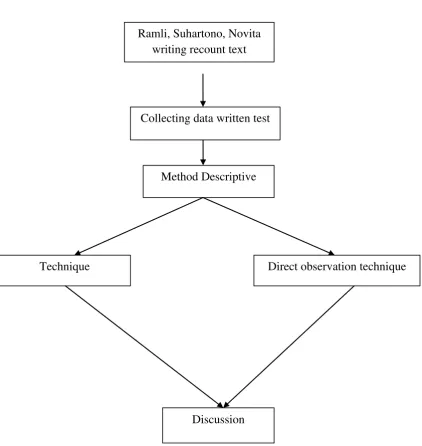
Figure 2.1 Frame of Thinking
Figure 2.1 Ramli, Suhartono, Novita
writing recount text
Collecting data written test
Method Descriptive
Technique Direct observation technique
Figure 2.2Review of Related Literature
CHAPTER III Related Studies
Writing
Nature Of Writing
Writing Process 1. Prewriting 2. Drafting 3. Revising 4. Editing 5. Publishing
Writing Ability Kind Of Writing
1. Paragraph 2. Essay Writing Assessment
a. Product Assessment b. Process Assessment
Components of writing
Function of Writing a. Writing is primarily for action b. Writing is primarily for information c. Writing is primarily for entertainment Recount Text
1. Descriptive Text
Teaching 1. Definition of teaching 2. Components of teaching
Learners The teaching process
The teaching of writing in junior high school English language teaching
The teaching writing recount text
CHAPTER III
RESEARCH METHOD
The research method was necessary for the researchers because it can guide the researchers to achieve their aims of the study based on the problems arising in the study. The research method in this study can be divided into five subdivisions, such as: approach and type of research, subject of study, Research instrument, data collection, data analysis, and data endorsement.
A. Research Design
This research was qualitative descriptive study, to describe the real phenomenon appropriate with the facts in field about teaching recount text of MTSN 2 Pulang Pisau in class eight grades.
A descriptive research was not intended to make a certain hypothesis. It just intend to describe the actual data and naturally occurring phenomena. Fraenkel and Wallen (2012, p.14) stated that in educational research, the most common descriptive methodology was the survey, as when researchers summarize the characteristics (abilities, preferences, behaviors, and so on of individuals or group or (sometimes) physical environments (such as schools). The focus of the research is on the teaching writing recount text.
This study used qualitative approach, which was characterized by observation and description in form of sentences or words. In this research, a descriptive qualitative method used to describe the teaching process of recount text of MTSN 2 Pulang Pisau.
B.Subject of the Study
The Subject in this research was the English language teacher in MTSN 2 Pulang Pisau, while that which became the subject of research was an English teacher at MTSN 2 Pulang Pisauu well as a core data or primary data source. Reasons for choosing the subject English language teacher because researcher wanted to know how the teaching of writing recount text in the eighth grade.
Primary research required data or information from the first source, usually referred to respondent. Data or information obtained through written questions used a questionnaire or orally used interviews.
C. Research Instrument
There were some research instruments in the study observation, and interviews as the instrument. Observation was technique of data collecting using our vision with no helping from other standard equipment. Observation was chosen to see the natural process in the classroom. Therefore, it conducted while the processes of teaching writing recount text in the classroom. The researcher not only observed the process, but also observed the implementation of usage of technique, material, and media in teaching writing recount text. The other instrument was interview. Interview was a process getting information in purpose to research needed by asked and answered session face to face between the interviewer and the interviewee, and by using a tool named interview guide.
1. Observation
development, and soon, when that event is happen. In gathering the data, the researcher takes a note all of activities that happened in the class as soon as possible.
According to Nazir, observation can be done in two ways. They were non systematic observation and systematic observation. But this research used systematic observation. On the systematic observation, the researcher had known what aspect that teacher wanted to observe that relevant with the problem and what the research goal, with systematic expression (Nazir, 1983, p. 30-34).
To make the instrument valid, the researcher conducted the observation two times for each class.
Before doing the observation, the researcher determined some indicators / aspects of the teacher‟s performance of the process in teaching writing recount text
was used the score range. It was called the observation sheet. The indicators / aspects were to describe how the teacher‟s performance and also the implementation of technique, material, and media whether it was very good, good, fair, or poor. Those aspects are helping students‟ developing their positive behavior, behave openly and flexible towards the students‟ and other people, showing teacher
passion and seriousness in teaching activity, handling the interaction in the class, implementing material in teaching writing skill, used media in teaching writing skill, and implementing the writing technique in teaching.
1. The study location at MTSN 2 Pulang Pisau. 2. Teacher.
3. The research subject was Teacher of English learning in MTSN 2 Pulang Pisau. 4. The research object was the teaching of Writing Recount Text used by the
teacher of MTSN 2 Pulang Pisau.
5. Goal, to describe the teaching of writing recount text used by the teacher of MTSN 2 Pulang Pisau.
2. Interview
The researcher conducted interview in order to emphasize the previous instrument. Since the researcher believes that interview needs to be answered directly without having any longer thought; therefore the researcher tried to used interview to support the validity of the observation data. In this case the researcher asked about the opinion or the perception teacher in used the media, material, and the technique in teaching writing recount text. The researcher also used an interview guide in interviewing the interviewee. It made the process of interview be more systematic to achieve the data expected and running on sequence. Therefore, the answer that is gotten can wrap all of variables with complete and deep information.
The researcher interviewed the eighth grade English teacher. There were 14 items of questions. The questions were about the material, the media, and the techniques that she
usually used. Besides that, the researcher also asked about the consideration of using those
components of teaching, the reason of using it, result of using it, and the respond of
study. Interview has a variety of forms including: individual, face-to-face interviews (Cohen D & Crabtree B, 2006).
3. Documentation
Document was a record of events that already apply. Documents can be in the form of text, images, or the works of a person monumental. Documents that form of writing, for example diaries, life histories, stories, biographies, regulations, policies. Documents in the form of images, such as photographs, motion pictures, sketches and others.E.g.documents in works of art, which may include pictures, sculptures, films and other. Study document was complementary to the used of the method of observation and interviews in qualitative research. Sugiyono (2012, p.240).
By using documentation in this research it was support the data that was found in the field. The write was use camera for taking pictures or video. There are some photos that contain the real condition of English teaching process in the classroom.
This technique had been used to collect written data related to this research. The data would like to be look for are:
1. General description of location at MTSN 2 Pulang Pisau.
2. Documentation the English Teaching of Writing Recount Text used by the teacher of MTSN 2 Pulang Pisau.
3. Documentation the way of the teacher evaluates the class of MTSN 2 Pulang Pisau.
The documents collected were assist researcher in understanding the phenomena that occur at the site of research and assist in making the interpretation of data. In addition, documents and data can assist in formulating literary theory and perform data validation.
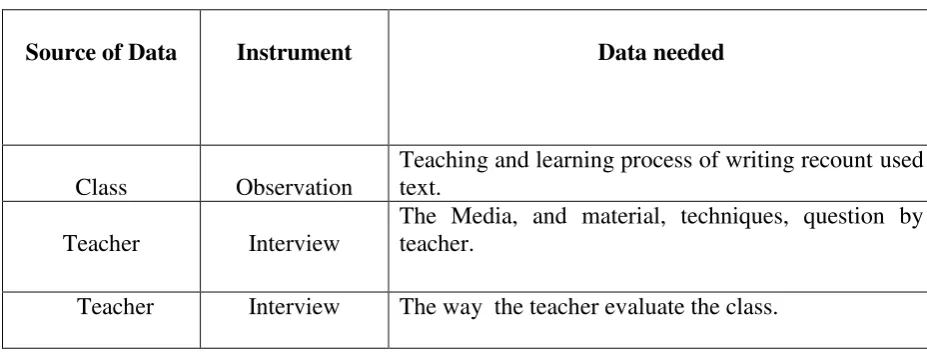
Table. 3.1
Source of Data, Iinstrument, and dataNneeded
Source of Data Instrument Data needed
Class Observation
Teaching and learning process of writing recount used text.
Teacher Interview
The Media, and material, techniques, question by teacher.
Teacher Interview The way the teacher evaluate the class.
D. Data Collection Procedure
This action research needed the data to support the investigation. There was a list of techniques and methods which can be used to gather data in the investigation and monitoring phases of action research. They were diaries, profiles, document analysis, tape / video recording and transcript, using an outside observer, interviewing, the running commentary, the shadow study, checklist, questionnaires, inventories, triangulation, and analytic memos.
was use observation form, and interview guide. The aim of using these techniques was to know all of the information about teaching writing recount text in the classroom.
E. Data Analysis Procedure
To analysis the data,” the written use three techniques they are data collection, data
reduction, data display” (Sugiyono, 2010, p.246).
1. Data Collection
This research used some of them which are appropriate to the school environment and can be done to support the action research. In this research, to collect data, the research used observation form, and interview guide. The aim of used these techniques were to know all of the information about teaching writing recount text in the classroom. 2. Data Reeducation
In qualitative research, does not necessarily refer to quantifying nominal data. Qualitative data needs to be reducing and transformed in order to make in more readily accessible, understandable, ad to draw out various themes and patterns (Bruce, 2007, p.33). The research selected selects all the data got in the field and chose the data relevant to the study. Then, the writer focused on that data indicate toward the answer of the problem study.
3. Data Display
In data display, the researcher had reported the relevant data and confirms the study result. It means that data collected from interviewed the teacher such as how do teacher in teaching writing recount. Then, to support the data from interview, the researcher also reported the data collect from documentation such as the picture, video, and recording.
The analysis of data was used a descriptive method. After the data are gathered, they was be organized into a manageable unit which can be analyzed and then a conclusions be drawn after that.
The technique used in analyzing the data was descriptive qualitative. The way to analyze the data is explained from observation, and interview result. The steps were: 1. Describing the instrument and data expected from the research.
2. Presenting the factual data found in the research 3. Analyzing the data by describing to the detail
4. Summarizing and interpreting the expected data found in the research
The data from each instrument are organized to get the information and described into three aspects. Those are:
1. Syllabus Design or teacher‟s planning
F. Data Endorsement
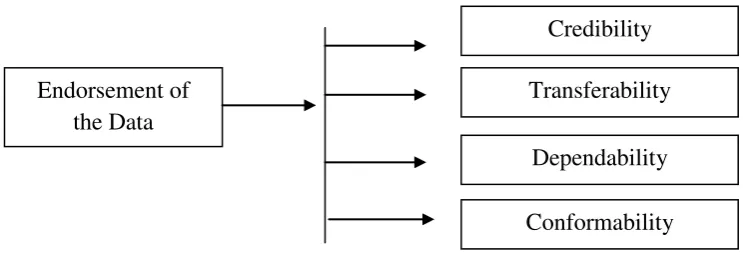
Throughout the process of data collection analysis, writer needs to make sure the findings and interpretation are accurate. To determine the accuracy or credibelity of data needed technique. There were four techniques to determine the validity of findings. They were credibility, transferability, dependability, and conformability.
Figure 3.1Endorsment of Data
1. Credibility
Credibility in qualitative research concerns the truthfulness of the inquiry‟s finding. Credibility or turth value involves how well the researcher has establihed confidence in the finding is based on the research design, participants, and context (Ary D, 2010, p. 498).
2. Transferability
Transferability was the degree to which the findings of a qualitative study can be applied or generalized to other contexts or to other groups (Ary D, 2010, p. 501).
3. Dependability
Credibility
Transferability
Dependability
Conformability Endorsement of
Some strategies to investigate are using an audit trail, replication logic, stepwise replication, code-recording, interrater comparison, and triangulation (Ary D, 2010, p. 501). It was performed to obtain an objective picture of the process of research conducted by researchers, both at the time of determining the problem, enter the field, specify the data source, perform data analysis, test the validity of the data, then find the results in the study.
4. Conformability
Conformability in qualitative researcher‟s concept of objectivity. The idea of
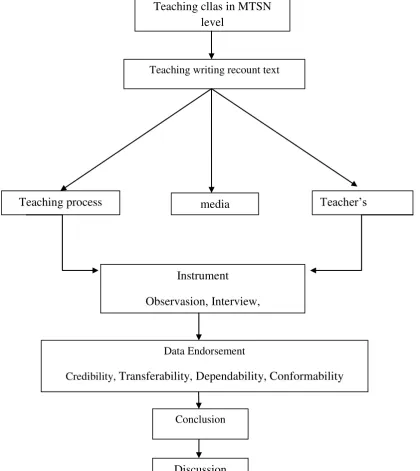
The collect the data there are several steps an explained infigure 3.2
Figure 3.2 the steps in collecting and analyzing data. Teaching cllas in MTSN
level
Teaching writing recount text
Teaching process media Teacher‟s
evaluate
Instrument Observasion, Interview,
Documentation
Data Endorsement
Credibility, Transferability, Dependability, Conformability
Conclusion
CHAPTER IV
RESEARCH FINDINGS RESULT AND DISCUSSION
This chapter discusses the findings of the research. The researcher then attempts to give discussion of those findings and results in order to find the answer of the questions study.
A. Data presentation
Based on the background above, the central of this research is how is the process the Teaching and learning of writing recount text in English eight grade student of MTSN 2 Pulang Pisau they are: 1).what does the teacher use material in teaching learning writing recount text?, 2) what does the teacher use media in teaching learning writing recount text?, 3).what the technique of t he teaching writing recount text at eight grade students of M T S N2 Pulang Pisau?
To answer the research problem, the researcher did observation in EFL class and interviews the teacher.
The research was conducted at MTSN 2 Pulang Pisau on July 19th until
September 19th 2017. The subject of this research was the English teacher who teaches eight grade students. The researcher chose VIII A, VIII B, and VIII C as representative classes. Since, there were two meeting of observations in each class; therefore, the researcher conducted six times observations. There were two different lesson plans in each meeting. In the first meeting the teacher used „Unforgettable Experiences‟ topic. In the second meeting the teacher used „Daily
Past Activities‟ topic. In this research, the researcher only focused on the process
of teaching writing recount text that related to its material, techniques, and media. Besides that the researcher also found out the interrelation of material, media, and techniques in teaching writing recount text and its implementation in classroom.
1. The way the teacher use material in teaching writing recount text in class
To describe the way the teacher use material in teaching writing recount text.Theresearchermaterial observed 1- 6 the class as illustrated the discussion bellow:
Teacher: Asalammualaikumwr. wbSalam, Good morning students . Student : Walaikumsalamwr. WbGood morning, sir .
Teacher: How are you today ?
Student: We are fine. How about you sir ?
Teacher: I am fine, thanks. Let me call you one by one to check presentation.
Student: Oke sir .
Teacher: Are you ready for learning today ? Student: Okay Sir, we‟re rready .
Teacher: (Teacher explained background of students). What are the moment the unforgotable in your life ?
Student: (The students answer it well), It‟s holiday or vacation Sir ! Teacher: Yeah ... the unforgotable moment is holiday. Now i want to
ask all fo you, what kind of the text about past experience ? Student: ( Students seem enthusiastic )
Teacher: Okay, today we‟ll learn about recount text. What are the generic structure and tenses that used in recount text ? Student: Orientation, complication, resolution.
Teacher: That‟s right (Then teacher explained about recount text in detail), now open your English book.
Student: Yes,Sir . (Students open the book and starting study).
that are used in recount text. Then, teacher mentioned learning objectives of study to students.
Beside doing observation to, get the data the researcher also made interview. It was done on Saturday 19 Augustus 2017 it begins at 10:04 – 11:05 in class VIII.
Dialing with the question:
“What are the books that used English teaching at class VIII? And
then is there any other source material that you used in taught
recount text except referencebook? For example ? And what is your
consideration to find other sources beside the reference book?” Mr.Imam Ibnu Maliki S.Pd ing said:
”(master bahasa inggris kelas 8. English focus .lks English on sky iya ada menggunakan internet karena di sekolah ini ada wifinya seperti kita ketahui zaman sekarang banyak anak- anak yang sudah biasa internetan jadi kita langsung menggunakan internet supaya materi kita tidak ketinggalan, dalam artian sudah baru. Selain itu di internet kita biasa banyak memberikan contoh pada siswanya seperti memberikan sebuah gambar lalu siswa mendeskripsikan gambar tersebut dengan membuat sebuah paragraph yang baik dan benar, kemudian siswa mengidentifikasi structure genericnya).A book that entitled “Master B.Inggris kelas 8.English Focus, LKS English on Sky and then, we used internet, because in school had wifi, as we know, this time many children able using internet, so we used the internet and make our material not obsolete and make new one. Beside that in internet we can gave them many examples like gave a picture then the students described about that picture and identified its generic structure. To make the material got more complete.”(Interview with respond on 19 Augustus 2017).
LKS English on sky then he explained the material about recount text and teacher also took that material from the internet.
2. The way the teacher use media in teaching writing recount text in class
To describe the way the teacher use media in teaching writing recount text the researcher observed 1-6 the class as illustrated the discussion bellow:
Teacher: (Teacher show a picture to the students). What is this ? Student: A camping picture,Sir.
Teacher: Oke good, then we are going to practice make a recount text about camping experience. In that sheet there are some blank words, so you have to fill in that blank word with the given word under the text. The time is 5 minutes, understood ?
Student: Yes, Sie. (Students finish their works) Teacher: Have you finished ?
Student: Yes, we have,Sir.
Teacher: Now discusses your answer.
Student: (The students come to the front of class and answer it on whiteboard. Teacher: Are they all correct ?
Student: Yes, Sir. (All of the students understand).
Beside doing observation to get the data the researcher also made interview. It was done on Saturday 19 Augustus 2017 it begins at 10:04 – 11:05 in class VIII. Dialing with the question:
”what does the teacher use media teaching writing recount text?”
Mr.Imam Ibnu Maliki S.Pd ing said:
“(cara saya menggunakan media tersebut adalah dengan cara saya memberikan sebuah serial gambar “camping” setelah itu saya bertanya kepada siswa gambar apa ini? Lalu saya juga menjelaskan tentang gambar tersebut dan mengaitkannya dengan penjelasan recount text. Lalu dalam gambar camping tersebut saya minta siswa untuk membuat paragraph yang baik dan benar, serta siswa menentukan generic structurnya pada paragraph yang telah siswa buat).May way using that media was give picture series “camping”, after that I ask to the student what the picture is? The explained that picture relate to recount text. The with that picture, I asked student make a good paragraph and student decide the generic structure on their own paragraph”.(interview with respond on 19 Augustus 2017).
Dialing with the question:
”What are the media that you usually use in teaching writing? And
did you always or sometimes use media when teaching? So, how thestudents‟ response when you taught used that media?”
Mr. Imam Ibnu Maliki S.Pd ing said:
From the data obtained above the research concluded that the way teacher used media the teaching writing recount text. Here the teacher‟s way using media is with picture and teacher explained about picture and then teacher ask the students to make paragraph and identified its generic structure.
3. The way the teacher use technique in teaching writing recount text in class
To describe the way the teacher use technique in teaching writing recount text. The technique researcherobserved1-6 the class as illustrated the discussion bellow:
Teacher: Do you understand about the material today ? Students: Yes sir we are understand.
Teacher: (After students have understood about the material given),Now i will give an evaluation sheet. This evaluation sheet has unarranged paragraph, to make you easier, I will give picture series on evaluation sheet.
Students: Yes, Sir.(Arrange the paragraph). Teacher: have you done arrange the paragraph? Students: done sir.
Teacher: after the paragraph rearrange, I want one of you to rewrite whole paragraph become a good text.
Students: (one of the students named anggi to write whole paragraph). Teacher: oke good, give applause to your friends. Oke students, then the
paragraph that arranged by your friends is good, now I want all of you to identify the generic structure.
Students: oke sir. (The bell is ringing).
Teacher: because the time is over, I want all of you to finish it at home. Thanks for your attention and don‟t forget the homework. Assalamualaikumwr.wb
Students: Walaikumsalamwr. wb.
the jumbled paragraph correctly. After the paragraph had been arranged, next, students were asked to rewrite the whole paragraph into a good text. Then the students identify its generic structure. The time was not enough to finish the evaluation, then, teacher closed the lesson.
Beside doing observation, to get the data the researcher also made interview. It was done on Saturday 19 Augustus 2017 it begins at 10:04 – 11:05 in class VIII. Dialing with the question:
”what you use technique the teaching writing recount text?”
Mr. Imam Ibnu Maliki S.Pd ing said:
”(cara teknik yang saya gunakan ini adalah dengan cara saya menerapkan penulisan sesuatu dengan tujuan kompetensinya. Lalu saya menyuruh menulis ulang paragraph dan membuat paragrapah berdasarkan serial gambar yang diberikan. Lalu saya meningkatkan pemahaman siswa tentang materi melalui teknik penulisan.teknik yang saya gunakan ada 6 teknik.teknik tersebut adalah the technique is picture sets technique, copy technique; examine sentences arrangement technique, completing technique, sentences combining technique, and parallel writing technique).The technique that I used was implementing the writing appropriate with the purpose of competence. Then I asked the students to rewrite the paragraph and make paragraph based the picture series given. Then I increase the students‟ understanding about the material through technique of writing. Then I used 6 techniques. The technique is picture sets technique, copy technique; examine sentences arrangement technique, completing technique, sentences combining technique, and parallel writing technique.”(Interview with respond on 19 Augustus 2017).
Dialing with the question:
”What kind of technique that you used to make the students easier
to understand the writing subject especially recount text? and then How the students‟ evaluation after you used that technique and
Mr.ImamIbnu Maliki S.Pding said:
“(fill in the blank, seperti yang saya jelaskan tadi saya menggunakan paragraph alasanya karena Siswa mudah mengerti terus lumayan baik siswa senagat begitu antusias dan mudah memahaminya dengan menggunakan teknik dan media yang saya gunakan).Fill in the blank, based on explain above, the reason for use paragraph was the students can easy to understand it and then the students were very enthusiastic and can easy to understand the material with May technique and media when I used it.”(Interview with respond on 19 Augustus 2017).
techniques above, the researcher can concludes that those techniques can we applied to help students in writing recount text, especially for junior high school students.
D. The Research Findings
1. Result Observation
Based on the result of observation and interview on data present, there were some process in teaching writing recount text. The process were material, media and
technique. As we know material was a source of learning that teacher used. While media was a tool to bridge the goal of the lesson. The last was a technique, it meant technique was any of wide variety of excersises, activites, or tasks used in the language classroom for realizing lesson objectives. The following text or paragraph was a
material, media and technique that teacher used to taught writing skill especially recount text ;
1. Teaching Material
Much of richness of language instruction is derived from supporting materials. The material uses also should be suitable with students‟ need. Therefore, textbook is
2. Teaching Media
Language teacher may use a variety of teaching aids to explain language meaning and construction, engage students in a topic, or as the basic of a whole activity (Harmer, 2001, p.134). In other word, it refers to media teaching. Media is such things that can be uses to distribute the message to sender to receiver to stimulate the sense, mind, attention, and the students‟ interest to build the teaching
learning process.
a. Visual media. It is maintain the students‟ interest by their visual. It is simple and easy to make it, and it is also cheap. The examples of visual media are pictures/photos, diagram, chart, graphs, poster, maps or globe, flannel board, bulletin board.
b. Audio media. It is maintain students‟ interest by their hearing. It is usually used by the teacher in listening class in native speaker sounds. The examples are radio, tape recorder, and laboratory.
c. Projected medium media. These kinds of media are spending long time to make and to operate, beside that need much cost. Nevertheless, nowadays most of them are usually taking over by computer to make it more efficient to use. The examples of projected media are slide, film strip, overhead projectors (OHP), film, loop film, television, and video.
3. Teaching Technique
other words, techniques include all tasks and activities. They are the product of a choice made by the teacher.
There are several kinds of techniques in teaching writing according to Raimes (1983, p.176), those are:
a. Technique in Using Pictures.
1) One picture for many different techniques. (It can be used to description, comparison and contrast, paragraph assembly, sentences combining, paragraph completion, controlled composition, guided composition, role-play, questions and answer, beyond the picture), 2) One picture for a sequence of tasks, 3) Picture sets (suitable for writing narrative and for speculating about the story beyond the picture), 4) Diagram, tables, graphs, and charts (talks about the information presented), 5) Maps.
b. Technique in Using Readings.
1) Copy (practice with the mechanics of punctuation, spelling, capitalization, and paragraph indentation), 2) Examine cohesive links (learning how to connecting words or sentences), 3) Examine punctuation and grammar, 4) Examine sentence arrangement, 5) Summarize, 6) Completing, 7) Speculate (make speculation about the given text), 8) React (stimulate written communication through reading). c. Technique in Using All Language Skills
d. Technique in Teaching Practical Writing
1) Forms, 2) Letters, 3) Lists, 4) Daily notes, 5) Instructions e. Technique in Teaching Organization
1) Outlines, 2) Analysis, 3) Models, 4) From meaning to organization. f. Technique in Responding To Students‟ Writing
1) Written comments, 2) Talking about the paper, 3) Checklist (use it to analyze the writing assignment), 4) Students‟ responses to students writing, 5) Self-editing (develops and improves their writing), 6) Ways of dealing with errors (let the student‟s analyses the error).
The techniques of teaching writing above are as a reference to determine which techniques that will be appropriate to teach eight grade students. To determine which the suitable techniques are, it is considered based on the students‟ level, students‟ ability, and the syllabus. It could be one or more technique that will be used in once teaching process.
2. Result Interview
The interview was done on Saturday, September 19th 2017. The researcher interviewed the eight grade teacher to get further information. A guided interview sheet was used to guidance the researcher interview the teacher in well sequence. The teacher‟s opinion as a result of interview will be listed as follows:
2. In teaching English at eight grade classes academic year 2017/2018, the teacher uses textbooks such as English in Focus for Grade VIII Junior High School, English on Sky for Grade VIII Junior High School, Master English for Grade VIII Junior High School, and LKS.
3. There are the other materials which are usually used by the teacher in teaching writing recount text except the textbooks above; those are worksheet from internet and from the other reference books. For the observed classes, some worksheet source was taken from internet.
4. The consideration in searching the other material except the available text books is in order to increase the exits material.
5. The teacher sometimes uses media in teaching English.
6. The teacher usually uses pictures as a media in teaching writing.
7. In teaching writing recount text, the teacher also usually uses pictures as a media.
9. The students‟ respond when the teacher teaches English by used that media
(picture) is good and always enthusiastic.
10. The teacher ever