rl ,] l I 1
Abstrak
strogen, terutama isoJTavon, mulai
dari
bahan makanan yang efekfi
t o e s tr o g en y anI
me n &un t un g kan sis t e m kardiov a s kular, n tekanan darah. (MedJ Indones 2002; 11: 120-3)Abstract
I
and basic science, suSSest the plausibility ofa
causal, inverseblood pressure. (Med J Indones 2002;
1I:
120-3)Keywords: atherosclerosis, hypercholesterolemia, arterial compliance, blood pressure
lZ0
PawitanPhytoestrogens' beneficial
effects on
cardiovascular
system
Jeanne
Adiwinata
PawitanùIed J Indones
found
in
human
diets, while resorcyclic lactones
aremycotoxins that develop
in
stored
crops. Therefore
they
arenot true
phytoestrogens,and
phytoestrogens can besimply divided
into
3 classes.)The majority of
phytoestrogensfound
in
typical
human
diets are
the isoflavones and lignans,while
themajor phyoestrogen
consumedby
mostAsian populations
isisoflavones.'
This review provides
an
overview
of
the
potential
sources and bio-availabiliry of phltoestro gens particularlyisoflavones,
and
discusses
their
potential use
to prevent cardiovascular diseases.POTENTL{L
SOURCES OF ISOFLAVONES
The major
sourcesof
isoflavonesin Asian diet
are soy andits
products.The primary
isoflavonesin
soybeans are genistein, daidzein, a"rd their respective B-gtycosides (genistin and daidzin).ln
addition, rnuchlower
arnountsof
glycitein and
is
glycoside
(glycitin)
are
presentin
soybeans.b Humans consume soybeans and thefu productsin
many forms,including
whole soybeans, lempeh, tofu,Several
lines
of
evidence, including
epidemiological,
clinical tnal
and basic science, suggest theplausibility
of
a causal, inverse relationship belween phytoesfogensand
cardiovascular
disease.The well
establish low
ratesof
cardiovascular
diseasesand the high
intakesof
dielary
phytoestrogens
in
Asian
populationsrelative to those
in
other
industrialized countries
areconsistent
with the
potential protective
effect
of
phytoestrogens. l-3Phyloestrogens are
nalurally
occurring plant compounds that have 2-p henylnaphthalene-type chem-tcal structuressimilar
to thoseof
eslrogens.'Th"y
arefound in
manyhuman foodstuffs
including
beans, grains,
green vegetables,fruils,
and nuts.aPhytoestrogens are
flavonoids broadly
groupedinto
4main classes, isoflavones, lignans,
coumestans,
andresorcyclic
lactones.
The
three
first
mentioned
areDepartment of Histotogy, Faculty of Medicine, [Jniversity of Indones ia, J akarra, Indonesia
Soybean Roasted soybean Soy flour Soy granule
Textured vegetable proteins Protein isolate
Totu
Tempeh
Miso
t,176
-
4,215+2,661
2,0t4
2,404
2,261-2,295+ 62t
-987t
260-
532"865 389 -647+
Vol 1 1 , No 2, April
-
June 2002and
soy milk. The
concentrationsof
isoflavons
in
itsmajor sources are shov/ed in Table l.
Table
l.
The potential sources ofisoflavonsSource Concenhation (pglg)
Phytoestrogens
l2l
Once ingested, several factors influence
the
bio-availability
of
isoflavones,
i.e. intestinal
degradationby
colonic
microflora
andthe
presenceof hber
in
thediet, which conelate positively
v/ith
absorption.rTIIE POTENSIAL
USE OF PITYTOESTROGENS
TO
PREVENT CARDIOVASCIILAR
DISEASES
Epidemiological
studies
Epidemiological
studies revealed
low
rates of
cardiovascular
diseases
among
Asian
populations
whose diets
were rich
in
phytoestrogens,
relative
to
those
in
Western countries.
This
evidence
suggests aplausible
causal
inverse relationship
between phytoestrogensand cardiovascular
disease.However,
this
association
is
confounded
by other
concomitant
dietary differences,
making it difficult to
attribute
thelow
ratesof
cardiovascular
diseasesto
phytoestrogen intake.tFurthermore, the major sourceof
phytoestrogensin
As'ian diets are
soy
and
its
products,
that
contain
cholesterol
lowering
agents,such
asa-linolenic
acidand saponins. Therefore, the
low
ratesof
cardiovasculardiseases among
Asian populations might
beattributed
to
those agents,
though
the
hypocholesterolemic
effectsof safonins in huirans
*"
tiiit speculative.6
To
assessthe
potential use
of
phytoestrogens
toprevent cardiovascular
diseases,several studies
wereconducted.
Among those
studies,
a
cross
sectionalstudy showed
that
dietary isoflavone intake
wasassociated
with
reduced cardiovascular diseaserisk
in
postmenopausal
women.
In
this
study's
adjustedModihed from Tham et al, 1998r
* More than one lot were assaYed
BIOAVAILABILITY
OF
ISOFLAVONE
PHYTOESTROGENS
Phytoestrogens
in
plants
aredifferent from
that found
in
humans and animals.
To be
absorbedthey shoul(
be fermented/metabolized
by
gut microflora.
In
plants,some
isoflavons
are bound
to
sugar residue
to
form
glycosides,
which are
inactive.
When
the
sugarresidue
is
removed,
the
glycoside
form
becomesactive compounds.l'6
In
plants,
boththe glycoside
andaglycon forms are present.l
In
humans,
.isoflavoneaglycones
are
absorb
faster and
in greater, amounts
than their
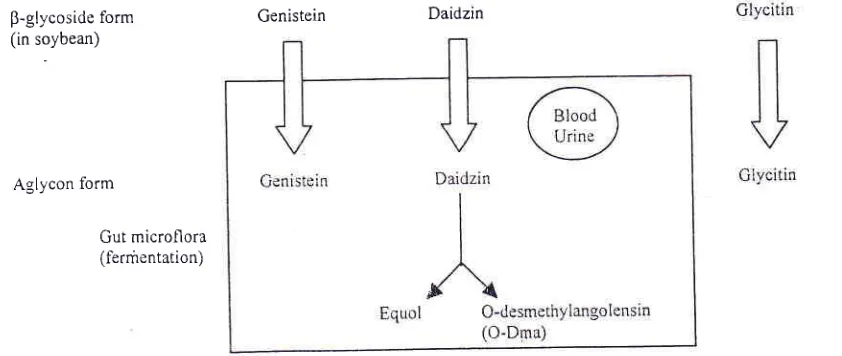
glycosides.TThe
conversion
processfrom
plant isoflavones
to
human isoflavons
detected in
blood
andurine
is showed inFigure
1.p-glycoside form (in soybean)
Aglycon form
Genistein Daidzin
Gut microflora (fermentation)
F f4 ,ii.
[image:2.612.70.491.546.724.2]122
Pawitananalyses,
genistein, daidzein,
and
total
isoflavone
intake were each positively
associated
with
HDL
cholesterol
and
inversely
associated
with
post challenge insulin.8Intervèntion study
An
intervention study
suggested
a
cardioprotective
role
for
supplemental phytoestrogen (isoflavone).
In
this
study, supplementation
of
34 mg
phytoestrogensfor 6
weeks showed improvements
in
lipid
andlipoprotein level,
and blood pressure.eMECHANISMS FOR
THE
CARDIOVASCULAR
PROTECTWE
EF'FECTS OFPHYTOESTROGENS
The
mechanisms
for
the
cardiovascular protective
effect ofphytoestrogens
areshown
by several studies.Phytoestrogens'
effect on atherosclerosis
A
study
showed
that
isoflavone
phytoestrogensreduced
tipid
peroxidation
in
vivo
and
increased theresistance
of
low-density lipoprotein
(LDL)
tooxidation. Isoflavones (genistein, daidzein
and equol)were also shown
asantioxidants
in vitro.
These factsmay
be a
significant
mechanism
in
reducingjhe
risk
of
atherosc leros is and cardiovascular' disease. I 0Furthermore, various studies
have
suggested
that genistein acts as a proteintyrosine
kinaseinhibitor.
An
increasein
tyrosine phosphorylation at tyrosine residuesof
plateletproteirs
is associatedwith
thrombin-inducedplatelet's activation. Therefore,
genistein as a tyrosinei.inus" inhibitor
is
though
to
be
responsible
for
a reductionin
the deposition and aggregationofplatelets,
and a
decreasein
the
progression
of
atherosclerosis. This thought is however opposedby
other workerswho
observed
that
concentrations
of
genistein
up
toTable 2. The dosage needed to get beneficial effect in various condition
Med J Indones
100
pglml,
had
no
significant effect
on
thrombin-induced
platelet
activation.
On the other hand
thoseworkers
demonstrated
that
daidzein,
which
has
noinhibitory
activity
for
tyrosine kinase,
and
aisogenistein were able
to
suppress
platelet
responses elicitedby
both collagen and thromboxane42.
However,
the
thought
that
genistein
and
daidzein
could
suppressplatelet activation was
opposed
by
aclinical
trial
involving
60
g/day
of
a
soy
protein
isolate
beveragepowder
for
28
days,
that
showed
adramatic
rise
in
plasma isoflavone
concentrations, detectedno
significant effect on platelet
aggregation.l2Therefore, more
sfirdieswill
need tobe
conducted toclariff
the
exact mechanism by,which
phytoestrogens affect various platelet responses.'Phytoestro
gens'
hypocholesterolemic effect
Several human
clinical
tials
with
phytoeshogens have reported inconsistent serum lipideffects,r
with
a bigger tendencyto
favorable effects.The
dose neededto
get a hypocholesterolemic effect is shown in Table 2.The mechanisms
for
thehypocholesterolemic effect
of
be
p-lor
of
Tof
particular significance
for
hyperlipidemics.
Lignans
may also affect cholesterol
homeostasis, asthey
havebeen
shown
to
inhibit the activity
of
cholesterol'7a-hydroxylase,
the
rate-limiting enzyme
in
thefàrmation
of
primary bite
acidsfrom cholesterol,r
Phytoestrogens' effects on
arteries
Soy
phytoestrogens
favorably influence
coronary
reactivity.
In
astudy
on theeffect
of
phytoestrogens(genistein,
phloretin, biochanin
A
and
zearalanone)on
isolated
rabbit coronary
artery
rings
showed that
genistein,
phloretin
and
biocha"rin
A
inducedSubject Phytoestrogens Dose/duration lmprovement
Perimenopausa[ women
Healthy, noffno-cholesterolemic, premenopausal women
Phytoestrogens tn soY
protetn
Conjugated isoflavones in soy product
34 mg in single dose or split into 2 doses for 6 weeks
45 mglday
Lipid and tipoprotein tevel, blood pressuret
[image:3.612.77.565.659.746.2]Vol I I, No 2,
April-June
2002significant
gender-independent
relaxation
in
rings
with and without
endothelium. This study demonstatedthat
phy-toestrogensinduce
endothelium-independentrela,xation
of
coronary
arteries.la'15
A
placebo-controlled
crossover
trial
tested
the
effects
of
phytoestrogens
in
the form
of
soy-isoflavones
in
peri- and
post-menopausal
women, and found
thatthe
systemic
arterial
compliance
(arterial
elasticity)
was
significantly improved
in
those
taking
soy-isoflavones.l6 Phytoestrogens
also inhibit
theprogression
of
atherosclerosis
in the
coronary,
iliac
and common carotid arteries.
The
cardiovascularbenefits
of
soy phytoestrogens appearto
be equalfor
males and females.la
In
anotherstudy
on humanaortic
smooth muscle cells(SMC),
phytoestrogens
may
confer protective
effectson the
cardiovascular system
by
inhibiting
vascularremodeling
andneointima formation.
In
conclusion,
phytoestrogens arestrongly
believed to have a potential role in thereduction ofcardiovascular
disease.The
mechanismsof
actionsmight
be throughblood
pressure
reduction, inhibition
of
lipid
peroxidation
andplatelet
aggregation,thus prevgnting
atherosclerosis,increasing
arterial
compliance
and/orhypocholesterolemic
effect.REFER.ENCES
l.
Tham
DM,
gardner CD, Haskel WL. Potential healthbenefits
of
dietary
phytoestrogens:a
review
of
theclinical, epidemiological,
and mechanistic evidence. J Cl in Endocrino I lvletab 1998;83 (7) :2223 -3 5.2.
Artaud-WildSM,
ConnorSL,
SextonJ,
Connor WE.Differences
in
coronary mortality can be explained by differencesin cholesterol and
saturated fat intakes in 40countries
but not
in
France and Finland.A
paradox.C irculation 1993 ;88:227 l -9.
3.
Keys A, Menotti{
Aravanis C, et al. The seven countriesshrdy:2,289 deaths in l5 years. Prev Med 1984;13:141-54.
4.
van der SchouwYT, de
Klein MJ, Peeters PH, GrobbeeDE.
Phy,to-oeshogens and cardiovascul.ar disease risk.Nutr Metab Cardiovasc Dis 2000;10(3):154-67.
Phytoestrogens
123Wildman REC, Medeiros DM. Nutrition supplement and
nutraceuticals.
[n:
Wildman REC,
Medeiros Divt.
Advanced humanNutrition.
Boca Raton: CRC Press; 2000. p. 367-398.Nlessina
MJ.
Legumes and soybeans: overviewof their
nuhitional profiles and health effects.Am J
Clin
Nutr1999;70(suppl):43 9S-50S.
Izumi T, Piskula
MK, Osawa S, Obata A, Tobe
K,
Saito M, et al. Soy isoflavone aglycones are absorbed faster andin higher amounts than their glucosides in humans. J Nutr
2000; I 30:1695-9.
Goodman-Gruen
D.
Kritz-SilversteinD.
Usual dietary isoflavone intake is associated with cardiovascular diseaserisk
factorsin
postmenopausal women.J
Nutr
2001;13l:1202-1206.
Washburn S, Burke GL, Morgan T, Anthony M. Effect
of
soy protein supplementation on serum lipoprotein, blood pressure, and menopausal symptoms inperimenopausal women. Menopause 1999;6(l):7-13.
Wiseman
H,
O'Reilly JD, Adlercreutz
H,
Mallet
AI,Bowey
EA,
Rowland
IR.
Isoflavone phytoestrogens consumedin
soy decrease F2-isoprostane concentrationsand
increase resistanceof
low-densify lipoprotein to oxidation in human. Am J Clin Nutr 2000;72(2):395-400. Nakashima S, KoikeT, Nozawa
Y.
Genistein, a proteintl,rosine kinase inhibitor, inhibits thromboxane A2- mdiated human platelet responses. MoI Pharmacol 1990;39:475-80.
Gooderham
MJ,
AdlercreutzH,
OjalaST, Wahala K,
HolubBJ.
A
soy protein isolaterich in
genistein anddaidzein and its effect on plasma isoflavone concentration,
platelet
aggregation,blood
lipids and
fatty
acidcomposition
of
plasma phospholipidin
normal men. JNutr 1996;126:2000-6.
Sirtori CR. Lovati MR, lvlanzoni C, Monetti M, Pazzuconi
F,
Gatti
E.
Soy and
cholesterol reduction: clinicalexperienco. J Nutr 1995;125(Suppl):5985-605S.
Clarkson TB, Anthony MS. Phy4oestrogens and coronary heart disease. Baillieres
Clin
EndocrinolMetab
1998;12:589-604.
Figtree GA, Griffiths H, Lu YQ, Webb ClvI, Iv{acteod K, Collins P. Plant-derived estrogens relax coronary arteries
in-vitro by a calcium antagonistic mechanism. J Am Colt Cardiol 2000;35: 1977-85.
Nestel PJ, Yamashita T, Sasahara T, Pomeroy S, Dart A, Komesaroff P, et
al.
Soy isoflavones improve systemic arterial compliance but not plasma lipidsin
menopausaland perimenopausal
women. Arteriosclerosis 1997;17:3392-8.
6
9
t0
ll
l2
t3
l4
l5
l6
.i
ai