J.Food Pharm.Sci. 5 (2017) 24 – 34
Avalaible online at www. jfoodpharmsci.com
Research Article
Investigation of Effect of Extensively Used Polymers on
Thermoreversible Properties of Pluronic
®
Tri-Block Polymer
Nilesh Ramesh Rarokar
1, Suprit D Saoji
1, and Pramod Khedekar
11 Department of Pharmaceutical Sciences Rashtrasant Tukadoji Maharaj Nagpur University Nagpur (M.S.), India
440033
ARTICLE INFO ABSTRACT
Received 09/06/2017
Received in revised form 17/07/2017 Accepted 11/08/2017
Available online 15/09/2017
Email:
[email protected] [email protected]
1. Introduction
The tri-block copolymers have more importance in fabrication of in situ gelling system for the delivery of various kinds of drugs, which can be administered by topical, opthalmic or parenteral routes. In situ gelling systems are the liquid formulations generating a solid or semisolid depot after administration (Packhaeuser C.B. et al. 2004, Eve Ruel-Garie´py and Jean-Christophe Leroux, 2004). These types of system have wide range of biomedical applications, such as drug delivery, tissue repair and cell encapsulation (Hoffman A. S., 2012, Qiu Y., and Park K., 2012). They are found to be more advantageous than the other traditional form of drug
delivery systems. Pluronic® F127 is a category of
non-toxic, water soluble, biodegradable tri block copolymer, which composed of polyethylene oxide (PEO) /polypropylene oxide (PPO)/polyethylene oxide (PEO) units. The tri-block copolymers having application in formulation of in situ gelling system and these are known for exhibiting the sol-gel transition property under a certain temperature (Gilbert J.C. et al., 1987). The sol-gel transition increases the application of poloxamer in pharmaceutical field. The US FDA guideline has presented Pluronic® F127 as an safe, inactive, low
toxic, biodegradable ingredient for different types of preparations because of their chemical inertness (e.g., This investigation presents a study on the effect of various polymers on gelling properties of tri-block (Pluronic®) copolymers and increasing the stability
parameter of in situ gelling system by altering their composition. The tri-block copolymers finds their importance in fabrication of in situ gelling system for the delivery of various kinds of drugs, which can be administered by topical, ophthalmic or parenteral routes. Pluronic®, is a category of non-toxic, water
soluble, biodegradable poly (ethylene oxide)/poly (propylene oxide)/poly ethylene oxide), tri-block copolymers which have application in formulation of various in situ gelling systems. This formulation undergo thermo-reversible gelation, where it exists as a free flowing liquid at low temperature and gels in the range of body temperature to form stable depot in aqueous environment. Gelling system was prepared according to the 'Cold Method' using different concentration of polymers (15% to 20% w/v) and subjected to the determination of gelation temperature (GT), viscosity study and effect of various polymers on the strength of gelation. Overall study on the gelation of system at particular temperature is the important parameter for formulation of in situ drug delivery system. It was established that addition of 0.5% w/v of HPMC K4M into gelling system make it stable for forming gel in the range of body temperature whereas methyl cellulose, carbopol 934P, and HPMC E-5 restrict the gel formation.
IV, inhalation, oral solution, suspension, ophthalmic or topical formulations) (Rowe R. et al., 2005).
The hydrophobic group of tri-block copolymer can increases the sol-gel transition and minimal the concentration of polymer required for sol-gel transition (Niu G. et al., 2008). The rheological properties of Pluronic® show temperature dependence along with the
chemical cross linking or entanglement of structures. As the internal cross linking of gelling system increases the sol-gel transition temperature decreases. Hence, the alteration in the cross linking capacity of copolymers the thermoreversible properties can also be improved. Simultaneously, the chemical cross linking of the tri block copolymer is responsible for the mechanical strength of the gel, lesser the cross linking soften the gel whereas greater the cross linking harder the gel. It means the increase in cross linking will improve the mechanical strength of the copolymers and ultimately the improvement in stability of gelling system whereas the gelation temperature of Pluronic® solution might be
altered by addition of various polymeric materials as well as drug addition also shows effect on that (Dumortier G.
et al., 2006). Thermally induced gelling systems show
thermoreversible sol-gel transitions and are
characterized by a lower critical solution temperature (LCST). They are liquid at room temperature and
produce a gel at or above the LCST (Eliaz R. et al., 2000).
Previously we prepared such type of
thermoreversible drug delivery system by incorporation of cubosome containing docetaxel trihydrate which is an anticancer agent. The incorporation of the drug-loaded cubosomes into a thermoresponsive gelling system results in a slower and a prolonged drug release.
According to the results of this study, a
thermoresponsive depot system based on Pluronic® (F127 and F68), containing cubosomal DTX, can be developed for a controlled drug delivery. The cubosome containing thermoresponsive depot formulation was found to be free flowing at ambient temperature and
formed a depot gel at body temperature (i.e. 37°C)
(Rarokar N. et al., 2015). Hence, the cubosome based
thermoreversible gel formulation may provide a possible solution to improve therapeutic efficiency of drug. Such systems are more useful for the delivery of cells or biopharmaceuticals that are susceptible to heat or
organic solvents (Lee J. et al., 2006).
The aqueous solution of Pluronic® is liquid at room
temperature and converted into the semisolid gel at a higher temperature (Gang Wei et al. 2002). This thermogelling property of tri-block polymer is applied to prepare thermosesnsitive formulations, however some drawbacks like low mechanical strength and less stability make it unfavourable for application in commercial drug formulations. These problems lead to instability of in situ
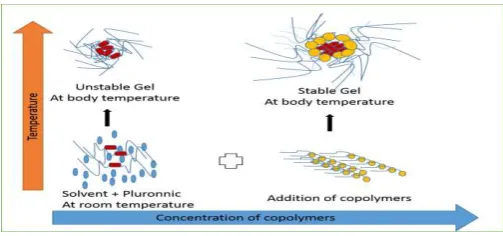
gelling system after administration. These issues can be sort out by altering the composition of gelling system using other copolymers along with the Pluronic® triblock
copolymers.
Aim of this study was to investigate the effect of various copolymers on gelling properties of Pluronic®
triblock copolymer and increase the stability of in situ
gelling system by altering their composition. Docetaxel trihydrate (DTX) was used as a model drug for this study and the effect of drug on the mechanical strength of gelling system was also studied.
Fig. 1. Effect of copolymers on mechanical strength and stability of gelling system
2. Materials and Methods 2.1. Materials
Docetaxel trihydrate was obtained as a gift sample from Scino Pharmaceuticals Pvt., Taiwan, Pluronic® F127 All other chemicals used in this study were of analytical grade.
2.2. Preparation of gelling system
Gelling system was prepared according to the Cold Method given in our previous article (Rarokar et al., 2015) with slight modification. Pluronic® F127(15-20%w/v)
and Pluronic® F68 (20-40%w/v) were weighed accurately
and solubilised in 15 mL of distilled water in a beaker with continuous stirring on magnetic stirrer at a speed of 500 rpm for 2hrs. The temperature of water maintained at 4±2°C. This mixture was then subjected to hydration at 4-8 °C overnight to get uniform glassy solution. The copolymers like methylcellulose (0.3-1.0% w/v), carbopol 934P (0.1-0.3%w/v), HPMC E-50 (0.3-1.0%) and HPMC K4M (0.3-1.0%w/v) was added separately with continuous stirring to prepared different batches. The weighed amount of drug (2%w/v) was dissolve in ethanol to make slurry. The drug slurry then mixed in the above homogeneous mixture. The final volume was made up and pH of the homogeneous mixture was adjusted to 7.0 using triethanolamine, whereas mixture containing carbopol 934P was adjusted to pH 5.8. The prepared gelling system was then subject to different evaluation parameters to study the effect of concentration of different copolymers onto the thermal properties of Pluronic®.
2.3. Drug-Excipient Compatibilty Studies a. Thermal Analysis
mg sample wighed into each aluminium pans and was subject to heating at a rate of 10.0 °C/ min from 0 °C to 400 °C. Nitrogen at a flow rate of 40 mL/min was used as a purge gas in DSC analyses. The results were analysed using the universal Analysis software version 4.5A, build 4.5.0.5 (TA Instruments, Inc., New Castle, DE, USA).
b. FTIR Spectroscopy
To determine any possible interactions, the physical mixtures of the drug (DTX) and the tri-polymers were analyzed using the Fourier transformed infrared (FTIR) spectroscopy. Briefly, the samples were dried in a hot air oven at 50°C for 2 h. The samples were compressed under pressure of 10 t/nm2 to prepare circular KBr disks. The samples were scanned in the range of 400 to 4000 cm−1. The shifts in the spectra of the drug in the presence of polymers and other components were investigated to determine physical interactions between the drug and the polymers, if any.
2.4. Viscosity Study of Polymers
The viscosity of homogeneous mixture prepared with Pluronic® tri-block copolymers were measured by
using DV-E Brookfield viscometer using small sample adaptor with spindle 63 for 19.1± 0.5°C and LV2 spindle for 37± 0.5°C. The Various concentrations of Pluronic®
F127 (15-20%w/v) and Pluronic® F68 (20-40%w/v)
previously prepared homogeneous mixtures were poured into adaptor of viscometer and angular viscosity was increase3d gradually from 10 to 100 rpm with time interval of 6 seconds at each speed. Same process was repeated for the reverse speed (100 to 10) with a similar time interval of 6 seconds. The results were calculated for mean± standard deviation(n=3). Similarly experiment was repeated for gel at 36.7°C to determined the viscosity by using spindle LV 2.
2.5. Measurement of Gelation Temperature by Tilting Method
The gelation temperature measurement was done by previously reported 'Tilting Method' (Tirnaksiz et al.,
2005). The gelation temperature (GT) was recorded for different batches of homogeneous mixture of tri-block
copolymer with different concentration with and without a model drug docetaxel trihydrate. Aliquots (1 mL) of prepared formulation were sealed and transferred to test tubes in the water bath at 4 ± 0.5°C then temperature was increased by 2 ± 0.5°C per step until 30 ± 0.5°C and then increment with 1°C in the region of sol-gel transition temperature. Gelation is the temperature that the meniscus would no longer move upon tilting through 90°. The method was very reproducible, giving coefficients of variation of less than 2% (n = 4).
3. Results
3.1. Drug-Excipient Compatibility Studies a. Thermal Analysis
The compatibility study of drug-polymer was studied by thermal analysis. DSC thermogram of docetaxel trihydrate exhibits a sharp endothermic peak at 227.82 °C which corresponds to its melting point. This peak of drug was not found in the DSC thermogram of polymer solution containing the drug. It indicates that the drug was uniformly dispersed into the gelling system and did not have any interaction with the other ingredients of gelling system.
b. FTIR Spectroscopy
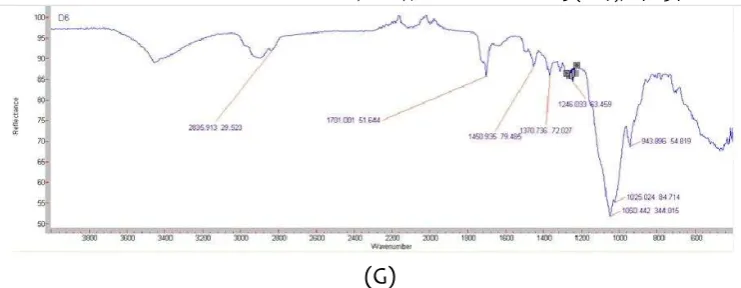
Drug-polymer interaction was determined by the FTIR analysis, the reports were found to be concurrent with a reference spectrum of docetaxel trihydrate. Docetaxel showed prominent peaks at 711.68, 850.55, 1099.35, 1168.78, 1245.93, 1712.67 and 3456.20 cm-1. The
characteristic peaks confirmed the structure of docetaxel trihydrate. These peaks were retained in the other spectra of drug with the tri-block copolymers i.e. Pluronic® F127 / F68 and copolymers Methyl Cellulose,
HPMC K4M, Carbopol 934P, HPMC E-50. The IR spectra did not show any shifting in the characteristic peaks of docetaxel as shown in Fig. 2. Hence, the FTIR study indicate that there were no positive evidences of interaction between docetaxel trihydrate and the employed polymers, this prove that drug is stable in presence of tri-block copolymers.
(B)
(C)
(D)
(E)
(G)
Fig. 2
:
FTIR spectra of Docetaxel trihydrate (A), Docetaxel trihydrate + Pluronic® F127 (B) and Docetaxel trihydrate + Pluronic® F68 (C), Docetaxel trihydrate+ HPMC K4M (D), Docetaxel trihydrate + Carbopol 934P (E), Docetaxel trihydrate + Methyl Cellulose (F), Docetaxel trihydrate + HPMC E-50 (G)3.2. Viscosity Study of Polymer
Results of viscosity study of Pluronic® F127 and F68
in different concentrations at various rpm shown are in the Table 1 and 2 respectively, it can be seen that as the concentration of Pluronic® F127 and F68 increases from
15% to 20%, the viscosity of polymer solutions also increases. Simultaneously, from Fig. 3 and Fig. 4, it becomes clear that the increase in speed of spindle of Brookfield viscometer result into the decrease in viscosity of Pluronic®® F127 and F68 respectively.
Table 1. Viscosity of Pluronic® F127 of Different Concentration at Various RPM
Fig. 3. Viscosity study of different concentration of Pluronic® F127 at various RPM
Table 2. Viscosity of Pluronic® F68 of different concentration at various RPM
Pluronic® F68 15% 16% 17% 18% 19% 20%
Concentration w/v w/v w/v w/v w/v w/v
RPM Viscocity (cP)
Fig. 4. Viscosity study of different concentration of Pluronic® F68 at various RPM
3.3. Gelation Teperature Study
a. Gelation Temperature of Pluronic ® F127
The GT was recorded for Pluronic® F127 gel alone
(GT1) and with drug (GT2). The Table 3 presents that the GT1 and GT2 decreases with increase in polymer concentration from 15- 20 % w/v as depicted in Fig. 5.
14 16 18 20 22 24
Fig. 5. Determination of GT of different concentration of Pluronic® F127 with and without drug
Table 3. Gelation temperature of Pluronic F127 of various concentrations with and without drug
Sr. No. Concentration of GT (°C) GT with drug (°C)
b. Gelation Temperature of Pluronic ® F68
The Fig. 7 clears that the GT of Pluronic® F68
without drug (GT3) decreases with increase in Pluronic®
F68 concentration. While GT of Pluronic® F68 with drug
Pluronic® F127 15% 16% 17% 18% 19% 20%
Concentration w/v w/v w/v w/v w/v w/v
(GT4) was found to be slightly increased as compared to the Pluronic® F68 alone but decreased with increase in concentration of Pluronic® F68.
10 15 20 25 30 35 40 45 50 docetaxel trihydrate (0C) T
2
Concentration of pluronic F68 (% w/v)
G
Fig.6. Determination of Gelation temperature of different concentration of Pluronic® F68 with and without drug
Table 4. Gelation temperature of Pluronic F68 of various concentrations with and without drug
Sr. No. Concentration of GT (°C) GT with drug (°C)
c. Gelation Temprature of Pluronic ® F127 and Pluronic ® F68 in Combination
Pluronic® mixture of Pluronic® F127 and Pluronic®
F68 were selected due to their thermo-gelling property. The GT of gelling system containing 15-18 % w/v concentration of Pluronic® F127 was found to be more by
37 °C. Whereas, 20% w/v Pluronic® F127 shows the GT
around 25°C, but it is not easy to administer due to increase in viscosity at the room temperature. The concentration of Pluronic® F68 at 25, 30, 33, 35 % w/v
showed GT 63o, 48o, 40o, 37o C respectively. It also
exhibit increased viscosity which makes it difficult to administer, so the combination of both the tri-block copolymer was used in various ratio for the preparation of gelling system. The results depicted in Table 5, shows that there was decrease in GT up to 30 °C for 18/20 ratio of Pluronic® F127 and Pluronic® F68. This makes the
combination more suitable for preparation of gelling system.
Table 5. GT of Pluronic® at various concentrations in combination (Pluronic® F127/ Pluronic® F68) with or without Docetaxel trihydrate.
3.4. Effect of Various Copolymers on the GT of Pluronic ® F127 and Pluronic ® F68
a. Effect of Methyl Cellulose on the GT of Pluronic ® F127
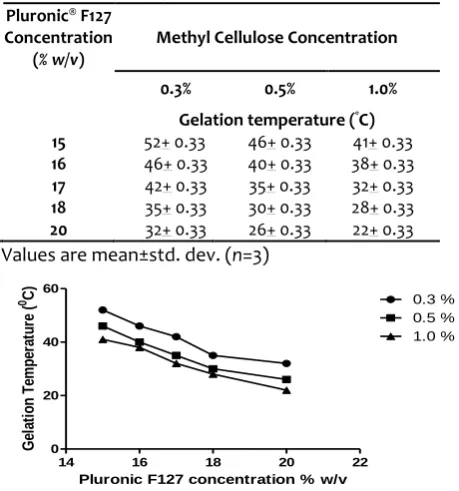
The effect of concentration of methyl cellulose was investigated on the GT of Pluronic® F127 as depicted in
Table 6. At the given concentration of Pluronic® F127
(15-20% w/v), the GT decreases with increase in concentration of methyl cellulose from 0.3-1.0% w/v (Fig.7). The gelling solution prepared by 0.3% w/v methyl cellulose was found to be clear and transparent than 1.0% and 0.5% but have high GT. Whereas 0.5% methyl cellulose gives transparent solution with low GT as compared to the 0.3% and gelling solution containing 1.0% methyl cellulose showed opaque appearance.
Table 6. Effect of Methyl Cellulose concentration on GT of
Fig. 7. Effect of various concentration of Methyl cellulose on GT of Pluronic® F127
Table 7. Effect of Methyl Cellulose concentration on GT of Pluronic® F68
Values are mean±std. dev. (n=3)
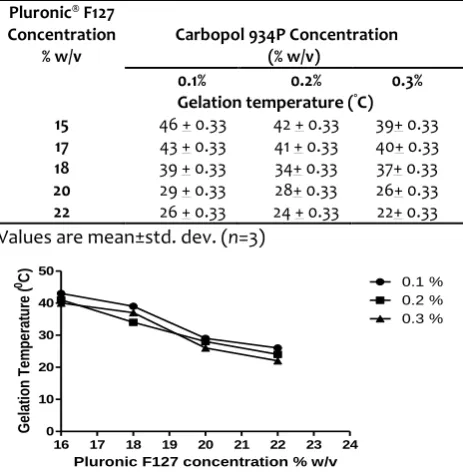
c. Effect of Carbopol 934P on the GT of Pluronic ® F127 Carbopol 934P was used as gelling agent that concentration of carbopol 934P as shown in Fig.8. Since, increase in the temperature results into the sol-gel transformation of Pluronic® solution but the presence of
carbopol restrict the gel formation after particular temperature and results in to the decreased in viscosity.
Table 8. Effect of Carbopol 934P concentration on GT of Pluronic® F 127. Values are mean±std. dev. (n=3)
16 17 18 19 20 21 22 23 24
Fig. 8. Effect of various concentration of Carbopol 934P on GT of Pluronic® F127
d. Effect of Carbopol 934P Concentration on GT of Pluronic ® F68
Carbopol 934P in the various concentration from 0.1 to 0.3 % w/v when used as a copolymer with Pluronic®
F68 for preparation of gelling system, it was found that as the concentration of carbopol 934P increases from 0.1 to 0.3% w/v the GT of Pluronic® F68 gradually decreases
up to certain extent but did not reaches around the normal body temperature. At higher concentration of Pluronic® F68 40% w/v and 0.3% w/v of Carbopol 934P
gelling system shows GT about 40°C and the system was found to be more viscous.
Table 9. Effect of Carbopol 934P concentration on GT of Pluronic® F68
Fig. 9. Effect of various concentration of Carbopol 934P on GT of Pluronic® F68 10). The addition of 0.5%w/v HPMC K4M into the gelling system shows the GT in the range of body temperature and found to be stable at 37 °C for more than 6 hour which supports the data retrieved for improvement in gel strength of the gelling system of Pluronic® F127.
14 16 18 20 22 24
Fig.10. Effect of various concentration of HPMC K4M on GT of Pluronic® F127
f. Effect of HPMC K4M Concentration on the GT of Plurinic ® F68
The study to determine the effect of addition of copolymer on the different concentration of Pluronic®
F68 revealed that the addition of HPMC K4M in the concentration of 0.3, 0.5 and 1.0 % w//v to the gelling system prepared by Pluronic® F68 results into the
significantly decrease in GT upto the range of body temperature. This study shows that little increase in the concentration of HPMC K4M form stable gelling system with lower GT.
Table 11. Effect of HPMC K4M concentration on GT of Pluronic® F68
Pluronic® F68
Fig.11. Effect of various concentration of HPMC K4M on GT of Pluronic® F68
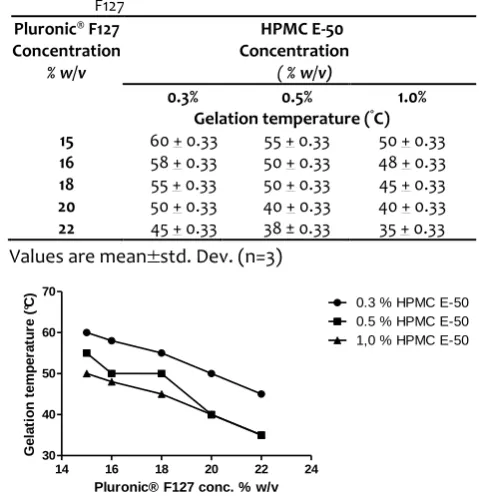
g. Effect of HPMC E-50 Concentration on Gelation Temperature of Pluronic ® F127
Results depicted in the Table 12 shows that addition of HPMC E-50 in the concentration of 0.3 to 1.0 % w/v decrease the gelation temperature with increase in concentration but not significantly reach the range of body temperature.
Table 12. Effect of HPMC E-50 concentration on GT of Pluronic® F127 Values are mean
±
std. Dev. (n=3)14 16 18 20 22 24
Fig.12. Effect of various concentration of HPMC E-50 on GT of Pluronic® F127
h. Effect of HPMC E-50 Concentration on Gelation Temperature of Pluronic ® F68
The effect of HPMC E-50 on the gelation temperature of Pluronic® F68 was found to be more
significant as compared to their effect on Pluronic® F127.
The increase in concentration of HPMC E-50 from 0.3 to 1.0% w/v helps to decrease GT of gelling system, at every stage of increasing the concentration of HPMC E-50 the GT was decreased by 5°C and it reaches 30°C ().
4. Discussion
The formulation of thermoresponsive gel which forms stable gel at ambient temperature in the range of body temperature is very difficult task. To achieve the desired outcomes the gelation property of tri-block copolymers need to alter with the use of various polymers. The tri-block copolymers find their importance in fabrication of in situ gelling system for delivery of different kind of drugs, which can be administered by topical, ophthalmic or parenteral routs. Pluronic®, is a
category of non-toxic, water soluble, biodegradable poly (ethylene oxide)/poly (propylene oxide)/polyethylene oxide), tri-block copolymers. The fabricated in situ gel shows thermo-reversible gelation which confirm by the existence of free flowing liquid at low temperature and undergo gelation to form stable depot at body temperature. The varying concentration of Pluronic® will
show effect on viscosity of formulation which results into the change in release of drug from the gelling system. The increased viscosity of polymer solution is also prone to difficulty in the handling and administration of gelling system. However, the gelation temperature of such a formulation is decreases as the concentration of Pluronic® increases but the viscosity
still one of the important parameter to fabricate ideal formulation/gelling system.
Though the Pluronic® is tri-block copolymer which
having property to form gelling system, it requires other copolymers which may be synthetic, semisynthetic or natural. However the natural polymers are always beneficial for the human biology but because of lack of desired physicochemical properties we cannot use it at every stage of formulation. Whereas synthetic polymers like HPMC, carbopol, methyl cellulose etc. have their own issues regarding biodegradability and biocompatibility so semisynthetic polymers are good option for fabrication of potential drug delivery system. Here in this study we investigate the effect of copolymers on the gelling properties to fabricate ideal thermoreversible gel simultaneously the dependent variables such as gelation time and gelation temperature also studied by altering the concentration of copolymers.
The previous literature shows that when we increase the temperature of polymer solution containing methyl cellulose beyond the critical temperature point (29± 2°C) the viscosity strongly increases and that results into the formation of thermoreversible gel the reason behind it the initiation of aggregation of particles to form pre-gel or loose gel domain showing shear thinning behaviour of the system. The author (Kobayashi et al., 1999) did not discussed about the exact concentration of methylcellulose needed for formation of stable gel.
When we used methyl cellulose as a copolymer or stabilizing agent along with the Pluronic® F127 and F68
the different results were obtained. The results depicted in this study shows that the increase in concentration of methyl cellulose (0.3%w/v to 1.0%w/v) in gelling system prepared with Pluronic® F127 leads to the decrease in
gelation temperature by 5°C. It forms opaque solution with increased viscosity and hence it was difficult to
inject. This system might be useful for thermoreversible gel but it was not so useful to form injectable gelling system. The Pluronic® F68 shows somewhat different
results when it was used in preparation of gelling system and the addition of 0.3-1.0% w/v methyl cellulose in to it results into the decreased in gelation temperature by carbopol 934P as a copolymer with Pluronics®. When the
concentration of gelling system was alter by addition of 0.1-0.3% w/v of carbopol 934P in gelling system prepared by use of Pluronic® F127, gelation temperature
continuously goes on decreasing with increase in the concentration of carbopol 934P. The gelation temperature with increase in concentration of carbopol 934P was found to be decreases but upto certain extent later on further addition it did not show any effect on gelation temperature, which may be due to the lack of water absorption sites on the surface of carbopol molecules.
From the results obtained after studying thermal behaviour of Carbopol 934P it was clear that the increase in concentration of carbopol 934P restrict the gel formation and ultimately the sol-gel transition was hampered. This gives the clue to use of carbopol 934P as a stabilizer in fabrication of thermoreversible gel rather than their use to improve gelling strength. Same study was carried out with Pluronic® F68 and carbopol 934P in
the concentration of 40% w/v and 0.3% w/v respectively which shows gelation at about 40°C and the system was found to be more viscous. This results proven the potential of Carbopol 934P to affect the sol-gel transition temperature which is exactly against the results depicted in previous literature (Asasutjarit R et al., 2011).
Mondal S. et al. were used HPMC E50LV as a copolymer with sodium alginate at the concentration of 1.5% w/w for the formulation of in situ ge and conclude that the use of HPMC E50LV in such a higher concentration gives transparent and clear free flowing gel which is very contraversial to the results obtained in our study (Mondal S. et al., 2012). In this study we
The investigation of effect of addition of HPMC K4M to the thermoreversible gelling system for altering the gelling properties of Pluronic® F127 and F68 revealed
that the 0.5% w/v of HPMC K4M shows better results than the previously added copolymers. The 0.5% w/v of HPMC K4M shows desire gelling temperature. However, other copolymer shows either higher or lower GT. In addition to that the introduction of HPMC K4M in 0.5% w/v concentration results into the formation of stable gel with improved gelling strength i.e. upto 6h the similar results were obtained when gelling system prepared with Pluronic® F68 but having issue with the
gelation temperature which was found to be more than the ambient temperature. The slightly increase in the concentration of HPMC K4M tends to form stable gel and lower GT. Hence the ultimate aim of the study was achieved by use of HPMC K4M as a copolymer in combination with Pluronic®.
5. Conclusion
Gelation temperature of the gelling system plays important role in the formulation of thermoresponsive depot system. As these formulations have GT near to the body temperature it opens the door for forming depot after insertion into the body, either in muscle or beneath the skin. So, it is necessary to optimize the gelation temperature of gelling system to form a potential depot system. In this study it was revealed that GT1 and GT2 of Pluronic® F127 decrease with increase in polymer
concentration. However, addition of 0.5% w/v of HPMC K4M into gelling system make it stable for forming gel in the range of body temperature whereas carbopol 934P and methyl cellulose restrict the gel formation. Besides the effect of addition of copolymer on the gelation temperature of gelling system, the role of model drug on the GT of system is also one of the major aspects as far as depot formulation is concern. Regardless of the other concentrations of the drug and polymers, the addition of 0.2% w/v docetaxel trihydrate increases the GT of polymer solution by 2-3°C. On the other hand presence of 0.5% w/v of HPMC K4M drops down the GT upto ambient temperature, which is the decisive factor for formation of in situ gel or depot system. Hence the prepared gelling system and the results obtained during this study can be utilized for the formulation of a potential depot forming drug delivery system.
References
An Y, Hubbell J A. Intraarterial protein delivery via intimallyadherent bilayer hydrogels. J Control Release 2000;64:205-215.
Asasutjarit R, Thanasanchokpibull S, Fuongfuchat A, Veeranondha S. Optimization and evaluation of thermoresponsive diclofenac sodium ophthalmic In-situ gels. Intl J Pharm 2011;411(1–2): 128-135.
Bochot A, Fattal E, Gulik A, Couarraze G, Couareur P. Liposomes dispersed within athermosensitive gel: a new dosage form for ocular delivery of oligonucleotides. Pharm Res 1998;15(9):1364-1369.
Burkoth A K, Anseth K S. A review of photocrosslinked polyanhydrides: in situ forming degradable networks. Biomaterials 2000;21:2395-2404.
Cao Y, Zhao N, Wu K, and Zhu X. Solution Properties of a
Thermosensitive Triblock Copolymer of N-Alkyl Substituted Acrylamides. Langmuir 2009;25:1699-1704. Cohen S, Lobel E, Trevgoda A, Peled Y. A novel in situ forming
phthalmic drug delivery system from alginates undergoing gelation in the eye. J Control Release 1997;44:201-208.
Dunn R L, English J P, Cowsar D R, Vanderbilt D P. Biodegradable in-situ forming implants and methods of producing the same. US Patent 1990;4: 938 763.
Dumortier G, J L Grossiord, F Agnely, and J C Chaumeil,
Areview of poloxamer pharmaceutical and
pharmacological characteristics, . Pharm Res
2006;23(12):2709-2728.
Eliaz R E, Kost J. Characterization of a polymeric PLGA-injectable implant delivery system for the controlled release of proteins. J Biomed Mater Res 2000;50:388-396. Eliaz R E, Szoka F C. Robust and prolonged gene expression
from injectable polymeric implants. Gene Ther 2002;9:1230-1237.
Eve Ruel-Garie´py, Jean-Christophe Leroux, In situ-forming hydrogels—review of temperature-sensitive systems. Eu J of Pharma and Biopharm 2004;58:409–426.
Gaikwad V et al. Formulation and evaluation of In-Situ gel of metoprolol tartrate for nasal delivery. J Pharm Res 2010;3:788-793.
Gang Wei, Hui Xu, Ping Tian Ding, San Ming Li, Jun Min Zheng, Thermosetting gels with modulated gelation temperature for ophthalmic use: the rheological and gamma scintigraphic studies. J Control Release 2002;83:65–74.
Gilbert J C, Richardson J C, Davies M C, Palin K J, and Hadgraft J, The effect of solutes and polymers on the gelation properties of pluronic F127 solutions for controlled drug
delivery, J Control Release ; : -118.
Haglund B O, Joshi R, Himmelstein K J. An in situ gelling system for parenteral delivery. J Control Release 1996;41:229-235. Haglund B O, Joshi R, Himmelstein K J. An in situ gelling system for parenteral delivery. J Control Release 1996;41:229-235. Hoffman A. S., 2012. Hydrogels for biomedical applications.
Advanced drug delivery reviews. 64, 18-23.
Hottori H., Uenoyama M., Kurita A., 2002. Photocrosslinkable chitosan as a dressing for wound occlusion and accelerator in healing process. Biomaterials 23, 833-840. Ishihara M., Nakanishi K., Ono K., Sato M., Kikuchi M., Saito Y.,
Yura H., Matsui T., Joshi A., Ding S., Himmelstrin. 1993. Reversible gelation compositions and methods of use. US Patent 5 252 318.
Kumar S., Haglund B. O., Himmelstein K. J., 1994. In situ forming gels for ophthalmic drug delivery. J. Ocul. Pharmacol. 10, 47-56.
Ishihara M., Obara K., Ishizuka T., Fujita M., Sato M., Nakanishi K., Ono K., Sato M., Kikuchi M., Saito Y., Yura H., Matsui T., Hottori H., Uenoyama M., Kurita A., 2002. Controlled release of fibroblast growth factors and heparin from photo-cross-linked chitosan hydrogels and subsequent effect on in vivo vascularization. J. Biomed. Mater. Res. 64A, 551-559.
Niu G., H. Zhang, L. Song, X. Cui, H. Cao, Y. Zheng, S. Zhu, Z. Yang, H. Yang, Thiol/acrylate-modified PEO-PPO-PEO triblocks used as reactive and thermosensitive copolymers, Biomacromolecules 9 (2008) 2621-2628. Ono K., Saito Y., Yura H., Ishizukawa K., Kurita A., Akaike T.,
Ishihara M., 2000. Photocrosslinkable chitosan as a biological adhesive. J. Biomed. Mater. Res. 49, 289-295. Packhaeuser C.B., Schnieders J., Oster C.G., Kissel T., 2004. In situ forming parenteral drug delivery systems: an overview. European Journal of Pharmaceutics and Biopharmaceutics 58, 445–455.
Qiu Y., Park K., 2012. Environment-sensitive hydrogels for drug delivery. Advanced drug delivery reviews. 64, 49-60. Qu T., Wang A., Yuan J., Shi J., Gao Q., 2009. Preparation and
characterization of thermo-responsive amphiphilic triblock copolymer and its self-assembled micelle for controlled drug release. Colloids and Surfaces B: Biointerfaces 72, 94–100.
Rarokar N R, Saoji SD, Raut NA, Taksande JB, Khedekar PB, and Dave VS, Nanostructured Cubosomes in a Thermoresponsive Depot System: An Alternative Approach for the Controlled Delivery of Docetaxel. AAPS PharmSciTech, Vol. 2015; 17(2):436-445.
Rowe R., P. Sheskey, and S. Owen, Pharmaceutical Handbook of pharmaceutical excipients, 5th edn., Pharmaceutical, London UK and American pharmaceutical association, Washington, USA, (2005).
Rozier A., Mazuel C., Grove J., Plazonnet B., 1989. Gelrite: A novel, ionactivated, in-situ gelling polymer for ophthalmic vehicles.Effect on bioavailability of timolol. Int. J. Pharm. 57, 163-168.
Shively M. L., Coonts B. A., Renner W. D., Southard J. L., Bennett A. T., 1995. Physicochemical characterization of polymeric injectable implant delivery system. J. C. Rel. 33, 237-243.
Srividya B., Cardoza R. M., Amin P. D., 2001. Sustained ophthalmic delivery of ofloxacin from a pH triggered in situ gelling system. J. Control. Rel. 73, 205-211.
Schmolka I. R., . Artificial Skin I. Preparation and
properties of Pluronic F- Gels for Treatment of Burns, J. Biomed. Mater. Res., 6, 571-582.