Full Terms & Conditions of access and use can be found at
http://www.tandfonline.com/action/journalInformation?journalCode=vjeb20
Download by: [Universitas Maritim Raja Ali Haji] Date: 11 January 2016, At: 20:59
Journal of Education for Business
ISSN: 0883-2323 (Print) 1940-3356 (Online) Journal homepage: http://www.tandfonline.com/loi/vjeb20
Applying What Works: A Case for Deliberate
Psychological Education in Undergraduate
Business Ethics
Christopher Drees Schmidt , Kathleen M. Davidson & Christopher Adkins
To cite this article: Christopher Drees Schmidt , Kathleen M. Davidson & Christopher Adkins (2013) Applying What Works: A Case for Deliberate Psychological Education in Undergraduate Business Ethics, Journal of Education for Business, 88:3, 127-135, DOI: 10.1080/08832323.2012.659295
To link to this article: http://dx.doi.org/10.1080/08832323.2012.659295
Published online: 20 Feb 2013.
Submit your article to this journal
Article views: 150
View related articles
CopyrightC Taylor & Francis Group, LLC ISSN: 0883-2323 print / 1940-3356 online DOI: 10.1080/08832323.2012.659295
Applying What Works: A Case for Deliberate
Psychological Education in Undergraduate
Business Ethics
Christopher Drees Schmidt and Kathleen M. Davidson
Villanova University, Villanova, Pennsylvania, USA
Christopher Adkins
College of William & Mary, Williamsburg, Virginia, USA
The teaching of business ethics continues to be a topic of great concern as both businesses and business schools seek to develop effective approaches for fostering ethical behavior. Responses to this objective have been varied, and consistent empirical evidence for a particular approach has not emerged. One approach, deliberate psychological education, offers a means for extending and integrating elements of developmental theory and has proven effective in professional settings, with college students, and recently, with undergraduate business students. The authors propose that this model be considered as an effective approach for business education programs and offer suggestions for integrating this model within undergraduate business curricula.
Keywords: cognitive developmental theory, deliberate psychological education, ethics, moral development, pedagogy, reflection
The multiple corporate scandals in recent decades continue to negatively impact the public’s trust in business (Kracher & Marble, 2008; Swanson, 2004). One dimension of the re-sponse effort has been to charge business schools with the responsibility of promoting increased levels of ethical train-ing with undergraduate students (Halbesleben, Wheeler, & Buckley, 2005; Swanson) especially given business schools are heavily criticized for producing graduates obsessed with making money regardless of moral consequences (Alsop, 2003). Business students cheat more, are less cooperative, and are more cynical than students from other majors (Brown, Sautter, Littvay, Sautter, & Bearnes, 2010; Covey, 2006; Frank, 2004; McCabe & Trevino, 1995). There are concerns in the literature that university education in vocational areas such as business is not accomplishing well the goal of moral development and that an ethical crisis exists within these disciplines (Cagle, Glasgo, & Holmes, 2008; Falkenberg & Woiceshyn, 2008; Mayhew, Seifert, & Pascarella, 2010;
Correspondence should be addressed to Christopher Drees Schmidt, Villanova University, Department of Education & Counseling, 800 Lan-caster Avenue, SAC-302, Villanova, PA 19085, USA. E-mail: christopher. [email protected]
McNeel, 1994; Nguyen, Basuray, Smith, Kopka, & McCul-loh, 2008). Among undergraduates, business majors were more likely to show significant decreases in principle reason-ing across their four-year programs. Additionally, graduate business students enter university with the lowest level of moral reasoning skills of any graduate students and are the only students to experience a decline in their moral reasoning upon graduation (Aspen Institute, 2003; Conroy & Nelson, 1989; Poff, 2007). More specifically, much of the business ethics education literature has focused on business schools’ need to increase efforts to foster moral reasoning develop-ment in students (Christensen, Pierce, Harmon, Hoffman, & Carrier, 2007), emphasizing that “sound moral reasoning is necessary for good business” (Kracher & Marble, 2008, p. 504). Hence, though it is accepted that higher levels of moral reasoning can positively impact ethical decision mak-ing, there remains a significant lack of ethics coursework in business curricula (Breaux, Chiasson, Mauldin, & Whit-ney, 2010) and a lack of coherence about the most effective pedagogies for enhancing moral development (Falkenberg & Woiceshyn; Mayhew & Engerg, 2010; Poff).
Deliberate psychological education (DPE; Mosher & Sprinthall, 1971; Sprinthall & Thies-Sprinthall, 1983) is
128 C. D. SCHMIDT ET AL.
grounded in cognitive developmental theory (Hunt, 1971, 1976; Kohlberg, 1968; Loevinger, 1976; Piaget, 1954) and seeks to positively impact the constructive nature of the meaning-making process through deliberate cognitive dis-course and instructor-assisted systematic personal reflection. The DPE model is designed to promote growth toward formal operations, increased psychological complexity, and identity formation (Brendel, Kolbert, & Foster, 2002; Royal & Baker, 2005) and has been repeatedly shown to promote moral rea-soning (principled) in different professions as well as assist-ing in the acquisition of desirable behavioral skills within professional roles (Neukrug & McAuliffe, 1993; Reiman & Peace, 2002; Royal & Baker; Sprinthall, Peace, & Kenning-ton, 2001). A recent DPE intervention with 178 undergradu-ate business students in a one-credit, semester-long course significantly increased student moral reasoning (Schmidt, McAdams, & Foster, 2009). Here we deliver a detailed ac-count of DPE and the unified and grounded framework it of-fers as well as its connection to some presently recommended teaching practices in business ethics. We suggest that this framework effectively responds to present business ethics education critiques. As university accreditation bodies call for more effective ethics coursework, determining the most beneficial delivery methods is critical (Breaux et al., 2010).
BACKGROUND
Intent on shaping effective and ethical future business lead-ers, recent literature addressing best practices in business ethics education emphasizes a strong commitment to consid-ering ethical dimensions throughout courses, curriculum, and academic communities in business education (Breaux et al., 2010; Business Roundtable Institute for Corporate Ethics, 2007; Poff, 2007; Wilhelm, 2008). Additionally, the litera-ture recommends developing pedagogy focused on enhanc-ing the moral reasonenhanc-ing capacities of students in order to prepare them for the ethical challenges they will face (Cain & Smith, 2009; Traiser & Eighmy, 2011).
To date, interventions toward these goals have consisted primarily of traditional classroom lectures coupled with case-study approaches, which introduce students to present ethical issues in business while providing frameworks for ethical analysis and decision-making (Adams, Tashchian, & Shore, 1999; Falkenberg & Woiceshyn, 2008; Fort & Zollers, 1999; Lampe, 1997; Sims, 2002; Wilhelm, 2008). Additionally, some programs have attempted to incorporate experiential learning approaches, ranging from role-playing, trips to local prisons, and various other service learning experiences (Bok, 1988; Bowden & Smythe, 2008; Castleberry, 2007; Kracher, 1999; Lampe; Sims).
Although some teaching techniques have successfully en-hanced student moral reasoning (Falkenberg & Woiceshyn, 2008; Nguyen et al., 2008), questions persist regarding the most effective educational interventions for promoting
eth-ical graduates (Breaux et al., 2010; Cagle et al., 2008) and the theoretical orientations that inform them. Various au-thors (King & Mayhew, 2002; Williams, Yanchar, Jensen, & Lewis, 2003) have emphasized that business ethics educa-tion interveneduca-tions must be grounded in relevant research and introduced early in the educational process when students’ character development is presumed to be in a more forma-tive place. Still, there is presently no accepted pedagogical model for this population (Breaux et al.; Cagle et al.). Inter-estingly, the educational intervention designed specifically to promote moral development, DPE (Mosher & Sprinthall, 1971; Reiman & Peace, 2002), has only once been applied in the area of business ethics education (Schmidt et al., 2009).
DELIBERATE PSYCHOLOGICAL EDUCATION (DPE)
Theory and Research
Based on cognitive developmental theory (CDT), DPE is a comprehensive theory of human development that explains how humans create meaning making systems used to in-terpret and make sense of their experiences in the world (Merriam, 2004; Merriam & Heur, 1996; Sprinthall et al., 2001). Educational efforts toward promoting growth in the moral domain of cognitive development stem from the work of Kohlberg (1976), and Rest, Narvaez, Bebeau, and Thoma’s (1999) and Rest, Narvaez, Thoma, and Bebeau’s (2000) neo-Kohlbergian approach. The tenants of CDT include, but are not limited to, the following: (a) individuals construct knowl-edge through experience; (b) development entails cognitive dissonance, and assimilation and accommodation assist in the process of equilibration; (c) cognitive and skill develop-ment occurs as an individual’s values and reasoning’s become more complex, integrated, and principled over time; (d) cog-nitive developmental growth is not automatic, but it occurs due to interactions within a supportive and progressively challenging context (Dotger, 2006); and (e) the process of cognitive development occurs in hierarchical and sequential stages (Cain & Smith, 2009; King, 2009; Zhang, 2002).
Adhering to these principles, DPE stimulates the cogni-tive and psychological processes that form individual mean-ing makmean-ing systems. DPE illustrates that the process of de-velopment occurs through person-environment interaction, wherein an individual is required to understand experiences in a more complex fashion and hence develop cognitively (Reiman & Peace, 2002; Reiman & Thies-Sprinthall, 1993; Royal & Baker, 2005). Individuals at higher levels of cogni-tive development have a propensity to function more effec-tively in a complex society; they tend to be more flexible, more adaptive, and more accurate in their responsiveness to change (Bennet-Levy, 2006; Duys & Hedstrom, 2000; Sprinthall, Reiman, & Thies-Sprinthall, 1996; Whiston & Coker, 2000). Additionally, those at higher levels are better
able to read and flex to changing circumstances, better able to take the emotional perspective of others, more tolerant of diverse perspectives, and more likely to find alternative solu-tions to problems (Brendel et al., 2002; Choate & Granello, 2006; Mudrack, 2003). DPE interventions performed with teachers at various levels of experience, law enforcement trainees, dentists, veterinarians, and multiple college student populations contribute to significant change in conceptual complexity, principled moral reasoning, as well as perfor-mance tasks (Bebeau, 1994; Clarkeburn, 2002; Duckett & Ryden, 1994; Kaiser & Ancellotti, 2003; Lawson & Foster, 2005; Morgan, Morgan, Foster, & Kolbert, 2000; Ponemon & Gabhart, 1994; Reiman & Peace, 2002; Reiman & Thies-Sprinthall, 1993; Royal & Baker, 2005; Self & Baldwin, 1994; Self, Olivarez, & Baldwin, 1994; Thies-Sprinthall, 1984).
Present business literature demonstrates the increasing recognition of CDT and moral development theory’s appli-cability to business ethics education (Bok, 2006; Falken-berg & Woiceshyn, 2008; Fraedrich, Thorne, & Ferrell, 1994; Izzo, 2000; Kracher, Chatterjee, & Lundquist, 2002; Mudrack, 2003; Poff, 2007; Traiser & Eighmy, 2011; Wil-helm, 2008). Authors have utilized these theoretical perspec-tives to conceptualize business student ethical development. Some of the suggested teaching strategies within business ethics education overlap with the instructional approach of DPE (e.g., Felton & Sims, 2005). However, the educational implementation of these perspectives has been haphazard at best (Traiser & Eighmy, 2011; Wilhelm, 2010; Nguyen et al., 2008), lacking the comprehensive connections to the theory’s major tenants and the conditions that stem from them.
DPE Conditions and Process
The DPE model identifies five necessary conditions of a learning environment in order for developmental change to occur (Reiman & Peace, 2002; Royal & Baker, 2005; Schmidt et al., 2009; Thies-Sprinthall, 1984), situating learn-ing in a social role-taklearn-ing context in which development is facilitated through collaborative activities, dilemma discus-sions, and active, guided inquiry. As mentioned, while some of these conditions have been implemented in business ethics education, all five are what constitute significant and replica-ble change. The first condition is that the learners experience a new and qualitatively significant role-taking experience (Poff, 2007; Wilhelm, 2008). The new role must require an advanced level of cognitive functioning from the learners’ present one, but it must not be so advanced that they become overwhelmed. Second, learners must be provided with care-ful and continuous guided reflection throughout the learn-ing process by a more capable other (Mayhew et al., 2010; Reiman & Johnson, 2003). Learners must be given ample op-portunities to reflect on and come to understand the unique meaning of their experience through activities such as small and large group discussions and journaling, whereby they
can balance their own perception of an experience with that of peers and the instructor (Poff; Wilhelm). This act includes both analysis (self-assessment) and metacognitive process-ing. A new experience alone is insufficient to promote devel-opment and hence, for cognitive growth to occur, reflection must be purposeful and continuous to ensure that the expe-rience has functional meaning to learners (Guiffrida, 2005; King & Kitchner, 1994; Sch¨on, 1983; Walsh, 2010); this balance describes the third condition. The fourth condition necessitates that the experience and reflection be continuous over time. Though 6–12 months is suggested (Rest, 1986), significant moral reasoning change has occurred in three-month-long interventions (Fischer & Pruyne, 2002; Griffith & Frieden, 2000; Schlaefli, Rest, & Thoma, 1985). Con-tinuity enables learners to accomplish the difficult task of incorporating newly acquired ways of making meaning. The final condition entails a combination of support and chal-lenge. Challenging learners to incorporate new systems for understanding their experiences requires that they also be supported through the pain and dissonance resulting from the abandonment of old systems (Kitchener, Lynch, Fischer, & Wood, 1993; Knowles, 1980; Maslow, 1968). Without ample individualized support and challenge, learners may revert back to the safety of old patterns of thought and action (Bower, Diehr, Morzinski, & Simpson, 1998).
DPE utilizes the Piagetian concept of facilitating cognitive growth through the establishment of a deliberate learner-to-environment mismatch in which learners are encouraged to use a mode of thinking one developmental level above their presently preferred one (Holloway & Wampold, 1986). Hunt (1976) stressed the importance of this Plus One approach as a means to encourage learners to pursue new levels of cognitive complexity without becoming overwhelmed in the task. An appropriately mismatched and individualized learn-ing condition enables changes in how one reasons cogni-tively and, thus, impacts future behaviors (Lawson & Foster, 2005). Though any strong university course should challenge students to higher levels of thinking, DPE is unique in that such challenges are individualized within reflective activities, paired with individualized support, and used in conjunction with the other conditions.
DPE Application
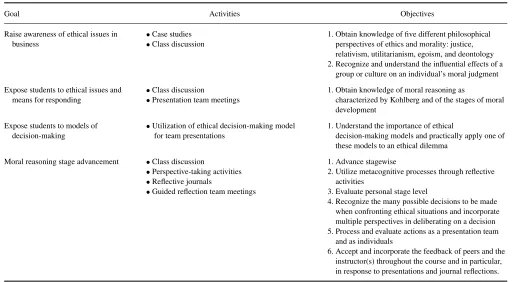
Adaptability to existing courses and curricula is a consis-tently reported strength of the DPE framework in previous applications. Therefore, satisfying the necessary DPE condi-tions in an existing course requires revision to only some as-pects of course content delivery, not the course itself. Table 1 outlines the goals, activities, and objectives utilized to orga-nize such a course. In line with a developmental model and a moral deliberation approach to teaching ethics, utilizing case studies for dilemma discussion and teaching the processes of psychological development (Falkenberg & Woiceshyn, 2008; Penn, 1990) remain requisite. With moral reasoning growth
130 C. D. SCHMIDT ET AL.
TABLE 1
Course Goals, Activities, Objectives in Relation to Deliberate Psychological Education
Goal Activities Objectives
Raise awareness of ethical issues in business
•Case studies •Class discussion
1. Obtain knowledge of five different philosophical perspectives of ethics and morality: justice, relativism, utilitarianism, egoism, and deontology 2. Recognize and understand the influential effects of a
group or culture on an individual’s moral judgment Expose students to ethical issues and
means for responding
•Class discussion
•Presentation team meetings
1. Obtain knowledge of moral reasoning as
characterized by Kohlberg and of the stages of moral development
Expose students to models of decision-making
•Utilization of ethical decision-making model for team presentations
1. Understand the importance of ethical
decision-making models and practically apply one of these models to an ethical dilemma
Moral reasoning stage advancement •Class discussion
•Perspective-taking activities •Reflective journals
•Guided reflection team meetings
1. Advance stagewise
2. Utilize metacognitive processes through reflective activities
3. Evaluate personal stage level
4. Recognize the many possible decisions to be made when confronting ethical situations and incorporate multiple perspectives in deliberating on a decision 5. Process and evaluate actions as a presentation team
and as individuals
6. Accept and incorporate the feedback of peers and the instructor(s) throughout the course and in particular, in response to presentations and journal reflections.
as a defining goal of the curriculum, the additional elements stemming from the DPE conditions should include (a) stu-dents engaging in written reflection via responses to prompts that highlight personal thought processes related to ethical reasoning; (b) instructor-assisted guidance through support and challenge by means of regular and detailed responses to the written reflections; (c) team evaluation of ethical dilemma case studies and a presentation of their findings and principles used for decision making; (d) face-to-face team reflections with one another and then the instructor postpresentation, focused on students’ intra- and interpersonal experiences; (e) directly and purposefully offering support and challenge to students in the classroom discussions to take multiple perspectives when considering the case studies and differ-ing student viewpoints; and (f) integratdiffer-ing micro and macro moral–ethical development assessments over the length of the course.
The DPE framework supports the emphasis of present business ethics education literature in that ethics courses should be grounded in moral philosophy and relevant re-search, applied to a present ethics course with minimal intru-sion, employ an analytical framework, attain concrete ethical knowledge and skills, illuminate the intrapersonal aspects of ethical development, increase self-understanding, develop an individual’s moral imagination, and clarify personal bound-aries (principles). DPE is designed to foster precisely this type of growth. Thus, on the basis of its pedagogical and professional relevance, the DPE framework emerges as one that seems particularly appropriate for responding to the
is-sue of teaching business ethics. Although only one study has examined DPE within undergraduate business ethics education (with promising results), its suitability is projected given its empirically proven effectiveness in a number of other fields. To illustrate, Table 2 outlines the delivery of one lesson, “A Stakeholder Analysis,” in a DPE-based business ethics classroom.
Implementing DPE Conditions
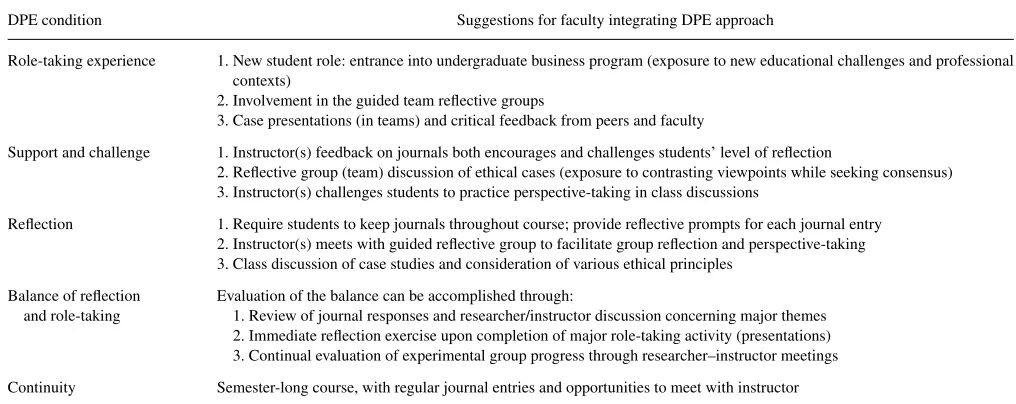
Table 3 highlights the critical instructional components re-lated to each of these DPE conditions. Entrance into under-graduate study, or specifically into an upper level business program and the new experiences inherent in it, can partially fulfill the role-taking experience necessary for this type of intervention. As noted in Table 3, student involvement in teams for presentations, reflective activities, and competitive business simulations can also satisfy this new role-taking ex-perience. The combination of the acts of deliberating within a small group, finalizing and delivering a presentation of the group’s work, and the guided reflection meetings that follow will likely suffice as experiences beyond student’s present zone of comfort. Because research shows that involvement in a service-learning experience, or peer helping relationship, that students can participate and reflect upon can additionally enhance moral reasoning capabilities (Comunian & Gielen, 2006), such activities could also be considered for inclusion. Students can receive different levels of support and chal-lenge during their coursework through multiple means:
TABLE 2
Deliberate Psychological Education (DPE) Lesson Plan
A stakeholder analysis (incorporating perspective-taking) DPE condition utilized Prior to class
Assignments 1. Reading: “A Stakeholders Approach to Business Ethics” (Weiss, 2003) 2. Case study: “An Education on Prescription Drugs” (Virginia Foundation for
Independent Colleges, 2005) In class
Review 1. Verbally summarize themes from the students’ written reflections, which have been responded to and returned electronically by instructor or assistant
1. Guided reflection 2. Support and challenge 2. Opportunity for student comments
Didactic 1. Review major points from reading 1. Balance 2. Use the case study from reading (Exxon Valdez) to emphasize topics from
reading
Team presentation 1. Brief review of dilemma 1. Role-taking
2. Stakeholders considered 2. Balance
3. Decision-making model utilized 4. Ethical principles utilized and emphasized 5. Three options for action
6. Reasoning behind final action choice
Discussion 1. Class questions and discusses team’s reasoning, option analysis, and offers suggestions
1. Support and challenge 2. Role-taking
2. Socratic dialogue Postclass
All students Reflection assignment: How important is it to acknowledge and incorporate multiple points of view when practicing moral deliberation? Why?
1. Guided reflection 2. Support and challenge 3. Balance
Presentation team Guided reflection team meeting immediately following the class
Additional journal question: What unique viewpoint did you bring to your group’s processing of your assigned ethical case in preparing for your presentation?
1. Guided reflection 2. Support and challenge 3. Balance
TABLE 3
Integrating Deliberate Psychological Education (DPE) Conditions Into an Undergraduate Course
DPE condition Suggestions for faculty integrating DPE approach
Role-taking experience 1. New student role: entrance into undergraduate business program (exposure to new educational challenges and professional contexts)
2. Involvement in the guided team reflective groups
3. Case presentations (in teams) and critical feedback from peers and faculty
Support and challenge 1. Instructor(s) feedback on journals both encourages and challenges students’ level of reflection
2. Reflective group (team) discussion of ethical cases (exposure to contrasting viewpoints while seeking consensus) 3. Instructor(s) challenges students to practice perspective-taking in class discussions
Reflection 1. Require students to keep journals throughout course; provide reflective prompts for each journal entry 2. Instructor(s) meets with guided reflective group to facilitate group reflection and perspective-taking 3. Class discussion of case studies and consideration of various ethical principles
Balance of reflection and role-taking
Evaluation of the balance can be accomplished through:
1. Review of journal responses and researcher/instructor discussion concerning major themes 2. Immediate reflection exercise upon completion of major role-taking activity (presentations) 3. Continual evaluation of experimental group progress through researcher–instructor meetings Continuity Semester-long course, with regular journal entries and opportunities to meet with instructor
132 C. D. SCHMIDT ET AL.
in-class instructor feedback, reflective dialogue through journal feedback, and in-person team guided-reflective groups. Within the stakeholder lesson (Table 2), students are challenged through course content discussion, ethical dilemma (case study) decision making, and more precisely within the guided reflection team meetings as well as the developing dialogue taking place within their reflective jour-nals. The instructor(s) can provide support for students’ understanding and processing of the content or case study and their willingness to engage themselves in the learning process, encourage their struggles with the dilemma, and provide empathetic responses to any challenges experienced with the material (i.e., prioritizing stakeholders, in-depth per-spective taking). As the most complex pedagogical require-ment of DPE, the instructor encourages a knowledge pertur-bation by differentiating the amounts of support, structure, and challenge offered to individual students; hence, the more intrapersonal reflective activities provide the greatest oppor-tunities for this condition.
Over the course of the semester the students should be increasingly confronted with more difficult content, more challenging case studies, and more complex dilemma discus-sions (Sims & Felton, 2006). Thus, students must consider a greater number of variables and consequently, the classroom discussions begin to highlight multiple ethical principles. As students gain comfort writing responses to reflective prompts, this DPE condition enables opportunities for more person-alized in depth responses to their journal entries and more complex questions about their reasoning process. For in-stance, if a student begins to explore concepts of fairness or equity when considering stakeholders, challenging person-alized responses might include facilitating further inquiry into the principles the student tends to utilize when defin-ing fairness or equity and the evolution of those principles. While many ethics courses intentionally provide increasingly challenging content, within DPE, the instructor(s) must con-sistently monitor and balance the supportive elements with the delivery of personalized challenges necessary to pro-mote growth (Faubert, Locke, Sprinthall, & Howland, 1996; Wilhelm, 2008).
A critical component of DPE entails the inclusion of pur-poseful reflective activities (guided inquiry). Business stu-dents in particular are rarely given sufficient opportunities to reflect on the content of their studies (Macfarlane, 1998; Poff, 2007). Students should be asked to write thoughtful and com-prehensive reflective journals over the course of the semester, which are reviewed and extensively commented on by the in-structor or an assistant. Inin-structors’ written responses should entail an understanding of the typical thought processes tak-ing place at each of the stages of moral development and an evaluation of what stage their responses evidence, and then encourage them to try and process the situation using reason-ing skills from one level above their present one. If a student prioritizes three stakeholders in their reasoning (self, stock-holders, customers) and evidences conventional reasoning
in the explanation, the instructor’s responses might include questions regarding the impact of a decision on other stake-holders (coworkers, general public, subordinates) and ask how considering the perspective of these others might impact the decision on the dilemma. Students may also be asked to evaluate their reasoning utilizing a standard moral develop-ment schema such as Kohlberg’s. Consistent and thoughtful responses using deliberate differentiation and questioning are not an effort to guide student understandings toward a partic-ular end, but rather an effort to encourage deeper reflections on the individual process experienced by the student.
Students should also be asked to discuss and reflect on dilemmas as a class and in small groups with the instructor providing encouragement and challenge to promote further reflection. As seen in Table 2, it is suggested that students par-ticipate in a postpresentation, reflective group in which they can share their individual experiences with the project as well as reflect on their particular group process. These meet-ings provide opportunities to support both their achievements and their struggles while integrating their understandings of how higher-level ethical reasoning impacts such a process. Because the presentation teams engage in a more in-depth exercise regarding the particular case study, multiple oppor-tunities for reflective dialogue on the process (not necessarily the content) are available: differing ethical principles, means and methods of reasoning, stage of reasoning, dominant per-spectives, and emotions experienced.
A DPE course design should be continuous in that stu-dents engage in the material and activities steadily over at least one semester. The DPE conditions are effective when students are given the time necessary to move through periods of disequilibrium and equilibrium within an action–inquiry framework.
SUMMARY
Despite the body of ethics education literature, very few studies have shown effectiveness in changing an individual’s ethical reasoning development through programmatic ethics training. Many interventions have succeeded in assisting stu-dents to identify certain ethical scenarios, but a change in the student’s moral reasoning did not occur (Halbesleben et al., 2005). Presently it should be clear, research based pedagogy or best practice is essential for business ethics education (Traiser & Eighmy, 2011). Initial results suggest that a DPE curriculum can impact business students as it has those in other fields of study; further evidence could provide the grounds for altering the way ethics is taught in busi-ness schools and provide a needed and established pedagogy (Cagle et al., 2008).
It should be noted that the DPE model as a whole could present some obstacles for consideration. For instance, fac-ulty may be reluctant to emphasize the psychological over the philosophical and organizational perspectives within their
classroom. Also, faculty may not feel they qualify as the more capable other (with elevated moral reasoning capac-ities; Reiman & Johnson, 2003) necessary to foster moral development. Finding a significant role-taking experience within or outside of the curriculum may prove difficult and would likely require additional coordination. Providing the detailed and continuous feedback, through journals or per-sonal meetings, requires time and attention from faculty that only some may be willing or able to contribute. Moreover, the requirement of a continuous intervention (e.g., one lasting long enough for the treatment effects to be seen), suggests that a full semester course is the minimum length (Schlae-fli et al., 1985; Wilhelm, 2008). These obstacles, however, are surmountable; critical elements of the DPE and pre- and postassessment measures can be infused into the design and implementation of a present business ethics course with min-imal additional instructor effort or assistance.
In developing theoretical and practical responses to ethical misconduct in business, there exist a number of empirically supported factors at play. First, those students of business who believe that their moral compass becomes firmly set at an early age, and is thus relatively unchangeable, have made false assumptions (Poff, 2007; Rest et al., 1999). Second, there are theoretically congruent, research based methods for encouraging moral development within educational pro-grams(Faubert et al., 1996; Mayhew & Engberg, 2010).
As scrutiny of businesses increases and the understanding that ethical practice is beneficial for the organization’s bot-tom line proliferates, a theoretically and empirically-based educational intervention must be considered (Halbesleben et al., 2005; Swanson, 2004). DPE’s success in enhancing moral reasoning cannot be overlooked. If individuals are to reorganize their thinking, they must be more actively in-volved in the process (Kohlberg, 1986) and their higher or-der reasoning skills must be stimulated (King, 2009). At the junior and senior levels, when students are about to enter a less constricted environment, encouraging and facilitating the personal growth necessary to most ethically problem solve seems even more appropriate. The DPE model offers such an opportunity and given the present state of affairs, this could be a vital time to integrate the latest psychological research with a population in need.
REFERENCES
Adams, J. S., Tashchian, A., & Shore, T. H. (1999). Frequency, recall and usefulness of undergraduate ethics education.Teaching Business Ethics,
3, 241–253.
Alsop, R. (2003, September 17). Right and wrong: Can business schools teach students to be virtuous? In the wake of all the corporate scandals, they have no choice but to try.The Wall Street Journal, R9.
Aspen Institute. (2003).Where will they lead? 2003 MBA student attitudes about business and society. Washington, DC: Author.
Bebeau, M. J. (1994). Influencing the moral dimensions of dental practice. In J. Rest & D. Narvaez (Eds.),Moral development in the professions: Psychology and applied ethics(pp. 121–146). Hillsdale, NJ: Erlbaum.
Bennett-Levy, J. (2006). Therapist skills: A cognitive model of their ac-quisition and refinement.Behavioural and Cognitive Psychotherapy,34, 57–78.
Bok, D. (1988). Can higher education foster higher morals?Business and Society Review,66, 4–9.
Bok, D. (2006).Our underachieving colleges. Princeton, NJ: Princeton Uni-versity Press.
Bowden, P., & Smythe, V. (2008). Theories on teaching and training in ethics.Electronic Journal of Business Ethics and Organization Studies,
13, 19–26.
Bower, D., Diehr, S., Morzinski, J., & Simpson, D. (1998). Support-challenge-vision: A model for faculty mentoring.Medical Teacher,20, 595–597.
Breaux, K., Chiasson, M., Mauldin, S., & Whitney, T. (2010). Ethics educa-tion in accounting curricula: Does it influence recruiters’ hiring decisions of entry-level accountants?Journal of Education for Business,85, 1–6. Brendel, J. M., Kolbert, J. B., & Foster, V. A. (2002). Promoting student
cognitive development.Journal of Adult Development,9, 217–226. Brown, T. A., Sautter, J. A., Littvay, L., Sautter, A. C., & Bearnes, B. (2010).
Ethics and personality: Empathy and narcissism as moderators of ethical decision making in business students.Journal of Education for Business,
85, 203–208.
Business Roundtable Institute for Corporate Ethics. (2007).Shaping tomor-row’s business leaders: Principles and practices for a model business ethics program. Charlottesville, VA: Author.
Cagle, J. A. B., Glasgo, P. W., & Holmes, V. M. (2008). Using ethics vignettes in introductory finance classes: Impact on ethical perceptions of undergraduate business students.Journal of Education for Business,84, 76–83. doi:10.3200/JOEB.84.2.76-83
Cain, J., & Smith, D. (2009). Increasing moral reasoning skills through online discussions. The Quarterly Review of Distance Education,10, 149–252.
Castleberry, S. B. (2007). Prison field trips: Can white-collar criminals positively affect the ethical and legal behavior of marketing and MBA students?Journal of Marketing Education,29, 5–17.
Choate, L., & Granello, D. (2006). Promoting student cognitive development in counselor preparation: A proposed expanded role for faculty advisers.
Counselor Education and Supervision,46, 116–130.
Christensen, L. J., Pierce, E., Harman, L. P., Hoffman, W. M., & Carrier, J. (2007). Ethics, CSR, and sustainability education in the Financial Timestop 50 global business schools: Baseline data and future research directions.Journal of Business Ethics,73, 347–368.
Clarkeburn, H. (2002). The aims and practice of ethics education in an un-dergraduate curriculum: Reasons for choosing a skills approach.Journal of Further and Higher Education,26, 307–315.
Comunian, A. L., & Gielen, U. P. (2006). Promotion of moral judgment maturity through stimulation of social role-taking and social reflection: An Italian intervention study.Journal of Moral Education,35, 51–69. Conroy, E. J., & Nelson, D. R. (1989). Business law and moral growth.
American Business Law Journal,27, 1–39.
Covey, S. M. R. (2006).The speed of trust: The one thing that changes everything. New York, NY: Simon & Schuster.
Dotger, B. H. (2006).Implementation fidelity and facilitator concerns in the process of disseminating a deliberate psychological and professional ed-ucation innovation. (Unpublished doctoral dissertation.) North Carolina State University, Raleigh, NC.
Duckett, L. J., & Ryden, M. B. (1994). Education for ethical nursing practice. In J. Rest & D. Narvaez (Eds.),Moral development in the professions: Psychology and applied ethics(pp. 51–72). Hillsdale, NJ: Erlbaum. Duys, D., & Hedstrom, S. (2000). Basic counselor skills training and
coun-selor cognitive complexity.Counselor Education and Supervision,40, 8–18.
Falkenberg, L., & Woiceshyn, J. (2008). Enhancing business ethics: Using cases to teach moral reasoning.Journal of Business Ethics,79, 213– 217.
134 C. D. SCHMIDT ET AL.
Faubert, M., Locke, D. C., Sprinthall, N. A., & Howland, W. H. (1996). Pro-moting cognitive and ego development of African-American rural youth: A program of deliberate psychological education.Journal of Adolescence,
19, 533–543.
Felton, E. L., & Sims, R. R. (2005). Teaching business ethics: Targeted outputs.Journal of Business Ethics,60, 377–391.
Fischer, K. W., & Pruyne, E. (2002). Reflective thinking in adulthood. Emergence, development, and variation. In J. Demick & C. Andreoletti (Eds.),Handbook of adult development(pp. 169–198). New York, NY: Plenum Press.
Fort, T., & Zollers, F. (1999). Teaching business ethics: Theory and practice.
Teaching Business Ethics,2, 273–290.
Fraedrich, J., Thorne, D. M., & Ferrell, O. C. (1994). Assessing the appli-cation of cognitive moral development theory to business ethics.Journal of Business Ethics,13, 829–838.
Frank, R. H. (2004).What price the moral high ground. Princeton, NJ: Princeton University Press.
Griffith, B., & Frieden, G. (2000). Facilitating reflective thinking in coun-selor education.Counselor Education and Supervision,40, 82–93. Guiffrida, D. (2005). The emergence model: An alternative pedagogy for
facilitating self-reflection and theoretical fit in counseling students. Coun-selor Education and Supervision,44, 201–213.
Halbesleben, J. R. B., Wheeler, A. R., & Buckley, M. R. (2005) Everybody else is doing it, so why can’t we? Pluralistic ignorance and business ethics education.Journal of Business Ethics,56, 385–398.
Holloway, E. L., & Wampold, B. E. (1986). Relation between conceptual level and counseling-related tasks: A meta-analysis.Journal of Counsel-ing Psychology,33, 310–319.
Hunt, D. E. (1971).Matching models in education. Toronto, Canada: Ontario Institute for Studies in Education.
Hunt, D. E. (1976). Teachers’ adaptation: Reading and flexing to students.
Journal of Teacher Education,27, 268–275.
Izzo, G. (2000). Compulsory ethics education and the cognitive moral de-velopment of salespeople: A quasi-experimental assessment.Journal of Business Ethics,28, 223–241.
Kaiser, D., & Ancellotti, T. (2003). A family counselor practicum based on a deliberate psychological education model.Counselor Education and Supervision,42, 286–301.
King, P. M. (2009). Principles of development and developmental change underlying theories of cognitive and moral development.Journal of Col-lege Student Development,50, 597–620.
King, P. M., & Kitchner, K. S. (1994).Developing reflective judgment: Understanding and promoting intellectual growth and critical thinking in adolescents and adults. San Francisco, CA: Jossey-Bass.
King, P. M., & Mayhew, M. J. (2002). Moral judgment development in higher education: Insights from the defining issues test.Journal of Moral Education,31, 247–270.
Kitchener, K. S., Lynch, C. L., Fischer, K. W., & Wood, P. K. (1993). Developmental range of reflective judgment: The effect of contextual support and practice on developmental stage.Developmental Psychology,
29, 893–906.
Knowles, M. (1980).The modern practice of adult education(2nd ed.). Chicago, IL: Association Press.
Kohlberg, L. (1968) Moral development. In D. Sills (Ed.),International en-cyclopedia of the social sciences(pp. 489–494). New York, NY: Crowell, Collier & Macmillan.
Kohlberg, L. (1976). Moral stages and moralization: the cognitive-developmental approach. In T. Lickona (Ed.),Moral development and behavior: Theory, research, and social issues(pp. 31–53). New York, NY: Holt, Rinehart and Winston.
Kohlberg, L. (1986). My personal search for universal morality.Moral Education Forum,11, 4–10.
Kracher, B. (1999). What does it mean when Mitchell gets an ‘A’ in business ethics? Or the importance of service learning.Teaching Business Ethics,
2, 291–303.
Kracher, B., Chatterjee, A., & Lundquist, A. R. (2002). Factors related to the cognitive moral development of business students and business professional in India and the United States: Nationality, education, sex and gender.Journal of Business Ethics,35, 255–268.
Kracher, B., & Marble, P. (2008). The significance of gender in predict-ing cognitive moral development of business practitioners uspredict-ing the so-cial moral reflection objective measure.Journal of Business Ethics,78, 503–526.
Lampe, M. (1997). Increasing effectiveness in teaching ethics to undergrad-uate business students.Teaching Business Ethics,1, 3–19.
Lawson, G., & Foster, V. A. (2005). Developmental characteristics of home-based counselors: A key to serving at-risk families.The Family Journal,
13, 163–161.
Loevinger, J. (1976).Ego development: Conceptions and theories. San Fran-cisco, CA: Jossey-Bass.
Macfarlane, B. (1998). Business ethics and the idea of a higher education.
Teaching Business Ethics,2, 35–47.
Maslow, A. (1968).Toward a psychology of being)(2nd ed.. New York, NY: Van Nostrand Reinhold.
Mayhew, M. J., & Engberg, M. E. (2010). Diversity and moral reasoning: How negative diverse peer interactions affect the development of moral reasoning in undergraduate students.The Journal of Higher Education,
81, 459–488.
Mayhew, M. J., Seifert, T. A., & Pascarella, E. T. (2010). A multi-institutional assessment of moral reasoning development among first-year students.The Review of Higher Education,33, 357–390.
McCabe, D. L., & Trevino, L. K. (1995). Cheating among business students: A challenge for business leaders and educators.Journal of Management Education,19, 205–214.
McNeel, S. P. (1994). College teaching and student moral development. In J. Rest & D. Narvaez (Eds.),Moral development in the professions: Psychology and applied ethics(pp. 27–49). Hillsdale, NJ: Erlbaum. Merriam, S. (2004). The role of cognitive development in Mezirow’s
transformational learning theory.Adult Education Quarterly,55, 60–8. doi:10.1177/0741713604268891
Merriam, S. B., & Heuer, B. (1996). Meaning-making, adult learning and de-velopment: A model with implications for practice.International Journal of Lifelong Education,15, 243–255.
Morgan, B., Morgan, F., Foster, V., & Kolbert, J. (2000). Promoting the moral and conceptual development of law enforcement trainees: A deliberate psychological educational approach.Journal of Moral Education,29, 203–218.
Mosher, R., & Sprinthall, N. A. (1971). Psychological education: A means to promote personal development during adolescence.Counseling Psy-chologist,2(4), 3–82.
Mudrack, P. E. (2003). The untapped relevance of moral development theory in the study of business ethics.Journal of Business Ethics,42, 225–236. Neukrug, E. S., & McAuliffe, G. J. (1993). Cognitive development and
human services education.Human Service Education,13, 13–26. Nguyen, N. T., Basuray, M. T. Smith, W. P., Kopka, D., & McCulloh, D. N.
(2008). Ethics perception: Does teaching make a difference?Journal of Education for Business,84, 66–75.
Penn, W. Y. Jr. (1990). Teaching ethics: A direct approach.Journal of Moral Education,19, 124–138.
Piaget, J. (1954).La construction du r´eel chez l’enfant / The construction of reality in the child. New York, NY: Basic Books.
Poff, D. C. (2007). Duties owed in serving students: The importance of teaching moral reasoning and theories of ethical leadership in educating business students.Journal of Academic Ethics,5, 25–31.
Ponemon, L. A., & Gabhart, D. R. L. (1994). Ethical reasoning research in the accounting and auditing professions. In J. Rest & D. Narvaez (Eds.),
Moral development in the professions: Psychology and applied ethics(pp. 101–119). Hillsdale, NJ: Erlbaum.
Reiman, A. J., & Johnson, L. E. (2003). Promoting teacher professional judgment.Journal of Research in Education,13, 4–14.
Reiman, A. J., & Peace, S. D. (2002). Promoting teachers’ moral reasoning and collaborative inquiry performance: A developmental role-taking and guided inquiry study.Journal of Moral Education,31, 51–66.
Reiman, A. J., & Thies-Sprinthall, L. (1993). Promoting the development of mentor teachers: Theory and research programs using guided re-flection.Journal of Research and Development in Education,26, 179– 185.
Rest, J. R. (1986).Moral development: Advances in research and theory. New York, NY: Praeger.
Rest, J. R., & Narvaez, D. (1994).Moral development in the professions: Psychology and applied ethic. Hillsdale, NJ: Erlbaum.
Rest, J. R., Narvaez, D., Bebeau, M. J., & Thoma, S. J. (1999). Postcon-ventional moral thinking: A Neo-Kohlbergian approach. Hillsdale, NJ: Erlbaum.
Rest, J. R., Narvaez, D., Thoma, S. J., & Bebeau, M. J. (2000). A Neo-Kohlbergian approach to morality research.Journal of Moral Education,
29, 381–396.
Royal, C. W., & Baker, S. B. (2005). Effects of a deliberate moral education program on parents of elementary school students. Journal of Moral Education,34, 215–230.
Schlaefli, A., Rest, J. R., & Thoma, S. J. (1985). Does moral education improve moral judgment? A meta-analysis of intervention studies using the defining issues test.Review of Educational Research,55, 319–352. Schmidt, C., McAdams, C., & Foster, V. (2009). Promoting the moral
reason-ing of undergraduate business students through a deliberate psychological education-based classroom intervention.Journal of Moral Education,38, 315–334.
Sch¨on, D. A. (1983).The reflective practitioner: How professionals think in action. New York, NY: Teachers College Press.
Self, D. J., & Baldwin, D. C. (1994). Moral Reasoning in Medicine. In J. Rest & D. Narvaez (Eds.),Moral development in the professions: Psychology and applied ethics(pp. 147–162). Hillsdale, NJ: Erlbaum.
Self, D. J., Olivarez, M., & Baldwin, D. C. (1994). Moral reasoning in veterinary medicine. In J. Rest & D. Narvaez (Eds.),Moral development in the professions: Psychology and applied ethics(pp. 163–172). Hillsdale, NJ: Erlbaum.
Sims, R. R. (2002).Teaching business ethics. Westport, CT: Quorum. Sims, R. R., & Felton, E. L. (2006). Designing and delivering business ethics
teaching and learning.Journal of Business Ethics,63, 297–312.
Sprinthall, N. A., Peace, S. A., & Kennington, P. A. D. (2001). Cognitive-developmental stage theories for counseling. In D. C. Locke, J. E. Myers, & E. L. Herr (Eds.),The handbook of counseling(pp. 109–129). Thousand Oaks, CA: Sage.
Sprinthall, N. A., Reiman, A. J., & Thies-Sprinthall, L. (1996). Teacher professional development. In J. Sikula (Ed.),Second handbook of research on teacher education(pp. 666–703). New York, NY: Macmillan. Sprinthall, N. A., & Thies-Sprinthall, L. (1983). The teacher as an adult
learner: A cognitive-developmental view. InEighty-second yearbook of the National Society for the Study of Education(pp. 13–35). Chicago, IL: The University of Chicago Press.
Swanson, D. L. (2004). The buck stops here: Why universities must reclaim business ethics education.Journal of Academic Ethics,2, 43–61. Thies-Sprinthall, L. (1984). Promoting the developmental growth of
super-vising teachers: Theory, research programs, and implications.Journal of Teacher Education,35(3), 53–60.
Traiser, S., & Eighmy, M. A. (2011). Moral development and narcissism of private and public university business students.Journal of Business Ethics,99, 325–334.
Virginia Foundation for Independent Colleges. (2005).Ethics Bowl case studies. Richmond, VA: Author.
Walsh, G. (2010). The importance of and an approach to comprehensive reflective practice.Biochemistry and Molecular Biology Education,38, 1–3.
Weiss, J. W. (2003).Business ethics—A stakeholder and issues management approach. Mason, OH: Thomson, South-Western.
Whiston, S., & Coker, J. (2000). Reconstructing clinical training: implica-tions from research.Counselor Education and Supervision,39, 228–53. Wilhelm, W. J. (2008). Integrating instruction in ethical reasoning into
un-dergraduate business courses.Journal of Business Ethics Education,5, 5–34.
Wilhelm, W. J. (2010). Ethical reasoning instruction in non-ethics business courses: A non-intrusive approach.The Delta Pi Epsilon Journal,LII, 152–167.
Williams, D. D., Yanchar, S. C., Jensen, L. C., & Lewis, C. (2003). Char-acter education in a public high school: A multi-year inquiry into unified studies.Journal of Moral Education,32, 3–33.
Zhang, L. F. (2002). Thinking styles and cognitive development.The Journal of Genetic Psychology,163, 179–195.