m
••
Jurnal Studi Gender dan Islam
Pusat Studi Wanita
Terakreditasi Menteri Riset, Teknologi, dan Pendidikan Tinggi Republik Indonesia Nomor 2/E/KPT/2015 (Sinta 2)
Editor in Chief: Marhumah
Managing Editor: Witriani
Editors:
Alimatul Qibtiyah, UIN Sunan Kalijaga, Yogyakarta
Muhammad Alfatih Suryadilaga, UIN Sunan Kalijaga, Yogyakarta ,Euis NurlaelawatiUIN Sunan Kalijaga, Yogyakarta
Mochamad Sodik, UIN Sunan Kalijaga, Yogyakarta Inayah Rohmaniyah, UIN Sunan Kalijaga, Yogyakarta
Masnun Tahir, UIN Mataram, NTB
Dewi Candraningrum, Universitas Muhammadyah Surakarta, Jawa Tengah Ummi Sumbulah, UIN Maulana Malik Ibrahim, Malang, Jawa Timur
Dwi Setyaningsih,UIN Sunan Ampel, Jawa Timur Nina Nurmila, UIN Sunan Gunung Djati, Jawa Barat Rachmad Hidayat, Universitas Gadjah Mada, Yogayakarta Sri Wiyati Eddyono, Universitas Gadjah Mada, Yogyakarta Eve Warburton, National University of Singapore, Singapore Tracy Wright Webters, University of Western Sydney, Australia
Language Editors:
Zusiana Elly Triantini, Fatma Amilia, Muh. Isnanto
TERAKREDITASI:
Nomor: 2/E/KPT/2015, Tanggal 1 Desember 2015
Alamat Penerbit/ Redaksi: Pusat Studi Wanita UIN Sunan Kalijaga Yogyakarta Jl. Marsda Adisucipto Yogyakarta 55281 Telp./ Fax. 0274-550779
Email: [email protected] Website: psw.uin-suka.ac.id
Musãwa adalah Jurnal Studi Gender dan Islam yang fokus pada kajian-kajian gender dan anak, baik yang terintegrasi dengan Islam maupun Hak Asasi Manusia. Diterbitkan pertama kali Maret 2002 oleh Pusat Studi Wanita Universitas Islam Negri Sunan Kalijaga Yogyakarta bekerja sama dengan Royal Danish Embassy Jakarta. Mulai tahun 2008 terbit dua kali dalam setahun yaitu bulan Januari dan Juli. Mulai tanggal 1 Desember 2015 Jurnal Musawa mendapatkan Akreditasi Nasional Kemristekdikti dengan Nomor: 2/E/KPT/2015
Redaksi menerima tulisan dengan tema Gender, Islam, dan HAM berupa hasil penelitian yang belum pernah dipublikasikan atau diterbitkan di media lain. Artikel ditulis dalam 6.000 – 10.000 kata sesuai dengan gaya selingkung Musawa yang dapat dilihat di halaman belakang. Naskah dikirimkan melalui Open Journal System (OJS) Musawa melalui alamat : http://ejournal.uin-suka.ac.id/musawa. Editor berhak melakukan penilaian tentang kelayakan suatu artikel baik dari segi isi, informasi, maupun penulisan.
125
PROPOSING FEMINIST INTERPRETATION OF THE QUR’AN AND
AFFIRMATIVE POLICY TO SUPPORT WOMEN LEADERSHIP IN
INDONESIAN STATE ISLAMIC HIGHER EDUCATION
Nina Nurmila
Universitas Islam Negeri Sunan Gunung Djati Bandung [email protected]
Abstrak
Agama itu bisa bersifat mendukung atau diskriminatif terhadap perempuan tergantung pada bagaimana kita menafsirkan agama, misalnya dalam hal kepemimpinan perempuan. Artikel ini akan mengkritisi penafsiran Al-Quran tentang kepemimpinan perempuan yang ada yang pada umumnya bersifat patriarki dengan menawarkan penafsiran feminis yang baru tentang Al-Quran, yang ramah terhadap perempuan, dan dengan menyarankan adanya kebijakan afirmatif untuk meningkatkan jumlah pemimpin perempuan di Perguruan Tinggi Keagamaan Islam Negeri (PTKIN). Artikel ini menggunakan metodologi feminis dengan menggunakan wawancara dan studi literatur sebagai metode pencari data. Penelitian ini menunjukkan bahwa kepemimpinan di PTKIN masih didominasi oleh laki-laki karena masih kuatnya budaya patriarki. Hanya ada tujuh rektor perempuan pada 58 PTKIN di Indonesia. Berdasarkan penemuan ini, penafsiran baru tentang Al-Quran yang ramah terhadap perempuan perlu dipromosikan dan kebijakan yang netral gender yang ada sekarang ini tentang seleksi rektor di PTKIN perlu direvisi menjadi kebijakan afirmatif untuk memberikan ruang yang lebih luas bagi kepemimpinan perempuan, agar dapat mencapai Planet 50-50 pada tahun 2030.
Kata Kunci: PTKIN, Kepemimpinan Perempuan, Islam, Tafsir Patriarki, Kesetaraan Gender Abstract
Religion can be supportive or discriminative toward women depending on how we interpret religion. When religion is interpreted from patriarchal lenses, it tends to be discriminative toward women, such as women’s leadership. This paper will challenge the existing mainstream patriarchal interpretation of the Qur’an on women’s leadership by offering a new feminist interpretation of the Qur’an which is friendly to women and suggesting affirmative policy to increase the number of women leaders in State Islamic Higher Education (Perguruan Tinggi Keagamaan Islam Negeri/PTKIN). This paper uses feminist methodology by using interviews and literature studies as methods of data collection. This study shows that men still dominate leadership in PTKIN due to the strong patriarchal culture. There are only seven female rectors out of 58 PTKIN in Indonesia. Based on this finding, the new interpretation of the Qur’an, which is friendly to women, needs to be promoted, and the existing gender-neutral policy on the selection of rector in PTKIN needs to be revised into affirmative policy to allow more rooms for women’s leadership to achieve Planet 50-50 by 2030.
126
Introduction
There are two essential sources of knowledge and guidance in Muslim lives: the Qur’an and Hadith. The Qur’an was revealed in the seventh century Arabia, which has a robust patriarchal system. Patriarchal culture is a system which position men to be superior to women.1 Asma Barlas argues that Islam is an anti-patriarchal system. This, according to her, can be seen, for example, in the case of Abraham and Mary. The Qur’an tells that Abraham undermined the authority of his father by not obeying him to worship his idol, preferring to obey God. Father is the center of authority in a patriarchal culture, and therefore, undermining a father is undermining the patriarchal system. In the case of Mary, written in Qur’anic verses Ali Imran (3): 35-37, her mother promised God that she would dedicate her child just to worship God. However, she was confused when she knew her baby was a female, but she was surprised that God accepted her promise even though her baby was a female. In a patriarchal culture, the mosque is usually dominated by men. Mary’s case negates this patriarchal culture. This is why Barlas argues that Islam is anti-patriarchal religion.2
The Prophet Muhammad also showed his compassion and sidedness to women during his daily lives. During the Prophet era, women had equal opportunity to participate in public spheres. Women were involved in the religious discussion and were free to express their opinion, and the Prophet responded well to the women’s demand to have their own time of discussion.3 The active participation of women and their freedom to express their opinion is well recorded in the Qur’an, for example, Chapter Al-Mujaadalah (58): 1 Kemdikbud, “Kamus Besar Bahasa Indonesia,” 2016,
https://kbbi.kemdikbus.go.id/; Nina Nurmila, “Pengaruh Budaya Patriarki Terhadap Pemahaman Agama dan Pembentukan Budaya,” KARSA: Journal of Social and Islamic Culture 23, no. 1 (1 Juni 2015): 1– 16, doi:10.19105/karsa.v23i1.606.
1-3. Al-Mujaadalah means “the woman who is arguing.” This Chapter tells about Khaulah, the woman who became a victim of dzihar (whose husband tells her that she is like his mother’s back). At that time, the consequences for dzihar were that the husband was free from conjugal responsibility, but the wife’s status was unclear: she was no longer being married, but she cannot marry another man. This practice of dzihar disadvantaged Arabian women, and therefore, Khaulah went to the Prophet to ask for his protection and solution. The Prophet did not answer and suggested Khaulah be patient, but Khaulah kept arguing about seeking a solution for her suspended marriage until the verses 1-3 Al-Mujaadalah were revealed. Based on these verses, the practice of dzihar was banned. Any husband who divorces his wife by using dzihar and wants to return to his wife should pay the fine by freeing a slave. This is how the Qur’an and the Prophet responded well to the quest of women.
After the Prophet passed away, Muslims can no longer ask him the solution for their daily problems. They have to rely on Muslim scholars’ opinions on their interpretation of the Qur’an or Hadith because to be implemented in Muslim daily lives, the Qur’an or Hadith should firstly be understood or interpreted. This interpretation has been mainly dominated by men, which was not free from their interests and patriarchal values. As a result, even though the Qur’an and the Prophet Muhammad tried to change patriarchal Arab tradition into a more social tradition for women, patriarchal tradition revives soon after the Prophet passed away. This patriarchal interpretation of the Qur’an has been influential in most Muslim societies, such as in the case of leadership in which most Muslims believe that only men can be leaders. 2 Asma Barlas, “Believing Women” in Islam: Unreading
Patriarchal Interpretations of the Qur’an, 1st Edition (Austin, TX: University of Texas Press, 2002).
3 Leila Ahmed, Women and Gender in Islam: Historical Roots of a Modern Debate, Reissue Edition (Yale University Press, 1993); Abdur Rahman I. Doi, Women in the Qur’an and the Sunnah (Ta-Ha, 1988).
127 This can become an obstacle for women to be
leaders, including at PTKIN, because most academicians still believe that leadership is only for men, and therefore, most leadership positions have been mainly given to men. The next part of this paper, after methodology, will show some examples of the patriarchal interpretations of the Qur’an on leadership, and this will be counterbalanced by the feminist interpretation, which is more friendly to women.
This research uses feminist methodology and gender as a tool of analysis. Feminist methodology criticizes the invisibility of women, both as the object and the subject of social science. It is the development of sociology about women to sociology for women.4 In this methodology, a researcher’s function is to give voice to the silenced group,5 the women. Feminists argue that the oppression against women has been internalized and therefore is hidden. Therefore, the technique used in feminist methodology is consciousness-raising. 6 Gender is social differences in the expected/appropriate roles, attributes, characteristics, attitudes, and behavior of men and women constructed in society.7 Gender is a crucial term to differentiate between sex (biological differences between male and female), which is God-given and unchangeable, and the social construction of femininity and masculinity, which is human-made and therefore is changeable. Women are biologically different from men: women have breasts, womb, and vagina, which allow them to menstruate, to be pregnant, to give birth, and to breastfeed. Any roles, attributes, characteristics, and behavior constructed by society, such as that women should be at home, cook, and take care of the children, 4 Sherry Gorelick, “Contradictions of Feminist
Methodology,” Gender & Society 5, no. 4 (1 Desember 1991): 459, doi:10.1177/089124391005004002. 5 Ibid., 462.
6 Ibid., 463–64.
7 Sasmita dkk., Parameter Kesetaraan Gender dalam Pembentukan Peraturan Perundang-undangan
are gender, which men can undertake. The term gender is used to achieve gender justice because, in a patriarchal society, most gender constructions disadvantage women, such as stereotypes that women are emotional, weak, and irrational. To use gender as a tool of analysis, there are four indicators of gender equality: access, control, participation, and benefit,8 and there are five indicators of gender inequality: subordination, marginalization, stereotype, violence, and double/multiple burdens.9
This research relies on both primary and secondary data sources. The primary data were collected by interviewing PTKIN female professors and candidates of prospective rectors, the former Director of PTKIN, and the Ministry of Religious Affairs (MORA) staff. For ethical reasons, I use pseudonyms, not the interviewees’ real names. Secondary sources consist of literature related to women leadership and MORA policy on rector selection, namely Peraturan Menteri Agama (PMA) Nomor 68 Tahun 2015 tentang Pengangkatan dan Pemberhentian Rektor dan Ketua pada Perguruan Tinggi Keagamaan yang diselenggarakan oleh Pemerintah (PMA 68/2015). Muslim Interpretations of Women Leadership
This part of the article will discuss Muslim interpretations of the Quranic verse 4: 34 on leadership, in which classical exegetes and modern Indonesian interpreters believe that only men can be leaders. This earlier patriarchal interpretation will be counterbalanced by feminist contextual interpretation of the Qur’an, which allows women’s leadership. However, this latest interpretation is still unpopular yet among many PTKIN academicians, and therefore, women in
(Jakarta: Kemenkumham, KemenPPPA dan Kemendagri RI, 2012), 21.
8 Ibid., 41–42.
9 Mansour Fakih, Analisis Gender dan Transformasi Sosial (Yogyakarta: Pustaka Pelajar, 1999).
128
PTKIN are still being discriminated against in accessing leadership positions.
As stated earlier, most Muslims mainly believe that only men can become leaders, both inside and outside their homes. This belief, other than due to patriarchal culture, is based on their literal interpretation of the Quranic verse 4: 34:
َُّللّٱ َلَّضَف اَمِّب ِّءآَسِّ نلٱ ىَلَع َنوُم ََّّٰوَق ُلاَج ِّ رلٱ ٍضْعَب َّٰىَلَع ْمُهَضْعَب ُ َّللّٱ َظِّفَح اَمِّب ِّبْيَغْلِّ ل ٌتََّٰظِّف ََّٰح ٌتََّٰتِّنََّٰق ُت ََّٰحِّل ََّّٰصلٱَف ْمِّهِّل ََّٰوْمَأ ْنِّم ْاوُقَفْنَأ آَمِّب َو ِّع ِّجاَضَمْلٱ يِّف َّنُهوُرُجْهٱ َو َّنُهوُظِّعَف َّنُهَزوُشُن َنوُفاَخَت يِّتََّّٰلٱَو َف ْمُكَنْعَطَأ ْنِّإَف َّنُهوُب ِّرْضٱ َو ًا يِّلَع َناَك َ َّللّٱ َّنِّإ ًلايِّبَس َّنِّهْيَلَع ْاوُغْبَت َلا ًاريِّبَك Men are in charge of women by [right of] what Allah has given one over the other and what they spend [for maintenance] from their wealth. So righteous women are devoutly obedient, guarding in [the husband’s] absence what Allah would have them, guard. However, those [wives] from whom you fear arrogance - [first] advise them; [then if they persist], forsake them in bed; and [finally], strike them. However, if they obey you [once more], seek no means against them. Indeed, Allah is ever Exalted and Grand (Qur’an.com, 2016).10
The following hadith is also often quoted to prohibit women from being a leader:
ةأرما مهرمأ اولو موق حلفي نل
“A group will never be prosperous if it is led by women.”
Moreover, all the above verse and hadith are supported by patriarchal and male-biased interpretations written in major influential books of Qur’anic exegesis such as those written by Ibn Kathir (d. 774 H/1373), Jalaluddin al-Mahally (d. 864 H/1459 M), and Jalaluddin al-Suyuty (d. 1505 M) (Jalalayn) as well as Indonesian
10 “Surah An-Nisa - 4:34,” 34, diakses 26 Oktober 2020, https://quran.com/4/34?translations=131.
11 “Altafsir.com - The Tafsirs - ريسافتلا,” diakses 26
Oktober 2020,
https://www.altafsir.com/Tafasir.asp?tMadhNo=0&tTa fsirNo=7&tSoraNo=4&tAyahNo=34&tDisplay=yes& Page=3&Size=1&LanguageId=1.
Qur’anic exegetes such as Hasbi Ash-Shiddieqy (1904-1975), Hamka (1908-1981) and Quraish Shihab (b. 1944). On Qur’anic verse 4: 34, Ibn Kathir wrote:11 ميق لجرلا :يأ } ِّءآَسِّ نلٱ ىَلَع َنوُما َّوَق ُلاَج ِّ رلٱ { :ىلاعت لوقي اهسيئر وه :يأ ،ةأرملا ىلع اذإ اهبدؤمو اهيلع مكاحلاو ،اهريبكو لاجرلا نلأ :يأ } ٍضْعَب َّٰىَلَع ْمُهَضْعَب ُ َّللّٱ َلَّضَف اَمِّب { ،تجوعا ةوبنلا تناك اذهلو ،ةأرملا نم ريخ لجرلاو ،ءاسنلا نم لضفأ ملسو هيلع الله ىلص هلوقل ؛مظعلأا كلملا كلذكو ،لاجرلاب ةصتخم “ ةأرما مهرمأ اولو موق حلفي نل “ ر دبع ثيدح نم يراخبلا هاو ،كلذ ريغو ،ءاضقلا بصنم اذكو ،هيبأ نع ةركب يبأ نب نمحرلا يتلا فلكلاو تاقفنلاو روهملا نم :يأ } ْمِّهِّل ََّٰوْمَأ ْنِّم ْاوُقَفنَأ آَمِّب َو { ملسو هيلع الله ىلص هيبن ةنسو هباتك يف نهل مهيلع الله اهبجوأ ضفلا هلو ،هسفن يف ةأرملا نم لضفأ لجرلاف ،لاضفلإاو اهيلع ل :ىلاعت الله لاق امك ؛اهيلع ًاميق نوكي نأ بسانف { ةَجَرَد َّنِهْيَلَع ِلاَج ِ رلِل َو }
Tafsir Jalalayn had a similar but shorter interpretation on men leadership over women in the family, in which men are positioned to be in charge of and to educate women, and that men are superior in their knowledge, reason, and guardianship:12
َنوُما َّوَق ُلاَج ِّ رلٱ} نوطلسم{ ِّءآَسِّ نلٱ ىَلَع} نهنوبِّ دؤي َّنِّهيديأ ىلع نوذخأيو{ ٍضْعَب َّٰىَلَع ْمُهَضْعَب ُ َّللّٱ َلَّضَف اَمِّب} يأ
اب نهيلع مهل هليضفتب كلذ ريغو ةيلاولاو لقعلاو ملعل { آَمِّب َو ْاوُقَفنَأ} نهيلع{ ْمِّهِّل َّٰوْمَأ ْنِّم
Here, I will use gender as a tool analysis in reading the above Qur’anic exegesis (tafsir) and Indonesian male exegesis, which I will discuss later. All these male exegetes, Ibn Kathir, Jalalayn, T.M. Hasbi Ash-Shiddieqy, Hamka, and Quraish Shihab, did not differentiate between gender and biological differences (sex), assuming that the male superiority over female is God-given (kodrat), not something should be achieved. All of them interpret that men are leaders for women because men are created by God to be superior to women; 12 “Altafsir.com - The Tafsirs - ريسافتلا,” diakses 26
Oktober 2020,
https://www.altafsir.com/Tafasir.asp?tMadhNo=0&tTafs irNo=8&tSoraNo=4&tAyahNo=34&tDisplay=yes&Use rProfile=0&LanguageId=1.
129 and that men are educators of women, assuming
that women are born subordinate to men in terms of knowledge and reason. From a gender perspective, this is a form of subordination, one of gender inequality indicators. One of the reasons for these ulama for not differentiating between sex (God-given) and gender (human-made social construction) is because the term gender only began to be used in feminist discourse beginning 1970 (twentieth century), while these exegetes lived in the fourteenth century (Ibn Kathir), fifteenth century Mahally) and fifteenth and sixteenth century (al-Suyuty) and Indonesian male exegetes lived in the twentieth century, except Quraish Shihab. The latter live in the twentieth and twenty-first century. These Qur’anic interpretations could also describe the situation of men and women at the time of interpretation, which was dominated by men and had strong patriarchal culture, except Quraish Shihab. Quraish Shihab lives when Indonesian women have better conditions, but he might not have the opportunity to study gender. As a result, all the Qur’anic exegeses written by these male exegetes tend to be gender-biased.
For example, Hamka interpreted Qur’anic verse 4: 34 that men and women’s position is not equal. He emphasized that “it is a fact [his emphasis] that men lead women, not the opposite. Because of this, men can have four wives because men can control women, while women would be miserable if they were permitted to have four husbands because women cannot control men”. Like Jalalayn, Hamka believed that Allah has made some (men) more excellent than others (women) in their strength, reason, and responsibility. For Hamka, men are like the head 13 Hamka, Tafsir al-Azhar, vols. 1-6 (Jakarta: Pustaka
Panjimas, 1966), 46–52.
14 T.M.H. Ash-Shieddieqy, Tafsir al-Qur’anul Majid an-Nuur, vol. 1 (Semarang: Pustaka Rizki Putra, 1956), 843.
of the body, the leader, and the family’s most important person.13 Besides subordinating women, this interpretation also stereotypes women for being weaker and less rational and, therefore, cannot lead men, another indicator of gender inequality. Shiddieqy has the same interpretation as Hamka in believing that men are biologically determined to be women’s leaders. However, he believed that in all other matters, the position of men and women are equal.14 Like all the above male exegetes, Shihab also believes that men are both physically and psychologically appropriate for their roles as leaders, and women are both physically and psychologically appropriate to be protected by men. In his opinion, men tend to choose the sport, hunting, and any activities involving physical movement, and they like challenges and fighting, while women tend to love peace and friendship; men tend to be aggressive and involved in the conflict, while women tend to be calm and peaceful.15 This Shihab’s opinion clearly shows that he was not familiar yet with the gender concept, assuming all of these social constructions as God-given.
Unlike the above gender-biased interpretation of the Qur’an 4: 34, Said Agil al-Munawar, the former Minister of Religious Affairs (2001-2004), interprets that this verse is about leadership the family because it mentions maintenance, not about leadership outside the house. Outside the house, both men and women have the same political rights to be leaders, as stated in the Qur’an Chapter At-Taubah (9): 71.16 Similarly, the late Asghar Ali Engineer, a progressive ulama from India, interpreted that women can be leaders. According to him, the Qur’an 4: 34 should be read as a socio-theological verse, not socio-theological verse. This 15 M. Quraish Shihab, Tafsir al-Mishbah. Pesan, Kesan dan
Keserasian al-Qur’an, vol. 2 (Jakarta: Lentera Hati, 2002), 426–27.
16 Said Agil al-Munawar, “Kepemimpinan Perempuan dalam Islam,” dalam Kepemimpinan Perempuan dalam Islam, ed. oleh Shafiq Hasyim (Jakarta: Jaringan Pendidikan Pemilih untuk Rakyat/JPPR, 1999), 18–19.
130
means that this verse is a contextual verse describing the sociological condition at the time of revelation: that at the time of revelation, “men were qowwam”; not “men should be qawwam.”17 Similarly, the late Nasr Hamid Abu Zaid, one of the progressive ulama from Egypt, interpreted the Qur’an 4: 34 as descriptive, not prescriptive,18 and in the interpretation of Husein Muhammad, it is informative, not normative verse (2011).19 This means, gender relations at the moment can be the same or different from that described in the Qur’an 4: 34, but the important thing is to maintain just relationship and shared distribution of responsibility inside and outside the house.
Moreover, Nasaruddin Umar’s finding of the concept of gender in the Qur’an is essential to counterbalance the existing patriarchal interpretations of the Qur’an, which tend to see male superiority as God-given, as described above. According to Umar, the Qur’an uses untsa (female) and dzakar (male) to refer to biological differences, the God-given (kodrat) aspect of the human being; while the Qur’an uses rijaal (masculine), nisa’ and mar’ah (feminine) to refer to gender differences.20 The Qur’an 4: 34 uses the word rijaal, not dzakar. This means the person who can become a family leader is not necessarily male, but the person who fulfill the two requirements stated in the Qur’an 4: 34: (1) to have superiority over his/her spouse; and (2) to spend the money for his/her family, as argued by Wadud.21 This also means that dzakar can never be rijaal, if he cannot fulfill the two requirements; and that untsa can be rijaal if she fulfills the two 17 Asghar Ali Engineer, The rights of women in Islam
(London: C. Hurst & Co, 1992), 45–46.
18 Nasr Hamid Abu Zaid, “The nexus of theory and practice,” dalam The New Voices of Islam. Rethinking Politics and Modernity, ed. oleh Mehran Kamrava (Berkeley and Los Angeles: University of California Press, 2006).
19 Husein Muhammad, Ijtihad Kyai Husein. Upaya membangun keadilan gender (Jakarta: Rahima, 2011). 20 Nasaruddin Umar, Argumen Kesetaraan Jender
Perspektif Al-Qur’an (Jakarta: Paramadina, 1999), 143–72.
requirements. At the moment, supespouse’s superiority is achieved by gaining a higher level of education and income. At the time of the Qur’anic revelation and the time of classical exegesis, most rijaal maybe men, but at the moment, it is changing. There has been an increasing number of women with a higher level of education and income than their husbands.
Similarly, Zaitunah Subhan also interprets that the Qur’an 4: 34 is not being normative for male leadership, but it is a contextual verse on economic roles. This means that men can only be superior if they are economically capable of supporting their families. She pointed out that the verse uses the word rijaal, the plural form of rajul or rijl (foot). This means the person who walks or work to earn money, which usually takes place in public space, can be called rijaal, while the person who mostly at home is called nisa’, regardless of their biological sex.22 Nurjannah Ismail also has a similar interpretation of the Qur’an 4: 34. She believes that male leadership is contextual, not normative. Like Wadud, Ismail also believes that men can only be of the farm leader ily if they fulfill the two requirements written in verse 4: 34. Therefore, a man cannot claim to be the family leader if the context changes or cannot fulfill the two requirements. 23 All of these progressive feminist interpretations of the Qur’an 4: 34 can also be applicable in reading the above hadith on leadership, that each of us is a leader and will be asked for the accountability of our leadership, to mean that this leader does not need to be necessarily male, but someone, either male or 21 Amina Wadud, Qur’an and Woman: Rereading the
Sacred Text from a Woman’s Perspective (New York: Oxford University Press, 1999), 70.
22 Zaitunah Subhan, Tafsir Kebencian: Studi Bias Jender dalam Tafsir al-Qur’an (Yogyakarta: LKiS, 1999), 177– 80.
23 Nurjannah Ismail, Perempuan dalam pasungan. Bias laki-laki dalam penafsiran (Yogyakarta: LKiS, 2003), 326.
131 female, who fulfills the requirement of being a
leader.
In response to the most quoted hadith, Mernissi argues that, even though this hadith is stated in Shahih Bukhari, the hadith اولو موق حلفي نل ةأرما مهرمأ cannot be used to be the basis of prohibiting women from being leaders. After reading Fathul Bari, the explanation about Shahih Bukhari by Ibn Hajar al-Asqalani, Mernissi knows that this hadith is ahad, only being told by one person, Abu Bakra, about 25 years after the Prophet passed away. No one else mentioned this hadith. Abu Bakra mentioned this hadith after the battle of Camel. Before this battle, he was supporting Aisha. However, when Ali defeated Aisha, he mentioned this hadith, perhaps to justify his position from being a supporter of Aisha into the supporter of Ali bin Abi Thalib. To be a hadith narrator, there are many requirements, having a strong memory and good morality. In Mernissi’s view, Abu Bakra is not morally fulfilling the requirements of being hadith narrator because, at Caliphate Umar Bin Khattab, Abu Bakra was accusing someone of committing Zina, but he could not provide four witnesses for his accusation. As a result, he was punished by being flogged 80 times. 24 Correspondingly, al-Munawar also argues that this hadith is contextual, not directed to all women in general, but directed to Persian Princess, who was still young and inexperienced, but she was chosen by her father to be the Queen. The Prophet himself was described to have an uneasy relationship with the King of Persia because the King of Persia ripped off the Prophet’s letter when the Prophet invited the King to accept Islam.25
Based on the above discussion, it can be concluded that when the Qur’an is interpreted using patriarchal lenses, the interpretation tends
24 Fatima Mernissi, The Veil And The Male Elite: A Feminist Interpretation Of Women’s Rights In Islam, trans. oleh Mary Jo Lakeland, Reprint Edition (Cambridge, Mass.: Basic Books, 1992), 93–108.
to be gender-biased: putting women in a subordinate position and can only be led by men, not being able to be a leader. On the other hand, when the Qur’an is interpreted contextually from an equal gender perspective, it provides more room to support women’s leadership. Within this interpretation, leadership can be achieved by fulfilling specific requirements, not God-given only for males. To support women’s leadership in PTKIN, this feminist interpretation needs to be promoted.
Women Leadership in the Indonesian State Islamic Higher Education
Indonesian State Islamic Higher Education (PTKIN) is under the Ministry of Religious Affairs (MORA). To select the Rector or Chair Person in PTKI, the Minister of Religious Affairs issued PMA 68/2015. PMA 68/2015 Article 3 explains the requirements to be a prospective rector, consisting of general and specific requirements. The general requirements are:
1. The civil servant who has become a lecturer; 2. Believing in the Oneness of God;
3. Maximum age of 60 for the incumbent rector 4. Having managerial experience in higher educational institutions with the lowest position of being Head of Department with a minimum of two years.
5. Submitting health certificate from the state doctor
6. Not being in the process of punishment for breaking the middle level of discipline based on the existing regulation;
7. Not being convicted based on the Court decision which has absolute legal force; 8. Applying for the position of Rector/Chair
Person in writing;
9. Submitting a written statement of: a. The leadership vision and mission
25 al-Munawar, “Kepemimpinan Perempuan dalam Islam,” 18.
132
b. Quality improvement program of the institution.
The specific requirements include: 1. Having a doctoral degree; and
2. Being a Professor for the university rector and minimum Associate Professor for the Rector/Chair Person of the institute or a higher educational school.
The above policy is a gender-neutral policy open for both males and females who meet the above requirements, which most people believe to be fair. However, in a patriarchal society, in which men have more privilege than women, and the ordinary Muslim interpretation that leadership is only for men, the gender-neutral policy, which is meritocratic, is not enough. As argued by Yentriyani and Madanih, discrimination can occur, even without intention or willingness to discriminate, but the result of specific actions or policies prevents someone from enjoying their rights thoroughly.26 Currently, the result of this policy is that PTKIN has only seven female rectors out of 58 PTKIN (about 12 percent), and participation of women in the selection process is far lower than that of men, which will be elaborated on in the next part of the paper.
Treating men and women equally, in which women have more barriers than men, can be discriminatory, as depicted in Figure 1 below:
26 Andy Yentriyani dan Dahlia Madanih, Pedoman Pengujian Kebijakan Konstitusional untuk Pemenuhan Hak Konstitusional dan Penghapusan Diskriminasi terhadap Perempuan (Jakarta: Komnas Perempuan, 2016).
27 Siti Ruhaini Dzuhayatin, “Gender Glass Ceiling in Indonesia: Manifestation, Roots, and Theological Breakthrough,” Al-Jami’ah: Journal of Islamic Studies 58, no. 1 (3 September 2020): 209–40, doi:10.14421/ajis.2020.581.209-240.
28 “Affirmative Action | Definition of Affirmative Action by Oxford Dictionary on Lexico.Com Also Meaning of
Figure 1. Giving the same rule of competition to the different group can be unfair
Women face double or multiple burdens at home, as depicted in Figure 1, and invisible structural barriers, the glass ceiling, which prevents women from climbing into the higher ladder of leadership position. This is also well argued by Dzuhayatin that gender-neutral policy cannot guarantee the absence of discrimination against women, pointing out the need for theological changes and affirmative action to break the gender glass ceiling (2020: 212-3).27
According to Lexico.com, affirmative action is “the practice or policy of favoring individuals belonging to groups known to have been discriminated against previously.”2829 Affirmative action is implemented by giving special temporary treatment to the group left behind or discriminated against, such as indigenous or racial minority groups or women. The need for affirmative action for a different group of people can be depicted in Figure 2:30
Affirmative Action,” Lexico Dictionaries | English,
diakses 26 Oktober 2020,
https://www.lexico.com/definition/affirmative_action. 29 Lexico.com, UK Dictionary.
https://www.lexico.com/definition/affirmative_action (2020) accessed 10 September 2020 at 10.05.
30 Ellen Gutoskey, “What’s the Difference Between Equity and Equality?,” 11 Juni 2020, https://www.mentalfloss.com/article/625404/equity-vs-equality-what-is-the-difference.
133 Figure 2. Treating different group differently
based on their need can facilitate fairness The above Figure 2 shows that treating people equally is good but does not necessarily guarantee access for all (equality). Therefore, special temporary treatment (affirmative action) (equity) is needed to allow disadvantaged groups such as women to better access the rector selection process. One example of affirmative action is the United Nations (UN), setting a minimum of 30 percent of women’s representation in politics. Thirty percent is the minimum number for a meaningful influence in the public decision-making process. This 30 percent quota of minimum representation of women in politics was launched in the Beijing Platform for Action in 1995 and reiterated in the UN Resolution No. 1325 on Women, Peace, and Security in 2000.31 Indonesia has adopted this UN affirmative policy. It has a strong basis in the Indonesian Constitution Article 28 H (2), which states that “Each person has the right for easy access and special treatment to have the same opportunity and benefit to achieve equality and justice.” Affirmative action is implemented, for example, in the revised version of Law No. 2/2008 on Political Parties, and now has been 31 Dzuhayatin, “Gender Glass Ceiling in Indonesia,” 211. 32 Ashleen Knutsen, “What Is the Planet 50-50 Campaign?,” Your Dream Blog, 30 Oktober 2017, https://yourdream.liveyourdream.org/2017/10/what-is-the-planet5050-campaign/.
revised into Law No. 2/2011; Law No. 10/2008 on the Election of Legislative, Local Council and Local Legislative Members; and Law No 7/2017 on General Election, as one of the efforts to increase women’s representation in politics, with the minimum quota of 30%.
To increase the number of women in leadership positions, on 8 March 2016, UN Women increased the minimum quota of 30% to 50% with the initiative of “Planet 50-50 by 2030: Step It Up for Gender Equality”. This movement asked the highest leader in politics to reduce the gender gap and step it up to achieve gender equality by having a balanced number of women participation in politics, education, health and safety, and media. One of the programs to support women’s leadership is “Increasing women’s leadership and participation in decision-making by setting numerical goals for women in leadership or political positions and creating mentoring programs.” Ninety-three countries, including Indonesia, have agreed to this initiative.32 With this
new initiative, according to Yohana Yambise, the former Minister of Women Empowerment and Child Protection (KPPPA), Indonesia needs to increase its affirmative policy from 30 to 50 % to achieve Planet 50-50 by 2030.33
Women’s Participation in the Selection of Rector
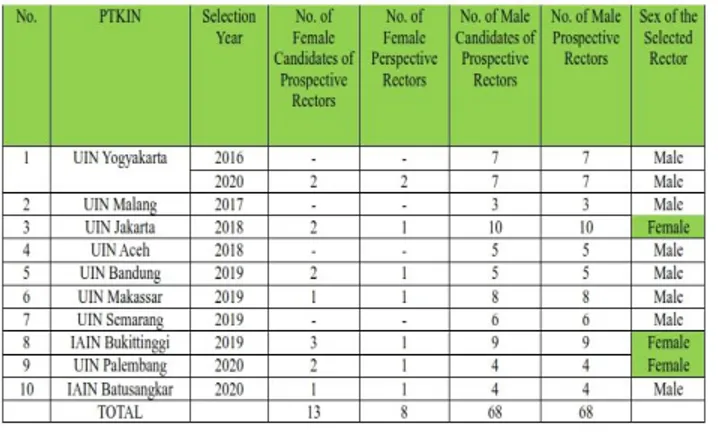
Since its enactment in 2015, there are 29 rectors selected based on PMA 68/2015. There are only seven female rectors out of 58 PTKIN (about 12 percent). This is far from having a balanced number of leadership (Planet 50-50), which aims to be achieved by 2030. The number of women’s participation in the selection of rector itself is still low, as depicted in the following Table 1 of 10 PTKIN, which I randomly selected:
33 Ratna Puspita, “Menteri PPPA: Indonesia Menuju Planet 50:50,” Republika Online, 8 Oktober 2019, 50, https://republika.co.id/share/pz1yjp428.
134
Table 1. The Number of Male and Female
Participants in the Rector Selection 2016-2020
Table 1 shows that women’s participation in the rector selection is far lower than men (8 women) compared to 68 men [only about 12%]). Also, all-male candidates could go through the next stage of the selection, from “candidates of prospective rectors” [bakal calon rector] into prospective rectors [calon rector]. However, this is not the case for women. Five women in the above Table 1 could not go through the next process of the selection for not being able to fulfill the administrative requirement of having the managerial experience in a higher educational institution with the lowest position of being Head of Department with a minimum period of two years (Article 3 [4]). This is because in a robust patriarchal system and in the context where most academicians still believe that leadership is only for men, most campus positions have been given to men. In the last 20 years, women are being given managerial positions on campus, mainly head of the department, the low managerial position, and only in the last five years, some women can climb to vice-dean, dean, vice-rector, and rector. However, some of these women have these positions, as argued by Dewi, due to their blood or marital relation or the same organizational affiliation with those in power.34 34 Kurniawati Hastuti Dewi, Indonesian Women and
Local Politics: Islam, Gender and Networks in Post-Suharto Indonesia (Singapore: NUS Press and Kyoto
University Press, 2015),
https://nuspress.nus.edu.sg/products/indonesian-There are also some other reasons why the participation of female candidates still low. First, the phenomenon of women becoming rectors is still new. Some women may not mentally be ready and confident to apply for the position. This is expressed, for example, by Eli, one of the female professors from UIN Yogyakarta: “I am just nobody, politically. My highest position was only being the head of the department. Even though this is considered to fulfill the requirement, I will not apply, I am just nobody” (interview with the author, 13 June 2020). Second, some other women felt pessimistic and apathetic about winning in the competition with male candidates, as reported by Nani, one of the female candidates of prospective rectors in IAIN in Sumatra, who could not go through the next level of competition due to the lack of duration, only seven months, in her managerial experience: “What is it for, even if we participate, it is the man who will be selected.”35 Third, in her view, to be in power, we have to be affiliated with a specific group. Without any affiliation, the chance to have a campus position is minimal (interview with the author, 1 Juni 2020). This is supported by Mila, one of the female professors from UIN Yogyakarta that “those who are not affiliated with any organization, either Nahdlatul Ulama (NU) or Muhammadiyah, would have less chance to have the position in the campus” (interview with the author, 4 Juni 2020). Fourth, the number of female academicians, especially professors, is far lower than that of male professors. For example, there are only five female professors in UIN SGD Bandung out of 41 professors (about 12 percent) and only five female professors out of 34 professors (about 15 percent) in UIN Yogyakarta. To be a professor, the person has to have a doctoral degree and have international publications. This takes so much time, not only for women-and-local-politics; Kurniawati Hastuti Dewi, Pemimpin Kepala Daerah dalam Jejaring Oligarki Lokal (Jakarta: LIPI Press, 2017).
135 females but also for male academicians, but
female academicians face more barriers in achieving this highest academic position due to their biological and patriarchal cultural expectation that women should take care of the children and do housework. The multiple burdens that women have in a patriarchal society are depicted, for example, in the following case study of Dian:
My first baby was so little when I got other younger ones. I was back and forth, juggling with motherhood, working as an academic, being a secretary in the department, and studying. My husband came and gone to Jakarta as he worked in Jakarta. Mostly my life becomes more challenging when he got three-month scholarships to Australia. I took care of my children while studying. It indeed hurt me.36
The above quote does not mean to discourage PTKIN to give the position to young female academicians but to show the importance of the support that needs to be provided for young female academicians to free them from multiple burdens. Bearing children is indeed a female kodrat, which can biologically only be done by women, but both men and women can do rearing children. Multiple burdens are one of the indicators of gender inequality. Therefore, to achieve gender equality, a support system on campus such as in the form of qualified and subsidized daycare need to be provided if shared responsibility with the spouse is not possible such as in the case of Dian, whose husband should be a way to study in Australia. Reproductive time is indeed a challenge for women, even though this time will end after 10 to 15 years when the children have grown up. Multiple burdens were a 36 Siti Muflichah, “Storying female academics’ career
development in Indonesian Islamic higher education: a postcolonial feminist analysis” (PhD Thesis, School of Education, The University of Queensland, 2020), https://espace.library.uq.edu.au/view/UQ:a6176c0. 37 Ada kriteria meritokrasi yang jadi pedoman, sehingga
siapapun yang memenuhi kriteria tersebut baik perempuan maupun laki-laki dapat dipromosikan
challenge for Dian, but she could overcome this challenge and finally climb to vice rector’s position at UIN in Kalimantan at the interview time. Therefore, there is no reason to justify discrimination against women by not giving any position on campus, assuming that women’s proper roles are just being mothers at home.
Suggestions to Increase Women’s Participation in the Selection of Rector
This part of the paper will discuss suggestions from my interviewees on how to increase women’s participation in the selection of PTKIN rector. The former Director of PTKI himself did not need to change the existing policy to increase women’s participation. For him, the policy is based on merit and is open for both men and women:
There are meritocratic criteria that become a guide. Therefore, whoever fulfills the criteria, both men and women, can be promoted to be the leader. The experience in the last several years has shown efforts to increase the participation of women who have the quality and capability to be leaders (interview with the author, 5 June 2020).37
Unfortunately, he did not give me further elaboration when I asked what efforts MORA has made to increase women’s participation, but he sent me the rector selection result at UIN Raden Fatah Palembang, whose selected rector was female, on 23 July 2020.
Different from the Director of PTKI, most women I interviewed show the need for affirmative policy. For example, from UIN Yogyakarta, Prof Muslimah suggested: to include the clause that narrates the importance of women’s involvement and their empowerment in leading State Islamic University/Institute (UIN/IAIN) (interview with the author, 30 March 2020).38 Based on this
menjadi pejabat. Pengalaman beberapa tahun terakhir ini telah menunjukkan upaya meningkatkan partisipasi dosen perempuan yang memiliki kualitas dan kapasitas untuk menjadi pejabat.
38 Klausul di depannya .... mungkin lebih dipadatkan yang memuat narasi tentang pentingnya keterlibatan dan menjadi penting untuk penguatan perempuan dalam memimpin UIN/IAIN.
136
suggestion, I propose the following revision of PMA 68/2015 Article 3 (1) (the proposal is in italic):
1. The civil servant who has become a lecturer, especially women;
Or
2. The civil servant who has become a lecturer, women, are encouraged to apply;
Such affirmative action has been commonly undertaken abroad, especially in a male-dominated job. For example, in recruiting Project Management Specialist (Engineering), USAID in Afghanistan wrote the following job advertisement: “Female candidates are strongly encouraged to apply.”39 This job advertisement even has the word firmly, encouraged, to show the eagerness to give better access to women. Affirmative action does not necessarily for women only, but any group left behind, such as indigenous groups. This can be seen from the following job advertisement from BHP, Australia: “We are an Equal Opportunity Employer, and we encourage applications from women and Indigenous people.40
Besides, Nani recommends two essential points to support women’s participation in the rector selection process: first, “to give an exception to female academicians who cannot fulfill one of the requirements to apply for rector position, as an affirmative action for women.”41 Second, she recommends a certain percentage of women’s representation in their participation in rector selection.42 Based on her first suggestion, I propose the following revision of PMA 68/2015 Article 3 (4):
Having managerial experience in higher educational institutions with the lowest 39 USAID, “Afghanistan,” 2017, https://www.usaid.gov/sites/default/files/documents/1
871/Solicitation-306-17-15-OI%20Project%20Management%20Specialist%20(En gineering)%20FSN%2010.pdf.
40 BHP, “Entry Level Opportunities,” 2020, https://au.indeed.com/viewjob?from=socialmediatags minimal&jk=e6927b7e2db07ca7.
position of being Head of Department with a minimum period of two years, except women. With the above-proposed revision, women such as Nani and four other female candidates of prospective rector can be included in the next level of rector selection. Moreover, based on Nani’s second recommendation, I propose the following additional point for PMA 68/2015 Article 3:
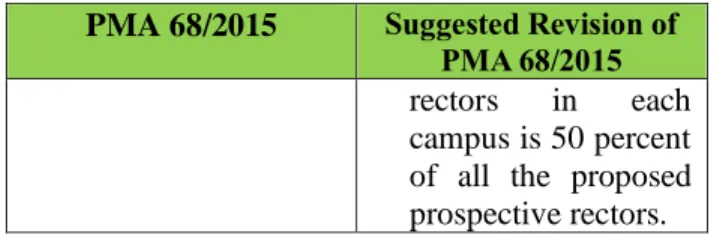
The representation of female prospective rectors in each campus is 50 percent of all the proposed prospective rectors.
The above point is based on the current number of affirmative action to achieve Planet 50-50 by 2030. Previously, the number proposed for affirmative action was 30 percent; but this was revised by the UN Women on 8 March 2016, as discussed above43 , and this was agreed to be adopted in Indonesia, as expressed by former Minister Yohana Yambise, on 8 October 2019.44 However, since the number of female professors within PTKIN still low, MORA can start this affirmative action from 30 percent. This affirmative policy, I believe, can motivate many female lecturers to speed up their career promotion into becoming full professors to enjoy democracy on campus, which is friendly to women. This affirmative policy can be changed back into a gender-neutral policy when Planet 50-50 is achieved as a temporary measure.
Conclusion
Islam is a religion of justice. Almost all Muslims believe that God is just. If Muslims believe that God is just, it is impossible that the Qur’an, the word of God, support any injustice. Likewise, the Prophet Muhammad, God’s massager, the best model for Muslims, must 41 “Jika dari persyaratan itu tidak ada perempuan [yang
mendaftar], harus ada keberpihakan kepada perempuan, buat pengecualian ... perlu afirmasi [untuk perempuan].”
42 “Harus ada ketentuan persentase supaya ada keterwakilan perempuan.”
43 Knutsen, “What Is the Planet 50-50 Campaign?” 44 Puspita, “Menteri PPPA.”
137 support justice, especially for marginalized
groups, such as women and the poor. If there is any Muslim uses the Qur’anic verses or the hadith to justify any injustice, the way the person understands the verses needs to be evaluated, or the hadith the person quotes has to be scrutinized. From the above discussion, it can be concluded that progressive and contextual reading of the Qur’an, which is just and friendly to women, has to be promoted to support women’s leadership in PTKIN.
PTKIN is under MORA. MORA issued PMA 68/2015 to regulate the selection of PTKI rector/chairperson. However, the participation of women in this process is still meager. Also, unlike male candidates, some female candidates of prospective rectors could not go to the next level of the selection due to their failure in fulfilling the requirement of Article 3 (4): having managerial experience in a higher educational institution with the lowest position of being Head of Department with a minimum period of two years. One of the reasons for this is that most campus positions have been traditionally given to men only. In the last 20 years, women are being given managerial position on campus, mainly head of the department, the lowest managerial position, and only in the last five years, some women can climb to the position of vice-dean, dean, vice-rector, and rector. Currently, PTKIN has seven female rectors out of 58 PTKIN (about 12 percent), which is good progress but is still far behind the target of Planet 50-50 by 2030.
Recommendation
To achieve the target of Planet 50-50 by 2030, it is recommended to revise the existing gender-neutral policy of PMA 68/2015 into affirmative policy, as summarized in Table 2 below. The left side is the existing gender-neutral policy, while the suggested revisions of the policy are in bold on the right side of the table:
PMA 68/2015 Suggested Revision of
PMA 68/2015 Article 3 Requirements to be the candidate of prospective rectors/chairperson: a. General
1. The civil servant who has become a lecturer;
2. Believing in the Oneness of God; 3. Maximum age of 60
for the incumbent rector
4. Having managerial experience in a higher educational institution with the lowest position of being Head of Department with a minimum period of two years. 5. Submitting health certificate from the state doctor
6. Not being in the process of punishment for breaking the middle level of discipline based on the existing regulation; 7. Not being
convicted based on the Court decision which has absolute legal force;
8. Applying for the position of Rector/Chair Person in writing; 9. Submitting a written statement of: a) The leadership vision and mission b) Quality improvement program of the institution. Article 3 Requirements to be the candidate of prospective rectors/chairperson: a. General
1. The civil servant who has become a lecturer, especially women; 2. Believing in the Oneness of God; 3. Maximum age of 60
for the incumbent rector
4. Having managerial experience in a higher educational institution with the lowest position of being Head of Department with a minimum period of two years, except women.
5. Submitting health certificate from the state doctor
6. Not being in the process of punishment for breaking the middle level of discipline based on the existing regulation;
7. Not being convicted based on the Court decision which has absolute legal force; 8. Applying for the
position of Rector/Chair Person in writing; 9. Submitting a written statement of: a) The leadership vision and mission b) Quality improvement program of the institution. 10.The representation of female prospective
138
PMA 68/2015 Suggested Revision of
PMA 68/2015 rectors in each campus is 50 percent of all the proposed prospective rectors. Table 2. PMA 68/2015 and Its Suggested
Affirmative Revision
MORA could choose one of the three proposed suggestions to revise the current PMA 68/2015. The most vital suggestion to speed up the increasing number of female rectors is the last suggestion: to add one more point of the requirement: The representation of female prospective rectors in each campus is 50 percent from all the proposed prospective rectors. This suggestion, I believe, will motivate women to be doctor and professor and be more confident to apply for leadership positions within PTKIN. If 50 percent is regarded too high, MORA can start with a 30 percent minimum representation of female prospective rectors. By revising gender-neutral policy into affirmative policy, MORA can be a leading institution in Indonesia, supporting women leadership to achieve Planet 50-50.
BIBLIOGRAPHY
“Affirmative Action | Definition of Affirmative Action by Oxford Dictionary on Lexico.Com Also Meaning of Affirmative Action.” Lexico Dictionaries | English. Diakses 26 Oktober 2020. https://www.lexico.com/definition/affirma tive_action.
Ahmed, Leila. Women and Gender in Islam: Historical Roots of a Modern Debate. Reissue Edition. Yale University Press, 1993.
“Altafsir.com - The Tafsirs - ريسافتلا.” Diakses 26
Oktober 2020.
https://www.altafsir.com/Tafasir.asp?tMad hNo=0&tTafsirNo=7&tSoraNo=4&tAyah No=34&tDisplay=yes&Page=3&Size=1& LanguageId=1.
“Altafsir.com - The Tafsirs - ريسافتلا.” Diakses 26
Oktober 2020.
https://www.altafsir.com/Tafasir.asp?tMad
hNo=0&tTafsirNo=8&tSoraNo=4&tAyahN o=34&tDisplay=yes&UserProfile=0&Lang uageId=1.
Ash-Shieddieqy, T.M.H. Tafsir al-Qur’anul Majid an-Nuur. Vol. 1. Semarang: Pustaka Rizki Putra, 1956.
Barlas, Asma. “Believing Women” in Islam: Unreading Patriarchal Interpretations of the Qur’an. 1st Edition. Austin, TX: University of Texas Press, 2002.
BHP. “Entry Level Opportunities,” 2020. https://au.indeed.com/viewjob?from=social mediatagsminimal&jk=e6927b7e2db07ca7. Dewi, Kurniawati Hastuti. Indonesian Women
and Local Politics: Islam, Gender and Networks in Post-Suharto Indonesia. Singapore: NUS Press and Kyoto University
Press, 2015.
https://nuspress.nus.edu.sg/products/indone sian-women-and-local-politics.
———. Pemimpin Kepala Daerah dalam Jejaring Oligarki Lokal. Jakarta: LIPI Press, 2017. Doi, Abdur Rahman I. Women in the Qur’an and
the Sunnah. Ta-Ha, 1988.
Dzuhayatin, Siti Ruhaini. “Gender Glass Ceiling in Indonesia: Manifestation, Roots, and Theological Breakthrough.” Al-Jami’ah: Journal of Islamic Studies 58, no. 1 (3
September 2020): 209–40.
doi:10.14421/ajis.2020.581.209-240.
Engineer, Asghar Ali. The rights of women in Islam. London: C. Hurst & Co, 1992. Fakih, Mansour. Analisis Gender dan
Transformasi Sosial. Yogyakarta: Pustaka Pelajar, 1999.
Gorelick, Sherry. “Contradictions of Feminist Methodology.” Gender & Society 5, no. 4 (1
Desember 1991): 459–77.
doi:10.1177/089124391005004002.
Ellen Gutoskey. “What’s the Difference Between Equity and Equality?,” 11 Juni 2020. https://www.mentalfloss.com/article/62540 4/equity-vs-equality-what-is-the-difference. Hamka. Tafsir al-Azhar, vols. 1-6. Jakarta:
Pustaka Panjimas, 1966.
Ismail, Nurjannah. Perempuan dalam pasungan. Bias laki-laki dalam penafsiran. Yogyakarta: LKiS, 2003.
Kemdikbud. “Kamus Besar Bahasa Indonesia,” 2016. https://kbbi.kemdikbus.go.id/.
139 Knutsen, Ashleen. “What Is the Planet 50-50
Campaign?” Your Dream Blog, 30 Oktober 2017.
https://yourdream.liveyourdream.org/2017 /10/what-is-the-planet5050-campaign/. Mernissi, Fatima. The Veil And The Male Elite:
A Feminist Interpretation Of Women’s Rights In Islam. Diterjemahkan oleh Mary Jo Lakeland. Reprint Edition. Cambridge, Mass.: Basic Books, 1992.
Muflichah, Siti. “Storying female academics’ career development in Indonesian Islamic higher education: a postcolonial feminist analysis.” PhD Thesis, School of Education, The University of Queensland, 2020.
https://espace.library.uq.edu.au/view/UQ:a 6176c0.
Muhammad, Husein. Ijtihad Kyai Husein. Upaya membangun keadilan gender. Jakarta: Rahima, 2011.
Munawar, Said Agil al-. “Kepemimpinan Perempuan dalam Islam.” Dalam Kepemimpinan Perempuan dalam Islam, disunting oleh Shafiq Hasyim. Jakarta: Jaringan Pendidikan Pemilih untuk Rakyat/JPPR, 1999.
Nurmila, Nina. “Pengaruh Budaya Patriarki Terhadap Pemahaman Agama dan Pembentukan Budaya.” KARSA: Journal of Social and Islamic Culture 23, no. 1 (1
Juni 2015): 1–16.
doi:10.19105/karsa.v23i1.606.
Puspita, Ratna. “Menteri PPPA: Indonesia Menuju Planet 50:50.” Republika Online, 8
Oktober 2019.
https://republika.co.id/share/pz1yjp428. Sasmita, Muhkamim, Rohika Kurniadi Sari,
Iwan Gunawan Rachman, Ergani, Andri Amoes, dan Widyastuti. Parameter Kesetaraan Gender dalam Pembentukan Peraturan Perundang-undangan. Jakarta: Kemenkumham, KemenPPPA dan Kemendagri RI, 2012.
Shihab, M. Quraish. Tafsir al-Mishbah. Pesan, Kesan dan Keserasian al-Qur’an. Vol. 2. Jakarta: Lentera Hati, 2002.
Subhan, Zaitunah. Tafsir Kebencian: Studi Bias Jender dalam Tafsir al-Qur’an. Yogyakarta: LKiS, 1999.
“Surah An-Nisa - 4:34.” Diakses 26 Oktober 2020.
https://quran.com/4/34?translations=131. Umar, Nasaruddin. Argumen Kesetaraan Jender
Perspektif Al-Qur’an. Jakarta: Paramadina, 1999. USAID. “Afghanistan,” 2017. https://www.usaid.gov/sites/default/files/do cuments/1871/Solicitation-306-17-15-OI%20Project%20Management%20Special ist%20(Engineering)%20FSN%2010.pdf. Wadud, Amina. Qur’an and Woman: Rereading
the Sacred Text from a Woman’s Perspective. New York: Oxford University Press, 1999.
Yentriyani, Andy, dan Dahlia Madanih. Pedoman Pengujian Kebijakan Konstitusional untuk Pemenuhan Hak Konstitusional dan Penghapusan Diskriminasi terhadap Perempuan. Jakarta: Komnas Perempuan, 2016.
Zaid, Nasr Hamid Abu. “The nexus of theory and practice.” Dalam The New Voices of Islam. Rethinking Politics and Modernity, disunting oleh Mehran Kamrava. Berkeley and Los Angeles: University of California Press, 2006.
NO BAGIAN STANDAR PENULISAN
1. Judul 1) Ditulis dengan huruf kapital.2) Dicetak tebal (bold).
2. Penulis
1) Nama penulis dicetak tebal (bold), tidak dengan huruf
besar.
2) Setiap artikel harus dilengkapi dengan biodata penulis,
ditulis di bawah nama penulis, dicetak miring (italic)
semua.
3. Heading
Penulisan Sub Judul dengan abjad, sub-sub judul dengan angka.
Contoh:
A. Pendahuluan
B. Sejarah Pondok Pesantren...
1. Lokasi Geografis
2. (dst).
4. Abstrak
1) Bagian Abstrak tidak masuk dalam sistematika A, B, C, dst.
2) Tulisan Abstrak (Indonesia) atau Abstract (Inggris)
atau (Arab) dicetak tebal (bold), tidak dengan
hurub besar.
3) Panjang abstrak (satu bahasa) tidak boleh lebih dari 1 halaman jurnal.
5. Body Teks
1) Teks diketik 1,5 spasi, 6.000 – 10.000 kata, dengan ukuran kertas A4.
2) Kutipan langsung yang lebih dari 3 baris diketik 1 spasi.
3) Istilah asing (selain bahasa artikel) dicetak miring (italic).
4) Penulisan transliterasi sesui dengan pedoman transliterasi jurnal Musãwa.
6. Footnote
1) Penulisan: Pengarang, Judul (Kota: Penerbit, tahun),
hlm. Contoh: Ira M. Lapidus, Sejarah Sosial Ummat
Islam, terj. Ghufron A. Mas’udi (Jakarta: PT. Raja
Grafindo Persada, 1988), 750.
2) Semua judul buku, dan nama media massa dicetak
miring (italic).
3) Judul artikel ditulis dengan tanda kutip (“judul artikel”) dan tidak miring.
4) Tidak menggunakan Op. Cit dan Loc. Cit.
5) Menggunakan Ibid. atau (Arab). Dicetak
miring (italic).
6) Pengulangan referensi (footnote) ditulis dengan cara:
Satu kata dari nama penulis, 1-3 kata judul, nomor
halaman. Contoh: Lapidus, Sejarah sosial, 170.
7) Setelah nomor halaman diberi tanda titik. 8) Diketik 1 spasi.
7. Bibliografi
1) Setiap artikel harus ada bibliografi dan diletakkan secara terpisah dari halaman body-teks.
2) Kata DAFTAR PUSTAKA (Indonesia),
REFERENCES (Inggris), atau (Arab) ditulis
dengan hurur besar dan cetak tebal (bold).
3) Contoh penulisan: Lapidus, Ira M., Sejarah Sosial
Ummat Islam, terj. Ghufron A.M., Jakarta: PT. Raja
Grafindo Persada, 1988.
Transliterasi Arab-Latin yang digunakan dalam tulisan berbahasa Inggris pada Jurnal Musãwa ini
adalah literasi model L.C. (Library of Congress). Untuk tulisan berbahasa Indonesia, memakai model
L.C. dengan beberapa modifikasi.
A. Transliterasi Model L.C. ح = h} ج = j ث = th ت = t ب = b ا = -س = s ز = z ر = r ذ = dh د = d خ = kh ع = ’ ظ = z} ط = t} ض = d} ص = s} ش = sh م = m ل = l ك = k ق = q ف = f غ = gh ي = y ء = ‘ ـھ = h و = w ن = n Pendek a =
َ
i =ِ
--- u =ُ
Panjang ā = ˏ ī = ﻱﺇ ū = ﻮﺃ Diftong ay = ﻱﺇ aw = ﻮﺃPanjang dengan tashdid : iyy = ﻱﺇ ; uww = ﻮﺃ
Ta’marbūtah ditransliterasikan dengan “h” seperti ahliyyah = atau tanpa “h”, seperti kulliya = ;
dengan “t” dalam sebuah frasa (constract phrase), misalnya surat al-Ma’idah sebagaimana bacaannya
dan dicetak miring. Contoh, dhālika-lkitābu la rayba fih bukan dhālika al-kitāb la rayb fih, yā
ayyu-hannās bukan yā ayyuha al-nās, dan seterusnya.
B. Modifikasi (Untuk tulisan Berbahasa Indonesia)
1. Nama orang ditulis biasa dan diindonesiakan tanpa transliterasi. Contoh: As-Syafi’i bukan
al-Syāfi’i, dicetak biasa, bukan italic.
2. Nama kota sama dengan no. 1. Contoh, Madinah bukan Madīnah; Mis}ra menjadi Mesir, Qāhirah
menjadi Kairo, Baghdād menjadi Baghdad, dan lain-lain.
3. Istilah asing yang belum masuk ke dalam Bahasa Indonesia, ditulis seperti aslinya dan dicetak
miring (italic), bukan garis bawah (underline). Contoh: ...al-qawā’id al-fiqhiyyah; Isyrāqiyyah;
‘urwah al-wusqā, dan lain sebagainya. Sedangkan istilah asing yang sudah populer dan masuk ke dalam Bahasa Indonesia, ditulis biasa, tanpa transliterasi. Contoh: Al-Qur’an bukan Al-Qur’ān; Al-Hadis bukan al-Hadīth; Iluminatif bukan illuminatif, perenial bukan perennial, dll.
4. Judul buku ditulis seperti aslinya dan dicetak miring. Huruf pertama pada awal kata dari judul buku