• Tidak ada hasil yang ditemukan

THE PERCEPTION OF THE PROCESS STANDARD MODEL OF ENGLISH EDUCATION AT THE VOCATIONAL SCHOOL IN BANTUL A THESIS

N/A
N/A
Protected

Academic year: 2019

Membagikan "THE PERCEPTION OF THE PROCESS STANDARD MODEL OF ENGLISH EDUCATION AT THE VOCATIONAL SCHOOL IN BANTUL A THESIS"

Copied!
209
0
0

Teks penuh

(1)

i

THE PERCEPTION OF THE PROCESS STANDARD MODEL

OF ENGLISH EDUCATION AT THE VOCATIONAL SCHOOL

IN BANTUL

A THESIS

Presented as a Partial Fulfillment of the Requirements to Obtain the Magister Humaniora (M.Hum) Degree

in English Language Studies

by

Cokrowihasto

Student Number: 056332030

THE GRADUATE PROGRAM IN ENGLISH LANGUAGE STUDIES SANATA DHARMA UNIVERSITY

(2)

ii

THE PERCEPTION OF THE PROCESS STANDARD MODEL

OF ENGLISH EDUCATION AT THE VOCATIONAL SCHOOL

IN BANTUL

A THESIS

Presented as a Partial Fulfillment of the Requirements to Obtain the Magister Humaniora (M.Hum) Degree

in English Language Studies

by

Cokrowihasto

Student Number :

056332030

Approved by

Dr. J. Bismoko ___________________________

(3)

iii

A THESIS

THE PERCEPTION OF THE PROCESS STANDARD MODEL

OF ENGLISH EDUCATION AT THE VOCATIONAL SCHOOL

IN BANTUL

Presented by

Cokrowihasto

Student Number : 056332030

Defended before the Thesis Committee and Declared Acceptable.

THESIS COMMITTEE

Chairperson : Dr. J. Bismoko _________________

Secretary : Dr. B.B. Dwijatmoko, M.A. _________________

Members : 1. F.X. Mukarto, Ph.D. _________________

: 2. Drs. Pius Nurwidasa Prihatin, M.Ed. _________________

Yogyakarta, 30 September 2011 The Graduate Program Director

Sanata Dharma University

(4)

iv

STATEMENT O F ORIGINALITY

This is to certify that all ideas, phrases, sentences, unless otherwise stated, are the ideas, phrases, and sentences of the thesis writer. The writer understands the full consequences including degree cancellation if he took somebody else's ideas, phrases, or sentences without proper references.

Yogyakarta, 30 September, 2011

Cokrowihasto

(5)

v

LEMBAR PERNYATAAN PERSETUJUAN

PUBLIKASI KARYA ILMIAH UNTUK KEPENTINGAN AKADEMIS

Yang bertanda tangan di bawah ini, saya mahasiswa Universitas Sanata Dharma:

Nama : Cokrowihasto

Nomor Mahasiswa : 056332030

Demi pengembangan ilmu pengetahuan, saya memberikan kepada Perpustakaan Universitas Sanata Dharma karya ilmiah saya yang berjudul:

The Perception of The Process Standard Model of English Education at The Vocational School in Bantul

Dengan demikian saya memberikan kepada Perpustakaan Universitas Sanata Dharma hak untuk menyimpan, mengalihkan dalam bentuk media lain, mengelolanya dalam bentuk pangkalan data, mendistribusikan secara terbatas, dan mempublikasikannya di Internet atau media lain untuk kepentingan akademis tanpa perlu meminta ijin dari saya maupun memberikan royalty kepada saya selama tetap mencantumkan nama saya sebagai penulis.

Demikian pernyataan ini yang saya buat dengan sebenarnya.

Dibuat di Yogyakarta

Pada tanggal : 30 September 2011 Yang menyatakan,

(6)

vi

ACKNOWLEDGMENTS

First of all I would like to say thank you to Allah, that He always guides me. I believe that without His blessing I would not have finished this thesis and obtained the degree. May He always be with us.

I would like to express my utmost gratitude to my advisor, Dr. J. Bismoko who always patiently supported with his advice, motivation, guidance, suggestions, helps and encouragement during writing this thesis. He was inspiring me with his valuable advice, valuable knowledge and valuable perspective. I would like also to thank to F.X. Mukarto, Ph.D, who has helped me and given me a chance to finish this thesis. He also always gave me spirit to finish the thesis. My gratefulness is also addressed to Dr. Pius Nurwidasa Prihatin, M.Ed, who gave me a lot of suggestions to make the betterment of this thesis.

I would also like to thank Dr. B.B. Dwijatmoko, M.A, Prof. Dr. Soepomo, Dr. Novita Dewi, M.S., M.A. (Hons) who had trained and given me a lot of knowledge and experiences in English.

My depth of gratitude is also due to Ibu Wita, Ibu Eva and their students who were willing to be the participants of my research. My gratitude is also to the principal of SMK 2 Sewon Bantul who was patiently and supportive in giving me information.

Finally, I am also very grateful to my principal of LPMP and all the staff for supporting me in finishing my thesis.

(7)

vii

TABLE OF CONTENTS

TITLE PAGE……… i

APPROVAL PAGE………. ii

DEFENSE APPROVAL PAGE……….. iii

STATEMENT OF ORIGINALITY………. iv

ACKNOWLEDGEMENTS………. v

TABLE OF CONTENTS………. vi

LIST OF TABLES……… ix

LIST OF APPENDICES……….. x

LIST OF ABBREVIATIONS ……….. xi

ABSTRACT………. xii

ABSTRAK……… xiii

CHAPTER I INTRODUCTION……….. 1

A. BACKGROUND……… 1

B. PROBLEM IDENTIFICATION ……… 4

C. PROBLEM LIMITATION……….. 5

D. STATEMENT OF RESEARCH QUESTION……… 5

E. RESEARCH GOAL……… 5

F. RESEARCH BENEFITS……….. 5

CHAPTER II LITERATURE REVIEW………. 7

A.THEORETICAL REVIEW……… 7

1. Perception………... 7

2. Process Standard Model……… 10

3. English Education……….. 17

4. Vocational School……….. 20

(8)

viii

CHAPTER III RESEARCH METHODOLOGY………. 33

A. RESEARCH PLAN………. 33

1. Research Design………... 33

2. The Nature of Data……….. 35

3. Setting……….. 35

4. Participants of the Study……….. 35

5. Types of Data and Data Sources……….. 36

6. Data Collection Methods………. 37

7. Technique of Data Analysis………. 46

8. Validation of Findings……….. 47

9. The Reliability of Findings………... 47

B. ACTUALIZATION OF RESEARCH………. 47

1. Data Collecting Procedures……… 47

2. Data Recording Procedures……… 47

CHAPTER IV DESCRIPTION AND INTERPRETATION …………... 48

A.THE DESCRIPTION ……….. 48

1. The Description of Mrs. Rina’s Syllabus………. 48

2. The Description of Mrs. Lisa’s Syllabus……….. 48

3. The Description of Mrs. Rina’sLesson Plan……… 49

4. The Description of Mrs. Lisa’s Lesson Plan………. 49

5. The Description of Mrs. Rina’s Classroom Observation……….. 49

6. The Description of Mrs. Lisa’s Classroom Observation………... 50

B.THE DESCRIPTION AND INTERPRETATION……….. 51

(9)

ix 2. The Description and Interpretation of

Mrs. Lisa’s Perception of The Process Standard Model

of English Education……… 59

3. The Description and Interpretation of

Mr. Hartono’s Perception of the Process Standard Model

of English Education Done by Mrs. Rina and Mrs. Lisa………... 66 4. Description and Interpretation of Students’ Perception

of the Process Standard Model of English Education

Done by Mrs. Rina……….. 70

5. The Description and Interpretation of Students’ Perception of The Process Standard Model of English Education

Done by Mrs. Lisa……….. 77

CHAPTER V CONCLUSIONS AND RECOMMENDATIONS……. 83

A. CONCLUSIONS………. 83

B. RECOMMENDATIONS………. 84

(10)

x

LIST OF TABLES

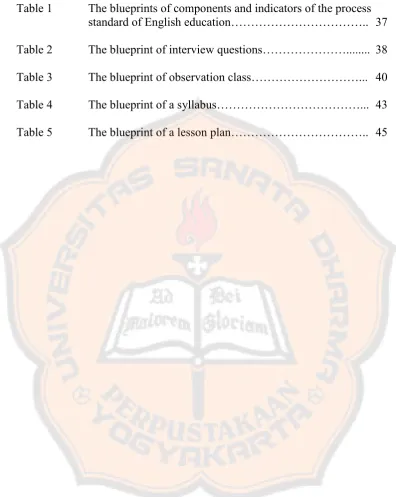
Table 1 The blueprints of components and indicators of the process

standard of English education……….. 37

Table 2 The blueprint of interview questions………... 38

Table 3 The blueprint of observation class………... 40

Table 4 The blueprint of a syllabus………... 43

(11)

xi

LIST OF APPENDICES

Appendix 1 Wawancara dengan ibu Rina.………. 93

Appendix 2 Interview with Mrs. Rina……… 102

Appendix 3 Wawancara dengan ibu Lisa……… 111

Appendix 4 Interview with Mrs. Lisa………. 120

Appendix 5 Wawancara dengan Kepala Sekolah………. 129

Appendix 6 Interview with the principal……… 133

Appendix 7 Wawancara dengan siswa ibu Rina……….. 137

Appendix 8 Interview with Mrs. Rina’s students……….. 142

Appendix 9 Wawancara dengan siswa ibu Lisa……… 145

Appendix 10 Interview with Mrs. Lisa’s students………... 149

Appendix 11 Rina’s Class Observation……… 153

Appendix 12 Lisa’s Class Observation………. 154

Appendix 13 The Syllabus of Mrs. Rina……….. 155

Appendix 14 The Syllabus of Mrs. Lisa………... 167

Appendix 15 The Lesson Plan of Mrs. Rina……… 183

(12)

xii

LIST OF ABBREVIATIONS

BSNP : Badan Standar Nasional Pendidikan

BSE : Buku Sekolah Elektronik

CD : Compact Disk

ISO : International Organization for Standardization ICT : Information Communication and Technology IT : Information Technology

KKG : Kelompok Kerja Guru

LCD : Liquid Crystal Display

LPMP : Lembaga Penjaminan Mutu Pendidikan

LKS : Lembar Kerja Siswa

MDG : Millennium Development Goals MGMP : Musyawarah Guru Mata Pelajaran

PISA : Programme for International Student Assessment RKB : Ruang Kelas Baru

(13)

xiii

ABSTRACT

Cokrowihasto. 2011. The Perception of the Process Standard Model of English Education at the Vocational School in Bantul. Yogyakarta: English Language Studies, Graduate Program, Sanata Dharma University.

Teaching English at Vocational High Schools need to be planned well in order to achieve its objectives. Teachers should prepare all teaching and learning activities and make sure that the process standards meet the requirements of the School-Based Curriculum.

This research tries to describe and interpret the perception on the process standard model of English education at the vocational school. It attempts to answer the research question ‘What is the teachers’ perception on the process

standard of English education at the vocational school in Bantul?’ The setting of the research was the Vocational High School in Bantul in which the English teachers applied the process standard in their teaching and learning activities. The data were collected through interview and documents. The research participants consisted of some English teachers, some students, and the headmaster. They were interviewed to get rich data. The teachers were observed during their teaching-learning activities. The documents related with teaching-learning process were collected to support this study. The regulation concerning with the process standard stated in Badan Standar Nasional Pendidikan/BSNP (The Board of National Education Standard).For it was a qualitative research, the report was in the form of descriptive and interpretive text.

The findings show that teachers perceive that the development of the syllabus is based on the content standard and the graduate competency standard. While the lesson plan partly pays attention to the gender difference, the previous ability, the intellectual step, interests, talents, learning motivation, potential, social abilities, emotion, learning styles, specific needs, speed learning, culture backgrounds, norms, values, and learners’ environment. The students need some books and other sources to help and motivate them. The teachers partly teach the lesson in a way that create interactive, inspiring, fun, and challenging activities. The teaching-learning processes always contain introduction, core and closing. The teacher-participants always try to make students get the same opportunity to do exploration, elaboration, and confirmation during the teaching-learning process. The supervision is still done by the curriculum vice principal. The supervision and the evaluation of the teaching-learning process are not done periodically by the headmaster and the supervisor.

There were some recommendations. The teaching-learning activities were to be improved to make students more active. Teachers should make some changes in making the syllabus to meet the need of the study program they taught. The design of the lesson plan should be different from one class to another class due their ability levels.

(14)

xiv

ABSTRAK

Cokrowihasto. 2011. The Perception of the Process Standard Model of English Education at the Vocational School in Bantul. Yogyakarta: English Language Studies, Graduate Program, Sanata Dharma University.

Pengajaran Bahasa Inggris di Sekolah Menengah Kejuruan perlu direncanakan dengan baik untuk mencapai tujuannya. Para guru harus menyiapkan segala persiapan kegiatan belajar mengajar dan memastikan bahwa

standar proses yang mereka gunakan telah

memenuhi persyaratan Kurikulum Tingkat Satuan Pendidikan.

Penelitian ini mencoba untuk mendeskripsikan dan menginterpretasikan persepsi pada model tandar proses pendidikan bahasa Inggris di sekolah kejuruan.Penelitian ini mencoba untuk menjawab pertanyaan “Apa persepsi Guru pada standar proses bahasa Inggris di Sekolah Menengah Kejuruan di Bantul? Tempat dari penelitian ini adalah salah satu Sekolah Menengah Kejuruan di Bantul di mana guru bahasa Inggris mereka telah menerapkan standar proses dalam pengajaran dan proses belajar mengajar. Data akan dikumpulkan melalui wawancara dan dokumen. Responden dari penelitian ini adalah beberapa guru, beberapa siswa dan kepala sekolah. Mereka diwawancarai untuk mendapatkan data yang banyak. Guru diobservasi pada pembelajarannya. Dokumen yang terkait dengan juga dikumpulkan untuk mendukung penelitian ini. Aturan yang berkenaan dengan standar proses tertera pada Badan Standar Nasional Pendidikan. Karena penelitian ini adalah penelitian kualitatif maka uraian akan disampaikan dalam bentuk deskriptif interpretative.

Hasil dari penelitian ini adalah guru memberikan persepsi bahwa silabus dikembangkan didasarkan pada standar isi dan standar kompetensi lulusan. Sedangkan rencana pembelajaran belum sepenuhnya memperhatikan perbedaan gender, kemampuan awal, perkembangan intelektual, minat, bakat, motivasi belajar, latar belakang budaya, norma, nilai, dan lingkungan peserta didik. Siswa perlu penambahan buku dan sumber lainnya untuk membantu dan memotivasi siswa. Guru belum sepenuhnya mengajarkan pelajaran dengan menyenangkan, interaktif, inspiratif dan menantang. Pembelajaran berisi pendahuluan, inti dan penutup. Para guru telah mencoba untuk membuat siswa mendapatkan kesempatan yang sama untuk melakukan eksplorasi, elaborasi dan konfirmasi. Supervisi masih diwakilkan ke wakil kepala sekolah bagian kurikulum. Pengawasan dan evaluasi proses pembelajaran tidak dilakukan secara berkala dan berkesinambungan oleh kepala sekolah dan pengawas.

Rekomendasinya adalah kegiatan belajar ditingkatkan sehingga siswa menjadi aktif. Guru membuat semacam perubahan dalam membuat silabus sesuai dengan jurusan yang mereka ajarkan. Desain dari rencana pelajaran harus berbeda dari satu kelas ke kelas lainnya yang disesuaikan dengan kemampuan siswa.

(15)

1

CHAPTER I

INTRODUCTION

In this chapter, I discuss the background of the research, problem

limitation, problem formulation, research goals, and research benefits. The

background of the research discusses the underlying reason and urgency of the

research. I present some basic reasons why the research needs to be carried out.

The problem limitation focuses on main problems which have been narrowed

from all existing issues. The problem formulation deals with research questions to

be answered in the research. The research goals specify the goals of the research.

A. Background

Teachers are very important persons in any education area. They

have a significant contribution to the development of education. According to

Hunt (2008) a good teacher should have the positive way to guide students in

learning. Second, he should have enough knowledge for his subject he teaches.

Third, he has the ability to convey the subject completely. Fourth, he should have

the ability to master the methodology. Fifth, he should have the ability to

motivate his students. And sixth, he should have the class management. They

have to know how to teach and they should have good personality.

Schools in Indonesia now apply the school based curriculum (Kurikulum

Tingkat Satuan Pendidikan=KTSP). Teachers need a higher competence because

they are given the autonomy to teach in their own way. They should be able to

(16)

2

National Education Standard (Badan Standar Nasional Pendidikan=BSNP) has

released 8 national education standards namely; 1) Educational content standards,

2) Graduate competency standard, 3) Process Standard, 4) Assessment standard,

5) Infrastructure Standard, 6) Teacher and staff educations standards, 7)

Management Standard, 8) Budget standard.

Process standard is one aspect of the standards mentioned above. It is the

standard that quite crucial to be applied. It is obvious that process standard is the

application of the teaching learning process. Teachers should prepare the syllabus

and lesson plans before conducting the teaching learning activities. Teachers

should also get the assessments of the teaching learning process they have done

due to the process standard.

In addition, some reports say that the implementation of the process

standard in most schools in Indonesia has not significantly well applied. Trends in

International Mathematics and Science Study (TIMSS) and Programme for

International Student Assessment (PISA) show the result that some students of

Indonesia are the winners of international Olympiad but in general, the schools,

teachers, means and other things especially in education aspects are still under the

standard (http://www.mandikdasmen.depdiknas.go.id, 24th August 2010).

Nowadays, 88,8% schools in Indonesia haven’t covered the minimum

education standard. 40.31% schools in Indonesia are under minimum standard.

48.89% schools in Indonesia are in the minimum education standard. So only

10,15% schools in Indonesia are in the national standard or may be above the

(17)

3

One of the standards in Indonesia is the process standard. Process

standard is usually applied in ISO. In education it is applied by teachers. It is an

important aspect that should be done by teachers before, while and after the

process of learning. Process standard may include objectives, content, method and

evaluation. Before the process of learning, the process standard may include

objectives, content, method and evaluation. While the process of learning, the

process standard may include objectives, content, method and evaluation. After

the process of learning, the process standard may include evaluation of objectives,

content, method and evaluation. The rules of the objectives of the teaching

learning process should refer to the objectives stated in the process standard

issued by BSNP. The content, the method, and evaluation should also refer to

BSNP.

It seems that the application of process standard in Indonesia may be

varied. In some cases the variation may be caused by the capacity of

understanding of the process standard. On the other hand it may also be caused by

the creativities of the schools or the creativities of the teachers themselves.

Similarly, it seems that the perception of process standard in Bantul may also be

varied.

I am interested in conducting the research on the perception of the process

standard in English education because it is one of the crucial aspects in

teaching-learning processes. And by understanding the participants’ perception of the

process standard the researcher knows the process standard applied in school.

The process standard that is one of the eight standards issued by BSNP is

(18)

4

standard will have the impact on of the students’ understanding. The students’

lack of understanding will influence the students’ achievement. I also realize that

the process standard is difficult to achieve because teachers are asked to make a

syllabus, lesson plans, and they should also present the materials in such a way in

order to make their students understand. Teachers may face some problems

concerning the naughty, low motivated, broken-hearted, and even intelligent

students,.. etc.

Vocational schools in our country need much attention in managing

them. English language that is one of the adaptive subjects needs much attention

too. As known before that English is an international language, so it is important

to give much attention to that subject. The application of English at vocational

schools is different from English applied in other stage of schools for example

Senior High School. The important thing about English subject which has to be

paid much attention in vocational school is the materials used in teaching-learning

activities. The materials should meet the needs of the departments or study

programs found in the vocational school. They should be real and suitable for the

students’ future work field.

B. Problem Identification

Process standard is one of eight standards of Indonesian national

standard namely graduate competency standard, content standard, process

standard, management standard, assessment standard, teacher and staff education

(19)

5

Process standard that is one of the eight standards consist of the

planning of the process of learning, the implementation of learning process,

assessment of learning, and supervision of learning (BSNP 2007: 41).

C. Problem Limitation

The setting of the research is one of vocational schools in Bantul

and the participants are English teachers of one vocational school. The focus of

the research is the description and interpretation of process standard of English

education at the vocational school in Bantul.

D. Statement of Research Question

What is the teachers’ perception of the process standard of English

education at the vocational school in Bantul?

E. Research Goal

The research goal describes and interprets the perceptions of the process

standard of English education. It focuses on the process standard model of English

education at the vocational school.

F. Research Benefits

Hopefully, there will be some parties that can take benefits from this

research. They are:

1. The School

This research provides feedback to the English process standard

(20)

6

their English Teachers. Then, the school may revise or improve the

process standard based on the feedback received.

2. The Teacher

The teacher can use this research as a feedback and self evaluation

to the teaching-learning process. So, the teacher can figure out whether the

syllabus and lesson plan employed have met the needs of the students.

This research can be a means to improve the syllabus and lesson plan

employed by the teacher.

3. The Researcher

First, the researcher may give clarification of the process standard.

Second, the researcher may predict the process standard. Eventually, the

researcher may give feedback to the vocational school.

4. The Management

The management may also have the benefit from this research. First,

the management may control the process standard of English. Second, the

management may use the result of the research for improving programs

needed by the teachers and schools. Third, the management may improve

(21)

7

CHAPTER II

LITERATURE REVIEW

This chapter is concerned with theoretical review of the research, and theoretical framework of the research. Theoretical review tries to contextualize the issue of process standard model in the current science and technology of English education. After reviewing the concepts or sub-concepts, I try to state the commentary, conclusion or perspective directly and indirectly related to the process standard model of English education.

A. THEORETICAL REVIEW

1. Perception

Ellis (2003) says that perception is not necessarily conscious but „noticing, which Schmidt defines as ‟availability for verbal report, requires focal awareness. So Ellis wrote in his book “The Study of Second Language Acquisition”

interpreted perception related to explicit and implicit knowledge. Perception may be perceived something that is implicitly and unconsciously received from the sensory but it can be checked through verbal report.

Thoha (1993) defines perception as a cognitive process in which a person views information and environment through listening, seeing, smelling, feeling and thinking.

(22)

8

respect, meaningful means that appearance is not merely the physical properties of the eyes but it is also the result of physiological processes.

Sadli (1986) defines a perception as an active process in which a person views stimuli together with his experiences, motivation and attitude. Knowledge of the identity of objects and features in the environment is obviously valuable. In the process of viewing objects of stimulus of course a person always tries to compare with what he has in his prior knowledge.

Baron and Byrne (2003) say that social perceptions are the processes used to understand other people. Other people have important role in our life. People often spend much time because they want to understand other people. What they want as an individual? Why do they behave like that? How they behave in a certain situation? Sometime the prediction of us is different from the reality.

Collier‟s Encyclopedia says that perception means the attempt to

(23)

9

kind of knowledge perception yields, and what conditions are required for its existence. This conceptual or epistemological approach to the question distinguishes the physiology and psychology, of the same phenomena.

Harre and Lamb (1983) argue that perception as a term in psychology perception refers to the apparently direct and immediate knowledge of the world and also of our direct and immediate knowledge of the world, and also of our own bodies, by neural signals from the eyes, the ears, the nose, the tongue, and the many other sense organs which include the skin senses of touch and hot and cold and pain and also organs of balance in inner ear, and the unconscious monitoring of forces on the muscles and joints to signals the position of limbs.

Nitzel (1983) says that perception is the immediate response at the personalitic level to energetic inputs to sense organs. The receptors of sense organs translate the environmental input into a neural discharge going to central nervous system. The brain uses the input with its own organization which of course, varies from time to time. On this account, not only the input to the receptor but also the state and activity of the central nervous system must be taken into account in explaining perception.

(24)

10

So, through the perception the researcher may find out the teacher participants‟ comprehension and knowledge about the process standard.

2. Process Standard Model

Brodbeck (1963) in Brady (1992) says that the term model is as a synonym for theory. So, a model often refers to some speculation about the connection between certain variables. Models are used to explain levels in curriculum, aspects of organizational practice or classroom interaction, and types of decision making. Furthermore, he argues that a model is curriculum elements that are objectives, content, method and evaluation (Brady, 1992: 69). While Tyler (1949) says that a model is based on four central questions, i.e., a) What educational purposes should the school seek to attain? b) What educational experiences can be provided that are likely to attain these purposes? c) How can these educational experiences be effectively organized? d) How can we determine whether these purposes are being attained?

(25)

11

These process activity and flow standards are beginning to emerge in a variety of businesses and industries. A second set of needed process evaluation approaches are process performance standards. Once companies in a particular industry achieve consensus about which activities and flows constitute a given process, they can begin to measure their own processes and compare their results with those of external providers. Finally, organizations need a set of process management standards that indicate how well their processes are managed and measured and whether they're on course for continuous improvement.

http://hbswk.hbs.edu/archive/4895.html

Process standard in ISO (International Organization for Standardization ) is developed according to the following principles

a. Consensus

The views of all interests are taken into account: manufacturers, vendors and users, consumer groups, testing laboratories, governments, engineering professions and research organizations.

b. Industry wide

Global solutions to satisfy industries and customers worldwide.

c. Voluntary

(26)

12

There are three main phases in the ISO standards development process as follows.

a. The need for a standard is usually expressed by an industry sector, which communicates this need to a national member body. The latter proposes the new work item to ISO as a whole. Once the need for an International Standard has been recognized and formally agreed, the first phase involves definition of the technical scope of the future standard. This phase is usually carried out in working groups which comprise technical experts from countries interested in the subject matter.

b. Once agreement has been reached on which technical aspects are to be covered in the standard, a second phase is entered during which countries negotiate the detailed specifications within the standard. This is the consensus-building phase.

c. The final phase comprises the formal approval of the resulting draft International Standard (the acceptance criteria stipulate approval by two-thirds of the ISO members that have participated actively in the standards development process, and approval by 75% of all members that vote), following which the agreed text is published as an ISO International Standard.

(27)

13

e. Most standards require periodic revision. Several factors combine to render a standard out of date: technological evolution, new methods and materials, new quality and safety requirements. To take account of these factors, ISO has established the general rule that all ISO standards should be reviewed at intervals of not more than five years. On occasion, it is necessary to revise a standard earlier.

f. To date, ISO's work has resulted in over 16 000 International Standards, representing more than 620 000 pages in English and French (terminology is often provided in other languages as well).

g. A list of all ISO standards appears in the ISO Catalogue

(28)

14

The goals of the Internet Standards Process are:

a. technical excellence;

b. prior implementation and testing;

c. clear, concise, and easily understood documentation; d. openness and fairness; and

e. timeliness.

The goal of technical competence, the requirement for prior implementation and testing, and the need to allow all interested parties to comment all require significant time and effort. On the other hand, today's rapid development of networking technology demands timely development of standards. The Internet Standards Process is intended to balance these conflicting goals. The process is believed to be as short and simple as possible without sacrificing technical excellence, thorough testing before adoption of a standard, or openness and fairness.

(29)

15

a process, in addition to student‟s sharing, asking students which process makes

the most sense, repeating the type of problem with different numbers or by altering the scenario.

Through reasoning and proof teachers can lead students to reason analytically by providing opportunities to note patterns, structures and relationships among real world situations and symbolic objects. In the elementary grades, students must be brought to the realization that mathematics makes sense and that answers can be examined using reason and logic in preparation for developing formal mathematical proofs. Creating and describing patterns offer important opportunities to make conjectures and give reasons for their validity.

Considering the importance of reasoning and proof so students should be able to recognize that reasoning and proof are fundamental components of mathematics, make and investigate conjectures, develop and evaluate mathematical arguments and proof, select and apply various types of reasoning strategies and methods of proof.

(30)

16

In brief I can say that process standard may be said as standard that must be done in order to have the best result. In the in firms, industries, ISO, internet, and Mathematics have their own process standard.

The process standard in education specifically in our country is one of the standards stated in BSNP (The National Institution of Education Standard). Due to the regulation of the minister of education of Indonesia number 41 in 2007 it is said that the process standard of education in Indonesia consist of how to plan the process of teaching, how to assess the result of teaching and how to supervise the teaching. The planning of the teaching may include syllabus and lesson plans. Syllabus as the basis of lesson plans include the identity of subjects, the theme of the subject, competency standard, based competency, the material, activities of teaching, competency indicator target, assessment, time allocation, and learning sources. Syllabus may developed by each unit of education based on content standard, and graduate competency standard and the rules of how to construct school based curriculum (Government Law 19. Section 17. subsection 2. 2005). Syllabus may be made by teachers individually or in groups of one unit of education or some units of education. The syllabus may also be made by Regional Teacher Association (Musyawarah Guru Mata Pelajaran=MGMP), or local teacher association (Kelompok Kerja Guru=KKG) and Official of Education. The improvement of syllabus may be under supervision of official education that has responsibility on each grade.

(31)

17

say that the process standard in this thesis is appropriate with the process standard stated by BSNP.

Process standard model of English education here may be meant as a kind of sample that process standard of English education may be applied. The model of process standard of English education here is the model of the implementation of process standard of English education in Indonesia as stated at BSNP number 41 in 2007.

3. English Education

Winch divides education into the liberal education and instrumental education. Liberal conception of education means the education as something that places priority of value on personal development as a desirable end in itself. Instrumental education values education for the extrinsic purposes for which it may be used. The ordinary use of the term education is commonly used in political senses. First education is implicated in the interests of different groups. Secondly, as a form of preparation for life, it is concerned with the values by which life should be lived. (Winch, p.25)

Alexis W. on 23 June 2011 in http://www.wisegeek.com/what-is-education.htm, says that education refers to the process of learning and acquiring

(32)

18

skills, as well as learning advanced skills that can make a person more attractive in the job market.

http://web.worldbank.org/WBSITE/EXTERNAL/TOPICS/EXTEDUCATION/0,, contentMDK:20040939~menuPK:282393~pagePK:148956~piPK:216618~theSite PK:282386,00.html

Education is universally recognized as a fundamental building block for human development and one of the strongest instruments for reducing poverty. Education is key to achieving the Millennium Development Goals (MDGs) and is a powerful driver for development of individuals and society— improving health, gender equality, peace, and stability. For this reason, it is at the center of the World Bank‟s mission for a world free of poverty. The Bank works

with governments through financing, analytic work, and policy advice to integrate education into national economic strategies and develop holistic and balanced education systems that produce results. The Bank aims to help countries achieve quality learning for all while investing in the skills and knowledge necessary for growth and competitiveness through effective education systems. It helps countries develop policies that address the need to expand global access to schooling, improve the quality of learning, and reach the poorest and most disadvantaged groups.

(33)

19

English education in this thesis is also meant as the process of learning and acquiring information concerning English. It can also the ways to teach values and it also can be political, how a person interests in English education. By learning English someone or a society may gain welfare because they can communicate to people all over the world in English.

4. Vocational School

Traditionally, a vocational school, also known as technical education, offered training in careers that require practical expertise. This includes specific trades such as welding, blacksmithing, or mechanics, or more general education geared to the retail or beauty industry. Now, however, more and more vocational schools are now offering courses to cover information technology and the tourism industry. Other careers that are typical at a vocational school include plumbing, electricity, carpentry, professional locksmithing, floral designer, and motorcycle repair technician. Other careers, which may not be so obvious, include medical transcription and medical insurance clerk, home inspection, professional bridal consultant, veterinary assistant, and hotel/restaurant management.

(34)

20

a vocational school can sometimes take the place of a traditional high school education. Courses such as wood and metal shop and home economics are a good example of vocational courses that are sometimes taught in traditional high schools. Other schools, however, may focus more on this type of courses and less in traditional subjects.

A vocational school is sometimes the best way for an adult to reenter the labor market. Adult education programs, such as the Work Incentive Program (WIN) and the Job Corps, are in place for unemployed adults that are currently in welfare and in need of an educational push before they can go out and find a new job. The U.S. Department of Education also provides financial aid for adults wishing to attend vocational school.

Whatever your reason for considering a vocational school, always investigate all options before making a final choice. If you are interested in qualifications and quality of classes, a community college is a great option, but if you prefer a small class size and more hands-on experience, a private vocational school may be a better choice.

(35)

21

to their taste and abilities. Implicit in concept is the meaning that working class children be trained for factory work simply because that is their destiny. This kind of thinking does not fit in with the principle of equal educational opportunity. Another concept is that vocational education is the education for manual work.

Vocational schools in Indonesia refer to the explanation of law number 20 section 15 year 2003 on National Education System, the main purpose of secondary vocational education is to prepare students to be able to work on a particular field.

To be able to work effectively and efficiently and can develop expertise and skills, learners must have a high stamina, and expertise to master the basic of science and technology, has a high work ethic, and able to communicate in accordance with the demands of the job, and have ability to develop themselves, then the structure of vocational education curriculum in this case, the vocational school is directed to achieve that goal. Vocational curriculum contains a compulsory subject, vocational subjects, local content, and self development.

According to Law No. 20 year 2003 on National Education System section 37,vocational school curriculum must include: a) religious education, b) civic education, c) language, d) mathematics, e) Natural Sciences, f) social sciences, g) arts and culture, h) physical and sports education, i) skills / vocational, and j) local content.

(36)

22

art and culture, sport and physical health education, and skills (consisting of computer skills and information management, entrepreneurship and vocational subjects). These courses aims to form a complete Indonesian person working in the human spectrum. English language is one of the compulsory subjects considered important matter (Sutrisno, 2008).

Language has a central role in the development of intellectual, social and emotional of learners and language is a supportive in studying all fields of subjects. Language learning is expected to help learners know themselves, their culture, and cultures of others. In addition, language learning also helps learners be able to express ideas and feelings, participate in society, and even find and use analytical and imaginative abilities that exist within them.

Language is a means of communication verbally and written, to understand and express information, thoughts, feelings, and as a means of science, technology, art and culture. The ability to communicate is the ability of discourse, namely the ability to comprehend or produce spoken and written sentences. Language skills include listening, speaking, reading and writing that can be used to respond to or create a discourse in public life.

(37)

23

The specific goals of vocational English are students are able to master the knowledge and skills in English to support the achievement of expertise program and able to apply the ability and the skills of English to communicate orally and written at intermediate level. There are also three levels at vocational English namely novice level, elementary level and intermediate level. (Regulation of the Minister of National Education number 22, 2006)

In brief vocational school can be said as school that prepares its students to be ready to work, it is also the way to reenter the labor market, and also known as technical education, offered training in careers that require practical expertise.

Vocational School in Bantul as it is stated at the title of the thesis it relates to the condition that the school is relatively new and almost all teachers are new except the transfer teachers. The second reason Bantul is my residence so I may conduct the research easily.

B. FRAMEWORK OF PRE UNDERSTANDING

School based management has been applied and school based curriculum has also been applied. The process standard that consists of syllabus, lesson plan, evaluation and supervision hopefully has been done by vocational school English teachers in Bantul.

The implementation of process standard is perceived as getting the minimum standard. So it will be better if the teacher has implemented more than process standard stated in BSNP.

(38)

24

The finding is that there is significant correlation between the frequency of training to the teaching performance. The third finding, there is significant correlation between motivation to the teaching performance. Other finding asserted by Akbar, he finds out that there is significant correlation between the length of teaching to the teaching performance.

The study related to perception has been done by Nurhayati (2010), she found out that teachers need some training to make syllabus, national examination may be implemented but it is not the judgment of the graduation and teachers should always be sharpened to develop the possession of degree of autonomous person.

Kristyowati (2009) concludes that school-based curriculum is now applied. The ultimate goal of the curriculum is students having a communicative competence. They can communicate both orally and writing. To implement it, teachers should determine the learning activities and also materials which can activate the students.

Nurtriatmo (2009) in his research entitled Teacher‟s Perception of English for

Tourism for the Junior High School concludes that another participant seemed to copy the approach, method and technique done by the senior. But in fact, she was still in process of having the ability like the senior one.

(39)

25

learning methods and techniques, appropriate assignments and projects, and objective as well as integrated evaluation. A teacher should be educative, facilitative, directive, consulting, controlling, and advisory. A teacher should also initiate, build, and maintain personal and friend-like friendship with students. A teacher should also recognize individual differences, strengths and weaknesses which is reflected from particular attitudes in learning such as appreciative, accommodative, and tolerant attitudes. Next, a teacher should have 2 categories of values namely learning activity-related value and the regulation of interpersonal relationship between teachers and their students. The learning activity-related value concerns with balance development, practical learning and democratic, whereas the regulation of interpersonal relationship between teachers and their students related to moral aspects of a person like respectful to others, self control, tolerance, empathy, sympathy, integrity, dedication, fairness, and responsible.

Kiswara, (2009) in his thesis The Meaning of Textbook Selection to SMP English Teachers, concludes that textbooks were considered as teaching media which provided teaching materials and teaching learning processes. They provided texts and exercises needed to achieve the goals of the curriculum which were stated in content standard and passing standard. Teachers who believed that students‟ future professionals need was second language competence needed

textbooks to provide the processes which could help students achieve second language literacy. For those who believed that students‟ future professional needs

(40)

26

Nurhadi (2010). In his thesis concludes that the problem on the lack of learning resources, they also thought that the learning sources were limited in their schools and they could change anytime. Besides textbooks, they tried to find from other sources like from internet, CDs, television, newspapers, and other sources that can make the teaching learning more active and alive.

Wahyundari (2010) concludes that it is important to make a commitment with students about the process; the rules, the place and the time of remedial teaching. The students will have the feeling of appreciating of the existence as a subject not an object of teaching and learning. The right handling of the students with learning difficulties or underachiever can be proved that the teacher develops his/her teaching professionalism.

(41)

27

Other finding asserted by Shofiana (Jakarta, 2008), she finds out that there is significant correlation between teacher‟s professionalism to the students‟

achievement. Basuki (2008) applies 12 aspects through motivation done by the headmaster to his teachers. Those aspects are (i). holding meeting to school council, (ii). doing monitoring to teachers (iii). making check list the completeness of learning program, (iv). doing supervision to classes, (v). relating the DP3 to learning program, (vi). developing study recommendation to learning program, (vii). developing credit point to learning program, (viii). developing teacher‟s certification with learning program, (ix). motivating teachers that

learning program is a must, (x) learning program is a guideline implementation, (xi). learning program is a control instrument, (xii) learning program is a continuous improvement.

By implementing those 12 aspects of motivation Basuki finds that motivation stimulate teachers to make teaching learning devices. He also finds that the 12 motivation may develop the teachers‟ spirit to make teaching learning

devices. Next, he finds that teachers may increase their knowledge and skills. Teachers make teaching learning devices through school based curriculum;

(42)

28

Waji (2010) finds that teachers‟ center activity (PKG) has important impact to

the teaching learning process. He finds that by conducting activities in teachers‟ center activity can make the betterment of their teaching learning process.

Nurkhoti‟ah (2010) finds that the literacy of information technology has

significant correlation to the teaching learning process. By mastering the information technology make the teachers‟ insight broader. They can understand

the instructional media easily, they can understand the material easily, and they can transfer the material to the students easily. Mastering of information technology can improve the teachers‟ teaching quality.

Enceng (2010) finds that there is significant correlation between motivation and the quality of services and the performance of the officer in Jatinangor sub-district of Sumedang sub-district. He conducted the research using an associative approach dealing with the correlation between motivation and performance toward the quality of services to the society. He used survey technique in

gathering the data. The descriptive analysis and inferential analysis were used in data analysis. The result is that there is significant correlation between motivation and performance toward the quality of services to the society.

In addition, Kristiantini (2006) finds that there is significant correlation between motivation, discipline, and environment to teachers‟ performance.

Ekosiswoyo (2003) also finds that there is significant correlation between the empowerment done by the teachers themselves to the teachers‟

(43)

29

empowerment done by the teachers themselves and the empowerment done by the headmaster have the significant correlation to the teachers‟ performance. Fourthly, the headmaster‟s leadership has the significant correlation to the teachers‟ performance. Fifthly, motivation has the significant correlation to the teachers‟ performance. So, the research finds that there is significant

correlation among empowerment, headmaster‟s leadership, and motivation to the teachers‟ performance.

Teachers‟ performance may also be influenced by guidance of the headmaster.

The guidance may be in the teachers‟ competence such as personality

competence, social competence, professional competence, vision and mission of the institution. This research was done by Salaeh (2009) in her thesis “Pembinaan Kompetensi Guru di SMP Muhammadiyah 7 Yogyakarta”.

Kadarko (2009: p. 36-37) finds that participants preferred to be trained by women rather than man. They feel having more relational relationship with the same gender.

Alton (2010) finds that there is significant correlation between classroom management to the students‟ performance. The research was done in the

elementary school of south Yogyakarta special territory.

(44)

30

constant comparative method was used in the data analysis. Because of the way the researcher‟s approach to the participants, the researcher could have the

discussion, suggestion and feedback from the participants. Fortunately, the participants do not feel that they were supervised. So, as a result the participants could make the betterment of their teaching learning process. Finally, this research has the result that through the supervision can make the teaching learning process better.

Nurliawati (2007) conducted research in relating the incentive to the teachers‟ performance. She used the product moment key. The result is that there is significant correlation between the incentive and the teachers‟ performance.

Meliani (2007) finds that there is significant correlation between teachers‟

professionalism to the students‟ performance at Kiansa Vocational School

Bandung. She conducted the research in Kiansa Vocational School and she used the regression, correlation, and normality analysis.

My pre-understanding of the teachers‟ perception can be summarized in the following :

a. Syllabus is important and teachers need some improvements to make syllabus better.

b. Teachers should determine the materials for their teaching-learning activities which can activate their students.

(45)

31

d. Teachers need to plan assignments and projects, evaluation methods, and class requirements and rules.

e. Textbooks are teaching materials and sources of learning. They can help students achieve second language literacy.

f. Schools may lack of the learning sources and they could change anytime. Besides textbooks, schools may try to find from other sources like from internet, CDs, television, newspapers, and other sources that can make the teaching learning more active and alive.

g. Supervision to classes done by the supervisor and school principal is needed. Supervision is effective in improving the teachers‟

professionalism.

(46)

33

CHAPTER III

METHODOLOGY

This chapter elaborates the empirical answer to standard process problem.

It talks about research design, setting and participants of the study, types of data

and data sources, data collection methods, technique of data analysis, validation

of the findings and the reliability of the finding.

The data was collected from the interview to some English teachers of

vocational school in Bantul. The documents of syllabus, lesson plan and

evaluation were also needed. To make the findings valid, the interview to students

were also needed. The interview to the headmaster was also needed. So, the

instruments were validated through the responses of the headmaster, students and

the teachers themselves.

A. RESEARCH PLAN

1. Research Design

The process of teaching and learning is going on because there are

planning of the teaching process, syllabuses, lesson plan, the process of teaching

and learning itself, the assessment and the supervision of the process of teaching

and learning. The steps of the teaching and learning should be done so if there is

something that is missing the output of the teaching will not be optimum. The

process of making syllabus, lesson plan, the implementation of the teaching the

assessment and the supervision of the process of teaching should be coherent so

the output of the teaching hopefully will be best. The researcher tries to describe

(47)

34

interview to English teacher to English vocational schools in Bantul. The

interview is about the process standard of English vocational school. This method

used words as data. So I may have my own interpretation on the participants’

statements. The participants’ statements were expressed in interview that allowed

them to understand their viewpoint, ideas and comprehension about the process

standard model of education.

I interviewed them in a relax way so they might express their viewpoint,

ideas and comprehension in the process standard freely. I hope that by

interviewing them in the relax situation the result of my research would be useful.

I prepared the questions related to process standard in order to focus on the topic.

I recorded the interview and I took transcript of it. Then, I tried to describe and

interpreted it.

The flow of the research is shown in the figure below:

Process standard

Planning of teaching -syllabus -lesson plan

Assessment

supervision Teaching and

learning process

result Interview

(48)

35

2. The Nature of Data

In order to answer the problem of this research I used three instruments

that were interview, observation and searching the documents. The nature of data

was narrative that was gained through interview, observation and searching the

documents. The interview was meant to gain the description of the participants’

statements and I might interpret it. The observation and the searching of the

documents were meant to support the interview data.

3. Setting

The setting was one of the Vocational School in Bantul and eventually this

school is near to my residence. In addition my friends are also there. The teachers

are welcome so I may conduct the research easily.

I choose vocational school as the respondent of this research because at

vocational school there are many challenges for English teacher in developing the

curriculum at vocational school. The goal of teaching and learning English as an

adaptive subject must also be varied. Although the vocational schools have the

same standard competence and basic competence but the teachers have to concord

their material to the subjects they taught.

4. Participants of the Study

The participants of the study were two of the English teachers of

vocational schools in Bantul There were several reasons why I chose the

participants. To make sense of the rich data I chose the participants that had

different background and prior knowledge. They had quite different ages, the

(49)

36

first was Mrs Rina and the second was Mrs. Lisa. Mrs. Rina was senior she was

39 years old and she had been teaching for about 16 years. She was new teacher at

the vocational school X here and she had been teaching at vocational Y and senior

high school Z in Bantul. She was S1 graduate of English education. She was state

teacher.

The second one was Mrs. Lisa who had been teaching for 5 years. She was

30 years old. She taught two vocational schools. The first was vocational A at

Sleman and the second one was here at vocational school in Bantul. She was S1

graduate of English education. She was private teacher.

Mr. Dodi was present there because he was the senior teacher there and

from the interviewed done Mr. Dodi had great role in this vocational school. Mr.

Dodi was my friend and he gave me much help in conducting this research. He

took the S2 degree and hopefully at the moment he would pass his exam.

Mr. Hartono was also the participant of this research. He was the

headmaster of the vocational school. And the students of Mrs. Rina and Mrs. Lisa

were also the participants of this research.

5. Types of Data and Data Sources

The types of data will be descriptive qualitative. Data sources will be the

responses of the interview, documents and observation of the English teachers

of vocational school in Bantul as participants of the research. The contents of

the interview were the teaching planning, teaching and learning processes,

assessment and supervision.

(50)

37

6. Data Collection Methods

The methods of the data collection will be collected from the interview,

documents and observation to the teachers.

a. Interview

Creswell (2002: 188) says that in interviews the researcher conducts

face-to face interviews with participants, interviews participants by telephone, or

engages in focus group interviews with six to eight interviewees in each group.

These interviews involve unstructured and generally open-ended questions that

are few in number and intended to elicit views and opinions from the participants.

The interview was conducted at one of the classroom of the vocational

school that was not used as teaching and learning. The interview was done in a

relax way in order to get thick data. It took about an hour and it was in the

morning so the respondents were fresh.

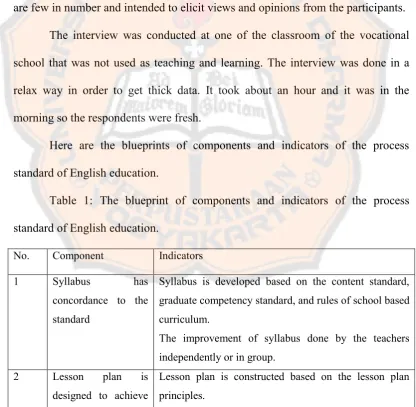
Here are the blueprints of components and indicators of the process

standard of English education.

Table 1: The blueprint of components and indicators of the process

standard of English education.

No. Component Indicators 1 Syllabus has

concordance to the standard

Syllabus is developed based on the content standard, graduate competency standard, and rules of school based curriculum.

The improvement of syllabus done by the teachers independently or in group.

2 Lesson plan is designed to achieve

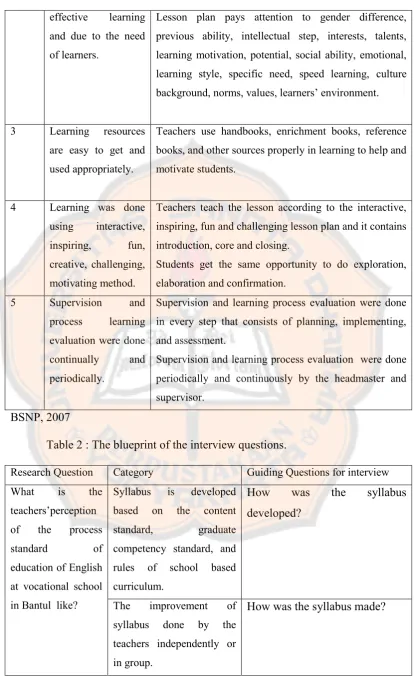
(51)

38

effective learning and due to the need of learners.

Lesson plan pays attention to gender difference, previous ability, intellectual step, interests, talents, learning motivation, potential, social ability, emotional, learning style, specific need, speed learning, culture

background, norms, values, learners’ environment.

3 Learning resources are easy to get and used appropriately.

Teachers use handbooks, enrichment books, reference books, and other sources properly in learning to help and motivate students. inspiring, fun and challenging lesson plan and it contains introduction, core and closing.

Students get the same opportunity to do exploration,

Supervision and learning process evaluation were done in every step that consists of planning, implementing, and assessment.

Supervision and learning process evaluation were done periodically and continuously by the headmaster and supervisor.

BSNP, 2007

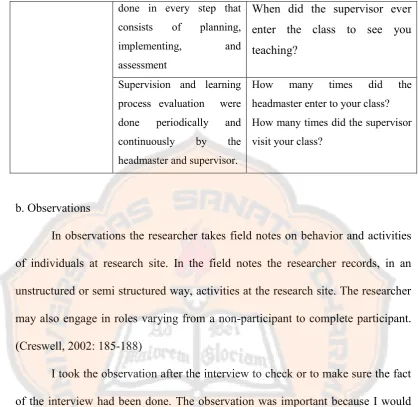
Table 2 : The blueprint of the interview questions.

Research Question Category Guiding Questions for interview What is the

teachers’perception

of the process standard of education of English at vocational school in Bantul like?

Syllabus is developed based on the content standard, graduate competency standard, and rules of school based teachers independently or in group.

(52)

39

Lesson plan is constructed based on the lesson plan principles

What is the content of the lesson

plan?

Lesson plan pays attention to gender difference, previous ability, intellectual step, interests, talents, learning motivation, potential, social ability, emotional, learning style, specific need, speed

When do you start teaching?

How do you treat the specific

need students?

Teachers use handbooks, enrichment books, How to get the handbooks? How about the library?

Teachers teach the lesson according to the interactive, inspiring, fun and challenging lesson plan and it contains introduction, core and closing.

What are the responds of the

students when you are teaching?

How do you teach of your

students?

How to make the teaching fun?

Students get the same opportunity to do exploration, elaboration and confirmation

How do you give students to get

the same opportunity to do

exploration, elaboration and

confirmation?

Supervision and learning process evaluation were

When did the headmaster enter

(53)

40

done in every step that consists of planning, implementing, and assessment

When did the supervisor ever

enter the class to see you

teaching?

Supervision and learning process evaluation were done periodically and continuously by the headmaster and supervisor.

How many times did the headmaster enter to your class? How many times did the supervisor visit your class?

b. Observations

In observations the researcher takes field notes on behavior and activities

of individuals at research site. In the field notes the researcher records, in an

unstructured or semi structured way, activities at the research site. The researcher

may also engage in roles varying from a non-participant to complete participant.

(Creswell, 2002: 185-188)

I took the observation after the interview to check or to make sure the fact

of the interview had been done. The observation was important because I would

get the real teaching. This observation would be the data that support the

interview had been done. I would like to present the blueprint of the observation

done in the classroom.

Tabel 3 : The blueprint of the observation class.

No Indicators Existence

(54)

41

A. Mastery of the material

3. Perform the mastery of the material

4. Relate the material to other relevant knowledge

5. Convey the material clearly and doe to learning hierarchy 6. Relate the material to the real life

B. Approach of learning

7. Implement the learning that is appropriate to the goals will be achieved.

8. Implement the learning harmoniously. 9. Have the control over the class.

10. Implement the teaching and learning contextually.

11. Implement the teaching and learning that is open to positive habits.

12. Implement the teaching and learning due to the time allocation.

C. The use of learning sources/ learning media. 13. Use the media effectively and efficiently 14. Have a good message.

15. Include the students in the use medias.

D. Learning that triggers and maintain students involvement. 16. Learning that triggers students to be active in the teaching

and learning.

17. Open to the students’ responses.

18. Grow the fun and the enthusiasm of students.

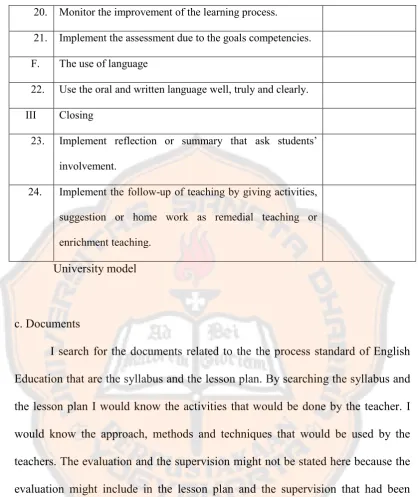
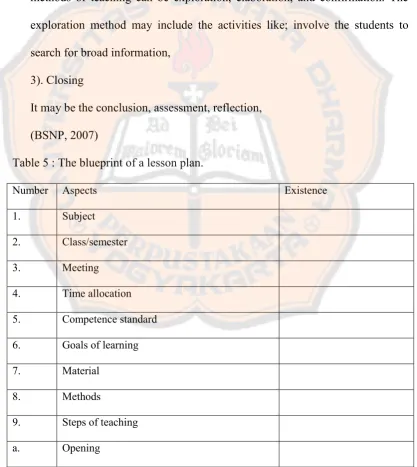
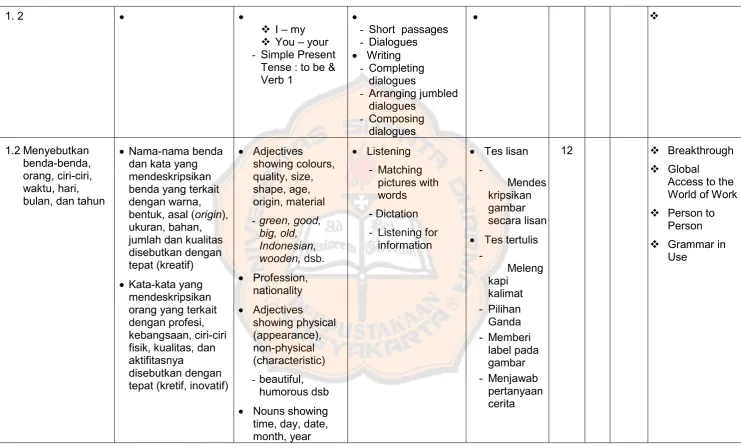
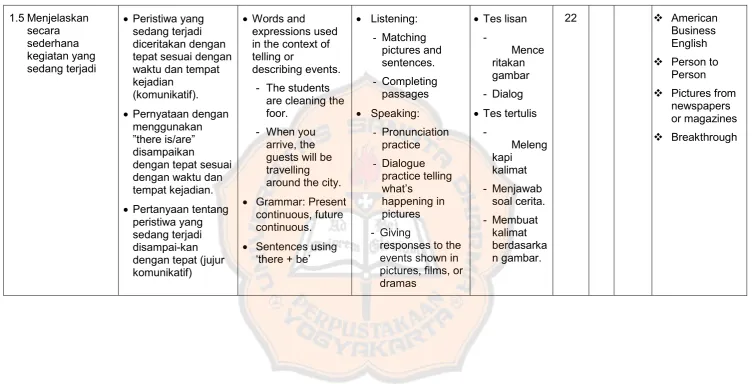
Gambar

Table 1 The blueprints of components and indicators of the process
Table 1: The blueprint of components and indicators of the process
Table 2 : The blueprint of the interview questions.
Tabel 3 : The blueprint of the observation class.
+7

Referensi

Dokumen terkait

Springate model dapat digunakan sebagai prediktor terhadap perusahaan. Fatmawati (2014) menyatakan hasil penelitiannya

Dalam pembahasan masalah ini yang akan dibahas adalah mengenai cara pembuatan dari mulai menentukan struktur navigasi, membuat disain antarmuka, pembentukan elemen, penggabungan

Save (save.FileName, System.Draw

Bagaimana tingkat kesehatan keuangan Credit Union LANTANG TIPO selama 3 (tiga) tahun, ditinjau dari aspek Permodalan, Kualitas Aktiva Produktif, Manajemen, Rentabilitas, dan

Pengaruh Manajemen Waktu terhadap Kinerja Pegawai Di Pusdiklat Geologi Bandung Universitas Pendidikan Indonesia | repository.upi.edu | perpustakaan.upi.edu..

Bila campuran udara dan bahan bakar terbakar dengan adanya percikan api dari busi yang panas sekali, maka akan menghasilkan tekanan gas pembakaran yang besar

Analisis Rasio Keuangan Dalam Memprediksi Kondisi Financial Distress Perusahaan (Studi Kasus : Perusahaan Manufaktur Yang Terdaftar Di Bursa Efek Indonesia).. Analisis

Berkenaan hal tersebut diatas, diminta Saudara untuk membawa dokumen asli perusahaan dan/atau rekaman yang sudah dilegalisir oleh pihak yang berwenang