i
Presented as Partial Fulfillment of the Requirements for the Degree ofSarjana Sastra
in English Letters
By
SWESTY NATALIANINGRUM
Student Number: 024214009
ENGLISH LETTERS STUDY PROGRAMME DEPARTMENT OF ENGLISH LETTERS
FACULTY OF LETTERS SANATA DHARMA UNIVERSITY
iv
ACKNOWLEDGEMENTS
First of all, I would like to express my gratitude to God the Almighty, who has given me the opportunity to be here and finish this thesis. Without Him, I could not finish this thesis. I would like to express my deep appreciation to my advisor, Dr. Fr. B. Alip, M.Pd.,M.A. for his help and suggestion in correcting my thesis and my co-advisor J. Harris Hermansyah S, S.S., M.Hum for all of his suggestions. I also thank all of the lecturers in English Letters Department of Sanata Dharma University for giving their time and energy in helping me during my study. I thank Mbak Ninik and other staff of the English Letters Department secretariat.
v
vi
TABLE OF CONTENTS ... vi
ABSTRACT ... vii
ABSTRAK ... viii
CHAPTER I INTRODUCTION... 1
A. Background of the Study ... 1
B. Problem Formulation ... 5
C. Objectives of the Study ... 5
D. Definition of Terms ... 6
CHAPTER II REVIEW OF LITERATURE ... 8
A. Review of Related Studies ... 8
B. Review of Related Theories ... 11
1. Morphemes ... 11
2. Affixation and Word Formation ... 16
3. Meaning ... 20
4. The Morphophonemic Process ... 21
C. Theoretical Framework ... 23
CHAPTER III METHODOLOGY ... 25
A. Object of the Study ... 25
B. Sample and Population of Research ... 25
C. Data Collecting and Processing Activities ... 26
D. Data Analysis ... 27
CHAPTER IV ANALYSIS ... 28
A. The Stems ... 28
B. The Lexical Meanings of the PrefixOver- ... 39
C. The Morphophonemic Process ... 46
CHAPTER V CONCLUSION ... 53
BIBLIOGRAPHY ... 55
vii
There are three different forms of the wordover, namelyover as preposition, overas particle, andoveras prefix. This study will only focus in the prefixover-. The prefixover-is chosen because it is frequently used not only in daily communication, but also in written form.
The objectives of the study are divided into three. First is to identify the stems which occur with the prefix over-. Second is to find out the meaning of the prefix over-. Third is to identify the kind of morphophonemic process that occurs.
The population and samples are taken from two dictionaries, they areOxford Advanced Learner’s Dictionary of Current English 6th edition and Merriam Webster’s Collegiate Dictionary. The study is conducted in two steps; they are data collection and data analysis.
viii ABSTRAK
Swesty Natalianingrum. 2007. A Morphological Study of English Prefix Over-. Yogyakarta: Jurusan Sastra Inggris. Fakultas Sastra. Universitas Sanata Dharma.
Ada tiga macam bentuk yang berbeda dari kata over, yaitu over sebagai preposisi, oversebagai partikel, dan oversebagai awalan. Penelitian ini hanya akan fokus pada awalan over-. Awalan over- dipilih karena sering digunakan dalam komunikasi sehari-hari dan juga dalam bentuk tulisan.
Tujuan dari penelitian ini dibagi menjadi tiga. Pertama untuk mengidentifikasi kata dasar yang muncul dengan awalan over-. Kedua untuk mencari tahu arti dari awalanover-. Ketiga untuk mengidentifikasi jenis proses morfofonemik yang terjadi.
Populasi dan contoh diambil dari dua kamus, yaitu kamusOxforddan kamus Merriam Webster. Penelitian ini dilakukan melalui dua tahap, yaitu pengumpulan data dan analisa data.
A. Background of the Study
Language plays a major role in human life. People from all over the world need a language to communicate. Therefore, we will find that there are so many languages in this world such as English, Danish, and Spanish. According to Moulton (in Bloomfield and Haugen 1974), every language exists in many styles. A language offers different ways of expressing ideas that are appropriate for different occasions. For example, we use one style in speaking with our close friend of our own age. The style of the language will be full of a sense of familiarity and friendship. This style must be different from the style when we are talking man to man, woman to woman, man to woman, and woman to man (Bloomfield and Haugen, 1974:3)
Since there are so many languages throughout the world, it is agreed that we need a language which can be used by people around the world so that there is no problem in understanding each other. English is chosen as the international language because English has been used in many fields in the world such as education, economy, even entertainment.
In theIntroduction to Linguistics, Wardaugh defines language as a system of arbitrary vocal symbols used for communication. Whenever we discuss a language, we will also discuss the linguistic levels of a language structure. The first level is Phonology, that is the study of sound system. The next level is Morphology, which
2
studies about the system of morpheme or word structure. The third level is Syntax or the study of sentence structure. The last level is Semantics or the study of sentence meaning.
English has many derived words which are formed by using processes such as affixation, acronym, back formation, blending and so on. However, the most common process occurs in forming new word is affixation. There are some numbers of affixes in English that are used to form a new word. Quirk, Greenbaum, Leech and Svartvik in their A Grammar of Contemporary English (1972) mention about 50 English affixes such as re-, in-, un-, dis-,andpre-to be called prefixes and–hood, ion, er, -ing, -ment,and–ationto be called suffixes.
Considering that affixation frequently occurs in daily language, it is very important for the writer to raise the topic about affixation which other researchers have not done.
categories of the derivative always change when affixes are attached to words, both suffixes and prefixes.
Since there are many kinds of English affix, the writer narrows the topic down and focuses only on one particular item, which is the prefixover-. The writer’s reason for choosing the prefix over- is that this prefix is frequently used not only in daily communication but also in written form as well. As the main source for finding the data, the writer will use Oxford Advanced Learner’s Dictionary of Current English andMerriam Webster’s Collegiate Dictionary. Also, other related information will be used as additional information which is taken from several books and the internet. In addition to over- as a prefix, there are four other categories of the word over, namelyoveras an adjective, an adverb, as a preposition and as a particle. In the first three categories, the wordoverhas different meanings, whilst the fourth category does not have particular meaning. The meanings of the first three categories and the examples of each category will be described as follows.
The word over as an adjective has two meanings. The first meaning is ‘finished; ended or concluded’ as in ‘The show is over’; while the second meaning is ‘through with or emotionally detached’ as in ‘He is finally over his ex-girlfriend’ (http://www.spotlightonline.de/CoCoCMS/generator/viewDocument.php?doc=996&a rchive=1). As an adjective, the word over modifies a noun, usually describing it or making its meaning more specific (http://en.wikipedia.org/wiki/Adjective).
4
head’. The second meaning is ‘in such way as to cover’ as in ‘Drape the fabric over
the table’. The third meaning is ‘more than or to a greater degree’ as in ‘I prefer the
purple over the pink’. The fourth meaning is ‘beyond; past; exceeding; too much or
too far’ as in ‘I think I’m over my limit for calories for today’. The last meaning is ‘again; another time or once more’ as in ‘I lost my paper and I had to do the entire assignment over’. (http://www.spotlight-online.de/CoCoCMS/generator/ viewDocument.php?doc=996&archive=1). As an adverb, it modifies any other parts of language (verbs, adjectives, other adverbs, clauses and sentences) except for nouns. It also has adverbial function, which is for answering Wh-questions (http://www.wikipedia.org/wiki/Adverb).
The word over as a preposition has three meanings. The first meaning is ‘above or higher than’ as in ‘There is tree over the lawn’. The second meaning is ‘across or spanning as’ in ‘There is a bridge over the river’. And the third meaning is
‘covering’ as in ‘There is a roof over your house’
(http://www.spotlightonline.de/CoCoCMS/
Lastly,overis a particle. In English there are many words that used overas its particle such astake overas in ‘She took over as manager two weeks ago’; go over as in ‘I always go over my revision notes just before I go into an exam’; and come over as in ‘Come over here’!. The particle over modifies the verb. This kind of verb is what so called as phrasal verbs. Particle itself belongs to function word. Function words are words that have little meaning or have ambiguous meaning, but instead serve to express grammatical relationship with other words within a sentence, or
specify the attitude or mood of the speaker
(http://www.en.wikipedia.org/wiki/Function_word). For instance the interjection oh. The interjection oh here has more than one meaning. First, it can express surprise such as“This gift is for you.” “Oh really?”. Second, it can express disappointment such as “I can’t come to your birthday party.” “Oh, that’s a shame.”. The interjection can be used for two different situations, but basically they are used for responding to someone else has said.
B. Problem Formulation
There are three main problems that should be analyzed in the study of prefix over-and the writer will present the problems as follow:
1. What stems are prefixed byover-?
2. What are the lexical meanings of the prefixover-?
6
C. Objectives of the Study
In this study of prefix over-, the writer tries to identify the stems which occur with the prefix over-. Then, the writer tries to find out the lexical meaning of the prefix over- and the derived words. Also, the writer tries to identify the kind of morphophonemic process that occurs.
D. Definition of Terms
In studying the English prefix over- in this paper, the writer feels it is necessary to give some definition of terms that are familiar with morphology and phonology and used in the title and the problem formulation above. In order to avoid misunderstanding of the meaning of each term, the writer gives definition for each of them below:
An affixation process is the process of word formation by way of adding a prefix, an infix, a circumfix, and a suffix (Gleason, 1958:59).
A morphemeis the minimal meaningful unit of language, a grammatical unit that is arbitrary union of sound and a meaning that cannot be further analyzed. Every word in every language is composed of one or more morphemes (Aronoff, Dobrovolsky & O’Grady, 1989:90)
A prefix is an affix that is attached to the initial position of a stem; for example, {pre-} in prewar and {un-} inundo (Aronoff, Dobrovolsky and O’Grady, 1989:98)
CHAPTER II
REVIEW OF LITERATURE
In this chapter, the writer will try to discuss the three parts. They are the review of related studies, the review of related theories and theoretical framework. In the theoretical framework, the writer tries to show how the writer applies the related theories and the study in analyzing the topic of this paper.
A. Review of Related Studies
In the problem formulation stated in the first chapter, the writer tries to discuss the stems that can be attached with the prefix over-, how the prefix changes the meaning of the stems, and lastly the morphophonemic process which occurs in the analysis. In order to answer those problems above, the writer uses an undergraduate thesis entitled The Morphological Study of the Prefixes of Time {Ante-, Fore-, Post-, Pre-} in Englishby Novita Artasari written in 2003 as the related study of this paper.
In her thesis, Artasari made an analysis on prefixes of time, that is prefix {Ante, Fore-, Post-, and Pre-}. She discusses the stems, the meaning, and the morphophonemic process of the prefix of time. First of all, she classified the stems according to the parts of speech that the words have such as noun, verb, and adjective. From her study of the stems of the prefixes of time she found that the prefixante-occurs with noun as inanteroom, verb as inantedate, and adjective as in antemortem.The prefixfore-only occurs with nouns as inforename,and a verb as in
forefeel. The prefixpost- occurs with a noun as in postconcert, verb as in postexist, and adjective as in postromantic. And the prefixpre-occurs with noun as inprewar, verb as inprework, and an adjective as inprerehearsal(Artasari, 2003:29-38).
Besides analyzing the stems, she also analyzed the meaning of the prefixes of time. She found that generally the prefixes of time have a general meaning, namely showing time. However, each prefix has its deeper meaning. The prefixes have lexical meanings since the meanings are found in the dictionary. The prefix ante-itself has two different meanings. Those meanings are firstly ‘prior’ (‘earlier’) as in antedate which means earlier date, and ‘prior to’ (‘earlier than’) as in antepaschal which means pertaining to the time before Easter. Secondly it means ‘anterior’ (‘forward’) as inantechamber which means forward chamber, and ‘in front of’ as in antechoir,which means in front of choir.
The second prefix, that is the prefix fore-, has three meanings. First are ‘earlier’ or ‘beforehand’ as in foredoom which means to doom beforehand. The second meaning is that ‘occurring earlier’ as in forenoon which means a time that occur earlier than noon. The last meaning of the prefix fore- is that ‘front part of something specified’ as in foreground which means a ground that is in front of a spectator.
10
‘subsequent to’ or ‘later than’ as in postoperative, which means subsequent to operative.
The last prefix is the prefix pre- which also has three meanings. The first meaning is ‘earlier than’ or ‘prior to’ or ‘before’ as in precensor, which means to censor before its release to the public. The second meaning is ‘in advance’ or ‘beforehand’ as in precancel, which means to cancel in advance of use. The last meaning is ‘in front of’ or ‘anterior to’ as in prefrontal, which means situated in the anterior part of the frontal lobe or region (Artasari, 2003:39-44).
In analyzing the morphophonemic process, Artasari found that there is only stress shift occuring in some stems before and after attaching the prefixes. For example the word antedate /,æntI’deIt/. The word date before attaching the prefix ante- does not have any stress, after the prefix ante- is attached to date, a stress occurs in the middle of the resulted word’s transcription. The changes are unpredictable or in the other words, there is no particular environment of the changes. She does not explain further about the stress shift of the prefixes because she only focuses on the segmental part. In the conclusion of the morphophonemic process, she concludes that the affixation process happens in the simple way that is by adding the prefixes of time to the stems and it does not cause the prefixes of time to have allomorphs or alternative morpheme shapes (Artasari, 2003:45-49).
to noun and verb. Prefix may have more than one meaning. The meaning of the stem will change after the prefix is attached. Therefore, the prefix can create a new word. Furthermore, the prefix can also make changes on the place of the stress in the stem. For instance, the prefixes of time cause stress shift to occur in the derived words. Since the writer also discusses about prefix it is important to see how Artasari analyzes the prefixes of time in her undergraduate thesis. The way she makes the analysis will help the writer to analyze the prefixover-.
B. Review of Related Theories
1. Morphemes
a. General Review of Morphemes
In everyday life, normal people produce so many sentences to express his idea or feeling toward what is happening everyday. These sentences can be broken down into smaller units, namely words. According to O’Grady and Dobrovolsky in their book entitled Contemporary Linguistic: An Introduction, a word is the minimal meaningful units of language (1989: 90). Every word in English has meaning such as car which means a road vehicle with an engine, four wheels, and seats for a small number of people.
12
identifiable meaning, for example the wordshouseswhich is made up fromhouseand –s. (O’Grady, Dobrovolsky and Katamba, 1997: 91).
The words in English can be divided into two major categories, namely content words and function words (Fromkin, Blair, and Collins, 2000: 64). Content words consist of nouns, verbs, adjectives, and adverbs. Meanwhile function words consist of pronouns, prepositions, conjunctions, interjections, determiners, and articles. The category such as nouns, verbs, adjectives and adverbs are also known as parts of speech (O’Grady, Dobrovolsky and Katamba, 1997:132). Each category has its own characteristics. The characteristic are like the following:
The first part of speech is a noun. According to Jackson, a noun refers to ‘things’ in general. If we have a noun for something, it implies that we view it as ‘thing’ (1982: 61). A noun has two characteristics. The first characteristic is that a noun can be combined with demonstratives, such asthis, that, these, those as inthis hat, that man, these boxes. Furthermore, a noun can also be combined with the
definite article, the, or theindefinite article, a, as inthe car ora check.In addition, a noun can be combined with possessive pronounssuch as my, your, her, his, its, our, theiras inmy bag, your dress,andtheir cats(Dwijatmoko, 2004:3).
The second characteristic is that a noun can take plural suffix–sas inhats, cat and bags. However, there are exceptions for the words women, children, oxen etc because these words do not take plural suffix–sfor their plural forms.
suffix–sin the present tense as inwalks, hits andcleansthe verbs remain in the same class, except when the subject is the third person singular. The second is that a verb can take the suffix –ing as in walking, hitting andsinging. The last characteristic is that a verb can have two forms to form the past tense. The first is what so called as regular verbs. Here, the verbs are only added by–edas inwaited, walked,andplayed. The second form is irregular verbs such assang, wet, gave andbrought. Yet, there are few words that remain in the same form when it is showing the past tense, they are cut, hit, read.
The third part of speech is an adjective. It has three characteristics. The first is that an adjective can be modified byintensifiers such asvery, so, quiteandrather as in very delicious, so beautiful, quite far, and rather hard. The second is that it can modify a noun, for example beautiful girl, delicious cake, hard exams. The last characteristic is that an adjective usually takes the suffixes –erand –est, for example big – bigger – biggest, fast – faster – fastest. However, some adjectives cannot occur
with–erand–est,but withmoreandmost as inmore beautifulandmost beautiful. In addition, all adjectives occur with the comparative wordsless and leastas in sweet – less sweet – least sweet. These forms are called comparative forms of adjectives.
14
that an adverb can modify an adjective as in obviously true, enormously tall. The third is that an adverb can be modified by an intensifier such as very quickly, rather easily. The last characteristic is that an adverb can occur with the comparative words
more, most, less, leastsuch asmore quickly, less easily(Dwijatmoko, 2004:4).
Similar to sentences, a word can also be broken down into a smaller unit, namely morpheme. Morpheme is the smallest unit of language that carries information about meaning or function (O’Grady, Dobrovolsky, and Katamba, 1997: 133).
A morpheme can be differentiated into two kinds, namely free morphemes and bound morphemes (O’Grady and Dobrovolsky, 1989: 93). Free morphemes are morphemes which can constitute a word by itself. Bound morphemes are morphemes which must be attached to another element. For example the morphemehouseis free since it can be used as a word on its own; plural–s, on the other hand, is bound.
A bound morpheme can be an affix. An affix is a bound morpheme which is attached to an existing word to form a new word or to show a syntactic meaning (Dwijatmoko, 2004:9). For instance the word governmental which consists of three morphemes: one free morpheme governand two affixes. The first affix is –ment so that the word becomes government, and the second affix is –al so that the word becomesgovernmental. An affix itself is divided into two; based on its function and its position. Further discussion on affix is in the following.
functions to form a new word. For example, a suffix –ness is added to an adjective happyand forms nounhappiness. An inflectional affix is an affix which functions to show a syntactic meaning. For example, the affix –ed added to a verbwalkand forms verb walked to show the past tense. There are differences that occur between derivational affix and inflectional affix. In the derivational affix, the affix forms a new word. There are two options in forming a new word (Katamba, 1993:47). First is by changing the meaning of the base to which the affix attached, for examplekindvs. unkind (both are adjectives but with opposite meanings). Second is by changing the word-class that a base belongs to, for example the addition of –ly to the adjectives kind and simple produces the adverbs kind-ly and simp-ly. Meanwhile in the inflectional affix; the affix does not form a new word. Derivational affix operates in morphological level, while inflectional affix operates in syntactic level.
An affix can also be differentiated into three categories based on the position. They are prefix, suffix, and infix (Katamba, 1993:44). A prefix is an affix attached before a root or stem or base, for example re-in remake and reread. A suffix is an affix attached after a root (or stem or base), for example–lyas inkindlyand quickly. An infix is an affix inserted into the root itself, for example -cub- as inincubate and incubus.
16
words, it is said that each allomorph of a morpheme can occur in certain position where the other allomorphs cannot occur. For example is the English plural suffix [s] which has three allomorphs, namely /z/, /s/, and /iz/. As stated before that each allomorph has its own position. It also happens to this suffix. When the preceding sound is a sibilant as in horse, bushand judge, the /iz/ occurs. Otherwise, when the preceding sound is voiceless as in cat, rock, or cliff, the /s/ allomorph occurs. Meanwhile, the /z/ allomorph occurs after a vowel or a voiced consonant as indogor day(Carstairs-McCarthy, 2002:22).
Basically, there are three criteria to determine whether two or more allomorphs are allomorphs of a different morpheme or not. The allomorphs are from the same morpheme if (i) the allomorphs are in complementary distribution, that is they have their position, (ii) they have the same meaning, and (iii) they are usually phonologically similar (Dwijatmoko, 2004: 11).
2. Affixation and Word Formation
a. General Review of Affixation and Word Formation
The following is a comment concerning the affixation and the word formation:
The broadest and most comprehensive classes of morphemes in English, and the most nearly universal in the languages of the world, are roots and affixes. In general, affixes are subsidiary to roots, while roots are the centers of such constructions as words. Prefixes are affixes which precede the root with which they are most closely associated. Suffixes are affixes which follows the root with which they are most closely associated. Affixes may be added directly to roots, or to constructions consisting of a root plus one or more other morphemes. A stem is any morpheme or combination of morphemes to which an affix can be added (Gleason, 1958: 58-59).
The stem is the form to which an affix is added. The stem often becomes the root of a word. The root of a word belongs to the content words, namely nouns (N), verbs (V), adjectives (A) and adverbs (Adv). For instance is the word cars. The affix –sis added to the wordcar. Here, the wordcaris the root. However, an affix can also be added to a larger unit than a root. For example the word criticized. Here, the past tense is added to the stemcriticizeso that the word consists of the root criticand the suffix–ize. In this case, the wordcriticis not only the root for the wordcriticized, but also the stem of criticize. Therefore, the stem of the word criticized is the word criticizeand is being added with suffix–ed(O’Grady and Dobrovolsky, 1989:90).
18
Compounding is a process of forming a new word by combining two already existing words. In English, compounds can be found in nouns, adjectives, and verbs. Since a compound consists of two members, so the first member becomes the modifier of the second. For example red-hot is a degree of hotness (O’Grady and Dobrovolsky, 1989:103-104).
Szymanek in his book entitled Introduction to Morphological Analysis identifies six types of compounding. The first is Noun – Noun as in wall-paper, leather shoe, sugar cane, and sound quality. The second is Verb – Noun as in pushbutton, treadmill, drawbridge, and washbasin. The third combination is Noun – Verb as in book review, haircut, bus stop, and TV show. The fourth is Adjective – Noun as in blackbird, high school, software, and strongman. The fifth isParticle – Nounas in afterthought, background, outlaw,anddowntown. The last combination is Particle – Verb as inbackset, income, outburst, andoutcome (1989:44-46).
The other types of word formation process which are common are acronym, that is a word which is formed by taking one or more phonological elements of the words which constitute it such asLAPD; back formation, that is a process whereby a word whose form undergoes a process of deaffixation to delete an affix to form a new category (O’Grady & Dobrovolsky, 1989:106) as in televise television; blending, that is a process whereby two parts of word are combined to form a new word as in brunch, smog; borrowing, that is a process in which a word from another language is
word is created without a base before such asXerox, Kodak; functional shift, that is a shift of the part of speech to form a new word such as run which is a verb, can also be used as a noun; morphological misanalysis, that is a process in which a new word is formed because of a wrong analysis such as cheeseburger, workaholic (Dwijatmoko, 2004:24-26).
b. The Prefix
20
3. Meaning
The second problem is about the lexical meanings of the prefix over-. Therefore, it is important to apply this theory. Language is composed from words. Words themselves must have a meaning. Even, a word has more than one meaning. However, there are words that do not have particular meaning. These are so-called as empty words. According to Lesley Jeffries inMeaning in English: An Introduction to LanguageStudy (1998), empty words are words which can fulfill the subject position in certain structures, but which add nothing to the meaning. These include there and itas in There isn’t any tea andit’s raining again. Meanwhile, the word such as cat has its own meaning, even when it is used out of context. As Jeffries stated that the lexical meaning such as catcan stand on its own, whereas grammatical meaning such astheonly functions in context.
4. The Morphophonemic Process
Since the last problem concerns with the morphophonemic process of the prefix that occurs, it is important to use this theory as the basic in making the analysis. A morphophonemic process will occur when an affix is added to the stem. In English, there are several types of morphophonemic process, namely assimilation, dissimilation, deletion, consonant and vowel change, flapped, metathesis, schwa epenthesis, stress shift, suppletion, and vowel and consonant lengthening (Wardaugh, 1977: 198).
The first type is assimilation. It is a process where one segment is influenced by another segment. It always produces from a sound becoming more like another nearby sound in terms of one or more of its phonetic characteristic (O’Grady, Dobrovolsky, and Katamba, 1997: 53). For example is the vowel I as in sing/sIη/. The vowelIis nasalized since it is followed by a nasal η.
The second type is the opposite of assimilation, that is what is called as dissimilation. Different from the assimilation process, the dissimilation process produces in two sounds becoming less alike in articulatory. For example the word fifths. Many speakers dissimilate the final /fɵs/ sequence to /fts/, in order to break up the sequence of three fricatives with a stop (O’Grady, Dobrovolsky, and Katamba, 1997: 54-55).
22
cluster on the word fifths and pronounce it as /fifs/ (O’Grady, Dobrovolsky, and Katamba, 1997: 55).
The fourth type is consonant and vowel change. It is a process where a consonant or a vowel change after an affix is added. For example the word music /mju:zIk/ becomes /mju:sI∫n/ after it is added by suffix–ion. /z/ inmusicbecomes /s/ in musician. Another example is the word describe /dIskraIb/ becomes /dIskrIp∫n/ after the suffix –ionis added. /aI/ in describebecomes /I/ in description(Wardaugh, 1977:198-200).
The fifth type is flapped. It occurs when a sound with a rapid movement of the tongue to the top of the mouth. For example the wordwrite/raIt/, after it is added by the suffix–ing, it becomes /raIdIη/ (Wardaugh, 1977: 241).
The sixth type is metathesis. It is a process that reorders a sequence of segments. It often produces in a sequence of phones that is easier to articulate. For example the word spagehetti that is pronounced as pesghetti /pƏsketi:/ by children (O’Grady, Dobrovolsky, and Katamba, 1997: 56).
The seventh type is schwa epenthesis. It is the insertion of a sound /I/ or /Ə/in pronunciation after the word is added by affixation. For example the word church /ʧ3:ʧ/ becomes / ʧ3:ʧIz/ after it is added by –s. /I/ in churches is called schwa epenthesis (Wardaugh, 1977: 241).
/Əd∧stI blækbord/. The primary stress [‘] is onblack, the secondary stress [^] is on dust and the tertiary stress [`] is on board, a and –y are unstressed [ ] (Wardaugh, 1977: 46).
The ninth type is suppletion. It occurs when a word does not have phonemic resemblance. For example the wordgobecomeswentin verb two, goodbecomesbest in superlative, to beis, am arebecomewas, werein verb two (Wardaugh, 1977: 252). The last type is vowel and consonant lengthening. It occurs when a word is attached to an affix, but it does not mean that all of the words become longer after they are attached to affix. For example the word thief/ɵIf/ becomes /ɵi:vz/ after the suffix–es is added. The lengthening is shown by the mark:, so it will be pronounced longer.
C. Theoretical Framework
There are three problems which are discussed in the thesis, they concern about the stems of the prefixover-, the meaning of the prefixover-, and the last is the morphophonemic process that occurs.
24
stems and the prefix are independently-meaningful units, so they have their own meaning.
The second problem concerns about the lexical meaning of the prefix over-. At this, the writer uses theory on meaning. The prefix over- itself has its own meaning. In order to find the meaning of the derived word, the meaning of the stem and the prefix are combined into one so that they will produce a new meaning.
A. Object of the Study
In this paper, the writer has chosen the prefix over-as the object of the study. The purpose of this study is to describe all the things which have relation with the prefix over-, therefore it is called descriptive research. The things here mean the description of the stem, the meaning of the prefix and the morphophonemic process of the prefix over-.
The writer analyzes three things that have been stated in the first chapter. These three things are the stems that can occur with the prefix over-, the lexical meanings of the prefix over-, and the morphophonemic process which occurs when the prefixover-is attached.
The discussion of the prefix over- is narrowed into the segmental part only. The writer will find whether there is a change on the phonetic transcription of the derived word after the prefixover-is attached or not. If there, then the writer will try to find the change that occurs such as the change on the stress, the change on the pronunciation and so on.
B. Sample and Population of Research
The object of this study is the attachment of the prefix over- to the words. This study uses words, which are formed with the prefix over- as the primary data
26
because this study is conducted by analyzing the words. The population samples used in this study are taken from two dictionaries, which are also the sources of this study, namely Oxford Advanced Learner’s Dictionary of Current English 6th edition and Merriam Webster’s Collegiate Dictionary. The reason why the writer chooses
Oxford Advanced Learner’s Dictionary of Current English 6th edition as the main source because it is commonly used by the English learners. Meanwhile, Merriam Webster’s Collegiate Dictionary is chosen because the writer finds that this dictionary has the phonetic transcription that is very useful for the analysis. It also has some words using the prefix over-, which do not occur in the Oxford Advanced Learner’s Dictionary of Current English 6thedition.Therefore, those two dictionaries complete each other. The population is all words which are attached by the prefix over-. From the two dictionaries, the writer finds that there are 157 words which
using the prefixover-. In this study, the writer will analyze them all.
C. Data Collection and Processing Activities
D. Data Analysis
In order to answer the problems, the writer would use all the data taken from the dictionary.
First of all in order to answer the first problem, the writer used the data of the free morpheme that attached to the prefix over- and then categorized them based on their category of the part of speech. The category was divided into four, namely noun, adjective, verb, and adverb.
Second, the writer identified the changes in meaning by comparing the meaning of the stems of the prefix over- and the derived words. Instead of knowing the changes in meaning, the writer would also find the meaning of the prefix over-directly. Based on the dictionary, the meanings of the prefix over- were more than usual or too much; completely; upper, outer, or extra; over or above. Those meanings were called lexical meanings since their meanings could be found on the dictionary. Here, the writer used Oxford Advanced Learner’s Dictionary of Current English 6th edition and Merriam Webster’s Collegiate Dictionary to find the meanings of the stems and the derived words.
CHAPTER IV
ANALYSIS
In this chapter, the writer tries to answer the problems stated in the first chapter. The problems concern about the stems that occur with the prefix over-, the lexical meaning that the prefix over- shows in the derived words, and lastly is the morphophonemic process which occurs in the derived words after the prefix over- is attached. All the data used in the analysis are taken from Oxford Advanced Learner’s Dictionary of Current English 6th edition and Merriam Webster’s Collegiate Dictionary.
A. The Stems
There are four categories of parts of speech that can be the stems of the prefix over-, namely a noun, an adjective, a verb, and an adverb. Based on the analysis, the
frequency and percentage of the occurrence of the stems are as seen in the following table.
Table 1 Stems of the prefix
over-Stem Frequency %
Verb 82 52.23%
Noun 58 36.94%
Adjective 16 10.19%
Adverb 1 0.64%
TOTAL 157 100%
From the table above, the writer finds that verbs have the most number of occurrences, and then followed by nouns and adjectives. The discussion of each category is as below.
1. Noun
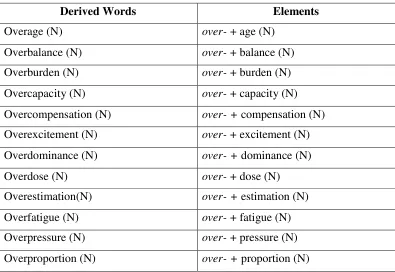
The first category of the stems is the noun. Even though, the prefix over- has been attached to the stem, which is a noun; the category of the derived word later will not change. It is still a noun. The following table will show it:
Table 1.1 Noun as the stem of the prefix
over-Derived Words Elements
Overage (N) over-+ age (N)
Overbalance (N) over-+ balance (N)
Overburden (N) over-+ burden (N)
Overcapacity (N) over-+ capacity (N)
Overcompensation (N) over- +compensation (N) Overexcitement (N) over-+ excitement (N)
Overdominance (N) over- +dominance (N)
Overdose (N) over-+ dose (N)
Overestimation(N) over- +estimation (N)
Overfatigue (N) over-+ fatigue (N)
Overpressure (N) over-+ pressure (N)
Overproportion (N) over- +proportion (N)
30
is age, in which its category is a noun. After the prefix over- attached, the category does not change. It remains a noun. Similar to the previous one, the word overbalance also has a noun as its stem that is balance. The following sentence is an example of the use of the wordoverbalance. The overbalance often happens between rich and poor and it creates jealousy for the poor. Word such as overburden is formed from the wordburdenalso does not undergo changes in its category. It is still a noun. The other word such as overcapacity also has the same category of part of speech, namely noun. Here is the example of the word overcapacity in a form of sentence.Overcapacity occurs when service or production given are much more than the demand.
Another derived word which also does not undergo changes in part of speech, it remains a noun, is the derived word overcompensationas inAn overcompensation claim is given when there is a client who just had a terrible accident. The writer also
adds some other derived words as well as the examples in forms of sentence as below.
words such as overdominance overestimation, overproportion also have the same category of stems as the previous ones. The stems are dominance, estimation, proportionrespectively.
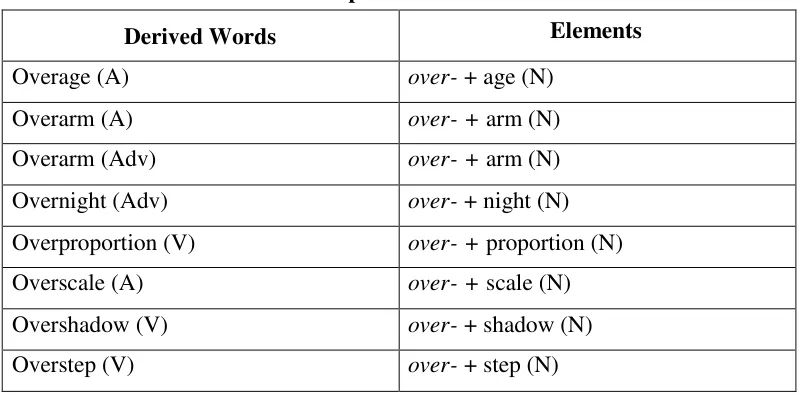
However, there are some stems that are nouns, which undergo syntactic changes on the category of the part of speech when the prefix over-is attached. The part of speech of the stems will change into another kind of part of speech when the prefix over- is attached. In this, the category of the stems is nouns. Yet, the attachment of the prefixover-will change the nouns category into different categories such as verbs or adjectives. The table below will be the proof of the statement above. Table 1.2 Noun as the stem of the prefix
over-Derived Words Elements
Overage (A) over-+ age (N)
Overarm (A) over- +arm (N)
Overarm (Adv) over- +arm (N)
Overnight (Adv) over-+ night (N)
Overproportion (V) over- +proportion (N)
Overscale (A) over- +scale (N)
Overshadow (V) over-+ shadow (N)
Overstep (V) over-+ step (N)
32
overscale sofa cost 23 million rupiahs, although she was aware that it was too big for
their living room In the meantime, the derived word overarm, which comes from a nounarm, result two different parts of speech, namely adjective and adverb. Here are the examples to differentiate betweenoverarmas an adjective and as an adverb.
1. The pitcher did an overarm throw. (ADJECTIVE) 2. He should throw the ball overarm. (ADVERB)
Meanwhile, the words such as overnight, overproportion, overshadow and overstep have different part of speech from the previous ones. They are verbs. Even though, they are verbs, the stems of these words do not have the same part of speech as the derived words. The stems are nouns. The word overproportion, although it is ended by the suffix–ion, has two parts of speech. They are nouns and verbs. In order to differentiate those words, the writer will give the examples as follows:
1. The price of rice is getting higher and causes the amount of famine in Indonesia overproportions. (VERB)
2. The overproportion of flood happens in Indonesia is generally caused by illegal loggings. (NOUN)
the example above. The example of sentence using the derived word overstep is shown as followHe was brave enough to overstep your authority in the last meeting.
Therefore, it can be concluded that the stems nouns will not undergo changes in their parts of speech as soon as the prefix over-attaches if they produces the same part of speech, that is nouns. However, the stems nouns may undergo changes in their part of speech after the prefix over- attaches because they produce derived words which have different parts of speech, namely adjectives, adverb and verbs.
2. Adjective
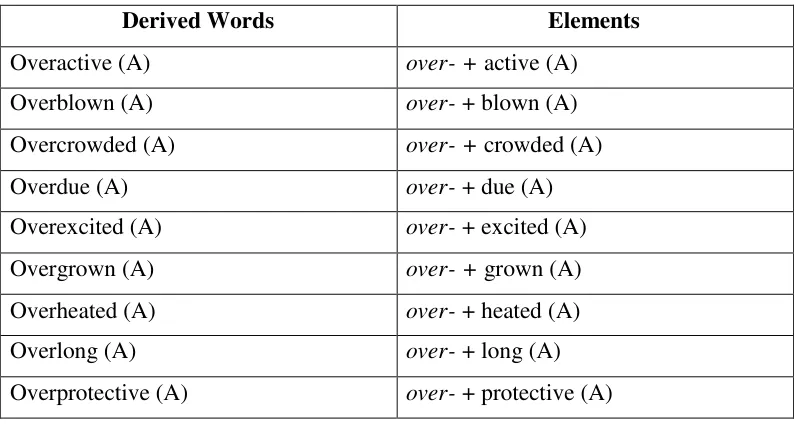
The second category of the stems is the adjective. Different from the nouns, the derived words do not undergo changes in their categories. In other words, the category of the stems and the derived words remain the same, that is adjectives, as in these examples below:
Table 1.3 Adjective as the stems of the prefix
over-Derived Words Elements
Overactive (A) over- +active (A)
Overblown (A) over-+ blown (A)
Overcrowded (A) over- +crowded (A)
Overdue (A) over-+ due (A)
Overexcited (A) over-+ excited (A)
Overgrown (A) over- +grown (A)
Overheated (A) over-+ heated (A)
Overlong (A) over-+ long (A)
34
Overripe (A) over-+ ripe (A)
Oversensitive (A) over-+ sensitive (A)
In the words above, the prefix over- does not change the category of the derived words when it is attached to the stems. The derived words overactive, as in That boy was overactive so that his parents did not know how to handle him, comes from the stem active. In this, it is clearly seen that the derived word overactiveis an adjective because it is preceded by to bewas. Next, the derived wordoverblown,as in He was well-known because of his overblown ambition, is from the stemblownwhich is also an adjective. Then, the derived words overcrowded and overdue also have adjectives as their stems, namelycrowded and due. The examples of these derived words in sentences are described as follows.
Too many poor people are living in overcrowded conditions. Here, the
derived wordovercrowdedmodifies the nounconditions. From the example, it can be seen one of adjective’s characteristics, that is modifying nouns. Another example is given here as in the derived word overdue. For example The rent is overdue. The derived word overdue is also from the stem due, which basically is an adjective. Different from the nouns, the adjectives do not produce different part of speech. This category remains the same.
examples of the derived words mentioned above in a form of sentences are described as follows.
First is the derived word overexcitedas inDon’t get the children overexcited before bedtime. Second is the derived wordovergrownas inThe garden is completely overgrown with weeds. Third is the derived word overheated as inDon’t sleep in an overheated room. Fourth is the derived word overlongas inI can’t imagine how she will do all activities that have been written in her overlong agenda. Fifth is the derived wordoverprotectiveas inOur neighbors become overprotective parents since their son recently has been caught shoplifting.
In order to prove that the adjective does not produce other categories for the derived words after the attachment of the prefix over-, the following sentence will show it The pineapple is overripe. From this sentence, the derived word overripe follows the to be ‘is’ which becomes the verb of that sentence. The parts of speech which can follow a verb only are nouns, adjectives and adverbs. The stem of the derived wordoverripeisripe. If the wordripeis used in a sentence, the sentence will be like thisThose bananas aren't ripe yet. They’re still green. Here, the adjective ripe comes after the to bearen’t. As an addition, to be is only followed by noun, adjective and adverb. Another example is given as an evidence as in theHe was oversensitive about his scar and thought everyone was staring at him. Here, the derived word
36
3. Verb
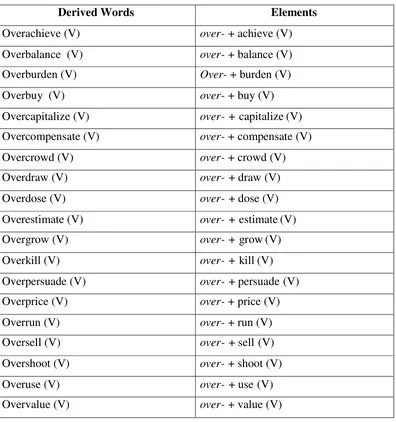
The third category of the stems is the verb. Verb has the most number of occurrences when it is attached to the prefixover-. Therefore, there are many derived words in which verb as their categories, as in these following examples:
Table 1.4 Verb as the stem of the prefix
over-Derived Words Elements
Overachieve (V) over-+ achieve (V)
Overbalance (V) over-+ balance (V)
Overburden (V) Over-+ burden (V)
Overbuy (V) over-+ buy (V)
Overcapitalize (V) over- +capitalize (V)
Overcompensate (V) over-+ compensate (V)
Overcrowd (V) over-+ crowd (V)
Overdraw (V) over- +draw (V)
Overdose (V) over- +dose (V)
Overestimate (V) over- +estimate (V)
Overgrow (V) over- +grow (V)
Overkill (V) over- +kill (V)
Overpersuade (V) over- +persuade (V)
Overprice (V) over-+ price (V)
Overrun (V) over-+ run (V)
Oversell (V) over- +sell (V)
Overshoot (V) over-+ shoot (V)
Overuse (V) over- +use (V)
The words above do not undergo changes because when the prefix over- is attached to the stems and produce the derived words, both the stems and the derived words have the same category, which is a verb. For example the stemestimatewhich is verb as in They estimate that the journey will take at least two weeks remains a verb although there is an attachment of the prefix over- so that the word becomes overestimate as in They were forced to the conclusion that they had overestimated him/his abilities. Another example is the stemuseas inGoing on the expedition gives me a chance to use all the training I've had. After the prefix over- is attached, the category remains the same, which is a verb. The derived word of the stem use is overuse as in I tend to overuse certain favorite expressions. Thus, from those two examples above, it can be concluded that verbs do not undergo changes on their category although the prefixover-is attached.
Besides the derived words overestimate and overuse, the writer also adds some more derived words as examples in the form of sentences. First is the derived word overbalance as in He overbalanced and fell into the water. Second is the derived wordoverburdenas in They were overburdened by their new projects. Third is the derived wordoverbuy as inThe manager decided to overbuy some new fabrics to avoid company’s lost when the monetary crisis happened again. Fourth is the
38
Seventh is the derived wordoverpersuade as in He is trying to overpersuade his wife so that she allows him to marry another woman. Eighth is the derived word
overprice as in The merchants overprice chicken and eggs after the Avian Flu happens. Ninth is the derived wordoverrunas inHer lectures never overrun. Tenth is the derived wordoversell as inHe has a tendency to oversell himself. Eleventh is the derived wordovershoot as inThe department may overshoot its cash limit this year. Twelfth is the derived wordovervalueas inIntelligence can be overvalued.
All these derived words do not undergo changes in their part of speech although the prefix over- attaches. After the attachment of the prefix over-, the category of the derived words remains the same, that is verbs.
Similar to the above, the derived wordoverdose, which comes from the stem dose, also does not undergo changes. It remains verbs. However, there is a difference
between overdose (N) andoverdose (V). In order to make it clearer, the writer will provide the examples of sentence using the derived wordoverdose. The firstoverdose comes from the stem dose which is a noun as in She took a massive overdose of sleeping pills, while the second overdosecomes from the stem dose which is a verb as inHe had overdosed on heroin. From this, it is clearly seen the difference between the wordoverdose(N) andoverdose(V).
4. Adverb
Table 1.5 Adverb as stem of the prefix
over-Derived Words Elements
Overmuch (Adv) over- +much (Adv)
The words above come from adverbs which are added by the prefixover-. The derived word overmuch which is an adverb as in She didn’t worry overmuch about the gossip,comes from an adverb muchas in I ate too much last night, and added by the prefixover-.
The adverbs do not have stems which can produce other categories such as nouns, adjectives or verbs after the prefix over- is attached. The occurrence of the adverbs as the stem of the prefix over-is not as many as other categories.
B. The Lexical Meaning of the Prefix
40
In this thesis, the writer will analyze the prefix over-. This prefix is derivational affix. Its function is to form a new word after the prefix is attached. Derivational affix can also change the category of the word where it is attached to. Besides changing the category of the stem, the derivational affix can also change the meaning of the stems after the prefix is attached. Therefore, the examples of words using the prefixover-have undergone changes in their meanings.
Based on Oxford Advanced Learner’s Dictionary of Current English (2000) and Merriam Webster’s Collegiate Dictionary (1993), the prefix over- has four meanings. The first meaning is more than usual or too much, the second meaning is completely, the third meaningis upper, outer or extra, and the fourth meaning is over
or above.
The writer will explain the list of the lexical meanings of the prefix over-below with some examples following it.
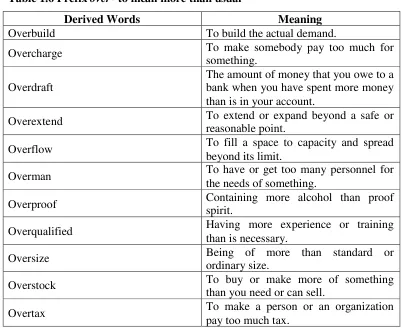
1.Over-to meanmore than usualortoo much
Table 1.6 Prefixover-to mean more than usual
Derived Words Meaning
Overbuild To build the actual demand.
Overcharge To make somebody pay too much for
something. Overdraft
The amount of money that you owe to a bank when you have spent more money than is in your account.
Overextend To extend or expand beyond a safe or
reasonable point.
Overflow To fill a space to capacity and spread
beyond its limit.
Overman To have or get too many personnel for
the needs of something.
Overproof Containing more alcohol than proof
spirit.
Overqualified Having more experience or training
than is necessary.
Oversize Being of more than standard or
ordinary size.
Overstock To buy or make more of something
than you need or can sell.
Overtax To make a person or an organization
pay too much tax.
Source: Oxford Advanced Learner’s Dictionary of Current English and Merriam Webster’s Collegiate Dictionary
Meanwhile, there are many derived words which mean ‘too much’.Below are some examples of the derived words that belong to this category, which means ‘too much’.
Table 1.7 Prefixover-to mean too much
Derived Words Meaning
Overcook To cook food for too long.
Overdo To do something too much.
Overdose Too great a dose.
Overdress To dress or adorn to excess.
42
Overemphasis Too much emphasis or importance.
Overfeed To give somebody or something too
much food. Overgrowth
Too much growth of something, especially something that grows on or over something else.
Overheat To heat to excess.
Overlord A person who has power over many
other people.
Overreach To fail by trying to achieve more than
is possible.
Oversexed Having stronger sexual desire than
usual.
Oversimple Too simple.
Overwrite To write too much or in an overly
elaborate style.
Overwork To make a person or an animal work
too hard.
Source: Oxford Advanced Learner’s Dictionary of Current English and Merriam Webster’s Collegiate Dictionary
There is a slight difference between the meanings of the prefixover-asmore than usual and too much. In the first meaning, there is clear boundary which limits between normal degree and excessive degree. Also, it can be clearly seen, for example the word overstock. The writer will give situation to explain the boundary. As if there was a seller who bought 50 clothes from the merchant and then he could only sold 5 clothes a day. Here, it can be seen that the clothes overstock, because the seller still has more or less 45 clothes to sell.
There were two zoo keepers who were feeding the lions at the same time. One of them gave a kilo of meat, while the other one gave two kilos of meat to the lions. According to A, giving one kilo of meat was enough for the lions because he did not want the lions to be so full. Meanwhile, B had different opinion. He thought that one kilo of meat was not enough for the lions. Thus, from the example above, it can not be measured the boundary between normal degree and excessive degree.
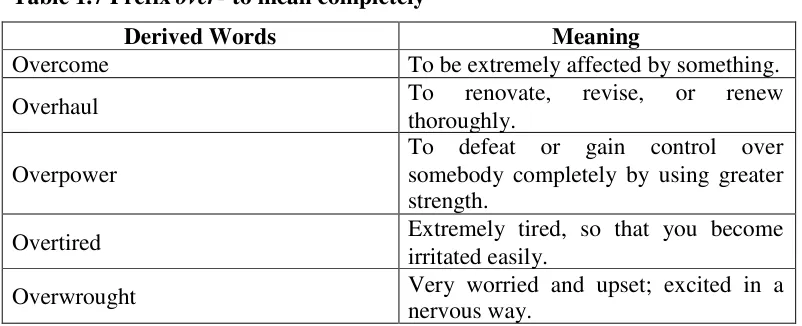
2.Over-to meancompletely
Most people think that the prefixover-only means too much. However, it has another meaning. The second meaning of the prefix over- is ‘completely’. The meaning ‘completely’ occurs in the words like the following:
Table 1.7 Prefixover-to mean completely
Derived Words Meaning
Overcome To be extremely affected by something.
Overhaul To renovate, revise, or renew
thoroughly. Overpower
To defeat or gain control over somebody completely by using greater strength.
Overtired Extremely tired, so that you become
irritated easily.
Overwrought Very worried and upset; excited in a
nervous way.
44
3.Over-to meanupper, outer,orextra
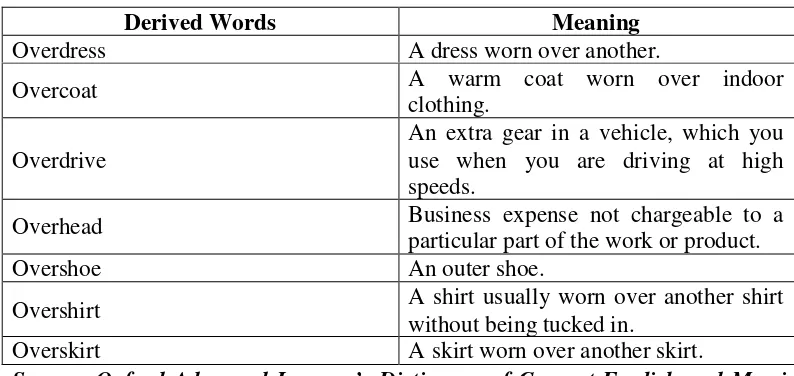
Besides having meanings ‘more than usual’ or ‘too much’ and ‘completely’, the prefix over-also has meaning ‘upper’, ‘outer’, or ‘extra’. Only some words using the prefix over- which have this meaning. All of them are nouns. The example of words which using the prefix over-and having meaning as ‘upper’, ‘outer’, or ‘extra’ are the following:
Table 1.8 Prefixover-to mean upper, outer or extra
Derived Words Meaning
Overdress A dress worn over another.
Overcoat A warm coat worn over indoor
clothing. Overdrive
An extra gear in a vehicle, which you use when you are driving at high speeds.
Overhead Business expense not chargeable to a
particular part of the work or product.
Overshoe An outer shoe.
Overshirt A shirt usually worn over another shirt
without being tucked in.
Overskirt A skirt worn over another skirt.
Source: Oxford Advanced Learner’s Dictionary of Current English and Merriam Webster’s Collegiate Dictionary
4.Over-to meanoverorabove
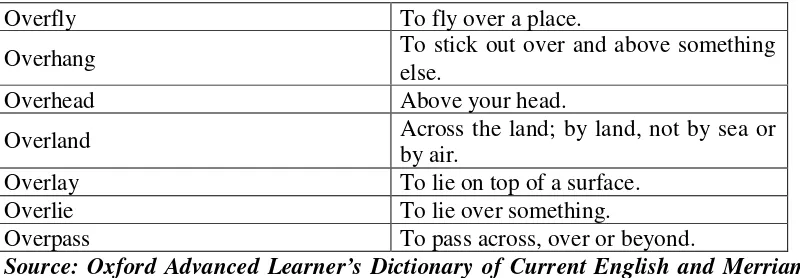
The prefix over- also means ‘over’ or ‘above’. The examples of words using the prefixover-which has meaning ‘over’ or ‘above’ are the following:
Table 1.9 Prefixover-to mean over or above
Derived Words Meaning
Overboard Over the side of a boat or a ship into the water.
Overfly To fly over a place.
Overhang To stick out over and above something
else.
Overhead Above your head.
Overland Across the land; by land, not by sea or
by air.
Overlay To lie on top of a surface.
Overlie To lie over something.
Overpass To pass across, over or beyond.
Source: Oxford Advanced Learner’s Dictionary of Current English and Merriam Webster’s Collegiate Dictionary
In English, there are words which also useover-. These words are also formed from the attachment of the prefix over-. However, they do not have special meanings. They will be understood if ‘too much’ or ‘excessively’ when they are used with the meaning of the base word. Below are the examples of those words:
Table 2.0 Prefixover-is understood as ‘too much’
Derived Words Meaning
46
C. The Morphophonemic Processes
The morphophonemic process here refers to the process in which the phonetic transcription of the stems undergoes changes after the prefix attached such as addition, deletion and so on. Since there are so many kinds of morphophonemic process in English, the writer will narrow it and use the most appropriate one.
In analyzing the prefix over-, the writer finds that there is only one morphophonemic process occurs, namely stress shifting. Therefore, in this study the writer will try to analyze some changes of stressed syllable and some changes of spelling. In addition, the prefix over- is a neutral affix, that is an affix that has no phonological effect to the base to which it is attached (Katamba, 1993:89). Therefore, the writer concludes that the stress shifting which occurs with the prefixover-is also neutral because the stress does not affect the stem. In other words, the stem does not undergo any changes in its spelling as well as its sounds. As stated in the Chapter II, all words which consist of more than one syllable will have a greater stress in one of the syllables. If there is no syllable stressed, the words cannot be heard. In this, the syllable which is given the prominent stress is the base.
added by the prefix over-. There are many words that belong to this category. Therefore, the writer will divide it into two sub-categories based on the amount of syllable. The first sub-category is the words, which consist of one syllable only. Below are the examples of one-syllable word:
Table 2.1 The first category of stem; the stresses of one-syllable words remain on the same position after added by the prefixover-.
Derived Words Part of Speech Phonetic Transcriptions
Overact V /,’/
Overbook V /,’/
Overcut V /,’/
Overflow V /,’/
Overlearn V /,’/
Overmatch V /,’/
Overpay V /,’/
Overrun V /,’/
Oversleep V /,’:/
Overweigh V /,’/
48
derived words. For example the stem run, which only consists of one syllable, does not undergo any changes in its spelling and stress after the prefixover-is added. The same case also happens with the other one-syllable words such as book, cut, flow, sleep, weigh.
The second sub-category is the words, which consist of two or more syllables. The following words are the examples of the two or more-syllable words.
Table 2.2 The first category of stem; the stresses of two or more-syllable words remain on the same position after added by the prefixover-.
Derived Words Part of Speech Phonetic Transcriptions
Overcommit V /,’/
Overdevelop V /,’/
Overexpose V /,’/
Overfishing V /,’/
Overissue V /,’:/
Overmaster V /,’:/
Overpopulate V /,’/
Oversimplify V /,’/
Oversubscribe V /,’/
Overvoltage V /,’/
prefix over- attaches to the stems populate and voltage, the stems only have one stress which occurs in front of the words or at the beginning of the words. After the prefixover-attaches and results new words, which areoverpopulateandovervoltage, two stresses occur. Therefore, the derived words have two stresses which are the primary stress and secondary stress. As for the stem populate, the category of the derived wordoverpopulateremains as a verb although the prefix over- is attached. It also happens on the derived wordovervoltage, which is a noun, that comes from the stemvoltage which is a noun. The writer concludes that the attachment of the prefix over-does not affect the part of speech of the stem. It proves that the prefixover-is a neutral prefix.
The second category is the stem, which has one primary stress that occurs in front of the word, but after it is added by the prefix over-, the stress changes into a secondary stress. Here is the example of the derived word which belongs to this category.
Table 2.3 Second category of stem; the primary stress changes into the secondary stress
Derived Word Part of Speech Phonetic Transcription
Overtrick N /’,/
50
consists of one syllable, so it only has one stress, which is primary one, which occurs in the initial position of the word /’/. Yet, after the prefix over- attaches, the primary stress changes into secondary stress. The first stress which occurs in front of the derived word is a primary stress /’,/, and the second stress, which is on the middle of the derived word, is a secondary stress /’,/.
The third category is the stem, which only has one primary stress and after the prefixover-is added, the primary stress shifts its place from the middle to in front of the derived word. The writer only finds some derived words which belong to this category. The examples will be given as follows:
Table 2.4 Third category of stem; the primary stress shifts its place from the middle to the initial position of the derived words.
Derived Words Part of Speech Phonetic Transcriptions
Overhaul V /’:/
Overkill V /’/
Overspill V /’/
Overtime N /’/
Overtone N /’/
over-, the primary stress shifts from the middle part to the initial position of the
derived word as stated in the table above.
According to the result of the comparison between the phonetic transcriptions of the stems, the prefixover-and the derived words, the writer concludes that there is a change in the resulted word or the derived word. A stress shift happens because most of the stresses have shifted from their places. It is shown through the occurrence of secondary stress in the derived words, the shifting of primary stress into secondary one, and the place shifting of primary stress, from middle position shifts to initial position. The writer concluded that the stress shifting occurs because it is affected by the resulted words. If the resulted words or derived words are nouns, then the primary stress occurs in initial position. Meanwhile, if the resulted words are verbs and consist of three to five syllables, then the primary stress remains in the same position and the secondary stress occurs in initial position. However, there is an exception for the resulted words overhaul, overkill and overspill. In these words there is no secondary stress occur because the resulted words only have one primary stress.
The reason why the writer concludes as stated in the previous sentence because there is no certain pattern that is found in the affixation process. In the other word, it can be said that if there is a morphophonemic change, such as assimilation, happen then the pattern must be easily recognizable. For instance in the word impossible, which its stem is possible. The assimilation occurs when the prefix in-,
in-52
is changed into im- so that it becomes more similar with the stem possible. The change from /n/ into /m/ is merely because /m/ has the same category so they are almost the same. Here, the pattern is clearly seen. If it is seen from the case above, the writer concludes that the prefix in- has an allomorph that occurs after the morphophonemic process happens. The allomorph of the prefixin-is the prefixim-.
It is different from the case of the prefixover-. The morphophonemic process of the prefixover-happens in a simple way and it does not affect the spelling and the sounds. It happens because the prefix over- belongs to the neutral affix, an affix which does not affect the stem after the affix is attached. Even though, the writer does not find certain pattern, such as assimilation, on the case of the prefixover-, it can be said that there is a morphophonemic process happens in the affixation of the prefix over-. The morphophonemic process that occurs is the stress shifting. The stress
shifting has been described as in the previous pages.
The prefix over- is a derivational morpheme because it can create a new meaning for the resulted words. Generally, there are four categories of parts of speech which become the stems of the prefix over-. They are nouns, adjectives, verbs and adverbs. As stated at the beginning of Chapter IV, verbs have the highest percentage of the stems. There are 82 words which can be attached to the prefixover-. However, not all of the stems can result the same category as the stems. There are some words that result into different categories of parts of speech, such as the stem nouns that result into adjectives or adverbs after they are attached to the prefixover-.
The prefix discussed in this thesis has lexical meanings. The lexical meanings can be found in the dictionary. There are four meanings of the prefix over-. The first meaning ismore than usual or too much such as in the wordoverbuild andovereat. The second meaning iscompletelysuch as in the wordovercome. The third meaning is upper, outer or extra such as in the word overdress and overgear. The fourth meaning isoverorabovesuch as in the wordoverheadandoverfly.
From the analysis of the morphophonemic process of the prefixover-, there is a morphophonemic process happen. In the morphophonemic process, there is a change occurring in the resulted words. Most of the stresses of the stems have shifted from their original places after the prefix over- attaches. The shifting is shown through the occurrence of secondary stress in the derived words, the shifting of
54
primary stress into secondary one and the place shifting of primary stress, from middle position shifts to initial position.