Message from Chairmen
On behalf of the Organizing Committee of the Sixth International Power Engineering Conference 2003 (IPEC2003), we take great pleasure and honor in welcoming all delegates to Singapore.
The main challenge facing today’s power engineering professionals remains that of satisfying the ever-increasing demand for reliable and high quality electricity by the most economical means. The key to meeting this challenge is to use the appropriate technologies and to complement them with sound industrial and managerial skills. This is particularly true in the light of the globalization of the world economy, where the utility industry is no exception. In order to prosper in this increasingly competitive market, electrical supply networks must provide quality service at prices acceptable to customers.
At the same time, one can see the tremendous growth and advances made in information technology in recent years – these developments show that the technology lends itself surprisingly well in helping us meet the new challenges. The identified theme of IPEC2003, “Information Technology in Today’s Electricity Market” is therefore very topical and timely.
IPEC, a biennial event since 1993, has always attracted in excess of 200 delegates on every occasion. IPEC2003 is particularly successful in that it has attracted 378 abstracts from 34 countries. After a rigorous review process, 187 full papers have been finally selected and included in the conference proceedings. The papers will be presented in 35 technical sessions over two-and-a-half days. In addition, a small exhibition of the latest products and services in power engineering has also been arranged in conjunction with the Conference.
For IPEC2003, we are extremely grateful to Professor Su Guaning, President, NTU, for taking time off from his busy schedule in officiating at the Conference Opening. We would also like to thank the IEE and IEEE for sponsoring our distinguished keynote speakers, Dr M. Kennedy and Dr M. Begovic respectively, to the Conference. Dr Kennedy and Dr Begovic will address delegates on how information technology can impact the operation, control and protection of electrical networks - topics which are truly befitting the Conference theme.
We would also like to express our appreciation to members of the International Advisory Committee who were instrumental in the conference organization. We thank all authors, session chairpersons and delegates for their support, and wish all of you a successful, stimulating and productive meeting and a pleasant stay in Singapore. To our supporters in the utility, equipment manufacturing and marketing industries, our sincere thanks for sponsoring some of the conference events, for placing the eye-catching advertisements in the souvenir magazine and for taking part in the exhibition displays.
Last but by no means the least, our sincere thanks to our fellow team members on the Organizing Committee and to those colleagues and friends who have been working behind-the-scenes. Without their unfailing cooperation and hard work, the event would simply not have been possible.
SS Choi SC Soh
The Sixth International Power Engineering Conference (IPEC2003), 27-29 November 2003, Singapore
Organizing Committee
Chairman SS Choi
Co-Chairman SC Soh
Secretary L Goel
Technical YY Wang
HB Gooi
Finance TM Lee
Merlin Toh
Publications CY Teo
B Devotta
Logistics KJ Tseng
PL So
Publicity TW Chan
TS Tay Exhibition/Sponsorships IW Butt
Technical/Social Visit AK Lim
Members MK Foo
The Sixth International Power Engineering Conference (IPEC2003), 27-29 November 2003, Singapore
International Advisory Committee
Australia
MJ Gibbard (Univ of Adelaide)
G Ledwich (Queensland Univ of Tech) RE Morrison (Monash Univ)
Canada
R Billinton (Univ of Saskatchewan) JW Estey (IEEE PES President) R Findlay (McMaster Univ) P Kundur (Powertech Labs) BT Ooi (McGill Univ)
China
YP Chen (Wuhan Univ of Hydraulic & Electric Engg.) ZJ Wang (Tsinghua Univ)
ZA Wang (Xi’an Jiaotong Univ) XX Zhou (EPRI)
France
D Georges (Institut National Polytechnique de Grenoble)
Germany
E Handschin (Universitat Dortmund) D Schroder (Tech Univ of Munich)
Hong Kong (SAR)
KP Wong(HK Polytechnic Univ) FF Wu (Hong Kong Univ)
India
MV Hariharan(IIT Bombay) M Ramamoorty (ERDA)
Japan
T Hiyama (Kumamoto Univ) Y Ichihara (Tokyo Electric) H Sasaki (Hiroshima Univ) A Yokoyama (Univ of Tokyo)
Malaysia
The Sixth International Power Engineering Conference (IPEC2003), 27-29 November 2003, Singapore
New Zealand
J Arrillaga (Univ of Canterbury) JT Boys (Univ of Auckland)
Norway
N Flatabo (SINTEF Energy Research)
Singapore
MT Chang (SquireMech) MH Er (NTU)
K Kuhan (Tuas Power) AC Liew (NUS)
South Africa
R Herman (Univ of Stellenbosch) A Petroianu (Univ of Cape Town)
Switzerland
G Andersson (ETH-Zentrum)
Thailand
K Karnasuta (EGAT)
United Kingdom
AT Johns (Univ of Bath) KL Lo (Univ of Strathclyde) YH Song (Brunel Univ)
USA
CC Liu (Univ of Washington)
MF McGranaghan (Electrotek Concepts) BD Russell (Texas A&M Univ)
IPEC 2003 Conference Schedule
Time Event/Location
08.00-08.45 Registration (Level 1, outside Pacific Ballroom 3)
09.00-10.00 Opening Ceremony
Guest of Honour: Professor Su Guaning (Level 1, Pacific Ballroom 3)
Keynote Address
Keynote Speaker 1: Dr. Malcolm William Kennedy 10.00-10.30 Tea Break (Level 1, Foyer)
10.30-11.15 Keynote Speaker 2: Dr. Miroslav M. Begovic 11.15-12.30 TA-1 (Ocean 2)
Power System Analysis and Stability Enhancement
TA-2 (Ocean 3)
Distribution Protection TA-3 (Ocean 4) Power Quality Improvement
TA-4 (Ocean 5) Neural Networks
Applications
12.30-14.00 Lunch
(Level 3, Summer House) 14.00-15.30 TP-1 (Ocean 2)
System Stability Enhancement
TP-2 (Ocean 3)
Partial Discharge TP-3 (Ocean 4)Harmonics Power Converters TP-4 (Ocean 5)
15.30-16.00 Tea Break (Level 2, Foyer) 16.00-17.30 TP-5 (Ocean 2)
Transient Stability and Voltage Stability
TP-6 (Ocean 3) High Voltage
Engineering
TP-7 (Ocean 4)
Active Filters Power Electronics and TP-8 (Ocean 5) Drives
T
H
U
R
S
D
A
Y
19.00-22.00 Banquet
(Level 1, Pacific Ballroom 3) 09.00-10.30 FA-1 (Ocean 2)
Distributed Generation and Energy Management
FA-2 (Ocean 3)
Condition Monitoring Power Quality Analysis FA-3 (Ocean 4) Power Electronic Drives FA-4 (Ocean 5) and Applications 10.30-11.00 Tea Break (Level 2, Foyer)
11.00-12.30 FA-5 (Ocean 2)
New Energy Systems Advanced Signal FA-6 (Ocean 3) Processing Applications
FA-7 (Ocean 4) Power System Economics
FA-8 (Ocean 5) Modeling of Power System Components
12.30-14.00 Lunch
(Level 3, Summer House ) 14.00-15.30 FP-1 (Ocean 2)
Operations and Control Modeling and New FP-2 (Ocean 3) Algorithms
FP-3 (Ocean 4)
Power Market Models Power System Analysis FP-4 (Ocean 5) and Modeling 15.30-16.00 Tea Break (Level 2, Foyer)
F
R
I
D
A
Y
16.00-17.30 FP-5 (Ocean 2) New Applications to Transmission Systems
FP-6 (Ocean 3) AI and UP-Based
Protection
FP-7 (Ocean 4) Network Management
and De-regulation
FP-8 (Ocean 5) AI Applications
09.00-10.30 SA-1 (Ocean 2)
Distribution Automation High Voltage Analysis SA-2 (Ocean 3) Power Market and De-SA-3 (Ocean 4) regulation
SA-4 (Ocean 5) Power Electronics
Applications 10.30-11.00 Tea Break (Level 2, Foyer)
11.00-12.30 SA-5 (Ocean 2) SA-6 (Ocean 3)
System Reliability SA-7 (Ocean 4)Generation Optimization in Power
Market
SA-8 (Ocean 5) Motor Drive Systems
12.30 Lunch
(Level 3, Summer House)
Post Conference Tours (meet outside Pacific Ballroom 3, Level 1)
S
A
T
U
R
D
A
Y
13.15 or 14.00
Tuas Power Ltd
(Departure at 13.15) Singapore City Tour (Departure at 14.00)
Session TA-1
Power System Analysis and Stability Enhancement
27-Nov-2003 (Thursday)Ocean 2: 1115-1230
Chairman Prof G. LEDWICH, Queensland University of Technology
TA-1.1 Improvement of Stability Boundary and Damping of a Power System by SVC, P1017
P KUMKRATUG, M H HAQUE, Nanyang Technological University, SINGAPORE
TA-1.2Power System Stability Improvement Using Superconducting Magnetic Energy Storage Unit,
P2251
A ABU-SIADA, W B LAWRANCE, W W L KEERTHIPALA, Curtin University of Technology, AUSTRALIA
TA-1.3Small Signal and Transient Stability of Power Systems with FACTS devices: Modeling,
Simulation and Analysis Using SIMULINK, P2003
U P MHASKAR, A M KULKARNI, Indian Institute of Technology Bombay, Powai, INDIA
TA-1.4Development of SVC Fuzzy-Logic Adaptive Controller for Stability Enhancement of Power
Systems, P2042
X YANG, *T S CHUNG, *D Z FANG, Tianjin University, CHINA, *The Hong Kong Polytechnic University, HONG KONG S.A.R.
_______________________________________________________________________________________________
Session TA-2
Distribution Protection
27-Nov-2003 (Thursday) Ocean 3: 1115-1230Chairman Mr P. C. LEE, PowerGrid
TA-2.1Petri Nets Model Based Fault Section Detection and Diagnosis In Electrical Power Networks,
P1019
R BOEL, G JIROVEANU, University of Ghent, BELGIUM
TA-2.2Characterization of Arcing Fault in Underground Distribution Cable, P1034
W K CHAN, A A MOHD ZIN, M S MAJID, H B AHMAD, Z MUDA, *K L LO, Universiti Teknologi Malaysia, MALAYSIA, *University of Strathclyde, UNITED KINGDOM
TA-2.3Effect of Overvoltages Performance on LV Side Arrester of Transformer in Distribution
Systems, P2007
C YU, P SAKARUNG, *P FUANGFOO, **A TAKKABUTRA, Y CHONGJAREARN, Dhurakijpundit University, THAILAND, *Provincial Electricity Authority (PEA), THAILAND, **Precise Electric Co., Ltd., THAILAND
TA-2.4Detection of Breaking Conductors on MV Overhead Lines, P2022
K J V RENSBURG, D BIRTWHISTLE, Queensland University of Technology, AUSTRALIA
_____________________________________________________________________________________
Session TA-3
Power Quality Improvement
27-Nov-2003 (Thursday)Ocean 4: 1115-1230
TA-3.1Active Filtering Applied to a Line-Commutated Inverter FED Permanent Magnet Wind Generator, P2174
H H TUMBELAKA, C V NAYAR, K TAN, *L J BORLE, Curtin University of Technology, AUSTRALIA, *The University of Western Australia, AUSTRALIA
TA-3.2Adaptive Unified Power Quality Conditioner for Improving Power Quality, P2248
L H TEY, P L SO, Y C CHU, Nanyang Technological University, SINGAPORE
TA-3.3An Efficient Approach for Placement of Active Power Line Conditioners in a Power System
for Mitigating Voltage Distortion, P1108
G CHANG, H L WANG, S Y CHU, National Chung Chang University, TAIWAN
TA-3.4Analysis of Series Voltage Restorer-Load Dynamics, P1002
J LI, S S CHOI, D M VILATHGAMUWA, Nanyang Technological University, SINGAPORE
______________________________________________________________________________________________
Session TA-4
Neural Network Applications
27-Nov-2003 (Thursday)Ocean 5: 1115-1230
Chairman A/Prof B. VENKATESH, Multimedia University
TA-4.1A Resilient-propagation based Adaptive ANN for Economic Load Scheduling, P2124
B KAR, K K MANDAL, N CHAKRABORTY, Jadavpur University, INDIA
TA-4.2Development of an Artificial Neural Network Based Relay to Detect Islanding Condition of
Embedded Generation, P2204
S K SALMAN, *D J KING, The Robert Gordon University, UNITED KINGDOM, *University of Abertay, UNITED KINGDOM
TA-4.3Power System Topology Identification Based on Artificial Neural Networks: Problem of
Utilization of Theoretical Knowledge, P2253
R LUKOMSKI, K WILKOSZ, Wroclaw University of Technology, POLAND
TA-4.4Artificial Neural Network Based Dynamic Load Models for Real Time Applications, P1061
D M VILATHGAMUWA, H M WIJEKOON, Nanyang Technological University, SINGAPORE
___________________________________________________________________________________
Session TP-1
System Stability Enhancement
27-Nov-2003 (Thursday)Ocean 2: 1400-1530
Chairman Prof C. CHEN, Shanghai Jiaotong University
TP-1.1Studies in System Thevenin Impedance Estimation from Normal Operational Data, P2063
M BAHADORNEJAD, G LEDWICH, Queensland University of Technology, AUSTRALIA
TP-1.2Transient Stability study of Interconnected Power System of North Oman, P2181
M AL-ABRI, *K ELLITHY, A AL-GHAFRI, Ministry of Housing, OMAN, *Sultan Qaboos University, OMAN
TP-1.3Analysis of SVC Contribution to Damping of a Power System Including Induction Motor
Effects, P2232
M BANEJAD, G LEDWICH, Queensland University of Technology, AUSTRALIA
TP-1.4Coordinated Design of Generator Excitation and FACTS for Transient Stability Enhancement
J SU, C CHEN, Shanghai Jiaotong University, CHINA
TP-1.5 Online Transient Stability Instructional Model, P1123
M YEDROUDJ, F J CHAKIB, W L NG, Singapore Polytechnic, SINGAPORE
TP-1.6 Application of Fuzzy Logic to Transient Stability Assessment, P2006
C K BABULAL, P S KANNAN, Thiagarajar College of Engineering, INDIA
_____________________________________________________________________________________
Session TP-2
Partial Discharge
27-Nov-2003 (Thursday) Ocean 3: 1400-1530Chairman Prof J. M. K. MACALPINE, The Hong Kong Polytechnic University
TP-2.1Leakage Current Waveform Pattern: A Diagnosis of Surface Discharge Characteristics on
The New Formulated TPE Materials Under Tracking Test, P1048
M A M PIAH, A DARUS, A HASSAN, Universiti Teknologi Malaysia, MALAYSIA
TP-2.2The Effect of Humidity on the Charge/Phase-Angle Patterns of AC Corona Pulses in Air,
P2057
J M K MACALPINE, C H ZHANG, The Hong Kong Polytechnic University, HONG KONG S.A.R.
TP-2.3Prediction of Small-gap Spark Paths in Air, P2056
J M K MACALPINE, L H CHEUNG, P Y NG, W L IP, D H QIU, The Hong Kong Polytechnic University, HONG KONG S.A.R.
TP-2.4Identification of the Type of Partial Discharge Using Wavelet Technique, P2169
T K CHIA, S BIRLASEKARAN, Nanyang Technological University, SINGAPORE
_____________________________________________________________________________________
Session TP-3
Harmonics
27-Nov-2003 (Thursday) Ocean 4: 1400-1530
Chairman Dr. W. W. L. KEERTHIPALA, Curtin University of Technology
TP-3.1Criteria for Identification of the Locations of Harmonic Sources in a Power System, P1128
M CEGIELSKI, T PYZALSKI, K WILKOSZ, Wroclaw University of Technology, POLAND
TP-3.2A Novel Harmonic Injection Scheme in Controlled Rectifier for Power Quality Applications,
P2009
A I MASWOOD, Nanyang Technological University, SINGAPORE
TP-3.3Effect of System Parameters on Harmonic Levels in AC/DC Systems, P2252
A ABU-SIADA, W W L KEERTHIPALA, Curtin University of Technology, AUSTRALIA
TP-3.4An Investigation of Harmonic Content in a Remote Mine Site, P2025
J G JAMES, *T K SAHA, ENERGEX Limited, AUSTRALIA, *University of Queensland, AUSTRALIA
_____________________________________________________________________________________
Session TP-4
Power Converters
27-Nov-2003 (Thursday) Ocean 5: 1400-1530TP-4.1A Phase Controlled Variable Inductor Designed for Frequency Stabilization of Current Fed Resonant Converter Power Supplies, P1029
P HU, S HUSSMANN, University of Auckland, NEW ZEALAND
TP-4.2Performance Comparison of A Current Controlled and Line Commutated Inverter in
Maximum Wind Energy Conversion, P2100
K TAN, S ISLAM, H TUMBELAKA, Curtin University of Technology, AUSTRALIA
TP-4.3Performance Comparison of Hysteresis Current Control for Single Phase Full Bridge Voltage
Source Inverters, P2102
O SARAMART, V KINNARES, King Mongkut's Institute of Technology Ladkrabang, THAILAND
TP-4.4Negative Output Multiple-Lift Push-Pull SC Luo-Converters, P2013
F L LUO, Nanyang Technological University, SINGAPORE
TP-4.5Identification Of Inverter Dynamics With Artificial Intelligence Using Volterra-Type-Equations,
P2239
S HOFMANN, C HINTZ, D SCHROEDER, Technische Universitaet Muenchen, GERMANY
TP-4.6 New Strategies For HPWM DC-AC Converter for Reduced Losses and THD and Random
Switching Thermal Equalization, P2244
S JEEVANANTHAN, A RAVI KUMAR, *P AJAY D VIMAL RAJ, ** B H S SATHESH, Pondicherry Engineering College, INDIA, *Sri Manakula Vinayagar Engg. College, INDIA, ** A.C. College of Engineering and Technology, INDIA
_____________________________________________________________________________________
Session TP-5
Transient Stability and Voltage Stability
27-Nov-2003 (Thursday)Ocean 2: 1600-1730
Chairman Ms Y. O. LEE, PowerGrid
TP-5.1Determination of Critical Load at Voltage Collapse Point Using V-I Characteristic, P1001
M H HAQUE, S CHEN, Nanyang Technological University, SINGAPORE
TP-5.2A Relational Database for Transient Stability Assessment, P2255
D Z FANG, T S CHUNG, K P WONG, *C KAI, The Hong Kong Polytechnic University, HONG KONG S.A.R., *Tianjin University, HONG KONG S.A.R.
TP-5.3On-Line Prediction of Voltage Collapse, P2165
T S SIDHU, V BALAMOUROUGAN, *M S SACHDEV, University of Western Ontario, CANADA, *University of Saskatchewan, CANADA
TP-5.4A Novel PMU Configuration and Application in Real-time Transient Stability Analysis and
Emergency Control, P1031
Z ZHONG, L CHENG, Y SUN, Tsinghua University, CHINA
TP-5.5Close-Loop Generator Tripping Scheme Based on Power System Real-Time Perturbed
Trajectory, P2011
J PENG, X LI, Y Z SUN, *H F WANG, Tsinghua University, CHINA, *Bath University, UNITED KINGDOM
TP-5.6 Development of Voltage Stability Constrained OPF as one of the functions of the Integrated
Power System Analysis Package, named IMPACT, P2105
Y TADA, A KURITA, R TANABE, H OKAMOTO, Tokyo Electric Power Co., JAPAN
Session TP-6
High Voltage Engineering
27-Nov-2003 (Thursday)Ocean 3: 1600-1730
Chairman Prof A. C. LIEW, National University of Singapore
TP-6.1The Discussion and Analysis of Power Supply Schemes of Active Optical-Fiber Electric
Transducer, P1018
X HAN, X YIN, Z ZHANG, Y NIE, Huazhong University of Science and Technology, CHINA
TP-6.2Time Domain Reflectometry Measurements to Determine Characteristic Impedance of Three
Phase Medium Voltage Cables, P2085
G MURTAZA HASHMI, S AFTAB QURESHI, University of Engineering and Technology, PAKISTAN
TP-6.3A Fundamental Study of Pollution Flashover Phenomena, P1091
B SUBBAREDDY, G R NAGABHUSHANA, Indian Institute of Science, Bangalore, INDIA
TP-6.4A Substation Fault Diagnosis System Based on Case-Based Reasoning and Rule-Based
Reasoning, P1101
Y DU, W YU, P ZHANG, Shanghai Jiaotong University, CHINA
TP-6.5Effect of Line Length on the Radiated Electromagnetic Interference due to Corona on HV
Transmission Lines, P2020
S K NAYAK, M J THOMAS, Indian Institute of Science, INDIA
TP-6.6 Transient Response in A Model Transformer for Different Types of Surges and Analysis with
Turn Resolution, P2265
B V SUMANGALA, G R NAGABHUSHANA, Indian Institute of Science, INDIA
_____________________________________________________________________________________
Session TP-7
Active Filters
27-Nov-2003 (Thursday) Ocean 4: 1600-1730Chairman Prof Y. CHEN, Wuhan University
TP-7.1Single-Phase Half-Bridge Active Power Filter (APF) in Conjunction with Uninterruptible
Power Supply (UPS), P1052
A F ABDUL GHAFAR, M F SAIDON, A M OMAR, Universiti Teknologi Mara, MALAYSIA
TP-7.2A Park Transform Based Detecting Method for Reference Current of Active Power Filter
Under Distorted Voltage, P2077
H DENG, *B YIN, *Y CHEN, National University of Singapore, SINGAPORE, *Wuhan University, CHINA
TP-7.3A Study on Three-Phase Active Power Filter Control Strategy Based on Fuzzy Logic and
Sliding Mode Control, P2073
Y CHEN, B YIN, J J SUN, H J LIU, Wuhan University, CHINA
TP-7.4A Study on the Design of the Link between Active Power Filter and Power System, P2064
Y CHEN, J J SUN, K DING, H J LIU, Wuhan University, CHINA
TP-7.5A Simplified Model for Analysis and Design of A Current Source Active Power Filter, P1107
H P TO, F RAHMAN, C GRANTHAM, The University of New South Wales, AUSTRALIA
Session TP-8
Power Electronics and Drives
27-Nov-2003 (Thursday)Ocean 5: 1600-1730
Chairman A/Prof J. B. X. DEVOTTA, National University of Singapore
TP-8.1Analysis of A Series Tuned ICPT Pick-Up Using DC Transformer Modeling Methods, P2157
G A COVIC, J E JAMES, J T BOYS, The University of Auckland, NEW ZEALAND
TP-8.2A New Asymmetric Hybrid Multilevel Inverter, P2125
F L LUO, Y LIU, Nanyang Technological University, SINGAPORE
TP-8.3Review the Cascade Double Γ-CL Current Source Resonant Inverter, P2113
F L LUO, J H ZHU, Nanyang Technological University, SINGAPORE
TP-8.4An Extended Kalman Filter Observer for the Direct Torque Controlled Interior Permanent
Magnet Synchronous Motor Drive, P2201
Z XU, M F RAHMAN, The University of New South Wales, AUSTRALIA
TP-8.5Alternative Electrical Machine Solutions for A Free Piston Generator, P1083
W ARSHAD, P THELIN, *T BÄCKSTRÖM, C SADARANGANI, Royal Institute of Technology, SWEDEN, *ABB, Västerås, SWEDEN
TP-8.6 Single-Stage High-Power-Factor Electronic Ballast For Multiple Fluorescent Lamps, P2106
*T F LIN, K S NG, C C LEE, H W CHEN, C S MOO, *National Cheng Kung University, TAIWAN, National Sun Yat-Sen University Kaosiung, TAIWAN
____________________________________________________________________________________
Session FA-1
Distributed Generation and Energy Management
28-Nov-2003 (Friday)Ocean 2: 0900-1030
Chairman Dr P. VENKATESH, Thiagarajar College of Engineering
FA-1.1Distributed Generation - Nanogrid Transmission and Control Options, P2084
J BRYAN, S ROUND, R DUKE, University of Canterbury, NEW ZEALAND
FA-1.2Fuel Cell Power Plant: Modeling and Its Application in an Isolated System, P1010
Y LI, S S CHOI, S RAJAKARUNA, Nanyang Technological University, SINGAPORE
FA-1.3Analyzing the penetration level of wind and photovoltaic generation technology into the grid
system using Efficient Resource Planning Methodology, P1078
N MARICAR, *S Rahman, Kolej Universiti Teknikal Kebangsaan Malaysia, *Virginia Polytechnic and State University, UNITED STATES
FA-1.4Energy Conservation Using Different Techniques and Efficient Equipment, P2087
G M HASHMI, S A QURESHI, University of Engineering and Technology, PAKISTAN
FA-1.5An Improved Evolutionary Programming Based Economic Dispatch of Generators with
Multiple Fuel Options, Ramp Rate Limits and Prohibited Operating Zones, P2062
P VENKATESH, P S KANNAN, R GNANADASS, *N P PADHY, Thiagarajar College of Engineering, INDIA, *Indian Institute of Technology, INDIA
Session FA-2
Condition Monitoring
28-Nov-2003 (Friday)Ocean 3: 0900-1030
Chairman A/Prof S. BIRLASEKARAN, Nanyang Technological University
FA-2.1Transformer Reliability Enhancement Using Online Dissolved Gas Monitoring and
Diagnostics, P1110
M ARSHAD, S. ISLAM, Curtin University of Technology, AUSTRALIA
FA-2.2Diagnostic Testing for the Determination of Quality of Live-Line Ropes, P2024
T K SAHA, *D WICHMANN, University of Queensland, AUSTRALIA, *Royal Australian Navy, AUSTRALIA
FA-2.3Investigating Some Important Parameters of the PDC Measurement Technique for the
Insulation Condition Assessment of Power Transformer, P2026 T K SAHA, P PURKAIT, University of Queensland, AUSTRALIA
FA-2.4Accelerated Aging Study on Oil-Paper Transformer Insulation Using Relaxation Studies,
P2171
H CAO, S BIRLASEKARAN, S S CHOI, Nanyang Technological University, SINGAPORE
FA-2.5VRML and Its Application in the CSCW Based Expert System of Busbar Trunking System,
P2261
R WU, D G CHEN, Y S GENG, W X TONG, Xi'an Jiaotong University, CHINA
FA-2.6Application of Multi-Sensor Information Fusion Technique in On-Line Monitoring System of
Transformers, P2129
W FAN, S TAN, G WANG, W LI, Wuhan University, CHINA
_____________________________________________________________________________________
Session FA-3
Power Quality Analysis
28-Nov-2003 (Friday)Ocean 4: 0900-1030
Chairman Mr K. Y. CHUA, PowerGrid
FA-3.1An Open Environment for Power Quality Monitoring and Analysis, P1087
X WANG, S CHEN, Nanyang Technological University, SINGAPORE
FA-3.2IGBT Based Static Transfer Switch, P1053
K C LEE, W W L KEERTHIPALA, S ISLAM, Curtin University of Technology, AUSTRALIA
FA-3.3Some Suggestions for Power Quality Control in Deregulated Electricity Market Environment,
P2034
J WANG, S CHEN, T T LIE, Nanyang Technological University, SINGAPORE
FA-3.4The Theory and Realization of Integrated Power Quality Conditioner System, P2065
Y CHEN, J J SUN, H J LIU, K DING, Wuhan University, CHINA
FA-3.5Wavelet-Based Energy Content Method for Classifying and Characterizing Short-Duration
Voltage Variations, P1005
H ZHU, S CHEN, Nanyang Technological University, SINGAPORE
FA-3.6Analysis and Mitigation of Voltage Flickering in Power Systems, P2194
_____________________________________________________________________________________
Session FA-4
Power Electronic Drives and Applications
28-Nov-2003 (Friday)Ocean 5: 0900-1030
Chairman Prof J. FAIZ, University of Tehran
FA-4.1A Theoretical Study on Permanent Magnet Synchronous Motors for Electric Vehicles, P1049
Y K CHIN, J SOULARD, Royal Institute of Technology, SWEDEN
FA-4.2Measurements on Slip Ring Units for Characterization of Performance, P1050
F MAGNUSSEN, E NORDLUND, S CHÂTELET, C SADARANGANI, Royal Institute of Technology, SWEDEN
FA-4.3Negative Output Super-Lift Luo-Converters, P2012
F L LUO, Nanyang Technological University, SINGAPORE
FA-4.4Sizing of Switched Reluctance Machine for Starter/ Alternator of Hybrid Electric Vehicles,
P2179
J FAIZ, K MOAYED-ZADEH, University of Tehran, IRAN
FA-4.5Application of a Multipurpose Voltage Source Converter (MVSC), P2059
B A MASAMILA, A H NZALI, B M MWINYIWIWA, University of Dar es Salaam, TANZANIA
______________________________________________________________________________________________
Session FA-5
New Energy Systems
28-Nov-2003 (Friday)Ocean 2 1100-1230
Chairman Prof C. ARNOLD, University of Canterbury
FA-5.1Modelling and Simulation of a Grid Connected Variable Speed Wind Energy Conversion
System, P1073
A B RAJU, K CHATTERJEE, B G FERNANDES, Indian Institute of Technology Bombay, Mumbai, INDIA
FA-5.2Variable-Speed Constant-Frequency Power Generation System with Rotating Converter and
Permanent Magnet Excitation System, P2037
C MI, Z SHEN, M DUCUSIN, J O'CONNOR, A FLOWERDAY, B HANSELMAN, University of Michigan - Dearborn, UNITED STATES
FA-5.3Three-phase Grid-connected Inverters Interface for Alternative Energy Sources with
Zero-sequence Component Injection PWM Method, P2078
H DENG, *B YIN, *Y CHEN, **W WANG, National University of Singapore, SINGAPORE, *Wuhan University, CHINA, **Beijing Bureau of Power Supply, CHINA
FA-5.4Electrical Braking of Grid Connected Wind Energy Conversion Systems (WECS), P2203
K RAJAMBAL, B UMAMAHESWARI, *C CHELLAMUTHU, Anna University, Chennai, INDIA, *Jerusalem College of Engineering, Chennai, INDIA
FA-5.5New Lightweight Safer Transformer, P2114
R L PROVOST, *T LIM, DuPont Company USA, KOREA, *DuPont Company Singapore, SINGAPORE
FA-5.6NAS Battery Energy Storage System for Power Quality Support in Malaysia, P2120
A B ISMAIL, M F M SIAM, *H TAKAMI, TNB Research Sdn. Bhd., MALAYSIA, *Tokyo Electric Power Company, JAPAN
Session FA-6
Advanced Signal Processing Applications
28-Nov-2003 (Friday)Ocean 3: 1100-1230
Chairman A/Prof T. W. CHAN, Nanyang Technological University,
FA-6.1A Wavelet-Based Method for Identifying Stator Earth Faults on Industrial Generators, P1068
K S YEO, T W CHAN, Nanyang Technological University, SINGAPORE
FA-6.2The Analyses of Fault Transient Using Wavelet Packet and Its Application to Distinguish a
Permanent Fault from a Temporary Fault, P2080
F JIANG, *Z Q BO, D WAIKAR, Y MOHD, Singapore Polytechnic, SINGAPORE, *ALSTOM T&D Protection & Control Ltd, UNITED KINGDOM
FA-6.3A Study on Wavelet Based De-noise of Traveling Wave Signal for Fault Location, P2155
Y CHEN, J ZHOU, S JIANG, F HU, Wuhan University, CHINA
FA-6.4A High-Speed Processing Method for Matrix Operation Type Protection Relay on Power
System, P2186
X ZUO, H KURIBAYASHI, *H OHNISHI, **K TSUJI, ***T HIYAMA, Kyuki Corporation, JAPAN, *Hokuden Techno Service Co., JAPAN, **Techno Tsuji Ltd, JAPAN, ***Kumamoto University, JAPAN
FA-6.5A Technique for Improving Performance of Phasor Estimation Algorithms in Presence of
Decaying DC Component, P2164
T S SIDHU, X D ZHANG, F ALBASRI, *M S SACHDEV, University of Western Ontario, CANADA, *University of Saskatchewan, CANADA
_____________________________________________________________________________________
Session FA-7
Power System Economics
28-Nov-2003 (Friday)Ocean 4: 1100-1230
Chairman A/Prof M. H. HAQUE, Nanyang Technological University
FA-7.1Revenue Reconciliation of Transmission Services Using Negative Flow Sharing Approach,
P1092
K L LO, M Y HASSAN, University of Strathclyde, UNITED KINGDOM
FA-7.2Unit Commitment through Fuzzy EP Method, P1132
B VENKATESH, R RANJAN, *H B GOOI, Multimedia University, MALAYSIA, *Nanyang Technological University, SINGAPORE
FA-7.3Fast Economic Dispatch of Power System Using Hopfield Model, P2168
P JAIN, K R NIAZI, M N I T, Jaipur, INDIA
FA-7.4Fuzzy Rule-based Asset Management Model for Electricity Transmission Systems - A Tool
for Strategic Decision Making, P2188
J J CRISP, Queensland University of Technology, AUSTRALIA
FA-7.5Cogeneration for Peak Demand Shortage, P2235
S ASHOK, National Institute of Technology, INDIA
FA-7.6 Improved Fast Evolutionary Algorithm for Security Constrained Nonconvex Economic Load
Dispatch, P2014
____________________________________________________________________________________
Session FA-8
Modeling of Power System Components
28-Nov-2003 (Friday)Ocean 5: 1100-1230
Chairman Dr Y. TADA, Tokyo Electric Power Co
FA-8.1A Novel Account of Iron Loss in the Analysis and Modelling of an Isolated Self-Excited
Induction Generator, P1080
D SEYOUM, D MCKINNON, F RAHMAN, C GRANTHAM, H P TO, The University of New South Wales, AUSTRALIA
FA-8.2A Novel Aggregate Load Model for Studying Power System Dynamic Behavior, P2099
K W LOUIE, J R MARTI, Manitoba HVDC Research Centre, CANADA
FA-8.3The World Wide WEB Perspectives for Online Power System Engineering Courses, P1106
M YEDROUDJ, P H LIM, F JIANG, D WAIKAR, Singapore Polytechnic, SINGAPORE
FA-8.4 Modelling and Analysis of Singapore Household Power Network for Implementing
Broadband Power Line Communications, P1086
H MENG, S CHEN, Y L GUAN, E GUNAWAN, P L SO, T T LIE, Nanyang Technological University, SINGAPORE
_____________________________________________________________________________________
Session FP-1
Operations and Control
28-Nov-2003 (Friday)Ocean 2: 1400-1530
Chairman Prof T. HIYAMA, Kumamoto University
FP-1.1Analysis of Auxiliary Supply System for Large Thermal Power Plant, P2097
R YUAN, H T LIU, C HONG, Y HE, Y CHEN, Wuhan University, CHINA
FP-1.2Experimental Studies on Multi-Agent based Automatic Generation Control for Isolated Power
System, P2184
T HIYAMA, H ESAKI, K MORI, *T FUNABASHI, Kumamoto University, JAPAN, *Meidensha Corporation, JAPAN
FP-1.3Experimental Studies on Remote Tuning of PSS Parameters Through Computer Network,
P2187
T HIYAMA, Y MATSUMOTO, Y HARA, Kumamoto University, JAPAN
FP-1.4Design of Decentralized Fuzzy Logic Controller for Load Frequency Control, P1007
K ELLITHY, K ELMETWALLY, Sultan Qaboos University, OMAN
FP-1.5 Experience on MAE MOH Power Plant Operation to Damp the Power Oscillation of 500 kV
Transmission Line, P1024
B JITMAN, P SONWAI, Electricity Generating Authority of Thailand (EGAT), THAILAND
FP-1.6Decentralized Variable Structure Control for Asynchronized Synchronous Generator
Paralleled with Synchronous Generator, P1118
J SONG, *Y CHEN, *D LIU, Hunan Electric Power Dispatch and Communication Bureau, CHINA, *Wuhan University, CHINA
FP-1.7 Power Flow Control by Sensitivity Based FACTS Controllers, P2212
R SADIKOVIC, G ANDERSSON, Swiss Federal Institute of Technology, SWITZERLAND
Session FP-2
Modeling and New Algorithms
28-Nov-2003 (Friday)Ocean 3: 1400-1530
Chairman Prof T. S. SIDHU, University of Western Ontario
FP-2.1A New Method for Transformer Protection Based on the Ratio of Voltage and Fluxional
Differential Current, P1032
Y XU, Q LIU, Q YANG, Q LIU, North China Electric Power University, CHINA
FP-2.2A Novel Transformer Protection Method Based on Transformer Model, P1069
Z WANG, Y XU, Q LIU, Q YANG, North China Electric Power University, CHINA
FP-2.3A Fault Location Scheme for Series Compensation Lines Based on Traveling Waves and
Wavelet Analysis, P2177
Z HUANG, Y CHEN, Wuhan University, CHINA
FP-2.4DC Offset Effects on Distance Relays - An Analysis Using LES and Mimic Filtering, P2161
T S SIDHU, *H S GILL, **M S SACHDEV, University of Western Ontario, CANADA, *ABB Inc., UNITED STATES, **University of Saskatchewan, CANADA
FP-2.5Advancements in Relay Modelling, P2162
T S SIDHU, M TAMIJIE SELVY, University of Western Ontario, CANADA
FP-2.6 Magnetic Hysteresis Modeling for Non-Sinusoidal Fields Using Counter Propagation
Neural Network, P1100
E FALLAH, J S MOGHANI, A TALEBI, Amirkabir University of Technology, IRAN
____________________________________________________________________________________
Session FP-3
Power Market Models
28-Nov-2003 (Friday)Ocean 4: 1400-1530
Chairman A/Prof T. T. LIE, Nanyang Technological University
FP-3.1Bidding Model and Algorithm for AGC Market, P2070
J GE, L Z ZHANG, North China Electric Power University, CHINA
FP-3.2Electric Power Market Models in Europe, P1003
F C CELIK, Istanbul Bilgi University, TURKEY
FP-3.3In Preparation for Competition: An Assessment of Market Power in the South African Electricity
Industry, P2088
J YAN, *M TSHIPALA, University of Cape Town, SOUTH AFRICA, *Technology Services International, ESKOM, SOUTH AFRICA
FP-3.4The Condenser Loss Control Monitoring & Maintenance Management of Mae Moh Thermal
Power Plant, P2053
K TEOWKUL, P TONGCHIEW, Electricity Generating Authority of Thailand (EGAT), THAILAND
FP-3.5Forward Contracts with Bilateral Options in Electricity Markets: Theory and Analysis, P2242
T S CHUNG, *S H ZHANG, K P WONG, C W YU, C Y CHUNG, The Hong Kong Polytechnic University, HONG KONG S.A.R., *Shanghai University of Technology, CHINA
FP-3.6Feasibility Study of Power System Operation in Deregulated Power Market in Japan Based
on Work Flow Analysis, P2047
CO., JAPAN
_____________________________________________________________________________________
Session FP-4
Power System Analysis and Modeling
28-Nov-2003 (Friday)Ocean 5: 1400-1530
Chairman Prof J. T. BOYS, The University of Auckland
FP-4.1Direct and Linear Regression Models for Demand Forecasting in Distribution Network
Planning with Uncertain Information, P2108
P T T BINH, Ho Chi Minh City University of Technology, VIETNAM
FP-4.2Switching Frequencies in Inductively Coupled Power Transfer Systems, P2156
J T BOYS, G A COVIC, J E JAMES, The University of Auckland, NEW ZEALAND
FP-4.3Approximate Calculation of Power Distribution Losses, P2230
N HARIYANTO, B HALIMI, *E SRIYATMO, *B HARSONO, P A DAHONO, Bandung Institute of Technology, INDONESIA, *PT. PLN, INDONESIA
FP-4.4 Short-Term Scheduling of a Hydro-Thermal System Using Linear Programming Technique,
P2115
N MWAKABUTA, A KYARUZI, University of Dar es Salaam, TANZANIA
FP-4.5Electromagnetic Field Coupling between Single Phase Power Transmission Line and
Telephone Cable, P1070
M ELHIRBAWY, L S JENNINGS, *S M DHALAAN, **W W L KEERTHIPALA, The University of Western Australia, AUSTRALIA, *GOTEVT, SAUDI ARABIA, **Curtin University of Technology, AUSTRALIA
FP-4.6 Data Input and Output for Power System Analysis, P1104
H BENYOUNIS, C ARNOLD, A AWALEH, H BERG, The University of Canterbury, NEW ZEALAND
_______________________________________________________________________________________
Session FP-5
New Applications to Transmission Systems
28-Nov-2003 (Friday)Ocean 2: 1600-1730
Chairman Dr G. SCHOFFNER, Siemens AG
FP-5.1Gas-Insulated Transmission Line - To Solve Transmission Tasks of the Future, P2005
H KOCH, G SCHOFFNER, Siemens AG, GERMANY
FP-5.2HVDC Thailand-Malaysia Interconnection Investigation based on PSCAD/EMTDC Program,
P2126
C YU, *K CHUANGARUN, *A VIRYSIRI, N PETCHARAKS, M RASARAKS, *U
JIRAKAJONGCHARIJKUN, Dhurakijpundit University, THAILAND, *Electricity Generating Authority of Thailand (EGAT), THAILAND
FP-5.3Identify the Needs to Install Interconnectors to the National Electricity Market of Australia, P1036
J COLQUHOUN, Z Y DONG, *D BONES, The University of Queensland, AUSTRALIA, *National Electricity Market Management Company Ltd, AUSTRALIA
FP-5.4FACTS Controllers for Improvement of Transient Stability, P2200
B V SANKER RAM, N R DOLA, G T RAM DAS, JNTU College of Engineering, Hyderabad, INDIA
J CHEN, T T LIE, D M VILATHGAMUWA, Nanyang Technological University, SINGAPORE
FP-5.6Time Domain Comparisons of Two Linear Models of a Thyristor-Controlled Series Capacitor,
P1046
J PERSSON, *L ROUCO, L SÖDER, Royal Institute of Technology, SWEDEN,*Instituto de Investigacíon Tecnológica IIT, Madrid, SPAIN
_____________________________________________________________________________________
Session FP-6
AI and UP-Based Protection
28-Nov-2003 (Friday)Ocean 3: 1600-1730
Chairman A/Prof C. Y. TEO, Nanyang Technological University
FP-6.1Design of Microprocessor-Based Self-Adaptive Inverse-Time Relay, P1054
B SONG, Y L CHEN, X XIANG, Nanjing Automation Research Institute, CHINA
FP-6.2Design and Implementation of ANN-Based Fault Locator for EHV Transmission Lines, P1079
M JOORABIAN, S M A TALEGHANI ASL, M MONADI, S A MARASHI, Shahid Chamran University, IRAN
FP-6.3A Simple Integrated Microcontroller Based Scheme for Alternator Protection, P2116
K B DAS, D GHOSH, D DASGUPTA, B. E. College (D. U.) INDIA
FP-6.4The New Software Design Method to Make Programmable Digital Relay, P2142
Y LI, Q X YANG, B YU, S XIAO, North China Electric Power University, CHINA
FP-6.5A New Phase Selector Based On Current and Voltage Sequence Components and Fuzzy
Logic, P2038
T ZHENG, W S LIU, T S BI, C Y LU, North China Electric Power University, CHINA
_____________________________________________________________________________________
Session FP-7
Network Management and De-regulation
28-Nov-2003 (Friday)Ocean 4: 1600-1730
Chairman Dr T. K. SAHA, The University of Queensland
FP-7.1Transmission Tariff Formulation in Indian Context, P2207
K K MANDAL, B KAR, J ROY, N CHAKRABORTY, Jadavpur University, INDIA
FP-7.2Support Vector Machine Based Electricity Price Forecasting For Electricity Markets Utilising
Projected Assessment of System Adequacy Data, P2195
D C SAMSOM, T DOWNS, T K SAHA, University of Queensland, AUSTRALIA
FP-7.3Pareto Optimization based Active and Reactive Power Management for Transmission System
Operators, P1119
A SCHMITT, J VERSTEGE, University of Wuppertal, GERMANY
FP-7.4 Loss Allocation Methods for Different Power Market Models, P2071
Z LIU, H Z CHENG, Shanghai Jiaotong University, CHINA
FP-7.5Strategic Energy Procurement: Effective Energy Management in Multi-Tenanted Premises,
P2182
K JUNG, M LIM, *B LAU, *P H NEO, **N T T NEO, Quality Power Management Pte Ltd,
FP-7.6 Bootstrap Feature Extraction Technique for Neural Network Based ATC Assessment, P1129
M M OTHMAN, A MOHAMED, A HUSSEIN, Universiti Teknologi Mara, MALAYSIA
_____________________________________________________________________________________
Session FP-8
AI Applications
28-Nov-2003 (Friday) Ocean 5: 1600-1730Chairman A/Prof G. SHRESTHA, Nanyang Technological University
FP-8.1Using Ant Colony System Algorithm to Solve Dynamic Transmission Network Expansion
Planning, P2048
H ZHAI, H Z CHENG, *X WANG, Shanghai Jiaotong University, CHINA, *Jiangsu Electric Power Company, CHINA
FP-8.2Determining Representative Load Curves for Consumer's Classes by Cluster Analysis,
P2068
P T T BINH, T Q D KHOA, Ho Chi Minh City University of Technology, VIETNAM
FP-8.3Seasonally Adjusted Voltage Estimation On LV Distribution Networks, P2128
E FOLEY, S DURYEA, *S ISLAM, Western Power Corporation, AUSTRALIA, *Curtin University of Technology, AUSTRALIA
FP-8.4The Data Reconfiguration Technology in the Management Information System for the
Complicated Power System, P2131
B ZHOU, S H RUAN, Sichuan University, CHINA
FP-8.5Load Flow Method Using Genetic Algorithm, P1033
C W LOK, A A MOHD. ZIN, M W MUSTAFA, *K L LO, Universiti Teknologi Malaysia, MALAYSIA, *University of Strathclyde, UNITED KINGDOM
FP-8.6Genetic Fuzzy Approach to Transmission Planning Considering Load and Generation
Uncertainties, P1065
G SHRESTHA, J FONSEKA, Nanyang Technological University, SINGAPORE
_____________________________________________________________________________________
Session SA-1
Distribution Automation
29-Nov-2003 (Saturday)Ocean 2: 0900-1030
Chairman A/Prof. P. L. SO, Nanyang Technological University
SA-1.1Enhancement of Load Balancing in Electrical Distribution Networks using Artificial Neural
Networks, P1071
M KASHEM, *V GANAPATHY, M NEGNEVITSKY, University of Tasmania, AUSTRALIA, *Monash University Malaysia, MALAYSIA
SA-1.2Research on Case-based Reasoning ICAD System for Relay Circuit, P1075
G ZHANG, Y GENG, D G CHEN, J WANG, Xi'an Jiaotong University, CHINA
SA-1.3A Distributed Power System Fault Diagnosis System Based on Recorded Fault Datum, P1099
Y DU, P ZHANG, W YU, Shanghai Jiaotong University, CHINA
SA-1.4The Design of the Channel Capacity for Distribution Automation Systems, P2132
SA-1.5Distribution Network Reconfiguration - A Case Study, P2231
E SRIYATMO, B HARSONO, *P A DAHONO, *A RIYADI, *N HARIYANTO, PT PLN, INDONESIA, *Bandung Institute of Technology, INDONESIA
SA-1.6Evaluation of MAC Protocols for Broadband PLC Networks, P2214
Y H MA, P L SO, Y L GUAN, E GUNAWAN, K Y SEE, S CHEN, T T LIE, Nanyang Technological University, SINGAPORE
_____________________________________________________________________________________
Session SA-2
High Voltage Analysis
29-Nov-2003 (Saturday) Ocean 3: 0900-1030Chairman A/Prof Y. L. TAN, Nanyang Technological University
SA-2.1A Study of Potential Distribution on Clean and Polluted Insulators, P1035
B SUBBAREDDY, G R NAGABHUSHANA, Indian Institute of Science, Bangalore, INDIA
SA-2.2Lightning Impulse Time Parameters Determination Using Moving Average Method for Digitally
Measured Record, P2021
S SATO, T HARADA, Utsunomiya University, JAPAN
SA-2.3Simulation and Analysis of Mechanism Faults of High Voltage Circuit Breaker Based on
Adams, P2260
X H WANG, M Z RONG, W YANG, Xi'an Jiaotong University, CHINA
SA-2.4Finite Difference Analysis on High Voltage End Windings of Electrical Machines, P2263
Y L TAN, Z X SHEN, L T POH, I S IE, Nanyang Technological University, SINGAPORE
SA-2.5Electric Field Distribution in Cable Terminations Based on the Finite Difference Method,
P2264
Y L TAN, Z X SHEN, I S IE, L T POH, Nanyang Technological University, SINGAPORE
_____________________________________________________________________________________
Session SA-3
Power Market and De-regulation
29-Nov-2003 (Saturday)Ocean 4: 0900-1030
Chairman Dr T. S. CHUNG, The Hong Kong Polytechnic University
SA-3.1Comparisons of Two Competitive Mechanisms SMP and PAB in the Perfect Competition and
the Monopoly Markets, P2135
Y WANG, L Z ZHANG, Y YANG, North China Electric Power University, CHINA
SA-3.2Unifying Software Processes for Deregulated Energy Markets - A Practitioner's Perspective,
P2163
V FILIPOVIC-GLEDJA, *H S GILL, ABB Inc, UNITED STATES, *ABB Inc., UNITED STATES
SA-3.3Nodal Price and Nodal Reliability in a Deregulated Composite System, P2167
P WANG, Y DING, Nanyang Technological University, SINGAPORE
SA-3.4Buyer’s Bidding Strategies Based on the Theory of Static Games of Incomplete Information,
P2234
D DUAN, J LIU, Sichuan University, CHINA
SA-3.5Unified Portfolio Analysis for Power Generation, Delivery, and Trading, P2052
SA-3.6Improving Efficiency of Artificial Neural Networks in Electricity Demand Forecasting, P1094 X-B Lu, L-F Sugianto, Monash University, AUSTRALIA
_____________________________________________________________________________________
Session SA-4
Power Electronics Applications
29-Nov-2003 (Saturday)Ocean 5: 0900-1030
Chairman A/Prof K. J. TSENG, Nanyang Technological University
SA-4.1Introduction of Flat Pickup Cores to an Inductively Coupled Power Transfer System for Fast
Moving Optical Sensors, P1013
D KACPRZAK, S HUSSMANN, P HU, University of Auckland, NEW ZEALAND
SA-4.2Power Efficiency Improvement of A Contactless Power Supply for Moving Sensors Using A
Soft Switched Detuning Technique, P1028
S HUSSMANN, P HU, University of Auckland, NEW ZEALAND
SA-4.3Thermal Analysis - Lumped-circuit Model and Finite Element Analysis, P1067
Y K CHIN, E NORDLUND, *D STATON, Royal Institute of Technology, SWEDEN, *Motor Design Ltd., UNITED KINGDOM
SA-4.4The Application of Three-Phase Inverter in Low-Volt Grid-Connected Photovoltaic Systems,
P2010
M ZHANG, J WU, South China University of Technology, CHINA
SA-4.5Experimental Test in the Determination of Bearing Currents in Dynamometer, P2039
R ONG, Ballard Power System, UNITED STATES
SA-4.6 Starting Characteristics of Rapid-Start Fluorescent Lamps, P2110
C S MOO, K H LEE, *H C YAN, W M CHEN, K S NG, National Sun Yat-Sen University Kaosiung, TAIWAN, *Fortune Institute of Technology, Chi Shan, TAIWAN
____________________________________________________________________________________
Session SA-6
System Reliability
29-Nov-2003 (Saturday) Ocean 3: 1100-1230Chairman Mr M. T. Chang, SquireMech
SA-6.1Effects of Spinning Reserve Allocation on Load Point Reliability in A Bilateral Power market,
P2001
Z SONG, L GOEL, P WANG, Nanyang Technological University, SINGAPORE
SA-6.2Radial System Reconfiguration to Maximize Reliability, P1127
B VENKATESH, R RANJAN, Multimedia University, MALAYSIA
SA-6.3Reliability Assessment of Distribution System Based on Discrete-Event System, P2072
Y DING, H Z CHENG, *C CHEN, *F JIANG, *L FANG, Shanghai Jiaotong University, CHINA, *Shanghai Municipal Electric Power Company, CHINA
SA-6.4Generating System Reliability Evaluation in an Hourly Spot Market, P2104
P A VISWANATH, L GOEL, P WANG, Nanyang Technological University, SINGAPORE
SA-6.5Reliability Assessment of Distribution Systems, P2224
SINGAPORE
_____________________________________________________________________________________
Session SA-7
Generation Optimization in Power Market
29-Nov-2003 (Saturday)Ocean 4: 1100-1230
Chairman A/Prof H. B. GOOI, Nanyang Technological University
SA-7.1Fuzzy Constrained Optimal Power Dispatch for Competitive Electricity and Ancillary Services
Markets, P1014
W ONGSAKUL, K CHAYAKULKHEEREE, Asian Institute of Technology, THAILAND
SA-7.2Research on the Economic Evaluation of the Grid, P1025
H ZHENG, L ZHANG, W TAO, North China Electric Power University, CHINA
SA-7.3Optimal Generation Scheduling with Demand-Side Bidding, P1060
J BAI, H B GOOI, Nanyang Technological University, SINGAPORE
SA-7.4Risk Mitigation using Forward Contract in Power Market, P1066
G SHRESTHA, T T LIE, B POKHREL, *S E FLETEN, Nanyang Technological University, SINGAPORE, *Norwegian University of Science and Technology, NORWAY
SA-7.5A Fuzzy Approach For Dynamic Economic Dispatch Under Uncertain Deregulated Power
System, P1098
P ATTAVIRIYANUPAP, H KITA, E TANAKA, J HASEGAWA, Hokkaido University, JAPAN
_____________________________________________________________________________________
Session SA-8
Motor Drive Systems
29-Nov-2003 (Saturday) Ocean 5: 1100-1230Chairman A/Prof F. L. LUO, Nanyang Technological University
SA-8.1Comparative Performance Evaluation of Two-phase PWM Inverter Fed Induction Motor
Drives with Various Topologies, P1057
J SINTHUSONTHICHAT, R AREEHAMAD, V KINNARES, King Mongkut's Institute of Technology Ladkrabang, THAILAND
SA-8.2Robust HPrecision Motion Control System for Linear Motor Direct-Drive XY Table
Mechanism, P2119
F L LUO, Z Z LIU, Nanyang Technological University, SINGAPORE
SA-8.3Novel Soft Switching Inverter for Brushless DC Motor Variable Speed Drives System, P2118
F L LUO, Z Y PAN, Nanyang Technological University, SINGAPORE
SA-8.4Effect of Complex Voltage Unbalance Factor on the Derating of a Three-phase Induction
Motor, P2191
J FAIZ, H EBRAHIMPOUR, University of Tehran, IRAN
SA-8.5Expansion of Speed Range of Open-loop Controlled Step Motors, P2183
J FAIZ, *M GANDOMKAR, University of Tehran, IRAN, *Islamic Azad University, IRAN
SA-8.6Identification Of Backlash, Friction And Linear Parameters Of A Nonlinear Drive System,
P2238
ACTIVE FILTERING APPLIED TO A LINE-COMMUTATED INVERTER
FED PERMANENT MAGNET WIND GENERATOR
Hanny H. Tumbelaka, Chem V. Nayar, Kelvin Tan
Curtin University of Technology (CRESTA) WA, Australia
Lawrence J. Borle
The University of Western Australia WA, Australia
Abstract
In this paper, the implementation of a shunt active power filter (APF) for compensating reactive and harmonic currents generated by a line-commutated inverter (LCI) in the permanent magnet synchronous generator (PMSG) wind energy conversion systems (WECS) is presented. The system consists of wind turbine and PMSG with a sensor-less MPPT and a LCI to deliver the power to the grid. The filter consists of a three-phase current-controlled voltage source inverter (CC-VSI) with a filter inductance at the ac output and a dc-bus capacitor. The CC-VSI is operated to directly control the ac grid current to be sinusoidal and in phase with the grid voltage. The switching is controlled using ramptime current control, which is based on the concept of zero average current error. The simulation results indicate that the filter is able to handle the reactive and harmonic currents, so that the grid currents are sinusoidal, in phase with the grid voltages and symmetrical. The filter also can operate accurately regarding the wind variation.
Keywords
Active Power Filter, Line-commutated inverter, WECS
1
INTRODUCTION
Permanent magnet synchronous generator (PMSG) wind energy conversion systems (WECS) generally operate in variable-speed variable-frequency mode. In order to achieve optimal power extraction from the wind, a maximum power point tracking (MPPT) controller is implemented. Then, the AC-DC-AC link is used to interconnect the WECS to the grid. Commonly, the link consists of an uncontrolled rectifier and a line-commutated inverter.
As wind speed is constantly varying, the PMSG produces variable-voltage and variable-frequency, which cannot be fed directly to the grid or loads. A three-phase diode rectifier is used to convert the output of the PMSG to dc current. The line-commutated inverter controls the
power flow from the dc reactor to the grid according to the maximum power operating point.
The line-commutated inverter (LCI) is commonly used to transfer power from a dc reactor to the three-phase ac grid [1, 2] because of low cost, simplicity, reliability and availability at high power levels. However, it produces reactive and harmonic currents that could lead to problems for the power system operation. Instead of attempting to modify the LCI topology and control to mitigate the problems, a three-phase shunt Active Power Filter (APF) can be installed between the output inverter and the grid as a practical solution. The combination of a line-commutated SCR inverter with an APF has some benefits compared to other interface options [2].
2
WIND ENERGY CONVERSION
SYSTEM (WECS)
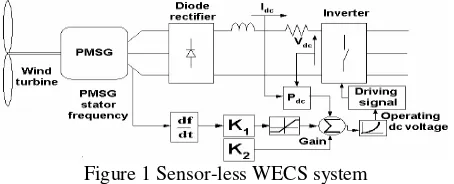
The WECS considered in this work consists of a PMSG driven by a fixed pitch wind turbine, a three-phase diode rectifier and a LCI as AC-DC-AC link to the grid as shown in figure 1.
Figure 1 Sensor-less WECS system
A sensor-less control scheme [3] is a simple and robust MPPT system. The sensor-less control system consists of two signal-tracking loops, namely a ‘power mapping’ loop that is related to the output power from PMSG WECS, and a PMSG frequency derivative loop to give tuning to the first loop. At a given wind speed, the output power at the dc link is used to estimate the optimal dc operating voltage through the ‘power-to-voltage mapping’ curve. Using the results determined by both loops, the LCI sets its firing angle to generate dc bus/link The Sixth International Power Engineering Conference
voltage and to control the power flow to the grid according to maximum power operating point.
2.1
Wind Driven PMSG Characteristics
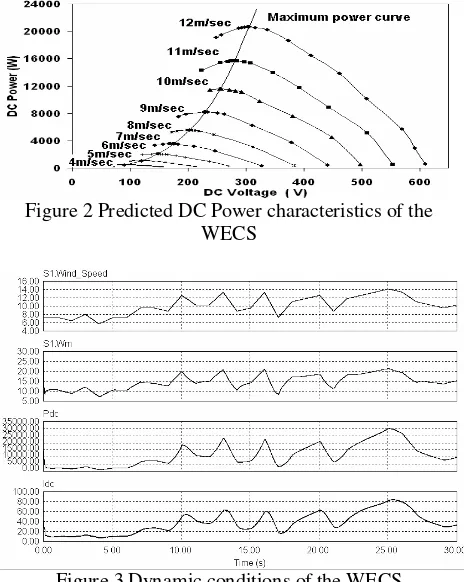
The loading characteristic of the PMSG WECS can be easily determined by connecting an adjustable load resistor to the output rectifier unit of the PMSG. Figure 2 shows the calculated corresponding output power of the PMSG (CRESTA-Curtin) for wind speeds ranging from 4 to 12m/sec [3], where the generator maximum power curves show the different operating dc voltages and currents over a range of wind speeds. In order to extract the peak power from the WTG at a given wind speed, the WECS has to match closely to the maximum power curve.
Figure 2 Predicted DC Power characteristics of the WECS
Figure 3 Dynamic conditions of the WECS
The dynamic condition of the WECS due to a random change of wind speed is shown in figure 3. The wind speed time characteristic is a first order reconstruction of continuous wind-speed that based on wind data recorded in ACRE’s laboratory in Western Australia with a sampling rate of 1 sample/sec [3]. As the wind speed increases or decreases, the MPPT controller is able to track the maximum power point closely, although the inertia of the turbine-generator and the energy storage elements in the circuit reduce the response speed. From figure 3, the rotor speed, dc power and dc current at the dc reactor can follow closely the wind-speed curve. However, by using a LCI, not only active power but also reactive power and harmonics are delivered to the grid.
3
THE LINE-COMMUTATED SCR
INVERTER (LCI)
The design and theoretical analysis of the LCI has been already well documented such as [4]. Basically, the 6-pulse line-commutated converter is a current source inverter (CSI) and consists of a three-phase thyristor or SCR bridge and an inductive filter at dc side. When the firing angle of the thyristor is between 90o and 180o, the bridge circuit operates in the inverter mode.
DC voltage and current of the LCI converter are given by: )] ( cos [cos 2 2
3 α α γ
π + + = N V V L d (1) )] ( cos [cos 2
2 α− α+γ
= T L d X N V I (2)
α = firing angle γ = commutation angle
XT = transformer leakage reactance
The LCI is inherently compatible with an ac system, and will naturally commutate with the line frequency. However, because of ac-side reactance effects on the commutation process, the LCI has to operate at firing angles less than 180o to guarantee against commutation failure. This requirement on firing angle causes non-unity displacement power factor operation. A notching effect also appears on the ac line voltage during commutation. Another disadvantage is that the line current waveform will be a quasi-square wave with high harmonic content.
4
A THREE-PHASE SHUNT ACTIVE
POWER FILTER (APF)
The three-phase shunt active power filter is a three-phase current controlled “voltage-source inverter” (CC-VSI) with a mid-point earthed, split capacitor in the dc bus and inductors in the ac output. It is essentially three independent single-phase inverters with a common dc bus.
appears as a high-impedance circuit for harmonics. By forcing the grid current to be sinusoidal, the APF can automatically provide the harmonic, reactive, negative and zero sequence currents for the LCI, following the basic current summation rule:
igrid (t) = iAPF (t) + iinverter (LCI) (t) (3)
The sinusoidal grid current reference signal is given by: iref (t) = k(t) vgrid-1(t) (4)
where vgrid-1(t) is the waveform of the fundamental component of the grid voltage, and k(t) is obtained from an outer control loop regulating the CC-VSI dc-bus voltage. This can be accomplished by a simple PI control loop. This is an effective way of determining the required magnitude of active current required, since any mismatch between the required load active current and that being forced by the CC-VSI would result in the necessary corrections to regulate the dc-bus voltage. In the VSI topology used in the APF, the dc-capacitor voltage must be greater than the peak of the ac grid voltage. Controllability is ensured by the proper relative sizing of the inverter filter inductance Linv and the choice
of the dc bus voltage so that the two output pwm states (per phase) will always result a corresponding opposite polarity current error signal slopes.
The performance and the effectiveness of the filter are enhanced by the use of the ramptime current control technique to control the CC-VSI [7]. The principle operation of ramptime current control is based on the concept of zero average current error (ZACE). In this application, the current error signal is the difference between the actual grid current and the desired/reference grid current waveform. The ramptime control produces switching instants, which result in the current error signal crossing zero at intervals of half the desired switching period. Hence the current error signal spends half the time on alternate sides of zero, resulting in an average value of zero, a close following of the reference signal, and a switching period (and hence switching frequency) very close to the desired value.
4.1
The Shunt Active Power Filter And
The Line-Commutated Inverter
The shunt type APF acts to eliminate the reactive and harmonic currents produced by non-linear loads from the grid current by injecting compensating currents intended to result in sinusoidal grid current with unity power factor. This filter has been proven to be effective in compensating harmonic current sources [8]. In this case, the LCI is considered as a harmonic current sourcing load because the LCI is a current source inverter (CSI) and produces harmonic and reactive currents to the grid.
During commutation of the LCI, current spikes occur in the grid currents as seen in figure 5. This is because PCC-A and PCC-B are tied together producing a relatively large voltage across each phase line
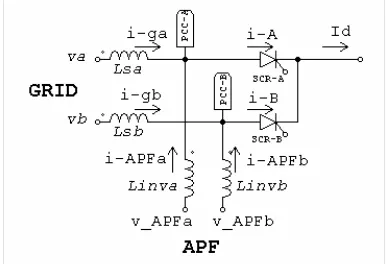
inductance, resulting in a relatively large di/dt in each of the two phase-currents, with each current moving away from the reference current. Consider the commutation process between SCR A and B as shown in figure 4. During that time, the voltage difference between line A and B at the PCC is zero (vPCC-A = vPCC-B). Since vb > va,
a commutating current (= iB) builds up at the outflow of
iA so that,
iA + iB = Id (5)
diB /dt = − diA /dt. (6)
Applying Kirchhoff’s current law at PCC, and ignoring dId/dt as being negligible, then the rate of change of each current is given by
diga /dt = diA /dt + diAPFa /dt (7) digb /dt = diB /dt + diAPFb /dt (8) digb /dt + diga /dt = − (diAPFb /dt + diAPFa /dt) (9)
where iA is iinverter(LCI) phase A and iB is iinverter(LCI) phase B, and Id is dc current.
Figure 4 Circuit equivalent during commutation process
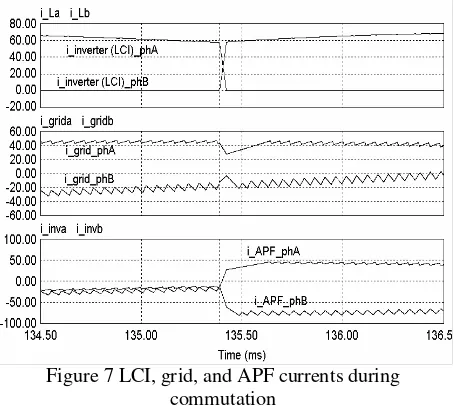
The effects of (9) can be seen in the figure 7. The APF is unable to eliminate the current spikes since it cannot decouple PCC-A from PCC-B. The APF attempts to compensate for the larger current error, and returns the current to the reference value within 200 µsec as seen in figure 7. The magnitude and duration of the current spikes is dependant on the size of Linv, the APF dc-bus voltage, and the speed of response of the APF. In this case the APF inductors are roughly half the size of the line inductance (transformer inductance), and the speed of response is less than half a switching period (< 25 µsec). Strict controllability is lost during the commutation since the current error signal moves away from zero regardless of switch position. However, as soon as the commutation has finished, controllability is returned, and the APF is able to force the grid current to return to the reference value.
frequency ripple in the ac grid currents. Also it will increase the di/dt of the switches during commutation process because the ac reactances seen by the LCI becomes smaller. Increasing Vdc will increase the stress of the switches.
Figure 5 LCI current and grid current - phase A
Figure 6 The spectrum of LCI current and grid current - phase A
Figure 7 LCI, grid, and APF currents during commutation
5
THE WECS WITH THE SHUNT
ACTIVE POWER FILTER
The APF for grid-current waveform control action is much faster than the dynamic behavior of the wind power extraction. The inertia of the turbine-generator also restricts the rotor speed from rapid fluctuation.
Furthermore, the firing angle of the 6-pulses LCI can be updated 6 times in a cycle or every 3.33 msec (for 50 Hz), so that the LCI output can be controlled only at intervals of 3.33 msec. Therefore, the APF (in this case using 20kHz switching frequency) is suitable for WECS with a line-commutated SCR inverter and is able to be coordinated with the MPPT controller.
Figure 8 The APF – WECS system configuration
To show a compensation for a PMSG WECS with LCI, a computer simulation was conducted to test the system configuration shown in figure 8. It consists of a 20 kW PMSG WECS connected to the grid through a 40 kVA transformer with ZTR = 5%. The three-phase shunt active
power filter (APF) is connected between the transformer grid and the LCI. In this case, the capacitor voltage at the APF dc bus is 800 V and the filter inductance (Linv) = 2.3% on a kVA base of 40 kVA and a V base of 400 Vrms.
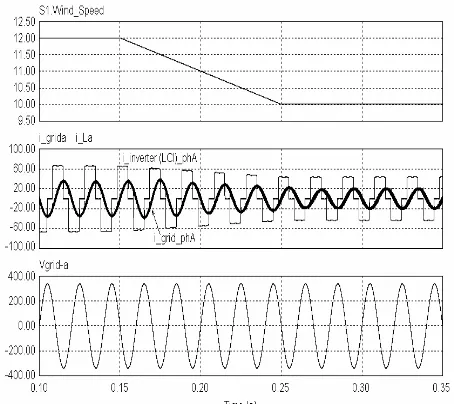
The simulation results of dynamic and steady state condition are presented in figure 9 to 12. Figure 9 shows that the three-phase shunt APF is able to eliminate the reactive and harmonic currents significantly. The grid current is sinusoidal with small commutation spikes and high switching frequency ripple (because the system is without a high switching frequency filter). However, from the current spectrum (up to 2 kHz) in figure 6, the spikes and the ripple do not contribute significantly to the low order harmonics. The grid currents are also symmetrical in magnitude and phase. From figure 10, it can be seen that the phase angle is 180o of the grid voltage, so that the power flows to the grid.
Figure 10 Filtering results under wind-speed changing
Figure 11 (a) Wind speed (b) Power flow (c) LCI and grid currents (rms value)
Figure 12 Total power factor (a) output LCI (b) at the grid
Furthermore, the APF has to be operated in dynamic condition because the wind speed is always changing randomly and the power flow as well, as shown before in figure 3. If the wind speed changes from 12 m/sec to 10 m/sec within 0.1 sec, the LCI current also changes in magnitude and phase. The APF is able to operate accurately so that the grid current is always sinusoidal
and at 180o phase to the grid voltage. Its magnitude corresponds to the active power delivered to the grid.
From figure 11, it is shown that the grid rms current after compensation is reduced significantly. The output rms current from the LCI is high because it contains reactive and harmonic components. Although the rms currents decrease, the active power filter does not affect the power flow. The active power delivered to the grid is similar to the dc power produced by PMSG through an uncontrolled rectifier. The small difference is related to the losses. The total power factor after compensation is nearly unity (figure 12-b). While the total power factor of the LCI output is very low, especially when the wind speed is low and the available power is low. The total power factor is calculated from:
α cos 1
rms I
I
PF = (10)
where I1 is the fundamental current.
6
CONCLUSION
This paper proposes the implementation of a three-phase active power filter to a line-commutated inverter fed PMSG WECS. The APF is operated to directly control the ac grid current to be sinusoidal and in phase with the grid voltage. From the simulation results, this system can compensate the reactive and harmonic currents generated by the LCI and provide nearly unity power factor operation, because there is still spikes and high switching frequency ripple. The APF can handle the dynamic condition due to wind speed variation and the LCI operation.
7
REFERENCES
1. Naik, R. and N. Mohan. A Novel Grid Interface for Photovoltaic, Wind-Electric, and Fuel-Cell Systems with a Controllable Power Factor of Operation. in IEEE - Applied Power Electronics Conference. 1995: IEEE.
2. Chen, Z. and E. Spooner, Grid Interface Options for Variable-speed, Permanent-magnet Generators. IEE Proc. Elect. Power Appl., 1998. 145(4): p. 273-283.
3. Tan, K. and S. Islam, Mechanical Sensor-less Robust Control of Wind Turbine Driven Permanent Magnet Synchronous Generator for Maximum Power Operation. International Journal of Renewable Energy Engineering, 2001. 3(3): p. 379-384.
4. Arrillaga, J., High Voltage Direct Current Transmission, ed. A. Wright. 1983: Peter Peregrinus Ltd. 245.
Conference (AUPEC). 2002. Melbourne, Australia: ACPE.
6. H.L.Jou, Performance Comparison of the Three-phase Active-Power Filter Algorithms. IEE Proc. Gener. Trans. Distrib., 1995. 142(6): p. 646 - 652.
7. Borle, L.J., Zero Average Current Error Control Methods for Bidirection