Parents’ and Teachers’ Perceptions
of the Assessment of the Students’ English Achievement
Agustinus Ngadiman Agnes Santi Widiati Yohanes Nugroho Widiyanto
Abstract. The need for the teaching of English as a foreign language in Indonesia has been felt by almost all levels of society, especially in big cities. Without realizing the schools readiness, society has put a great expectation on the success of the English teaching. In fact, the success of the English teaching is also influenced by the parents’ involvement in the school program. Parents’ involvement will be beneficial when parents and teachers have the same perception about instructional programs, including the assessment of the students’ achievement. The study proves that parents and teachers have similar perceptions of some aspects of the English achievement assessment but different perceptions of other aspects of the assessment. In some respects, such as the function of test, the types of tests used to assess students’ English achievement, parents and English teachers are of the same perception. In other respects, however, such as the level of difficulty, the validity of the test, and the materials covered in the test, they are of different perception. This mismatch of perception may cause problems for the teachers, parents, and students.
Key words: perceptions, assessment, English achievement, secondary schools.
Introduction
The need for the teaching of English as a foreign language in Indonesia has been felt by almost all levels of society, especially in big cities. People believe that the English mastery can guarantee the bright future of the students when they apply for a job. This great expectation is also responded by the policy makers by introducing English to the 4th grade of elementary schools based on the recent national curriculum. Even in practice, there are many kindergartens which also use English instruction.
children’s study, including assessment. However it cannot be denied that most of the parents are laymen of the instructional program so that they might have different expectation from what their children’s teachers provide and conduct in class. The gap between what the parents expect and what the teachers provide may stem from their different perceptions of assessment.
In an effort to empower parents’ involvement in education, this study is carried out to reveal both parents’ and teachers’ perception of the assessment. The study specifically aims at answering the following questions
a. What is parents’ perception of the assessment of English achievement?
b. What is teacher’s perception of the assessment of English achievement?
Research Methodology
The Instruments
To obtain the data needed in this study, questionnaires were given to the responded randomly selected. To obtain the maximal results of the respondents’ perception of the assessment of the students’ English achievement two versions of questionnaire were administered. The first version was in Indonesian and the other was in English. The Indonesian version of the questionnaire was administered to the parent respondents. The English version was administered to the teacher respondents. To get further information, informal interviews with some English teachers were also conducted.
The Respondents
Table 1
Parent Respondents’ Educational Background
Educational Background Abbreviation Number
Elementary School & Junior
Secondary School ES/JSS 42
Senior High School SSS 115
College/University ( Undergraduate
/Graduate Schools) C/U 56
Total Number 212 Respondents
Note:
ES : Elementary School JSS : Junior Secondary School SSS : Senior Secondary School C : College
U : University
The Findings
In general, parents and teachers have similar perceptions of the functions of tests and the types of tests used to assess students’ English achievement, but different perceptions of the level of difficulty, the validity, and the materials covered in the tests. The data also reveal that the educational background of the parents does not significantly influence their perceptions of the assessment. Detailed descriptions of the findings are as follows:
(a) Parents’ and Teachers’ Perceptions of the Function of
Achievement Assessment
Achievement tests are, according to Finochiaro (1993), fundamentally used
(1) to determine (a) whether our teaching methods and techniques are in fact producing learning and (b) which aspects of these are in need of revision
(2) to measure students’ achievement against previously established objective so that they can (a) be moved to the next higher level, if feasible, to other more suitable groups within the same level, (b) be certified as ready to be graduated from a school or to qualify for professional study or employment, (c) be held at the same level for another period of time, or (d) be excluded from the program. The study reveals that most of the parent and the teacher respondents in
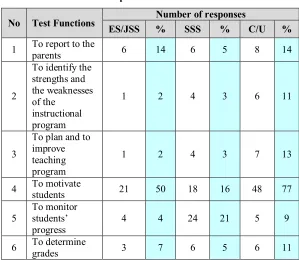
the Senior Secondary School were of the same opinion. According to them the functions of achievement test administered in Senior Secondary School under study were as follows:
a. to make report to the parents
c. to plan and to improve teaching program d. to motivate the students
e. to monitor students’ progress f. to determine grades
g. to measure the students’ achievement of the instructional objectives
h. to determine students’ class rank
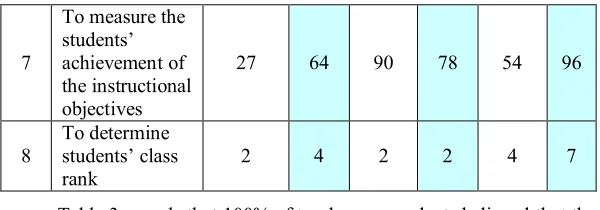
Table 2 shows that most of the parent respondents thought that the main functions of achievement tests were to measure the students’ achievement of the instructional objectives and to motivate students to study. As a whole there is no correlation between parents’ educational background and their perceptions of the function of achievement test. The table indicates that 50% of the ES/JSS, 16% of the SSS, and 77% of the C/U parent respondents stated that the function of classroom test was to motivate students. The table also shows that 64% of the ES/JSS, 78% of the SSS and 96% of the C/U parent respondents stated that the function of classroom test is to measure students’ achievement of the instructional objective. Only a few of them ( 4% of the ES/JSS, 2% of the SSS and 7% of the C/U parent respondents) stated that classroom test was to determine students’ class rank.
Table 2
Parents’ Perceptions of the Functions of Tests
7
Table 3 reveals that 100% of teacher respondents believed that the main function of classroom test is to motivate students. 73% of them mentioned that classroom test was used to monitor students’ progress. Only 27% of them stated that classroom test was used to plan and to improve teaching program. 45 % of them stated that classroom test was to determine students’ class rank.
Table 3
Teachers’ Perception of the Functions of Tests
No Test Functions Number %
1 To report to the parents 5 45
2 To identify the strengths and the weaknesses of the instructional program
6 55
3 To plan and to improve teaching program 3 27
4 To motivate students 11 100
5 To monitor students’ progress 8 73
6 To determine grades 5 45
7 To measure students’ achievement of the instructional objectives
4 36
8 To determine students class rank 5 45
(b) Parents’ and Teachers’ Perceptions of the Kinds of Tests Used to Assess Students’ English Achievement
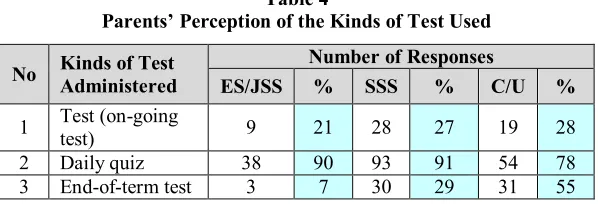
the students’ achievement was measured by means of an on-going test. 90% of the ES/JSS, 91% of the SSS, and 78% of the C/U stated that students’ achievement was assessed by means of daily quizzes. 7% of the ES/SSS, 29% of the SSS and 55% of the C/U parent respondents stated that end-of term test was used to measure students’ English achievement.
Table 4
Parents’ Perception of the Kinds of Test Used
No Kinds of Test
Administered
Number of Responses
ES/JSS % SSS % C/U %
1 Test (on-going
test) 9 21 28 27 19 28
2 Daily quiz 38 90 93 91 54 78
3 End-of-term test 3 7 30 29 31 55
Table 5 indicates that 89% of teacher respondents stated that students’ achievement was mainly determined by means of daily quizzes. 67% of them stated that they measured students’ achievement by means of on-going test. Only 22% of them stated that end-of-term test was used to measure students’ achievement.
Table 5
Teachers’ Perception of the Kinds of Test Used
No Kinds of Test Administered Number %
1 Test (on-going test) 6 67
2 Daily quiz 9 89
3 End-of-term test 4 22
Informal interview, however, found that most teachers realized that the average results of those three tests were used to make decisions about the students’ English achievement, and at the end of the school year whether or not a student could be promoted to the higher level of education.
(c) Parents’ and Teachers’ Perceptions of the Test Contents
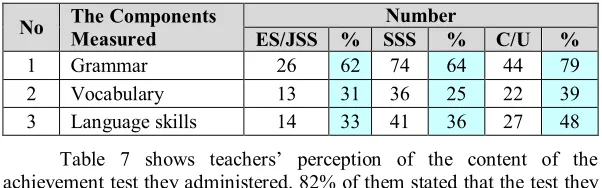
vocabulary. Perhaps they believe that learning a language means learning grammatical rules and vocabulary; and without those language components one cannot communicate with the language learned.
Table 6
Parents’ Perception of the Content of the Test
No The Components
Measured
Number
ES/JSS % SSS % C/U %
1 Grammar 26 62 74 64 44 79
2 Vocabulary 13 31 36 25 22 39
3 Language skills 14 33 41 36 27 48
Table 7 shows teachers’ perception of the content of the achievement test they administered. 82% of them stated that the test they administered covered grammatical items, 73% of them stated that the test covered vocabulary and 45% of them stated that the test covered language skills.
Informal interview with some teachers, however, revealed that some teachers admitted that English skills and language components were analyzed integratedly. But some others stated that the tests focused on the grammar only rather than on other components. Some other teacher respondents said that the tests measured the students’ knowledge (competence) rather than performance. Thus the emphasis of the assessment was put on grammar rather than on the language skills such as reading, listening, speaking and writing. If it was the case, the assessment applied did not accord with the principles of assessment as prescribed in the Teaching Program Guidelines that emphasized on language use rather than usage. As a result assessing students’ achievement on grammatical items was the priority, vocabulary the second, and language skills was the least. The following table depicted the teachers’ perception of the content of the English achievement rest.
Table 7
Teachers’ Perception of the Content of the test
No The Components Measured Number %
1 Grammar 9 82
2 Vocabulary 8 73
3 Language skills 5 45
(d) Parents’ and Teachers’ Perceptions of the Test Construction
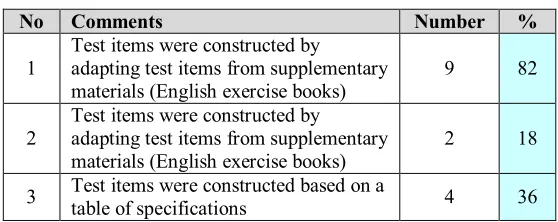
supplementary materials (English exercise books available). Four teachers (36% of the teacher respondents) admitted that they constructed test items based on a table of specifications.
Table 8
The Construction of the Test Items
No Comments Number %
1
Test items were constructed by
adapting test items from supplementary materials (English exercise books)
9 82
2
Test items were constructed by
adapting test items from supplementary materials (English exercise books)
2 18
3 Test items were constructed based on a
table of specifications 4 36
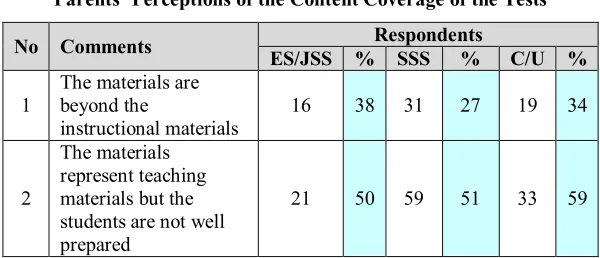
Table 9 indicates that eight or 73% of teacher respondents believed that the tests they constructed were valid because the tests covered the materials they taught to the students and the tests were relevant to the instructional objectives. They stated if the students were unable to do the test because they were not prepared for the test. However, 6 or 55% of the teacher respondents admitted that the tests they constructed covered broader than what had been taught to the students, and thus they lacked content validity.
Table 9
Teachers’ Perceptions of the Content Coverage of the Tests
No Comments Number %
1 The materials are beyond the
instructional materials 6 55
2
The materials represent teaching materials but the students are not well prepared
8 73
Table 10
Parents’ Perceptions of the Content Coverage of the Tests
No Comments Respondents
Furthermore, the statement that the tests were valid was however questionable because most teachers said that. (a) the tests were constructed just a few days before they were administered; (2) no try-out was done, and (3) the construction of the test was not based on the instructional objectives. Some others said that they constructed the test after they had completed teaching a unit of materials. In addition, there was no school guideline to construct the achievement tests. It seems that the tests were constructed intuitively without considering the content coverage, validity, and reliability as well as the instructional objectives.
Table 11 reveals that 18% of teacher respondents stated that the test was constructed while preparing for the instruction, 55% of them stated that they constructed the test jus a few days before the test was given to the students, 9% of them stated the test was constructed when preparing unit lesson plans, 9% of them stated the test was constructed after identifying the topics, and 55% of hem stated that the test was constructed after they finished teaching a unit of materials.
Table 11 The Test Construction
The tests were constructed:
No Answers Number %
1 While preparing the instruction 2 18 2 A few days before a test was given to
students 6 55
3 When preparing unit lesson plans 1 9
4 After identifying topics 1 9
5
After finishing teaching a unit of materials and determining materials to cover in the test
(e) Parents’ and Teachers’ Perceptions of the Difficulty Level of the Test
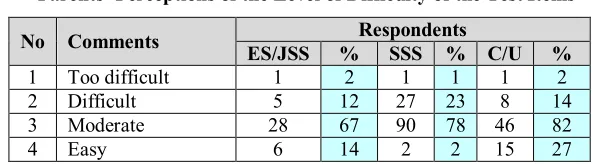
As indicated in table 12, 67% of the ES/JSS, 78% of the SSS, and 82 of the C/U believed that most of the tests belonged to the moderate level of difficulty. If their children got poor grades in English, it is not because of test but the children themselves who did not prepare themselves for the test although the teachers had informed the test schedule to them.
The table also indicates that 12% of the ES/JSS, 23% of the SS, and 14% of the C/U parent respondents, however, stated that the tests were difficult. 12% of the ES/JSS, 1% of the SSS, and 2% of the C/U parent respondents stated the test was too difficult for the children. They found their children had prepared well for the test and had mastered the materials taught; yet, they got poor grades. The reasons were, according to the: (a) the tests were too difficult, and (2) the contents of the tests were beyond the materials taught. Only 14% of ES/JSS, 2% of SSS, and 27 % of C/U parent respondents stated the test was essay.
Table 12
Parents’ Perceptions of the Level of Difficulty of the Test Items
No Comments Respondents
ES/JSS % SSS % C/U %
1 Too difficult 1 2 1 1 1 2
2 Difficult 5 12 27 23 8 14
3 Moderate 28 67 90 78 46 82
4 Easy 6 14 2 2 15 27
In terms of the difficulty level, most of the teacher respondents believed that the vocabulary and grammar in the tests were not difficult. Table 13 indicates that none (0%) of the teacher respondents stated that the test was too difficult; 73% of them stated that the test was difficult, 73% of them stated that the test was moderately difficult, and 27% of hem stated that the test was easy. In addition, informal interview with teacher respondents revealed that none of the teacher respondents did any try-out and item analysis. Thus any evidence did not support their claim that the level of difficulty of the test belonged to the moderate level.
Table 13
Teachers’ Perception of the difficulty level of the test items
No Difficulty Level Number %
1 Too difficult 0 0
2 Difficult 8 73
3 Moderate 8 89
(f) Parents’ and Teachers’ Perceptions of Grade as a Success Indicator
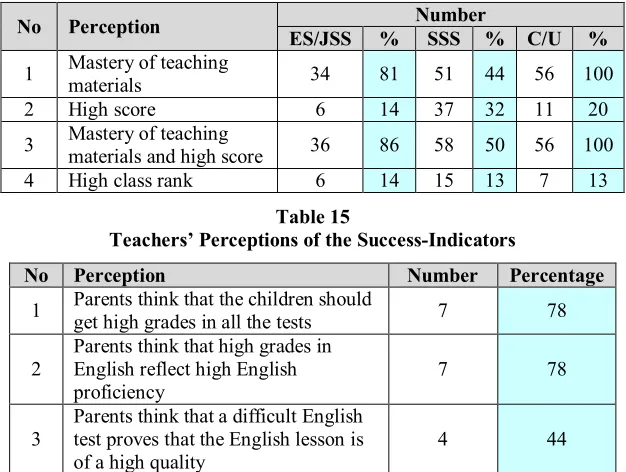
Table 15 shows that 78% of the teachers thought that parents considered that achieving high scores was more important for the parents than achieving high degree of learning. They also believed that parents thought that high grades in English reflected high degree of proficiency. Parents’ opinion that a difficult test indicates the high quality of the English lesson was supported only by 44% of teacher respondents. It is true that grade is viewed as success indicator, but it is not the main focus of their consideration. This perception is however incorrect. The study revealed contradictory impression. Most parents considered both mastering teaching materials and achieving high scores were important. Table 14 shows that 86% of ES/JSS, 50% of SSS, and 100% of C/U of parent respondents considered both mastering teaching materials and achieving high score were equally important. The table shows that 81 % 0f ES/JSS, 44% of SSS, and 100% 0f C/U the parent respondents considered mastering teaching materials important. Only 14% of ES/JSS and 13% of C/U parent respondents considered high class rank important.
Table 14
Parents’ Perceptions of the Success-Indicators
Table 15
Teachers’ Perceptions of the Success-Indicators
Informal interview also revealed that parents had the impression that parents did care much about their children’s English ability and high scores did satisfy them. It can be concluded then that both teachers and
No Perception Number
ES/JSS % SSS % C/U %
1 Mastery of teaching
materials 34 81 51 44 56 100
2 High score 6 14 37 32 11 20
3 Mastery of teaching
materials and high score 36 86 58 50 56 100
4 High class rank 6 14 15 13 7 13
No Perception Number Percentage
1 Parents think that the children should
get high grades in all the tests 7 78 2
Parents think that high grades in English reflect high English proficiency
7 78
3
Parents think that a difficult English test proves that the English lesson is of a high quality
parents believed that the success or the failure in learning English was indicated by the grades the children gained. For them, poor grades means failure and good grades indicated success. Great efforts were therefore done by both parents and teachers to foster students’ capacity in gaining good grades in English. Some of the parents always monitored their children’s assignment. Some others sent children to non-formal English courses or private courses (courses given by individual person either at the children’s home or the home of the teacher).
Discussion
A good test must be valid, reliable and accountable. A good test must also be able to test the good, the average and the poor students. A test is valid if it measures what should be measured. In general the validity as well as the reliability of the test used to measure students achievement was however questionable because most teacher respondents said that. (a) the tests were constructed just a few days before they were administered; (2) no try-out was done, and (3) the construction of the test was not based on the instructional objectives. Some others said that they constructed the test after they had completed teaching a unit of materials. In addition, there was no school guideline to construct the achievement tests. It seems that the tests were constructed intuitively without considering the content coverage, validity, and reliability as well as the instructional objectives. If it is the case the results of the students’ achievement reported to the parents, which are also used to determine whether or not the students can be promoted to the higher level of education, are invalid and unreliable. Unfortunately, because of their ignorance of the evaluation concept, all parents accepted whatever the results reported to them. When they found that the results of the English achievement of their children were not satisfactory they just said that the children were not well prepared for the test.
Most of the teacher respondents claimed that the tests they constructed belonged to the moderate level of difficulty; On the contrary, most parent respondents thought that the tests were difficult. The teachers’ perception of the difficulty level, however, was not the result of item analysis. Thus, the discriminating power of the test was questionable. The test could not differentiate the good students from the average and from the poor ones.
their children’s progress by asking their children, checking the assignments or notebooks, or communicating with the English teacher.
The study reveals that both parents and teachers believed that the results of the achievement test reflect the students’ English proficiency. However, informal talk with some teachers uncovered that many students could pass several semesters of language courses with high grades and still be unable to use the language for reading or for conversing with other people speaking English. Thus, the accountability of the result of the test was however questionable. Perhaps it is the result of the test focusing too much on language components, such as grammatical items and vocabulary. It may also be the result of instruction emphasizing too much on teaching language components rather than language skills.
Though the Teaching Program Guidelines of the 1994 Curriculum suggests a meaning-based approach be applied both in the teaching-learning process as well as in evaluating students’ achievement. Most of the time available is spent on giving students discrete grammar exercises in loose sentences, not contextual. Thus, grammar is presented not as an element of communication. Grammar is presented in detail without considering grammatical items mostly needed in daily communication. The tests are also constructed accordingly.
The Teaching Program Guidelines of the 1994 Curriculum suggest a continuous evaluation be conducted along with the process of the teaching and learning activities. The study reveals that parents and teachers believed daily quizzes, on-going tests, and end of semester unit tests were administered to assess students’ progress as well as the students achievement. In addition, the decision made about the students’ achievement and whether or not the students were promoted was based on the results of the on-going tests, daily quizzes, and end-of semester unit tests. Unfortunately, decision about students’ achievement was only on the quantitative data found through classroom tests. Qualitative information obtained through observation of students’ performance and personal interviews was never used to make students’ achievement.
Conclusion
The study uncovers the facts that parents and teachers have similar perceptions of some aspects of the English achievement assessment but different perceptions about other aspects of the assessment. In some respects, such as the function of test, the types of tests used to assess students’ English achievement; parent and English teacher respondents are of the same perception. In other respects, however, such as the level of difficulty, the validity of the test, and the materials covered in the test, they are of different perception. This mismatch of perception may stem from:
as teaching English as outlined in the Teaching Program Guidelines of the 1994 Curriculum;
(b) the parents being ignorant about the essence of achievement test in particular and test in general.
If it is claimed that the test content is relevant to the materials taught, this still does not meet the expectation of the parents, and the society in general, that the ultimate goal of teaching English is communicative ability or language use rather than usage. Thus, the parents also realize that mastering language components such as grammar and vocabulary cannot guarantee that a language learner can use the language for communication.
As revealed in this in this study, the wrong practice of constructing and administering English achievement tests and interpreting the test result has happened at school. In order for the English program in the secondary schools to yield a success, the school should made an appropriate attempt to overcome the wrong practice. The fact that quite a lot of trainings for trainers have been conducted is a good sign of the effort to improve the English program at schools. It should be realized, however, that many other factors do hinder the teachers’ effort in implementing the right procedure of teaching and assessing students’ English achievement.
Recommendation
In order for the objectives of teaching English at the senior secondary schools to be optimally achieved, both parents and teachers should have the right perceptions of the interrelated elements of teaching including the assessment of the students’ achievement, and thus, they can act accordingly. Based on the findings of this study, the researchers would like to recommend the following:
(1) an in-depth analysis on the difficulties faced by the teachers in implementing the principles of assessment as well as teaching should be done, especially by the school managers, to give the right solution to the teachers.
(2) the English teachers should be aware of their autonomy and responsibility, and act accordingly, in developing the teaching materials, in implementing the appropriate teaching techniques, and assessing the students’ achievement in line with the objectives of teaching English at their schools.
(3) Parents should be well informed about the function of assessment in learning-process.
(4) Parent-teacher association should be revitalized.
References
Brown, John Dean. 1996.Testing in Language Program. New Jersey: Prentice-Hal.
Finocchiaro, Mary and Sydney Sako, 1983. Foreign Language Testing. A Practical Approach. New York: Regents
Heaton, J.B. 1991.Writing English Tests. Hong Kong: Longman Group, Ltd