Proceedings of the IConSSE FSM SWCU (2015), pp. MA.90–92 ISBN: 978-602-1047-21-7
SWUP MA.90
The determinant of traveled expenditure and the number of
visitors in Semarang District
Sri Subantia, Mulyantob, Nughtoh Arfawi Kurdic
aFaculty of Mathematics and Natural Science, bFaculty of Economics and Business, cFaculty of Mathematics and Natural Science,
Sebelas Maret University, Jl Ir Sutami 36A, Surakarta 57126, Indonesia
Abstract
The objective of this study was to know the determinant of traveled expenditure and the number of visitors at some tourist destinations in Semarang District. By using primary data obtained from survey to the tourists who were visiting. Methods of analysis with econometric approach through logistic regression and ordinary least squares (OLS).
The determinants number of visitors were the experience of visiting, travel costs,
revenue, budget allocations traveled in a month, age, gender, and the origin of the respondents, while the determinants of traveled expenditure were revenue, perception, distance, and number of family members.
Keywords number of visitors, traveled expenditure
1.
Introduction
The Semarang District is a district in Central Java Province whose capital is Ungaran. Administrative boundaries are bordered by Semarang City and Demak District in the north, Boyolali District istrict and Grobogan District in the south, Kendal District and Temanggung District in the west. Salatiga district is at the middle of the Semarang District. Semarang District has natural tourism, cultural, historical heritage of war, and the interesting history of technology.
One of the economic activities which until now needs to be improved in the Semarang District is the tourism sector, because tourism is a sector that is very complex and multidimensional whether physical, social, cultural, economic and political. Tourism activities includes not only foreign and domestic tourists, but also some activities that provide services to tourists such as hotels, business trips, guides, restaurants, and so on. Success in the tourism is reflected by the increasing number of visitors.
S. Subanti, Mulyanto, N.A. Kurdi
SWUP MA.91
2.
Materials and methods
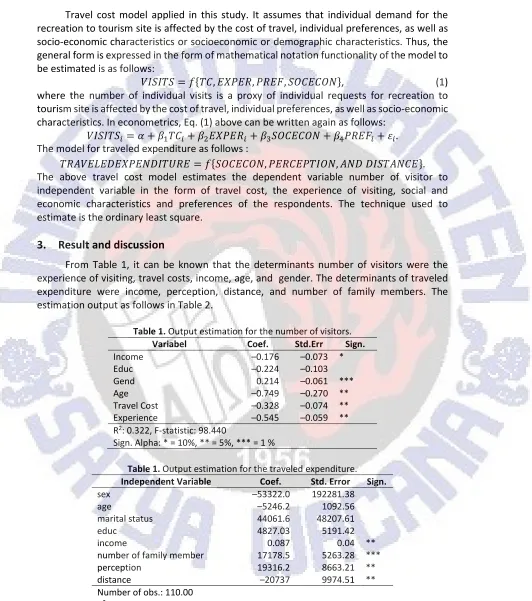
Travel cost model applied in this study. It assumes that individual demand for the recreation to tourism site is affected by the cost of travel, individual preferences, as well as socio-economic characteristics or socioeconomic or demographic characteristics. Thus, the general form is expressed in the form of mathematical notation functionality of the model to be estimated is as follows:
væv æ= ) , çrxçü, xüçô, æ› ç › +, (1)
where the number of individual visits is a proxy of individual requests for recreation to tourism site is affected by the cost of travel, individual preferences, as well as socio-economic characteristics. In econometrics, Eq. (1) above can be written again as follows:
væv æ = m + + çrxçü + ‰æ› ç › + ïxüçô + .
The model for traveled expenditure as follows :
ü( ç<çœçrxç œv •üç = )æ› ç › , xçü çx v› ,( œœvæ ( ç+.
The above travel cost model estimates the dependent variable number of visitor to independent variable in the form of travel cost, the experience of visiting, social and economic characteristics and preferences of the respondents. The technique used to estimate is the ordinary least square.
3.
Result and discussion
From Table 1, it can be known that the determinants number of visitors were the experience of visiting, travel costs, income, age, and gender. The determinants of traveled expenditure were income, perception, distance, and number of family members. The estimation output as follows in Table 2.
Table 1. Output estimation for the number of visitors.
Variabel Coef. Std.Err Sign.
R2: 0.322, F-statistic: 98.440
Sign. Alpha: * = 10%, ** = 5%, *** = 1 %
Table 1. Output estimation for the traveled expenditure.
Independent Variable Coef. Std. Error Sign.
The determinant of traveled expenditure and the number of visitors in Semarang District
SWUP MA.92
4. Conclusion and remarks
The government needs to formulate policies for better tourism development. Javanese cultural performances and traditional markets as could be an alternative besides natural environment. Then, the development of cultural tourism and enviromental tourism can be applied to the development of tourism in Semarang District.
References
Bateman, I., Carson, R., Hanemann, M., & Hanley, N. (2002). Economic valuation with stated
preference techniques. A manual, United Kingdom, Department for Transport.
Bowker, J.M., & Stoll, J.R. (1988). Use dichotomous choice non market methods to value the whooping
crane resource. American Journal of Agricultural Economics, 70, 372–381.
Hakim, A.R., Subanti, S., & Tambunan, M. (2011). Economic valuation of nature based tourism object
in Rawapening Indonesia: An application of travel cost and contingent valuation method. Journal
of Sustainable Development, 4(2).
Lee, C.-K., & Han, S.Y. (2002). Estimating the use and preservation values of national parks tourism