J.Food Pharm.Sci. 1 (2013) 81-84
Avalaible online at www. jfoodpharmsci.com
Research Article
Estimation of Naturally Produced Water-Soluble Vitamins in Different
Asavas and Arishtas Using Liquid Chromatography
Nikhil Kumar Singh, Alok Sharma, Meena Sharma, Rahul Singh*, and Chandrakant Katiyar
Dabur Research & Development Centre, Dabur India Limited, Ghaziabad, India
ARTICLE INFO ABSTRACT
Received 11/07/2012
Received in revised form 12/08/2012 Accepted 12/08/2012
Available online 01/02/2013
1. Introduction
Although the past decade has seen a paradigm shift
in consumer s inclination from western medicines to
herbal medicines, yet there is a segment which is skeptical about using classical ayurvedic preparations due to lack of enough documentation to establish their safety and efficacy (Patwardhan et al., 2006).
Asava and Arishtas are unique dosage form
contributed by Ayurveda and are supposed to have indefinite shelf life. In terms of current understanding, this phrase assumes more importance because this dosage form has an inherent attribute of continuous hydro-alcoholic extraction and probably formation of natural analogues of the chemical compounds present in the medicinal plants (Sekar and Mariappan, 2008). Flowers of Woodfordia fructicosa are used for fermentation to produce self generated alcohol in
Asavas andArishtas (Krores et al., 1993). These flowers contain yeast. Since water-soluble vitamins are also produced from yeast, it was hypothesized that Asavas
and Arishtas may also contain vitamins. Asava and
Arishthas are used as natural supplements / tonic for boosting general health through ayurveda.The present study was undertaken in this background (API, 2003). Since the process of fermentation also results in generation of vitamins, the same principle was correlated with their efficacy by comparing them with the recommended dose of vitamins for a healthy living .
Considering HPLC as a powerful tool in the analysis of complex matrix, the vitamin analysis was carried out simultaneously using a simple and rapid HPLC separation method (Sharma et al., 2011).
2. Materials and methods
Vitamins B1, B2, B3, B5 & B6 were obtained from
Sigma-Aldrich. HPLC grade Methanol was obtained from Merck (Darmstodt, Germany). AR (Analytical Reagent) grade triethylamine, pentane sulphonic acid sodium salt & acetic acid were obtained from Qualigens (Mumbai, India). Seven samples of Dabur Asava and Arishthas were procured from local market.
Self fermented polyherbal Ayurvedic preparations are called Asavas and Arishtas and are efficacious classical preparations. Insignificant efforts have been made to delve deep into scientific rationale of this ancient dosage form of Ayurveda. An investigative analysis using reversed phase chromatography was conducted to evaluate and estimate the presence of water-soluble vitamins in seven Asavas and Arishtas namely Drakshasava, Ashokarishta, Dashmulrishta, Khadirarishta, Lauhasava, Arjunarishta and Ashwagandharishta. The study revealed that these preparations contained water soluble vitamins B1, B2, B3 & B6 in significant concentrations. Reversed phase high performance liquid chromatography was carried out on an Agilent 1200 DAD system. Separation was carried out on an Inertsil ODS 3 V column (250 mm x 4.6 mm, 5 µm) at wavelength of 265 nm.
Keywords: Water- soluble vitamins, HPLC, Reversed phase chromatography,
Asavas and Arishtas
2.1. Mobile Phase
Water, Methanol & Acetic acid in the ratio of 73:26.5:0.5, with 1.92g Pentane sulphonic acid & 0.9 ml triethylamine were used in the study. Mobile phase
solution were filtered with a 0. μm membrane filter
paper utilising a millipore filtration set and subsequently degassed for 15 minutes with an ultrasonic bath. The column was washed with at least 100 to 150 ml of mobile phase and then equilibrated at a flow rate of 1 ml per minute before injecting the standard mixture.
2.2. Standard preparation
All the stock solutions as well as dilutions were prepared in amber colored bottles. Stock solutions for vitamins B1, B2, B3 & B6 were prepared by dissolving
reference/working standard in 2% acetic acid & 25% methanol. Stock solution for B5 was prepared by
dissolving reference material into mobile phase. A mixture of all the standards was prepared by taking a suitable aliquot to give a final concentration of: Vitamin B1 (5 ppm), Vitamin B2 (1 ppm), Vitamin B3 (5 ppm)
Vitamin B5 (20 ppm) and Vitamin B6 (2 ppm), against
which the vitamins were quantified in the sample.
2.3. Sample Preparation
About 5.0 ml of sample was taken into 25 ml amber colored volumetric flask. The sample was mixed well in the diluent by leaving the flask on a wrist-shaker for about 10 minutes under dark conditions. The solution thus obtained was filtered using 45µ filter paper for injecting into the chromatograph.
2-4. Validation of method
The HPLC method was validated by defining the precision, linearity and recovery. Six determinations of the same solution were performed under same conditions to evaluate the method precision. Linearity of the method was performed by analyzing a standard solution by the proposed method in the concentration range. The accuracy of the proposed method was determined by a recovery study, while was carried out by adding standard solution in the Asavas & Arishtas.
3. Results & Discussion
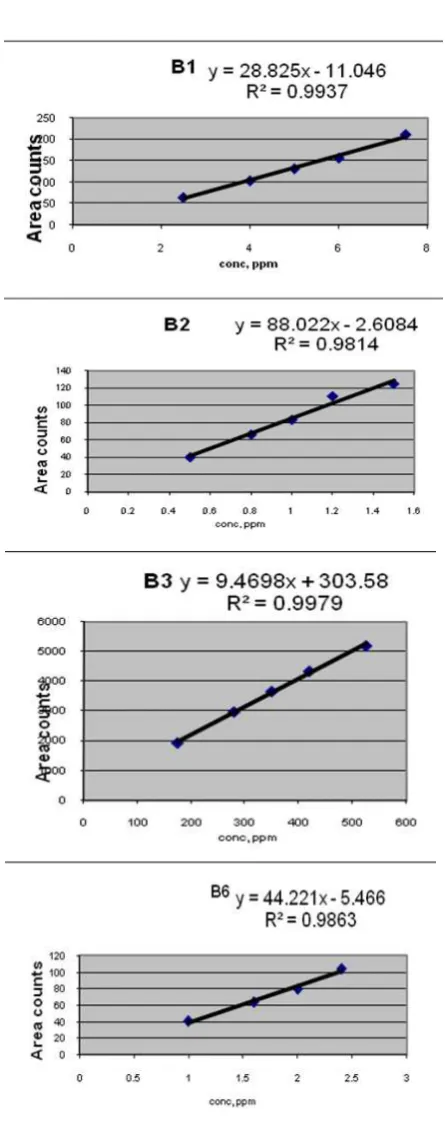
Six determinations of the same solution were performed under same conditions to evaluate the method precision. The precision of the method for determination of vitamins in Asavas & Arishtha’s is shown in Table 1. The linearity relationship between the concentration of the vitamins and the respective peak area was plotted at different concentrations (Figure 1). As seen from Table 2, the correlation co-efficient for all the vitamins is more than 0.998. To ensure the accuracy of the data obtained recovery of the vitamins in the same matrix were performed. The values have been tabulated in Table 3.
Table 1. Precision of the method for determination of vitamins
Sample
No. Vitamins Mean area %RSD
1 B1 112.83 2.75
2 B2 78.26 1.37
3 B3 51.75 1.35
4 B6 71.45 1.92
Fig 1. Linearity Graphs for B1, B2, B3 and B6
Table 2. Linearity relationship between the concentrations of vitamins
Sample No. Vitamins r2 Concentration
Range (ppm)
1 B1 0.994 2.5 – 7.5
2 B2 0.981 0.5 – 1.5
3 B3 0.998 175 - 525
4 B6 0.998 1.0 – 2.4
Table 3. Recovery of vitamins
Sample No.
Vitamins Initial
(ppm)
Fortification (ppm)
% Recovery
1 B1 61 85 72
2 B2 19 21 91
3 B3 1020 1009 101
4 B6 20 30 67
Vitamin estimation was carried out in Drakshasava,
Ashokarishta, Dashmulrishta, Khadirarishta, Lauhasava,
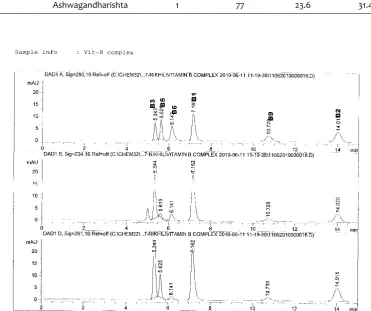
Arjunarishta and Ashwagandharishta from Dabur India Limited (Kalaiselvan et al., 2010). The values for all the vitamins in different Asavas & Arishthas as an average of 5 batches have been summarized in Table 4. Figure 2 showed the chromatogram indicating the separation of vitamins at 280, 234 & 261 nm. The findings show that Vitamin B5 could not be detected in any of the samples.
Interestingly, as given in Table 4, in most of the cases, the concentration of Vitamin was more than the recommended daily intake. All the asavas-arishthas were found to be rich source of Vitamin B6 with estimated
values much higher than the minimum recommended values (Khor and Siong, 1996). Although the study indicated presence of Vitamin B9 (Folic acid) in many of
the samples, but since the quantitation was beyond the scope of the study, it has not been reported.
Table 4. Vitamin estimation with respect to daily intake in Asavas and Arishtas
Product Vitamin B1 Vitamin B2 Vitamin B3 Vitamin B6
(mg) (mg) (mg) (mg)
RDI* - 1.5 1.7 2 2
Vitamin intake in single dose
of 60 mL
Drakshasava 0.65 11.4 4.9 159
Ashokarishta 2.2 10.9 24.3 5.5
Dashmulrishta 1.6 10 52.4 58.2
Khadirarishta 1.9 7.7 63 29
Lauhasava 2.3 8.5 26.1 90.2
Arjunarishta 12 1.8 11 18
Ashwagandharishta 1 77 23.6 31.4
Fig 2. Chromatogram indicating the separation of vitamins at 280, 234 and 261 nm
The presence of water soluble vitamins in various concentrations justifies the claimed benefits of these Ayurvedic preparations (Asavas & Arishtha) as general tonics. The study provides a scientific evidence for the efficacy of these products for such usage.The methodology presented has an advantage in terms of ease of use & time of analysis over the other widely used methods which involve extraction, chemical reactions followed by fluorimetry for B1 & B2, spectrophotometry (for niacin & folic acid) & titrations for ascorbic acid & pyridoxine (Deutsch, 1984). Need for the use of hazardous chemicals such as cynogen bromide for the estimation of niacin poses additional difficulties. Of late, it has been difficult to obtain this toxic and carcinogenic chemical. We hope that this work will act as a stimulant for other scientific studies on this unique form of Ayurvedic preparations.
4. Conclusion
The present study establishes the presence of good amount of vitamins from B complex range in the
Drakshasava, Ashokarishta, Dashmulrishta, Khadirarishta,
Lauhasava, Arjunarishta and Ashwagandharishta thereby supporting the usage of these Asavas & Arishtas in the form of general tonics suitable to be taken in routine life without any side effects due to its herbal base.
References
Ayurvedic Formulary of India, Central Council for Research for Ayurveda and Siddha, 2nd Edn., Part 1, Ministry of Health and family Welfare, Government of India, 2003, 113. Deutsch MJ. Vitamins and other nutrients. In: Official Methods
of Analysis of the AOAC, Williams S ed, 14th edn,
Association of Official Analytical Chemists, Washington, D.C. 1984, 836-847.
Kalaiselvan V.; Kumar K.; Shah AK.; Patel FB.; Shah CN.; Kalaivani M.; Rajasekaranm A, Quality assessment of different marketed brands of Dasmoolaristam, an Ayurvedic formulation. Int. J.Ayur. Res. 2010, 1(1), 10-13. Khor SC.; Siong TE.; Development of a HPLC method for the
simultaneous determination of several B-Vitamins and ascorbic acid, Malaysian Journal of Nutrition, 1996, 2, 49-65.
Krores BH.; Ajj VB.; Abeysekera AM.; Desilva KTD.; Labadie RP, Fermentation in traditional medicine: the impact of Woodfordia fructicosa flowers on the immunomodulatory activity and the alcohol and sugar content of Nimbu arista. J. of Ethnopharmacol.1993, 40, 117-125
Patwardhan B.; Vaidya ADB.; Chorghade M, Ayurvedic and Natural Product drug discovery. Curr. Sci. 2006, 86, 789-799.
Sekar S.; Mariappan S, Traditionally fermented biomedicines, arishtas and asavas from Ayurveda. Ind. J. of Trad. Know.
2008, 7(4):548-556.
Sharma A.; Singh N.; Sharma M.; Singh R.; Kant KC, Comparative Study of Determination of Reducing Sugar by High-Performance Liquid Chromatographic and
Titration Method in Chyawanprash: A Traditional
Polyherbal Formulation. Int. J. of Drug Discov. and Herbal Res. 2011, 1(4)106-111.