WOMEN’S SPEECH FEATURES USED BY THE MAIN
CHARACTER IN
“LUCY”
LUC BESSON’S MOVIE
THESIS
Submitted as Partial Fulfillment of the Requirements for the Sarjana Degree of English Department Faculty of Letters and Humanities State Islamic
University SunanAmpel Surabaya
By:
Siti Maulidatur Rohmania Reg. Number A33212089
ENGLISH DEPARTMENT
FACULTY OF LETTERS AND HUMANITIES
STATE ISLAMIC UNIVERSITY SUNAN AMPEL SURABAYA
WOMEN’S SPEECH FEATURES USED BY THE MAIN
CHARACTER IN
“LUCY”
LUC BESSON’S
MOVIE
THESIS
Submitted as Partial Fulfillment of the Requirements for the Sarjana Degree of English Department Faculty of Letters and Humanities State Islamic
University SunanAmpel Surabaya
By:
Siti Maulidatur Rohmania
Reg. Number A33212089
ENGLISH DEPARTMENT
FACULTY OF LETTERS AND HUMANITIES
STATE ISLAMIC UNIVERSITY SUNAN AMPEL SURABAYA
ABSTRACT
Rohmania, Siti Maulidatur.2016. Women’s Speech Features Used by The Main Character in “Lucy”Luc Besson’s Movie. Thesis. English Department, Faculty of Letters and Humanities, State Islamic University of Sunan Ampel Surabaya. Advisor : Endratno Pilih Swasono, M.Pd.
Key words : Women Language, Women’s Speech Features, Movie
This research was intended to analyze women’s speech features used by the main characters in “Lucy” Luc Besson’sMovie. Women’s speech features are features that specifically indicate the characteristic of women’s language and show the differences of language usage between men and women. Because the main character in this movie are female, the writer decided to analyze the use of women’s speech features by the main characters in “Lucy” movie and the type of women’s speech features which occurs most frequently by the main characters in this movie.
INTISARI
Rohmania, Siti Maulidatur. 2016. Women’s Speech Features Used By The Main Character In “Lucy” Luc Besson’s Movie. Skripsi. Sastra Inggris, Fakultas Bahasa dan Sastra, UIN Sunan Ampel, Surabaya.
Pembimbing : Endratno Pilih Swasono, M.Pd.
Kata kunci : Bahasa Perempuan, Fitur Bahasa Perempuan, Film
Penelitian ini dimaksudkan untuk meneliti ciri-ciri berbicara wanita yang digunakan oleh pemeran utama dalam “Lucy”Luc Besson’sMovie. Ciri-ciri berbicara wanita adalah ciri-ciri yang secara rinci menunjukkan karakteristik bahasa wanita dan menunjukkan perbedaan penggunaan bahasa antara pria dan wanita. Karena pemeran utama pada movie ini adalah perempuan, penulis memutuskan untuk meneliti penggunaan ciri-ciri berbicara wanita oleh pemeran utama dalam “Lucy” movie dan tipe dari ciri-ciri bahasa wanita yang paling sering digunakan oleh pemeran utama pada movie ini.
TABLE OF CONTENTS
Inside Cover Page ... i
Inside Title Page ... ii
Declaration Page ... iii
Motto ... iv
Dedication Page ... v
Thesis Advisor’s Approval Page ... vi
Thesis Examiner’s Approval Page ... vii
Acknowledgements ... viii
Table of Contents ... x
Abstract ... xiii
Intisari ... xiv
CHAPTER 1 INTRODUCTION 1.1 Background of The Study ... 1
1.2 Statement of Problem ... 4
1.3 Objectives of The Study ... 4
1.4 Significances of The Study ... 4
1.5 Scope and Limitation ... 5
1.6 Definition of Key Terms ... 5
CHAPTER 2 LITERATURE REVIEW 2.1 Theoritical Framework ... 7
2.1.1 Women Language ... 7
2.1.2 Women’s Speech Features ... 8
2.1.2.1 Lexical Hedges ... 9
2.1.2.2 Tag Questions ... 9
2.1.2.4Empty Adjective ... 11
2.1.2.5Percise Color Term ... 13
2.1.2.6Intensifier ... 13
2.1.2.7 Hypercorrect Grammar ... 14
2.1.2.8 Superpolite Form ... 14
2.1.2.9 Avoidance of Strong Swear Word ... 16
2.1.2.10 Emphatic Stress ... 16
2.2 Previous Study ... 18
CHAPTER 3 METHOD OF THE STUDY 3.1 Research Approach ... 21
3.2 Technique of Data collection... 21
3.2.1 Source of Data... 21
3.2.2 Instrument ... 22
3.2.2 Technique of Collecting Data ... 22
3.3 Technique of Data Analysis ... 23
CHAPTER 4 FINDINGS AND DISCUSSIONS 4.1 Types of Women’s Speech Features ... 25
4.1.1 Lexical Hedges or Filler ... 26
4.1.2 Tag Question ... 31
4.1.3Rising Intonation on Declaratives ... 32
4.1.4Empty Adjectives ... 33
4.1.5 Precise Color Terms ... 33
4.1.6 Intensifier ... 33
4.1.7 Hypercorrect Grammar ... 42
4.1.8 Superpolite Forms ... 49
4.1.9 Avoidance of Strong Swear Words ... 51
4.1.10 Emphatic Stress ... 52
CHAPTER 5 CONCLUSION AND SUGGESTION
5.1 Conclusion ... 56
5.2 Suggestion ... 57
CHAPTER I INTRODUCTION
This chapter presents the background of the study, statement of problems,
objective of study, significance of the study, scope and limitation, and the
definition of key terms.
1.1Background of the study
Women’s speech features are several aspects of speech difference between
women and men which indicate the characteristic of women’s speech. According
to Holmes in An Introducing to Sociolinguistic (1992: 164), “Women and men do not speak in exactly the same way as each other in any community”. The
linguistic forms used by women and men contrast to different degrees in all
speech. Between men and women have their own characteristic and behavior in
the society, so it can make them become different in some aspects, especially in
the way they use language in their communication. There are some differences
between man and woman speech, for example, when men talked to men, the
content categories of such talk focused on competition and teasing, sports,
aggression, and doing things. On the other hand, when women talked to women,
the equivalent categories were the self, feelings, their relation with other, home,
and family. And also, when women talked to men, the content categories such as
2
Some Linguists have suggested that women use more standard speech
from than man. Descriptions that women’s speech display more variety in
intonation than men’s, women use euphemisms more than men, women make
more use of expressive adjectives, use intonation indicating uncertainly, more
indirect and polite, better grammar and fewer colloqualism, and tend to be
collaborative rather than competitive, are among the most often cited differences
between the two varieties (Jendra, 2010:52). Lakoff provides a list of ten women’s
speech was characterized by linguistic features, such as lexical hedges or fillers,
tag questions, rising intonation on declaratives, ‘empty’ adjectives, precise colour
terms, intensifiers, ‘hypercorrect’ grammar, ‘superpolite’ forms, avoidance of
strong swear words, and emphatic stress (as cited in Holmes, 1992:314). One of the way to know about women’s speech is by watching movie where the main
character of the movie is a woman who has special character or special utterance
in her speech. Then, it can be found some women’s speech features that used by
the character.
The main reason why the writer has chosen this movie because of its
language, such as the dictions and some utterances which give more data to be
analyzed using theory of women’s speech features. The reader will more realize
that studying about women’s speech features is very important to get more
understanding in relation with language.
The writer focuses on a study of women’s speech features based on
Lakoff’s theory which used by the main character in “Lucy” movie as the object
3
theory was suitable for this. It was produced by Virginie Silla and distributed by
Universal Pictures. The film was shot in Taipe, Paris and New York City. The
artist Scarlett Johansson, Morgan Freeman, Amr Waked and Choi Min-sik. This
movie released on July 25, 2014.
(http://en.m.wikipedia.org/wiki/Lucy_(2014-_film).
This movie tells about a women who lives in Taipe, the kidnap and the use
by a gangster to smuggle drugs and medicines. The smuggelrs using the body of
Lucy as a middleman. Even though, drugs that planting in the body of Lucy turn
out leaking and reacting with the DNA system. Instantaneous, Lucy felt
something was not right and she can feel all the things that exist around her. She
can absorb ability someone, can move object with mind and can’t feel the pain as
well as some ability to others who don’t have normal human.
The writer decides to take the dialogues in “Lucy” movie as the part of her
study because the main characters of this movie is a woman, she is Lucy. The
writer assumes that the female characters will certainly use the linguistic features
defined by Robin Lakoff. Therefore, by choosing the dialogues of the movie
which have been known by a lot of people, it can make the reader will be
interesting to read and attract curiocity about women’s speech features. The types
of women’s speech features are claimed to be used more often by women than
men in both communication. In the way they speak also different, women usually
4
1.2Statement of problems
Based on the background of the study above, the study conducted to find
out the answer of some problems in relation with the discussion above, as follows:
1.2.1. What types of women’s speech features are used by the main characters
in “Lucy”Luc Besson’smovie?
1.2.2. Which type of women’s speech features used by the main character in
“Lucy”Luc Besson’smovie occurs most frequently?
1.3Objective
Regarding to the problems of statement above, the objectives of this study
are:
1.3.1. To know the types of women’s speech features used by the main
characters in “Lucy” Luc Besson’smovie.
1.3.2. To know the type of women’s speech features which occurs most
frequently by the main character in “ Lucy”Luc Besson’smovie.
1.4Significance
The significance of this study is expected to give more information and
add the knowledge to the reader about women’s speech features. The writer hope
that the reader can identify and learn about women’s speech features easily
through an interesting object. The writer hope that this study can become a
reference for linguistic students to learn more about women’s speech features and
5
interested in women’s speech features to be analyzed deeper. In addition, they can
learn about how women’s speech features are used in women’s speech in order to
know their speech characteristic through the movie script. Meanwhile practically,
reader can notice and practice women’s speech features in daily conversation.
This research hopefully can help the readers to conduct the research about this
movie with another aspect in different field.
1.5Scope and Limitation
The scope of this study is concerned with ten types of features of women’s
language according to Lakoff. They are lexical hedges or fillers, tag questions,
rising intonation on declaratives, ‘empty’ adjectives, precise colour terms,
intensifiers, ‘hypercorrect’ grammar, ‘superpolite’ forms, avoidance of strong
swear words, and emphatic stress. This study is limited in the use of utterances
made by the main character in the “Lucy” movie because the writer analyze about
human speech features and this theory was suitable for this.
1.6Definition of Key Term
To avoid misunderstanding, some key terms used in this study are defined:
1.6.1. Main character is an imaginary person represented in a work of fiction
(play in film or story).
1.6.2. Women’s speech features are features of speech that commonly uttered by
women than by men in the way they are speaking. Lakoff provides a list of
6
lexical hedges or fillers, tag questions, rising intonation on declaratives,
‘empty’ adjectives, precise colour terms, intensifiers, ‘hypercorrect’
grammar, ‘superpolite’ forms, avoidance of strong swear words, and
emphatic stress (as cited in Holmes, 2001:314).
1.6.3. Women’s language: a language that signifies the characteristics of women
such as avoiding direct and forceful statements, and relying on conforms
that conveys hesitation and uncertainty.
1.6.4. Lucy is title and main characer in a 2014 English-language French science fiction action film. This movie was written and directed by Luc Besson
and producted by his wife Virginie Silla for his company Europacorp. The
film was shot in Taipe, Paris and New York City. It stars Scarlett
Johansson, Morgan Freeman, Amr Waked and Choi Min-sik. The film was
released on July 25, 2014, and became a box office success, grossing over
$458 million against a budget of $40 million. It won the 2014 Saturn
Award for Best Action and various other awards.
CHAPTER 2 LITERATURE REVIEW
In this chapter, the writer will be present the theories and references that
are related to analysis. They are women’s language, women’s speech features, and
previous study.
2.1 Theoretical Framework 2.1.1 Women’s Language
Language is sometimes believed to be varied in accordance with gender,
namely men’s language and women’s language variety (Jendra, 2010:51).
Women’s language has become fondation the attitude that women are weakness.
The weakness and powerlessness of women is reflected in both the ways women
are expected to speak, and the ways in which women speak. In appropriate
women’s speech, strong expression of feeling is avoided, expression of
uncertainty is favored, and means of expression in regard to subject-matter
deemed ‘trivial’ to the ‘real’ world are elaborated (Lakoff, 1973:45).
Robin Tolmach Lakoff has a professor of linguistics at the University of
California at Berkeley since 1972. She is the first linguist who began the research
for definitive features of women’s language. She introduced the terms women’s
8
enormously influential and cited by a lot of linguistics who study the search of sex
in language use for the next two decades. As cited in Cuellar (2006), during the
last three decades, Lakoff’s ideas have been appraised, discussed, disputed,
accepted and/or rejected.
According to Ceullar (2006), Robin Lakoff’s seminal book Language and
Women’s Place (1975) opened a new start in linguistic studies when she called
the attention to a traditionally forgotten issue: the differences in language used by
men and women. Lakoff’s work was portrayed a clear situation of inequality in
society and how it was reinforced by the use of language by men and women.
Moreover, Lakoff underlines that linguistic features typical of women’s language
are general tendencies and correspond to spoken, not written language.
Lakoff’s writing has become the basis for many researchers who conduct
the research about women’s language as subject. She published ten basic
assumptions about what she felt as special women’s language in 1975.
2.1.2 Women’s Speech Features
Lakoff suggested that a distinct group of feature-lexical, syntactic, and
pragmatic-distinguish the speech of women by using intropection and linguistic
intuition as her method. Below are the types of features of women’s language
9
2.1.2.1Lexical Hedges Fillers
Lakoff decided hedging as one of characteristic of features of women’s
language. She refers to the frequent use of such as well, you see, like, you know,
sort a/sort of, kind a/kind of, I think, I guess and It seems like. For example :
a. It’s sort of a good film
Lakoff (cited in Holmes, 1992:316) claimed that hedging devices explicity
signal lack of confidence. So, she claimed women use hedging devices to express
uncertainty, and they use intensifying device to persuade their to take them
seriously.
2.1.2.2Tag Question
The tag question is a syntactic device listed by Lakoff which may express
uncertainty (Holmes, 1992:318). We find that syntactically too women’s speech
is peculiar. There is no syntactic rule in English that only women may use. But
there is at least one rule that a women will use in more conversational situations
than a man. This is the rule of tag question formation (Lakoff, 1973:53). A tag
question, being intermediate between these, is used when the speaker is stating a
claim, but lacks full confidence in the truth of the claim. For example if she says:
a. John is here, isn’t he?
Woman will probably not be surprised if her respondent answer ‘no’, but if she
says:
10
Based on that question, one of the chances that she is already biased in favor
of positive answer, wanting only confirmation by the addresssee. She still want a
response from her addressee, as she do with a yes-no question; but she has
enough knowledge to predict that response, much as a declarative statement
without assumption that the statement is to be believed by the addressee leeway,
not forcing the addressee to go along with the views of the speaker.
2.1.2.3Rising Intonation on Declaratives
Related to this special use of a syntactic rule is a widespread difference
perceptible in women’s intonational patterns. Lakoff (1973:55) said that there is
a peculiar sentence intonation-pattern found in English only among women,
which has the form of declarative answer to a question, but has the rising
inflection typical of yes-no question, as well as being especially hesitent.
A. When will dinner be ready? B. Oh ... around six o’clock?
It is as though (B) were saying, ‘Six o’clock, if that’s OK with you, if you
agree’. Example (A) is put in the position of having to provide confirmation,
and (B) sounds unsure. Here we find unwillingness to assert an opinion carried
to an extreme. One likely consequence is that these sorts of speech-patterns are
taken to reflect something real about character and play a part in not taking a
woman seriously or trusting her with any real responsibilities, since 'she can't
make up her mind', and 'isn't sure of herself'. And here again we see that people
11
behavior that may have nothing to do with inner character, but has been
imposed upon the speaker, on pain of worse punishment than not being taken
seriously.
Lakoff (1973:56) Such features are probably part of the general fact that
women's speech sounds much more 'polite' than men's. One aspect of politeness
is as we have just described: leaving a decision open, not imposing your mind,
or views, or claims, on anyone else.
2.1.2.4Empty Adjectives
Similar sorts of disparities exist elsewhere in the vocabulary. For instance, a
group of adjectives which have, besides their specific and literal meanings,
another use, that of indicating the speaker’s approbation or admiration for
something. Some of these adjectives are neutral as to sex of speaker, either men
or women may use them. But another set seems, in its figurative use, to be
largely confined to women’s speech. This kind of adjectives called ‘empty’
adjectives, which means that those only convey an emotional reaction rather
than specific information. Representative lists of both types are below:
Neutral Women Only
Great adorable
Terrific charming
Cool sweet
Neat lovely
12
In Lakoff’s opinion (cited in Cameron, 1990:226-227), if a man uses the
women’s adjectives, the word women’s adjectives will damage his reputation. On
the other hand, a women may freely use the neutral words. However, a women’s
use of women’s words’ is without risks. Where a woman has a choice between the
neutral words and the women’s words, as man has not, she may be suggesting
very diffrent things about her own personality and her view of the subject matter
by her choice of words of the neutral words or words of the women’s words. Look
at these two sentences:
a. What a terrific idea! b. What a divine idea!
Sentence (a) might be used under any appropriate conditions by a female
speaker, but (b) is more restricted. Probably it is used appropriately only in case
the speaker feels the idea referred to be essentially unimportant to the world at
large – only an amusement for the speaker herself. In other words, the use of
neutral word is more appropriate for formal situations, while the use of
women’s words is only used in non-formal situations.
Lakoff (1973:53), said that These words aren't, basically, 'feminine'; rather,
they signal 'uninvolved', or 'out of power'. Any group in a society to which these
labels are applicable may presumably use these words; they are often
considered 'feminine', 'unmasculine', because women are the 'uninvolved', 'out
13
2.1.2.5Precise Color Terms
Lakoff (cited in Wardhaugh, 2006:318) claims that women use color words
like mauve, beige, aquamarine, lavender, and magentabut most men do not. Fine discrimination of color is relevant for women, but not for men. Men find
such discussion amusing because they consider such a question trivial, irrelevant
to the real world.
a. The wall is mauve
Women are not expected to make decisions on important matters, like what
kind of job to hold they are relegated the non-crucial decisions as a sop.
Deciding whether to name a color ‘lavender’ or ‘mauve’ is one such sop. This
lexical disparity reflects a social inequity in the position of women. If we want
to change this opinion, we should give women the opportunity to participate in
the real decision of life (Lakoff, cited in Cameron, 1990:224).
2.1.2.6Intensifier
Intensifier such; so, just, very and quite seem more characteristic of
women’s language than of men’s, though it is found in the latter, particularly in
the speech of male academics. For example, the following sentences:
a. I feel so unhappy!
b. That movie made me so sick!
Men seem to have the least difficulty using this construction when the
sentence is unemotional or non subjective-without reference to the speaker
14
c. That sunset is so beautiful! d. Fred is so dumb!
Substituting an equative like so far absolute superlatives (like, very, really)
seems to be away of backing out of committing oneself strongly to an oponion.
Rather like take question. One might hedge in this way with perfect right in
making esthic judgment (as in (c) or intellectual judgements (as in (a)). To
hedge in this situation is to seek to avoid, making any strong statement: a
characteristic, as we have noted already and shall not further, women’s speech.
2.1.2.7Hypercorrect Grammar
Lakoff (cited in Holmes, 1992:314), stated that hypercorrect grammar is the
consistent use of standard verb forms. Lakoff said that hypercorrect grammar
involves an avoidance of terms considered vulgar or coarse.
a. ‘g’ in words such as ‘going’ instead of the more casual ‘goin’
2.1.2.8Superpolite Forms
A request may be in the same sense a polite command, in that it does not
overtly require obedience, but rather suggests something be done as a favor to
the speaker. An overt order (as in an imperative) expresses the (often-impolite)
assumption of the speaker’s superior position to the addressee, carrying with it
the right to enforce compliance, whereas with a request the decision on the face
of it is left up to the addressee. The same is true of suggestions. Here, the
15
merelythat he will be glad if he does. Once again, the decision is up to the
addressee, and a suggestion therefore is politer than an order.
a. Close the door b. Please close the door c. Will you close the door? d. Will you please close the door? e. Won’t you close the door?
A sentence like won’t you please close the door would then count as a doubly
compound request. A sentence like (c) is close in sense to ‘Are you willing to
close the door?’ According to the normal rules of polite conversation, to agree
that you are willing is to agree to do the thing asked of you. Therefore this
apparent inquiry functions as a request, leaving the decision up to the
willingness of the addressee. Phrasing it as a positive question make the
(implisit) assumption that a ‘yes’ answer will be forthcoming. Sentence (d) is
more polite than (b) or (c) because it combines them: Please indicating that to
accede will be to do something for the speaker, and will you, as noted,
suggesting that the addressee has the final decision. If the question is phrased
with a negative, as in (e), the speaker seems to suggest the stronger likelihood of
a negative response from the addressee. Since the assumption is then that the
addressee is that much freer to refuse, (e) acts as a more polite request than (c) or
16
2.1.2.9Avoidance of Strong Swear Words
Lakoff (1973:50) found that the speech of women and that of men in the use
of particles that grammarians often describe as ‘meaningless’. There may be no
referent for them, but they are far from meaningless: they define the social
context of an utterance, indicate the relationship the speaker feels between
himself and his addressee, between himself and what he is talking about. For
example, the following sentences:
a. Oh dear, you’ve put the peanut butter in the refrigerator again. b. Shit, you’ve put thr peanut butter in the refrigerator again.
It is safe to predict that people would classify the first sentence as part of
‘women’s language’, the second as ‘men’s language’. Women usually use softer
forms such us ‘Oh, Dear!’, while the men use stronger ones such as ‘Dammit!’ or
‘Shit!’. It is interesting, by the way, to note that men’s language is increasingly
being used by women, but women’s language is not being adopted by men, apart
from those who reject the American masculine image (e.g. homosexuals).
2.1.2.10Emphatic Stress
Women tend to use words which to emphasize the utterance or strengthen
the meaning of an utterance.
a. It was a brilliant performance
17
As cited in Holmes (1992:316), the internal coherence of the linguistic
featured Lakoff identified can be illustrated by dividing them into two group.
First, there are linguistic devices which may be used for hedging or reducing the
force of an utterance. Secondly, there are features which may boost or intensify a
proposition’s force. Features which may serve as hedging devices are lexical
hedges, tag questions, question intonation, superpolite forms, and euphemisms,
while boosting devices are intensifiers and emphatic stress.
Lakoff (cited in Holmes, 1992:316), claimed both kinds of modifiers were
evidence of an unconfident speaker. Hedging devices explicity signal lack of
confidence, while boosting devices reflect the speaker’s anticipation that the
addressee may remain unconvinced and therefore supply extra reassurance. So,
she claimed women use hedging devices to express uncertainly, and they use
intensifying devices to persuade their addressee to take them seriously. Women
boost the force of their utterances because they think that otherwise they will not
be heard or paid attention to. So, according to Lakoff, both hedges and boosters
18
2.2 Related Studies
Studies on women’s language have been done by several researchers. First
researcher is Dian Rosita (2008) from Airlangga University. She studied about An
Analysis of Sex and the City TV Series’s Dialogue Based on Ten Types of
Women's Linguistic Features. She analyzes the dialogue of Sex and the City
drama TV series. There are six season of Sex and the City. But the researcher is
only focuses on Sex and the City episode The Real Me. It used qualitative
method. It is conducted to find what types and which types of women’s linguistic
features occur most frequently. The results of this study show that not all types of
women's linguistic features occur in the dialogues. There are only nine types of
women's linguistic features occur in the dialogues, they are lexical hedges or
fillers, tag question, rising intonation on declaratives, `empty' adjectives,
specialized vocabularies, intensifiers, `superpolite' forms, avoidance of strong
swear words, and emphatic stress. One feature which did not occur in the
dialogues is `hypercorrect' grammar. This study has proven Lakoff’s theory that
women use women’s linguistic features more often than male.
Second researcher is Isni Al-Rofi’ (2014) from State Islamic University of
Sunan Ampel Surabaya. She analyzed about women’s speech features used by the
main characters in “The Chronicles of Narnia: The Lion , The Witch and The
Wardrobe” Movie. The researcher focus on women’s speech features there are ten
types of Women’s speech features, they are lexical hedges or filler, tag question,
rising intonation, empty adjective, intensifier, hypercorrect grammar, superpolite
19
research is the researcher concluded that the most frequently used of women’s
speech features from all main characters‟ utterances are lexical hedges or filler
and intensifier. It is used by all main characters for 26 times each types from 261
utterances and the percentage is 31,3%. These two features are the common
features used by all main characters. Once again, based on Lakoff theory, all main
characters can be categorized as people who might has a tendency to be lack of
self-confidence and has strong feeling about something. The second rank is empty
adjective which is used for 11 times, with the percentage 13,3%. The third rank is
superpolite form with 10,8%. The next is tag question with 4,8%. Emphatic stress
got 3,6%, hypercorrect grammar got 2,4%. The least features are rising intonation
and avoidance of strong swear word with 1,2%. Precise color terms do not find in
the main characters‟ utterances in this movie. This research used theory of Lakoff,
Holmes and Cameron to analyze the data that apply descriptive qualitative
method.
Third resercher is Futika Permatasari (2010) from State Islamic University
of Maulana Malik Ibrahim Malang. She analyzed about women’s speech features
used by the characters of “Sex and The City” movie. She used Lakoff’s theory to
find her research problem. This research focuses on analyzing women’s speech
features used by thecharacters of Sex and the City movie. Women’s speech
features are several typesof speech which reflect uncertainty and lack of
confidence as the characteristics ofwomen’s speech. Meanwhile, women’s
language is a language that signifies thecharacteristic of women such as avoiding
20
uncertainty.The purpose of this research is to find out how the characters of Sex
and the Cityuse women’s speech features. The design of this research is
descriptivequalitative. The result of this research is the researcher found eight
types of women’s speech features used in the dialogues, such as lexical hedges or
fillers, tag question, rising intonation on declaratives, empty adjectives,
intensifiers, superpolite forms, avoidance of strong swear words, and emphatic
stress.
Last researcher is Farida Mas Huriyatul Mu’min (2010) from State Islamic
University of Maulana Malik Ibrahim Malang. She analyzed about women’s
language used by the main character of “Thirteen” movie. She found that there are
seven types of women’s linguistic features occur in the dialogues, they are lexical
emphatic stress, intensifiers, empty adjective, tag question, super polite form,
lexical hedges, and rising intonation. She also found that women’s language that
used by the main character is affected by the social and education background.
She used Lakoff’s and Holmes theory to answer her research problem.
The present study is different from the previous study. This research
analyzed about women’s speech features used by the main characters in “Lucy”
Luc Besson’s movie. The writer used an action movie as her corpus of the study.
The writer used Lakoff’s theory to answer her research problem. The purpose of
her research to find the women’s speech features that used by the main characters
in “Lucy” movie and find out the type of women’s speech features which occur
CHAPTER 3
METHOD OF THE STUDY
In the section tell about the method which is used in this research. It consists of
research approach, technique of data collection, source of data, instrument,
procedure, and technique of data analysis.
3.1 Research Approach
This research has been analyzed by using descriptive qualitative approach
in analyzing women’s speech features that used by the main characters in “Lucy”
movie. According to Flick, in A companion to Qualitative Research (2004:3), stated
that qualitative research claims to describe life worlds from the inside out, from the
point of view of people who participate. By so doing it seeks to contribute to a better
understanding of social realities and to draw attention to processes, meaning
patterns and structural features.
3.2 Technique of Data collection 3.2.1 Source of Data
The data of this research is taken from the action movie of “Lucy”, and
using some book and website. The data source were the utterences from script that
are the words, phrases, clauses, and sentences used by the main character of the
22
3.2.2 Instrument
In qualitative research, the main instrumen is person (Moleong:2007).
Therefore, The instrument to analyze the data in this research is the researcher itself.
Moleong (2005:9) said that a human instrument is used in a research because only
human who has capability to understand the real condition of the research subject.
3.2.3 Technique of collecting data
In this research, the writer will collects the data through the following steps:
1) Watching and understanding the movie
The writer watch “Lucy” movie from beginning to the end. Then,
the researcher try to understand the story especially the characteristic of
the main character in this movie.
2) Finding and reading the script of the movie
The writer try to find the script and read it carefully the dialogues
based on the words, sentences, clauses, or phrases that are used by the
main character.
3) Identifying the data
After finding the dialogues, the writer identified words, sentences,
clauses, or phrases into ten types of women’s speech features such as
lexical hedges or fillers, tag questions, rising intonation on declaratives,
‘empty’ adjectives, precise colour terms, intensifiers, ‘hypercorrect’
grammar, ‘superpolite’ forms, avoidance of strong swear words, and
23
4) Note taking
After identifying the data into ten types of features women’s
language, the writer taking note and giving a mark the utterances to
know expression spoken by Lucy which are possible to be analyzed by using Robin Lakoff’s theory of women’s speech features.
3.3 Technique of Data Analysis
After collecting the data from the movie, the data has been analyzing
by using following steps. First, understanding the data from the script of the
movie “Lucy” to know the meaning of the utterances that used by the main
character in the movie. Second, the writer makes the list of data in the table,
to select the necessary data that can be analyze in the research. After that,
the next step is collecting and classifying the data concerning the cases of
the research. In this step, the writer will apply the theory that is connected
with the problems of the research to be described and to analyze the data
with the theory. Last, concluding the data based on the finding as the result
24
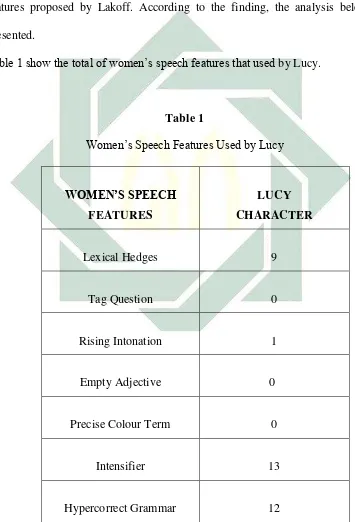
Table: 1
Present of Women’s Speech Features
WOMEN’S SPEECH FEATURES
LUCY CHARACTER
Lexical Hedges
Tag Question
Rising Intonation
Empty Adjective
Precise Colour Term
Intensifier
Hypercorrect Grammar
Superpolite Form
Avoidance of Strong Swear
Words
Emphatic Stress
CHAPTER 4
FINDINGS AND DISCUSSION
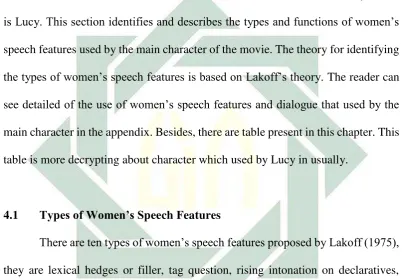
This chapter discusses about the analysis of the data which is shown in the
table. The data were taken from the utterances of the main character in Lucy movie is Lucy. This section identifies and describes the types and functions of women’s
speech features used by the main character of the movie. The theory for identifying
the types of women’s speech features is based on Lakoff’s theory. The reader can
see detailed of the use of women’s speech features and dialogue that used by the
main character in the appendix. Besides, there are table present in this chapter. This
table is more decrypting about character which used by Lucy in usually.
4.1 Types of Women’s Speech Features
There are ten types of women’s speech features proposed by Lakoff (1975),
they are lexical hedges or filler, tag question, rising intonation on declaratives,
empty adjectives, precise color term, intensifier, hypercorrect grammar, superpolite
forms, avoidance of strong swear words, and emphatic stress. Several examples of
each type of women’s speech features used by the main character in Lucy movie is
26
4.1.1 Lexical Hedges or Filler
Lakoff claimed that lexical hedges or filler is one of women’s speech
features. It expresses a lack of confidence and reflects of women’s insecurity. She
also said that women use hedging devices to express uncertainty. Lexical hedges
are shown by the use of well, you see, sort a/sort of, like, you know, kind a/kind of, I guess, I think, and it seems like. “Pause fillers” such as uh, um, and ah, also categorized as “hedges” because of their function is expressing uncertainty. This
feature is found in the main character of this movie as the example below:
Richard : Look, you can even see the reception from here. Come on. Lucy : What’s in the case?
Richard : I don’t know, it’s just some paperwork. Lucy : Yeah, welllet’s see it then.
Richard : It’s locked, and no one but Mr. Jang has the code. I’m just the delivery boy.
Based on the dialogue above, the situation is crowded, at the time Lucy and
Richard were standing in front of the hotel. They spoke something. There was
Richard get Lucy enter into hotel to give the case brought her to Mr. Jang. Every
time Lucy ask to Richard, Richard always pretend do not know what is in the case.
Lucy did not give up to ask what is in the case.
Lucy uses lexical hedges “well” when she wants to Richard to open the case
. She uses “well”to express her curious to case that Richard’s bring. Than, Richard
gives doubt respond to Lucy if He did not have code to open the case and just Mr.
Jang that has his code.
27
Lucy : Do you get paid to do this? Richard : Yeah, kind of.
Lucy : Like, how much?
Richard : Okay, we are negotiating now or…?
Lucy : No, no. How much do you get paid? I want to know, how much?
Richard : A thousand dollars.
The situation in the dialogue above is a little tighten. Lucy didn’t want to go
to the hotel, but Richard still forced Lucy. Than, Lucy asked to Richard, did he get
the money to sent the case?, After listen the Richard’s answered, Lucy wants to
know how much that He get paid with uses lexical hedges “Like”. Lucy uses word
“Like” to express the curiosity of her, because Lucy very suspicious with his job
and how much Richard got money from his job. Richard just laugh and did not
answer, He changed the subject and He wanted negotiating with Lucy. Richard
wanted Lucy that could help him. Lucy also uses lexical hedges or filler when She
talked to Richard as the example below.
Lucy : You get paid a thousand dollars for delivering paperwork, really?
Richard : I don’t know, it takes me ten minutes and they pay me a grand and the rest is none of my business.
Lucy : Well, it’s not my business either, I’ll tell you now.
Richard : Listen!
Lucy : What?
Richard : We split it down the middle, hm? That’s five hundred for you and five hundred for me.
Based on the dialogue above the situation is little tighten. Lucy looks
shocked when Lucy know if Richard gets paid a thousand dollars. Lucy do not
28
if this task very brief and furthermore did not my business. Than, Lucy uses lexical
hedges “Well” to response Richard’s statement, if it was also not her business.
Lucy went directly to leaved Richard but Richard grabbed Lucy’s hand to stopped
her and said to Lucy if He wants devide his payment, five hundred dollars for him
and five hundred dollar for Lucy. Lucy still uses lexical hedges in her dialogue
below.
Richard : Listen, it’s the third time this week I’m showing up at the same hotel with the same cowboy hat.
Lucy : Well…
Lucy : Problem solved. Go, go. I’ll wait for you, go. I’ll wait. Richard : Lucy, honey, I…I’ve done this a dozen times. It’s
paperwork. It’s probably some designs so they can copy them, that’s how it works in this country. Even my Stetson was made here, look.
The situation in the dioalogue above is started tense. Richard looked
nervous in front of the Lucy. Richard explained to Lucy why the reason He did not
delievery the case himself. Richard said it was not the first time He went to the same
hotel and it was impossible for him to come in the hotel used the same hat. Than,
Lucy uses lexical hedges “well” after listen the words of Richard. Lucy uses word
“well” to give a solution to Richard that there was no recognize of her. Lucy take
a hat on the Richard’s head then put the hat on her head. After that Lucy order
Richard to go to the hotel. But Richard still refused and He said that the works
sistem in this country like this. Besides, Lucy used pause filler in her utterance when
she talked to The Receptionist as the example below.
The Receptionist : Miss, may I help you?
29
The Receptionist : Yes. Um…
The situation in the dialogue above is silent and tighten when Lucy walks
nervously into the hotel lobby and walks over the reception. After arrived in front
of the reception, the receptionist ask to Lucy ‘what can the receptionist help to
Lucy?” and than Lucy uses filler “Uh” when She answer the reception’s question.
Lucy looked very nervous and repeatedly uses filler “Uh” to convince receptionist
if She really wants to meet with Mr. Jang. After hearing the Lucy’s answered, the
receptionist began to call Mr. Jang. Lucy uses pause or fillers when She talked to
the receptionist as the example below.
The Receptionist : What’s your name?
Lucy : No, Richard. Richard’s uh…he’s just looking for a place to
park.
The Receptionist : Mr. Jang still wants to know your name.
The situation on the dialogue above is begin to calm down when the
receptionist called Mr. Jang, and Mr. Jang wanted to know her name. Lucy shocked
when the receptionist ask her name, She began nervous to answer the reception’s
question. Lucy uses filler “Uh” when She answered the reception’s question. She
uses filler “Uh” to lost her nervousness and convince the receptionist if She had
come with Richard. Than, the Receptionist was calling Mr. Jang again, but Mr. Jang
still wanted to know her name. The receptionist asked to Lucy again to clarification,
what did She come alone or with Richard. Lucy also uses lexical hedges when she
30
Phone Voice Royal Suite : Can you describe the contents of the case?
Lucy : It’s…it’s four plastic pouches filled with a blue powder, like a…maybe a purple powder. I don’t
know, looks gross.
Phone Voice Royal Suite : Mr. Jang wants to offer you a job.
The situation in the dialogue above is very tighten because Lucy was afraid
because in the case is something dangerous. Lucy took a code that writen by Mr.
Jang nervously and carefuly when opened the case. After the case opened, Lucy
shocked with the contents of the case. She felt relieved after opened the case. Mr.
Jang told to translator and order to Lucy explained the contents of the case. Than,
translator told to Lucy that Mr. Jang want to know the content of the case. Lucy
uses lexical hedges “Like” when She explained all the contents of the case to Mr.
Jang. She uses word “Like” to mention the thing that the object in the case. After
hearing Lucy explanation, the translator said to Lucy if Mr. Jang to give her a job.
Lexical hedges used by Lucy in her utterance as presented below.
Lucy : Learning is always a painful process. Like when you’re little and your bones are growing and you ache all over. Do you believe I can remember the sound of my own bones growing? Like this grinding under the skin. Everything is different now, like sounds are music that I can understand. Like fluids.
Based on the dialogue above, the situation is silent when Lucy went to the
hotel to meet Mr. Jang. Lucy killed his guards that in the hotel. Than Lucy looked
Mr. Jang was getting a tatto with someone. Lucy opened the door and ask to her go
away. Suddenly, Lucy sticked two knives in Jang’s hands. After that, She talked to
31
about learning, where as a child, He felt the pain in the whole his body when his
bones growing. Lucy used lexical hedges in her utterance as below.
Lucy : It’s funny, I used to be so concerned with who I was and what I wanted to be and, now that I have access to the furthest reaches of my brain, I see things clearly and realize that what makes us, it’s primitive. They’re all obstacles. Does that make any sense? Like this pain you’re experiencing, it’s blocking you from understanding. All you know now is pain, that’s all you know, pain. Where are the others? The others carrying the drugs, I need the rest of it. For medicinal purposes.
Based on the dialogue above, the situation is silent and little tighten. At the
time, Mr. Jang felt a pain because the knives stick in his hands, He watched and
Listened to Lucy. Lucy talked to Mr. Jang used Lexical Hedges “See” because
Lucy has felt pain in her body. Than, Lucy asked to Mr. Jang ‘Did He ever felt pain
like what in her did?’. Lucy also want to know where He brought the rest of drugs,
because She needed to medicinal purposes. Mr. Jang just silent and did not talk.
4.1.2 Tag Question
Tag question is a syntactic device which may express uncertainty. Lakoff
said that tag question is usable under certain contextual situations: not those in
which a statement would be approppriate, nor those in which a yes-no question is
generally used, but in situations intermediate between these. Tag question is mostly
featured with the wosrd ..., isn’t it?, ..., do you?, and etc. In this movie, the
32
4.1.3 Rising Intonation
Rising Intonation is a peculiar sentence intonation pattern only among
women. It is not only has the form of declarative answer to a question, but also has
the rising inflection typical of a yes-no question and seems like being especially
hesitant. This make someone was seeking information and thought that the speaker
may has the requisite information. The writer find rising intonation in Lucy
utterance in the movie. Rising intonation used by Lucy as the example below.
Phone Voice Royal Suite : Mr. Jang wants to know what’s in the case? Lucy : No, I don’t know what’s in the case. Do you
speak English, or don’t you speak English? Phone Voice Royal Suite : Yes, I do. I studied one year in International High
School in New York.
Based on the dialogue above, the situation is little serious. At the time, Lucy
was sit on the chair with weep. Mr. Jang called the translator to help him talked to
Lucy. After that, the translator asked to Lucy about the case. Lucy used Rising
Intonation in her utterance “No, I don’t know what’s in the case. Do you speak,
English, or don’t you speak English?”. In this utterance she heightened the voice
to give a stressing toward the translator that He really can speak English. Then, the
translator response Lucy’s utterance, He explained that He can speak English
because He ever studied one year in International High School in New York.
4.1.4 Empty Adjective
33
adjective, which means that those only convey an emotional reaction rather than
specific information. It also called ‘empty’ because it is meaning less, can be
omitted or changed into another words. In this movie, the writer does not find empty
adjective which is used by the main character Lucy in the movie.
4.1.5 Precise Color Term
One of women’s speech features according Lakoff is precise color terms.
Lakoff gives the example of the lexical difference when women make more precise
in naming colors, like mauve, lavender, plum, magenta, aquamarine, ecru, and others. Discrimination of color is relevant for women, but not for men because
women are not expected to make decisions on important matters, such as what kind
of job to hold. In this movie, the writer does not find precise color term which is
used by the main character in the movie.
4.1.6 Intensifier
Intensifier such as so, really, just, quite and very are used by the main character in this movie. Intensifier are commonly used by women as her attempt to
show their strong feeling about something. Lakoff claimed that women use
intensifying devices to persuade their addressee to take them seriously.
Richard : Sweetheart, don’t get paranoid on me, alright? You trust me, don’t you?
34
The situation in the dialogue above between Richard and Lucy are not focus
because the hotel is very crowded. There were Lucy and Richard spoke something.
Richard said to Lucy that Lucy have to trust him. Lucy tried to remember again
about what She did with Richard last night. She got party and alcohol in the club.
Lucy used intensifier “Really” when she told to Richard about her feelings. Lucy
said to Richard that She love him, but on the other side Lucy also must be care and
paid attention to her own. Lucy used word “Really” to Richard convinced that
actually She very love him. Than, Lucy turned on her body and left him but Richard
grabbed her arm and said what would she did at home. Lucy also uses intensifier
when She talked to Richard. It shows as the example below.
Lucy : No, no. How much do you get paid? I want to know, how much? Richard : A thousand dollars.
Lucy : You get paid a thousand dollars for delivering paperwork, really? Richard : I don’t know, it takes me ten minutes and they pay me a grand and
the rest is none of my business.
Based on the dialogue above, the situation is suddenly tighten. When Lucy
asked to Richard, how much money that he got to this work. Richard answered that
he got a thousand dollars. Than, Lucy used intensifier “Really” when She asked
again to Richard. Lucy little bit unbelieve to Richard’s spoken. Lucy used word
“Really” to ask her doubt to Richard. After that, Richard received Lucy’s question
with answered that she did not know, Richard though the job and He got the money
when He did the job. Intensifier also used by Lucy in conversation. The utterance
35
Richard : Lucy, honey, I…I’ve done this a dozen times. It’s paperwork. It’s probably some designs so they can copy them, that’s how it works in this country. Even my Stetson was made here, look.
Richard : It says so on the label, “Made in Taiwan.” Lucy : So long, Cowboy, with the fake Stetson. Richard : Baby, please.
Based on the dialogue above, the situation is panic. When Richard took the
hat in Lucy’s head, He looked label of the hat. Lucy took again the hat and Lucy
wearing the hat to Richard’s head with used intensifier “So long”. Lucy uses word
“So long” to express her feeling so tired to Richard because of his utterances.
Afterwards, Lucy left Richard but Richard grabbed her hand to her stop. Richard
asked to Lucy that She can help her. Lucy also uses intensifier in her utterance to
the receptionist. The dialogue shows below.
The Receptionist : What’s your name?
Lucy : No, Richard. Richard’s uh…he’s just looking for a place to park.
The Receptionist : Mr. Jang still wants to know your name.
The situation in the dialogue above is little serious. At the time in the hotel
was not many visitors, there were just some people that out of the hotel. When Lucy
came to the receptionist and said that she wanted to meet with Mr. Jang. The
receptionist called to Mr. Jang directly. The other word the receptionist asked Lucy
about her name, unfortunately Lucy was not concentrate to receptionist because She
focus on Richard the receptionist question. Lucy said that Richard still looked for
the parked. Lucy used intensifier “Just” to convince to the receptionist if She comes
36
Jang again and said that Lucy saw Richard outside for waiting for Lucy. Lucy still
used intensifier when She talked to the receptionist as below.
The Receptionist : Lucy what?
Lucy : Ju…just Lucy. If he could…if he could be quick, cause I
have uh…I have…I have to… The Receptionist : Just a second, while I tell him.
In the dialogue above, the situation is very quiet and little tighten when the
receptionist asked Lucy’s full name. Lucy very shocked and nervous when She
answered the question from the receptionist. Lucy uses intensifier “Just” to
convince that the real name just Lucy. Lucy asked to the receptionist to tell Mr.
Jang in order to Mr. Jang come soon, because She did not have many time.
Afterward, the receptionist asked to Lucy to wait in minute, he will call Mr. Jang
to sent her message. Lucy uses intensifier in her utterance as below.
Lucy : Lucy. Yes, I’m Lucy. Please, there’s just been a terrible mistake. I’m just supposed to deliver this case. If you lost the key, you don’t have to chop off my hand, you can just cut the chain, okay?
Lucy : Please. I’m begging you, please.
Based on the dialogue above, the situation is frightening. In the situation
Lucy looked very afraid when Mr. Jang’s guard brought her to Mr. Jang. Lucy cried
in front of Mr Jang, She afraid that She got torment by Mr. Jang. Lucy uses
intensifier “Just” when She told to Mr. Jang. Lucy explains to Mr. Jang actually
this is a mistaken. She came here to give the case only. Mr. Jang only silent and
looked at the Lucy. Lucy felt very afraidto lost the keys because Mr. Jang cut her
37
Richard. After hearing Lucy’s utterances, Mr. Jang asked his guard to put Lucy
behind the table. Then, Mr. Jang took a telephone and called the translator. Mr. Jang
asked to translator that He must be translated what Lucy talked about. Lucy uses
two intensifiers in her conversation to the translator. It shows presented below.
Lucy : He gave me a paper with numbers on it. I don’t…what is this?
Phone Voice Royal Suite : It’s the code to open the case Lucy : What’s really in here? Phone Voice Royal Suite : Nothing dangerous.
Lucy : So why won’t he open it himself?
Phone Voice Royal Suite : He doesn’t trust Mr. Richard.
Based on the dialogue above, the situation is little tighten. Lucy cried and
told to translator explained to Mr. Jang with spanish language. Lucy told all the
case if Richard gave her case to give to Mr. Jang. After Mr. Jang knowing all, He
took a paper in front of her then wrote some number in the paper. Afterward, the
paper gived to Lucy. Lucy shocked and confused why Mr. Jang gave her a paper
that written the some number. Than, the translator said to Lucy, that the number is
coded to open the case. Lucy uses intensifier “ Really” when Lucy asked to
translator what the content of the case. The translator answered that in the case not
something dangerous. Lucy uses word “ Really” to convince that in the case not
something dangerous, but the translator remain the same answered, that is if in the
case was not something dangerous.
Lucy also uses intensifier “So” when the translator said if the content of the
case not dangerous. The word “So” used by Lucy to asked the translator why not
38
the translator answered that Mr. Jang never believe to Richard. Intensifier used by
Lucy as present below.
Lucy : Okay, okay. Keep calm. You just have to wait, just pray for time. You have time to think it through on the plane. Just take the flight. Take the fight and get out of here. Okay, that’s the main thing right now. Just save time. Don’t try anything. Keep your cool. You’re alive. You’re alive. You’re alive. That’s all that matters. Just…wait. Save time. Save time.
Based on the dialogue above, the situation is quiet and dibble. When Lucy
in custody with the situation her face covered by a black cloth. There Lucy spoke
herself, She only needs time to turn away from the custody. Lucy uses intensifier
“Just” to calm her heart. She sure will be alive when she did not anything and the
importance thing, She must keep calm to think of the way to get out of there. When
Lucy felt calm, suddenly the cover his face was opened by someone. Lucy found
herself in a room with two thugs, one of the thugs tried to worthless Lucy but Lucy
avoid from the thugs. After that, one of the thugs hit Lucy. Lucy also used intensifier
when She talked to her mother as dialogue below.
Lucy : I remember the taste of your milk in my mouth. The room, the liquid.
Lucy’s Mother : Sweetie, what are you talking about?
Lucy : I just want to tell you that I love you, mom, and dad.
Lucy’s Mother : Sweetie.
Lucy : And I want to thank you for the thousand kisses that I can still feel on my face. I love you, Mom.
Lucy’s Mother : I love you too, sweetie. More than anything in the world.
Based on the dialogue above, the situation is affectionate. At the time, Lucy
39
stomach. In the aware condition, Lucy took her phone and she was calling her
mother. Lucy talked to her mother that she felt everything. Space, air, vibration, the
people and she still remember warmth that gave her mother. Than, her mother called
Lucy with named “sweetie”, her mother confused what is Lucy was talking about
and why suddenly Lucy said like that with her. Lucy answered mother’s confusion
with uses intensifier “ Just”.
Lucy uses word “Just” to explain and convince to her mother that she very
love her mother and father. Lucy also said thank you that her affection that during
still save in her heart. After hearing Lucy’s explained, her mother said she also very
love with Lucy more than anymore. Intensifier used by Lucy to Prof. Norman
presented below.
Lucy : Professor Norman, my name is Lucy. I just read all your research on the human brain. We need to meet.
Professor Norman : All of my research? Well, I’m very flattered, young lady, but I find that hard to believe. I must have written no less than…
Based on the dialogue above, the situation is little serious. At the time, Lucy
in front of her notebook. She was searching article about brain capacity. Lucy found
some research article from Prof. Norman. Lucy read all research from Prof. Norman
in a few minute. After read all, Lucy called prof. Norman to ask his research. Lucy
introduced herself to Prof. Norman and Lucy uses intensifier “Just” when she
explained to Prof. Norman if she has found his research and read all his research
about human brain. After hearing Lucy’s explain, Prof. Norman just laughs and did
40
interested in his research about human brain capacity and she wanted to meet him,
but Prof. Norman still hesitant and felt unbelieve, if that Lucy have read all his
reserch. The example of intensifier used by Lucy when She talked to Prof. Norman.
The dialogue shows below.
Professor Norman : Are you one of Emily’s friends? This sounds like one of her silly jokes. Is she there with you?
Lucy : No, I’m on my own. Professor Norman : Who are you? Lucy : I just told you.
Professor Norman : Uh…Lucy, right? Yes. Sorry.
Based on the dialogue above, the situation is seriously. At the time, Prof.
Norman still hesitant and still did not trust Lucy’s words because Prof. Norman
thougt that Lucy impossible to read all his research until detail and knowing page
total hiss research. Than, Prof. Norman supposed to Lucy is one of Emily’s friends.
Suddenly, Lucy sit in her apartement seen in screen TV, and Prof. Norman shocked,
why she suddenly appear in his TV. Prof. Norman very anxious, than He asked to
Lucy directly, “who is she actually?”. Lucy answered the question of Prof. Norman
uses intensifier “Just” to explain and convince to Prof. Norman if She did not mean
anything, She really wanted to talk to Prof. Norman about his research, and than
Prof. Norman was responding to the Lucy’s said with relax and she also asked
apologize to Lucy because she did not believe her. Lucy still uses intensifier in her
dialogue with Prof. Norman as presented below.
41
Lucy : Yes, and I can start to control other peoples’ bodies. Also, I can control magnetic and electric waves. Not all of them,
just the most basic. Television. Lucy : Telephone.
Lucy : Radio.
Professor Norman : That’s amazing.
The situation in the dialogue above is quiet and little serious when Prof.
Norman stared at Lucy on the TV monitor. At the time, Prof. Norman asked to Lucy
about “How can control her metabolism?”. Lucy answered uses intensifier “Just”
to convince Prof. Norman that She can control her metabolism in the most basic
thing, that is appeared on Television, Telephone, and Radio. After knowing that
She could be appeared anywhere, Prof. Norman shocked and felt that what He saw
was very amazing for him.
4.1.7 Hypercorrect Grammar
Hypercorrect grammar is the consistent use of standard verb sound. Women
tend to use hypercorrect grammar than men. It involves avoidance of coarse
language. The writer found some hypercorrect grammar which are used by Lucy.
The examples presented below.
Richard : I’m so sorry, I really need your help. Lucy : No. Stop it! Take this off me, right now! Richard : I can’t.
Lucy : Take this off me, right now!
Richard : I can’t, Mr. Jang’s the only one who has the key. All you have to do is go into the hotel and ask for him at the reception.