• Tidak ada hasil yang ditemukan

GREEN CHEMISTRY APPLICATION FOR THE SYNTHESIS OF (1)-N-4’-METHOXYBENZYL-1,10-PHENANTHROLINIUM BROMIDE | Firdaus | Indonesian Journal of Chemistry 21611 40697 1 PB

N/A
N/A
Protected

Academic year: 2017

Membagikan "GREEN CHEMISTRY APPLICATION FOR THE SYNTHESIS OF (1)-N-4’-METHOXYBENZYL-1,10-PHENANTHROLINIUM BROMIDE | Firdaus | Indonesian Journal of Chemistry 21611 40697 1 PB"

Copied!
3
0
0

Teks penuh

(1)

Indo. J. Chem., 2008, 8 (3), 423 - 425

Maulidan Firdauset al.

423

* Corresponding author.

Email address : [email protected]

GREEN CHEMISTRY APPLICATION FOR THE SYNTHESIS OF

(1)-

N

-4’-METHOXYBENZYL-1,10-PHENANTHROLINIUM BROMIDE

Maulidan Firdaus

1*

, Jumina

2

, and Chairil Anwar

2 1

Department of Chemistry, Faculty of Mathematics and Natural Sciences, Sebelas Maret University, Jl. Ir Sutami 36A Surakarta 2

Department of Chemistry, Faculty of Mathematics and Natural Sciences, Gadjah Mada University, Sekip Utara kotak pos BLS 21, Jogjakarta

Received 16 June 2008; Accepted 19 September 2008

ABSTRACT

A simple, energy–efficient, and relatively quick synthetic procedure for the synthesis of (1)–N–4’– methoxybenzyl–1,10-phenanthrolinium bromide, based on green chemistry principles has been carried out. The synthesis was started by solvent-free reduction of p-anisaldehyde with NaBH4 to give 4-methoxybenzyl alcohol in 98% yield to be followed by solvent-free treatment of the resulted alcohol with PBr3 to yield 4-methoxybenzyl bromide (86%). Furthermore, the obtained bromide was reacted with 1,10-phenanthroline in acetone at reflux for 12 h to give the phenanthrolinium salt target in 68% yield.

Keywords: green chemistry, p-anisaldehyde, (1)–N–4’–methoxybenzyl–1,10–phenanthrolinium bromide

INTRODUCTION

Sustainability is increasingly an important issue in the wider context dealing with population, health, environment, energy, technology, renewable resources, and the sciences, as an integral part of the rapidly emerging field called green chemistry [1]. Green chemistry finds increasing attention to make important contributions to the conservation of resources by development of more effective and environmentally benign chemical processes [2].

New synthetic methods must include environmental and ecological point of views. Many organic solvents are ecologically harmful. Therefore, it has become primordial to decrease the amount of solvents in the reaction media. The best solvent from ecological point of view is without a doubt no solvent [3]. Demonstrating solvent-free reactions as a way of minimizing waste and energy usage are both integral aspect of the principle of green chemistry. By adopting the principles of green chemistry, benign synthesis of antimalaria from 1,10-phenanthroline derivative was performed in this research.

Many researches in the synthesis of new antimalarial compounds have been conducted in order to address the problem of drug-resistant. One of them is 1,10-phenanthroline derivatives. Previous study on both in vitro and in vivo antiplasmodial activity of diaza phenantrene analogues indicated that 1,10-phenanthroline skeleton represented potential antimalarial lead compounds [4,5,6].

Unfortunately, all of antimalarial compound obtained from 1,10-phenanthroline derivatives reported in scientific publication were not synthesized using environmentally benign procedure. The synthesis of antimalaria (1)–N

–4’–methoxybenzyl–1,10-phenanthro-linium bromide (5) from 1,10-phenanthroline (4) and p -anisaldehyde (1) as starting material has been reported [7]. The methods used to synthesize the compound were not “green”. Some used organic solvents, created excess waste, and consumed relatively huge energy. Therefore, there is an urgent need to develop antimalaria (5) from (1) as the starting material based on green chemistry principles. Part of the synthetic route used in this research was solvent-free reaction.

EXPERIMENTAL SECTION

General

Most of organic compounds utilized in this research were commercial products of high purity purchased from Merck in exception for PBr3 (purchased from UGM Organic Chemistry Laboratory) and used as such without any further purification. Melting point was determined on a electrothermal 9100 melting point apparatus and are not corrected. Infrared spectra were obtained on a Shimadzhu FTIR-8201 PC spectrometer. 1

H NMR were recorded at 60 MHz with a Jeol JNM-MY or at 500 MHz with a Jeol JNM-ECA spectrometer using TMS as an internal reference. Mass spectra were measured on a Shimadzhu QP-5000 GCMS spectrometer.

Solvent-free reduction of p-anisaldehyde (1)

(2)

Indo. J. Chem., 2008, 8 (3), 423 - 425

NaHCO3. The mixture was then extracted with 2 x 10 mL of dichloromethane. The organic layer was dried with Na2SO4 anhydrous to be followed with evaporation of the solvent to give (2). FTIR (neat) max: 3348 (OH), 3001,

Solvent-free synthesis of 4-methoxybenzyl bromide (3)

This procedure was adopted from literature [9] with a slight modification. Compound (2) (0.01 mol) was

Synthesis of (1)–N –4’–methoxybenzyl–1,10-phenanthrolinium bromide (5)

This reaction was performed according to the method as previously reported [5]. Compound (4) (1 mmol) and (3) (1 mmol), and 15 mL acetone were added to a 50 mL round bottom flask. The mixture was refluxed for 12 h and cooled to room temperature. The precipitate was then washed with acetone to yield (5). m. p. 197 –

Antimalaria (5) can be synthesized from (1) through three steps reaction. Step one was done by solvent-free reduction of (1) using NaBH4. The second step was achieved by solvent-free bromination of the alcohol (2) obtained from step one. Finally, the resulted bromide (3) was then treated with 1,10-phenanthroline (4) to give the target compound (5) (Scheme 1).

In exception for step three, these synthetic procedures demonstrate an environmentally benign

Scheme 1

synthetic methodology with respect to green chemistry principles. The solvent-free method is indeed providing an improvement in the efficiency of resource utilization, reducing solvent waste and energy usage, accelerating reaction time, and enlarging reaction yield. p -Anisaldehyde itself was chosen as starting material since this compound is a renewable raw material. It can be obtained by permanganate oxidation of anethole [10], the major constituent of anise oil (ca. 60 – 80%).

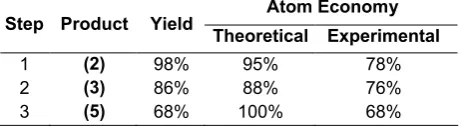
In this context then the question is how ‘green’ is the procedure? Atom economy of the reaction is one of the measures to answer this question. In principle, a reaction with higher atom economy is preferable to one with lower atom economy, because higher atom economy means less waste produced for a given amount of product produced [11]. Atom economy can be calculated from actual laboratory data or it can be a theoretical prediction. The atom economy and yield of the reaction from step one to step three is compiled in Table 1. The theoretical atom economies of the reactions are relatively high. This means that the reactions are less waste and preferable to be carried out in the green chemistry principles.

The experimental atom economy of each steps of the reaction is relatively high. In exception for step three, the atom economy is not as high as its atom economy prediction. This indicated that the formation of phenanthrolinium salt did not occur easily. Both of the reactants involved in the reaction are bulky substituents. Therefore, the nucleophile (4) is not easy to attack the electrophile (3) to yield the expected product (5). Thus, beside theoretical atom economy, synthetic procedures must consider the selectivity of the reactants.

(3)

Indo. J. Chem., 2008, 8 (3), xx - xx

Maulidan Firdauset al.

425

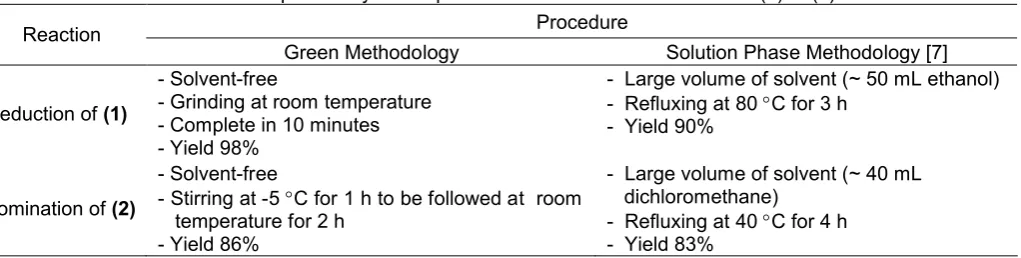
Table 2. Comparison synthetic procedures for the transformation of (1) to (3) Procedure

Reaction

Green Methodology Solution Phase Methodology [7]

Reduction of (1)

- Solvent-free

- Grinding at room temperature - Complete in 10 minutes - Yield 98%

- Large volume of solvent (~ 50 mL ethanol) - Refluxing at 80 C for 3 h

- Yield 90%

Bromination of (2)

- Solvent-free

- Stirring at -5 C for 1 h to be followed at room temperature for 2 h

- Yield 86%

- Large volume of solvent (~ 40 mL dichloromethane)

- Refluxing at 40 C for 4 h - Yield 83%

to (3) in solution phase methodology involved large volume of solvent, consumed more energy, and needed long reaction time.

CONCLUSION

By demonstrating the principles of green chemistry, (1)–N–4’–methoxy benzyl–1,10-phenanthrolinium bromide has been synthesized from p-anisaldehyde through three steps reaction. First, solvent-free reduction of p-anisaldehyde with NaBH4 to be followed by solvent-free treatment of the resulted alcohol with PBr3. Finally, the obtained bromide was reacted with 1,10-phenanthroline to give the phenanthrolinium salt target. Solvent-free reduction and bromination reactions represent a viable alternative to traditional solution phase methodology.

ACKNOWLEDGEMENT

The financial support from Indonesian Directorate General of Higher Education in the form of BPPS fellowship is greatly appreciated.

REFERENCES

1. Anastas, P. T., and Warner, J. C., 1998, Green Chemistry: Theory and Practice, Oxford University Press, Oxford.

2. Metzger, J. O. and Eissen, M., 2004, C. R. Chimie, 7, 1 – 13.

3. Metzger, J. O., 1998, Angew. Chem. Int. Ed., 37 (21), 2975 – 2978.

4. Yapi, A. D., Mustofa, M., Valentin, A., Chavignon, O., Teulade, J. C., Mallie, M., Chapat, J., and Blace, Y., 2000, Chem. Pharm. Bull., 48 (12), 1886 – 1889.

5. Yapi, A. D., Valentin, A., Chezal, J. M., Chavignon, O., Chaillot, B., Gerhardt, R., Teulade, J. C., and Blace, Y., 2006, Arch. Pharm. Chem. Life Sci., 339, 201 – 206.

6. Wijayanti, M. A., Sholikhah, E. N., Tahir, I., Hadanu, R., Jumina, Supargiyono, and Mustofa, 2006, J. Health Sci., 52(6), 794 – 799.

7. Hadanu, R., Matsjeh, S., Jumina, Mustofa, Wijayanti, M.A., and Sholikhah, E.W., 2007, Synthesis and Test Antiplasmodial Activitiest of (1)–N–4’–Methoxybenzyl–1,10–phenanthrolinium bromide Compound, 1st International Conference on Chemical Sciences proceeding, Jogjakarta. 8. Cho, B. T., Kang, S. K., Kim, M. S., Ryu, S. R., and

An, D. K., 2006, Tetrahedron, 62, 8164 – 8168. 9. Bush, H. J. S., 2003, The Preparation of

1,3,6,8-Tetraene Systems for Use as Intramolecular Diels-Alder Substrates in Desymmetrization Reactions, Ph.D. Thesis, University of Southampton, Southampton.

10. Kusumaningsih, T., Sastrohamidjojo, H., and Soelistyowati, R. D., 2000, Teknosains, 13 (2), 247 – 261.

Gambar

Table 1. Atom economy and yield of each step for the synthesis of (5)Atom Economy
Table 2. Comparison synthetic procedures for the transformation of (1) to (3)

Referensi

Dokumen terkait

Pb-IIP was synthesized through 4 reaction stages (Scheme 1), namely: 1) grafting of chloroacetic on chitosan (CMC), 2) adsorption of Pb(II) ion on CMC (CMC-Pb), 3) Cross-linking

The aim of this study was to develop a synthesis method of low-grade natural zeolite with high impurities to produce synthesized zeolites NaA via alkaline fusion hydrothermal

However, microwave heating the urea solution without ascorbic did not resulted in the formation of C-dot thus it can be concluded that the main precursor in this synthesis is

The synthesis of dibenzylidenecyclohexanone derivatives via environmentally friendly Microwave Assisted Organic Synthesis (MAOS) crossed aldol condensation had been carried out..

The optimum synthesis conditions of carboxymethyl chitosan obtained in this study are the use of temperature reaction at 60 °C and 40% (w/v) NaOH concentration for alkalizing

Percentage of CDHHK4R resulted from synthesis in various reaction time (a) and power of microwave oven (b).. 20.0-50.0 ppm with aliphatic carbon binds oxygen signal appeared

A new type of sensing materials for humidity measurement has been developed based on conducting polymer polypyrrole synthesised from pyrrole by adding some dopant compounds, bromide

Untuk mengarahkan produk reaksi kepada satu macam konformer maka metode tersebut perlu dilakukan modifikasi, salah satu yang telah dilakukan adalah dengan menggunakan pengalkilasi