SYNTHESIS AND ANTIPLASMODIAL ACTIVITY
TESTING
OF
(1)-
N
-(4-METHOXYBENZYL)-1,10-PHENANTHROLINIUM BROMIDE
Ruslin Hadanu1,*, Sabirin Mastjeh2, Jumina2, Mustofa3, Mahardika Agus Widjayanti3 and Eti Nurwening Sholikhah3
1
Department of Chemistry, Pattimura University, Ambon, Indonesia. 2
Laboratorium of Organic Chemistry, Department of Chemistry, Universitas Gadjah Mada, Yogyakarta, Indonesia 55281. 3
Medical Faculty, Universitas Gadjah Mada, Yogyakarta, Indonesia 55281.
Received 7 April 2007; Accepted 25 May 2007
ABSTRACT
Synthesis of (1)-N-(4-methoxybenzyl)-1,10-phenanthroline bromide from 1,10-phenanthroline monohydrate and 4-methoxybenzaldehyde as starting material and evaluation of its antiplasmodial activities have been carried out.
The 4-methoxybenzyl alcohol was prepared from 4-methoxy-benzaldehyde using sodium borohydride (NaBH4)
reagent and ethanol absolute solution. The mixture was refluxed for 3 h. To yield colorless dilution compound with
90.41 % in efficiency. Furthermore, bromination of 4-methoxybenzyl alcohol with phosphorus bromide (PBr3) was
conducted by refluxing for 3 h. The product of this reaction was yellow liquid of 4-methoxybenzyl bromide, 79.03% yield and 95.34 % purity. The final step of reaction was benzylation of 1,10-phenanthroline monohydrate with
4-methoxybenzyl bromide reagent. It was conducted by refluxing in aceton for 8 h at 55 oC. The yield of the reaction
was (1)-N-(4-methoxybenzyl)-1,10-phenanthroline bromide (77.63%). It is pink solid form, and its melting point is
192-193 oC. Identification of the product was carried out by means of GC-MS, IR and 1H-NMR spectrometers. The in
vitro antiplasmodial activity on chloroquine-resistant Plasmodium falciparum FCR-3 strain and chloroquine sensitive P. falciparum D10 strain for (1)-N-(4-methoxybenzyl)-1,10-phenanthroline bromide were determined by microscopic
method. The result showed that after 72 h incubation, it has IC50 0.93±0.02 µM and 1.21±0.09 µM, respectively.
Keywords: 1,10-phenanthroline, (1)-N-(4-methoxybenzyl)-1,10-phenanthroline bromide, 4 methoxybenzaldehyde, antiplasmodial activities
INTRODUCTION
Malaria, a tropical disease caused by protozoan
parasites of the genus Plasmodium, has been a real
concern for centuries and is now extended to more than 40% of the world’s population. Plasmodium falciparum, the most prevalent species across the globe, may cause cerebral malaria that is often fatal [1]. Word Health Organization (WHO) estimated that, in 2006, there were 300-500 million cases of malaria and more than 1.5-2.7 million deaths due to it. Furthermore, international travel becomes more common. For this reason, malaria is not confined to the tropical zones of the world, and imported malaria is an increasingly serious problem.
Chemotherapy remains as one of the most rational measures to control the intolerable burden of malaria as antimalarial vaccine is not yet available. Beside it is proven that the vector control measures are very difficult to sustain in most endemic setting. However, the rapid spread of the malarial parasite resistance to the antimalarial drug mainstay, chloroquine (CQ) and sulfadoxine-phyremethamine, within the last few decades alerted to the efforts to develop alternative antimalarial drugs. Chloroquine is a 4-aminoquionoline derivative antimalarial drug that was introduced near the
end of World War II, and remains as chosen the drug for vivax malaria in many parts of the world. Its therapeutic efficacy and safety, wide distribution, ready availability and relatively low price quickly proved this drug to be one of the most successful and important drugs ever deployed against an infectious disease. Its heavy use in subsequent decades has however led to CQ resistance in P. falciparum at the end of 1950s and has spread rapidly throughout the world afterwards [2].
The halofantrine as new antimalarial has good therapeutic effects [3]. Halofantrine is more active against strains of P. falciparum that are resistant to
chloroquine, pyrimethamine, and quine [4]. However,
halofantrine is known to have some unwanted side effects, such as abdominal pain, nausea, vomiting, diarrhea, orthostatic, hypertension, prolongation of QTc intervals, pruritus, rash [5] and hepatotoxic [6]. The 1,10-phenanthroline derivatives are similar to halofantrine as antimalarial drug which its added at heterocyclic with two nitrogen atoms. In 2000, Yapi reported that the 1,10-phenanthroline ring system appeared as a new class of potential antimalarial compound [7]. Now, as part of our research concerning the synthesis and biological activities of 1,10-phenanthroline derivatives. Mustofa was synthesized * Corresponding author. Tel/Fax : 081578876567/085228447288
Email address : [email protected]
thirteen derivatives of 1,10-phenanthroline and evaluated their in vitro antiplasmodial activities and Quantitative Structure-Activity Relationship (QSAR) [8]. Based on the QSAR model of the 1,10-phenanthroline
derivatives, 12 new compound of N-alkyl-and N-benzyl
1,10-phenanthroline derivatives were synthesized and
were evaluated for their in vitro and in vivo
antiplasmodial activity [9-17]. This study was conducted to synthesize a new derivate of N-benzyl-1,10-phenanthroline i.e. (1)-N-(4-methoxybenzyl)-1,10-phenanthrolinium bromide and to evaluate its in vitro antiplasmodial activity.
EXPERIMENTAL SECTION
In general, the melting points of compound were determined on melting point electro thermal 9100 and are not corrected. The spectrum of structures compound measurements was taken using the following instruments: FTIR spectrums were taken on Shimadzu
FTIR-8201 PC; 1H-NMR spectrums were obtained on
JEOL 60 MHz and JEOL 500 MHz. MS spectrum was recorded on GC-MS Shimadzu QP 5000.
Synthesis of 4-methoxybenzyl alcohol (2)
OCH3
OH
A A
B B
A mixture of powdered sodium borohydride (4.52 g, 0.12 mol) and ethanol absolute (60 mL) was stirred at room temperature for 20 min, then
4-methoxybenzaldehyde (1) (5.44g, 0.04 mol) was added,
and the mixture was refluxed for another 3 hours. The result of reaction was evaporated to remove ethanol, and the mixture was diluted with water (50 mL), neutraled with HCl 11%. The mixture was extracted with ethyl acetate (3x25 mL), and the combined organic layers were washed with water. After it was washed with water, the mixture was dried over sodium sulfate anhydrous and evaporated to get colorless oil (4.49 g, 90.41%). Found:
FT-IR (net): 3348.2 cm-1, 3001.0 cm-1, 2935.5 cm-1,
2873.7 cm-1, 1612.6 cm-1, 1585.4 cm-1, 1512.1 cm-1,
1461.9 cm-1, 1450.0 cm-1, 1373.2 cm-1, 1176.5 cm-1,
1110.9 cm-1, and 817.8 cm-1. 1H-NMR (CDCl3; 60 MHz)
δ
: 7.3-7.0 (2H, d, HA), 6.9-6.7 (2H, d, HB), 4.2 (2H, s,H
B
CH2), 4.0 (1H, s, HOH), and 3.7 (3H, s, HCH3).
Synthesis of phosporus tribromide as reagent
A powdered of phosphorus red (18.6 g, 0.60 mol) in carbon tetrachloride (135 mL) was stirred in room temperature for 1h. The liquid of bromine (132.24 g, 0.83 mol) was dropped slowly and stirred continuously for
another 1 h. The mixture was refluxed 1h, then the result of reaction was distillated to give two fractions i.e.
carbon tetrachloride as solvent (bp 71-72 oC) and
phosphorus tribromide as product of reaction (bp
172-173 oC, bp theoretical 175 oC).
Synthesis of 4-methoxybenzyl bromide (3)
OCH3
Br
A4-methoxybenzyl alcohol (2) (2.47 g, 0.018 mol)
was added into a solvent carbon tetrachloride (40 mL). The mixture was stirred at room temperature, and then
phosphorus tribromide (4.8 mL PBr3 in 5.2 mL of
carbon tetrachloride) was added slowly into a mixture, drop by drop. The mixture was continuously stirred to be continue at room temperature for 30 min, then at
50-60 oC for another 2 h. The result of reaction was diluted
with solution of sodium bicarbonate (5%, 2x20 mL) and then washed with water (2x30 mL). The combinating of organic layers was dried over sodium sulfate anhydrous and evaporated to get yellow oil (2.98g, 79.13%).
Found: FT-IR (net): 3004.9 cm-1, 2935.5 cm-1, 2835.2
cm-1, 1608.5 cm-1, 1512.1 cm-1, 1461.9 cm-1, 1370.0
cm-1, 1253.6 cm-1, 1176.5 cm-1, 1099.5 cm-1, 1033.8
cm-1, 833.2 cm-1, and 759.9 cm-1. GC-MS (purity
95.34%)(relative intensity) m/z:202 [M+]; 202, 122, 121
(base peak), 106, 91, 78 and 51.
Synthesis of (1)-N
-(4-methoxybenzyl)-1,10-phenanthrolinium bromide (5)
Br A
B
C D
E F G H
N N H3CO
A solution of 1,10-phenanthroline (4) (0.39 g,
0.002 mol) and 4-methoxybenzyl bromide (3) (1.0 g,
0.005 mol) in acetone (25 mL) was refluxed for 8 hours. The mixture of result reaction was cooled. The precipitate which formed was filtered, and washed with
acetone. Yield: FT-IR (KBr): 3340.5 cm-1, 3028.0 cm-1,
2993.3 cm-1, 1596.9 cm-1, 1542,9 cm-1, 1469.7 cm-1,
1454.2 cm-1, 1364.0 cm-1, 1226.2 cm-1, 1033.8 cm-1,
883.5 cm-1, 848.6 cm-1, 717.3 cm-1, and 621.0 cm-1. 1
H-NMR (DMSO-d6; 500 MHz)
δ
: 9.18-9.11 (1H, s, HA),8.93-8.92 (1H, s, HC), 8.66-8.61 (1H, s, HH), 8.24-8.23
(1H, s, HB);B 8.05-8.03 (1H, d, HF), 7.98 (1H, m, HE&D),
7.00 (2H, s, HCH2), 6.90-6.82 (4H, m, Hph), 4.41-4.36
(Hhidrogen bonding) and. 3.31 (3H, s, HCH3).
BIOLOGICAL ACTIVITY
Parasites were cultured according to the method described by Trager and Jensen [18] and modified by
Benoit [19]. FCR-3 was considered as a chloroquino
resistant strain and D10 was considered as a chloroquine sensitive strain. The culture medium was replaced daily and the cultures were synchronized by 5% D-Sorbitol lysis before using (Merk, Darmstadt, Germany). The method used for in vitro antimalarial activity testing was adapted from microscopic method. The molecules were tested 3 times in triplicate in 96-well plates (Nunc, Denmark) with plasmodium at ring stage at 2% parasitemia, 3% hematocrit. For each test, the parasite cultures were incubated with molecul tested at various concentrations for 72 h. Parasite growth was estimated by painting with Giemsa (5%) for 30 seconds. The parasite control in the presence without molecul testes was referred to as 100% growth. The
concentrations inhibiting 50% of the parasite (IC50) were
determined by SPPS 13.0 software. The IC50 was used
to discribe antiplasmodial activity of the molecul tested.
RESULT AND DISCUSSION
The synthesis of the 1,10-phenanthroline derivatives can be conducted from 8-aminoquinoline and 1,10-phenanthroline as starting materials. In this study, we focused on synthesis 1,10-phenanthroline derivatives from 1,10-phenanthroline and 4-methoxy-benzaldehide as starting materials. There are three steps of the reactions for synthesis (1)-N-(4-methoxybenzyl)-1,10-phenanthrolinium bromide compound. The first step of reaction was reduction of 4-methoxybenzaldehyde to get colorless oil (4-methoxybenzyl alcohol) with 90.41% in efficiency. The second step of process was bromination of 4-methoxybenzyl alcohol with phosphorus tribromide to get yellow oil of 4-methoxybenzyl bromide, 79.03% yield and 95.34% purity. Steps of synthesis mentioned above represented the process of reagen alkylation and
then reacted with 1,10-phenanthroline monohydrate (4).
The final step reaction was N-benzylation of 1,10-phenanthroline monohydrate with 4-methoxybenzyl
bromide (3) reagent to yield:
(1)-N-(4-methoxybenzyl)-1,10-phenanthroline bromide (77.63%), pink solid form,
melting point 192-193oC, and the scheme reaction is
shown in Fig 1.
OCH3
O H
NaBH4
ethanol
OCH3
OH PBr3
OCH3
Br
CCl4
N N
acetone
N N H3CO
Br
(1) (2)
(3) (4) (5)
Fig 1. Schema reaction of synthesis
(1)-N-(4-methoxybenzyl)-1,10-phenanthrolinium bromide compound
Br N N H3CO
Fig 2. FTIR spectrum of (1)-N-(4-methoxybenzyl) 1,10-phenanthrolinium bromide
Structural determination of (1)-N-(4-methoxybenzyl)-1,10-phenanthrolinium bromide was
made on the basis of FTIR and 1H-NMR studies. The
FTIR spectrum showed pick in 3340.5 cm-1 indicated
the product of reaction has hidrogen bonding, and FTIR spectrum is shown in Fig 2.
The product of N-benzylation reaction was
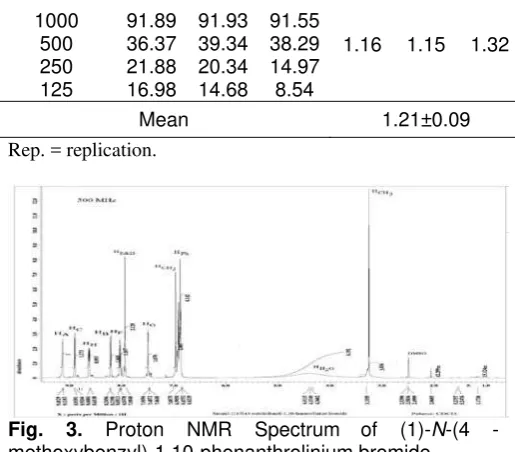
characterized by 1H-NMR. In the 1H-NMR spectrum of
(1)-N-(4-methoxybenzyl)-1,10-phenanthrolinium brom-ide as product showed eleven proton species. The
chemical shift (
δ
) at 4.41-4.36 ppm indicated hidrogenbonding between
(1)-N-(4-methoxybenzyl)-1,10-phenanthrolinium bromide and H2O, and it agrees with
infrared spectrum. The specific spectra showed at
δ
7.00 ppm with singlet splitting indicated proton of pick
from methylene (-CH2-). The complete result showed in
Fig. 3 and Table 1.
Based on infrared spectrum and 1H-NMR
spectrum, the product of N-benzylation reaction was indicated of
(1)-N-(4-methoxybenzyl)-1,10-phenanthrolinium bromide (5) compound.
Table 1. List of chemical shift of 1H-NMR spectrum from experiment and Chem Office Software
Experiment Data Chem Office Data
Proto
Splitting
δ
(ppm
1 singlet 8.81 blue=goo
d
1 singlet 8.00 blue=goo
d
1 singlet 7.26 blue=goo
d
Table 2. Parasite Growth Inhibition and IC50 of
(1)-N-(4-methoxybenzyl)-1,10-phenanthrolinium bromide on FCR-3 strain
Inhibition (%) IC50 (µM)
Mean 0.82±0.01
Rep. = replication.
Table 3. Parasite Growth Inhibition and IC50 of
(1)-N-(4-methoxybenzyl)-1,10-phenanthrolinium bromide on D10 strain
Mean 1.21±0.09
Rep. = replication.
Fig. 3. Proton NMR Spectrum of (1)N(4
-methoxybenzyl)-1,10-phenanthrolinium bromide
The result of investigation antiplasmodial activities using chloroquine-resistant FCR-3 strain is summarized in Table 2. Whereas, the result of evaluation antiplasmodial activities using chloroquine-sensitive D10 strain is summarized in Table 3.
Sholikhah [17] reported the activities of 8 new compounds of N-alkyl and N-benzyl-1,10-phenanthrolinium derivatives: 1) (1)-N-methyl-1,10-pe-nanthrolinium sulfate, 2) (1)-N-ethyl-1,10-penanthro-linium sulfate, 3) (1)-N-t-buthyl-1,10-penanthro(1)-N-ethyl-1,10-penanthro-linium chloride, 4) (1)-N-benzyl-1,10-penanthrolinium chloride, 5) N-benzyl-1,10-penanthrolinium bromide, 6) (1)-N-benzyl-1,10-penanthrolinium iodide, 7) (1)-N-(4-methoxybenzyl-1,10-penanthrolinium chloride, and 8) (1)-N-(4-benzyloxy-3-methoxybenzyl-1,10-penanthroli-nium chloride compounds. Of the 8 compounds tested,
the compounds (5) and (6) had the highest activity
(IC50=0.10-0.13µM and 0.18-0.23 µM, respectively),
against FCR-3 strain. Compound (6) had the highest
activity (IC50=0.33-0.34µM) on D10 strain P. falciparum.
This treatment with (1)-N-(4-methoxybenzyl)-1,10-phenanthrolinium bromide compound significantly inhibited parasitemia of P. falciparum FCR-3 strain and D10 strain. Although the suppression of parasitemias was never complete (100% inhibition of parasite growth), the results indicate antiplasmodial potential,
but it had lower activity compared to (5) and (6)
compound. The (1)-N-(4-methoxybenzyl)-1,10-phenanthrolinium bromide had higher activity than compound (1)-N-t-buthyl-1,10-penanthrolinium chloride (1.84-7.15µM) and (1)-N-(4-benzyloxy-3-methoxybenzyl-1,10-penanthrolinium chloride (1.08-2.19µM).
CONCLUSION
The (1)-N-(4-methoxybenzyl)-1,10-phenanthroli-nium bromide was synthesized, characterized, and evaluated of in vitro antiplasmodial activity. Three steps of synthesis are reduction, bromination and N-alkylation and the yields: pink solid form (77.63%), melting point
192-193 oC. Results of in vitro antiplasmodial activity on
chloroquine-resistant Plasmodium falciparum FCR-3
strain and chloroquine sensitive P. falciparum D10 strain were determined by microscopic method after 72 h
incubation have IC50 0.93 ± 0.02µM and 1.21 ± 0.09 µM,
respectively.
ACKNOWLEDGEMENT
The study was funded by Postgraduate Research Grant from Minister of National Education, Indonesian Goverment. We thank also to PT. Konimex Indonesia for providing the chloroquine diposphate used in the test.
REFFERENCES
1. Robbert, A., Vical, F.A., Cabaret, O.D., and Meunier, B., 2001, Pure Appl. Chem., 73, (7): 1173-118. 2. Baird, J.K., Widay, I., Fryauff, D.J., Sutanihardja,
M.A., Leksana, B., Widjaya, H., Kysdarmanto, and Subianto, B., 1997, Am J Trop Med Hyg, 56: 627-631.
3. Basco, L. K., Ruggeri, C., and Le Bras, J., 1994,
Molecules Antipaladiques: Relations Structure-Activity, ed Masson, 108-234.
4. Rang, H.P., Dale, M.M., Ritter J.M., andMoore P.K.,
2003, Pharmacology, 5th ed, Edinburgh: Churchill
Livingstone.
5. Karbwang, J., and Na-Banchang, K., 1991, Clin Phamacokinet, 27: 104-109.
6. Bassi, P.U., Buratai, B.I., and Kuchali, W., 2006,
AJBR, 9: 31-35.
7. Yapi, A.D., Mustofa, M., Valentin A., Chavignon O., Teulade, J., Mallie, M., Chapat, J., and Blace, Y., 2000, Chem. Pharm. Bull., 48: 1886-1889.
8. Mustofa, M., Yapi, A. D., Valentin, A., and Tahir, I., 2003, J Med Sci., 35: 67-74.
9. Hadanu, R., 2004, Syntesis of antimalarial (1)-N-alkyl-1,10-phenanthrolinium and 3-(2-hydroxy-ethyl)-2-methyl-1,10-phenanthroline-4-ol, Thesis, Gadjah Madah University, Yogyakarta.
10. Hadanu, R., Anwar C., Jumina, and Mustofa, 2005, Journal Science and Sibernatika, 18 (3): 297-307. 11. Supargiyono, Jumina, and Mustofa, 2005, New
antimalarial of (1)-N-benzil-1,10-phenanthroline: Synthesis, antiplasmodial activity, toxicity, phamacokinetic, action mechanism and their
formula. Research Report of Post Graduate
Research Grant. Jakarta: Minister of Education Indonesian Goverment.
12. Mustofa, Jumina, Wijayanti M.A., Tahir, I., and Sholikhah, E.N., 2005, Development of New Compounds of 1,10-phenanthroline Derivatives as
Antimalarial Drug, Researh Report of 10th
Competitive Integrated Research. Jakarta: Minister of Research and Technology Indonesian Goverment.
13. Hadanu, R., Matsjeh S., Jumina, Mustofa,
Wijayanti M.A., and Sholikhah E.N., 2006, Synthesis of antimalarial compound (1)-N-(4-ethoxybenzyl)-1,10-phenanthrolinium chloride, Proceding of Seminar and Congress Association Chemist of Indonesian, Jakarta.
14. Hadanu, R., Matsjeh S., Jumina, Mustofa,
Wijayanti M.A., and Sholikhah E.N., 2006, Synthesis Of Antimalarial Drug (1)-N-(4-ethoxybenzyl)-1,10-phenanthrolinium Bromide, Proceding of International Seminar on Department of Chemistry, Gadjah Mada University, Yogyakarta.
15. Hadanu, R., Matsjeh S., Jumina, Mustofa,
Wijayanti M.A., and Sholikhah E.N., 2006c,
Synthesis of (1)-N-(4-benzyloxy-3-methoxy-benzyl)-1,10-phenanthrolinium chloride as Antimalarial, Proceding of Claster Scince-Technology Seminar, Gadjah Madah University, Yogyakarta.
16. Wijayanti, M.A., Sholikhah, E.N., Tahir, I, Hadanu, R., Jumina, Supargiyono, and Mustofa, 2006, J Health of Sci, 52 (6): 794-799.
17. Sholikhah, E.N., Supargiyono, Jumina, Wijayanti, M.A., Tahir, I, Hadanu, R., and Mustofa, 2006, Southeast Asian J Trop Med Public Health, 37 (6): 072-1077.
18. Trager, W., and Jensen, J.B., 1976, Science, 193: 673-675.
19. Benoit, F., Valentin, A., Pellisier, Y., Marion C., and
Dakuyo, Z., 1995, Trans Roy. Soc. Trop. Med.
Hyg., 89: 217-218.