ME-13
PROBLEM BASED AND METACOGNITIVE LEARNING TO IMPROVE
MATHEMATICAL REFLECTIVE THINKING SKILLS
Abdul Muin1 and Lia Kurniawati2
Department of Mathematics Education UIN Syarif Hidayatullah Jakarta 1
[email protected], [email protected] Abstract
This study was conducted to determine the student’s reflective thinking skills who are taught with problem-based learning and metacognitive; to know the mathematical reflective thinking skills of students who are taught by conventional learning; to identify the difference of increased reflective thinking skills among students that taught with problem-based learning and metacognitive and students who are taught by conventional learning. The analytical method used is the means difference testing using the Mann Whitney test and t-test. Research subjects were students of the fifth semester of mathematics education in the course Structure of Algebra I and the seventh semester student in the course Mathematical Statistics II. The results showed that the Structure of Algebra I course, student’s reflective thinking skills with problem-based learning has implications for the development of mathematical ideas to solve the problem: in the course of Mathematical Statistics II, student’s reflective thinking skills has implication on efficiency and simplicity in a solving problems, and mathematical reflective thinking skills approach to student learning with problem-based learning in the Structure of Algebra I course is better than mathematical reflective thinking skills of students in conventional learning approach. Similarly, the mathematical reflective thinking skills that students are learning the metacognitive approach the subject of Mathematical Statistics II better than reflective mathematical thinking skills of students in conventional learning approach.
Keyword: mathematical reflective thinking, problem based learning, metacognitive
INTRODUCTION
In the learning process, what is to be achieved packaged in the form of learning objectives. It is the purpose of formal learning. In addition to understand the formal learning objectives also student needs to have or set their own goals which imply the motivation to mastery something of the learning process that he or she do. Thus, students can control the process of understanding in learning through connecting with its own learning objectives that have been set. Aside from his own goal-setting in learning, the process of understanding tends to increase with possess the tools of learning as expressed by Muin (2010). These tools are the ability to think. These critical thinking skills are important to be possessed by anyone who wants to learn.
to cooperate with the nation.
The results of research Sumarmo et al (Hulukati, 2005)describe that today's mathematics learning among others has the following characteristics: more learning centered on the teacher / lecturer, the approach used is more expository, teacher / lecturer dominates the class activities, exercises are given more of a routine. While the curriculum requires a process that is student-centered learning, develop student creativity, creating a fun but challenging conditions, to develop value-laden capabilities, providing diverse learning experiences and learning through practice (learning by doing). Therefore, there needs to be extra hard efforts of all parties concerned with the educational process to jointly strive to improve the learning process that occurs at this time.
Recognizing the importance of a strategy and learning approach to develop the students thinking skills, it is absolutely necessary to mathematics learning that more actively involve students in the learning process itself. This can be realized through an alternative learning that is designed such that it reflects the involvement of students actively and constructively. Students as learners need to get used to being able to construct their own knowledge and being able to transform into other that more complex situations so that such knowledge will become the property of the learner itself, which is attached forever. The process of constructing knowledge can be done by the learners themselves based on the experience that has been previously owned, or may also be a result of the discovery that involve environmental factors. Based on the views of constructivism, a learning strategy must have characteristics as follows: use more time to develop an understanding that can enhance the ability of learners to use the knowledge, involve students in the learning process so that the abstract concepts presented more concrete, implementation of small group discussions, presentation of the problems that are not routine.
Several of mathematics learning approach that is based on the constructivist is problem-based learning (PBL) and metacognitive learning. Problem-problem-based learning provides a learning environment that gives many opportunities for learners to develop the mathematical thinking skills. With PBL, they tried to dig, adapt, change resolution procedures, also verify that the appropriate solution to the new problem situation obtained.PBL is also very thick with the metacognitive approach which focuses on learning activities, assist and guide the students when they have difficulties, and help develop metacognitive awareness, both in selecting, remembering, recognizing, organizing the information that it faces, down to how to resolve problem (Suzana, 2003).
Based on the background of the problems that have been described, there are few studies that formulated the problem: how mathematical reflective thinking skills of students who are taught with a problem based learning and metacognitive; how mathematical reflective thinking skills of students who are taught by conventional teaching; whether the mathematical reflective thinking skills of students who are taught with a problem based learning and metacognitive higher than the mathematical reflective thinking skills of students who are taught by conventional learning.
The purpose of this study is to, knowing mathematical reflective thinking skills of students who are taught with a problem based learning and metacognitive; knowing the mathematical reflective thinking skills of students who are taught by conventional teaching; knowing the differences of the increasing of student mathematical reflective thinking skills among students who are taught the metacognitive problem based learning and the students taught with conventional teaching.
RESEARCH METHOD
ME-15
effect will be seen is student’s mathematical reflective thinking skills. Experimental design used in this study is posttest control group design with cluster random sampling that involves two groups: experimental group and control group.The experimental group received the treatment of learning with problem-based learning/metacognitive approach, while the control group received the conventional learning. Both groups were equally given posttest with design is described as follows:
Target population is the entire student majoring in Math Education on semester V and VII academic year 2013/2014 Faculty of Education UIN Syarif Hidayatullah Jakarta. The sample in this research is 147 students, with details of 86 students from semester V and 61 students from semester VII. Problem based learning is given to 42 students on class VA and 44 students on class VB as a control group with conventional learning. Metacognitive approach is given to 30 students on class VII B and 31 students on class VIIA as a control group.
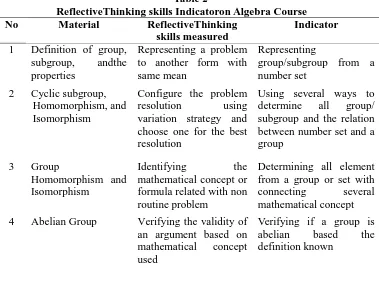
The instruments used in this study are the questions of essay given as posttest. This test is given to the experimental class and the control class in Algebra and Mathematical Statistics Course to measure reflective thinking skills. The data analysis used is the test of two mean
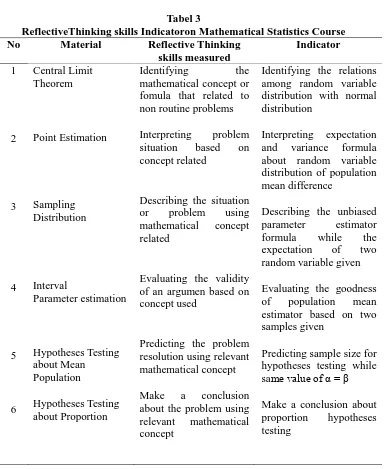
skills measured
ReflectiveThinking skills Indicatoron Mathematical Statistics Course No Material Reflective Thinking
ME-17
thinking skills was analyzed both of experiment and control group.
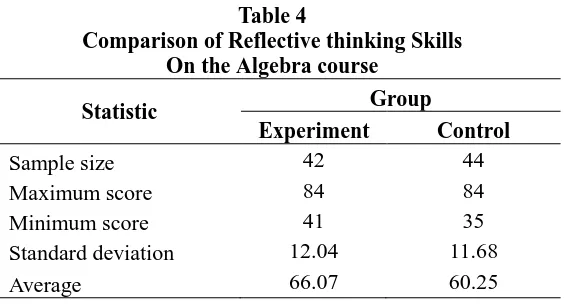
Table 4
Comparison of Reflective thinking Skills On the Algebra course
Statistic Group
Experiment Control
Sample size 42 44
Maximum score 84 84
Minimum score 41 35
Standard deviation 12.04 11.68
Average 66.07 60.25
Based on Table4, in the experimental class obtained an average value of 66.07on Algebra Course with a maximum score of 84 and a minimum score of 41, while the values obtained in the control class average of 60.25with a maximum score of 84 and a minimum value 35. Meanwhile, based on Table 5 in the experimental class obtained an average value of 72.67on Mathematical Statistics Course with a maximum score of 96 and a minimum score of 45, while the values obtained in the control class average of 62.55 with a maximum score of 95 and a minimum score of 30.
Table 5
Comparison of ReflectiveThinking Skills On Mathematical Statistics
Statistic Group
Experiment Control
Sample size 30 31
Maximum score 96 95
Minimum score 45 30
Standard deviation 12.49 16.13
Average 72.67 62.55
Tables 4 and 5, descriptively indicate a difference in the value of descriptive statistics between the two groups. From Table 4 in Algebra Course can be seen that the average value of experiment group is higher than the average value of the control group by a margin of 5.82. In the Mathematical Statistics course as in Table 5 shows the same case with the, they both indicate that students in the experimental class has a greater ability than students in the control classes. It is descriptive views of the average score obtained.
Table 6
Rank of average on Experiment and Control
Algebra course N Mean Rank Sum of Ranks
Algebra Score
Experiment 42 49.61 2083.50
Control 44 37.67 1657.50
Table 7
Mann Whitney U Statistic
Value of Algebra
Mann-Whitney U 667.500
Z -2.226
Asymp. Sig. (2-tailed) .026
The average value for both classes Rank descriptively quite different. The average value for the experimental class rank of 49.61, while the average value for the control class rank of 37.67. To see this difference in statistical inference used the Mann Whitney U test. Table7 shows that the value of the test statistic U is 667.5 with a value of Z= -2226 (for large sample sizes). This test gives the probability value for fallacy risk of 0.026 is more less than 0.05. Based on the test obtained that the average rank for the two groups is different, and the average rank of experimentation classes greater. These results suggest that student’s reflective thinking skills with using problem based learning in the Algebra course is better than student’s reflective thinking skills with using learning conventionally.
Learning material designed with problem based learning gives students reflective thinking skills better.
Problem-based learning by Boud & Felleti (1997), and Fogarty
(1997), stated that the problem-based learning is an approach of learning by making the
confrontation to the students with the practical problems, ill-structured, or open-ended
stimulus in learning. A more complete explanation expressed by Cunningham et.al.
(2000), that is problem-based learning is a teaching strategy that simultaneously
develops problem solving strategies, disciplinary knowledge, and skills to put the
students in problem solving activities by making the confrontation of the problem
structure in the form of real problems in their daily lives. A similar view was also
expressed by Barrett (2005), that problem based learning is a process of determining the
solution of problem through activities that focus on understanding the problem solution.
To examine the two mean differences of student’s reflective thinking skills in mathematical Statistics course used the t test. The following Table 8 is the result.
Tabel 8 StatistikUji t t df Sig. (1-tailed) Mean
Difference
Std. Error Difference
MathStat Score
2.733 59 .0041 10.11828 17.52679
Fallacy Risk given of this test was 0.0041, very small compared with significance level of 5%. The average score of students reflective thinking skills in a class with metacognitive is greater than the average score of students reflective thinking skills who are learning conventionally.
ME-19
(Muin, 2011). Referring to the opinion of Schoenfeld (1987), Blakey & Spence (1990),
Huit (1997), when metacognitive involved in the learning process, the student will
automatically be active in thinking. Metacognitive concepts presented Biryukov (2004),
referring to allegations of thinking about what a person knows (metacognitive
knowledge), what a person can do (metacognitive skills), and what a person knows
about the metacognitive ability (metacognitive experiences).
CONCLUSION AND SUGGESTION
Based on the research that has been done can be concluded as follows:
1. On the subject of algebra course mathematical reflective thinking skills of students who give learning approach with problem-based learning have implications for the development of mathematical ideas to solve problems.
2. On the subject of Mathematical Statistics mathematical reflective thinking skills of students who give learning approach with metacognitive have implications for the efficiency and simplicity in a problem solving.
3. The mathematical reflective thinking skill of students who give conventional learning approach both on the Algebra and the mathematical Statistics course had relatively similar capabilities in terms of no interesting implications in the learning process.
4. The mathematical reflective thinking skills of students with problem based learning in the algebra course are better than mathematical reflective thinking skills of students in the conventional approach. Similarly, the mathematical reflective thinking skills of students with metacognitive approach in the Mathematical Statistics course better than mathematical reflective thinking skills of students who are learning in the conventional approach.
5. Both learning approaches of Problem Based Learning and Metacognitive provide a greater contribution to the student mathematical reflective thinking skills. A good mathematical reflective thinking skill implies to the effectiveness and efficiency of the process of understanding and problem solving.
6. For next research, it is necessary to consider about the disposition of mathematical reflective thinking skills and the association about of them
7. Multivariate analysis of variance can be consider to be used for analyze mathematical reflective thinking in the related subject matter.
BIBLIOGRAPHY
Barret, T. (2005). Understanding Problem Based Learning. Available:
http://www.aishie.org/readings/2005-2/chapter-2.pdf. [Dec 12, 2010]
Biryukov, P. (2004). Metacognitive Aspects of Solving Combinatorics Problems.In International Journal for Mathematics Teaching and Learning [Online], Vol 1 (74) ISSN 1473 – 0121, 20 pages. Available: http://www.ex.ac.uk/cimt/ijmt/biryukov.pdf [March 29, 2004].
Blakey, E & Spence, S. (1990). Developing Metacognitive.Dalam Eric Degests on Information Resources [Online].Available: http://www.iap.ac.id/ERICDigests/metacognitive.html
[April 1,2004]
Fogarty, R. (1997). Problem Based Learning and Other Curriculum Models for the Multiple Intelligence Classroom. Arlington Height: Skylight.
Huitt, B. (1997). Educational Psychology Interactive: Metacognition [Online]. Available:
http://chiron.valdosta.edu/whuitt/Col/Cogsys/Metacogn.html [March 12, 2004].
Hulukati, E. (2005). MengembangkanKemampuanKomunikasidanPemecahanMasalahSiswa SMP melaluiPembelajaranGeneratif.Disertasi PPs UPI Bandung: Not Published.
Ibrahim, M. danNur, M. (2004). PembelajarandenganMetodePemecahanMasalah.Available:
www.educare.e-fkipinla.net [January 25, 2011].
Kaune, C. (2006). Reflection and Metacognition in Mathematics Education – Tools for the Improvement of Teaching Quality.The International Journal on Mathematics Education, 38, 350–360.
Maulana
(2007).AlternatifPembelajaranMatematikadenganPendekatanMetakognitifuntukMening katkanKemampuanBerpikirKritisMahasiswaPGSD.Theseson Post graduate school UPI Bandung: Not Published.
Muin, A (2011). The Situations That Can Bring Reflective Thinking Process In Mathematics Learning, International Seminar and the Fourth National Conference on Mathematics Education, Department of Mathematics Education, Yogyakarta State University, 21-23 July 2011
Schoenfeld, A. (1987). Metacognition.Learning and Mathematics [Online].Available:http://mathforum.org/sarah/Discussion.Sessions/schoenfeld.html
[March12, 2004]