Consumer Perceptions of Islamic Insurance
Companies in Brunei Darussalam
Mohamed Sharif Bashir and Nor Hafiizah Hj Mail
Faculty of Business and Management Science, Sultan Sharif Ali Islamic University, Jalan Pasar Baharu, Gadong BE1310, Brunei Darussalam
[email protected], [email protected]
Abstract. The takaful (Islamic insurance) industry has developed rapidly in Brunei Darussalam since its establishment in the early 1990s. It has emerged as an important component of the Islamic financial system in Brunei and competes with conventional insurance. Increases in total assets and gross total premium of takaful companies’ contributions were indicative of the public’s awareness and interest toward takaful products based on the profit-sharing approach, which is not offered by conventional insurance. The purpose of this paper is to examine the consumer perceptions of takaful companies in Brunei Darussalam. It focuses on select takaful products in order to investigate consumer perceptions. The paper provides an overview of Brunei’s takaful industry. A survey questionnaire was conducted to collect relevant and recent data on consumer perceptions relating to their respective takaful companies. The findings show that the most common problem encountered by takaful policyholders involves the claiming process. Some suggestions have been offered for improving the takaful industry performance in Brunei such as upgrading technology to foster delivery of services and upgrading staff skills by more training.
Keywords: Islamic finance, takaful, Islamic insurance, consumer perception, Brunei Darussalam, Islamic financial institutions.
1 INTRODUCTION
considering the future of its social and welfare provision and the need to further develop the saving culture of its citizens. This is likely to benefit players in the life insurance segment [6], [15], [16].
The present paper tries to provide suitable answers to the questions that arise concerning customer perceptions about the takaful business in Brunei Darussalam. The organisation of this paper is as follows: section 2 starts with the brief introduction for each takaful company in Brunei, section 3 presents the analytical framework, section 4 provides the results and discussion, and the last section focuses on the findings and recommendations.
2. BACKGROUND OF BRUNEI’S TAKAFUL INDUSTRY
Brunei Darussalam is a small and wealthy economy that is growing at a slow and steady rate. Brunei is the fourth largest oil producer in Southeast Asia and the ninth largest exporter of liquefied natural gas worldwide. It has remained stable with an average inflation rate of 1.5% over the past two decades. It is considered to have the second highest quality of life in the Association of Southeast Asian Nations (ASEAN) region, and Brunei has an estimated US$31,000 per capita income [7], [16].
The insurance industry was established in Brunei more than 30 years ago. However, the takaful business started just 18 years ago with the establishment of Insurans Islam TAIB on March 3, 1993. As an Islamic state, Negara Brunei Darussalam is keen to promote Islamic financial institutions, which include Islamic banks and takaful institutions, in its economy [7], [9]. As official statistics show, the contribution of the insurance sector to Brunei’s GDP is still below 2%, but in recent years it has been growing at a significant pace [15], [16], [22].
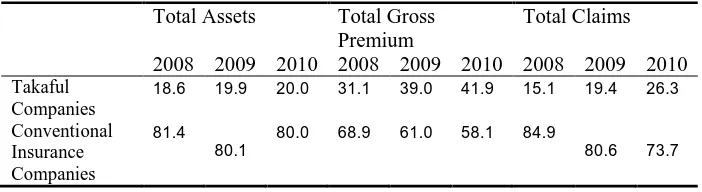
Table 1. Total Assets, Gross Premium, and Claims of Takaful and Conventional Insurance
Companies in Brunei, 2008-2010 (%)
Total Assets Total Gross Premium
Total Claims
2008 2009 2010 2008 2009 2010 2008 2009 2010
Takaful Companies
18.6 19.9 20.0 31.1 39.0 41.9 15.1 19.4 26.3
Conventional Insurance Companies
81.4 80.1
80.0 68.9 61.0 58.1 84.9
80.6 73.7
Source:[7].
based on the profit-sharing approach that is not offered by conventional companies. Regarding gross claims, the total claims contribution by takaful companies increased at 15.1%, 19.4%, and 26.3% in 2008, 2009, and 2010, respectively. Conventional insurance companies’ contribution in total claims declined from 84.9%, 80.6%, and 73.7% over those three years, respectively. As for takaful companies, their shares in total assets increased at 18.6%, 19.9%, and 20.0% in 2008, 2009, and 2010, respectively, while the shares of conventional companies declined from 81.4%, 80.1%, and 80.0% in 2008, 2009, and 2010, respectively [7].
The Islamic insurance industry is tightly regulated, with Takaful Order 2008 being the central document setting out the terms and conditions under which the industry operates. This order was issued in October 2008 and was enforced beginning the following month. The order codified takaful operations, ensuring that the industry as a whole was based on a firm foundation and that its products offered and activities met the requirements of Islamic law [6], [7].
There are two types of insurance companies in Brunei Darussalam: conventional and takaful. Both types offer a wide range of non-life and life insurance products. Currently, there are two takaful operators in Brunei Darussalam: Insurans Islam TAIB Sdn Bhd and Takaful Brunei Darussalam Sdn Bhd (Takaful Am Sdn Bhd and Takaful Keluarga Sdn Bhd) [2], [9], [12]. Besides the takaful companies, there are also nine conventional insurance companies operating in Brunei Darussalam: American International Assurance Co. Ltd, Audley Insurance Co. Sdn Bhd, MBA Insurance Company Sdn Bhd, ETIQA Insurance Bhd, National Insurance Company Bhd, Standard Insurance Sdn Bhd, TOKIO Marine Insurance Singapore Ltd, TM Asia Life Singapore Ltd, and Great Eastern Life Assurance Co. Ltd. Both takaful and conventional insurance companies are now under the supervision of the newly established Brunei Darussalam Monetary Authority (AMBD), pursuant to the Autoriti Monetary Brunei Darussalam Order of 2010, which took effect January 1, 2011. It was previously under the supervision of the Ministry of Finance’s Insurance Section. However, both are governed by two different regulations. Takaful companies are regulated under Takaful Order 2008, and conventional insurance companies are governed by Insurance Order 2006 [6], [10], [21]. The takaful companies in Brunei started in the early 1990s and developed rapidly. They are successfully doing business on a competitive basis with conventional insurance companies in Brunei’s insurance market [2], [9], [15].
2.1 Insurans Islam TAIB Sdn Bhd
sound and professional consultation services to customers through well-trained, highly courteous, and efficient personnel supported by the use of the latest advanced information technologies.
There are three types of takaful businesses offered by Insurans Islam TAIB Sdn Bhd: general takaful, family takaful, and special risk takaful. There are about 16 takaful schemes offered under the general takaful business, 10 takaful schemes in family takaful business, and eight takaful schemes under the special risk takaful business. All three takaful businesses use a mudarabah (profit-sharing) model as their takaful concept [9].
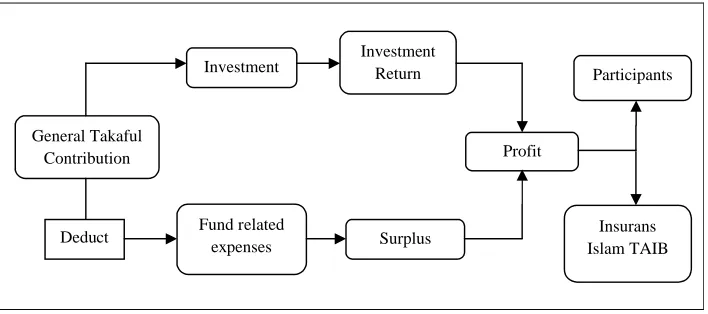
For the general takaful business, the contributions received will be divided into two parts: a tabaru’ (gift) fund and an investment fund. The tabaru’ fund will be utilised and deducted with the costs of managing the fund and other related expenses such as claims settlement and reserves, business acquisition costs, re-takaful costs, and other technical reserves that are required by statutory regulations or business practices [14], [18], [19]. The investment fund will be invested in Shariah compliant investment instruments. The surplus from the fund and the investment returns will make-up the profit for the fund. The profit produced will be shared between Insurans Islam TAIB (as the manager of the fund) and the participants at a ratio determined by Insurans Islam TAIB from time to time (known as Al-Mudarabah). Most of the takaful products offered by Insurans Islam TAIB are based on the mudarabah model, but they offer one takaful product based on the al-wakalah model, takaful sinar, which relates to protection of life and against critical illnesses [9].
Figure 1. Flow Chart of General Takaful Business
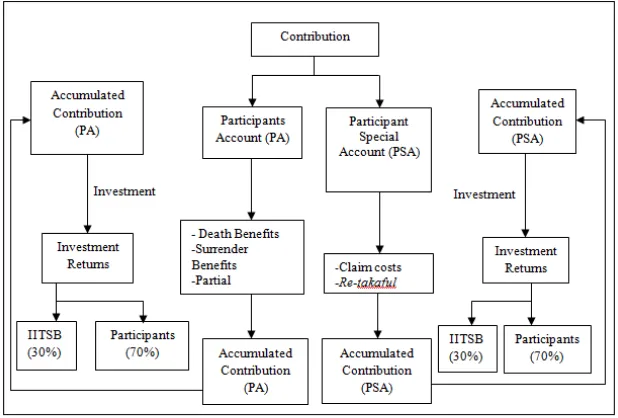
For the family takaful business, the takaful contribution received from the participants (policy holders) will be allocated into two accounts, namely a participants account (PA) and a participants special account (PSA). The participants account is the saving element in the contribution, whereas the participants special account is the tabaru’ element in the contribution. PA will be deducted with death, surrender, and partial withdrawal benefits, and PSA will be deducted with claims
Investment
General Takaful Contribution
Investment Return
Fund related
expenses Surplus
Profit
Insurans Islam TAIB
Participants
and re-takaful costs. Investment return from the PA and PSA will be distributed between Insurans Islam TAIB and policy holders according to the pre-agreed ratio. As of the date of this paper, Insurans Islam TAIB is still operating a composite takaful business and has yet to segregate their family takaful from their general takaful, but it is noted that Insurans Islam TAIB does comply with the capitalisation requirements under Takaful Order 2008 by making provisions for minimum capitalisation of B$8 million for each of its takaful business classes [6], [9].
2.2 Syarikat Takaful Brunei Darussalam
Syarikat Takaful Brunei Darussalam Sdn Bhd is a holding company that consists of two takaful operators as its subsidiaries, Takaful Brunei Am Sdn Bhd (formerly known as Takaful IBB Berhad) and Takaful Brunei Keluarga Sdn Bhd (formerly known as Takaful BIBD Sdn Bhd), in order to comply with the Takaful Order of 2008. On November 13, 2010, Syarikat Takaful Brunei Darussalam held its official launching on the change of name and logos of its subsidiaries Takaful Brunei Am Sdn Bhd and Takaful Keluarga Sdn Bhd. The companies were renamed to reflect their future respective business functions in line with the requirements of the Takaful Order of 2008. Takaful Brunei Am Sdn Bhd, which was formerly known as Takaful IBB Berhad, now will be only focused on general takaful products [14], [16], [21], [22].
Figure 2. Flow Chart of Family Takaful business
country’s Islamic financial sector. Furthermore, it is hoped that the combination and synergy of both companies’ expertise and experience can strengthen and further develop the takaful industry and provide a wider scope of services throughout the country. It is foreseen that this merger will provide awareness within Negara Brunei Darussalam as to the benefits and the advantages of prudent takaful practices as well as greatly contribute toward the country’s Islamic finance with its vision for 2035. This is also in line with the mission and vision of developing and cultivating a savings culture in Brunei Darussalam through the use of takaful.
Syarikat Takaful Brunei Darussalam Sdn Bhd, through its two subsidiaries, offers both family takaful (takaful keluarga) and general takaful (takaful am). The majority of the products offered by the operators are wakalah model-based. While the wakalah model is employed for short-term takaful products (takaful am products that are between 1 and 2 years long), the mudharabah model is employed for longer-term takaful products (investment-linked and life-savings insurance plans) [8], [14], [17], [20].
Notably, under the wakalah model, the operators (shareholders) are paid a fixed fee (upfront) as commission on participants’ contributions and all expenses are paid for by the operators. Under this model, the operators do not have a share in any profits from investments or surpluses from the underwriting fund. Under the mudarabah model, the operators earn a percentage from the net profits, such as 30% for management of takaful operater and the remaining share ratio 70% for policyholders. According to mudharabah requirements, the operators are responsible for all operating expenses incurred (previously it was charged to participants) [3], [5], [9], [11]. A review of the types of models employed in Brunei reveals that there is a mixture of the two models, wakalah and mudharabah, both within a company and among companies with a preference for mudharabah in one and wakalah in the other [14], [16], [18], [21].
2.3 Types of Takaful Business
Al-Mudarabah Model. A takaful operator that uses the al-mudarabah model in their business has a variation in terms of management fees, product design, and distribution channels. In the al-mudarabah contract, the takaful operator acts as the mudharib (manager) and participants act as the rabbul mal (capital provider) [1],[13]. The profit from this transaction will be shared according to the agreed ratio between the takaful operator and participants. However, losses will be borne by participants as the capital provider. Nevertheless, to protect the participant, the takaful operator needs to follow strict requirements and not to invest in risky investments [1], [3], [14]. This model is the preferred takaful model in Brunei presently, although there is a move to shift to the al-wakalah model [8], [13], [17].
Al-Wakalah Model. The al-Wakalah model is different from the al-mudarabah model because in the wakalah model, the relationship between the takaful operator and participant is basically as agent and capital provider. The takaful operator acts as the participant’s agent and will be paid fees for the services provided. The fees are charged as a fixed amount or percentage, or based on the agreed ratio from the investment profits [11], [12], [13].
3. METHODOLOGY AND DATA SOURCES
3.1 Instruments
In an attempt to examine consumer perceptions of Islamic Insurance Companies in Brunei, a survey was conducted. The questionnaire consists of 4 sections. Each section is designed specifically to derive relevant information from the respondents. In section 1, the questionnaire asked about the respondent’s demographic characteristics. For section 2, the questionnaire asked about the respondent’s insurance policy. In section 3, the questionnaire asked about the respondent’s understanding and knowledge about the performance of takaful companies in Brunei Darussalam. There are 20 statements given in this section asking them to score each of the 5 appropriate answers on a Likert-type scale of 1 to 5. Lastly, in section 4, the respondents are required to give their opinions and suggestion on the given questions.
3.2 Data Sources
Syarikat Takaful Brunei Darussalam Sdn Bhd and Insurans Islam TAIB Sdn Bhd, and from government-published documents.
4. RESULTS AND DISCUSSION
4.1 Respondents’ Demographic Characteristics
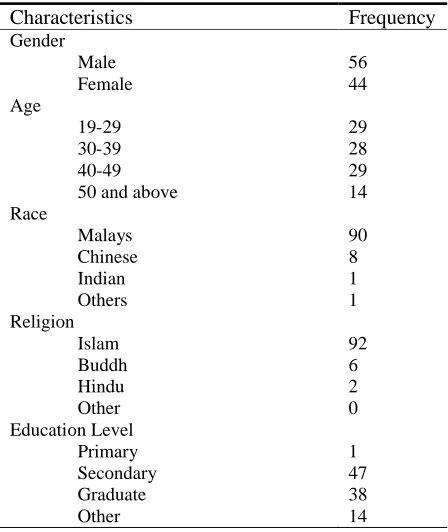
Table 2 shows that 56% of the respondents are male and 44% are female. Most of them fall between ages 19-29 and 40-49 (29% each), followed by age group 30-39 (28%), with 14% of respondents who said they were more than 50 years of age. Of the respondents, 90% are Malays, followed by 8% Chinese, 1% Indian, and 1% other. It also shows that 92% of the respondents are Muslim, followed by 6% who are Buddhists, and 2% who are Christian. Of the respondents, 1% just graduated from primary school, 47% graduated from secondary school, 38% graduated from university, and 14% have other educational levels including national diploma and postgraduate degrees.
Table 2. Respondents’ Demographic Characteristics
Characteristics Frequency
Gender
Male 56
Female 44
Age
19-29 29
30-39 28
40-49 29
50 and above 14
Race
Malays 90
Chinese 8
Indian 1
Others 1
Religion
Islam 92
Buddh 6
Hindu 2
Other 0
Education Level
Primary 1
Secondary 47
Graduate 38
Other 14
Frequency
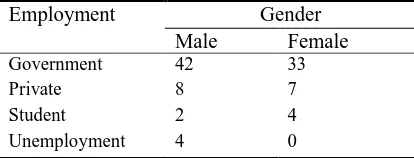
Table 3 shows that 75% of the respondents work in the government sector, followed by 15% working in the private sector, 6% who are students, and 4% who are unemployed. In terms of monthly salary levels, around 40% of the respondents make $1000-$2000, followed by 24% who make $2001-$3000, 23% who make more than $3000, and 13% who make less than $1000.
4.2 Respondents’ Insurance/Takaful Policy
Table 4. Respondents’ Insurance/Takaful policy
Question Frequency
Do you have insurance (conventional and takaful) policy? Yes
Which part inside the policy you wish to understand more? The product
Claiming Process
Fees
Takaful terms Other
20 47 2 Is there any policy (s) that you wish to purchase but not offer by takaful company in Brunei?
Yes No
6 94
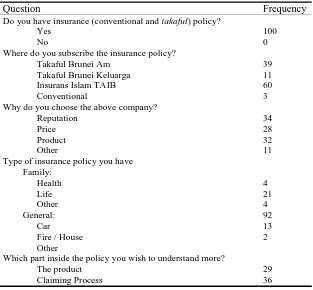
Table 4 indicates that all of the 100 respondents have insurance/takaful policies. The survey is especially confined to those who have insurance/takaful policies. This is to meet the objective of the survey to examine the customer’s perception of the takaful companies in Brunei. Almost 53.1% of the respondents bought their policy from Insurans Islam TAIB Sdn Bhd, followed by 34.5% respondents bought from Takaful Brunei Am Sdn Bhd, 9.7% respondents bought from Takaful Keluarga Sdn Bhd, and 2.7% of the respondents who said they have conventional insurance policies.
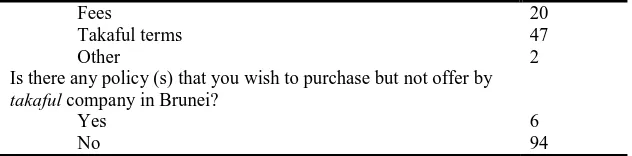
Also in Table 4, about 32.4% of the respondents chose reputation as their reason for choosing the takaful company, while 30.5% respondents chose the products, 26.7% chose the price, and 11% have other reasons. The other reasons are such as through recommendations from family, friends, and insurance agents, because of personal reasons, and because takaful companies are Shariah-based institutions. The most common insurance policy held by the respondents is car insurance (67.7%). Second highest is life insurance (15.4%). Third highest is fire insurance (9.6%). About 2.9% of respondents have other insurance policies (family takaful) beside the listed plan, such as travelling and domestic housemaid takaful plans. It also showed that 1.5% of the respondents have other insurance policies through general takaful products beside the listed products, such as student takaful plans. About 47% of the respondents want to know more on the takaful terms, 26.9% of the respondents want to know about the claiming process, 21.6% want to know about the product, and 1.5% want to know about topics other than those listed point in the questionnaire such as the investment projects for family takaful businesses.
Table 4 indicates that the most respondents (94%) do not have any takaful products that they wish to purchase. On the other hand, 6% of them wish purchase other takaful products beside those already on the market such as investment-linked insurance, insurance for laptops, insurance for personal valuable items such as gold, jewelry, and securities such as notes, bonds, etc.
4.3 Cross-Tabulation Analysis
Table 5. Gender and Age
Gender Age
19-29 30-39 40-49 above 50
Male 10 21 14 11
Female 19 7 15 3
Total 29 28 29 13
Table 5 shows that a plurality of male respondents is between 30-39 years old and a plurality of female respondents is between the ages 19-29. Moreover, the overall highest respondent’s age are between the ages of 19-29 or 40-49.
Table 6. Employment and Age
Employment Age
19-29 30-39 40-49 above 50
Government 18 20 26 75
Private 6 6 3 15
Student 3 2 0 6
Unemployment 2 0 0 4
Table 6 indicates that 75% of the respondents work in the government sector. This is followed by 15% of respondents who work in the private sector, 6% who are students, and 4% who are unemployed. From the age part, it shows that most of the respondents who work for the government are 40-49 years old. On the other hand, most of the respondents who work in the private sector are 19-29 and 30-39 years old. For respondents who are students, most are 19-29 years old, and most of the respondents who are unemployed are 19-29 years old or older than 50.
Table 7. Employment and Gender
Employment Gender
Male Female
Government 42 33
Private 8 7
Student 2 4
Unemployment 4 0
Table 8. Employment and Monthly Salary
Employment Monthly Salary
Above 3000 3000-2001 2000-1000 Below 1000
Government 20 20 28 7
Private 2 2 9 2
Student 1 1 1 3
Unemployment 0 1 2 1
Table 8 indicates that most of the respondents (who work in the government sector) receive a monthly salary between $1000-$2000. It is similar with respondents who work in the private sector. The highest number of respondents (9) have monthly salaries between $1000-$2000. For the respondents who are students, most had incomes less than $1000 per month. On the other hand, the 2 unemployed respondents have incomes between $1000-$2000 per month. Thus, most of the respondents (40%) have salaries between $1000-$2000 per month.
Table 9. Insurance Policy and Employment
Insurance policy Employment
Government Private Student Unemployment
Health 3 1 0 0
Life 17 2 1 1
Car Insurance 70 14 5 3
Fire 12 1 0 0
Table 9 shows that the highest insurance policy that the respondents purchased is car insurance. The second highest is life insurance, followed by fire and health insurance. The table also shows that the highest takaful participants (78.5%) are respondents who work in the government sector. This is followed by the respondents who work in the private sector, students, and the unemployed.
Table 10. Insurance Policy and Takaful Companies
Insurance policy Insurance Company
Takaful Am Takaful Keluarga Insurans TAIB
Health 1 1 2
Life 5 4 15
Car Insurance 37 10 53
Fire 8 2 8
4.4 The Performance of Takaful Companies in Brunei
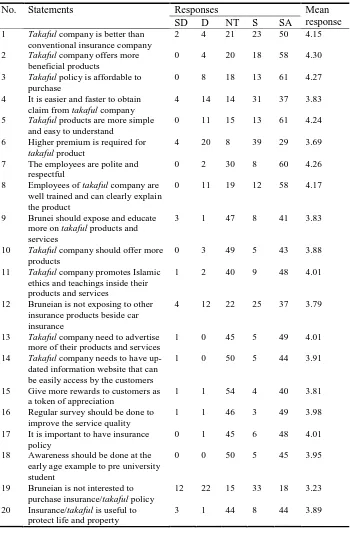
Table 11 showed that 50% of the respondents agree that a takaful company is better than a conventional insurance company, and 21% said that they strongly agreed. On the contrary, 4% of respondents disagreed and 2% of respondents strongly disagreed. From 100 respondents, 23% do not have any opinion about whether a takaful company is better than a conventional insurance company. Based on respondents’ opinions on products, it showed that 58% of respondents agreed that takaful companies offer more beneficial products than other insurance operators, and 20% strongly agreed. This was followed by 18% who agreed and 4% who disagreed. Regarding takaful policy, 61% of respondents agreed that takaful policies are affordable, and 18% of the respondents strongly agreed and 13% did not have any opinion. However, 8% of the respondents disagreed on this. Based on the question about obtaining claims from takaful companies, the above result showed that 37% of the respondents agreed that obtaining claims from takaful companies is easier and faster than from other insurance operators. Out of 100 respondents, 14% strongly agreed about this. However, 31% did not have an opinion about this. On the other hand, 14% disagreed and 4% strongly disagreed.
As shown in Table 11, about 61% of the respondents agreed that takaful products are simpler and easier to understand. This was followed by 15% who strongly agreed. However, 11% of the respondents disagreed and they found takaful products complicated. From 100 respondents, 13% did not have an opinion about this. In regards to premiums required for takaful products, the above result showed that 39% of the respondents do not know if takaful products require higher premiums than those of other insurance operators. Around 29% of the respondents, agreed and 8% strongly agreed that higher premiums are required for takaful products.conversely , 20% disagreed and 4% strongly disagreed.
In regards to employee attitudes and training skills, 60% of the respondents agreed that takaful employees are polite and respectful. On top of this, 30% strongly agreed; however, 8% of the respondents did not know and only 2% disagreed. Employees of takaful companies are well trained and can clearly explain the product. Table 9 shows that 58% of the respondents agreed that the takaful employees are well trained, 19% strongly agreed, 12% did not know, and 11% disagreed.
It also indicates that 47% of respondents strongly agreed and 41% agreed that Bruneians should be better exposed to and educated more about takaful products and services. However, 3% of the respondents strongly disagreed and 1% disagreed. The other 8% did not know about this. It shows that 49% of the respondents strongly agreed and 43% agreed that takaful companies should offer more products. About 5% did not know and 3% disagreed about this matter.
and services. Around 9% of respondents did not have any idea, 2% disagreed, and 1% strongly disagreed.
About 37% of respondents agreed and 22% strongly agreed that Bruneians are not exposed to other insurance products beside car insurance. In contrast, 25% said they were not aware of this, while 12% disagreed, and 4% strongly disagreed about this statement. The above table showed that 49% of the respondents agreed and 45% strongly agreed that takaful companies need to advertise more of their products and services. Conversely, 5% of the respondents did not know, and 1% disagreed about this. The above result showed that 50% of the respondents strongly agreed and 44% agreed that takaful companies need to have an updated website that can be easily accessed by customers. Conversely, 5% did not know and 1% strongly disagreed on this matter.
Table 11 shows that 54% of the respondents strongly agreed and 40% agreed that takaful companies should give more rewards to their customers. About 4% had no comment on this matter and 1% strongly disagreed and 1% disagreed. The above table showed that 49% agreed and 46% strongly agreed that a regular survey should be done to improve the service quality of takaful companies. On the other hand, 3% did not have a comment and 1% each either strongly disagreed or disagreed on this matter. Almost 48% agreed and 45% strongly agreed that it is important to have insurance policies. On the other hand, 6% did not have an opinion and 1% disagreed about this. As shown in the above table, 50% of the respondents strongly agreed and 45% agreed that awareness should begin at an early age. In contrast, 5% did not have an opinion about this matter. Nearly 33% were unaware about this. Moreover, 22% disagreed and 12% strongly disagreed. However, 18% of the respondents agreed and 15% strongly agreed that Bruneians were not interested in purchasing insurance/takaful policies. Almost 44% strongly agreed and agreed that insurance/takaful is useful to protect life and property. Conversely, 8% did not have any opinion about this, 3% of the respondents strongly disagreed and 1% disagreed.
Table 11. Consumers Response on Takaful Products and Services in Brunei Darussalam
4 It is easier and faster to obtain claim from takaful company
12 Bruneian is not exposing to other insurance products beside car
15 Give more rewards to customers as a token of appreciation
1 1 54 4 40 3.81
16 Regular survey should be done to improve the service quality
1 1 46 3 49 3.98
17 It is important to have insurance policy
0 1 45 6 48 4.01
4.5 Respondents’ Opinions
The respondents were requested to give their opinions and suggestions on the research topic. Based on their experiences dealing with takaful companies, some of the respondents have encountered the following problems and difficulties:
1. Long waiting time, especially during peak periods.
2. Very difficult to obtain claims. The processes are too bureaucratic and complicated.
3. The computer system sometimes does not work. Thus, everything needs to be done manually and this makes the processing time consuming.
4. One of the respondents found that the price of the insurance policy suddenly increased because of the merger of two takaful companies.
5. The renewal process is too tedious because too many procedures need to be done. For example, the car’s blue card is sometimes at a different place. In that case, the customer needs to go to the bank (where the loans are taken) to take the blue card and pay a deposit of $50. After that, the customer has to go to the takaful company to renew the insurance. Then, the customer needs to return the blue card to the bank.
Some of the ideas and suggestions given by the respondents to improve the performance of takaful companies in Brunei are as follows:
1. The takaful companies need to improve their service delivery and need to conduct road shows to educate the public on the importance of takaful. 2. The takaful companies need to be more competitive with other insurance
operators, especially in terms of price. The public needs to be exposed to insurance and its importance through more advertisements and promotions. 3. Open more counters and extend operation hours, especially during peak
periods. This is to prevent the customer from waiting too long. Companies also should provide up-to-date information and promotions on company websites.
4. Provide clearer and simpler explanations on takaful products so that customers can understand and avoid misunderstanding. Conduct talks about the importance and benefits of takaful at every school in Brunei Darussalam, especially at secondary schools, (including lower and upper levels), vocational schools and universities.
5. The takaful companies should have online facilities to enhance more of their services provided. In line with this, the company’s IT system should be upgraded with more training for the takaful employees, especially regarding customer service and product explanation.
4.6 Descriptive Analysis
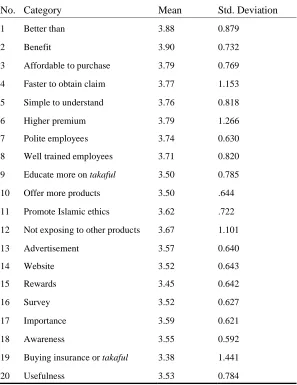
conventional insurance companies. When asked about beneficial products, the results show that the mean is 3.90 (Std. deviation = 0.73), which means on average the respondent strongly agreed that the takaful company offers more beneficial products than conventional insurance companies do. When asked which policy is affordable to purchase, the results show that the mean is 3.79 (Std. deviation = 0.77), which means on average the respondent strongly agreed that the takaful insurance policies are more affordable to purchase than those of conventional insurance companies. When asked which is faster for obtaining claims, the mean is 3.77 (Std. deviation = 1.02), which means on average the respondent strongly agreed that it is easier and faster to obtain claims from a takaful company. When asked about understanding of products, the results show that the mean is 3.76 (Std. deviation = 0.82), which means on average the respondent strongly agreed that the takaful products are simpler and easier to understand than those of conventional insurance companies. When asked which amount of premium paid is higher, the results show that the mean is 3.79 (Std. deviation = 1.27), which means on average the respondent strongly agreed that the higher premium is paid by takaful participants.
When asked about employee politeness, the results show that the mean is 3.74 (Std. deviation = 0.63), which means on average the respondent strongly agreed that the takaful company has polite and respectful employees. When asked about employees’ skills, the results show that the mean is 3.71 (Std. deviation = 0.82), which means on average the respondent strongly agreed that takaful company employees are well trained and explain products clearly. When asked about promoting products and educating efforts, the results show that the mean is 3.50 (Std. deviation = 0.79), which means on average the respondent strongly agreed that Bruneians should be more exposed and educated about takaful products and services. When asked which company offers more products, the results show that the mean is 3.50 (Std. deviation = 0.64), which means on average the respondent strongly agreed that takaful companies should offer more products. When asked about promotion of ethics and knowledge that appeared in products, the results show that the mean is 3.67 (Std. deviation = 0.72), which means on average the respondent strongly agreed that the takaful company promotes Islamic ethics and teachings on their products and services. When asked whether Bruneians are exposed to other insurance products besides car insurance, the results show that the mean is 3.67 (Std. deviation = 1.10), which means on average the respondent strongly agreed that Bruneians are not exposed to other takaful products besides car insurance.
the takaful company should give more rewards to their customers as a token of appreciation. When asked about usefulness of conducting consumer surveys, the results show that the mean is 3.52 (Std. deviation = 0.62), which means on average the respondent strongly agreed that a regular survey should be conducted to improve takaful companies’ service quality.
Table 12. Descriptive Statistics
No. Category Mean Std. Deviation
1 Better than 3.88 0.879
2 Benefit 3.90 0.732
3 Affordable to purchase 3.79 0.769
4 Faster to obtain claim 3.77 1.153
5 Simple to understand 3.76 0.818
6 Higher premium 3.79 1.266
7 Polite employees 3.74 0.630
8 Well trained employees 3.71 0.820
9 Educate more on takaful 3.50 0.785
10 Offer more products 3.50 .644
11 Promote Islamic ethics 3.62 .722
12 Not exposing to other products 3.67 1.101
13 Advertisement 3.57 0.640
14 Website 3.52 0.643
15 Rewards 3.45 0.642
16 Survey 3.52 0.627
17 Importance 3.59 0.621
18 Awareness 3.55 0.592
19 Buying insurance or takaful 3.38 1.441
20 Usefulness 3.53 0.784
= 0.59), which means on average the respondent strongly agreed that awareness on the importance of having insurance should target a generation in its youth, for example pre-university students. When asked about buying insurance or takaful policy by Bruneian, the results show that the mean is 3.38 (Std. deviation = 1.44), which means on average the respondent strongly agreed that Bruneians are not interested in buying insurance or takaful policies. Finally, when asked about usefulness of insurance or takaful, the results show that the mean is 3.53 (Std. deviation= 0.78), which means on average the respondent strongly agreed that takaful or insurance is useful to protect life and property.
5. CONCLUSION AND POLICY IMPLICATIONS
The findings can be summarized as follows:
1. Regarding the availability of the educational programs conducted by the government as well as the takaful companies, there are only a few educational programs conducted. Bruneians still need to be better exposed and educated on the importance of insurance, especially of takaful products. This statement is supported by 47% of the respondents who strongly agreed and 41% who agreed.
2. The majority of the respondents subscribed to their takaful policy at Insurans Islam TAIB followed by Takaful Brunei Am and Takaful Brunei Keluarga. Moreover, the majority of respondents who participated in a takaful policy chose it because of the takaful company’s reputation, followed by product and price, respectively.
3. The majority of the respondents have car insurance. Only a few of them have other policies. This result proved that most Bruneians are not exposed to other insurance policies besides car insurance. Most of the survey respondents also agreed on this. The reason for this may be that car insurance is required by law for every car in Brunei.
4. The most common problem encountered by takaful policyholders regards the claim process. Most of the policyholders expressed unhappiness that it was difficult to obtain their claims. The processes are too bureaucratic and complicated. Takaful companies should find a better solution to this problem.
5. The majority of respondents suggested that takaful companies should better train their employees about their products and also on customer service. This is very important because when the employees have proper training on this matter, they can provide excellent service to customers and this can benefit the company and its reputations. Therefore, takaful companies should take this issue very seriously.
computer system so that they can provide higher quality and more innovative services.
7. Besides the problem of the claim process, another common problem encountered by the policyholders was long waiting time. This problem is getting worse during peak periods. To solve the problem, takaful companies are suggested to have online registration so that the customers can register early and just come to pay for the insurance.
It is interesting to conclude that Brunei Darussalam is among the Muslim countries that are very active in promoting Islamic Financial Institutions (IFIs) in its economy. Takaful companies are among the popular IFIs in Brunei. Takaful companies were established in Brunei 18 years ago. The first takaful company incorporated in Brunei Darussalam was Insurans Islam TAIB Sdn Bhd, which was inaugurated on March 3, 1993. Currently, there are two takaful companies in Brunei Darussalam, namely Insurans Islam TAIB Sdn Bhd and Syarikat Takaful Brunei Sdn Bhd. One of the current issues concerning the takaful industry relates to educating the public on the importance of takaful/insurance policies. As mentioned earlier, recently the Brunei Government began seriously considering its citizens’ social and saving culture. This can benefit the life insurance business. The most common problems that the majority of customers encountered were long waiting periods, bureaucracy, and complicated claims processes. Less action has been done by takaful companies to address these problems. Most of the survey respondents who are also takaful customers expressed their unhappiness about these matters. Therefore, takaful companies in Brunei Darussalam should put more effort into solving these problems.
The findings suggest several policy implications as follows:
1. Takaful companies should take the opportunity to offer an innovative life insurance product that can benefit the public, especially Bruneians. Most of the Brunei population is Muslim, therefore takaful companies have a greater advantage in this regard.
2. Takaful companies should provide more training to their employees, especially on how to explain their products more effectively and understandably. Besides this, the employees should be given more training on customer relationship services. A properly trained employee can provide excellent service to customers and this can benefit the company and its reputation as a whole.
3. Takaful companies should improve their computer system to provide faster service. This will avoid customer frustration, which can give the companies a bad.
REFERENCES
1. AAOIFI, “Accounting, Auditing and Governance Standards for Islamic Financial Institutions”, No 12, Appendix E, 2004/2005.
2. Abdul R., & Abdul, K, “A Brief Description of Islamic Insurance (Takaful)”, The Islamic Bank of Brunei Bhd, Bandar Seri Begawan, 1998.
3. Abouzaid, A, “Takaful Market: The Challenges of the Fast Growing Industry”,
2007. Retrieved from
http://www.takaful.coop/doc_store/takaful/Challenges%20of%20Takaful%20sector %20September%202007.pdf,April 18, 2011.
4. Ali, E. R., & Odierno, H, “Essential Guide to Takaful”, CERT Publications, Kuala Lumpur, 2008.
5. Ali, E. R, “Panduan Asas Takaful”, CERT Publications, Kuala Lumpur, 2010. 6. Government of Brunei Darussalam. “Takaful Order 2008”, Supplement to
government gazette part 2: Government of Brunei Darussalam, 2008.
7. Government of Brunei Darussalam, “Financial Institution Division”, Ministry of Finance, Bandar Seri Begawan, 2011
8. Hashim, N. H, “Life Insurance Purchasing Decision: A Preliminary Study”, The Journal of Muamalat and Islamic Finance Research” 2006; 3(1): 153-170.
9. Insurans Islam TAIB, “Annual Report 2010”, Bandar Seri Begawan, 2011.
10. Insurance. Retrieved from
http://www.bruneidirecthys.net/about_brunei/insurance.html, February 18, 2011. 11. Matraji, S, “Journey from the Commercial Insurance Contract to Takaful”, First
International Forum on Islamic Economics, Finance and Business for Young Scholars, Universiti Teknologi MARA and Islamic Research & Training Institute, Islamic Development Bank, Sheraton Perdana Resort Langkawi, Malaysia, 18-20 April 2006, 211-241.
12. Metussin, B, “Ugama dan Insurans Islam Di Negara Brunei Darussalam”, Bandar Seri Begawan, 2004.
13. Mohd, M. B, “Applied Takaful and Modern Insurance”, Sweet & Maxwell Asia, Kuala Lumpur, 2007.
14. Mohd, M. B, “Legal Capacity to Contract of Takaful: An Islamic Jurisprudential Consideration”, International Journal of Islamic Financial Services 2002; 4(1): 20– 2.
15. Oxford Business Group, “Brunei Darussalam Report 2008”, 2008. Retrieved from www.oxfordbusinessgroup.com, May 25, 2011
16. Oxford Business Group, “Brunei Darussalam Report 2009”, 2009. Retrieved from www.oxfordbusinessgroup.com, May 25, 2011
17. Pravaiz, S, “Takaful Concept”, 2011. Retrieved from http://www.al-wasl.com/downloads/dhaka/Takaful_Concepts_Final.pdf, April 18, 2011.
18. Ramliy, J., Mansor, N. M., & Rahman, M. Z, “Asas Takaful Buku Panduan”, Islamic Banking and Finance Institute Malaysia (IBFIM), Kuala Lumpur, 2007. 19. Saiful, A. R, “Critical Issues on Islamic Banking and Financial Markets”, Dinamas
Publishing, Kuala Lumpur, 2007.
20. Salahuddin, A, “Islamic Banking Finance and Insurance: A Global Overview”, A. S. Noordeen, Kuala Lumpur, 2007.
306
http://islamicfinanceupdates.wordpress.com/2008/11/28/brunei-approves-islamic-banking-order-2008/, May 25, 2011.