CHAPTER III
THE RESEARCH METHODOLOGY
A.Type of the Study
This research used quantitative research to gather the numerical data.
Quantitative research was research carried out by collecting numerical data from
sample drawn from a certain population. Thus, it finally attempted to generalize
the research findings to the whole population through statistical analysis.
Similarly, an understanding of the conclusions of the study would be better if also
with tables, graphs, charts, images, or other display1.
B. Design of the Study
The use of method in a research is very necessary, because it able to help a
researcher to get data easily. In this study, the writer used research and
development quantitative design of the study. According to Brog and Gall,
research and development is a powerful strategy for improving practice. It is a
process used to develop and validate educational product2
C. Population and Sample 1. Population
1
Suharsimi Arikunto, Manajemen Penelitian, p. 11
2
Population is all the subject of the research. According to encyclopedia of
educational evaluation, “a population is a set (or collection) of all elements
processing one or more attributes of interest”. According to Suharsimi Arikunto,
Population is „‟the whole of research subject‟‟3
. The writer chooses the population
is all of the third semester students of English study program of the State Islamic
College of Palangka Raya.
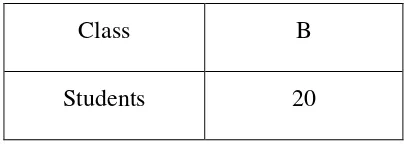
Table 3.1 the Number of Population
Class B
Students 20
2. Sample
Sample is some or represent of population that is researched. If the subject
is less than 100, preferably taken all that research is the study population. But if
the amount is large, it could be taken between 10 - 15% and more4. Because the
population is less than 100, in this case the study is population study since the
writer takes the entire subject as the sample.
D. Research Instrument
3Suharsimi Arikunto, “Prosedur Penelitian Suatu Pendekatan Praktik”, 2002,
Jakarta: Rineka Cipta, p.102.
4
In a study, instrument as a tool for collecting data plays a very significant
role in that it greatly determines the result of the study.
1. Research Instrument.
Because there is one variable, namely: the problem of reported speech. For
measuring these variables, the writer used test as instrument for measuring
them in research.
2. Research Instrument of Try Out
The aim of instrument of try out is to know the test instruments are
relevant to be given to the students. The writer performed try out. It is used to
know the validity of the test, reliability and level of difficulties of the test. The
instruments try out was tested to the other class of school of the population of
the study but in the same level. The try out test was administrated to the third
semester of STAIN Palangka Raya.
3. Research instrument Validity
Validity is concerned with the extent to which an instrument measures
what one thinks it is measuring5. Simply, it can be said that the test will be
valid, if it measures accurately what intended to measure.
In this study, the validation of instrument is mainly direct to the content
validity. Related to the writing test, the content validity is check by examining
and the test use to measure the objectives. The writer used inter-rater method
(test of validity). Inter-rater is two raters who score the students‟ writing to get
5
the score compositions as possible. The researcher used product moment
correlation as the formula to calculate the validity from the result6.
rxy =
Where:
rxy : Index correlation number “r” product moment
N : Number of class
∑xy : Multiplication results between score X and score Y
∑x : Total value of Rater I
∑y : Total value of Rater II
Interpretation:
rxy > rt = valid
rxy < rt = Invalid
Riduwan in Mayasarah states the criteria of interpretation of
validity7:
0.800 – 1000 = very high validity
0.600 – 0.799 = high validity
04.00 – 0.599 = fair validity
0.200 – 0.399 = poor validity
0.000 – 0.199 = very poor validity
6
Anas Sudijono, Pengantar Ilmu Statistik Pendidikan, Jakarta: PT. Raja Grafindo Pustaka, 1997, p.193
7
4. Research instrument Reliability
The reliability of a measuring instrument is the degree of consistency
with which it measures whatever it is measuring8.
In rater reliability, there are inter-rater and intra-rater reliability. A simple
way to determine the reliability of ratings is to have two or more observers
independently rate the same behaviors and then correlate the observers‟ ratings.
The resulting correlation is called the inter-rater9. Meanwhile intra-rater
reliability referred to consistency of rater in scoring the same paper or two
different point of time. It point out and individual accuracy in scoring a
particular composition.
In this study, the researcher applied inter-rater reliability to correct
students‟ score. The coefficient correlation and interpretation of inter-rater
reliability according to Djiwandono as show in table10:
Table 3.1
Inter-rater reliability coefficient correlation and interpretation
Correlation coefficient interpretation
0.80 to 1.00 Very high
0.60 to 0.79 High positive
0.40 to 0.59 Moderate
0.20 to 0.39 Low
8
Donald Ary, Lucy Cheser Jacob, Chris Sorensen, Asghar Razavieh,
Introduction to Research in Education 8th Edition, p. 236
9
Ibid. 256
10
0.00 to 0.19 Little
5. Index of difficulty
The index of difficulty (or the facility value) of an item simply shows how
easy or difficult the particular item proved in the test. The index of difficult
(F.V.) is generally expressed as the fraction (or percentage) of the student who
answered the item correctly. It is calculated using the formula11:
F.V =
N R
F.V = Index of the difficulties (Facility Value)
R = the number of correct answers (Represent)
N = the number of the students taking the test
To interpret the index of difficulty, it used Robert L. Thorndike and
Elizabeth Hagen‟s interpretation12 .
P< 0.30 = Difficult
P 0.30-0.70 = Fair
P> 0.70 = Eas
E. Data Collection Procedures
In the study, the writer used several procedures in collecting the data, as
follows:
1. Grouping, the writer determined the class into one group
11
Ibid., p. 125
12
2. Giving Pretest, the writer has given the pre-test to determine the students ability, the pretest was conducted on Thursday, 25st September
3. Giving Treatment, the writer taught module in using preposition of time to the class
4. Giving Posttest, the writer has given the post-test to determine the effect of
module. The posttest was conducted on Saturday, 16st October 2014
F. Data Analysis Procedure
Data analysis is the process of systematically searching and arranging the
interview transcripts, field notes, and another material that you accumulate to
increase your own understanding of them and to enable you to present what you
have discovered to others13. There are four steps in analyzing errors are:
1. Identifying Error
The first step to identify error is to identify them. To identify errors we
have to compare the sentences learners produce with what seem to be normal
or „correct‟ sentence in the target language which correspond with them.
2. Describing Errors
Once all the errors have been identified, they can be described and
classified into types. There are several ways of doing this. One way is to
classify errors into grammatical categories. Another way might be to try to
13
identify general ways in which the learners‟ utterances differ from the
reconstructed target-language utterance.
3. Explaining Errors
The identification and description of error are preliminaries to the much
more interesting task of trying to explain what they occur. Errors are
systematic to a large extent and predictable to a certain extent. The mother
tongue language sometimes uses another word instead of a distinct word. In
this step we can explain the source of the errors.
4. Error Evaluation
Evaluating errors determine wether the error is global errors or local
errors. The errors classification may determine wether it is a serious error or
not14.
14