FACTORS INFLUENCING MUSLIMS COMPLIANCE
BEHAVIOR
IN PAYING ZAKAH OF INCOME: A CASE STUDY IN JAYAPURA
(A NON-MUSLIM REGION IN INDONESIA)
Ira Eka Pratiwi
Al-Fatah State Islamic College (STAIN Al-Fatah) Jayapura, Indonesia
Abstract
behavior control. In general, the Theory of Planned Behavior can be used to determine Muslims’ compliance in paying Zakah.
Keywords: Zakah Compliance, Theory of Planned Behavior, Non-Muslim Region, Indonesia
Introduction A.
Zakah is the third pillar of Islam and obliged to be fulfilled by every Muslim who qualifies as muzakki by way of channeling their Zakah to the recipient of Zakah (mustahik). According to Nasution et al. (2006), the main purpose of Zakah’s activity from the point of view of the market economy system is to create a more equitable distribution of income. In the system of Islamic
government, Zakah is a fiscal policy instrument that has enormous
potential to become the main source of state income, so it can be a driving force of economic empowerment of people and income distribution that will eventually improve the nation’s economy. One type of Zakah that must be issued is Zakah of income. According to Baznas (2017), Zakah is issued by muzakki every month if their earnings already meet nishab equal to 524 kg staple food (BAZNAS, 2017).
As the fourth most populous country in the world (World Bank, 2016) and one of the world’s largest Muslim-majority countries, about 85% of the total population (BPS, 2017), Indonesia has enormous Zakah potential. Several studies have shown that the potential of Zakah in Indonesia is increasing every year with a large number (BAZNAS, 2017). However, the potential does still not correlate with the realization of Zakah collected. According to the National Board of Zakat (BAZNAS) (2017), recent data show that there is a high gap between the potential of Zakah and Zakah funding where its realization in 2015 is only about 1.3%
of its potential. Heikal and Khaddafi (2014) mentioned that in
A number of studies have been conducted to determine the behavior of muzakki in paying Zakah by using the theory of planned behavior proposed by Ajzen (1991). The theory explained that the intention of human affects their behavior to do or not to do something. It also explained that the human intention is
influenced by attitude, subjective norm and perceived behavioral
control. Research conducted by Bidin (2009) concluded that attitudes and subjective norms affect the intention of someone on paying Zakah. Saad, et al. (2010) also proved that attitude,
subjective norm and perceived behavioral control influenced the
intention of paying Zakah. In addition, intention and perceived behavioral control also affects Zakah compliance behavior.
The total Muslim population in Jayapura is the lowest in Indonesia, which is about 19% of the total population (BPS Jayapura, 2017). This fact is in line with the potential of Zakah in Jayapura which is also the lowest in Indonesia at Rp 117 billion (BPS, 2009). However, if this potential is well managed starting from collection and distribution then it can have an impact on the economy of the people of Jayapura itself. Therefore, it is important
to know the factors influencing Zakah compliance behavior on
paying Zakah so that it can help to optimize the collection of Zakah from its existing potential. On the other hand, the study of Jayapura community behavior using the theory of planned behavior, especially behavior on paying Zakah has never been done before, so this research is expected to be one of references for further research.
Theory of planned behavior is the best theory that can be used to determine the behavior of an individual (Nashwan, Jabbar and Romle, 2016). In Theory of planned behavior, there are three important dimensions that affect human intention to do something, i.e attitude, subjective norm and perceived behavioral control. Furthermore, the intention and perceived behavioral
control influence human behavior. The research conducted by
of attitude, subjective norm and perceived behavioral control,
income, education, and knowledge have significant influence on Muzakki’s intention. Heikal and Khaddafi (2014) also found that
the attitude, subjective norms, and perceived behavioral control
positively and significantly influenced the intention of paying
Zakah in Lhokseumawe, Aceh. Therefore, this study used the
Theory of Planned Behavior to find out the factors influencing
Jayapura Muslims’ compliance behavior on paying Zakah of income that can be explained through the following diagram.
Diagram 1. Theory of Planned Behavior and Zakah Compliance Behavior
Based on the diagram above, the statements of problem proposed in this study are: (1) Does attitude have a positive
and significant influence on Jayapura Muslims’ intention in
paying zakah of income; (2) Does subjective norm positively and
significantly affect Jayapura Muslims’ intention in paying zakah
of income?; (3) Does perceived behavioral control positively and
significantly affect Jayapura Muslims’ intention in paying zakah
of income; (4) Does perceived behavioral control positively
and significantly influence Jayapura Muslims’ Zakah on income
compliance behavior?; (5) Does Jayapura Muslims’ intention
positively and significantly influence Jayapura Muslims’ Zakah on
income compliance behavior?
Based on those statements of the problem above, this study was conducted with the objectives: (1) To examine the
influence of attitude on Jayapura Muslims’ intention in paying zakah of income; (2) To examine the influence of subjective
norm on Jayapura Muslims’ intention in paying zakah of income;
Attitude (x1)
Subjective Norm (x2)
Perceived Behavioral Control (x3)
Intention (y)
(3) To examine the influence of perceived behavioral control on
Jayapura Muslims’ intention in paying zakah of income; (4) To
examine the influence of perceived behavioral control on Jayapura
Muslims’ Zakah on income compliance bahavior; (5) To examine
the influence of Jayapura Muslims’ intention on Zakah on income
compliance behavior.
The hypothesis of this reasearch were: (1) Attitude has
a positive and significant influence toward Jayapura Muslims’
intention in paying zakah of income; (2) Subjective norm has
a positive and significant influence toward Jayapura Muslims’
intention in paying zakah of income; (3) Perceived behavioral
control has a positive and significant influence toward Jayapura
Muslims’ intention in paying zakah of income; (4) Perceived
behavioral control has a positive and significant influence toward
Jayapura Muslims’ compliance behavior on paying Zakah on
income; (5) Intention has a positive and significant influence
toward Jayapura Muslims’ compliance behavior on paying Zakah on income.
This research was a quantitative research. According to Sugiyono (2016), quantitative research is a research used to examine a particular population or sample, data collection using research instruments and data analysis is quantitative or
statistical with the aim to test the predefined hypothesis. The
The data that have been collected was analyzed by multiple linear regression analysis. The classsical assumption test should be done to detect the problems of multicollinearity and autocorrelation before condected the regression. Furthermore, after meeting the criteria of classical assumptions, the regression
results are analyzed by t-test, F-test and the coefficient of
determination (Nachrowi and Usman, 2008).
This study used two regression models as follows:
Model 1
y = a + b1x1 + b2x2 + b3x3 +e
Where,
y = Intention in paying zakah of income as dependent variable
x1 = Attitude as independent variable
x2 = Subjective Norm as independent variable
x3 = Perceived Behavioral Control as independent variable
a = Constanta
b1, b2, b3 = Coefficient of regression
e = Residual variable
Model 2
z = a + b1x3 + b2y + e
Where,
z = Zakah on income compliance behavior as dependent variable
x1 = Perceived Behavioral Control as independent variable
y = Intention in paying zakah of income as independent variable
a = Constanta
b1, b2 = Coefficient of regression
Discussion B.
Zakah on Income 1.
In Islam, Zakah is divided into 2 types, namely: 1) Zakah al Fitr, Zakah issued in Ramadan before the date of 1 Syawal (feast of Eid al-Fitr and mandatory issued by every Muslim to purify himself with the size of Zakah issued a sha (3 ½ liters) of staple food or can be changed with money which has proportional value to the size or price of food or staple food (Ministry of Religion, 1983), 2) Zakah al Mal or Zakah property, is Zakah issued to purify property when the property have met the mandatory requirements of Zakah. One type of property that is required to be issued as zakah is income, so called Zakah on income or profession. Al-Qardawi mentions that the rule of paying Zakah rule is mentioned in the Qur’an 30 times where 27 of them are mentioned together with the rules of prayer (Firdaus et al., 2012). Some verses of Qur’an that explained the rules Zakah income:
Believe in Allah and His Messenger (Muhammad), and spend of that where of He has made you trustees. And such of you as believe and spend (in Allah’s Way), theirs will be a great reward (Qur’an, 57:7).
O you who believe! Spend of the good things which you have (legally) earned, and of that which We have produced from the earth for you, and do not aim at that which is bad to spend from it, (though) you would not accept it save if you close your eyes and tolerate therein. And know that Allah is Rich (Free of all wants), and Worthy of all praise (Qur’an, 2:267).
Both of the verses of Qur’an reflect the obligation of every
Muslim to issue his wealth including income, whether through business or trade or agricultural products or professions in the
field of services and other fields that bring wealth. Zakah on
income is spent when it has reached nishab, while if not reach its nishab, then is not obligatory to spend as Zakah (Muhammad, 2002). However, some scholars still have different opinion about the nishab of Zakah on income. This is due to the absence of a firm
Zakah on agriculture, that is 815,758 kg (Bagir, 2008). Meanwhile, Yusuf Qardhawi imposed a nisab of 77.50 grams of gold on each income received with haul for 1 year and the rate of Zakah is 2.5%. Meanwhile, according to BAZNAS (2017), nishab for Zakah on income is analogous to Zakah agricultural products that amounted to 524 kg of staple food and paid from gross income.
Theory of Planned Behavior 2.
Theory of Planned Behavior (TPB) is a theory proposed by Ajzen and Fishbein (1980) and is the development of Theory of Reasoned Action (TRA) that began to be developed in 1967. In TPB, the main factor determining a person’s behavior is the intention or the interest to perform a behavior. The presence of an intention or interest indicates how big a person wants to try or how much effort is planned to be executed and ultimately will result in an action or behavior. In general, if a person’s intention toward a behavior is stronger, he will have the greater chance to perform the behavior (Ajzen, 1991).
Attitude
Subjective Norm
Perceived Behavioral
Control
Intention
Behavior
Diagram 2. Ajzen and Fisbein’s Theory of Planned Behavior
defines attitude as an individual judgment of the impression gained in performing a behavior. Attitudes are influenced by belief
in certain consequences and judgments on beliefs. Meanwhile, subjective norm refers to the perception of the individual towards another individual who is considered important for him or her self
to behave. Thus, subjective norm is influenced by the presence of people or figures that become the role model and the motivation
to follow the role model. Nevertheless, Ajzen insisted that this theory can be applied if the behavior is in the control of will, opportunity and the availability of capital such as money, time, skills and education. Therefore, perceived behavioral control is added to the TPB to complete the TRA (Ajzen, 1991). Thus, based on the theory of planned behavior, there are three factors that determine the intention of a person to behave, namely attitude, subjective norm and behavior control perception, while behavior
is influenced by the intention and perceived behavioral control.
A number of studies have been conducted to find out the
behavior of Muslims on paying Zakah on income. Among them are research conducted by Huda and Gofur (2012). This research was
conducted to analyze the influence of attitude, subjective norm,
perceived behavioral control, Muzakki income and education toward Muzakki’s intention in DKI Jakarta on paying Zakah profession. Another study was also conducted by Satrio and
Siswantoro (2016). They examined the influence of earnings,
trust and religiosity on Muzzaki’s intention in paying zakah of income through Zakah institutions. Meanwhile, Sapingi et al.
(2011) conducted a study of the factors that influence Zakah on
income using the Theory of Planned Behavior. The results found
that the intention of paying Zakah was influenced by attitude and
perceived behavioral control.
Noor and Saad (2016) have also conducted a study on
the influence of attitude and perception of service quality on
arises as mediation between attitude and perception of service quality with compliance behavior on paying Zakah. Bidin et al.
(2016) conducted research about factors that influence Zakah
compliance behavior by using the Theory of Reasoned Action. The result suggested that the theory of Reasoned Action can be used to explain the behavior of compliance on paying Zakah. The result of this research also concluded that attitude and subjective norm
had significant influence toward intention on paying Zakah.
Demographic Characteristics 3.
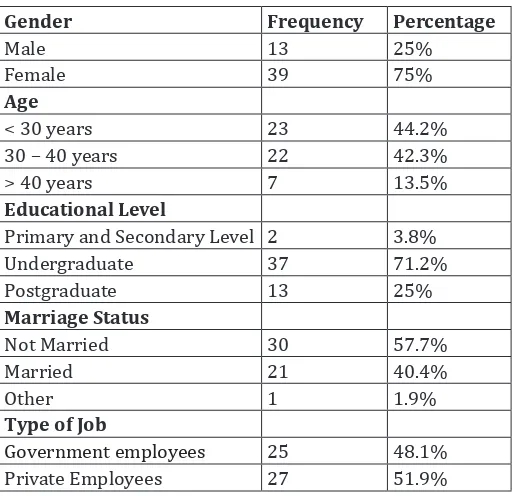
A total of 52 respondents took part on this study. The general description of respondents’ demographic characteristics can be explained by Table 1. The majority of the respondents ware female (75%) and the highest respondents were from the age group below 30 years old. Most of the respondents’ education level was undergraduate and the highest type of job was from private employees. The majority of respondent were also still not married.
Table 1 Demographic Characteristics
Gender Frequency Percentage
Male 13 25%
Female 39 75%
Age
< 30 years 23 44.2%
30 – 40 years 22 42.3%
> 40 years 7 13.5%
Educational Level
Primary and Secondary Level 2 3.8%
Undergraduate 37 71.2%
Postgraduate 13 25%
Marriage Status
Not Married 30 57.7%
Married 21 40.4%
Other 1 1.9%
Type of Job
Government employees 25 48.1%
Reliability and Validity 4.
According to Sugiyono (2016), a valid instrument means that the instrument can be used to measure what should be measured. Meanwhile, a reliable instrument is an instrument that, when used multiple times to measure the same object will produce the same data. Validity testing can be done by using Pearson Moment Correlation technique. According to Masrun (1979), the minimum requirement to meet the valid criteria is
r-value ≥ 0.3. Based on the result of validity test, the instrument had been valid because r-value ≤ 0.30. Meanwhile, reliability
testing indicate that the instrument were reliable. It was indicated
by the value of Cronbach Coefficient Alpha. According to Sekaran (2003), the acceptable value of Cronbach Coefficient Alpha is 0.60
to 0.70. From the results of reliability testing in table 2 it can be seen that the value of Cronbach’s alpha is 0.900.
Table 2 Reliability Testing
Cronbach>s
Alpha
Cronbach>s Alpha Based
on Standardized Items N of Items
0.918 0.900 24
Multiple Linear Regression Analysis 5.
Multicollinearity, Autocorrelation, and Normality of Data
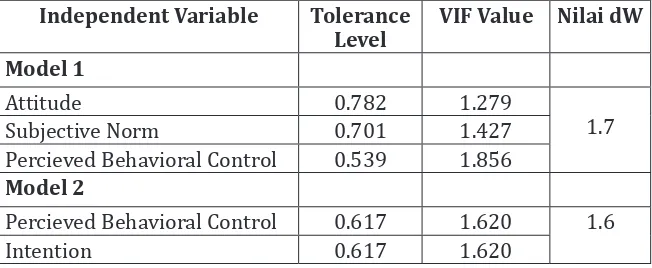
According to Nachrowi (2008),, it is necessary to meet classical assumption before conducting regression so that the interpretation of the regression result is not misleading. If the regression does not have multocollinearity problem, it is assumed that the independent variables in the regression equation have no linear relationship. According to Kleinbaum et al. (1988), there are two ways that can be used to detect the problem of collinearity, i.e
by tolerance test where there is no tolerance level ≤ 0.01 and all of the Variance Inflation Factor (VIF) values are below 10. Based
One-Sample test showed that data were normally distributed. This can
be seen from the significance value of 0.961 > 0.05. Table 3 Multicollinearity Test
Independent Variable Tolerance Level
VIF Value Nilai dW
Model 1
Attitude 0.782 1.279
1.7
Subjective Norm 0.701 1.427
Percieved Behavioral Control 0.539 1.856 Model 2
Percieved Behavioral Control 0.617 1.620 1.6
Intention 0.617 1.620
Hypothesis Testing 6.
This research was conducted to analyze the factors
influencing Muslims’ compliance behavior on paying Zakah on
income by using Theory of Planned Behavior. The research was conducted in the capital city of Papua Province, Jayapura, where it is a non-Muslim majority region in Indonesia. Multiple linear regression used to analysis two models of regression equation proposed. The independent variables of model 1 consisted of attitude, subjective norm, and perceived behavioral control, while the dependent variable was Muslims’ intention to pay Zakah on income. In model 2, the independent variables were Muslim’s intention in paying zakah of income and perceived behavioral control, while the dependent variable were Muslims’ compliance behavior on paying Zakah on income.
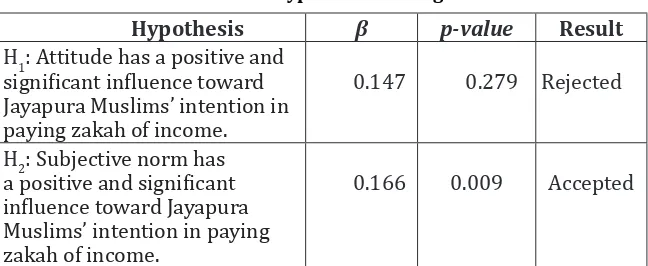
The result of regression in model 1 showed that the
subjective norm and perceived behavioral control influenced Muslims’s intention in paying zakah of income significantly. Meanwhile, attitude has no significant effect on Muslims’ intention
regression in model 2 indicated that both the variable of Muslims’ intention to pay Zakah on income and perceived behavioral
control significantly influence Muslims’ compliance behavior on
paying Zakah on income. The p-value of the two variables were
Dependent variable: Muslims’ intention in paying zakah of income
Table 5 Regression Result (Model 2)
Variabel β t-value p-value
Constant 2.366 0.714 0.478**
Percieved Behavioral Control 0.337 1.647 0.106**
Muslims’ intention in paying zakah of income
1.575 5.627 0.000**
Note: Significance: *p < 0.05; **p < 0.1; R2 = 0.776, adjusted R2 = 0.602; Dependent variable: Muslim’s compliance behavior on paying Zakah on income
H3: Perceived behavioral
H4: Perceived behavioral control has a positive and The investigation used the Theory of Planned Behavior initiated by Ajzen and Fishbein (1991). In this research, there were two regression model proposed. The R2 value of model 1 indicated that the three independent variables, i.e attitude, subjective norm, and perceived behavioral control could explain the variance of Muslims’ intention in paying zakah of income of 68.7%, while the remaining 31.3% could be explained by other factors not included in this study. The result also showed that all independent variables simultaneously affect the Muslims’ intention in paying zakah of income. This could be seen from the F-value of 14,263 where the
significance value is 0.000 <0.05.
Meanwhile, the partial test result using t test indicated that
attitude did not influence Muslims’ intention in paying zakah of income significantly. This can be seen from the t-test value that is equal to 1.095 with significance level of 0.279 > 0.05. These
behavioral intention significantly because essentially Zakah on
income has not been universally accepted and the understanding of each individual regarding Zakah on income is also still different. In this study, around 80% of the respondents stated that Zakah on income is mandatory, however only 60% of the respondents stated that Zakah issued is to help Muslim fellow and to purify his wealth or income.
The results of this study indicated that subjective norm
significantly influenced the Muslims’ intention in paying zakah of
income. It could be seen from the value of t-test that is equal to
2.710 with the significance level of 0.009 < 0.05. This result is in
line with the result found by Sapingi et al (2011). In this study, although most respondents stated that they pay Zakah on income
not because of the influence of preacher (Ustad/Kiyai/Mubaligh)
or their employer, but more than 80% of the respondents agreed that their close related person also paid Zakah and supported them to pay Zakah on income. According to Ajzen (2005), individual tends to feel social pressure to engage in behavior if social referrals recommend doing so. In this case, the social referrals are the closest people such as family and friends.
The result of the research also showed that perceived
behavior control influenced Muslims’ intention in paying zakah of income significantly. It was indicated by t-value of 3.304 < 0.05 and the significance value was 0.002. This study is similar
to Aji (2014), Sepryana (2013), and Huda & Gofur (2012) who
found that perceived behavior control significantly influenced the
intention of paying Zakah on income. It indicated that there is no obstacle met to be able to pay Zakah on income. From the results of this study, most of the respondents stated that the place to pay Zakah can be reached easily. In addition, they also had income that reached nishab of Zakat al Mal.
77.6%, while the 22.4% could be explained by other factors not included in this study. F-value indicated that all the independent variables simultaneously affect Muslims’ compliance behavior on
paying Zakah on income. The F-value was 37.125 and significance
value was 0.000 <0.05. Meanwhile, partial test results showed that both Muslims’ intention in paying zakah of income and perceived behavioral control affected Muslims’ compliance behavior. According to Ajzen (2005), if the individual has the intention to perform a behavior, then the individual tends to do a behavior. The results of this study are also in accordance with
Saad et al. (2010) who found the significantly affect of intention
to the compliance behavior on paying Zakah. Overall, the results of this study indicated that the Theory of Planned Behavior can be used to analyze and understand the complaince behavior of Muslims on paying Zakah on income.
Conclusion C.
Based on the result of this research, it can be concluded that
subjective norm and perceived behavioral control significantly influenced Muslims’ intention in paying zakah of income in
Jayapura, a non-Muslim majority region in Indonesia, while attitude
did not significantly influence Muslims’ intention in paying zakah
of income. In addition, both Muslims’ intention in paying zakah
of income and perveived behavioral control influence Muslims’
increase the understanding and the importance of paying Zakah on income to the Muslims’ society by conducting some studies, seminars or socialization regarding Zakah on income. In addition, additional facilities are needed to facilitate the Muslims citizen to pay Zakah on income and obtain information about Zakah easily.
There are some limitations in this study, such as the number of respondents and the variables analyzed. Therefore, it is suggested for further research to continue by increasing the number of respondents so that the result can represent the overall condition of Jayapura, and also it is needed to add more factors
as the independent variables to see other factors influencing the
References
________. 2017. Data Badan Pusat Statistik Provinsi Jayapura.
Retrieved fromhttp://Jayapura.bps.go.id on 20 May 2017.
________. 2017. Zakah Profesi. Badan Amil Zakah Nasional (Baznas). Retrieved from http://pusat.baznas.go.id on 28 May2017.
Ahmad, N & Mohamad, M. 2011. A study on zakah of employment
income: Factors that influence academics’ intention to
pay zakah. 2nd International Conference on Business and
Economic Research (ICBER) Proceeding.
Aji, Hustomo. 2014. Intensi Muzakki Membayar Zakah Pendekatan
Teori Planned Behaviour Modifikasi (Studi Terhadap
Pegawai Kementerian Agama Pusat). BIMAS Islam Journal, vol.7. no.3, ISSN: 1978-9009. Kementerian Agama RI, Jakarta.
Ajzen, Icek. 1991. Theory of planned behavior. Organization Behavior and Human Decision Professes 50.
Ajzen, Icek. 2005. Atitudes, personality and behavior. 2nd edition. New York: Open University Press.
Badan Pusat Statistik. 2017. Data Kependudukan. Retrieved from
http://bps.go.id on 28 May 2017.
Bagir, Muhammad. 2008. Fiqih Praktis I. Bandung: Mizan Media Utama.
Bidin, Zainol, Deraman, Mat Jusoh., & Othman, Mohd Zainuddin. 2016. The relationship among attitude, subjective norm and behavioral intention on zakah. 3rd International Conference
on Masjid, Zakah and Waqf (IMAF) Proceeding, Malaysia. Bidin, Zainol., Idris, Kamil Md, Shamsudin, Faridahwati, Mohd.
Departemen Agama. 1983. Ilmu Giqih Jilid I. Jakarta: Direktorat Pembinaan Perguuan Tinggi Agama Islam.
Ferdinand, Augisty. 2005. Structural Equation Modelling Dalam Penelitian Manajemena: Aplikasi Model-model Rumit dalam Penelitian untuk Tesis Magister dan Disertasi Doktor.
Semarang: Badan Penerbit Universitas Diponegoro.
Firdaus, Muhammad, Beik, Irfan Syauqi, Irawan, Tonny, & Juanda, Bambang. 2012. Economic estimation and determinations of Zakah potential in Indonesia. Working Paper of Islamic Research and Training Instritute 1433-07. Malaysia.
Given, Lisa .M. (Ed). 2008. The sage encyclopedia of qualitative research methods. California: SAGE Publication, Inc.
Heikal, Mohd, Khaddafi, Muammar, & Falahuddin. 2014. The
intention to pay Zakah commercial: An application of revised theory of planned behavior. Journal of Economics and Behavioral Studies. Indonesia.
Huda, Nurul & Gofur, Abdul. 2012. Analisis intensi muzaki dalam membayar Zakah profesi. Al-Iqtishad Vol.IV, No.2.
Masrun. 1979. Reliabilitas dan Cara-cara Menentukannya.
Universitas Gajah Mada.
Muhammad. 2002. Zakah Profesi, Wacana Pemikiran Dalam Fiqih Kontemporer. Jakarta: Salemba Diniyah.
Nachrowi, Nachrowi Djalal & Usman, Hardius. 2008.
Penggunaan teknik ekonometri (Edisi Revisi). Jakarta: PT.
RajaGrafindo Persada.
Nashwan, Saeed Awadh, Jabbar, Hijatullah Abdul, Romle, Abd Rahim. 2016. The application of theory of planned behaviour on business zakah compliance in Yemen: A proposed framework. Middle-East Jounal of Scientific
Nasution, Mustafa Edwin, Setyanto, Budi, Huda, Nurul, Mufraeni, Muhammad Arief, & Utama, Bey Sapta. 2006. Pengenalan Eksklusif: Ekonomi Islam. Jakarta: PT. Kencana Prenada Media Group.
Noor, Azura Mohd & Saad, Ram Al Jaffri. 2016. The impact of Attitude and perceived service quality on zakah compliance behavior: The mediating effect o trust. ISSC 2016: International Soft Science Conference, The European Proceeding of Social and Behavioural Scinece eISSN: 2357- 1330.
Saad, Ram Al Jaffri., Bidin, Zainol., Idris Kamil Mohd & Hussain Mohd H Mohd. 2010. “Faktor-faktor yang mempengaruhi gelagat kepatuhan Zakah perniagaan”. Pengurusan 30 Journal. Malaysia.
Sapingi, Raedah., Ahmad, Noormala, & Mohamad, Marziana. 2011. A Study On zakah of Employment Income: Factors
That Influence Academics’ Intention To Pay Zakah. 2nd
International Conference on Business and Economic Research. Proceeding.
Sekaran, Uma. 2003. Research Methods for Business: a Skill Building Approach (4th ed.). United States of America: John Wiley and Sons, Inc.
Sepryna, Anissa, & Ratnasari, Nissa Ghulma. 2013. Pengaruh Sikap, Norma Subjektif dan Kontrol Perilaku Yang dirasakan Terhadap Niat, Serta Pengaruh Niat terhadap Kepatuhan Membayar Zakah Penghasilan. Jurnal UI-ANA. Universitas Indonesia.
Sugiono. 2008. Metode penelitian kuantitatif kualitatif & R dan D.
Bandung: Alfabeta.