OPENSSL
COOKBOOK
A Guide to the Most Frequently Used
OpenSSL Features and Commands
Ivan Ristić
fffUTXbchSdRZR^\
FINE TECHNOLOGY BOOKS
BULLETPROOF
SSL / TLS AND PKI
The Complete Guide to Securely Using SSL/TLS and PKI in Infrastructure Deployment and Web Application Development
Ivan Ristić
Free edition: Getting Started
The complete guide to securely using SSL/TLS
and PKI in infrastructure deployment and
OpenSSL Cookbook
OpenSSL Cookbook
by Ivan Ristić
Version 1.1, published in October 2013.
Copyright © 2013 Feisty Duck Limited. All rights reserved.
First published in May 2013.
ISBN: 978-1907117053
Feisty Duck Limited
www.feistyduck.com [email protected]
Address:
6 Acantha Court Montpelier Road London W5 2QP United Kingdom
Production editor: Jelena Girić-Ristić
Copyeditors: Melinda Rankin, Nancy Wolfe Kotary
All rights reserved. No part of this publication may be reproduced, stored in a retrieval system, or transmitted, in any form or by any means, without the prior permission in writing of the publisher.
The author and publisher have taken care in preparation of this book, but make no expressed or implied warranty of any kind and assume no responsibility for errors or omissions. No liability is assumed for incidental or consequential damages in connection with or arising out of the use of the information or programs contained herein.
Table of Contents
Preface . . . v
Feedback vi
About Bulletproof SSL/TLS and PKI vi
About the Author vi
1. OpenSSL Cookbook . . . 1
Getting Started 2
Determine OpenSSL Version and Configuration 2
Building OpenSSL 3
Examine Available Commands 4
Building a Trust Store 5
Key and Certificate Management 7
Key Generation 7
Creating Certificate Signing Requests 11
Creating CSRs from Existing Certificates 13
Unattended CSR Generation 13
Signing Your Own Certificates 13
Creating Certificates Valid for Multiple Hostnames 14
Examining Certificates 15
Key and Certificate Conversion 18
Configuration 20
Cipher Suite Selection 21
Performance 31
A. SSL/TLS Deployment Best Practices . . . 35
Introduction 35
1. Private Key and Certificate 36
1.1. Use 2048-bit Private Keys 36
1.2. Protect Private Keys 36
1.3. Ensure Sufficient Hostname Coverage 36
iv
2. Configuration 38
2.1. Deploy with Complete and Valid Certificate Chains 38
2.2. Use Only Secure Protocols 38
2.3. Use Only Secure Cipher Suites 39
2.4. Control Cipher Suite Selection 39
2.5. Support Forward Secrecy 40
2.6. Disable Client-Initiated Renegotiation 40
2.7. Mitigate Known Problems 40
3. Performance 41
3.1. Do Not Use Too-Strong Private Keys 42
3.2. Ensure That Session Resumption Works Correctly 42
3.3. Use Persistent Connections (HTTP) 42
3.4. Enable Caching of Public Resources (HTTP) 42
4. Application Design (HTTP) 42
4.1. Encrypt 100% of Your Web Site 43
4.2. Avoid Mixed Content 43
4.3. Understand and Acknowledge Third-Party Trust 43
4.4. Secure Cookies 44
4.5. Deploy HTTP Strict Transport Security 44
4.6. Disable Caching of Sensitive Content 44
4.7. Ensure That There Are No Other Vulnerabilities 44
5. Validation 45
6. Advanced Topics 45
Changes 46
Version 1.3 (17 September 2013) 46
Acknowledgments 46
About SSL Labs 47
About Qualys 47
B. Changes . . . 49
v1.0 (May 2013) 49
Preface
For all its warts, OpenSSL is one of the most successful and most important open source projects. It’s successful because it’s so widely used; it’s important because the security of large parts of the Internet infrastructure relies on it. The project consists of a high-performance implementation of key cryptographic algorithms, a complete SSL/TLS and PKI stack, and a command-line toolkit. I think it’s safe to say that if your job has something to do with security, web development, or system administration, you can’t avoid having to deal with OpenSSL on at least some level.
This book is intended primarily for OpenSSL users who need to perform routine tasks of key and certificate generation and configure programs that rely on OpenSSL for SSL/TLS func-tionality. The majority of the Internet is powered by open source products, and virtually all of those projects rely on OpenSSL. Apache httpd has long been a favorite, but it’s now being pursued by nginx, which is increasingly gaining in popularity. And, even in the Java camp, Apache Tomcat performs better when coupled with OpenSSL, replacing the native Java im-plementation of SSL/TLS.
This book is—at least at the moment—built around a chapter from my third book, Bullet-proof SSL/TLS and PKI. I’m still writing it. I’ve decided to make the OpenSSL chapter free because this very successful open source project is not very well documented and because the documentation that you can find on the Internet is often wrong and outdated. Thus, good documentation is in great demand.
vi Preface
Feedback
Reader feedback is always very important, but especially so in this case, because this is a living book. In traditional publishing, often years pass before reader feedback goes back into the book, and then only if another edition actually sees the light of day (which often does not happen for technical books, because of the small market size). With this book, you’ll see new content appear in a matter of days. Ultimately, what you send to me will affect how the book will evolve.
The best way to contact me is to use my email address, [email protected]. Sometimes I may also be able to respond via Twitter, where you will find me at @ivanristic.
About Bulletproof SSL/TLS and PKI
Bulletproof SSL/TLS and PKI, the book that I’m working on at the moment, is the book I wish I had back when I was starting to get involved with SSL. I don’t remember when I started using SSL, but I do remember that when I was writing my first book, Apache Security, I began to appreciate the complexities of cryptography. I even began to like it. Before that point I thought that SSL was simple, but then I realized how vast the world of crypto actually is.
In 2009 I began to work on SSL Labs, and for me, the world of cryptography began to unravel. Fast-forward a couple of years, and in 2013 I still feel like I’m only starting. Cryptography is a unique field in which the more you learn, the less you know.
In supporting the SSL Labs users over the years, I’ve realized that there’s a lot of documenta-tion on SSL/TLS and PKI but also that it suffers from two problems: (1) it’s not documented in one place, so the little bits and pieces (e.g., RFCs) are difficult to find, and (2) it tends to be very detailed and low level. It took me years of work and study to begin to understand the entire ecosystem.
Bulletproof SSL/TLS and PKI aims to address the documentation gap, as a very practical book that first paints the whole picture and then proceeds to discuss the bits and pieces that you need in daily work, going as deep as needed to explain what you need to know.
About the Author
1
1
OpenSSL Cookbook
OpenSSL is an open source project that consists of a cryptographic library and an SSL toolkit. From the project’s web site:
The OpenSSL Project is a collaborative effort to develop a robust, commer-cial-grade, full-featured, and Open Source toolkit implementing the Secure Sockets Layer (SSL) and Transport Layer Security (TLS) protocols as well as a full-strength general purpose cryptography library. The project is managed by a worldwide community of volunteers that use the Internet to communicate, plan, and develop the OpenSSL toolkit and its related documentation.
OpenSSL is a de facto standard in this space and comes with a long history. The code initially began its life in 1995 under the name SSLeay,1 when it was developed by Eric A. Young and Tim J. Hudson. The OpenSSL project was born in the last days of 1998, when Eric and Tim stopped their work on SSLeay to work on a commercial SSL toolkit called BSAFE SSL-C at RSA Australia.
Today, OpenSSL is ubiquitous on the server side and in many client tools. Interestingly, browsers tend to use other libraries. The command-line tools provided by OpenSSL are most commonly used to manage keys and certificates.
OpenSSL is dual-licensed under OpenSSL and SSLeay licenses. Both are BSD-like, with an advertising clause. The license has been a source of contention for a very long time, because neither of the licenses is considered compatible with the GPL family of licenses. For that rea-son, you will often find that GPL-licensed programs favor GnuTLS.
1
Getting Started
If you’re using one of the Unix platforms, getting started with OpenSSL is easy; you’re virtually guaranteed to already have it on your system. The only problem that you might face is that you might not have the latest version. In this section, I assume that you’re using a Unix platform, because that’s the natural environment for OpenSSL.
Windows users tend to download binaries, which might complicate the situation slightly. In the simplest case, if you need OpenSSL only for its command-line utilities, the main OpenSSL web site links to Shining Light Productions for the Windows binaries. In all other situations, you need to ensure that you’re not mixing binaries compiled under different versions of OpenSSL. Otherwise, you might experience crashes that are difficult to troubleshoot. The best approach is to use a single bundle of programs that includes everything that you need. For example, if you want to run Apache on Windows, you can get your binaries from the Apache Lounge.
Determine OpenSSL Version and Configuration
Before you do any work, you should know which OpenSSL version you’ll be using. For exam-ple, here’s what I get for version information with openssl version on Ubuntu 12.04 LTS, which is the system that I’ll be using for the examples in this chapter:
$ openssl version
OpenSSL 1.0.1 14 Mar 2012
At the time of this writing, a transition from OpenSSL 0.9.x to OpenSSL 1.0.x is in progress. The version 1.0.1 is especially significant because it is the first version to support TLS 1.1 and TLS 1.2. The support for newer protocols is part of a global trend, so it’s likely that we’re going to experience a period during which interoperability issues are not uncommon.
Note
Various operating systems often modify the OpenSSL code, usually to fix known is-sues. However, the name of the project and the version number generally stay the same, and there is no indication that the code is actually a fork of the original project that will behave differently. For example, the version of OpenSSL used in Ubuntu 12.04 LTS2 is based on OpenSSL 1.0.1c. At the time of this writing, the full name of the package is openssl 1.0.1-4ubuntu5.5, and it adds 44 patches to OpenSSL 1.0.1c.
2
Building OpenSSL 3
To get complete version information, use the -a switch:
$ openssl version -a OpenSSL 1.0.1 14 Mar 2012
built on: Wed May 23 00:01:41 UTC 2012 platform: debian-amd64
options: bn(64,64) rc4(16x,int) des(idx,cisc,16,int) blowfish(idx)
compiler: cc -fPIC -DOPENSSL_PIC -DZLIB -DOPENSSL_THREADS -D_REENTRANT -DDSO_DLFCN … -DHAVE_DLFCN_H -m64 -DL_ENDIAN -DTERMIO -g -O2 -fstack-protector …
--param=ssp-buffer-size=4 -Wformat -Wformat-security -Werror=format-security -D… _FORTIFY_SOURCE=2 -Wl,-Bsymbolic-functions -Wl,-z,relro -Wa,--noexecstack -Wall … -DOPENSSL_NO_TLS1_2_CLIENT -DOPENSSL_MAX_TLS1_2_CIPHER_LENGTH=50 -DMD32_REG_T=int … -DOPENSSL_IA32_SSE2 -DOPENSSL_BN_ASM_MONT -DOPENSSL_BN_ASM_MONT5 -DOPENSSL_BN_ASM… _GF2m -DSHA1_ASM -DSHA256_ASM -DSHA512_ASM -DMD5_ASM -DAES_ASM -DVPAES_ASM -DBSAES… _ASM -DWHIRLPOOL_ASM -DGHASH_ASM
OPENSSLDIR: "/usr/lib/ssl"
The last line in the output (/usr/lib/ssl) is especially interesting because it will tell you where OpenSSL will look for its configuration and certificates. On my system, that location is essen-tially an alias for /etc/ssl, where Ubuntu keeps SSL-related files:
lrwxrwxrwx 1 root root 14 Apr 19 09:28 certs -> /etc/ssl/certs drwxr-xr-x 2 root root 4096 May 28 06:04 misc
lrwxrwxrwx 1 root root 20 May 22 17:07 openssl.cnf -> /etc/ssl/openssl.cnf lrwxrwxrwx 1 root root 16 Apr 19 09:28 private -> /etc/ssl/private
The misc/ folder contains a few supplementary scripts, the most interesting of which are the scripts that allow you to implement a custom Certificate Authority (CA).
Building OpenSSL
In most cases, you will be using the operating system–supplied version of OpenSSL, but some-times there are good reasons to upgrade. For example, your current server platform may still be using OpenSSL 0.9.x, and you might want to support newer protocol versions (available only in OpenSSL 1.0.1). Further, the newer versions may not have all the features you need. For example, on Ubuntu 12.04 LTS, there’s no support for SSL 2.0 in the s_client command. Although not supporting this version of SSL by default is the right decision, you’ll need this feature if you’re routinely testing other servers for SSL 2.0 support.
You can start by downloading the most recent version of OpenSSL (in my case, 1.0.1c):
$ wget http://www.openssl.org/source/openssl-1.0.1c.tar.gz
$ ./config --prefix=/opt/openssl --openssldir=/opt/openssl
You can then follow with:
$ make
$ sudo make install
You’ll get the following in /opt/openssl:
drwxr-xr-x 2 root root 4096 Jun 3 08:49 bin drwxr-xr-x 2 root root 4096 Jun 3 08:49 certs drwxr-xr-x 3 root root 4096 Jun 3 08:49 include drwxr-xr-x 4 root root 4096 Jun 3 08:49 lib drwxr-xr-x 6 root root 4096 Jun 3 08:48 man drwxr-xr-x 2 root root 4096 Jun 3 08:49 misc -rw-r--r-- 1 root root 10835 Jun 3 08:49 openssl.cnf drwxr-xr-x 2 root root 4096 Jun 3 08:49 private
The private/ folder is empty, but that’s normal; you do not yet have any private keys. On the other hand, you’ll probably be surprised to learn that the certs/ folder is empty too. OpenSSL does not include any root certificates; maintaining a trust store is considered outside the scope of the project. Luckily, your operating system probably already comes with a trust store that you can use. You can also build your own with little effort, as you’ll see in the next section.
Examine Available Commands
OpenSSL is a cryptographic toolkit that consists of many different utilities. I counted 46 in my version. If it were ever appropriate to use the phrase Swiss Army knife of cryptography, this is it. Even though you’ll use only a handful of the utilities, you should familiarize yourself with everything that’s available, because you never know what you might need in the future.
There isn’t a specific help keyword, but help text is displayed whenever you type something OpenSSL does not recognize:
$ openssl help
openssl:Error: 'help' is an invalid command.
Standard commands
Building a Trust Store 5
rsa rsautl s_client s_server s_time sess_id smime speed spkac srp ts verify version x509
The first part of the help output lists all available utilities. To get more information about a particular utility, use the man command followed by the name of the utility. For example, man ciphers will give you detailed information on how cipher suites are configured.
Help output doesn’t actually end there, but the rest is somewhat less interesting. In the second part, you get the list of message digest commands:
Message Digest commands (see the `dgst' command for more details) md4 md5 rmd160 sha
sha1
And then, in the third part, you’ll see the list of all cipher commands:
Cipher commands (see the `enc' command for more details)
aes-128-cbc aes-128-ecb aes-192-cbc aes-192-ecb aes-256-cbc aes-256-ecb base64 bf
bf-cbc bf-cfb bf-ecb bf-ofb
camellia-128-cbc camellia-128-ecb camellia-192-cbc camellia-192-ecb camellia-256-cbc camellia-256-ecb cast cast-cbc
OpenSSL does not come with any trusted root certificates (also known as a trust store), so if you’re installing from scratch you’ll have to find them somewhere else. One possibility is to use the trust store built into your operating system. This choice is usually fine, but default trust stores may not always be up to date. A better choice—but one that involves more work —is to turn to Mozilla, which is putting a lot of effort into maintaining a robust trust store. For example, this is what I did for my assessment tool on SSL Labs.
Because it’s open source, Mozilla keeps the trust store in the source code repository:
Unfortunately, their certificate collection is in a proprietary format, which is not of much use to others as is. If you don’t mind getting the collection via a third party, the Curl project provides a regularly-updated conversion in Privacy-Enhanced Mail (PEM) format, which you can use directly:
http://curl.haxx.se/docs/caextract.html
But you don’t have to write a conversion script if you’d rather download directly from Mozilla. Conversion scripts are available in Perl or Go. I describe both in the following sections.
Note
If you do end up working on your own conversion script, note that Mozilla’s root certificate file actually contains two types of certificates: those that are trusted and are part of the store and also those that are explicitly distrusted. They use this mechanism to ban compromised intermediate CA certificates (e.g., DigiNotar’s old certificates). Both conversion tools described here are smart enough to exclude dis-trusted certificates during the conversion process.
Conversion Using Perl
The Curl project makes available a Perl script written by Guenter Knauf that can be used to convert Mozilla’s trust store:
https://raw.github.com/bagder/curl/master/lib/mk-ca-bundle.pl
After you download and run the script, it will fetch the certificate data from Mozilla and convert it to the PEM format:
$ ./mk-ca-bundle.pl
Downloading 'certdata.txt' ... Processing 'certdata.txt' ...
Done (156 CA certs processed, 19 untrusted skipped).
If you keep previously downloaded certificate data around, the script is also smart enough to perform new conversations only when data is updated.
Conversion Using Go
If you prefer the Go programming language, Adam Langley has a conversion tool in it that you can find on GitHub:
https://github.com/agl/extract-nss-root-certs
Key and Certificate Management 7
$ wget https://raw.github.com/agl/extract-nss-root-certs/master/convert_mozilla… _certdata.go
Then download Mozilla’s certificate data:
$ wget https://mxr.mozilla.org/mozilla/source/security/nss/lib/ckfw/builtins… /certdata.txt?raw=1 --output-document certdata.txt
Finally, convert the file with the following command:
$ go run convert_mozilla_certdata.go > ca-certificates
2012/06/04 09:52:29 Failed to parse certificate starting on line 23068: negative … serial number
In my case, there was one invalid certificate, but otherwise the conversion worked.
Key and Certificate Management
Most users turn to OpenSSL because they wish to configure and run a web server that sup-ports SSL. That process consists of three steps: (1) generate a strong private key, (2) cre-ate a Certificate Signing Request (CSR) and send it to a CA, and (3) install the CA-provided certificate in your web server. These steps (and a few others) are covered in this section.
Key Generation
The first step in preparing for the use of public encryption is to generate a private key. Before you begin, you must make several decisions:
Key algorithm
OpenSSL supports RSA, DSA, and ECDSA keys, but not all types are practical for use in all scenarios. For example, for SSL keys everyone uses RSA, because DSA keys are effec-tively limited to 1024 bits (Windows doesn’t support anything stronger) and ECDSA keys are yet to be widely supported by CAs. For SSH, DSA and RSA are widely used, whereas ECDSA might not be supported by all clients.
Key size
Passphrase
Using a passphrase with a key is optional, but strongly recommended. Protected keys can be safely stored, transported, and backed up. On the other hand, such keys are inconvenient, because they can’t be used without their passphrases. For example, you might be asked to enter the passphrase every time you wish to restart your web server. For most, this is either too inconvenient or has unacceptable availability implications. In addition, using protected keys in production does not actually increase the securi-ty much, if at all. This is because, once activated, private keys are kept unprotected in program memory; an attacker who can get to the server can get the keys from there with just a little more effort. Thus, passphrases should be viewed only as a mechanism for protecting private keys when they are not installed on production systems. In other words, it’s all right to keep passphrases on production systems, next to the keys. This, although not ideal, is much better than using unprotected keys. If you need better se-curity, you should invest in a hardware solution.3
To generate an RSA key, use the genrsa command:
$ openssl genrsa -aes128 -out fd.key 2048
Generating RSA private key, 2048 bit long modulus ....+++
...… +++
e is 65537 (0x10001)
Enter pass phrase for fd.key: ****************
Verifying - Enter pass phrase for fd.key: ****************
Here, I specified that the key be protected with AES-128. You can also use AES-192 or AES-256 (switches -aes192 and -aes256, respectively), but it’s best to stay away from the other algo-rithms (DES, 3DES, and SEED).
Warning
The e value that you see in the output refers to the public exponent, which is set to 65537 by default. This is what’s known as a short public exponent, and it significantly improves the performance of RSA verification. Using the -3 switch, you can choose 3 as your public exponent and make verification even faster. However, there are some unpleasant historical weaknesses associated with the use of 3 as a public exponent,
3
Key Generation 9
which is why generally everyone recommends that you stick with 65537. The latter choice provides a safety margin that’s been proven effective in the past.
Private keys are stored in the so-called PEM format, which is ASCII:
$ cat fd.key
A private key isn’t just a blob of random data, even though that’s what it looks like at a glance. You can see a key’s structure using the following rsa command:
$ openssl rsa -tex -in fd.key
[...]
---END RSA PRIVATE
KEY---If you need to generate the corresponding public key, you can do that with the following rsa
command:
$ openssl rsa -in fd.key -pubout -out fd-public.key Enter pass phrase for fd.key: ****************
The public key is much shorter than the private key:
$ cat fd-public.key
It’s good practice to verify that the output contains what you’re expecting. For example, if you forget to include the -pubout switch on the command line, the output will contain your private key instead of the public key.
DSA key generation is a two-step process: DSA parameters are created in the first step and the key in the second. Rather than execute the steps one at a time, I tend to use the following two commands as one:
$ openssl dsaparam -genkey 2048 | openssl dsa -out dsa.key -aes128 Generating DSA parameters, 2048 bit long prime
This could take some time [...]
read DSA key writing DSA key
Enter PEM pass phrase: ****************
Verifying - Enter PEM pass phrase: ****************
This approach allows me to generate a password-protected key while avoiding leaving any temporary files (DSA parameters) and/or temporary keys on disk.
The process is similar for ECDSA keys, except that it isn’t possible to create keys of arbitrary sizes. Instead, for each key you select a named curve, which controls key size, but it controls other EC parameters as well. The following example creates a 256-bit ECDSA key using the
Creating Certificate Signing Requests 11
$ openssl ecparam -genkey -name secp256r1 | openssl ec -out ec.key -aes128 using curve name prime256v1 instead of secp256r1
read EC key writing EC key
Enter PEM pass phrase: ****************
Verifying - Enter PEM pass phrase: ****************
OpenSSL supports many named curves (you can see the full list if you specify the -list_curves
switch), but, for web server keys, you’re limited to only two curves that are supported by all major browsers: secp256r1 (OpenSSL uses the name prime256v1) and secp384r1.
Creating Certificate Signing Requests
Once you have a private key, you can proceed to create a Certificate Signing Request (CSR). This is a formal request asking a CA to sign a certificate, and it contains the public key of the entity requesting the certificate and some information about the entity. This data will all be part of the certificate.
CSR creation is usually an interactive process that takes the private server key as input. Read the instructions given by the openssl tool carefully; if you want a field to be empty, you must enter a single dot (.) on the line, rather than just hit Return. If you do the latter, OpenSSL will populate the corresponding CSR field with the default value. (This behavior doesn’t make any sense when used with the default OpenSSL configuration, which is what virtually everyone does. It does make sense once you realize you can actually change the defaults, either by mod-ifying the OpenSSL configuration or by providing your own configuration files.)
$ openssl req -new -key fd.key -out fd.csr Enter pass phrase for fd.key: ****************
You are about to be asked to enter information that will be incorporated into your certificate request.
What you are about to enter is what is called a Distinguished Name or a DN. There are quite a few fields but you can leave some blank
For some fields there will be a default value, If you enter '.', the field will be left blank.
---Country Name (2 letter code) [AU]:GB
State or Province Name (full name) [Some-State]:. Locality Name (eg, city) []:London
Organization Name (eg, company) [Internet Widgits Pty Ltd]:Feisty Duck Ltd Organizational Unit Name (eg, section) []:
Please enter the following 'extra' attributes to be sent with your certificate request A challenge password []:
An optional company name []:
Note
According to section 5.4.1 of RFC 2985, challenge password is an optional field that was intended for use during certificate revocation as a way of identifying the original entity that had requested the certificate. If entered, the password will be included verbatim in the CSR and communicated to the CA. It’s actually quite rare to find a CA that relies on this field, however. All instructions I’ve seen recommend leaving it alone. Having a challenge password does not increase the security of the CSR in any way. Further, this field should not be confused with the key passphrase, which is a separate feature.
After a CSR is generated, use it to sign your own certificate and/or send it to a public CA and ask him or her to sign the certificate. Both approaches are described in the following sections. But before you do that, it’s a good idea to double-check that the CSR is correct. Here’s how:
$ openssl req -text -in fd.csr -noout Certificate Request:
Data:
Version: 0 (0x0)
Subject: C=GB, L=London, O=Feisty Duck Ltd, CN=www.feistyduck.com… /[email protected]
Subject Public Key Info:
Public Key Algorithm: rsaEncryption Public-Key: (2048 bit)
Modulus:
00:b7:fc:ca:1c:a6:c8:56:bb:a3:26:d1:df:e4:e3: [16 more lines...]
d1:57
Exponent: 65537 (0x10001) Attributes:
a0:00
Signature Algorithm: sha1WithRSAEncryption
a7:43:56:b2:cf:ed:c7:24:3e:36:0f:6b:88:e9:49:03:a6:91: [13 more lines...]
Creating CSRs from Existing Certificates 13
Creating CSRs from Existing Certificates
You can save yourself some typing if you’re renewing a certificate and don’t want to make any changes to the information presented in it. With the following command, you can create a brand-new CSR from an existing certificate:
$ openssl x509 -x509toreq -in fd.crt -out fd.csr -signkey fd.key
Note
Unless you’re using some form of public key pinning and wish to continue using the existing key, it’s best practice to generate a new key every time you apply for a new certificate. Key generation is quick and inexpensive and reduces your exposure.
Unattended CSR Generation
CSR generation doesn’t have to be interactive. Using a custom OpenSSL configuration file, you can both automate the process (as explained in this section) and do certain things that are not possible interactively (as discussed in the next section).
For example, let’s say that we want to automate the generation of a CSR for
www.feistyduck.com. We would start by creating a file fd.cnf with the following contents:
[req] prompt = no
distinguished_name = distinguished_name
[distinguished_name] CN = www.feistyduck.com
emailAddress = [email protected] O = Feisty Duck Ltd
L = London C = GB
Now you can create the CSR directly from the command line:
$ openssl req -new -config fd.cnf -key fd.key -out fd.csr Enter pass phrase for fd.key: ****************
You’ll be asked for the passphrase only if you used one during key generation.
Signing Your Own Certificates
is to generate a self-signed certificate. If you’re a Firefox user, on your first visit to the web site you can create a certificate exception, after which the site will be as secure as if it were protected with a publicly trusted certificate.
If you already have a CSR, create a certificate using the following command:
$ openssl x509 -req -days 365 -in fd.csr -signkey fd.key -out fd.crt Signature ok
subject=/CN=www.feistyduck.com/[email protected]/O=Feisty Duck … Ltd/L=London/C=GB
Getting Private key
Enter pass phrase for fd.key: ****************
You don’t actually have to create a CSR in a separate step. The following command creates a self-signed certificate starting with a key alone:
$ openssl req -new -x509 -days 365 -key fd.key -out fd.crt
Creating Certificates Valid for Multiple Hostnames
With OpenSSL, by default, generated certificates have only one common name and are thus valid for only one hostname. Therefore, if you have several web sites, you must generate a sep-arate certificate for each site. When the same person or group of people maintain several web sites, it’s fine to use only one certificate for all of the sites; this is what multidomain certificates are for. Actually, even if you’re running a single web site, you should ensure that the certificate is valid for all possible paths that end users can take to reach it. In practice, this means using at least two names, one with the www prefix and one without (e.g., www.feistyduck.com and
feistyduck.com).
There are two mechanisms for supporting multiple hostnames in a certificate. The first is to list all desired hostnames using an X.509 extension called Subject Alternative Name (SAN). The second is to use wildcards. You can also use a combination of the two approaches when it’s more convenient. In practice, for most sites, you can specify a bare domain name and a wildcard to cover all the subdomains (e.g., feistyduck.com and *.feistyduck.com).
Warning
Examining Certificates 15
First, place the extension information in a separate text file. I’m going to call it fd.ext. In the file, specify the name of the extension (subjectAltName) and list the desired hostnames, as in the following example:
subjectAltName = DNS:*.feistyduck.com, DNS:feistyduck.com
Then, when using the x509 command to issue a certificate, refer to the file using the -extfile
switch:
$ openssl x509 -req -days 365 \
-in fd.csr -signkey fd.key -out fd.crt \
-extfile fd.ext
The rest of the process is no different from before. But when you examine the generated certificate afterward, you’ll find that it contains the SAN extension:
X509v3 extensions:
X509v3 Subject Alternative Name:
DNS:*.feistyduck.com, DNS:feistyduck.com
Examining Certificates
Most of the time, certificates appear to use what are essentially random arrays of bytes. But they contain a great deal of information; you just need to know how to unpack it. The x509
command does just that, so let’s look at our self-signed certificates.
In the following example, I use the -text switch to print certificate contents and -noout to reduce clutter by not printing the encoded certificate itself (which is the default behavior):
$ openssl x509 -text -in fd.crt -noout Certificate:
Data:
Version: 1 (0x0)
Serial Number: 13073330765974645413 (0xb56dcd10f11aaaa5) Signature Algorithm: sha1WithRSAEncryption
Issuer: CN=www.feistyduck.com/[email protected], … O=Feisty Duck Ltd, L=London, C=GB
Validity
Not Before: Jun 4 17:57:34 2012 GMT Not After : Jun 4 17:57:34 2013 GMT
Subject: CN=www.feistyduck.com/[email protected], … O=Feisty Duck Ltd, L=London, C=GB
Subject Public Key Info:
Public Key Algorithm: rsaEncryption Public-Key: (2048 bit)
00:b7:fc:ca:1c:a6:c8:56:bb:a3:26:d1:df:e4:e3: [16 more lines...]
d1:57
Exponent: 65537 (0x10001) Signature Algorithm: sha1WithRSAEncryption
49:70:70:41:6a:03:0f:88:1a:14:69:24:03:6a:49:10:83:20: [13 more lines...]
74:a1:11:86
Self-signed certificates usually contain only the most basic certificate data, as seen in the pre-vious example. By comparison, certificates issued by public CAs are much more interesting, as they contain a number of additional fields (via the X.509 extension mechanism). Let’s go over them quickly.
The Basic Constraints extension is used to mark certificates as belonging to a CA, giving them the ability to sign other certificates. Non-CA certificates will either have this extension omit-ted or will have the value of CA set to FALSE. This extension is critical, which means that all software-consuming certificates must understand its meaning.
X509v3 Basic Constraints: critical CA:FALSE
The Key Usage (KU) and Extended Key Usage (EKU) extensions restrict what a certificate can be used for. If these extensions are present, then only the listed uses are allowed. If the exten-sions are not present, there are no use restrictions. What you see in this example is typical for a web server certificate, which, for example, does not allow for code signing.
X509v3 Key Usage: critical
Digital Signature, Key Encipherment X509v3 Extended Key Usage:
TLS Web Server Authentication, TLS Web Client Authentication
The CRL Distribution Points extension lists the addresses where the CA’s Certificate Revoca-tion List (CRL) information can be found. This information is important in cases in which certificates need to be revoked. CRLs are CA-signed lists of revoked certificates, published at regular time intervals (e.g., seven days).
X509v3 CRL Distribution Points: Full Name:
URI:http://crl.starfieldtech.com/sfs3-20.crl
Note
Examining Certificates 17
that issued it, browsers are able to verify its integrity. In fact, if CRLs were distributed over SSL, browsers might face a chicken-and-egg problem in which they want to verify the revocation status of the certificate used by the server delivering the CRL itself!
The Certificate Policies extension is used to indicate the policy under which the certificate was issued. For example, this is where Extended Validation (EV) indicators can be found (as in the example that follows). The indicators are in the form of unique object identifiers (OIDs), and they are unique to the issuing CA. In addition, this extension often contains one or more
Certificate Policy Statement (CPS) points, which are usually web pages or PDF documents.
X509v3 Certificate Policies:
Policy: 2.16.840.1.114414.1.7.23.3
CPS: http://certificates.starfieldtech.com/repository/
The Authority Information Access (AIA) extension usually contains two important pieces of information. First, it lists the address of the CA’s Online Certificate Status Protocol (OCSP) responder, which can be used to check for certificate revocation in real time. The exten-sion may also contain a link to where the issuer’s certificate (the next certificate in the chain) can be found. These days, server certificates are rarely signed directly by trusted root certificates, which means that users must include one or more intermediate certificates in their configuration. Mistakes are easy to make and will invalidate the certificates. Some clients (e.g., Internet Explorer) can use the information provided in this extension to fix an incomplete certificate chain, but many don’t.
Authority Information Access:
OCSP - URI:http://ocsp.starfieldtech.com/
CA Issuers - URI:http://certificates.starfieldtech.com/repository/sf… _intermediate.crt
The Subject Key Identifier and Authority Key Identifier extensions establish unique subject and authority key identifiers, respectively. The value specified in the Authority Key Identifier ex-tension of a certificate must match the value specified in the Subject Key Identifier exex-tension in the issuing certificate. This information is very useful during the certification path-build-ing process, in which a client is trypath-build-ing to find all possible paths from a leaf (server) certificate to a trusted root. Certificate authorities will often use one private key with more than one certificate, and this field allows software to reliably identify which certificate can be matched to which key. In the real world, many certificate chains supplied by servers are invalid, but that fact often goes unnoticed because browsers are able to find alternative trust paths.
4A:AB:1C:C3:D3:4E:F7:5B:2B:59:71:AA:20:63:D6:C9:40:FB:14:F1 X509v3 Authority Key Identifier:
keyid:49:4B:52:27:D1:1B:BC:F2:A1:21:6A:62:7B:51:42:7A:8A:D7:D5:56
Finally, the Subject Alternative Name extension is used to list all the hostnames for which the certificate is valid. This extension is optional; if it isn’t present clients fall back to using the information provided in the Common Name (CN), which is part of the Subject field.
X509v3 Subject Alternative Name:
DNS:www.feistyduck.com, DNS:feistyduck.com
Key and Certificate Conversion
Private keys and certificates can be stored in a variety of formats, which means that you’ll often need to convert them from one format to another. The most common formats are:
Binary (DER) certificate
Contains an X.509 certificate in its raw form, using DER ASN.1 encoding.
ASCII (PEM) certificate(s)
Contains a base64-encoded DER certificate, with ---BEGIN CERTIFICATE--- used as the header and ---END CERTIFICATE--- as the footer. Usually seen with only one certificate per file, although some programs allow more than one certificate depending on the context. For example, the Apache web server requires the server certificate to be alone in one file, with all intermediate certificates together in another.
Binary (DER) key
Contains a private key in its raw form, using DER ASN.1 encoding. OpenSSL creates keys in its own traditional (SSLeay) format. There’s also an alternative format called PKCS#8 (defined in RFC 5208), but it’s not widely used. OpenSSL can convert to and from PKCS#8 format using the pkcs8 command.
ASCII (PEM) key
Contains a base64-encoded DER certificate with additional metadata (e.g., the algo-rithm used for password protection).
PKCS#7 certificate(s)
A complex format designed for the transport of signed or encrypted data, defined in RFC 2315. It’s usually seen with .p7b and .p7c extensions and can include the entire certificate chain as needed. This format is supported by Java’s keytool utility.
PKCS#12 (PFX) key and certificate(s)
Key and Certificate Conversion 19
.pfx extensions. This format is commonly used in Microsoft products. These days, the PFX name is used as a synonym for PKCS#12, even though PFX referred to a different format a long time ago (an early version of PKCS#12). It’s unlikely that you’ll encounter the old version anywhere.
PEM and DER Conversion
Certificate conversion between PEM and DER formats is performed with the x509 tool. To convert a certificate from PEM to DER format:
$ openssl x509 -inform PEM -in fd.pem -outform DER -out fd.der
To convert a certificate from DER to PEM format:
$ openssl x509 -inform DER -in fd.der -outform PEM -out fd.pem
The syntax is identical if you need to convert private keys between DER and PEM formats, but different commands are used: rsa for RSA keys, and dsa for DSA keys.
PKCS#12 (PFX) Conversion
One command is all that’s needed to convert the key and certificates in PEM format to PKCS#12:
$ openssl pkcs12 -export -out fd.p12 -inkey fd.key -in fd.crt -certfile … fd-chain.crt
Enter Export Password: ****************
Verifying - Enter Export Password: ****************
The reverse conversion isn’t as straightforward. You can use a single command, but in that case you’ll get the entire contents in a single file:
$ openssl pkcs12 -in fd.p12 -out fd.pem -nodes
Now, you must open the file fd.pem in your favorite editor and manually split it into individ-ual key, certificate, and intermediate certificate files. While you’re doing that, you’ll notice additional content provided before each component. For example:
Bag Attributes
localKeyID: E3 11 E4 F1 2C ED 11 66 41 1B B8 83 35 D2 DD 07 FC DE 28 76 subject=/1.3.6.1.4.1.311.60.2.1.3=GB/2.5.4.15=Private Organization…
/serialNumber=06694169/C=GB/ST=London/L=London/O=Feisty Duck Ltd… /CN=www.feistyduck.com
CERTIFICATE---MIIF5zCCBM+gAwIBAgIHBG9JXlv9vTANBgkqhkiG9w0BAQUFADCB3DELMAkGA1UE BhMCVVMxEDAOBgNVBAgTB0FyaXpvbmExEzARBgNVBAcTClNjb3R0c2RhbGUxJTAj [...]
This additional metadata is very handy to quickly identify the certificates. Obviously, you should ensure that the main certificate file contains the leaf server certificate and not some-thing else. Further, you should also ensure that the intermediate certificates are provided in the correct order, with the issuing certificate following the signed one. If you see a self-signed root certificate, feel free to delete it or store it elsewhere; it shouldn’t go into the chain.
Warning
The final conversion output shouldn’t contain anything apart from the encoded key and certificates. Although some tools are smart enough to ignore what isn’t needed, other tools are not. Leaving extra data in PEM files might result in problems that are difficult to troubleshoot.
It’s possible to get OpenSSL to split the components for you, but doing so requires multiple invocations of the pkcs12 command (including typing the bundle password each time):
$ openssl pkcs12 -in fd.p12 -nocerts -out fd.key -nodes $ openssl pkcs12 -in fd.p12 -nokeys -clcerts -out fd.crt $ openssl pkcs12 -in fd.p12 -nokeys -cacerts -out fd-chain.crt
This approach won’t save you much work. You must still examine each file to ensure that it contains the correct contents and to remove the metadata.
PKCS#7 Conversion
To convert from PEM to PKCS#7, use the crl2pkcs7 command:
$ openssl crl2pkcs7 -nocrl -out fd.p7b -certfile fd.crt -certfile fd-chain.crt
To convert from PKCS#7 to PEM, use the pkcs7 command with the -print_certs switch:
openssl pkcs7 -in fd.p7b -print_certs -out fd.pem
Similar to the conversion from PKCS#12, you must now edit the fd.pem file to clean it up and split it into the desired components.
Configuration
Cipher Suite Selection 21
use for communication. This topic is important because virtually every program that uses OpenSSL reuses its suite configuration mechanism. That means that once you learn how to configure cipher suites for one program, you can reuse the same knowledge elsewhere. The second topic is the performance measurement of raw crypto operations.
Cipher Suite Selection
A common task in SSL server configuration is selecting which cipher suites are going to be supported. Programs that rely on OpenSSL usually adopt the same approach to suite configuration as OpenSSL does, simply passing through the configuration options. For ex-ample, in Apache httpd, the cipher suite configuration may look like this:
SSLHonorCipherOrder On
SSLCipherSuite "RC4-SHA:HIGH:!aNULL"
The first line controls cipher suite prioritization (and configures httpd to actively select suites). The second line controls which suites will be supported.
Coming up with a good suite configuration can be pretty time consuming, and there are a lot of details to consider. The best approach is to use the OpenSSL ciphers command to deter-mine which suites are enabled with a particular configuration string.
Obtaining the List of Supported Suites
Before you do anything else, you should determine which suites are supported by your OpenSSL installation. To do this, invoke the ciphers command with the switch -v and the parameter ALL:COMPLEMENTOFALL (clearly, ALL does not actually mean “all”):
$ openssl ciphers -v 'ALL:COMPLEMENTOFALL'
ECDHE-RSA-AES256-GCM-SHA384 TLSv1.2 Kx=ECDH Au=RSA Enc=AESGCM(256) Mac=AEAD ECDHE-ECDSA-AES256-GCM-SHA384 TLSv1.2 Kx=ECDH Au=ECDSA Enc=AESGCM(256) Mac=AEAD ECDHE-RSA-AES256-SHA384 TLSv1.2 Kx=ECDH Au=RSA Enc=AES(256) Mac=SHA384 ECDHE-ECDSA-AES256-SHA384 TLSv1.2 Kx=ECDH Au=ECDSA Enc=AES(256) Mac=SHA384 ECDHE-RSA-AES256-SHA SSLv3 Kx=ECDH Au=RSA Enc=AES(256) Mac=SHA1 [106 more lines...]
Tip
In my case, there were 111 suites in the output. Each line contains information on one suite and the following bits:
1. Suite name
2. Required minimum protocol version
3. Key exchange algorithm
4. Authentication algorithm
5. Cipher algorithm and strength
6. MAC (integrity) algorithm
7. Export suite indicator
If you change the ciphers parameter to something other than ALL:COMPLEMENTOFALL, OpenSSL will list only the suites that match that configuration. For example, you can ask it to list only cipher suites that are based on RC4, as follows:
$ openssl ciphers -v 'RC4'
ECDHE-RSA-RC4-SHA SSLv3 Kx=ECDH Au=RSA Enc=RC4(128) Mac=SHA1 ECDHE-ECDSA-RC4-SHA SSLv3 Kx=ECDH Au=ECDSA Enc=RC4(128) Mac=SHA1 AECDH-RC4-SHA SSLv3 Kx=ECDH Au=None Enc=RC4(128) Mac=SHA1 ADH-RC4-MD5 SSLv3 Kx=DH Au=None Enc=RC4(128) Mac=MD5 ECDH-RSA-RC4-SHA SSLv3 Kx=ECDH/RSA Au=ECDH Enc=RC4(128) Mac=SHA1 ECDH-ECDSA-RC4-SHA SSLv3 Kx=ECDH/ECDSA Au=ECDH Enc=RC4(128) Mac=SHA1 RC4-SHA SSLv3 Kx=RSA Au=RSA Enc=RC4(128) Mac=SHA1 RC4-MD5 SSLv3 Kx=RSA Au=RSA Enc=RC4(128) Mac=MD5 PSK-RC4-SHA SSLv3 Kx=PSK Au=PSK Enc=RC4(128) Mac=SHA1 EXP-ADH-RC4-MD5 SSLv3 Kx=DH(512) Au=None Enc=RC4(40) Mac=MD5 export EXP-RC4-MD5 SSLv3 Kx=RSA(512) Au=RSA Enc=RC4(40) Mac=MD5 export
The output will contain all suites that match your requirements, even if they’re insecure. Clearly, you should choose your configuration strings carefully in order to activate only what’s secure. Further, the order in which suites appear in the output matters. When you configure your SSL server to actively select the cipher suite that will be used for a connection (which is the best practice and should always be done), the suites listed first are given priority.
Keywords
doc-Cipher Suite Selection 23
umentation for a comprehensive list of keywords, but it turns out that the ciphers documen-tation is not up to date; it’s missing some more recent additions. For that reason, I’ll try to document all the keywords in this section.
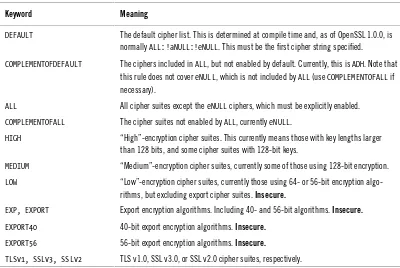
Group keywords are shortcuts that select frequently used cipher suites. For example, HIGH will select only very strong cipher suites.
Table 1.1. Group keywords
Keyword Meaning
DEFAULT The default cipher list. This is determined at compile time and, as of OpenSSL 1.0.0, is normally ALL:!aNULL:!eNULL. This must be the first cipher string specified.
COMPLEMENTOFDEFAULT The ciphers included in ALL, but not enabled by default. Currently, this is ADH. Note that this rule does not cover eNULL, which is not included by ALL (use COMPLEMENTOFALL if necessary).
ALL All cipher suites except the eNULL ciphers, which must be explicitly enabled.
COMPLEMENTOFALL The cipher suites not enabled by ALL, currently eNULL.
HIGH “High”-encryption cipher suites. This currently means those with key lengths larger than 128 bits, and some cipher suites with 128-bit keys.
MEDIUM “Medium”-encryption cipher suites, currently some of those using 128-bit encryption.
LOW “Low”-encryption cipher suites, currently those using 64- or 56-bit encryption algo-rithms, but excluding export cipher suites. Insecure.
EXP, EXPORT Export encryption algorithms. Including 40- and 56-bit algorithms. Insecure.
EXPORT40 40-bit export encryption algorithms. Insecure.
EXPORT56 56-bit export encryption algorithms. Insecure.
TLSv1, SSLv3, SSLv2 TLS v1.0, SSL v3.0, or SSL v2.0 cipher suites, respectively.
Digest keywords select suites that use a particular digest algorithm. For example, MD5 selects all suites that rely on MD5 for integrity validation.
Table 1.2. Digest algorithm keywords
Keyword Meaning
MD5 Cipher suites using MD5. Obsolete and insecure.
SHA, SHA1 Cipher suites using SHA1 and SHA2 (v1.0+).
SHA256 (v1.0+) Cipher suites using SHA-256.
Note
TLS 1.2 introduced support for authenticated encryption, which bundles encryption with integrity checks. When the so-called AEAD (Authenticated Encryption with Associated Data) suites are used, the protocol doesn’t need to provide additional integrity verification. For this reason, you won’t be able to use the digest algorithm keywords to select AEAD suites, even though their names include SHA256 and SHA384
suffixes.
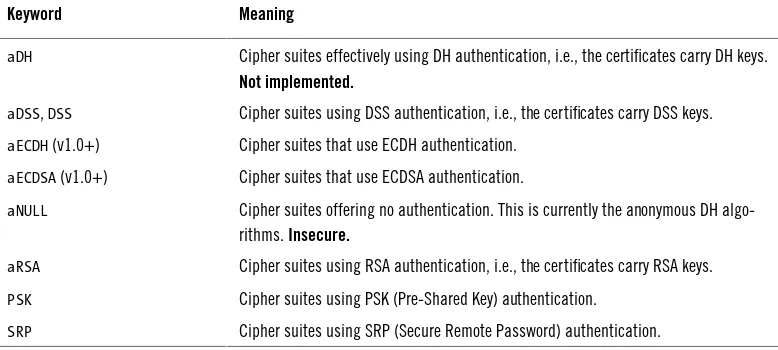
Authentication keywords select suites based on the authentication method they use. Today, virtually all public certificates use RSA for authentication. In the future, we should see a very slow rise in the use of Elliptic Curve (ECDSA) certificates.
Table 1.3. Authentication keywords
Keyword Meaning
aDH Cipher suites effectively using DH authentication, i.e., the certificates carry DH keys. Not implemented.
aDSS, DSS Cipher suites using DSS authentication, i.e., the certificates carry DSS keys.
aECDH (v1.0+) Cipher suites that use ECDH authentication.
aECDSA (v1.0+) Cipher suites that use ECDSA authentication.
aNULL Cipher suites offering no authentication. This is currently the anonymous DH algo-rithms. Insecure.
aRSA Cipher suites using RSA authentication, i.e., the certificates carry RSA keys.
PSK Cipher suites using PSK (Pre-Shared Key) authentication.
SRP Cipher suites using SRP (Secure Remote Password) authentication.
Cipher Suite Selection 25
Table 1.4. Key exchange keywords
Keyword Meaning
ADH Anonymous DH cipher suites. Insecure.
AECDH (v1.0+) Anonymous ECDH cipher suites. Insecure.
DH Cipher suites using DH (includes ephemeral and anonymous DH).
ECDH (v1.0+) Cipher suites using ECDH (includes ephemeral and anonymous ECDH).
EDH (v1.0+) Cipher suites using ephemeral DH key agreement.
EECDH (v1.0+) Cipher suites using ephemeral ECDH.
kECDH (v1.0+) Cipher suites using ECDH key agreement.
kEDH Cipher suites using ephemeral DH key agreements (includes anonymous DH).
kEECDH (v1.0+) Cipher suites using ephemeral ECDH key agreement (includes anonymous ECDH).
kRSA, RSA Cipher suites using RSA key exchange.
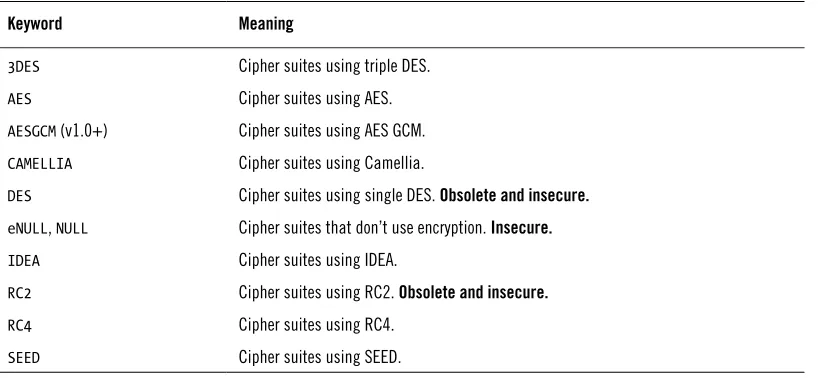
Cipher keywords select suites based on the cipher they use.
Table 1.5. Cipher keywords
Keyword Meaning
3DES Cipher suites using triple DES.
AES Cipher suites using AES.
AESGCM (v1.0+) Cipher suites using AES GCM.
CAMELLIA Cipher suites using Camellia.
DES Cipher suites using single DES. Obsolete and insecure.
eNULL, NULL Cipher suites that don’t use encryption. Insecure.
IDEA Cipher suites using IDEA.
RC2 Cipher suites using RC2. Obsolete and insecure.
RC4 Cipher suites using RC4.
SEED Cipher suites using SEED.
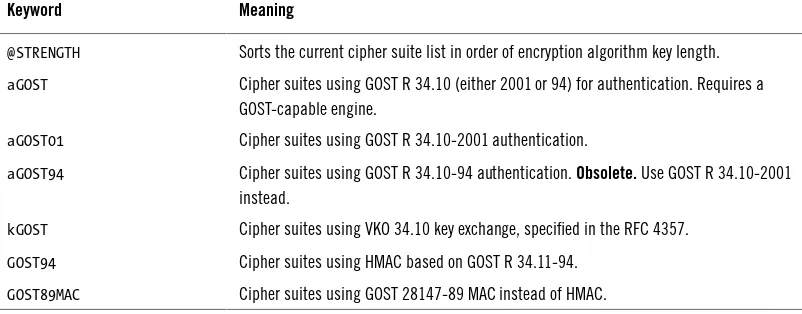
Table 1.6. Miscellaneous keywords
Keyword Meaning
@STRENGTH Sorts the current cipher suite list in order of encryption algorithm key length.
aGOST Cipher suites using GOST R 34.10 (either 2001 or 94) for authentication. Requires a GOST-capable engine.
aGOST01 Cipher suites using GOST R 34.10-2001 authentication.
aGOST94 Cipher suites using GOST R 34.10-94 authentication. Obsolete. Use GOST R 34.10-2001 instead.
kGOST Cipher suites using VKO 34.10 key exchange, specified in the RFC 4357.
GOST94 Cipher suites using HMAC based on GOST R 34.11-94.
GOST89MAC Cipher suites using GOST 28147-89 MAC instead of HMAC.
Combining Keywords
In most cases, you’ll use keywords by themselves, but it’s also possible to combine them to select only suites that meet several requirements, by connecting two or more keywords with the + character. In the following example, we select suites that use RC4 and SHA:
$ openssl ciphers -v 'RC4+SHA'
ECDHE-RSA-RC4-SHA SSLv3 Kx=ECDH Au=RSA Enc=RC4(128) Mac=SHA1 ECDHE-ECDSA-RC4-SHA SSLv3 Kx=ECDH Au=ECDSA Enc=RC4(128) Mac=SHA1 AECDH-RC4-SHA SSLv3 Kx=ECDH Au=None Enc=RC4(128) Mac=SHA1 ECDH-RSA-RC4-SHA SSLv3 Kx=ECDH/RSA Au=ECDH Enc=RC4(128) Mac=SHA1 ECDH-ECDSA-RC4-SHA SSLv3 Kx=ECDH/ECDSA Au=ECDH Enc=RC4(128) Mac=SHA1 RC4-SHA SSLv3 Kx=RSA Au=RSA Enc=RC4(128) Mac=SHA1 PSK-RC4-SHA SSLv3 Kx=PSK Au=PSK Enc=RC4(128) Mac=SHA1
Building Cipher Suite Lists
The key concept in building a cipher suite configuration is that of the current suite list. The list always starts empty, without any suites, but every keyword that you add to the configuration string will change the list in some way. By default, new suites are appended to the list. For example, to choose all suites that use RC4 and AES ciphers:
$ openssl ciphers -v 'RC4:AES'
Cipher Suite Selection 27
$ openssl ciphers -v 'RC4 AES'
Keyword Modifiers
Keyword modifiers are characters you can place at the beginning of each keyword in order to change the default action (adding to the list) to something else. The following actions are supported:
Append
Add suites to the end of the list. If any of the suites are already on the list, they will remain in their present position. This is the default action, which is invoked when there is no modifier in front of the keyword.
Delete (-)
Remove all matching suites from the list, potentially allowing some other keyword to reintroduce them later.
Permanently delete (!)
Remove all matching suites from the list and prevent them from being added later by another keyword. This modifier is useful to specify all the suites you never want to use, making further selection easier and preventing mistakes.
Move to the end (+)
Move all matching suites to the end of the list. Works only on existing suites; never adds new suites to the list. This modifier is useful if you want to keep some weaker suites enabled but prefer the stronger ones. For example, the string RC4:+MD5 enables all RC4 suites, but pushes the MD5-based ones to the end.
Sorting
The @STRENGTH keyword is unlike other keywords (I assume that’s why it has the @ in the name): It will not introduce or remove any suites, but it will sort them in order of descending cipher strength. Automatic sorting is an interesting idea, but it makes sense only in a perfect world in which cipher suites can actually be compared by cipher strength.
Take, for example, the following cipher suite configuration:
In theory, the output is sorted in order of strength. In practice, you’ll often want better control of the suite order.
• For example, AES256-SHA (a CBC suite) is vulnerable to the BEAST attack when used with TLS 1.0 and earlier protocols. If you want to mitigate the BEAST attack serv-er-side, you’ll prefer to prioritize the RC4-SHA suite, which isn’t vulnerable to this prob-lem.
• 3DES is only nominally rated at 168 bits; a so-called meet-in-the-middle attack reduces its strength to 112 bits,4 and further issues make the strength as low as 108 bits.5 This fact makes DES-CBC3-SHA inferior to RC4-SHA and any other 128-bit cipher suite.
Handling Errors
There are two types of errors you might experience while working on your configuration. The first is a result of a simple typo (remember that keywords are case sensitive) or an attempt to use a keyword that does not exist:
$ openssl ciphers -v 'HIGH:@STRENGTH' Error in cipher list
140460843755168:error:140E6118:SSL routines:SSL_CIPHER_PROCESS_RULESTR:invalid … command:ssl_ciph.c:1317:
The output is cryptic, but it does contain an error message.
Another possibility is that you end up with an empty list of cipher suites, in which case you might see something similar to the following:
$ openssl ciphers -v 'SHA512' Error in cipher list
140202299557536:error:1410D0B9:SSL routines:SSL_CTX_set_cipher_list:no cipher … match:ssl_lib.c:1312:
Putting It All Together
To demonstrate how various cipher suite configuration features come together, I will present one complete real-life use case. Please bear in mind that what follows is just an example. Be-cause there are usually many aspects to consider when deciding on the configuration, there isn’t such a thing as a single perfect configuration.
4
Meet-in-the-middle attack (Citizendium)
5
Cipher Suite Selection 29
For that reason, before you can start to work on your configuration, you should have a clear idea of what you wish to achieve. In my case, I wish to have a reasonably secure and efficient configuration, which I define to mean the following:
1. Use only strong ciphers of 128 effective bits and up (this excludes 3DES).
2. Use only suites that provide strong authentication (this excludes anonymous and ex-port suites).
3. Do not use any suites that rely on weak primitives (e.g., MD5).
4. Implement robust support for Forward Secrecy, no matter what keys and protocols are used. With this requirement comes a slight performance penalty, because I won’t be able to use the fast RSA key exchange. I’ll minimize the penalty by prioritizing ECD-HE, which is substantially faster than DHE.
5. Prefer ECDSA over RSA. This requirement makes sense only in dual-key deployments, in which we want to use the faster ECDSA operations wherever possible, but fall back to RSA when talking to clients that do not yet support ECDSA.
6. With TLS 1.2 clients, prefer AES GCM suites, which provide the best security TLS can offer.
7. Because RC4 was recently found to be weaker than previously thought,6 we want to push it to the end of the list. That’s almost as good as disabling it. Although BEAST might still be a problem in some situations, I’ll assume that it’s been mitigated client-side.
Usually the best approach is to start by permanently eliminating all the components and suites that you don’t wish to use; this reduces clutter and ensures that the undesired suites aren’t introduced back into the configuration by mistake.
The weak suites can be identified with the following cipher strings:
• aNULL; no authentication
• eNULL; no encryption
• LOW; low-strength suites
• 3DES; effective strength of 108 bits
• MD5; suites that use MD5
• EXP; obsolete export suites
6
To reduce the number of suites displayed, I’m also going to eliminate all DSA, PSK, SRP, and ECDH suites, because they’re used only very rarely:
!aNULL !eNULL !LOW !3DES !MD5 !EXP !DSS !PSK !SRP !kECDH
Now we can focus on what we want to achieve. Because Forward Secrecy is our priority, we can start with the kEECDH and kEDH keywords:
kEECDH kEDH !aNULL !eNULL !LOW !3DES !MD5 !EXP !kEDH !PSK !SRP !kECDH
If you test this configuration, you’ll find that RSA suites are listed first, but I said I wanted ECDSA first:
ECDHE-RSA-AES256-GCM-SHA384 TLSv1.2 Kx=ECDH Au=RSA Enc=AESGCM(256) Mac=AEAD ECDHE-ECDSA-AES256-GCM-SHA384 TLSv1.2 Kx=ECDH Au=ECDSA Enc=AESGCM(256) Mac=AEAD ECDHE-RSA-AES256-SHA384 TLSv1.2 Kx=ECDH Au=RSA Enc=AES(256) Mac=SHA384 ECDHE-ECDSA-AES256-SHA384 TLSv1.2 Kx=ECDH Au=ECDSA Enc=AES(256) Mac=SHA384 ECDHE-RSA-AES256-SHA SSLv3 Kx=ECDH Au=RSA Enc=AES(256) Mac=SHA1 ECDHE-ECDSA-AES256-SHA SSLv3 Kx=ECDH Au=ECDSA Enc=AES(256) Mac=SHA1 ECDHE-RSA-AES128-GCM-SHA256 TLSv1.2 Kx=ECDH Au=RSA Enc=AESGCM(128) Mac=AEAD [...]
In order to fix this, I’ll put ECDSA suites first, by placing kEECDH+ECDSA at the beginning of the configuration:
kEECDH+ECDSA kEECDH kEDH !aNULL !eNULL !LOW !3DES !MD5 !EXP !DSS !PSK !SRP !kECDH … !CAMELLIA
The next problem is that older suites (SSL 3) are mixed with newer suites (TLS 1.2). In order to maximize security, I want all TLS 1.2 clients to always negotiate TLS 1.2 suites. To push older suites to the end of the list, I’ll use the +SHA keyword (TLS 1.2 suites are all using either SHA256 or SHA384, so they won’t match):
kEECDH+ECDSA kEECDH kEDH +SHA !aNULL !eNULL !LOW !3DES !MD5 !EXP !DSS !PSK !SRP … !kECDH !CAMELLIA
At this point, I’m mostly done. I only need to add the remaining secure suites to the end of the list; the HIGH keyword will achieve this. In addition, I’m also going to make sure RC4 suites are last, using +RC4 (to push existing RC4 suites to the end of the list) and RC4 (to add to the list any remaining RC4 suites that are not already on it):
kEECDH+ECDSA kEECDH kEDH HIGH +SHA +RC4 RC4 !aNULL !eNULL !LOW !3DES !MD5 !EXP … !DSS !PSK !SRP !kECDH !CAMELLIA
Performance 31
ECDHE-ECDSA-AES256-GCM-SHA384 TLSv1.2 Kx=ECDH Au=ECDSA Enc=AESGCM(256) Mac=AEAD ECDHE-ECDSA-AES256-SHA384 TLSv1.2 Kx=ECDH Au=ECDSA Enc=AES(256) Mac=SHA384 ECDHE-ECDSA-AES128-GCM-SHA256 TLSv1.2 Kx=ECDH Au=ECDSA Enc=AESGCM(128) Mac=AEAD ECDHE-ECDSA-AES128-SHA256 TLSv1.2 Kx=ECDH Au=ECDSA Enc=AES(128) Mac=SHA256 ECDHE-RSA-AES256-GCM-SHA384 TLSv1.2 Kx=ECDH Au=RSA Enc=AESGCM(256) Mac=AEAD ECDHE-RSA-AES256-SHA384 TLSv1.2 Kx=ECDH Au=RSA Enc=AES(256) Mac=SHA384 ECDHE-RSA-AES128-GCM-SHA256 TLSv1.2 Kx=ECDH Au=RSA Enc=AESGCM(128) Mac=AEAD ECDHE-RSA-AES128-SHA256 TLSv1.2 Kx=ECDH Au=RSA Enc=AES(128) Mac=SHA256 DHE-RSA-AES256-GCM-SHA384 TLSv1.2 Kx=DH Au=RSA Enc=AESGCM(256) Mac=AEAD DHE-RSA-AES256-SHA256 TLSv1.2 Kx=DH Au=RSA Enc=AES(256) Mac=SHA256 DHE-RSA-AES128-GCM-SHA256 TLSv1.2 Kx=DH Au=RSA Enc=AESGCM(128) Mac=AEAD DHE-RSA-AES128-SHA256 TLSv1.2 Kx=DH Au=RSA Enc=AES(128) Mac=SHA256 AES256-GCM-SHA384 TLSv1.2 Kx=RSA Au=RSA Enc=AESGCM(256) Mac=AEAD AES256-SHA256 TLSv1.2 Kx=RSA Au=RSA Enc=AES(256) Mac=SHA256 AES128-GCM-SHA256 TLSv1.2 Kx=RSA Au=RSA Enc=AESGCM(128) Mac=AEAD AES128-SHA256 TLSv1.2 Kx=RSA Au=RSA Enc=AES(128) Mac=SHA256
ECDHE suites are first, followed by DHE suites, followed by all other TLS 1.2 suites. Within each group, ECDSA and GCM have priority.
In the second group are the suites that are going to be used by TLS 1.0 clients, using similar priorities as in the first group:
ECDHE-ECDSA-AES256-SHA SSLv3 Kx=ECDH Au=ECDSA Enc=AES(256) Mac=SHA1
Finally, the RC4 suites are at the end:
ECDHE-ECDSA-RC4-SHA SSLv3 Kx=ECDH Au=ECDSA Enc=RC4(128) Mac=SHA1 ECDHE-RSA-RC4-SHA SSLv3 Kx=ECDH Au=RSA Enc=RC4(128) Mac=SHA1 RC4-SHA SSLv3 Kx=RSA Au=RSA Enc=RC4(128) Mac=SHA1
Performance
As you’re probably aware, computation speed is a significant limiting factor for any crypto-graphic operation. OpenSSL comes with a built-in benchmarking tool that you can use to get an idea about a system’s capabilities and limits. You can invoke the benchmark using the
If you invoke speed without any parameters, OpenSSL produces a lot of output, little of which will be of interest. A better approach is to test only those algorithms that are directly relevant to you. For example, for usage in a SSL web server, you might care about RC4, AES, RSA, ECDH, and SHA algorithms:
$ openssl speed rc4 aes rsa ecdh sha
There are three relevant parts to the output. The first part consists of the OpenSSL version number and compile-time configuration. This information is useful if you’re testing several different versions of OpenSSL with varying compile-time options:
OpenSSL 0.9.8k 25 Mar 2009
built on: Wed May 23 00:02:00 UTC 2012
options:bn(64,64) md2(int) rc4(ptr,char) des(idx,cisc,16,int) aes(partial) … blowfish(ptr2)
compiler: cc -fPIC -DOPENSSL_PIC -DZLIB -DOPENSSL_THREADS -D_REENTRANT -DDSO_DLFCN … -DHAVE_DLFCN_H -m64 -DL_ENDIAN -DTERMIO -O3 -Wa,--noexecstack -g -Wall -DMD32_REG… _T=int -DOPENSSL_BN_ASM_MONT -DSHA1_ASM -DSHA256_ASM -DSHA512_ASM -DMD5_ASM -DAES… _ASM
available timing options: TIMES TIMEB HZ=100 [sysconf value] timing function used: times
The 'numbers' are in 1000s of bytes per second processed.
The second part contains symmetric cryptography benchmarks (i.e., hash functions and pri-vate cryptography):
Finally, the third part contains the asymmetric (public) cryptography benchmarks: