REFLECTED IN
NANNY 911A THESIS
Presented as a Partial Fulfillment of the Requirements
to Obtain the Magister Humaniora (M.Hum.) Degree
in English Language Studies
by
Umi Rohmiyatun 106332029
THE GRADUATE PROGRAM OF ENGLISH LANGUAGE STUDIES SANATA DHARMA UNIVERSITY
iv
This is to certify that all ideas, phrases, sentences, unless otherwise stated, are
the ideas, phrases, and sentences of the thesis writer. The writer understands the full
consequences including degree cancellation if she took somebody else’s ideas,
v
PUBLIKASI KARYA ILMIAH UNTUK KEPENTINGAN AKADEMIS
Yang bertanda tangan di bawah ini, saya mahasiswa Universitas Sanata Dharma:
Nama : Umi Rohmiyatun
NIM : 106332029
Demi pengembangan ilmu pengetahuan, saya memberikan kepada Perpustakaan
Universitas Sanata Dharma karya ilmiah saya yang berjudul:
Respect and Obedience of Children Reflected in Nanny 911
beserta perangkat yang diperlukan (bila ada). Dengan demikian saya memberikan
kepada Perpustakaan Universitas Sanata Dharma hak untuk menyimpan, mengalihkan
dalam bentuk media lain, mengelolanya dalam bentuk pangkalan data,
mendistribusikan secara terbatas, dan mempublikasikannya di internet atau media lain
untuk kepentingan akademis tanpa perlu meminta ijin dari saya maupun memberikan
royalti kepada saya selama tetap mencantumkan nama saya sebagai penulis.
Demikian pernyataan ini yang saya buat dengan sebenarnya.
Dibuat di Yogyakarta
vi
Praise to Allah Subhana Wa Ta’ala finally I have managed to complete this
thesis. My deep gratitude goes to Dr. B. B. Dwijatmoko, MA, my thesis advisor, for
his invaluable support, guidance, patience and kindness during the completion of this
thesis. I would also like to offer my gratitude to the lecturers: Prof. Dr. Soepomo
Poedjosoedarmo, Dr. Novita Dewi, M.S., M.A. (Hons), Dr. Fr. B. Alip, M. Pd., M.
A., Dr. J. Bismoko, Dr. Alb. Budi Susanto, S.J., Prof. Dr. Ch. Bakdi Sumanto, S.U.,
and Drs. F.X. Mukarto, M.S., Ph.D., for their guidance and willingness to share their
valuable knowledge during my study in Sanata Dharma University. I also express my
sincere gratitude to Mbak Lely, Pak Mul, and all staff of Sanata Dharma University
for their assistance in my study.
My appreciation goes to PPPPTK Matematika Yogyakarta that has given me a
chance to relish this academic journey. My colleagues in Setpim, Widya
Suwarningsih, and Anggrahini Suharto, deserve my gratitude for taking care of the
job during my study. I also thank all my friends in English Language Studies 2010,
especially Orpa Tambing, Anjar Dwi, and Lelly Sepniwati for their lovely
companionship. To Supriyo Eko, my husband, and Banyu Aji, my son, I thank them
for their love and support. Aliyya Adzkiya and Alifa Nastiti, my daughters, I love
vii
relentless prayer, without them I would not be me. Last but not least, I thank all
whose names I cannot mention one by one. May Allah grant endless blessings to
them all.
viii
B. Related Studies……….. 25
C. Theoretical Framework .………... 28
CHAPTER III. RESEARCH METHODOLOGY ………. 30
A. Type of the Study ..………. 30
B. Data Source....………... 30
C. Data Collection ………... 32
D. Data Analysis……….. 35
1. The Concept of Respect and Obedience ………. 9
2. Sentence Types and Moods………. 11
3. Context ……… 13
4. Speech Acts ……… 16 5. Politeness and Face Threatening Acts ……… 18
6. Control Acts Strategies ……….. 23
TITLE PAGE ………. i
APPROVAL PAGE ……… ii
DEFENCE APPROVAL PAGE ………. iii
STATEMENT OF WORK ORIGINALITY ……….. iv
LEMBAR PERNYATAAN PERSETUJUAN PUBLIKASI KARYA ILMIAH …… v
ACKNOWLEDGEMENTS ……… vi
CHAPTER II. LITERATURE REVIEW ………... 9
ix
CHAPTER IV. ANALYSIS RESULTS AND DISCUSSION…..…………. 36
A. Sentence Types and Moods …………. .……… 36
1. Declarative……….. 37
a.Disobeyed Utterances…………..……… 37
b.Obeyed Utterances..……… 45
2. Imperative……... 52
a.Disobeyed Utterances ………..………... 52
b.Obeyed Utterances……….. 54
3. Interrogative... 57
a.Disobeyed Utterances……….. 57
b.Obeyed Utterances……….. 60
B. The Strategies Used to Gain Respect and Obedience………. 64
CHAPTER V. CONCLUSIONS AND SUGGESTIONS……….. 72
A. Conclusions ……… 72
B. Suggestions ……… 74
BIBLIOGRAPHY ………... 75
x
LIST OF TABLES
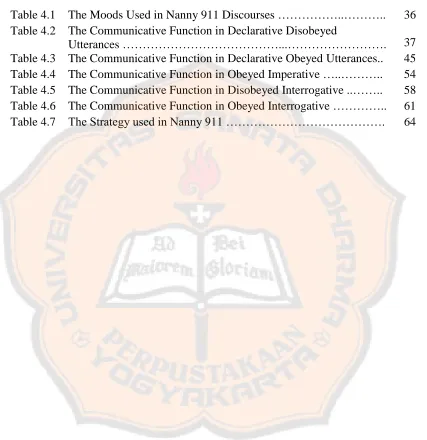
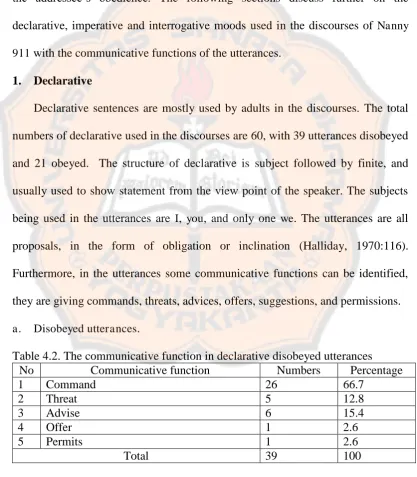
Table 4.1 The Moods Used in Nanny 911 Discourses ………..……….. 36 Table 4.2 The Communicative Function in Declarative Disobeyed
Utterances ………...………. 37
xi
Figure 2.1. The Moods System ………..………..……... 12 Figure 2.2. Giving or demanding, goods-&-services or information ...……. 13
xii
xiii
Umi Rohmiyatun. 2013. Respect and Obedience of Children Reflected in Nanny 911. Yogyakarta: English Language Studies, Graduate Program, Sanata Dharma University.
People sometimes want others to do what they want or to make them follow the rule. Using language is one way to achieve this purpose because language can be used as a tool to accomplish particular ends. The utterance used in persuading others to do something is included in the directive category of speech acts. One example of people controlling others’ behavior is parents or adults who want children to follow their instruction or to follow the rule. The study aims at revealing the features and the strategies of the language used by parents or adults to control the acts of the children in everyday conversation.
The study focuses on two problems. The first is ‘What linguistic features are used to gain respect and obedience in Nanny 911?’. The second is ‘What strategies are employed to gain respect and obedience in Nanny 911?’.The data for the analysis were taken from the transcribed conversation of the television series Nanny 911. There were 17 episodes in the first season taken to be the data. The total number of the data were 140 utterances. Pragmatics theories were used in the analysis. The data were classified into the moods and to the obeyed and disobeyed utterances. Further, they were categorized into their communicative function also the possible reason of their being obeyed or disobeyed. Finally, the nonconventional strategies used were explored.
xiv
ABSTRAK
Umi Rohmiyatun. 2013. Respect and Obedience of Children Reflected in Nanny 911. Yogyakarta: Program Kajian Bahasa Inggris, Program Kajian Bahasa Inggris, Universitas Sanata Dharma.
Seseorang kadang menginginkan orang lain untuk melakukan apa yang mereka inginkan atau membuat mereka mengikuti suatu aturan tertentu. Penggunaan bahasa adalah salah satu cara untuk mencapai tujuan ini karena bahasa dapat digunakan sebagai suatu alat untuk mencapai tujuan tertentu. Ucapan-ucapan yang digunakan dalam membujuk orang lain untuk melakukan sesuatu termasuk dalam kategori tindak tutur direktif. Salah satu contoh mengendalikan perilaku orang lain adalah orang tua atau orang dewasa lain yang menginginkan anak-anak untuk mengikuti perintahnya atau untuk mengikuti aturan tertentu. Studi ini bertujuan untuk mengungkapkan sifat-sifat dan strategi-strategi bahasa yang digunakan oleh orang tua atau orang dewasa lain untuk mengendalikan perilaku anak-anak dalam percakapan sehari-hari.
Studi ini menitikberatkan pada dua tujuan. Tujuan pertama adalah mengungkapkan sifat-sifat kebahasaan yang digunakan untuk mendapatkan kepatuhan anak-anak. Yang kedua adalah mengungkapkan strategi-strategi yang digunakan untuk mendapatkan kepatuhan. Data diambil dari transkrip percakapan serial televisi Nanny 911. Terdapat 17 episode dari musim pertama yang dijadikan data dalam studi ini. Jumlah keseluruhan data ada 140 ungkapan. Data tersebut diklasifikasikan kedalam moods, kemudian kedalam ungkapan-ungkapan yang dipatuhi dan yang tidak dipatuhi. Selanjutnya data dimaksud diidentifikasi fungsi komunikatifnya, juga kemungkinan alasan dipatuhi atau tidak. Akhirnya, strategi-strategi nonkonvensional yang digunakan diteliti.
xv
1
CHAPTER I
INTRODUCTION
This chapter covers the introduction to the study. It consists of the
background of the study, the research questions, the research objectives, and the
research benefits. The background of the study introduces the focus of the study.
The research questions and the research objectives cover the core issues of the
study. Finally, the research benefits are presented to describe the contribution of
the study.
A. Background
To be able to get what someone wants, one has to communicate their desires
to others using language. Holtgraves (2002) states a language can be viewed as a
tool used to accomplish particular ends. In other words, language is used to
perform a meaningful action, with consequences for the speaker and the hearer. A
mother who wants her daughter to behave well will tell her to be good. The
consequence for the hearer, in this case the daughter, is that she obeys her mother
and behaves well.
However, to choose the proper utterance in a communication is sometimes
not a simple thing to do. What a mother should say to her daughter to put a litter
in a dustbin? Is it “Put the litter in the dustbin!”, “Why don’t you put the litter in
the dustbin?”, “Would you put the litter in the dustbin?”, “Can you put the litter
2
nice to see litter on a clean place”. Which one would be chosen by the mother and
which one would be listened and obeyed by the daughter?
In the context of a family relationship, verbal communication between
children and parents, may fail when the intention of the parent is not understood
by the children, also when parents do not comprehend what the children’s need or
feel. Certain sentence types and strategies may be needed to deal with children,
especially in the control acts of their behavior.
The relationship among the elders and children are normally defined by the
cultural background of the family. In the western culture, the elders are not
necessarily respected by the youngers. Australian schoolchildren, for example,
expressed less respect to their parents than Japanese (Fischer, 2006:19). Frei and
Shavers as quoted by Fischer and Li (2006) stated that respect is only paid to
those who are respectworthy, those with individual distinctions, qualities, merit
and achievement.
Tamis Le-Monda, Way, Hughes, Yoshikawa, Kahana, and Niwa (2008)
assert that parents in western cultures are illustrated as supporting the
developmental goals that are autonomy-oriented. Further, Tamis Le-Monda, et al
advise four key values are associated with the developmental goal of autonomy.
The first value is personal choice, providing the opportunities to assert personal
preferences and establishing unique identity. It is associated with enhanced
motivation and achievement. The second value is intrinsic motivation, or being
intrinsically driven to achieve goals. It is closely related to optimism about the
3
believed to be the basic of happiness and achievement of personal goals. The
fourth value is self-maximization, achieving one’s full potential. To sum up,
parents believe that children should make their own choices, intrinsically
motivated, feel good about themselves, and realize their potential to be a unique
and autonomous beings.
Conversely, Petersen (2008) asserts sometimes parents demand respect and
obedience from their children. Parents may threaten, punish, shame, bribe, and
reward their children as a form of showing their power to force their children to
comply. It will lead children to grasp that they should respect power and authority,
instead of respecting relationships and respecting each other as individuals. The
latter according to Petersen (2008) is much more important. Respect for power
and authority is more likely to enforce conflict among parents and children.
Parents should win, not demand or force, respect from children. Demand and
force respect may bring children’s compliance but does not build true respect for
each other. True respect is won by giving respect and recognizing others as
equals. This applies to everyone, including children.
Respect may lead to obedience. However, obedience may also arise from
fear, for example from fear of physical punishment. Both respect and fear may be
the root of obedience, yet obedience that arises from respect will build discipline.
On the other hand, obedience that arises from fear will end up in chaos when the
treat of punishment disappear (www.eqi.org retrieved on April,18, 2012).
Related to the language, some possible linguistic devices may be used to
4
common types of sentences: declarative, imperative, interrogative, and
exclamatory. A declarative sentence declares or states a fact or opinion.
Imperative commands or requests, is usually with implied subject. Interrogative
asks question and is used with auxiliary verb before the subject. Exclamatory
emphasizes a statement. Holtgraves (2002), referring Austin speech act theory,
suggests that a person is doing something with his words. When someone speaks,
he performs a locutionary act. At the same time he also performs an illocutionary
act, or act in saying. Simultaneously, he also performs a perlocutionary act, or
giving effect of the utterance on the hearer. Consequently, speech acts theory can
clarify the speaker’s intention and the effects to the hearer.
Searle (1969) classifies the speakers’ possible action with their utterances.
The speech acts are specified based on the taxonomy and the relation between the
words and the worlds. The first is directives, an attempt to get the hearer to
perform some future action. It includes requesting, ordering, and questioning.
Second is assertives, an attempt to represent an actual state of affairs. It includes
asserting, concluding, informing, predicting, and reporting. Third is commissives,
an attempt to commit the speaker to a future course of action. It includes warning,
promising, threatening, and guaranteeing. Fourth is declaratives, an attempt to
bring about change in some institutional state of affairs. It includes declaring war,
performing a marriage. Fifth is expressives, an attempt to express psychological
state. It includes thanking, complaining, greeting, and apologizing.
Respect and obedience sometimes are intended action demanded by
5
with certain speech acts might be employed to gain the action of respect and
obedience. Adult might use language to gain children’s respect and obedience. A
depiction of children and adults communication that demands children’s respect
and obedience can be found in Nanny 911. It is a reality show on television
program that presents families with mischievous children. The families usually
have two or more children, aged less than 9 years. Some British Nannies are
engaged in the show. In the first season of the reality show, the nannies featured
are Head Nanny Lilian, Nanny Deborah, Nanny Stella, and Nanny Yvone.
The show was originally broadcasted in the US on the Fox channel and in
the UK on the ITV2 channel. Many other countries also aired the show in their
local television. In Indonesia, for example it is aired in Metro TV. Not only
broadcasted, it is also adapted in the local television. The series is produced in 51
episodes for 4 seasons.
An episode of Nanny 911 covers a week of interaction between the Nanny
and the family. The usual steps are started on the first day with the Nanny
observing the family in order to determine a suitable plan of action for changing
the children's behavior; then at the end of the day the Nanny discusses what
should be done with the parents. The next days shows the plan being
implemented. At the end of the week, the family usually has changed their
behavior. The unruly children has become nice, obedient, and helpful. This series
is considered to be the appropriate source of data because it gives a lot of
6
The series gives certain strategies for parents to deal with their children bad
behavior. Furthermore, Carrol and Reid (2009) mention that there are eleven
principles in Nanny 911. First, parents should be consistent. When they say no to
their children, it should mean no, and when they say yes it should also mean yes.
Second, every action has its consequence. Good behavior will get reward, while
bad behavior will get punishment. Third, say what you want and mean what you
say. Before speaking, someone should think first because it will have impact,
whether it is good or bad. Fourth, parents should works as a team. When parents
do not agree on one thing, children will be confused on who they should listen to.
As a result, they would not listen to either of their parents. Fifth, parents should
not promise if they cannot or do not intend to fulfill it. When parents promise to
their children that they will take them to Disneyland, then they should be ready to
take them. Breaking promises will make the children do not believe them. Sixth,
parents should listen to the children. Parents should acknowledge the children
feelings, by saying “I understand” or “I listen to you”. Consequently, parents
provide time for their children to listen and understand them. Seventh, parents
should define routines. It is because routine will made the children feel safe and
use their time structurally. Eighth, respect is reciprocal for both children and
parents. When parents do not respect their children, the children will not respect
them in return. Ninth, positive reinforcement works more effectively than
negative reinforcement. Praises, compliments, and prides are much more
benefited than being negative, talkative, and indifferent. Tenth, behavior is
7
behavior is rejected everywhere. Eleventh, parents should define their role.
Parents role is not to make the children attach to them, but to make them ready to
face the outer world and let them be themselves.
However, this research will not deliberate on the nannies’ parenting
strategies. This research will analyze the utterances used by the parents and the
nannies to the children and the effect that rose from the utterances. It will discuss
the sentence types and the strategies used to gain respect and obedience from the
children. Celce-Murcia and Larsen-Freeman (1999) suggest that sentence mood
conveys the speakers’ mood, therefore identifying the sentence types is significant
to understand the mood of the speaker. Consequently, discussing the linguistic
features is essential in understanding how respect and obedience are obtained in
the utterances. The discussion will also cover the strategies used in the utterances
to gain the desired action from the hearer. Besides employing conventional
strategies, such as using imperatives, speakers sometimes also use
non-conventional strategies. The analysis explores the non-non-conventional strategies
used by adults to gain obedience and respect from children.
The questions raised in this research are as follows
1. What linguistic features are used to gain respect and obedience in Nanny 911?
2. What strategies are employed to gain respect and obedience in Nanny 911?
C. Research Objectives
Based on the research questions, this research has two objectives. The first
objective of this study is to identify the linguistic features used to gain and show
8
respect and obedience from children. In order to achieve this objective, first, the
utterances used by parents to communicate with their children will be identified.
Then, the linguistic features related to the sentence types and the communicative
functions of each utterance will be studied.
The second objective is to identify the strategies used to gain respect and
obedience from children. It will reveal the nonconventional strategies used by
adults in their utterances. Further, the possible reasons of the children’s
compliance related to the employed strategies are revealed.
D. Research Benefits
The study is expected to have some benefits. First, a better understanding in
communicating with children would be achieved. To know what types of
sentences and strategies are proper when dealing with children in a certain context
and condition would help to reduce miscommunication and misunderstanding
when communicating with children. As a result, it will contribute to the
understanding of children communication development of the pragmatics.
Second, the findings may be applicable in defining the appropriate language to
teach children, especially in their early childhood when they are not able to do
verbal communication appropriately. In other words, the research is aimed to give
benefit practically to parents and teachers, and theoretically, to students of
9
CHAPTER II
LITERATURE REVIEW
This chapter is divided into three sections. They are the theoretical review,
the related studies, and the theoretical framework. The first is the theoretical
review which includes theories that will be applied in answering the questions
proposed in this research. The second section is review on the related studies on
the same topic, communication between adult and children. The third section is
the theoretical framework presenting the explanation on how each theory is used
to answer the problems.
A. Theoretical Review
This section presents the theories that will be used in the analysis. It covers
the theories that are useful to answers the research questions. They are the theories
on of respect and obedience, sentence types and moods, also on pragmatics
1. The Concept of Respect and Obedience
Respect means to recognize the value of people and things and to treat them with
consideration, care and concern. It is also to treat others the way someone would like to be treated. Respect is not only applied to people, it also applied to someone’s
possessions and environment. The foundation of respect is constant, regardless of
whether you are demonstrating respect for a person, an object, or our planet.
(www.peacefulsolution.org retrieved on February 10, 2014)
The teaching in the Peaceful Solution emphasized a list of some common forms
of disrespect that are widespread within the society. First is verbal disrespect which
10
teasing; bullying; threatening to hurt someone; and sarcasm. The second is physical
disrespect includes assault with a weapon, hitting, pushing or kicking as well as
touching someone’s body inappropriately. The third is self disrespect includes not
taking care of oneself by not keeping oneself clean, abusing alcohol, experimenting
with drugs, engaging in premarital sex, and even dressing and acting inappropriately.
The fourth is disrespect for the environment includes littering, polluting and harming
animals and plants. The fifth is disrespect for property includes stealing, and defacing
property as in the case of graffiti. The last is other forms of disrespect include rude or
vulgar gestures and inappropriate public behavior such as playing songs with vulgar
language in a public place. (www.peacefulsolution.org retrieved on February 10,
2014)
Milgram asserts that obedience is an element in the structure of social life.
Some system of authority is a requirement of all communal living and only the
person dwelling in isolation who is not forced to respond, with defiance or
submission, to the commands of others. For many people, obedience is an
ingrained behavior tendency, a potent impulse overriding training in ethics,
sympathy, and moral conduct. However, the problem of obedience is not only
psychological. It is also developed by the form and shape of society.
(www.grossmont.edu retrieved on February 10, 2014)
McLeod (2007) suggest that obedience is a form of social influence where
an individual acts in response to the order from another individual with the
authority figure. It is assumed that without the order the person would have acted
differently. Obedience occurs when you are told to do something by the authority.
11
receiving the order (http://www.simplypsychology.org/obedience.html retrieved
on February 10, 2014).
2. Sentence Types and Moods
Celce_Murcia, et al (1999) suggest that English sentences have three main
moods, they are declarative (indicative), interrogative, and imperative, and two
minor moods; exclamatory and subjunctive. Mood conveys the speaker’s attitude
toward the factual content of the sentence. There are three main options in the
English mood system correspond to the three main communicative functions of
language: telling someone something, asking someone something, and getting
someone to do something. However, a sentence type does not necessarily match
its function. It is possible to ask someone to do something using the three types.
For example, someone can ask other to do something using the imperative, the
declarative or the interrogative.
(1) Take the litter!
(2) I want you to take the litter. (3) Would you take the litter?
The three sentences are expressed in different moods, however, they have similar
functions of telling the hearer to take the litter.
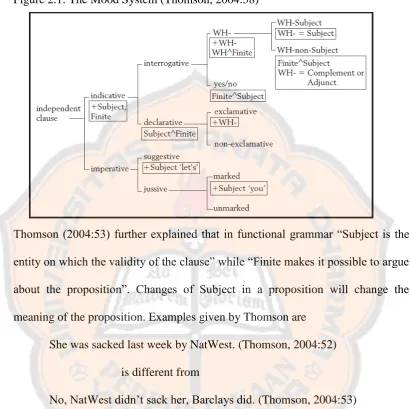
In the discussion of moods, Halliday (1994) identifies three kinds of mood,
they are declarative, imperative, and interrogative. Each of them has their own
characteristics, which is essentially identified by the existence of subject and finite
12
Figure 2.1: The Mood System (Thomson, 2004:58)
Thomson (2004:53) further explained that in functional grammar “Subject is the
entity on which the validity of the clause” while “Finite makes it possible to argue
about the proposition”. Changes of Subject in a proposition will change the
meaning of the proposition. Examples given by Thomson are
She was sacked last week by NatWest. (Thomson, 2004:52)
is different from
No, NatWest didn’t sack her, Barclays did. (Thomson, 2004:53)
The first proposition is about ‘she” while the second is about “NatWest”, therefore
changing in subject will make new complete message. Finite enables a speaker to
signals three basic claims of the validity of a proposition which can be accepted or
rejected by the listener. First, tense will show whether a proposition is valid for
the present time or for other time or for unreal situation. Second, polarity will
show whether the validity is positive or negative. Third, modality will show to
13 The examples on proposition validity are
She was a brilliant actress. She still is. (Thomson, 2004:53)
You know what I mean. No, I don’t, as a matter of fact. (Thomson, 2004:53)
It could be a word meaning “inferior”. Oh, yes, it must be, because the rest is an anagram. (Thomson, 2004:53)
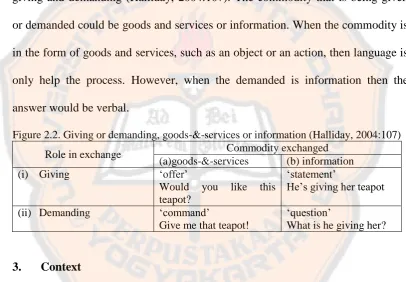
In an exchange or a conversation, the fundamental types of speech role are
giving and demanding (Halliday, 2004:107). The commodity that is being given
or demanded could be goods and services or information. When the commodity is
in the form of goods and services, such as an object or an action, then language is
only help the process. However, when the demanded is information then the
answer would be verbal.
Figure 2.2. Giving or demanding, goods-&-services or information (Halliday, 2004:107)
Role in exchange Commodity exchanged
Holtgraves (2002) it is because what a speaker means with an utterance can only
be derived with some reference to the context. Further, Holtgraves marks that
14
language has implications for the thoughts and feelings of the parties involved and
the relationships between them. Our utterances addressed to other people are filled
with feelings, goals, thoughts and values.
Context determines the meaning of utterances. Different context would
determine different meaning of utterances. In his research, Song quoted some
definitions of context from other writers. Cook as quoted in Song (2010) defines
context in narrow sense as knowledge of factors outside the text under
consideration, in broad sense as knowledge of other parts of the text under
consideration. Song (2010) classifies context into three types, they are linguistic,
situational, and cultural context. Linguistic context is the relationship between
words, phrases, sentences, and paragraph. Situational context refers to the
environment, time and place where the discourse happen. It also includes the
relationship between the participants. Cultural context implies to the culture,
customs, and background of language of the participants.
Song (2010) also generalizes the role of context in a discourse. They are
eliminating ambiguity, indicating referents, and detecting conversational
implicature. Ambiguity suggests lexical and structural ambiguity. Lexical
ambiguity refers to word, phrase, sentence that have more than one possible
meaning or interpretation, while structural ambiguity refers to the grammatical
structure of sentences. Indicating referents refers to referents words such as the
pronouns of the participants of a discourse. Detecting conversational implicature
means understanding the intended meaning of an utterance, it is related to the
15
Ervin-Tripp, O’Connor, and Rosenberg (1984) mention that compliance to a
speaker’s command or directive is unlikely happening when (1) compliance
interrupts the hearer’s conversation, (2) compliance would disrupt the hearer’s
present or planned activity, (3) the projected things is expensive or the activity is
difficult, (4) the properties discussed belongs or is currently in use by the hearer,
(5) a subordinate tries to direct someone in authority beyond their normal rights.
Leech (1988) asserts that two individuals might have incompatible goals
which lead to direct conflict with the scale of decreasing gravity as (1) actual
conflict (strongest), in which a makes or tries to make b do A, but b tries to or
does not A, (2) disobedience, in which a tells/orders b to do A, but b does not do
A, (3) will flouting, in which a communicates to b that a wants b to do A, but b
does not do A, (4) will incompatibility, in which a communicates to b that a wants
b to do A, but b communicates to a that b does not want to do A. Further, Leech
(1988) claims that on the reverse of the positive and negative actions above, there
are another four types of situations: (1) actual conflict (strongest) in which a stops
or tries to stop b doing A, but b tries to do or does A, (2) disobedience in which a
forbids b to do A, but b does A, (3) will flouting in which a communicates to b
that a wants b not to do A, but b does A, (4) will incompatibility (weakest) in
which a communicates to b that a wants b not to do A, but b communicates to a
that b wants to do A.
Hymes’s (1974) theory of SPEAKING is applicable to analyze a speech
and its context. It is indeed an old theory; nevertheless it is useful in explaining a
16
S- Setting and scene, setting refers to the time and place while scene refers to the
environment of the situation. In the Nanny 911, the setting and scene is usually in
the house whether it is in a kitchen, in a bedroom, etc. Second, P-Participants, it
refers to the parties involves in the speech, including the speaker and the audience.
In the Nanny 911 series the participants of a speech involves children and adult
whether they are the parents or the nannies. Third, E-Ends, the purpose and goal
of the speech along with any outcomes of the speech. The purpose and goal of a
speech event in Nanny 911 is to make the children behave as the adult wants or in
line with the set rules in the family. Fourth, A-Act Sequence, the order of events
took place during the speech. The speech event might be started by a child’s
refusal to obey the parents’ rules, then with their exchange arguments, and ended
with the child or the parent giving up on the issue. Fifth, K-Key, the overall tone
or manner of the speech, in the series the tome or manner is mostly in anger from
the parents and from the children side. Sixth, I-Instrumentalities, the form and
style of the speech being given. The style and form of speech is usually informal
between adult and children. Seventh, N-Norms, defines what is socially
acceptable at the event. In adult and child conversation, both parties may have
their own arguments, however, still there are some rules that has to be obeyed.
And finally, G-Genre, the type of speech that is being given. It means the speech
acts that are applied in the speech event.
4. Speech Acts
In relation with speech act of a speech event, Jowarowska (2011) asserts
17
intended actions and how hearers infer intended meaning from what is
said. Austin as cited in Holtgraves (2002) classifies speech acts into lucotion,
illucotion, and perlucotion. Lucotion is the literal meaning of what is said by the
speaker. Illucotion is the social function of the utterance, it can be a refusal, a
command, a complaint, or any other thing. Perlucotion is the effect that take place
after the utterance.
Another speech act theory developed by Cohen also cited in Holtgraves
(2002) identifies five categories of speech acts based on the functions assigned to
them. The first is representatives, it includes assertions, claims, and reports. The
second is directives, it includes suggestions, requests, and commands. The third is
expressives, it includes apologies, complaint, and thanks. The fourth is
commisives, which includes promises, threats, and offers. The last category is
declaratives, which includes decrees and declarations.
Searle (1969) also develops five illocutionary points that represents an
important attempt of the speakers to perform something with their utterances.
They are (1) directives, that attempt to have the hearer to perform some future
action which includes requesting, ordering, and questioning; (2) assertives,
attempt to represent the actual state of affairs to commit the speaker to the case, it
includes asserting, concluding, informing, predicting, and reporting; (3)
commissives, attempt to commit the speaker to future course of action, it includes
warning, promising, threatening, and guaranteeing; (4) declaratives attempt to
18
war, performing a marriage; (5) expressives attempt to express a psychological
state which includes thanking, complaining, greeting and apologizing.
5. Politeness and Face Threatening Acts
A communication always involves participants that in the politeness strategy
involve the face of the participants. Brown and Levinson (1987:61) cited in Nadar
(2009:32) defines face as the public self-image that every participants wants to
claim for himself, consisting in two related aspects: (a) negative face; the basic
claim to territories, personal preserves, rights to non-distraction – i.e. to freedom
of action and freedom from imposition, (b) positive face: the positive consistent
self-image or personality (crucially including the desire that this self-image be
appreciated and approved of) claims by the participants. In short, a participant has
two faces, the negative face is the individual desire to be free from others
interference and the positive face is the individual desire to be approved and
favored by others. Brown and Levinson (1987: 65-68), as quoted by Nadar, state
further that the face concept is universal and some utterances tend to be an
annoying act which is termed as Face Threatening Acts (FTA).
FTA may threaten the positive face and the negative face of the hearer.
Some acts that threat the negative face are (a) utterance of ‘orders and requests,
suggestions, advice, reminding, threats, warnings, dares; (b) utterances of offers,
promises; (c) utterances on compliments, expressions of strong (negative)
emotions toward the hearer such as anger and hatred. Another acts that threat the
positive face are (a) utterances of disapproval, criticism, contempt, ridicule,
19
or disagreements, challenges; (c) utterances of violent (out of control)) emotions
(S gives H possible reason to fear him or be embarrassed by him); (d) utterance of
irreverence, mentions of taboo topics, including those that are inappropriate in the
context (S indicates that he doesn’t value H’s values and doesn’t fears J’s fears);
(e) utterances on bad news about H, or good news (boasting) about S (S indicates
that he is willing to cause distress to H, and/or does not care about H’s feeling); (f)
utterances on dangerously emotional or decisive topics such as politics, race,
religion, women’s liberation (S raises the possibility or likelihood of face
threatening acts (such as above) occurring i.e. S creates a
dangerous-to-face-atmosphere; (g) utterances on non-cooperation in an activity, such as disruptively
interrupting H’s talk, making non-sequiturs or showing non-attention (S indicates
that he doesn’t care about H’s negative or positive wants); (h) utterances on
address terms and other status marked identification in initial encounters (S may
misidentify H in an offensive or embarrassing way, intentionally or accidentally).
Although the acts are classified as threatening the positive face or the negative
face, Brown and Levinson, quoted in Nadar (2009) note that there are some
expressions that may threat both negative and positive face.
Brown and Levinson as cited in Nadar (2009) also suggest some strategies
to save the face of the hearer. To save the positive face (1) to notice and attend H
(his interest, wants, deeds, goods) also giving special attention to H, such as their
physical appearance; (2) exaggerate (interest, approval, sympathy) to H; (3)
intensify interest to H; (4) use in-group identity markers; (5) seek agreement; (6)
20
assert or presuppose S’s knowledge of and concern for H’s wants; (10) offer,
promise; (11) be optimistic; (12) include both S and H in the activity; (13) give or
ask for reasons; (14) assume or assert reciprocity; (15) give sympathy to H.
Nadar (2009) cited Brown and Levinson’s strategies in saving positive face
in a conversation, they are (1) be conventionally indirect; (2) question and hedge;
(3) be pessimistic; (4) minimize the imposition; (5) give deference; (6) apologize;
(7) impersonalize S and H; (8) state the FTA as a general rule; (9) nominalize;
(10) go on record as incurring a debt, or as not indebting H.
According to Leech (1988), the maxim of politeness involves the self or the
speaker, the other or the hearer. The maxim of politeness tend to go in pair as in
the tact maxim (in impositives and commissives) is to minimize cost to other and
to maximize benefit to other, in the generosity maxim (in impositives and
comissives) is to minimize benefit to self and maximize cost to self, in the
approbation maxim (in expressives and assertives) is to minimize dispraise of
other and maximize praise of other, in the modesty maxim (in expressives and
assertives) is to minimize praise of self and maximize dispraise of self, in the
agreement maxim (in assertives) is to minimize disagreement between self and
other, and to maximize agreement between self and other, in the sympathy maxim
(in assertives) is to minimize antipathy between self and other and to maximize
sympathy between self and other (1988:132).
Politeness does not only deal with the content of the conversation, but also
21
139). One of the examples is how people aware of the turn-taking in a
conversation, when should they keep silent or should speak.
Watts (2003) argues the structures of linguistic politeness are consists of
(1) term of address including first names like Bill, David; deferential names like
sir; first name+surname like Richard Wells; title+surname like Dr. Weber, (2)
formulaic expressions of specific speech act types like thanking such as very many
thanks, thank you very much or apologizing like excuse me, (3) ritualized
expressions of leave-taking like bye or bye bye, (4) hedges of different kinds, i.e.
linguistic expressions which weaken the illocutionary force of a statement: by
means of attitudinal predicates like I think, I don’t think, I mean, or by no means
of adverbs such as actually, (5) solidarity markers, i.e. linguistic expressions
which appeal to mutual knowledge shared by the participants, or support and
solidarity from participants, like you know, (6) boosters, i.e. linguistic expressions
enhancing the force of the illocution in some way, like of course, clearly, (7)
sentential structures containing specific modal verbs, such as may I ask you to
accept.
While House and Casper as cited in Watts (2003) propose the structure of
linguistic politeness are categorized in eleven groups. The first is the politeness
markers, i.e. expressions added to the utterance to show deference to the addressee
and to bid for cooperative behavior, for example the use of politeness markers
please, if you wouldn’t/don’t mind, tag questions with modal verbs such as
will/would following an imperative structure in close the door will you/would
22
The second is play-downs, syntactic devices which likely tone down the
perlocutionary effect of an utterance on the addressee. The category is subdivided
into: the use of past tense (I wonder if …., I thought you might….), progressive
aspects together with past tense (I was wondering whether…, I was thinking you
might …), an interrogative containing a modal verb (would it be a good idea …,
could we …), a negative interrogative containing a modal verb (would it be a
good idea …, could we …), a negative interrogative containing a modal verb
(wouldn’t it be a good idea if…, couldn’t you….) (quoted in Watts; 182-184).
The third is consultative devices, structures which seek to involve the
addressee and attempt for their cooperation, e.g. Would you mind …, Could you …
The fourth is hedges, a structure which avoid giving a precise propositional
content and leaving an option open to the addressee to impose her/his own intent,
e.g. kind of, sort of, somehow, more or less, rather, and what have you.. The fifth
is understaters, a means of underrepresenting the propositional content of the
utterance by a phrase functioning as an adverbial modifier or also by an adverb
itself, e.g. a bit, a little bit, a second, a moment, briefly. The sixth is downtoners,
modulate the impact of the speaker’s utterance, e..g. just, simply, possibly,
perhaps, really (quoted in Watts; 182-184).
The seventh is committers, to lower the degree to which the speaker commit
her/himself to the propositional content of the utterance, e.g. I think, I believe, I
guess, in my opinion. The eight is forewarning, this strategy could be realized by
many different structures in which the speaker makes some kind of metacomment
23
they about to flout (e.g. far be it from me to criticize, but…., you may find this a
bit boring, but…., you’re good at solving computer problems)..The ninth is
hesitators, pauses filled with non-lexical phonetic materials, such as er, uhh, ah,
or instances of stuttering.. The tenth is scope-staters, expression of a subjective
opinion about a state of affairs referred to in the proposition, e.g. I’m afraid you’re
in my seat, I’m disappointed that you couldn’t…., it was a shame you didn’t…... .
The last one is agent avoiders, refer to propositional utterances in which the agent
is suppressed or impersonalized, deflecting the criticism from the addressee to
some generalized agent, e.g. passive structures or utterances such as people don’t
do X (quoted in Watts; 182-184).
6. Control Acts Strategies
Gordon and Ervin-Tripp (1984) suggest that compliance of control acts can
be achieved by considering to get attention of the addressee and calculating the
cost and the status of the participant. The observed steps in getting compliance are
(1) attention-getters, to get the attention of the addressee by verbal or nonverbal
means, such as “hey!” or waving hand. An attention-getter alone can function as a
request if the context makes clear what is wanted by the speaker.(2) framing
moves, to set up a cooperative situation to make an instrumental move more
effective, a preliminary moves such as proposing a particular kind of play may be
necessary, “Let’s play fire engine.” (3) persuasive adjuncts, instrumental moves
are often prefaced or followed by reasons, promises, threats, and so forth, which
serves to justify the request or persuade the hearer, like “I haven’t got enough
24
moves in themselves. (4) instrumental moves, a conventional speech act may
occur, qualified by the addition of politeness formula, vocatives, and so on. (5)
responses, the hearer responses such as assent, denial and excuses for
noncompliance, and requests for clarification require much attention to politeness
and persuasion as do the original speaker’s instrumental moves and adjuncts, (6)
remedies, after hearing a response, a speaker may repeat, alter, intensify, clarify,
or add persuasive arguments to support an instrumental move that has been
challenged.
Nonconventional strategies (NCI) are commonly used when the speaker
wants to maintain deference or mitigate the appearance of control (Gordon
1984:306). There are three basic approaches of NCIs: (1) R (The Reason)
identifying the reason or cause for the hearer to carry out, or facilitate the desired
action and make the hearer awake of it e.g. “It’s your turn”. Five strategies
related to Reason approach are first, call attention to a problem. A hearer’s action
is necessary to make up some problem, or a problem can be identified that the
desired action would remedy, state the problem, e.g. “This is too heavy for me”.
Second is to state an infraction. If the hearer is engaged in an activity that violates
a norm or create a problem, state the infraction, e.g. “You’re not supposed to do
that”. Third is to make a correction. If the hearer is engaged in an inappropriate
action, make the hearer aware of the appropriate action, e.g. “That goes there”,
Fourth is to provide preconditions. If the hearer carries out the desired action
when specific precondition are met, make the hearer aware that such
25
toorestall intervention. If intervention in some activity is anticipated, identify, or
justify the planned activity, the effect is a prohibition, e.g. “That’s mine” said as
speaker grabs toy. (2) N (Neutralize) anticipate an obstacle to the hearer’s
cooperation and neutralize it, e.g. “I’ll give you a dollar for it”. Three strategies
related to obstacle neutralization approach: (a) N.1. Anticipate counterarguments:
if the hearer may have reasons not to cooperate with the goal, identify a way to
mitigate such obstacle and inform the hearer, e.g. “If I can have a kitten I’ll take
care of it all by myself.” (b) N.2. Modify cost: If the cost of a goal or activity is
high, find a way of neutralizing it by minimize cost, e.g. ask for small amount,
provide compensation, e.g. “If you give me this for a while, you can have this for
a while”, or increase cost of noncompliance, e.g. threaten hearer, “If you don’t
give it to me, I’ll take my truck back” (c) N.3. Change activity context: If the
framing situation or current activity is not favorable to obtaining the goal, invoke
a different situation or activity, e.g. a child denied access to a toy may suggest a
game or activity in which the use of the toy is routine. (3) G (Goal) make the
hearer awake of the desired goal situation or some aspect of it and hope the hearer
brings it voluntarily, e.g. “Do we have any candy?” asked when child knows
“we” do.
B. Related Studies
There are several studies that related to this study. First is Speech Acts by
Mother and Child: Determining Their Nature and Form by Josie Bernicot, Judith
Comeau, and Helga Feider (1993). The goal of the study is to determine to what
26
situation affect the production of speech acts during an interaction between an
adult and a child. Variations in the nature of the speech acts produced (assertive,
directive, expressive, and commissive) and in their linguistic form (imperative,
declarative, interrogative, and exclamative) are studied in relation to three
variables describing the communication situation: (a) a psychological variable, the
mother’s child-raising style (coercive or inductive) which was assessed using a
questionnaire on parental control behavior (b) a social variable, the social role of
the speaker (mother or child); and (c) a cultural variable, the origin of the dialogue
partners (French or Canadian). For each cultural sample, 15-minute dialogues
were recorded while 10 pairs of mothers in interaction with their 5 and 6 year old
daughters performed a task involving drawing on a computer. The results suggest
that for children between the ages of 5 and 6, the production of speech acts is
mainly controlled by the social characteristics of the communication situation
rather than by its psychological and cultural features. Mothers appear instead to be
sensitive to all three kinds of factors. Moreover, the four types of speech acts were
found to differ in their frequency of occurrence, linguistic form, and reaction to
the psychological, social, and cultural characteristics of the communication
situation. The study suggests that the effects of these characteristics on speech act
production are not uniform, but vary according to the index under consideration.
The second study is Children’s Pragmatic Competence: A Case Study of
English Speech Acts Performed by American Children by Toshihiko Suzuki
(2010). It attempts to demonstrate the pragmatic competence of American
27
was taken from pupils aged 8 – 10 in San Francisco in March 2010. It was
designed to reveal native English speaking children’s pragmatic ability to realize
their intentions verbally in the form of speech acts, and to consider its significance
in human language acquisition in pragmatic development, also to apply the
research results to English Language Teaching in Japan. The data consist of six
English speech acts, i.e. complimenting, requesting, thanking, inviting,
apologizing, comforting, performed orally by children in role-play with puppets
and then transcribed for the examination of their linguistic features in detail. The
finding of the study is confirming that positive direction strategies were usually
used in the face enhancing acts, i.e. apologizing, complimenting, and thanking,
and negative direction strategies dominated in face threatening acts, i.e. inviting
and requesting. The features are commonly found in adults’ interaction, therefore
it indicates that people at different ages are following general rules for performing
speech acts.
The third study is Understanding Request by Susan Ervin-Tripp, Amy
Strage, Martin Lampert, and Nancy Bell (1986). It is intended to understand the
extent to which interlocutors actually rely on linguistic information, contextual aid
and situational knowledge to understand request. The data are taken from 11
three-years-old, 10 five-years-old, and 11 seven-years-old native speakers of
English. The finding is that listeners can interpret contextual demand without
explicit language. Contextual information, in many cases, is enough to get the
28
The current study on respect and obedience is aimed at finding the linguistic
features and the strategies used. It is more or less similar to the studies mentioned,
however it is limited to the act of gaining respect and obedience.
C. Theoretical Framework
The concepts of respect and obedience are the basic theories for the study. It
assists to build the understanding of the two concepts of respect and obedience.
Both concepts are helpful to identify which utterance is obeyed and which one is
disobeyed.
The theory on sentence consists the basic concepts of sentences and its
categories. It is helpful to understand the identification of the types of sentences
and moods in the adult children communication. Further, it is used to categorize
the utterances into their types of sentences and moods.
The context theory clarifies the understanding on the discourses between
children and adults. Understanding the utterances in a discourse is inseparable
from the context of the discourse because different context will demand different
understanding of utterances.
The theory of speech acts is valuable in interpreting the intention of the
speaker and the perception of the hearer. Since the discussion is mostly about
telling others to do something, the utterances are speech acts. It is also used to
define the communicative function of each utterance.
The politeness theories help to identify any deference or mitigation in the
utterances. It deliberates not only with the use of certain politeness marker’s but
29
defining the utterances and the strategies used in saving the face. Control acts
30
CHAPTER III
RESEARCH METHODOLOGY
This chapter discusses the methodology applied in the study. It covers four
parts, namely Types of Study, Data Source, Data Collection, and Data Analysis.
The type of the study elucidates the kind of the study conducted in the research.
The data source consists of the main source of the data as the object of the study.
The data collection covers the way the data is collected and processed in the
research. The data analysis comprises the steps taken to answer the questions
posed in Chapter I.
A. Types of Study
This research is a pragmatic study. Thomas proposes that pragmatics is the
study of ‘meaning in interaction’ involving the negotiation of meaning between
speaker and hearer, the context of utterance (physical, social, and linguistic) and
the meaning potential of an utterance (quoted in Cameron 68). The study
describes the language use in gaining respect and obedience in adult – children
communication, especially in parents – children interaction. The discussion is on
the types of sentences, mood, and communicative function of the utterances.
Further, it discusses the nonconventional strategies employed in the process of
gaining children’s respect and obedience.
B. Data Source
The data source was the recording of the reality show Nanny 911. Nanny 911
31
FOX television and also many other parts of the worlds. The duration of each
episode is 60 minutes included the commercial breaks. In Indonesia the series
were broadcasted by Metro TV. Nanny 911 was an adaptation of an English serial
entitled Little Angels, a film of an American family with unruly children who
were reformed by British Nannies who formerly served the Royal families. In
Nanny 911, different nannies were on duties for different issues in different
families. In each episode, the Head Nanny Lilian Sperling decides which nanny is
suitable to help solve the family problem. For example, Nanny Deborah Carrol is
good in dealing with discipline, Nanny Stella Reid is expert to form routines and
family system.
An episode of Nanny 911 begins with the pictures of some families with
unmanaged children, follows by the introduction of the parents, the children and
the unaccepted behavior of the children. One of the nannies then is sent by The
Head Nanny Lilian Sperling to the family. The supervision of the nanny in the
family lasts for one week. On the first day, the nanny observes the family and
takes notes on the behavior of each member of the family. At the end of the day,
the nanny, mother, and father discuss the family issues on the nanny’s perspective.
In the morning, the nanny already prepares the family rules to overcome the
problems of the family. In some episodes, at the first days there are party who
does not willing to follow the rule. They can be the father, mother, or the children.
This makes the nanny force the family to follow the rule. After they follow the
32
being happier. On the last day, the nanny says good bye to the family and gives
them presents or gifts.
The data taken was limited to Season 1 of Nanny 911 produced in the year
2004. It was taken because the study was about respect and obedience in children
– adult communication and the TV show contained the examples of interactions
between children – adult which shows respect and obedience. It represented the
various nannies and families, also the differences of utterances between the
obeyed and the disobeyed. The nannies presented in the series were Nanny
Deborah Carrol, Nanny Stella Reid, and Nanny Ivonne Finnerty. Seventeen
families were presented in Season 1, they were The Rock Family, The Johnston
Family, The Paul Family, The Mccray Family, The Mckelvain Family, The
Mcroberts Family, The Lorimor Family, The Priore Family, The Sterneman
Family, The Finck Family, The Dunleavy Family, The Cubbison Family, The King
Family, The Amico Family, The Lawrence Family, The Dickson Family, and The
Silcock Family.
C. Data Collection
The data of this study were taken from the discourses between adult and
children in the Season 1 of Nanny 911. There were some steps done to gather the
data. First was to watch the show carefully to consider which part of the show that
involved adult-children communication which demanded the children’s respect
and obedience. Second was to transcribe the discourses. Third was to classify
which discourses show the children’s respect and obedience and which discourses
33
Examples of the data were shown below. After watching the episode of The
Finck Family, choosing the scenes that contain conversations which demand
respect and obedience, the writer transcribed the discourses. The first was a
conversation between Nanny Deb and Catherine, a child of The Finck Family,
when suddenly Catherine cried because she wanted to have her mommy’s timer
and her mommy did not want her to have it. The setting was the living room.
Nanny Deb : Excuse me, Catherine. You need to use your word, you have a wonderful word. Take your breath. You are doing a good job. You are just upset, tell me why?
Catherine : I want that….
Nanny Deb : You want the timer? OK. Look, mommy took the timer away because she does not want you to have it. But we are not whining any more. Do you need to have sometime in your room or would you like to play with your sisters downstairs?
Catherine : Play downstairs… Nanny Deb : OK.
The second conversation was between Mrs. Finck and her son, David, who cried
and would not stop crying when his mother told him to. The setting was the living
room.
Mommy : No kicking, David! (David keeps on kicking) David : No…..
Mommy : Say I’m sorry for using bad words, Mommy. David : No…..
Mommy : Then this is going bye bye. I’m taking it away. David : No…. (crying)
Mommy : You want me to give it to you back? No more bad words. (giving the toy to David)
The number of data taken was 140 utterances. The utterances then were classified
according to the responds of the hearer whether it was positively responded or
obeyed, or negatively responded or disobeyed. Each utterance was given the code
according to the number of the episodes. The numbers of the episodes in the series
34
McCray Family, (5) The McKelvain Family, (6)The McRoberts Family, (7)The
Lorimor Family, (8) The Priore Family, (9) The Sterneman Family, (10) The
Finck Family, (11) The Cubbison Family, (12) The Dunleavy Family, (13) The
King Family, (14) The Amico Family, (15) The Lawrence Family, (16) The
Dickson Family, and (17) The Silcock Family
A discourse was then divided into each turn of the conversation. For
instance Mommy’s utterance and David’s response was considered as one turn
then coded as a. Mommy’s utterance was then coded as 1 and David’s respond
was coded as 2. The table below shows the illustration of the coding.
The next step was to classify the discourses that gained the children’s respect and
obedience and those that did not. It was seen from the children’s responses
whether they give positive or negative responses. Positive responses meant that
the children voluntarily followed the adults saying without any resistance,
whereas negative responses were whether the children resisted the adult saying or
follow them with resistance. For example, the utterance (10.a.1) was classified as
Participants Utterance Code
Mommy No kicking, David! 10.a.1 (David: No ….. Da id keeps o ki ki g and crying)) 10.a.2 Mommy Say I’ sorry for usi g ad ords, Mo y. 10.b.1
Da id: No….. (crying)) 10.b.2
Mommy Then this is goin bye bye. 10.c.1
I’ taki g it a ay. 10.c.2
Da id: No…. ryi g 10.c.3
35
having negative response. David answered No to his mother’s order to stop
kicking, he also still kept on kicking and crying despite his mother’s order.
D. Data Analysis
This part presents the steps taken in answering the research questions which
have been formulated in the first chapter. Several steps were taken in the process
of analyzing the data. The first step was classifying the data into the mood
whether they were imperative, declarative, or interrogative. It was to answer the
first research question What linguistic features are used to gain respect and
obedience in Nanny 911? The next step was identifying which utterance included
in the obeyed or disobeyed utterances. It was based on the responses of the
children on the directives expressed by the adult.
The step was followed by identifying the communicative function of each
utterance. It was to identify the function of the utterances in the context of the
discourse. The politeness strategies, the cost of action, and the face threatening
acts were also included in the discussion to figure out the possible reason of the
utterances being obeyed or disobeyed.
The following step concerned with the second research question What
strategies are used to gain respect and obedience in Nanny 911? The strategies
used in the utterances were identified whether it is conventional strategies or
nonconventional strategies. In this step, the approaches in the nonconventional
strategies were identified. The last step was concluding the findings. The findings
consisted of the form of language used by adults to gain respect and obedience