DEVELOPING PRIMARY
STUDENTS’ ABILITY TO DRAW
3D REPRESENTATIONAL OBJECTS
Rahmah Johar1, Linda Vitoria2, Aklimawati3
Syiah Kuala University1,2, Serambi Mekkah University3 [email protected],
[email protected],[email protected]3
Abstract
The ability to draw 3D objects is a part of spatial ability which is a important skill needed in science and daily life. However, current Indonesian elementary mathematics curricula do not provide enough support for the development of students’ spatial ability. The purpose of this study was to design activities to develop students’ ability to draw 3D object. We used design research approach consisted of two cycles. The first cycle was followed by 6 students from class VB and the second cycle was followed by 26 students from class VA at SDN 67 Percontohan Banda Aceh, Indonesia. Data was collected by asking students to draw a representation of 3D objects on a piece of paper followed by short interview with several students. Result of the first cycle shown that 1) there were some revisions made related to some activities and 2) there were 2 out of the 6 students are on level 4; 2 on level 3; and 2 on level 2. Result of the second cycle shown that there were 2 out of the 26 students are on level 4; 7 on level 3; 9 on level 2; and 9 students are on level 1 of drawing 3D objects. We conclude that many students have difficulties in drawing 3D objects. Photo of objects arrangements can support students’ ability to draw 3D objects arrangements. Most of the students’ drawings did not show 3D figure, even 2D figure. This study can serve as crucial data in the effort to support students’ spatial ability.
Keywords: spatial ability, 3D objects, visualization, Indonesian curriculum
INTRODUCTION
Spatial ability is an important skill that is required in many aspects of our daily life such as reading maps, packing objects, using mirror, and so on (Maier, 1996; Ben-Haim, Lappan, & Houang, 1985). Spatial ability is also an essential requirement in learning mathematics, natural sciences, architecture, and economic fore casting. In fact, spatial ability is also used in psychological therapies (Crano & Johnson, 1991). Additionally, as an important aspect of intelligence, spatial ability is also assessed in international assessments such as Trends in Mathematics and Science Study (TIMMS) and Program for International Student Assessment (PISA).
Considering the importance of spatial ability, education system should pay attention to
develop students’ spatial ability. )n )ndonesia,there have been few reports on students’
spatial ability level. However, PISA survey results year after year show that Indonesian
students’ spatial skills are below average Fleischman, Hopstock, Pelczar, & Shelley,
development of students’ spatial ability. One example is apparent in the student book for the fifth grade students (Susilawati, Maryanto, Subekti, Karitas, & Kusumawati, 2014) where the formula for the volume of a cube is given without sufficient reasoning. There
was no activity designed to develop students’ reasoning about three-dimensional (3D)
object itself.
Ben-haim et al. (1985) found that students in grade 5 to 8 did not mach well visualitation of each side of three-dimensional (3D) object. Then, Revina, Zulkardi, Darmawijaya, & van Galen (2011) have designed some activities to develop students reasoning of 3D object. One of the activity was they asked students to shown the object arrangements on the
students’ table, then asked students to draw them. Nevertheless, some students got some
difficulties to draw 3D object after they shown a concrete 3D arrangements. This study offer photo of objects arrangements to help students draw that object. Reserach questions are as follow:
1. How photo of objects arrangements support students’ ability to draw 3D objects
arrangements?
2. How students visualize a three-dimensional object into two-dimensional drawing?
THEORETICAL FRAMEWORK
Spatial Ability
Spatial ability is not a genetic intelligence because it can be improved by experience and learning with suitable materials (Nagy-Kondor, 2014). However, previous studies show
that several factors that determine someone’s spatial ability such as age and gender are
among the factors (Yilmaz, 2009; Marunic & Glazar, 2014). Yilmaz (2009) argues that boys tend to demonstrate better spatial skills than girls do. A test administered after a geometry course to assess men and women’s spatial ability shows that women’s average scores are lower than the men’s Marunic & Glazar, 2014). As for the right age to develop spatial ability, Salthouse et al. (in Olkun, 2003) suggested that it is preferable at children before late twenties, because spatial ability seems to be weaken as we get older.
According to Maier (1996), there are five elements of spatial ability: spatial perception, spatial visualization, mental rotation, spatial relations, and spatial orientation. In this study, we merely focused on spatial visualizations. Maier (1996) explained that spatial visualization is the ability to visualize a configuration in which there is movement or
displacement among internal parts of the configuration . Ben-haim et al. (1985)
Realistic Mathematics Education
Realistic Mathematics Education (RME) is a student-centered learning approach that allows students to actively construct their own knowledge. There are three key principles of RME: guided reinvention, didactical phenomenology, and self-developed models (Gravemeijer, 1994). In this study we focused on the principle of self-developed models, which gives opportunities for students to use their own models in their learning to understand formal mathematics (Gravemeijer, 1994).
For geometry education, RME has long history that dated back to the 1700s where Fröbel (in de Moor, 1991) arguesthat learning geometry through observation is not enough because students need concrete experience with geometry such as drawing and constructing. De Moor (1991) lists various aspects of realistic geometry including projecting, locating, orientating, spatial reasoning, drawing and constructing, measuring and calculating. The most important point is that meaningful realistic geometry learning process uses reality as the tool to explain geometric phenomena. Students’ everyday activity or games can be implemented in designing the learning process of geometry so that students can learn through familiar experience.
METHOD
This study was aimed at designing activities to develop students’ spatial ability. Design research was chosen as the research approach to answer the research questions. It consisted of two cycles. Cycle 1is called a pilot experiment. We worked with six students of class V-B at SDN 67 Percontohan Banda Aceh. The main researcher acted as the teacher at that time, while the regular teacher and the other researchers acted as the observers. Cycle 2 called as a teaching experiment involves 26 students of class V-A at SDN 67 Percontohan Banda Aceh. The regular teacher of SDN 67 Percontohan Banda Aceh taught and the researchers observed. Each cycle consisted of three lessons. The first lesson had
two activities: Drawing ObjectArrangement activity and Counting Block activity. This
article only focuses on DrawingObject Arrangement activity.
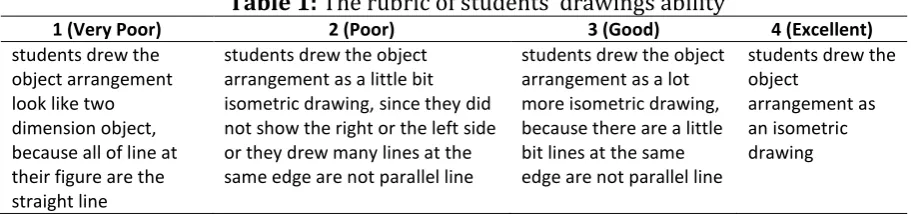
Data was analyzed using a set of criteria listed in the rubric as shown in table 1 to describe
the students’ drawing ability. Triangulation involved different sources: videotaping of
activities, students’ written works, and short interview. These sources will be used to address the research questions.
Table 1: The rubric of students’ drawings ability
1 (Very Poor) 2 (Poor) 3 (Good) 4 (Excellent) not show the right or the left side or they drew many lines at the same edge are not parallel line
RESULT AND DISCUSSION
The activity of Revina et al. put four different object arrangements on the students’ table (see figure 1) then asked students working in group to draw the nearest the object arrangement with their chairs so that someone who see their drawing can understand and can check the number of objects by only seeing the drawing.
Figure 1: Four different object arrangements on the students’ table
According to the findings of Revina et al. (2011), there was 1 of 7 groups at that class made wrong drawing. They had difficulties in perceiving the structures of the tissue pack in their drawing. So that, we revised the activity for cycle 1. The activity is, teacher put three different object arrangements on the cartoon paper. Teacher shown them to around class to make sure all of students could see them, from the top, front, right, and the left side. Teacher already took a picture of them and put it on teachers’ power point. Then teacher shown the picture to students using projector (see figure 2).
Figure 2:Pictures on the teacher’s slide in cycle
Teacher asked students to choose one picture who want to draw. Then students are asked to draw it on their paper individually so that someone who sees the drawing know the
a. The results of cycle 1
There were 5 of 6 students chosen picture 2 in the figure 2 with the details of their drawings are as follow.
1) There were 2 of 5 students drew the object arrangement as an isometric drawing (level 4), as shown in the figure 3 below.
Figure 3: MF’s drawing on the left side and AL’s drawing on the right side
2) There were 2 of 5 students drew the object arrangement as a lot more isometric drawing, because there are a little bit lines at the same edge are not parallel line (level 3), as shown in the figure 4 below.
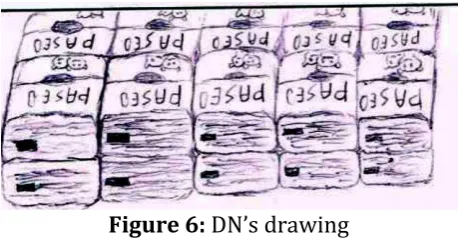
Figure 4: DN’s drawing on the left side and Fi’s drawing on the right side
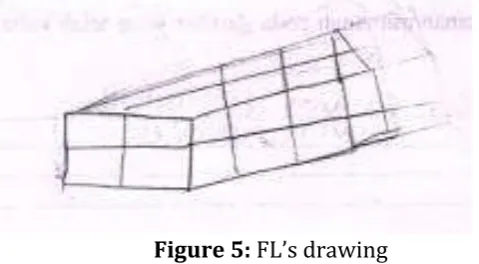
3) There was 1 of 5 students drew the object arrangement as a little bit isometric drawing, because there are a lot more lines at the same edge are not parallel line (level 2), as shown in the figure 5 below.
Figure 5: FL’s drawing
Figure 6: DN’s drawing
There was no student chosen picture 2 in the figure 2. According to interview, one student gave reason that drawing waver arrays was difficult because it was a complex package, it is not smooth package.
According to above explanation, we had some revision as below:
The pictures on teachers’ slide only tissues pack arrays, even in three views see
figure 7). Then, students are asked to draw it on their paper individually so that some one who see the drawing know the number of objects by only seeing the drawing The duration to draw is 15 minutes, it was 5 minutes longer then cycle 1
Figure 7: Pictures on the teacher’s slide in cycle
b. The results of cycle 2
The results of cycle 2 are described as follows.
1) There were 5 students chosen picture 1 in the figure 7. The details of their drawings are as follow.
There were 2 of 5 students drew the object arrangement an isometric drawing (level 4), as shown in the figure 8 below.
Figure 8: MF and SM’s Drawing
Picture 2
There were 3 of 5 students drew the object arrangement as a lot more isometric drawing, because there are a little bit lines at the same edge are not parallel line (level 3), as shown in the figure 9 below.
Figure 9: KF, ZS, and DA’s Drawing
2) There were 20 students chosen picture 3 and 1 student chosen picture 2 in the figure 7.
There were 3 of 20 students drew the object arrangement a lot more isometric drawing, because there are a little bit lines at the same edge are not parallel line (level 3), as shown in the figure 10 below.
Figure 10: Kh, N), and YA’s Drawing
There were 8 of 20 students drew the object arrangement as a little bit isometric drawing, since they did not show the right or the left side (level 2). Two of them are as shown in the figure 11 below.
Figure 11: MS and TM’s Drawing
Figure 12:MA and CN’s Drawing
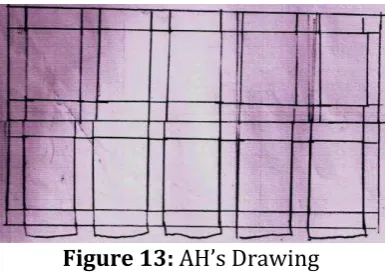
4) There was 1 student drew the object arrangement did not match to the picture, as shown in the figure 13 below.
Figure 13:A(’s Drawing
According to students during interview, Picture 1 in Figure 7 is more difficult then Picture 2 either Picture 3 to draw because in Picure 1 there are three sides to draw while in Picture 2 either Picture 3 only the top and the front side to draw.
In brief, the findings of this study are as follow:
Only 5 of 20 students drew the object arrangement as an isometric drawing
6 students drew the object arrangement as a lot more isometric drawing, because there are a little bit lines at the same edge are not parallel line
8 students drew the object arrangement as a little bit isometric drawing, since they did not show the right or the left side or they drew many lines at the same edge are not parallel line
9 students drew the object arrangement look like two dimension object, because all of line at their figure are the straight line
CONCLUSION
Photo of objects arrangements can support students’ ability to draw D objects arrangements. Most of the students’ drawings do not show D figure, even D figure. The students seem to have difficulty drawing the right and the left side of the objects. We suggested to other researcher to put only one photo of objects arrangements design - it is in isometric type only - to foster students ability to draw 3D object into 2D drawing. This study gave input to Indonesian curriculum for better mathematics teaching and learning.
REFERENCES
Ben-haim, D., Lappan, G., &Houang, R.T. (1985). Visualizing rectangular solids made of
small cubes: analyzing and effecting students’ performance. Educational Studies in
Mathematics, 16, 389-409.
Crano, W.D. & Johnson, C.D. (1991). Facilitating reading comprehension through spatial skills training. Journal of Experimental Education, 59(2), 113-127.
de Moor, E. (1991). Geometry instruction in the Netherlands (ages 4 – 14) – the realistic approach. In L. Streefland (ed). Realistic mathematics education in primary school: on the occasion of the opening of the Freudenthal Institute. 119-138.
Fleischman, H.L., Hopstock, P.J., Pelczar, M.P., & Shelley, B.E. (2010). Highlights from PISA 2009: Performance of U.S. 15-year old students in reading, mathematics, and science literacy in an international context (NCES 2011-004). U.S. Department of Education, National Center for Education Statistics. Washington, DC: U.S. Government Printing Office.
Gravemeijer, K. (1994). Developing realistic mathematics education. Utrecht: CD-� Press.
Maier, P.H. (1996). Spatial geometry and spatial ability – How to make solid geometry solid? Proceedings of the Annual Conference on Didactics of Mathematics, 69-81.
Marunic, G. &Glazar, V. (2014). Improvement and assessment of spatial ability in
engineering education. Engineering Review, 34(2), 139–150.
Nagy-Kondor, R. (2014). Importance of spatial visualization skills in Hungary and Turkey: Comparative studies. Retrieved January 1, 2015 from http://ami.ektf.hu/uploads/ papers/finalpdf/AMI_43_from171to181.pdf
OECD (2014). PISA 2012 Results in focus: what 15-year-olds know and what they can do with what they known: Executive Summary. Paris: OECD.
Revina, S., Zulkardi, Darmawijaya, and van Galen, F. (2011). Spatial visualization tasks to
support students’ spatial structuring in learning volume measurement. Journal on
Mathematics Education (Indo-MS_JME), 2(2), 127-146.
Stacey, K. (2011) The view of mathematics literacy in Indonesia: Journal on Mathematics Education (Indo-MS_JME), 2(2), 1-24.
Susilawati, F., Maryanto, Subekti, A., Karitas, D., Kusumawati, H. (2014). Tema 8 Ekosistem. Buku Tematik Terpadu Kurikulum 2013: Buku Siswa SD/MI Kelas V [Ecosistem. Thematic integrated curriculum 2013: Students textbook for elementary school
grade 5st]. Jakarta: Kemendikbud.