Jurnal Engineering Edu Vol. 2 No. 4, Oktober 2016 ISSN LIPI : 2407-4187
i
SUSUNAN REDAKSI
PENANGGUNG JAWAB Kasnadi, S.Pd, M.Si
PIMPINAN REDAKSI Wijanarko, S.Pd, M.Si
REDAKSI ENGINEERING Ing Muhammad, ST. M.M.Op Nugroho Budiari, ST
Ady Supriantoro, ST REDAKSI PENDIDIKAN Dody Rahayu Prasetyo, S.Pd, M.Pd Muhammad Nuri, S.Pd
Ikhsan Eka Yuniar, S.Pd MITRA BESTARI
Dr. Cuk Supriyadi Ali Nandar, ST, M.Eng (BPPT)
Dr. Agus Bejo, ST, M.Eng (Universitas Gajah Mada Yogyakarta) Mukhammad Shokheh, S.Sos, MA (Universitas Negeri Semarang) Dwi Anggriyani, S.Pd, M.Pd (Universitas Muhammadiyah Bengkulu)
SEKRETARIAT
Meity Dian Eko Prahayuningsih, SHI
Email : [email protected]
Nomer ISSN Lembaga Ilmu Pengetahuan Indonesia ( LIPI ) : 2407-4187
Jurnal Engineering Edu Vol. 2 No. 4, Oktober 2016 ISSN LIPI : 2407-4187
ii
Jurnal Engineering Edu Vol. 2 No. 4, Oktober 2016 ISSN LIPI : 2407-4187
iii
PENGANTAR REDAKSI
Bulan Oktober merupakan bulan Pemuda, karena di bulan ini terdapat Hari Sumpah Pemuda.
Pemerintah telah mencanangkan Hari Sumpah Pemuda tahun ini, dengan sebuah tema yang sangat menantang “Pemuda Menatap Dunia”. Dalam sambutannya, Menteri Pemuda dan Olah Raga memberikan beberapa contoh pemuda yang telah mampu menduni sesuai bidangnya masing-masing. Tentu saja mereka semua adalah para pemuda yang patut untuk kita teladani.
Jurnal Engineering Edu, merupakan jurnal ilmiah di bidang Pendidikan dan Ilmu Teknik. Sebuah Jurnal yang dapat digunakan sebagai wadah dan wahana bagi para pemuda untuk mencurahkan ide, gagasan, hasil penelitian dan pengalaman empiris di bidang Pendidikan dan Ilmu Teknik.
Tentu saja ini sejalan dengan tema Hari Sumpah Pemuda “Pemuda Menatap Dunia”, karena bukan tidak mungkin karya-karya yang termuat dalam jurnal ini, akan dibaca dan dijadikan referensi bagi dunia pendidikan dan ilmu teknik di belahan dunia lain.
Untuk memenuhi harapan tersebut, Jurnal Engineering Edu edisi Oktober 2016 ini memuat karya ilmiah yang telah diterjemahkan ke dalam Bahasa Inggris. Karya dalam bahasa Inggris tersebut berjudul, “Result Improvement of Writing Skills Learning about Self-Identity in French Language Lessons through Pictorial Word Card Medium The Student of Grade X.1 SMA Negeri 1 Batangan.” Di bidang teknik, juga menampilkan sebuah artikel mengenai tema yang sedang hangat mengenai robotika yang dimasukkan sebagai materi tambahan dalam pelatihan calon tenaga kerja di Balai Besar dan Pengembangan Latihan Kerja (BBPLK) Medan. Artikel robotika yang sangat menarik itu berjudul, “Implementasi Robotika Menggunakan Lego NXT 2.0 sebagai Materi Tambahan di BBPLK Medan”. Selain kedua artikel, juga dimuat artikel ilmiah dengan judul sebagai berikut, “Peningkatan Hasil dan Aktivitas Belajar PKn Materi Kedaulatan Rakyat dalam Sistem Pemerintahan Indonesia dengan Metode Simulasi pada Siswa Kelas VIIIE SMP Negeri 1 Candimulyo Magelang”, “Peningkatan Keterampilan Pidato dengan Menggunakan Teknik Berbicara Terpimpin Kelas VIII di SMP PIRI I Yogyakarta” dan “Performansi Sistem Pengering Menggunakan Kolektor Surya dan Tungku Biomassa Aliran Alami dengan Memvariasikan Ketinggian Cerobong”.
Artikel-artikel tersebut semoga mampu menggugah semangat berkarya dalam rangka “Menatap Dunia”. Selamat menikmati artikel-artikel yag ada, saran dan kritik membangun senantiasa redaksi nantikan guna perbaikan di edisi berikutnya.
Salam Redaksi
Jurnal Engineering Edu Vol. 2 No. 4, Oktober 2016 ISSN LIPI : 2407-4187
iv
DAFTAR ISI
Result Improvement of Writing Skills Learning about Self-Identity in French Language Lessons through Pictorial Word Card Medium The Student of Grade X.1 SMA Negeri 1
Batangan………....1-9 Peningkatan Hasil dan Aktivitas Belajar PKn Materi Kedaulatan Rakyat
dalam Sistem Pemerintahan Indonesia dengan Metode Simulasi pada Siswa Kelas VIIIE SMP Negeri 1 Candimulyo
Magelang...11-22 Peningkatan Keterampilan Pidato dengan Menggunakan
Teknik Berbicara Terpimpin Kelas VIII di SMP PIRI I
Yogyakarta...23-45 Implementasi Robotika Menggunakan Lego Mindstorms NXT 2.0
sebagai Materi Tambahan di BBPLK
Medan...47-56 Performansi Sistem Pengering Menggunakan Kolektor Surya
dan Tungku Biomassa Aliran Alami dengan Memvariasikan Ketinggian
Cerobong...57-66
Jurnal Engineering Edu Vol. 2 No. 4, Oktober 2016 ISSN LIPI : 2407-4187
Result Improvement of Writing Skills Learning about Self Identity in French Language Lessons……….….…..……1 RESULTS IMPROVEMENT OF WRITING SKILLS LEARNING ABOUT SELF-IDENTITY
IN FRENCH LANGUAGE LESSONS THROUGH PICTORIAL WORD CARDS MEDIUM THE STUDENTS OF CLASS X.1 SMA N 1 BATANGAN
Agustina Pramu Indah, S. Pd.
Guru SMA Negeri 1 Batangan Pati Jawa Tengah ABSTRACT
The purpose of this research is to improve the learning results of the writing skills of Self Identity grade X SMA N 1 Batangan Lessons through the medium of pictorial word cards. This class action research undertaken researchers at the first semester. The subjects were students of class X.1 SMA N 1 Batangan.
The method used in this research is the research methods class act through the medium of a pictorial word cards held with four stages: (1) planning, (2) implementation, (3) observation, (4) reflection. In the implementation of the actions carried out in two cycles. Data was collected using items. Data analysis using comparative descriptive and continued reflection. Research is conducted in two cycles, the cycle 1 and Cycle II. The results showed that the reconditioning (pre cycle) of 30 students (43.3%) was only 13 (43,3%) to reach the KKM, with an average score of 65. After repairs at the cycle I average value rose to 79, there is one student (3.3%) was achieved a perfect score, while the 25 students (83,3%) and reached a value of ≥ 75, and only 4 students (13.3%) of which get value < 75. In Cycle II, the average value of students increased from 79 to 85. Students who got a perfect score increased to 3 students (10%), and in cycle II there is no student who gets an < 75, it means all students are able to reach the limits of KKM. On cycle II improved learning results amounted to 13.3%.
Keywords: Student, learning, outcomes, illustrated, word, cards.
INTRODUCTION
based on the French Language competency standard curriculum in 2004, France language
teaching in high
school includes four competencies,
namely listening (compréhension orale), talking (production orale), reading (compréhension écrite), and writing (production écrite). Based on the France Language curriculum SMA/MA, standards of competence to write the theme of
"Self-identity" class X is disclosing information in
writing in the form
of exposure or simple dialogue about identity. Wri ting competency standard is composed of two basic competences, namely (1) write words, phrases, and sentences with letters, spelling and proper punctuation, (2) disclose information in writing in the appropriate context, simple sentences that reflect the skills using words, phrases with letters, spelling,
punctuation and proper structure. In the second basic competence, students are required to disclose information in writing in the appropriate context, simple sentences that reflect the skills using words, phrases with letters, spelling,
punctuation and proper structure. As for the indicators are achieved, namely (1) to determine the proper vocabulary appropriate context, (2) compose the
words/phrases into sentences with the right structure. The
material provided is présenter des personnes. Acc ess indicator is can be introduce people in writing by the person using the structure, diction, and proper conjugation.
Based on the initial observation and the results of daily test class X of SMA N 1 Batangan at first semester in academic year 2012/2013, students still have the writing skills are quite low. It can be seen from the average value of daily test student, i.e. minimum completeness criteria French language is 75.
Students who achieve a minimum completeness criterion only amounted to 13 people or 43.3% of the total students. Mistakes made by student located in conjugation and gender selection (feminine or masculin). Examples: (1) * Elle m'ap pelle Agnes Monica, (2) * Elle estIndonésien. sup
posed Elle s'appelle
Agnes Monica, (2) * Elle est Indonésienne.
Based on the results of the study on condition of early (pre cycle), the researchers discuss with peers to find the difficulties faced in
Jurnal Engineering Edu Vol. 2 No. 4, Oktober 2016 ISSN LIPI : 2407-4187
2 ……….Agustina Pramu Indah, S.Pd the students conjugation and gender selection, as
well as the difficulty in finding teachers method or the right media. After the analysis of the problem, due to the lack of successful learning because: (1) use only the method of teacher lectures, so that the students become passive, (2) lack of tools or media to stimulate active students.
After discussing with peers, as well as the supervisor (Principal), researchers using one of the media to overcome these problems, namely the media cards aid. Word cards that are meant here is a card inscribed with the words, subject matter, namely the identity of the self. Words consisting of all card pronoms personels, conjugation of verbs all pronoms, and adjectives. In the process of learning, students are asked to compose
an appropriate image with
the word card structure, conjugation and
proper diction. With the card, the picture words (1) teacher lecturing, not many teachers simply directing and guiding student learning, (2) students become active.
Through the media card, are expected to help students understand the material Self identity, in terms of conjugation based on gender with a fun learning techniques and easy to understand.
Formulation of The Problem
Based on the background that has been expressed above, the formulation of the problem in this research is: "Whether through the medium of word cards can improve learning outcomes identity writing skills in French language learning classroom students X.1 SMA N Batangan at the first semester in academic year 2012/2013?”
Research Objectives
The purpose of this research is to improve the learning results of identity writing skills of students class X. 1 SMA N 1 at the first Semester in academic year 2012/2013 through the medium of the cards aid.
Benefits of Research
The results of this research are expected to provide benefits that are means, both individuals and institutions, including:
1. For teachers Teachers get a
varied learning media contributions that can fix
and improve the system of teaching in the classroom.
2. For schools
Contribute suggestions or contributions to schools in order to repair learning so that it can increase the potential of the students.
3. For students
a. Facilitate students
in writing practice foreign language paragraph.
b. Students became
interested in making his passion increased s o did her achievements.
c. Can reduce errors in writing- speaking France.
METHOD Setting Research
Research progress in high school of SMAN 1 Batangan. The research was conducted at the beginning of the first semester in academic year 2012/2013. This research was carried out for two months, starting in July up to August 2012 is adapted to material identity which is a theme that is found at the beginning of the semester
Research Subject
The subject of this research is the research on the students of class X 1 SMA N 1 Batangan at the first semester in academic year 2012/2013, which amounts to 30 students. Consists of 21 female students and 7 male students.
C. Data Source
The source of the data in this study is the daily test scores of students in the initial condition (pre cycle), the cycle I and Cycle II. The daily test scores is an indicator of increased student learning outcome increases.
Research Variables
This study uses two variables, namely:
1. The free Variable (X)
A free variable in this study is a media cards aid.
2. Variable (Y)
A bound variable in this study is the result of student learning.
Data Collection Tools and Techniques
Data collection techniques used in this research is the technique of the test, the results of the observations of peers and technical documentation. Data collection tool used is the value of the list and details of the problem in
Jurnal Engineering Edu Vol. 2 No. 4, Oktober 2016 ISSN LIPI : 2407-4187
Result Improvement of Writing Skills Learning about Self Identity in French Language Lessons………..………3 writing. The data obtained are then analyzed
instruments that have been prepared.
Data Analysis
The analysis of the data used in this study is a comparative descriptive analysis, which compares the results of the research on Cycle I and Cycle II. A result of the comparison is the reflection in the research as learning improvement. Descriptive research purpose is to generate a description, presented in the form of data analysis, tables, and graphs.
Indicators of Performance
The research is said to be successful if the results of student learning on Cycle II increases or better of the results of the learning. Pretest and cycle I With indicators of performance that no students whose value is below the KKM.
Procedure Actions
This Research Study is a class act. In this study consisted of a Cycle I and Cycle II. Each phase of the cycle consists of: (1) Action Planning, (2) Implementation of the action, (3) Observation (4) Reflection.
1. Planning
At the planning stages of teacher learning improvement plan (RPP) and the research instrument. In this case the research instruments used in the shape of the test description. Test description test that question is writing sentences about "identity" in accordance with a person's identity. The test is expected to be able to measure the ability of students in writing about identity
The instruments are made in the form of an instrument that could measure the ability of students in writing "Self identity" at grade X. 1.
The material to be tested in the research refers to the map of the French language learning material grade X. the material contained in the lattice as follows:
Table 1. Grating Instrument
NO Variable Indicator No of items 1 Identity Identity which
includes: name, age, profession, place of residence,
nationality.
Five sentences in one
paragraph
2. The implementation
This study is planned to last for 2 cycles.
Cycle 1 and Cycle II implemented in accordance with the planning of learning provided in the RPP.
Outline the steps of learning to use media cards that are carried out on the said Cycle 1 and Cycle II are as follows:
a) The teacher divided the group then gave a set of cards and a different photo on each group.
Because different groups of each photo, then there is a different word cards according to the photos, namely Word card stating the name (example SBY), age (60), and shelter (Jakarta).
b) Teacher explains material about identity and ask students to find a card that matches with the teacher. For example, teachers explain the material to reveal the names.
Example:
The teacher asks for the name of the image by showing photos (Comment s'appelle t-il?
„Who‟s name?) Then students are looking for answers on cards that have been provided.
c) After students found the answer, each student writes the answer in the book.
d) Teachers explain the material to reveal the name of the corresponding to the subject complete with conjugation as well as the use of gender selection (masculin or féminin).Subject taught was the first, second and third singles.
e) Students listen while looking for words that explained the teacher card as well as understand it. Then write the material that the teacher explained in full.
f) Teacher explains material about identity information, namely to express age, profession, address, and nationality. In explaining the material teachers do not write on the Board but rather explain verbally, while the students listen and look at the card.
g) Teacher took one word, e.g. card type card pronoms personel, verbs card, or card adjectives.
h) Teachers take card pronoms personel. Then the students are asked to compose a word card in accordance with the drawing. Students compose the available cards (with no subject card), then write the complete identity that reveals the name, age, profession, address, nationality and based on the existing card and complete a card is not available.
i) Teacher also explains the material element of verbs, as well as do pos test adjective element to find out students ' writing ability of self
Jurnal Engineering Edu Vol. 2 No. 4, Oktober 2016 ISSN LIPI : 2407-4187
4 ……….Agustina Pramu Indah, S.Pd identity. Students were given the same test
question on pretest moment.
3. Observations
At this stage of observation, researchers collaborated with peers to be observers during the repair Cycle 1 and Cycle 2 lasts. A friend of the associate‟s job is to observe and record the important things that happened during the repair of the learning Cycle I and Cycle II takes place.
The observations are very useful to researchers as a material improvement of learning in the next Cycle. If the observations are already meet the performance indicators, the research was stopped and declared successful.
4. Reflection
At this stage of reflection, observations from my colleague discussed with supervisor (Principal) as feedback for researchers to determine the corrective action that will be performed.
Reflections on Cycle I repair materials is for researchers to continue the cycle II.
Scoring
On the instrument in this study there was a problem writing the identity that includes five parts: 1) reveal the name, 2) reveal the age, 3) revealed the professions, 4) reveals the address, and 5) reveal the nationalities. Scoring is calculated based on each piece. The maximum total score is 18 with details as follows:
1. Disclose the name (3 points)
- Score a maximum of 3, if the electoral structure, gender, and conjugation is true.
- Score 2, if the right two of the elements assessed, for example: structure and gender selection is correct, but there is an error in conjugation.
- Score1, if one of the elements assessed, for example: there is a mistake in the selection of gender and conjugation but the structure is correct.
- Score 0, if there is an error in the structure, gender selection, and conjugation.
2. Reveal age (3 points)
- Score a maximum of 3, if the electoral structure, gender, and conjugation is true.
- Score 2, if the right two of the elements assessed, for example: structure and gender selection is correct, but there is an error in conjugation.
- Score 1, if one of the elements assessed, for example: there is a mistake in the selection
of gender and conjugation but the structure is correct.
- Score 0, if there is an error in the structure, gender selection, and conjugation.
3. Disclose the professions (4 points)
- Score a maximum of 4, in structure, gender selection, conjugation and orthographic are right.
- Score 3, when actually three of the elements assessed, for example: structure, gender selection, and conjugation is true but there are mistakes in orthography.
- Score 2, if the right two of the elements assessed, for example: structure and gender selection is correct, but there is an error in the conjugation and orthography.
- Score 1, if one of the elements assessed, for example: there is a mistake in the selection of gender and conjugation, and orthography but its structure is correct.
- Score 0, if there is an error in the structure, gender selection, and conjugation.
4. Disclose the address (4 points)
- Score a maximum of 4, in structure, gender selection, conjugation and orthographic are right.
- Score 3, when actually three of the elements assessed, for example: structure, gender selection, and conjugation is true, but there are mistakes in orthography.
- Score 2, if the right two of the elements assessed, for example: there is a mistake in the selection of gender and orthography but the structure and the conjugation right.
- Score 1, if one of the elements assessed, for example: there is a mistake in the selection of gender, conjugation and orthography but its structure is correct.
- Score 0, if there is an error in the structure, gender selection, conjugation, and orthography.
5. Disclose the nationality (4 points)
- Score a maximum of 4, in structure, gender selection, conjugation and orthographic are right.
- Score 3, when actually three of the elements assessed, for example: structure, gender selection, and conjugation is true, but there are mistakes in orthography.
- Score 2, if the right two of the elements assessed, for example: there is a mistake in the selection of gender and orthography but the structure and the conjugation right.
Jurnal Engineering Edu Vol. 2 No. 4, Oktober 2016 ISSN LIPI : 2407-4187
Result Improvement of Writing Skills Learning about Self Identity in French Language Lessons………..………5 - Score 1, if one of the elements assessed, for
example: there is a mistake in the selection of gender, conjugation and orthography but its structure is correct.
- Score 0, if there is an error in the structure, gender selection, conjugation, and orthography.
Description:
- The structure, in this case the sentence pattern is correct, if the authors are right, i.e. subject + predicate, + object or subject + predicate, + description/adjective. In addition to the sentence pattern is wrong.
- The correct conjugation, when the conjugation is true according to the subject and the spelling right.
Example:
Il s'appelle Jokowi (correct)
S'apele/s'appele/IL s'apelle Jokowi (wrong) Il m'appelle Jokowi (wrong)
- Gender selection is correct, 1) when the subject is sexed male then adjust his adjective men and when the subject is sexed female then adjust her adjective women. 2) When the photos show male gender then the subject used must be male, as well as the sexed female. In addition it is wrong.
- Correct orthography, if the accent in the writing and spelling are correct.
Example:
- "à" which means "on" (true), if it is written
"a" is wrong. Because if it is written "a"
does have, is the third person singular conjugation of the verba avoir.
- lycéen "/" lycéenne (right) → lyceen/lyceenne (wrong) because the pronunciation is changed without any grave accent on the letter "e".
- "lycéen" (right) → rycean (incorrect) because it has no meaning.
-
After the score is determined, then conducted an assessment to determine the respondent's test results. Score is calculated from the number of correct answers obtained by the respondent, then the calculated value obtained by respondents using the following formula:
Description:
S: the value you're looking for
R: raw score obtained respondents
N: the maximum score is ideal from a test
SM: standard mark (the magnitude of the scale of assessment of the desired 100)
(Purwanto 1986: 130)
After the unknown value derived the value of students, are included in the assessment criteria France language in high school SMAN 1 Batangan with KKM 75, as follows:
Table 2. KKM
Interval value Criteria
100 Special
>75 completeness
<75 Incompleteness
RESULTS AND DISCUSSION
Research Results
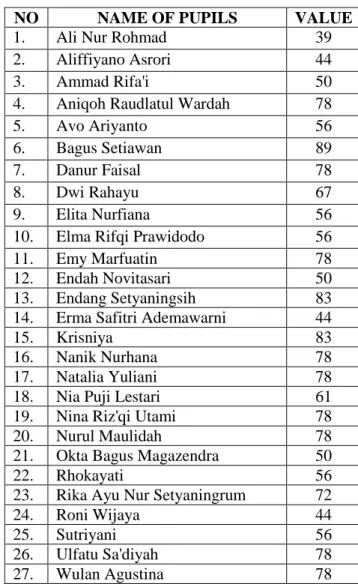
1. Description of initial conditions (Pre cycle) On the initial conditions of the learning process is executed one time meeting with conventional methods. Student learning outcomes can be seen in the table below:
Table 3. Pre Cycle Value
NO NAME OF PUPILS VALUE
1. Ali Nur Rohmad 39
2. Aliffiyano Asrori 44
3. Ammad Rifa'i 50
4. Aniqoh Raudlatul Wardah 78
5. Avo Ariyanto 56
6. Bagus Setiawan 89
7. Danur Faisal 78
8. Dwi Rahayu 67
9. Elita Nurfiana 56
10. Elma Rifqi Prawidodo 56
11. Emy Marfuatin 78
12. Endah Novitasari 50
13. Endang Setyaningsih 83
14. Erma Safitri Ademawarni 44
15. Krisniya 83
16. Nanik Nurhana 78
17. Natalia Yuliani 78
18. Nia Puji Lestari 61
19. Nina Riz'qi Utami 78
20. Nurul Maulidah 78
21. Okta Bagus Magazendra 50
22. Rhokayati 56
23. Rika Ayu Nur Setyaningrum 72
24. Roni Wijaya 44
25. Sutriyani 56
26. Ulfatu Sa'diyah 78
27. Wulan Agustina 78
Jurnal Engineering Edu Vol. 2 No. 4, Oktober 2016 ISSN LIPI : 2407-4187
6 ……….Agustina Pramu Indah, S.Pd
28. Yeny Farida 67
29. Yohana Yuliani 61
30. Yoyok Sugiarto 78
The amount 1.964
Average 65,47
The highest value 89
The lowet value 39
Percentage of completeness 56,7%
Percentage of incompleteness 43,3%
The above table shows that the highest value obtained was 89 students, while the lowest value is 39. The average value of students are 65, 47.
From the above table it can be seen that the ability of the students of class X 1 SMA N1 Batangan identity in writing prior to the holding of the cycle I of improvement can be specified as follows:
(1) Special value, i.e. students who achieve a value of 100, no.
(2) The value has been completed, i.e. students who are achieving more value from 75, totalling 13 people or 43.3%
(3) The value has been incomplete, i.e. students who achieve less than 75 values, amounted to 17 students or 56.7%.
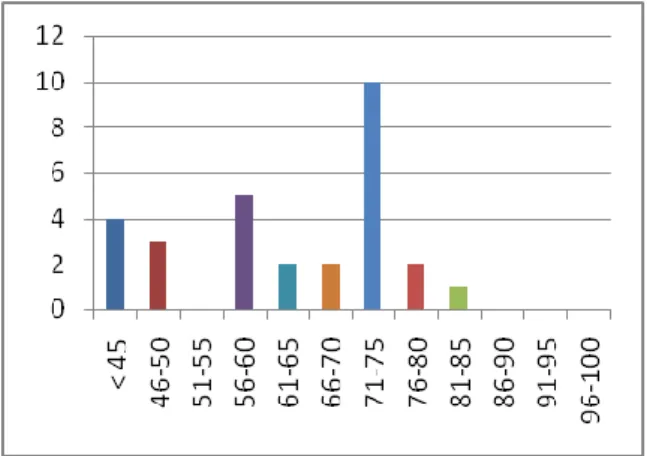
Next to the data presented in the form of interval value, to be described in the form of graphs.
Table 4. Interval Value of Pre Cycle
No Interval value No of Pupils
1. < 45 4
2. 46-50 3
3. 51-55 0
4. 56-60 5
5. 61-65 2
6. 66-70 2
7. 71-75 1
8. 76-80 10
9. 81-85 2
10. 86-90 1
11. 91-95 0
12. 96-100 0
The number of
students 30
In the form of a graph, the results of studying the pre Cycle can be described in Figure2 of the following:
Figure 2. Study Results of Pre Cycle
2. The Cycle I
At this stage the researcher carrying out planning, after students perform pretest, performed repair Cycle 1 learning by using learning words in the card media write about identity with the results of the study as follows:
Table 5. Learning Cycle 1 Result
NO Name of Pupils Value
1. Ali Nur Rohmad 61
2. Aliffiyano Asrori 78
3. Ammad Rifa'i 67
4. Aniqoh Raudlatul Wardah 89
5. Avo Ariyanto 78
6. Bagus Setiawan 100
7. Danur Faisal 83
8. Dwi Rahayu 78
9. Elita Nurfiana 72
10. Elma Rifqi Prawidodo 78
11. Emy Marfuatin 83
12. Endah Novitasari 78
13. Endang Setyaningsih 78
14. Erma Safitri Ademawarni 67
15. Krisniya 89
16. Nanik Nurhana 89
17. Natalia Yuliani 89
18. Nia Puji Lestari 78
19. Nina Riz'qi Utami 83
20. Nurul Maulidah 89
21. Okta Bagus Magazendra 78
22. Rhokayati 78
23. Rika Ayu Nur Setyaningrum 78
24. Roni Wijaya 76
25. Sutriyani 78
26. Ulfatu Sa'diyah 83
27. Wulan Agustina 83
28. Yeny Farida 78
29. Yohana Yuliani 76
30. Yoyok Sugiarto 81
The amount 2395
average 79.86
Jurnal Engineering Edu Vol. 2 No. 4, Oktober 2016 ISSN LIPI : 2407-4187
Result Improvement of Writing Skills Learning about Self Identity in French Language Lessons………..………7
The highest value 100
The lowest value 61
The percentage of completeness 86,67%
The percentage of incompleteness
13,33%
From the table it is known that student learn to use the media card in learning word written class X.1 at the first semester of SMAN 1 Batangan has increased. Improvement of the learning outcomes can be seen from the following comparison:
a. The average value increased from 65,46 on Pre Cycle be 79,86 on Cycle 1.
b. In the pre Cycle there is no child that achieve a perfect score, on Cycle 1 there are 1 students who achieved a perfect score, i.e. the value 100.
c. In Pre cycle, students who achieve values of ≥ 75 as much as 13 students, on a Cycle 1 students who achieve values of ≥ 75 increased to 26 students.
d. At Pre Cycle 17 students get value of 75, on Cycles 1 in the cycle I the number of students who scored 75 only 4 students
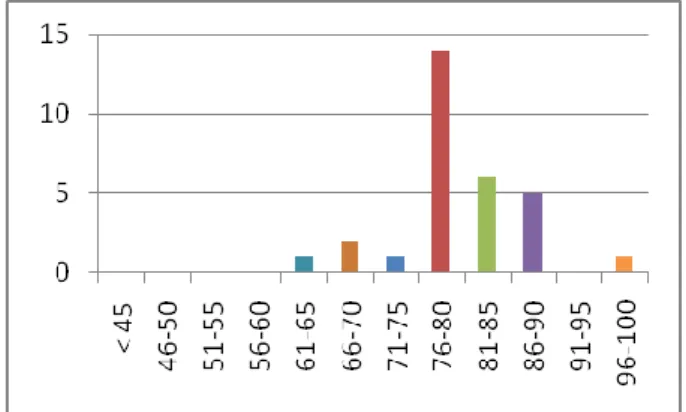
Next to the data presented in the form of interval value, to be described in the form of graphs.
Table 6. Interval value of Cycle I
No Interval value
The number of students
1. < 45 0
2. 46-50 0
3. 51-55 0
4. 56-60 0
5. 61-65 1
6. 66-70 2
7. 71-75 1
8. 76-80 14
9. 81-85 6
10. 86-90 5
11. 91-95 0
12. 96-100 1
The number of
stdents 30
In the form of graphs, results of the learn Cycle 1 can be described in Figure 3 of the following:
Figure 3 results of the Learn Cycle 1
3. Cycle II
At this stage of the cycle II students are given treatment learning with media cards aid back. Student learning outcomes can be seen in the following table:
Table 7. Results Learn Cycle II
NO Name of students Value
1. Ali Nur Rohmad 80
2. Aliffiyano Asrori 82
3. Ammad Rifa'i 76
4. Aniqoh Raudlatul Wardah 90
5. Avo Ariyanto 80
6. Bagus Setiawan 100
7. Danur Faisal 90
8. Dwi Rahayu 80
9. Elita Nurfiana 80
10. Elma Rifqi Prawidodo 82
11. Emy Marfuatin 86
12. Endah Novitasari 80
13. Endang Setyaningsih 82
14. Erma Safitri Ademawarni 78
15. Krisniya 96
16. Nanik Nurhana 92
17. Natalia Yuliani 100
18. Nia Puji Lestari 80
19. Nina Riz'qi Utami 90
20. Nurul Maulidah 100
21. Okta Bagus Magazendra 82
22. Rhokayati 80
23. Rika Ayu Nur Setyaningrum 82
24. Roni Wijaya 80
25. Sutriyani 82
26. Ulfatu Sa'diyah 86
27. Wulan Agustina 88
28. Yeny Farida 89
29. Yohana Yuliani 80
30. Yoyok Sugiarto 86
The amount 2559
Average 85.30
The highest value 100
The lowest value 78
The percentage of completeness 100%
The percentage of incompleteness 0%
Jurnal Engineering Edu Vol. 2 No. 4, Oktober 2016 ISSN LIPI : 2407-4187
8 ……….Agustina Pramu Indah, S.Pd On Cycle II is the average value of students
increased from 79, 86 became 85, 30. The number of students who got a perfect score increased to 3 students (10%), and in Cycle II there is no student who gets an increase of <75, so happened amounted to13.3%.
Next to the data presented in the form of interval value, to be described in the form of graphs.
Table 8. Interval Cycles II
No Interval value
The number of students
1. < 45 0
2. 46-50 0
3. 51-55 0
4. 56-60 0
5. 61-65 0
6. 66-70 0
7. 71-75 0
8. 76-80 11
9. 81-85 6
10. 86-90 8
11. 91-95 1
12. 96-100 4
The number of
students 30
In the form of graphs, results of the learn Cycle II can be described in Figure 4 of the following:
Figure 4. Outcome of Learning Cycles II
Based on the results of the analysis of data on student learning outcomes learning improvement Cycle II, shows already meet the indicators of student learning outcomes i.e.
research on Cycle II increases or better of the results of the learning Cycle I and cycles. With indicators of performance that no students whose value is below the KKM. So the research was halted until cycle II in accordance with the planning.
Discussion
Based on the initial observation and the results of daily test class X.1 of SMA N1 Batangan at the first semester in academic Years Lessons 2012/2013, students still have the writing skills are quite low. It can be seen from the average value of daily test, i.e. Minimum completeness criteria 65, 47 language of France is 75. Students who achieve a minimum completeness criterion only amounted 13 people or 43.3% of the total students. Errors made students located on conjugation and gender selection.
After the repair is done Learning Cycle I, increased student learning outcomes. Average value 65,47 increased in Pre Cycle at 79,86 at Cycle I. On the learning Cycle I there is 1 student who achieved a perfect score, i.e. the value 100.On Cycle 1 students receive only 4 students
<75 (13,33 percent).
On Cycle II is the average value of students increased from 79,86 became 85,3. The number of students who got a perfect score increased to 3 students (10%), and in Cycle II there is no student who gets an < 75, or all the students reached the limits of KKM. Furthermore the data summarized in the following table:
Table 9.
Recapitulation Student Learning Outcomes
No Name of students Pre C I C II
1. Ali Nur Rohmad 39 61 80
2. Aliffiyano Asrori 44 78 82
3. Ammad Rifa'i 50 67 76
4. Aniqoh Raudlatul Wardah
78
89 90
5. Avo Ariyanto 56 78 80
6. Bagus Setiawan 89 100 100
7. Danur Faisal 78 83 90
8. Dwi Rahayu 67 78 80
9. Elita Nurfiana 56 72 80
10. Elma Rifqi Prawidodo
56
78 82
11. Emy Marfuatin 78 83 86
12. Endah Novitasari 50 78 80
13. Endang Setyaningsih 83 78 82 14. Erma Safitri
Ademawarni
44
67 78
15. Krisniya 83 89 96
16. Nanik Nurhana 78 89 92
17. Natalia Yuliani 78 89 100
18. Nia Puji Lestari 61 78 80
19. Nina Riz'qi Utami 78 83 90
20. Nurul Maulidah 78 89 100
21. Okta Bagus Magazendra
50
78 82
Jurnal Engineering Edu Vol. 2 No. 4, Oktober 2016 ISSN LIPI : 2407-4187
Result Improvement of Writing Skills Learning about Self Identity in French Language Lessons………..………9
22. Rhokayati 56 78 80
23. Rika Ayu Nur Setyaningrum
72
78 82
24. Roni Wijaya 44 76 80
25. Sutriyani 56 78 82
26. Ulfatu Sa'diyah 78 83 86
27. Wulan Agustina 78 83 88
28. Yeny Farida 67 78 89
29. Yohana Yuliani 61 76 80
30. Yoyok Sugiarto 78 83 86
The amount
1964 239
5
255 9 Average
65.47 79.8
6
85.3 0 The highest value 89 100 100 The lowest value 39 61 78 The Percentage of
completeness
56,7
%
86,6 7%
100
% The percentage of
incompleteness
43,3
%
13,3 3%
0%
CONCLUSION
Based on the results of the research, it can be concluded that the application of media in learning Word card writing about identity on a class X 1 SMA N 1 Batangan can improve student learning outcomes. It can be seen from the results achieved to the respondent at the stage of pre Cycle, the cycle I and Cycle II. On the value of the initial conditions of the 30 students only 13 students (43.3 percent) to reach the KKM, with average value 65,47. After a given action on Cycle I, the average value rose to 79,85, there is student (33,3%) to reach a perfect score, 25 students (83,3%) and reached a value of ≥ 75 and only 4 students (13.3%) of which get value < 75.
In Cycle II, the average value of students increased from 79,86 became 85,3. The number of students who got a perfect score increased to 3 students (10%), and in Cycle II there is no student who gets an < 75, occur an increase of 13.3%.
ADVICE
Based on the above conclusions, suggestions that can be recommended is as follows:
1. In learning writing skills of self identity, teachers may consider the media cards aid as one of the variations of the technique of teaching.
2. Teachers should be able to make use of the media to teach the languages of France, because by using the student media become more spirited learning and can make in his studies. The media was not only media card, but can use other media, such as flash media, media images, or real objects.
3. Other researchers might be able to continue this research with the material and different skills.
BIBLIOGRAPHY
Alwi, Hasan,dkk. 1998. Tata Bahasa Buku Bahasa Indonesia. Jakarta: Perum Balai Pustaka.
Arikunto, Suharsimi. 2006. Prosedur Penelitian.
Jakarta: Rineka Cipta.
Cuq, Jean-Pierre dan Isabelle Gruca. 2002. Cours de Didactique du Français Langue Etrangère et Second. Saint-Martin-d‟Hères (Isère): PUG
Hamalik, Oemar. 1994. Media Pembelajaran.
Bandung: Citra Adikarya.
Nurgiyantoro, Burhan. 1988. Penilaian dalam Pengajaran Bahasa dan Sastra.
Yogyakarta: BPFE
Purwanto, Ngalim. 1984. Prinsip-prinsip dan Teknik Evaluasi Pengajaran. Jakarta:
Remaja Eka Karya.
Sadiman, Arif. 2008. Media Pendidikan. Jakarta:
Raja Grafindo Persada.
Sudjana, Nana. 2007. Media Pengajaran.
Bandung: Sinar Baru Rineka Cipta.
Soeparno. 1988. Media Pengajaran Bahasa.
Yogyakarta: Intan-Pariwara.
Valette, Rebecca. 1975. Le Test en Langue Étrangères Guide Pratique. Paris:
Classique Hachette.
http://fr.wikipedia.org/wiki/média
Jurnal Engineering Edu Vol. 2 No. 4, Oktober 2016 ISSN LIPI : 2407-4187
Melejitkan Prestasi Siswa dengan Hipnotis
Oleh : Ng. Irsyad Mochammad Judul : Hypnosis for Student
Penulis : Ichsan Solihudin, S.S, C.H, C.Ht, C.I Penerbit : DAR! Mizan
Tahun terbit : 2015
Tebal : 150 halaman ISBN : 978-602-242-693-6
Hipnotis sudah banyak dikenal dikalangan masyarakat. Namun tidak jarang masyarakat memberikan stigma negatif terhadap hipnotis. Hal ini tidak lepas dari banyaknya kejahatan yang mengatasnamakan hipnotis, misalnya gendam. Bahkan orang awam kemudian menyamakan hipnotis dengan ilmu gendam yang merupakan ilmu hitam untuk membuat orang tidak sadar sehingga mau menuruti semua yang kita inginkan atau kita katakan. Ilmu hipnotis, belum dianggap sebagai sebuah hal ilmiah yang bisa digunakan dan dimanfaatkan dalam banyak bidang dan banyak hal.
Buku setebal 150 halaman yang ditulis oleh Ichsan Solihudin ini, mencoba memperkenalkan apa dan bagaimana ilmu hipnotis itu sebenarnya. Ia menggambarkan bagaimana sejarah ilmu hipnotis dan bagaimana perkembangannya hingga kini. Hipnotis sudah dipakai oleh bangsa Mesir pada tahun 1552 untuk penyembuhan penyakit. Sekarang ini, hipnotis sudah dimanfaatkan untuk berbagai kepentingan, dari pengobatan hingga sebagai tontonan - hiburan.
Sesuai dengan judulnya, Hypnosis for Student, buku ini memberikan berbagi cara dan upaya pemanfaatan ilmu hipnotis untuk meningkatkan prestasi belajar siswa. Dimulai dengan bagaimana mengubah dan membentuk konsep diri, sugesti positif untuk meningkatkan prestasi, visualisasi, self-hypnosis, melakukan kebiasaan Sang Juara, hingga bagaimana meraih cita-cita kuliah dengan berburu beasiswa. Buku ini sangat menarik untuk dijadikan bahan koleksi bacaan, sehingga dapat membantu siswa, orang tua bahkan para guru untuk bisa memberikan sugesti positif pada diri siswa demi meraih prestasi. (Resensor adalah Penulis Buku “Buku Saku Anti Galau”)
Jurnal Engineering Edu Vol. 2 No. 4, Oktober 2016 ISSN LIPI : 2407-4187
Peningkatan Hasil dan Aktivitas Belajar PKn Materi Kedaulatan Rakyat………..………11 PENINGKATAN HASIL DAN AKTIVITAS BELAJAR PKn
MATERI KEDAULATAN RAKYAT DALAM SISTEM PEMERINTAHAN INDONESIA DENGAN METODE SIMULASI PADA SISWA KELAS VIII E
SMP NEGERI 1 CANDIMULYO MAGELANG
Suhardi, S.Pd, M.Pd
Guru SMP Negeri 1 Candimulyo Magelang Jawa Tengah ABSTRAK
Penelitian Tindakan Kelas (Classroom Action Research) ini bertujuan untuk mengetahui seberapa jauh metode simulasi dapat meningkatkan hasil belajar siswa dan mendeskripsikan penerapan metode simulasi untuk meningkatkan hasil belajar siswa Kelas VIIIE SMP N 1 Candimulyo Magelang. Penelitian ini terdiri atas dua siklus, setiap siklus terdiri atas tahapan perencanaan tindakan, pelaksanaan tindakan, observasi &
evaluasi, dan refleksi. Hasil analisis data tersebut adalah sebagai berikut: (1) Persentase hasil belajar PKn setelah dikelompokkan menjadi 4 kategori pada siklus I yaitu baik sekali 6,25%, baik 46,88%, cukup 40,42% dan kurang 6,25%, dengan nilai rata-rata 71,53 (2) Persentase hasil belajar PKn setelah dikelompokkan menjadi 4 kategori pada siklus II yaitu baik sekali 56,25%, baik , cukup 28,13%, cukup 15,62% dan kurang 0% dengan nilai rata-rata 83,50 (3) Aktivitas siswa yang bersifat positif seperti mendengarkan penjelasan guru, bertanya, menjawab atau menanggapi pertanyaan, menghormati pendapat teman, bekerjasama dalam kelompok, membaca buku paket atau materi, mengalami peningkatan persentase dari setiap siklus. Aktivitas yang bersifat negatif seperti belajar pelajaran lain, mengganggu teman, dan keluar masuk kelas, mengalami penurunan persentase dari setiap siklus. Dari hasil penelitian ini dapat disimpulkan bahwa penggunaan metode simulasi dalam pembelajaran langsung meningkatkan hasil belajar PPKn siswa kelas VIIIE SMP Negeri 1 Candimulyo, dari nilai rata-rata 72,34 menjadi 74,69.
Kata Kunci: Peningkatan, hasil, aktivitas, belajar, metode, simulasi.
PENDAHULUAN
Kegiatan belajar mengajar adalah suatu kondisi yang dengan sengaja diciptakan.Guru yang menciptakannya guna membelajarkan anak didik.Guru yang mengajar dan anak didik yang belajar.Perpaduan dari kedua unsur manusiawi ini lahirlah interaksi edukatif dengan memanfaatkan bahan sebagai mediumnya. Di sana semua komponen pengajaran diperankan secara optimal guna mencapai tujuan pengajaran yang telah ditetapkan sebelum pengajaran dilaksanakan (Syaiful Bahri Djamarah dan Zain, 2006:37).
Proses pembelajaran PKn di Kelas VIII E SMP N 1 Candimulyo, kebanyakan masih mengunakan paradigma yang lama dimana guru memberikan pengetahuan kepada siswa yang pasif. Guru mengajar dengan metode konvensional yaitu metode ceramah dan mengharapkan siswa duduk, diam, dengar, catat dan hafal.Akhirnya yang terjadikegiatan belajar mengajar menjadi monoton dan kurang menarik perhatian siswa. Kondisi seperti itu tidak akan meningkatkan kemampuan siswa dalam memahami mata pelajaran PKn. Akibatnya nilai akhir yang dicapai siswa tidak seperti yang diharapkan. Pada pelaksanaan Ulangan Harian materisistem pemerintahan Indonesia dan peran
lembaga negara sebagai pelaksana kedaulatan rakyat, hasil yang dicapai siswa kelas VIII E sangat jauh dari memuaskan,dimana daya serap siswa hanya mencapai 25% dengan nilai rata-rata kelas hanya mencapai 59.
Suasana belajar yang tidak kondusif seperti itu jelas merupakan masalah yang harus segera diatasi, karena berakibat pada rendahnya daya serap siswa terhadap materi pembelajaran dan penguasaan kompetensi dasar yang telah ditetapkan, dan akhirnya menyebabkan prestasi hasil belajar siswa menjadi rendah. Bertolak dari kenyataan seperti itu maka perlu dicari alternatif solusi untuk meningkatkan hasil belajar siswa terutama yang berhubungan dengan faktor kegiatan pembelajaran. Salah satu solusi alternatif yang dipilih untuk diterapkan di sini dan yang diharapkan bisa mengatasi masalah khusus kegiatan pembelajaran dalam bidang studi PKn tersebut adalah pembelajaran dengan metode simulasi.
Rumusan masalah dalam penelitian ini adalah: 1) Seberapa jauhMetode Simulasidapat hasil dan aktivitas belajar PKn siswa Kelas VIII E SMP Negeri 1 Candimulyo tahun pelajaran 2011/2012? 2) Bagaimana penerapan metode simulasi dalam pembelajaran PKn untuk
Jurnal Engineering Edu Vol. 2 No. 4, Oktober 2016 ISSN LIPI : 2407-4187
12 ………..………..Suhardi, S.Pd, M.Pd meningkatkan hasil dan aktivitas belajar siswa
Kelas VIII E SMP N 1 Candimulyo tahun pelajaran 2011/2012?
Tujuan penelitian ini adalah: 1) Untuk mengetahui seberapa jauhmetode simulasi dapat meningkatkan hasil dan aktivitas belajar PKn siswa Kelas VIII E SMP Negeri 1 Candimulyo tahun pelajaran 2011/2012. 2) Mendeskripsikan bagaimana penerapan metode simulasi untuk meningkatkan hasil dan aktivitas belajar siswa Kelas VIII E SMP N 1 Candimulyo tahun pelajaran 2011/2012.
KAJIAN PUSTAKA
Pengertian Belajar dan Pembelajaran
Belajar merupakan aspek dari perkembangan yang menunjuk pada perubahan (modifikasi) perilaku sebagai hasil dari praktik dan pengalaman (Oemar Hamalik, 2010:84).
Reber menyatakan bahwa belajar adalah the process of acquiring knowledge. Belajar adalah proses mendapatkan pengetahuan (Agus Suprijono, 2011:3). Ashar Arsyad dalam bukunya Media Pembelajaran menyatakan: “Belajar adalah suatu proses yang kompleks yang terjadi pada diri setiap orang sepanjang hidupnya. Proses belajar itu terjadi karena adanya interaksi antara seseorang dengan lingkungannya. Oleh karena itu, belajar dapat terjadi kapan saja dan di mana saja.Salah satu pertanda bahwa seseorang itu telah belajar adalah adanya perubahan tingkah laku pada diri orang itu yang mungkin disebabkan oleh terjadinya perubahan pada tingkat pengetahuan, keterampilan, atau sikapnya” (2007:1). Sedangkan menurut Syaiful Bahri Djamarah dan Aswan Zain : “Belajar adalah proses perubahan perilaku berkat pengalaman dan latihan. Artinya tujuan kegiatan adalah perubahan tingkah laku, baik yang menyangkut pengehuan, keterampilan maupun sikap, bahkan meliput segenap aspek organisme atau pribadi. Kegiatan belajar mengajar seperti mengorganisasi pengalaman belajar, mengolah kegiatan mengajar, menilai proses, dan hasil belajar, kesemuanya termasuk dalam cakupan tanggung jawab guru. Jadi, hakikat belajar adalah perubahan”(2006:10-11). Dalam konteks pembelajaran, belajar merupakan usaha atau kegiatan pelajar dalam menyerap dan mengolah bahan ajar atau ilmu, sehingga memperoleh pengetahuan baru, keterampilan baru, sikap baru atau menyempurnakan pengetahuan, keterampilan dan sikap yang sudah dimiliki sebelumnya (Seni Apriliya, 2007:55).
Dari beberapa pengertian tentang belajar tersebut dapat disimpulkan bahwa belajar adalah segenap rangkaian kegiatan atau aktivitas yang dilakukan secara sadar oleh seseorang dan mengakibatkan perubahan dalam dirinya berupa penambahan pengetahuan atau ketrampilan berdasarkan alat indera dan pengalamannya.Oleh sebab itu apabila setelah belajar siswa tidak ada perubahan tingkah laku yang positif dalam arti tidak memiliki kecakapan baru serta wawasan pengetahuannya tidak bertambah maka dapat dikatakan bahwa belajarnya belum sempurna.
Proses pengajaran memegang peranan penting untuk mencapai tujuan pengajaran yang efektif adalah interaksi guru dengan siswa. Mengingat kedudukan siswa sebagai objek dan sekaligus sebagai subjek dalam pengajaran, maka inti proses pengajaran tidak lain adalah kegiatan belajar siswa dan kegiatan mengajar guru dalam mencapai suatu tujuan pengajaran. Proses pembelajaran adalah kegiatan yang bernilai edukatif. Nilai edukatif tersebut mewarnai interaksi yang terjadi antara guru dengan siswa, siswa dengan siswa, siswa dengan sumber belajar dalam mencapai tujuan pembelajaran yang ditetapkan. Harapan yang ada pada setiap guru adalah bagaimana materi pelajaran yang disampaikan kepada anak didiknya dapat dipahami secara tuntas.Untuk memenuhi harapan tersebut bukanlah sesuatu yang mudah, karena harus disadari bahwa setiap siswa memiliki karakteristik yang berbeda baik dari segi minat, potensi, motivasi, kecerdasan dan usaha siswa itu sendiri termasuk faktor yang berasal dari luar diri siswa seperti lingkungan. Terhadap keberagaman pribadi yang dimiliki oleh setiap siswa tersebut, sebagai guru harus mampu memberikan pelayanan yang sama sehingga siswa merasa mendapatkan perhatian yang sama. Untuk memberikan pelayanan yang sama tentunya perlu solusi dan strategi yang tepat, sehingga harapan yang sudah dirumuskan sebagai tujuan pembelajaran dan dilaksanakan dalam proses pembelajaran dapat tercapai.
Hasil Belajar dan Penilaian Hasil Belajar PKn Menurut Blom (Agus Suprijono, 2011:6-7), hasil belajar mencakup kemampuan kognitif, afektif dan psikomotorik.Domain kognitif adalah knowledge (pengetahuan, ingatan), comprehension (pemahaman, menjelaskan, meringkas, contoh), application (menerapkan), analysis (menguraikan, menentukan hubungan), synthesis (mengorganisasikan, merencanakan, membentuk bangunan baru), dan evaluation (menilai).Domain
Jurnal Engineering Edu Vol. 2 No. 4, Oktober 2016 ISSN LIPI : 2407-4187
Peningkatan Hasil dan Aktivitas Belajar PKn Materi Kedaulatan Rakyat………..………13 afektif adalah receiving (sikap menerima),
responding (memberikan respons), valuing (nilai), organization (organisasi), characterization (karakterisasi).Domain psikomotor meliputi
initiatory, pre-routine, dan
rountinized.Psikomotor juga mencakup keterampilan produktif, teknik, fisik, sosial, manajerial, dan intelektual. Dari pendapat di atas dapat dipahami bahwa dalam hasil belajar terkandung kemampuan keterampilan, sikap dan keterampilan yang diperoleh siswa setelah ia menerima perlakuan yang diberikan oleh guru sehingga dapat mengkonstruksikan pengetahuan itu dalam kehidikupan sehari-hari.
Hasil belajar PKn adalah hasil belajar yang dicapai siswa setelah mengikuti proses pembelajara PKn berupa seperangkat pengetahuan, sikap, dan keterampilan dasar yang berguna bagi siswa untuk kehidupan sosialnya baik untuk masa kini maupun masa yang akan datang.Sesuai dengan karakteristiknya, hasil belajar siswa yang diharapkan pada mata pelajaran Pendidikan Kewarganegaraan terdiri atas tiga aspek kompetensi yaitu a) aspek pengetahuan kewarganegaraan (civic knowledge), b) keterampilan kewarganegaraan (civic skill), dan c) watak atau karakter kewarganegaraan (civic dispositions) (Depdiknas:2006).
Aspek pengetahuan kewarganegaraan (civic knowledge) menyangkut kemampuan akademik yaitu keilmuan yang dikembangkan dari berbagai teori atau konsep politik, hukum, dan moral.
Sehingga dengan demikian pada mata pelajaran Pendidikan Kewarganegaraan merupakan bidang kajian multidisipliner.Secara lebih rinci materi pengetahuan kewarganegaraan meliputi pengetahuan tentang hak dan tangung jawab warganegara, hak asasi manusia, prinsip-prinsip dan proses demokrasi, lembaga pemerintahan dan non pemerintah, identitas nasional, pemerintahan berdasar hukum (rule of law) dan peradilan yang bebas dan tidak memihak, konstitusi, serta nilai- nilai dan norma – norma dalam masyarakat.
Aspek keterampilan kewarganegaraan (civic skill) meliputi keterampilan intelektual (intelectual skills) misalnya keterampilan dalam merespon berbagai persoalan politik dengan merancang dialog dengan DPR dan keterampilan berpartisipasi (participatory skills) dalam kehidupan berbangsa dan bernegara misalnya adalah keterampilan dalam mengunakan hak dan kewajibannya di bidang hukum, yang dilakukan dengan cara segera melapor kepada pihak yang berwajib atas terjadinya kejahatan yang diketahuinya.
Sedangkan mengenai aspek watak atau karakter kewarganegaraan (civic dispositions) merupakan dimensi yang paling subtansial dan esensial dalam mata pelajaran Pendidikan Kewarganegaraan.Dimensi ini dapat dipandang sebagai muara dari pengembangan kedua dimensi sebelumnya. Berdasarkan hal tersebut di atas, maka setelah belajar Pendidikan Kewargenegaraan seorang warganegara diharapkan memiliki pengetahuan kewarganegaraan yang baik, terutama pengetahuan di bidang hukum, politik, dan moral dalam kehidupan berbangsa dan bernegara, untuk selanjutnya memiliki keterampilan secara intelektual maupun secara partisipatif dalam kehidupan berbangsa dan bernegara. Dan pada akhirnya pengetahuan dan keterampilannya itu akan membentuk watak dan karakter yang mapan, sehingga menjadi sikap dan kebiasaan hidup sehari-hari yang mencerminkan warga negara yang baik seperti sikap relegius, toleran, jujur, adil, demokratis, menghargai perbedaan, menghormati hukum, menghormati hak orang lain, memiliki semangat kebangsaan yang kuat, memiliki kesetiakawanan sosial, dan lain-lain.
Membicarakan hasil belajar, tidak bisa lepas dari masalah penilaian atau evaluasi.Penilaian dilakukan untuk memperoleh informasi tentang kemajuan dan hasil belajar dalam ketuntasan penguasaan kompetensi (Nurhadi, dkk, 2004:109).
Menurut Zaenal Aqib, evaluasi (penilaian) merupakan upaya untuk membuat keputusan tentang tingkat hasil belajar siswa sesuai dengan tujuan pembelajaran. Tujuan evaluasi hasil belajar adalah memberikan informasi berkenaan dengan kemajuan siswa, pembinaan kegiatan belajar, menerapkan kemampuan dan kesulitan, untuk mendorong motivasi belajar, membantu perkembangan tingkah laku, dan membimbing siswa untuk memilih sekolah atau jabatan/pekerjaan (2010:69).
Penilaian hasil belajar PKn adalah proses sistematis dan sistemik untuk mengumpulkan informasi, melalui proses pengukuran dan non- pengukuran, atau penggunaan instrument tes maupun non-tes, yang dapat dipergunakan sebagai dasar dalam pengambilan keputusan tentang siswa, perbaikan program, dan perbaikan proses pembelajaran. Penilaian adalah memberi nilai tingkat pencapaian hasil belajar-mengajar serta efektivitas program dan proses pembelajaran (Depdiknas, 2007:7).
Berdasarkan uraian di atas jelas bahwa penilaian hasil belajar PKn seharusnya tidak hanya dilakukan melalui tes tertulis maupun tidak