
SPEECH FUNCTIONS IN OPRAH WINFREY SHOW
a thesis
submitted in partial fulfillment of the requirements
for the degree of Magister Pendidikan
in English
by
Murti Ayu Wijayanti
2201504014
GRADUATE PROGRAM OF ENGLISH EDUCATION
SEMARANG STATE UNIVERSITY
ii
DECLARATION
I hereby declare that this thesis is definitely my own work. I am completely
responsible for the content of this thesis. Opinions or findings of others included
in this thesis are quoted or cited in accordance with ethical standard.
Semarang,
February
15
th,
2007
iii
SUPERVISOR APPROVAL
This thesis, by Murti Ayu Wijayanti, entitled ‘Speech Functions in Oprah
Winfrey Shows’ has been approved by the supervisors to be examined by the
Board of Examiners.
Semarang,
February
26,
2007
Supervisor
1
Supervisor
2
Ahmad
Sofwan,
Ph.D
Drs. Jan Mujiyanto,
M.Hum
iv
APPROVAL
A Master in English Education Thesis
entitled
Speech Functions in Oprah Winfrey Show
Prepared and presented by
Murti Ayu Wijayanti
2201504014
was defended in front of the Board of Examiners On March 6, 2007
and was declared acceptable
Board of Examiners
Chairman
Secretary
Prof. Mursid Saleh, Ph.D.
Helena
I.R.
Agustien,
Ph.D.
NIP. 130354512
NIP. 130812911
First Examiner
Prof. A. Maryanto, Ph.D.
NIP. 130529509
Second Examiner
Third Examiner
Jan Mujiyanto, M.Hum.
Ahmad
Sofwan,
Ph.D.
v
To Ikhwah
vi
PREFACE
During the slow production of this thesis I have accumulated many debts
to many people. However, only a small number of them I have space to
acknowledge here. I am grateful to Director of the Graduate Program, Semarang
State University, Prof. A. Maryanto, Ph.D. for his encouragement to complete my
thesis. My gratitude also goes to my first advisor, Ahmad Sofwan, Ph. D. for his
patient guidance in accomplishing my thesis. I owe much to my second advisor,
Drs. Jan Mujiyanto, M.Hum. for his guidance and encouragement during my
thesis writing.
I am grateful to my colleagues in Dian Nuswantoro University for their
support and warm love. I am also grateful to my classmates, Mulatsih, Yulia,
Wuri, Semi, Widya for their encouragement during my thesis writing.
I owe much to Ikhwah for giving me full support and love during this
thesis completion. I also owe much to my students who have given me valuable
support and care.
Finally, I deeply thank my family for their prayer and support, especially
vii
ABSTRACT
Wijayanti, Murti Ayu. 2007. Speech Functions in Oprah Winfrey Show. Thesis,
Graduate Program, Semarang State University. Supervisors: I. Ahmad Sofwan,
Ph.D., II. Drs. Jan Mujiyanto, M.Hum.
Key Words: speech function, role enactment, talk show
This thesis is based on a study focusing on the speech functions realized
by Oprah as the host and her guests in Oprah Winfrey Show. The main purposes
of the study were to explain the speech functions chosen by Oprah and her guest
and describe the role enactment among them.
The data were taken from two Oprah Winfrey shows. Those two shows
were chosen according to the two different programs of Oprah Winfrey Show.
One program was about entertainment with artists featuring Jon Stewart, and
another was about ordinary people who experienced dramatic life featuring Polly
Mitchell. The data were recorded from one of television stations in the form of
video compact disc and were transcribed to get the written data. The written data
were then identified in terms of turn and moves. The next step was analyzing the
speech function of every move based on the chart provided by Eggins and Slade.
The speech function choices were then interpreted synoptically to give the
quantification of the discourse structure.
The results of this study show that (1) Oprah plays her role as the initiator
while her guests play their roles as the supporters, (2) the status difference
between the guests affect the distribution of speech function choices, (3) both
guests produce higher number of moves and clauses than Oprah indicating that
they get more space to speak, (4) as the host, Oprah produces higher number of
registering move (encouraging her guests to speak) which becomes the reason
why Oprah is considered to be a great host who can reveal the fact from her guests
without threatening them, (5) both guests produce higher number of responding
moves than Oprah showing that they provide information rather than seek it, (6)
compared to her guests, Oprah makes more tracking move (one of rejoinder
moves) by clarifying, checking and confirming indicating that she has more power
to get the clearer information.
viii
ix
TABLE OF CONTENTS
Preface ... vii
Abstract ... viii
Table of Contents ... x
List of Tables ... xiii
List of Figures ... xiv
List of Appendixes ... xv
Chapter
1 INTRODUCTION
...
1
1 1 Background of the Study ...
1
1 2 Research Questions ...
4
1 3 Objective of the Study...
5
1 4 Significance of the Study ...
5
2 REVIEW OF RELATED LITERATURE ...
6
2 1
Systemic Functional Linguistics ...
6
2 1 1 Field ...
7
2 1 2 Tenor ... 9
2 1 3 Mode ... 11
2 2
Speech Function ... 15
x
2 2 2 Sustaining Speech Function ... 20
2 2 2 1 Continuing speech Functions ... 20
2 2 2 2 Reacting Speech Functions: responding ... 22
2 2 2 3 Reacting Speech Functions: rejoinder ... 24
2 2 3 Speech Function Network ... 26
2 3 Mood of Clause ... 27
2 4 Talk Show ... 29
2 5
Oprah Winfrey Show ... 29
2 6
Biography of Oprah Winfrey ... 30
2 6
Previous Related Studies ... 32
3 PROCEDURES OF INVESTIGATION
... 34
3 1 Research Method... 34
3 2 Unit of Analysis ... 34
3 3 Source of Data ... 35
3 4 Role of Researcher ... 36
3 5 Reliability and Validity ... 36
3 6 Technique of Data Collection ... 37
3 7 Technique of Data Analysis ... 38
4 FINDINGS AND DISCUSSION
... 40
4 1 Synoptic Interpretation of Discourse Structure ... 40
4 1 1 Synoptic Interpretation of Speech Functions in Talk Show 1 ... 41
xi
4 1 1 2 Continuing ... 45
4 1 1 3 React – Responding ... 50
4 1 1 4 React – Rejoinder ... 55
4 1 2 Synoptic Interpretation of Speech Functions in Talk Show 2 ... 58
4 1 2 1 Opening ... 60
4 1 2 2 Continuing ... 62
4 1 2 3 React – Responding ... 67
4 1 2 4 React – Rejoinder ... 71
4 2
Summary of Analysis ... 72
4
3
Pedagogical
Implication
...
75
5CONCLUSION AND SUGGESTION
... 76
5 1 Conclusion ... 76
5 2 Suggestion ... 78
References ... 79
xii
LIST OF TABLES
Table Page
2 1 Technical vsEveryday Language ... 8
2 2 Formal vsInformal Situations ... 10
2 3 Mode: Characteristics of Spoken/Written Language Situations ... 13
2 4 Speech Functions and Responses ... 15
2 5 Speech Function and Typical Mood in Clause ... 16
2 6 Congruent and Incongruent Realizations of Speech Functions ... 17
2 7 Speech Function Labels for Opening Moves ... 19
2 8 Summary of Continuing Speech Functions ... 21
2 9 Summary of Sustaining Responding Speech Functions ... 23
2 10 Summary of Sustaining Rejoinder Speech Function ... 24
2 11 Basic Mood Types ... 27
xiii
LIST OF FIGURES
Figur Page
2 1 The Field Continuum ... 8
2 2 The Power Continuum ...
9
2 3 The Affective Involvement Continuum ...
9
2 4 The Contact Continuum ... 10
2 5 Spatial or Interpersonal Distance ... 12
2 6 The Experiential Distance Continuum ... 12
2 7 Context and Language in the Systemic Function Model ... 14
xiv
LIST OF APPENDICES
Appendix Page
1Transcript of Talk Show 1 (Oprah Winfrey and Jon Stewart) ... 81
2Transcript of Talk Show 1 (Oprah Winfrey and Polly Mitchell) ... 87
3Analysis of Speech Function in Talk Show 1 ... 91
1
CHAPTER I
INTRODUCTION
1.1 Background of the Study
In everyday life, language is used to share ideas and exchange meanings.
By means of language, people are able to tell what they mean.Moreover, it can
also make them understand what other people think about.
Language also conveys news. Pinker (1995: 83) says that for journalists,
when a dog bites a man, that is not news, but when a man bites a dog, that is
news. With language, the news is made. Next, the news is shared in a community
that shares the same language.
There are two kinds of language, verbal and non verbal language. Verbal
language is mostly used for people to communicate in modern era. However,
when tracing back to the past, people used gesture or picture to interact with
others. It then developed to verbal language which gave more ease to share ideas.
Fiske (1990: 67) states that non verbal communication is carried on
through presentational codes such as gestures, eye movements, or quality of voice
that can give message only about here and now. In the other words, people can’t
send message about their feelings last week.
Through verbal language, people can send message about their feeling
studied. That’s why, it is a good way to understand more about language through
verbal language in the form of written or spoken text.
A number of studies on language whether written or spoken have been
conducted, such as study on the work of popular authors, everyday conversation,
and so on. It is natural since having language is part of what it means by human.
Then, it is not exaggerating when people want to know about language. The
reason is because they hope that this knowledge will lead them to insight about
human nature (Pinker, 1995: 404).
Linguists, for the first time, paid attention to spoken text little bit
late.Halliday (1994: xxii) states that communities without a written language
obviously have their literacy sacred text in spoken form. Then, when writing
evolves the value tends to be transferred to written language and speech is largely
ignored.
Fortunately, there was a new invention, a tape recorder. Halliday finds that
tape recorder which can capture every single conversation was the greatest
invention in linguistics. As the result, spoken language can be easily captured and
analyzed.
Halliday (1994: xxii-xxiii) also proposes two main reasons why spoken
language or speech is important for the study. The first reason is because of the
unconscious nature of spoken language. It is spoken language that responds
continually to the small but subtle changes in its environment. The second reason
is that because much of the written language which achieves lexically is achieved
Halliday (1985: 5-11) notes that the way into understanding about
language lies in the study of texts. Text according to Halliday is defined as a
semantic unit. It consists of words and sentences that are made of meanings. It is
also as social exchange of meanings. As a form of exchange, a text is meaningful
because it can be related to interaction among speakers. Another definition comes
from Eggins (1994: 5). She defines a text as a complete linguistic interaction
whether spoken or written, preferably from beginning to end. It is verbal or non
verbal used to interact to share meanings.
In spoken text or what someone says, speech sound or voice becomes the
medium. There are also two other media, such as radio and television. Those
mechanical media transmit the speech sound produced by the speaker to the
listeners, in this case is audience.
A television program that serves the audience with spoken text is talk
show. Talk show is defined as a television or radio program in which people,
especially well - known people are invited to talk in informal way about various
topics (Hornby, 1995: 188). In the show, they talk spontaneously without the full
script given by a scrip writer.
Talk show is an invention of twentieth century broadcasting. It takes a
very old form of communication and transforms it into a low cost but highly
popular form of information and entertainment through the institution, practices,
and technologies of television (Timberg, http: //www. museum.
For the last decade, a talk show that gets people’s attention is Oprah
Winfrey Show. It is seen by more than 49 million viewers a week in the United
States and is broadcast internationally in 121 countries. It also ranks second
among all U.S. talk shows (http: //www2.oprah.com).
Television talk show is the representation of casual conversation. It is
necessary for us to study how it becomes the magnet for the audience. Trying to
find out what strength the talk show has from the language point of view is good
for us who want to understand more about language.
1.2 Research Question
The research questions of this study are as follows:
(1)
What speech functions choices are used by Oprah Winfrey?
(2)
What speech functions choices are used by the guests in Oprah Winfrey
Show?
(3)
How are the role enactment patterns realized in the show?
1.3 Objective of the Study
The objectives of this study are as follows:
(1)
Describing the speech function choices used by Oprah Winfrey.
(2)
Describing the speech function choices used by the guests in Oprah
Winfrey Show.
1.4 Significance of the Study
The findings of this study are expected to contribute theoretically and
practically. Theoretically, this study can give more view in the study of discourse.
Practically, students can learn more the example of speech functions that can be
used to help them speak English. Other researchers can also get the benefit,
especially those who are willing to conduct further study on discourse.
1.5 Outline of the Report
The thesis is organized in five chapters. Chapter I is the introduction of the
study. It presents the background of the study, research question, objective of the
study, significance of the study, and outline of the study.
Chapter II is review of related literature. It provides theories related to the
topic of the study.Chapter III presents the procedures of investigation. It consists
of research method, unit of analysis, source of data, role of the researcher,
technique of data collection, and technique of data analysis. Chapter IV discusses
the findings and discussion consisting of the general findings and further
discussion. And finally, chapter V draws conclusion of the study and provides
6
CHAPTER II
REVIEW OF RELATED LITERATURE
2.1 Systemic Functional Linguistics
From time to time, the studies on spoken interaction have been conducted
through several points of view. Analyzing conversation started from ethno
methodology. It focused on common social interaction. Then the theory of
Conversational Analysis (CA) emerged. It was the root of discourse analysis
(Tesch, 1990: 5). Discourse analysis focused on the analysis of the text whether
spoken or written.
This study is based on systemic functional linguistics approach. This is one
of influenced approaches to analyzing conversation. This approach is based on the
work of Halliday(Halliday and Hasan, 1985: 44). He notes that people study about
language in order to understand language and how it works. Moreover Eggins
(1994: 2) asserts that the systemic approach tries to answer the question
functionally and semantically. Functionally, it answers the questions about how
people use language and how language is structured for use. Then semantically, it
tries to seek answer the questions about how many different meanings we use
language to make and how language is organized to make meanings.
Meanings are shared in interaction. However, not only one meaning
delivered at the same time, but can be several strands of meaning simultaneously.
metafunctions; ideational meanings (experiential and logical), interpersonal
meanings, and textual meanings.
Eggins and Slade (1994: 49) give more explanations about how to analyze
conversation based on the metafunctions. They are:
(1)
Ideational meanings: it focuses on the topics people talk about, when, by
whom, how topic transition and closure is achieved, etc.
(2)
Interpersonal meanings: it focuses on the kinds of role relations in the
conversation, the attitudes that the interactants express to each other, the way
they negotiate with others, etc.
(3)
Textual meanings: it focuses on the cohesion in the conversation, different
patterns of salience and foregrounding, etc.
Egins and Slade (1997: 51) then note that those three strands of meaning or
tripartite structure of language is an encoding of the tripartite structure of the
context of situation in which we use language. Social context of situation based on
Halliday (Halliday and Hasan, 1985: 12) include field, tenor and mode.
2.1.1 Field
Halliday (Halliday and Hasan, 1985: 12) defines field as the activity or focus
of the topic, whereas Gerot and Widnell (1995: 15) define field as what is going
on. Meanwhile Eggins (1994: 67) gives definition of the field as the situational
variable that has to do with the focus of the activity in which we are engaged.
The situations based on Eggins (1994: 67) may be either technical or
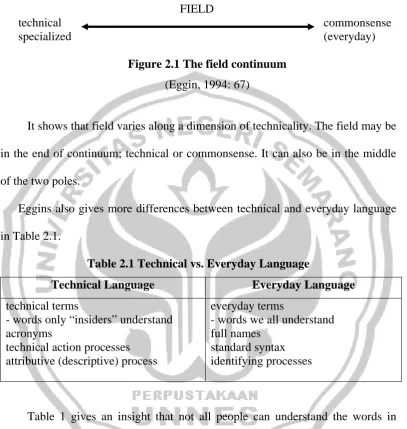
everyday in their construction of an activity focus, as indicated by Figure 2.1.
FIELD
technical
commonsense
specialized
(everyday)
Figure 2.1 The field continuum
(Eggin, 1994: 67)
It shows that field varies along a dimension of technicality. The field may be
in the end of continuum; technical or commonsense. It can also be in the middle
of the two poles.
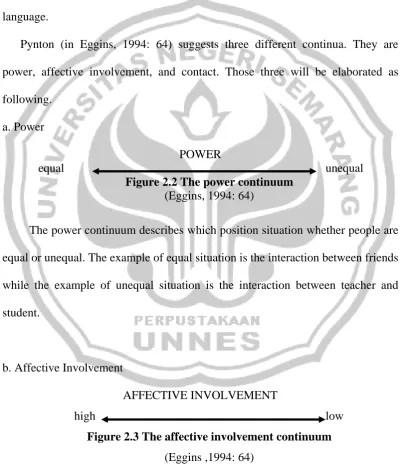
Eggins also gives more differences between technical and everyday language
in Table 2.1.
Table 2.1 Technical vs. Everyday Language
Technical Language
Everyday Language
technical terms
- words only “insiders” understand
acronyms
technical action processes
attributive (descriptive) process
everyday terms
- words we all understand
full names
standard syntax
identifying processes
Table 1 gives an insight that not all people can understand the words in
technical language, for example the word in architecture. Only insiders or those
who include in the same community will understand this technical language. It’s
2.1.2 Tenor
Tenor according to Halliday (Halliday and Hasan, 1985: 12) and Gerrot and
Wignell (1994: 15) refers to role and role relationship, Whereas Eggins (1994: 63)
defines tenor as the social role relationships played by interactans. It means that
the kind of social role they are playing in a situation will effect on how they use
language.
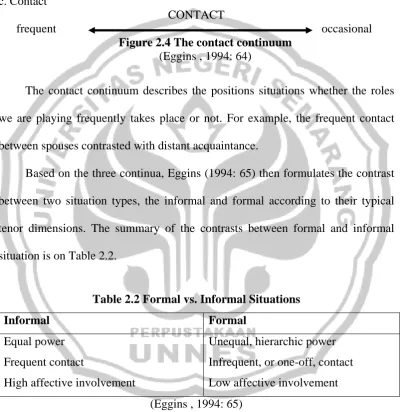
Pynton (in Eggins, 1994: 64) suggests three different continua. They are
power, affective involvement, and contact. Those three will be elaborated as
following.
a. Power
POWER
equal
unequal
Figure 2.2 The power continuum
(Eggins, 1994: 64)
The power continuum describes which position situation whether people are
equal or unequal. The example of equal situation is the interaction between friends
while the example of unequal situation is the interaction between teacher and
student.
b. Affective Involvement
AFFECTIVE INVOLVEMENT
high
low
Figure 2.3 The affective involvement continuum
(Eggins ,1994: 64)
Figure 2.3 schematizes the affective involvement continuum, in which
are those in which the affective involvement is high or low. In other words, the
involvement of their emotion is high or low. The example of high affective
involvement is between husband and wife, whereas between colleagues are not.
c. Contact
CONTACT
frequent
occasional
Figure 2.4 The contact continuum
(Eggins , 1994: 64)
The contact continuum describes the positions situations whether the roles
we are playing frequently takes place or not. For example, the frequent contact
between spouses contrasted with distant acquaintance.
Based on the three continua, Eggins (1994: 65) then formulates the contrast
between two situation types, the informal and formal according to their typical
tenor dimensions. The summary of the contrasts between formal and informal
situation is on Table 2.2.
Table 2.2 Formal vs. Informal Situations
Informal Formal
Equal power
Frequent contact
High affective involvement
Unequal, hierarchic power
Infrequent, or one-off, contact
Low affective involvement
(Eggins , 1994: 65)
An informal situation would typically involve interactants who are equal
power, who see each other frequently, and who are affectively involved. A formal
situation, in contrast, would typically involve interactants who are not equal, who
2.1.3 Mode
Mode according to Halliday (Halliday and Hasan, 1985: 12) refers to what
part the language is playing whether written or spoken. Eggins (1994: 53) also
defines mode as the role language is playing in interaction. Meanwhile Gerrot and
Wignell (1995: 11) note that mode refers to how language is being used whether
the channel of communication is spoken or written and language is being used as
a mode of action or reflection.
Martin (1985) as restated by Eggins (1994: 53) has suggested that the role
can be seen as involving two simultaneous continua which describe two different
types of distance, spatial and experiential distance.
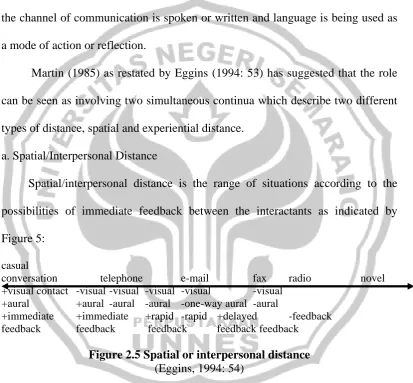
a. Spatial/Interpersonal Distance
Spatial/interpersonal distance is the range of situations according to the
possibilities of immediate feedback between the interactants as indicated by
Figure 5:
casual
conversation telephone e-mail fax radio novel
+visual contact -visual -visual -visual -visual -visual +aural +aural -aural -aural -one-way aural -aural
+immediate +immediate +rapid -rapid +delayed -feedback
feedback feedback feedback feedback feedback
Figure 2.5 Spatial or interpersonal distance
(Eggins, 1994: 54)
In casual conversation, there are both visual contact and aural. As the result,
the feedback in that situation is immediate. At the other end of the continuum is
novel where there is no visual or aural contact and thus no possibility of
immediate feedback. The other types of situations, such as telephone, e-mail, fax,
b. Experiential Eistance
Playing commentating recounting constructing
a game e.g. calling experience experience
e.g. bridge a match report in the newspaper e.g. (non)-
fiction
language language constituting
accompanying social process
social process
language as ACTION language as
REFLECTION
Figure 2.6 The experiential Distance Continuum
(Eggins, 1994: 54)
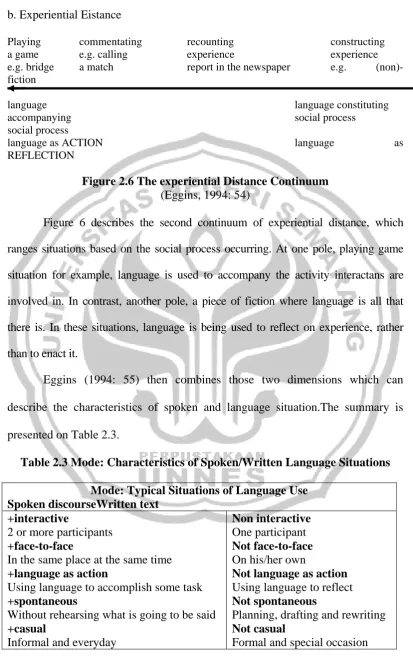
Figure 6 describes the second continuum of experiential distance, which
ranges situations based on the social process occurring. At one pole, playing game
situation for example, language is used to accompany the activity interactans are
involved in. In contrast, another pole, a piece of fiction where language is all that
there is. In these situations, language is being used to reflect on experience, rather
than to enact it.
Eggins (1994: 55) then combines those two dimensions which can
describe the characteristics of spoken and language situation.The summary is
presented on Table 2.3.
Table 2.3 Mode: Characteristics of Spoken/Written Language Situations
Mode: Typical Situations of Language Use
Spoken discourseWritten text
+interactive
2 or more participants
+face-to-face
In the same place at the same time
+language as action
Using language to accomplish some task
+spontaneous
Without rehearsing what is going to be said
+casual
Informal and everyday
Non interactive
One participant
Not face-to-face
On his/her own
Not language as action
Using language to reflect
Not spontaneous
Planning, drafting and rewriting
Not casual
Table 2.3 shows that the situation is different between spoken and written
text. The participant in written text is single, but there are two or more participants
in spoken discourse. In spoken discourse, the participants should be in the place at
the same time. In written text, however the participants are not face to face. In
addition, the situation in spoken discourse is spontaneous. For example, someone
responds directly to his friend’s question. The situation will be different in written
text which is planned, drafted, and rewritten.
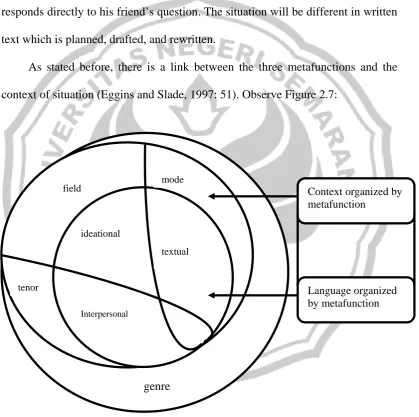
As stated before, there is a link between the three metafunctions and the
context of situation (Eggins and Slade, 1997: 51). Observe Figure 2.7:
Figure 2.7: Context and language in the systemic function model
(Eggins and Slade, 1997: 51)
Figure 2.7 shows that the field is realized through the ideational
metafunction.The mode is realized by the textual metafunction, whereas the tenor
fieldtenor
Interpersonal
textual ideational
mode
Context organized by metafunction
Language organized by metafunction
is realized through interpersonal metafunction. And the whole system of language
and context is included in genre.
2.2 Speech Function
In analyzing conversation, I focused on interpersonal meanings, especially
the speech function. Speech function is a type of move interactants use to initiate a
piece of dialogue (Eggins and Slade, 1997: 180). By revealing the speech function
chosen by speakers, people can get information about the role enactment pattern
among them.
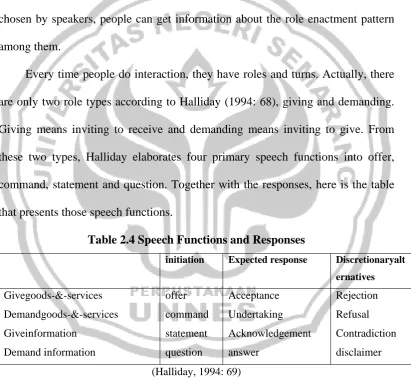
Every time people do interaction, they have roles and turns. Actually, there
are only two role types according to Halliday (1994: 68), giving and demanding.
Giving means inviting to receive and demanding means inviting to give. From
these two types, Halliday elaborates four primary speech functions into offer,
command, statement and question. Together with the responses, here is the table
that presents those speech functions.
Table 2.4 Speech Functions and Responses
initiation Expected response Discretionaryalt
ernatives
Givegoods-&-services
Demandgoods-&-services
Giveinformation
Demand information
offer
command
statement
question
Acceptance
Undertaking
Acknowledgement
answer
Rejection
Refusal
Contradiction
disclaimer
(Halliday, 1994: 69)
Table 2.4 shows that there is the orientation of the exchange whether the
speaker is giving or demanding. In addition, there is the commodity exchanged
Eggins and Slade (1997: 181) state that there is a choice between initiating
and responding moves. Every time speakers take their roles, they assign the
listeners to take their roles too so that the conversation runs well. The listeners’
roles are the response of the initiation made by the speakers.
Halliday (1994: 68) notes that the interactivity by pairing each of four basic
initiating speech functions with expected response that can be verbalized or not be
verbalized. However, there is also possibility for the listener to give response out
of the expected one.
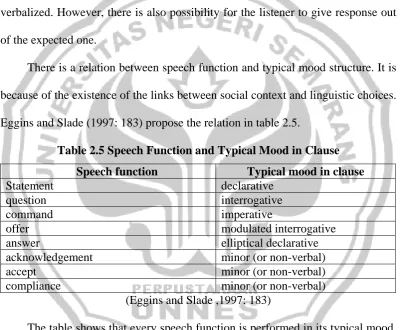
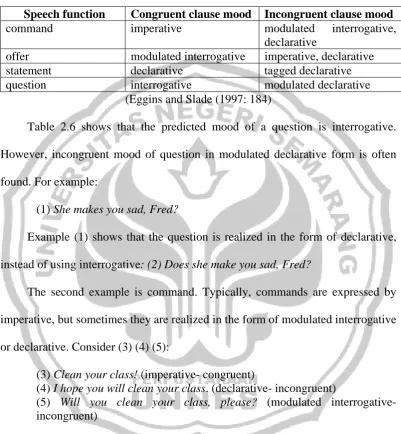
There is a relation between speech function and typical mood structure. It is
because of the existence of the links between social context and linguistic choices.
Eggins and Slade (1997: 183) propose the relation in table 2.5.
Table 2.5 Speech Function and Typical Mood in Clause
Speech function
Typical mood in clause
Statement declarative
question interrogative
command imperative
offer modulated
interrogative
answer elliptical
declarative
acknowledgement
minor (or non-verbal)
accept
minor (or non-verbal)
compliance
minor (or non-verbal)
(Eggins and Slade ,1997: 183)
The table shows that every speech function is performed in its typical mood.
However, we can find that in natural conversation, it is impossible for the
interactants to use the predicted mood all the time. In relation with speech
function and mood in clause, Halliday states that when speech function is not
and vice versa. In detail, Eggins and Slade (1997: 184) give the summary of
congruent and incongruent realizations of speech functions.
Table 2.6 Congruent and Incongruent Realizations of Speech Functions
Speech function
Congruent clause mood Incongruent clause mood
command imperative modulated
interrogative,
declarative
offer modulated
interrogative
imperative,
declarative
statement declarative tagged
declarative
question interrogative
modulated
declarative
(Eggins and Slade (1997: 184)
Table 2.6 shows that the predicted mood of a question is interrogative.
However, incongruent mood of question in modulated declarative form is often
found. For example:
(1)
She makes you sad, Fred?
Example (1) shows that the question is realized in the form of declarative,
instead of using interrogative: (2) Does she make you sad, Fred?
The second example is command. Typically, commands are expressed by
imperative, but sometimes they are realized in the form of modulated interrogative
or declarative. Consider (3) (4) (5):
(3)
Clean your class! (imperative- congruent)
(4)
I hope you will clean your class. (declarative- incongruent)
(5)
Will you clean your class, please? (modulated interrogative-
incongruent)
Another example is when someone offers something, typically the mood
clause is modulated interrogative. However, in natural conversation, an offer
performed in imperative or declarative is often found. Consider (6), (7), (8)
(7)
Take this sugar for you. (imperative- incongruent)
(8)
There is some sugar for you. (declarative- incongruent)
Analyzing speech functions in detail is needed. The reason is because it can
make the subtle analysis from the data we get. Without a delicate speech function
system, the analysis of conversation will not be satisfactory.
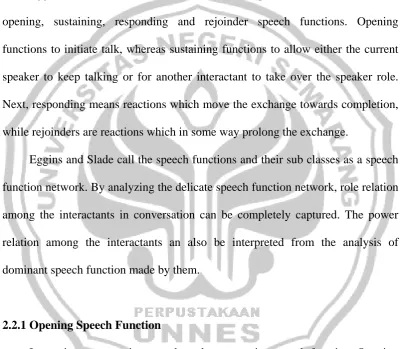
Eggins and Slade (1997: 191) elaborate the speech functions classes into
opening, sustaining, responding and rejoinder speech functions. Opening
functions to initiate talk, whereas sustaining functions to allow either the current
speaker to keep talking or for another interactant to take over the speaker role.
Next, responding means reactions which move the exchange towards completion,
while rejoinders are reactions which in some way prolong the exchange.
Eggins and Slade call the speech functions and their sub classes as a speech
function network. By analyzing the delicate speech function network, role relation
among the interactants in conversation can be completely captured. The power
relation among the interactants an also be interpreted from the analysis of
dominant speech function made by them.
2.2.1 Opening Speech Function
In starting conversation, people make an opening speech function. Opening
functions to initiate a sequence of talk. It indicates the claim to a degree of control
the interaction. Let’s observe Table 7:
Table 2.7 Speech Function Labels for Opening Moves
Speech Function
Discourse purpose Congruent mood Example
offer give goods and services Modulated interrogative
Would you like some more wine?
command Demand goods and
services
imperative Look
Statement: fact
Give factual information Full declarative; no modality; no appraisal
You met his sister.
Statement: opinion Give individual/ evaluative information Full declarative; modality and/or appraising lexis This conversation needs Allenby. Question: open: fact Demand factual information Wh-interrogative; no modality; no appraisal What’s Allenby doing these days?
Question: closed: fact
Demand confirmation/ agreement with factual information
Polar interrogative; no modality; no appraisal
Is Allenby living in Lodon? Question: open: opinion Demand opinion information Wh-interrogative; modality/ appraisal
What do we need here?
Question: closed: opinion
Demand agreement with opinion information
Polar interrogative; modality/ appraisal
Do we need Allenby in this conversation?
(Eggins and Slade, 1997: 194)
There are two kinds of opening; attending and initiating. Someone’s call,
greeting, or all of which to get the hearer’s attention, are called them as attending.
Whereas initiating goes to the main course of interaction; giving and demanding
exchanging goods, services or information as the commodities.
Demanding information or questioning can be both in the form of open or
closed question. Open questions means questions which seek to elicit completion
of a proposition from the addressee. Those are usually realized by
wh-interrogatives. Closed questions present a complete proposition for the support or
confrontation of the addressee which are realized by polar interrogatives.
Giving or demanding information can be classified into fact and opinion.
The difference between them is the use of either expressions of modality or
with opinion exchanges generating arguments, while fact exchanges often remain
brief or develop into story-text.
2.2.2 Sustaining Speech Function
Sustaining moves keep negotiating the same proposition.Sustaining talk may be
achieved by the speaker to continue talking (continuing speech functions) or by other
speaker to give reaction (reacting speech functions).The continuing status of a move
will be realized by its potential or actual elliptical status in relation to the prior move.
2.2.2.1 Continuing speech Functions
There are three kinds of continuing speech function a speaker can choose;
monitoring, prolonging, and appending. Monitoring means to deploy moves in
which the speaker focuses on the state of the interactive situation, such as by
inviting another speaker to give response or by checking that the audience is
following. Whereas prolonging moves are those where a continuing speaker adds
their contribution by giving more information. Finally, appending move is
mid-way between a continuing move and prolonging move. The summary of
continuing speech functions is presented in Table 8.
Table 2.8 Summary of Continuing Speech Functions
Speech function Discourse purpose Congruent mood
Continue: monitor Check that audience is still engaged
Elliptical major clause or minor clause with interrogative intonation
Prolong: elaborate Clarify; exemplify or restate Full declarative, linked (or linkable) by; for example, I mean, like
Prolong: extend Offer additional or
contrasting information
excepton the other hand Prolong: enhance Qualify previous move by
giving details of time, place, cause, condition, etc.
Full declarative, linked (or linkable) by; then, so, because
Append: elaborate Clarify; exemplify or
previous move after intervention by another speaker
Elaborating nominal group
Append: extend Offer additional or
contrasting information to previous move after intervention by another speaker
Extending nominal group
Append: enhance Qualify previous move after intervention by another speaker
Enhancing prepositional/ adverbial phrase
(Eggins and Slade, 1997: 201)
When someone is prolonging, he may employ elaboration, extension, or
enhancement of the prior move. In elaborations, a move clarifies, restate or
exemplifies an immediately prior move. It can be made by inserting conjunctions
such as: for example, like, I mean. Next, in extension, a move adds to the information
in an immediately prior move, or provides contrasting information by inserting
conjunctions such as: and, but, instead, or, except. At last, in enhancement, a move
qualifies or modifies the information in an immediately prior move by providing
temporal, spatial, causal or conditional detail by inserting conjunctions such as: then,
so, because.
2.2.2.2 Reacting Speech Functions: responding
Responses are reactions which move the exchange towards completion.
There are two options of responding; supporting and confronting. Supporting
moves are preferred response while confronting moves are dispreferred or
There are four main categories of supporting moves; developing, engaging,
registering, and replying. Developing then may be sub divided into elaborating,
extending, and enhancing. Then replying is sub classified into accepting,
complying, agreeing, answering, acknowledging, and affirming.
Two options of confronting are disengaging and replying. Replying is then
sub divided into declining, non-complying, disagreeing, withholding, disavowing,
and contradicting.
Table 2.9 Summary of Sustaining Responding Speech Functions
Speech function
Discourse purpose Congruent mood
engage Show willingness to interact by responding to salutation. Etc.
Minor: typically “yea” or matched response
register Display attention to the speaker Repetition of speaker’s word (s): paralinguistic expressions such as Mmh, Uh huh; ritual exclamations, minor clauses
comply To carry out demand or goods
and services.
Non-verbal expressions of undertaking (e.g. “OK”)
accept To accept preferred goods and services
Non-verbal; expression of thanking
agree To indicate support of
information given
Yes; positive polarity
acknowledge To indicate knowledge of
information given
Expressions of knowing
Answer To provide information demanded
Complete missing structural elements
Affirm To provide positive response
toquestion
Yes; positive polarity
Disagree To provide negative response to question
Negation of proposition
Non-comply To indicate inability to comply with prior command
Non-verbal; no expressions of undertaking; negation of verbal command
Withhold To indicate inability to provide demanded information
Negative elliptical declarative
Disavow To deny acknowledgement of
information
Expressions of disclaiming knowledge
Table 9 shows that engage means to show the willingness to interact. The
example of engaging is answering the salutation. When a hearer responds to
someone’s greeting, it means that he chooses engage speech function. Then when
he wants to show his attention as the response to someone’s speech, he chooses
register move. For the complete explanation, see Eggins and Slade,1997: 204 –
208.
2.2.2.3 Reacting Speech Functions: rejoinder
Rejoinder moves are moves to set underway sequences of talk that interrupt,
postpone, abort, or suspend the initial speech function sequence. Rejoinder moves
do not only negotiate what is already on the table but also give further explanation
or demanding further details.
There are two sub classes of rejoinders; tracking and challenging. Tracking
moves are supporting in the sense of delaying anticipated exchange completion
without indicating disagreement with it. There are four types of tracking;
checking, confirming, clarifying, and probing moves. Whereas challenging
confronts prior talk by detaching, rebounding,and countering.
Table 2.10Summary of Sustaining Rejoinder Speech Function
Speech function
Discourse purpose Congruent mood
check To elicit repetition of a misheard element of move
Elliptical polar interrogative
confirm To verify information heard Elliptical wh-interrogative; wh/element from prior move clarify To get additional information needed
to understand prior move
Elliptical wh-interrogative; wh/new element (not in prior move)
Probe To volunteer further details /
implications for confirmation
the moves it’s tracking or tagged declarative
Resolve To provide clarification, acquiesce with information
Elliptical declarative; mood adjunct of polarity and modality.
detach To terminate interaction Silence; expression of
termination Rebound To question relevance, legitimacy,
veracity of prior move.
Wh-interrogative, elliptical
Counter To dismiss addressee’s right to his/he position
Non-elliptical declarative;
negation of understanding/rightness
Refute To contradict import of a challenge Elliptical declarative; negation
Re-challenge
To offer alternative position Elliptical interrogative
(Eggins and Slade, 1997: 213)
When someone can’t hear what his interaction partner has said, he can
choose checking speech function by using elliptical polar interrogative.
Confirming and clarifying moves are not similar to one another. When he only
needs to verify the information, he chooses confirming move. However, when he
needs more information to understand prior move, he chooses clarifying move.
For the complete explanation, see Eggins and Slade, 1997: 209 – 213.
2.2.3 Speech Function Network
Eggins and Slade (1997) summarize all moves in the form of network, as
shown in Figure 2.8:
Move is divided into opening, sustaining, responding and rejoinder speech
functions. Opening is then subdivided into attending and initiating. Next,
sustaining is subdivided into continuing and reacting. At last, reacting can be sub
divided into responding and rejoinder speech functions. The complete explanation
2.3 Mood of Clause
The next major patterns which enact roles and role relations are mood with
the associated subsystems of polarity and modality (Eggins and Slade, 1997: 74).
Mood is the constituents in casual conversation. According to Mathiesen (1995:
391), mood is the central aspect of the grammar of exchange. It is the resources
for interacting dialogically. Moreover Mathiesen notes that those resources give
the clause a value as a proposition or a proposal that can be negotiated by the
interactants in a dialogue. The basic types of mood that occur in casual
conversation will be presented as follow.
Table 2.11 Basic Mood Types
Mood Type
Example
declarative: full
declarative: elliptical
imperative: full
imperative: elliptical
wh-interrogative: full
wh-interrogative: elliptical
polar interrogative: full
polar interrogative: elliptic
exclamative: full
exclamative: elliptical
minor
He plays the double-bass
This year.
Look at that man walking up there.
Look
When are you gonna do…all your odds’ n
sods subjects?
Who?
Yeah but what IS it?
Does he?
What rubbish you talk, Brad!
What rubbish!
Right
(Eggins and Slade, 1997: 75)
Eggins and Slade (1997: 85) state that declarative clauses are usually used
to initiate conversation. They construct the speaker as taking on an active,
initiatory role in talk by present both factual information or attitudinal opinion.
requesting information from others. Tagged declarative is the midway between the
declarative and polar interrogative which functions to claim the status role of the
giver of information and recognize the role of other interactants to confirm or
refute the information. The next is imperatives which functions to make
commands or demand someone to do something.And the last, Exclamatives are
typically used to encode a judgement or evaluation of events.
Mood consists of Subject and Finite that are closely linked together. Finite
has the function of making the proposition finite. While subject provides the rest
of what it takes to from a proposition (Halliday, 1994: 74).
The other constituents in dialogue are predicator and some combinations of
complements or adjuncts. Predicator gives content or representational meaning to
the process the subject in engaged in. Complements, furthermore, enable the
expansion of the field of negotiation. Whereas adjuncts functions to add extra
information about the events expressed in the core of the proposition.
2.4 Talk Show
Talk show is defined as a television or radio program in which people,
especially well- known people are invited to talk in informal way about various
topics (Hornby, 1995: 188). It is always to a degree spontaneous and high
structured. (Timberg, http: //www. museum. tv/archives/etv/talkshows.htm). It is
not the full script but the out line of talk show given by the program director.
Talk show developed out of forty years of television practice and antecedent
talk traditions from radio and popular theatre (Timberg, http: //www. museum.
tv/archives/etv/talkshows.htm). It developed from a very simple talk or chat
program to a very popular talk show. Talk show development started from NBC
with Tonight Show in 1954 hosted by Steve Allen to the very popular and modern
talk show hosted by Oprah Winfrey.
To remain on the air, a talk show should give sensitive idea to get the
audiences’ attention. Only a show that can serve its audience will survive among
other talk shows. As the consequence, good talk shows will get high rate and give
influence to the audience.
2.5 Oprah Winfrey Show
Oprah Winfrey Show is one of talk shows that get people’s attention. It is
seen by more than 49 million viewers a week in the United States and is broadcast
internationally in 121 countries. It also ranks second among all U.S. talks shows
(http: //www2.oprah.com). Moreover, this talk show wins more than 30 Emmy
Awards (Raatma, 2001: 94).
In her book, Raatma (2001:83) says that most of people love Oprah
Winfrey Show because they love the host. They always think that Oprah makes
them relaxed. They also feel that Oprah sits with them and talks about everything.
Oprah Winfrey becomes the guest of everyone’s house everyday by giving
their lives. She also gives more insight about the latest issues, such as children
abuses, plastic surgery, and so on.
2.6 Previous Related Studies
Eggins and Slade (1997) conducted a study on some casual conversations
between English native speakers. Their study has two main aims. The first aim is
to develop a comprehensive set of analytical techniques for describing language
patterns. The second aim is to offer a critical explanation of the role casual
conversation plays in society. They found that conversation involving interactants
who are close and familiar frequently has a confrontational orientation. The talk is
also quite highly elliptical. However, conversation involving less intimate
participants has an orientation toward consensus.
Another study on interpersonal meaning was conducted by Suprihadi
(2004) in question and answer episode of a thesis examination at English
Department of Muria Kudus University. The participants of this study were
lecturers as the examiners and one student as the examinee. He found that the
thesis examination was a collaborative supervising in which the examiners
collaboratively give informationto rather than demand it from the student.
Hartono (2004) studied the power relation in the radio casual conversation
of the English radio program. He found that the hosts of the program were more
powerful than the callers. The hosts enacted power by controlling turn – taking
Another study was conducted by Sunardi (2006) focusing on the casual
conversation between a native and non - native speaker. He found that non native
speaker played his role as the initiator, while the native speaker plays her role as
the supporter. He also found that non native speaker showed his egocentricity in
the conversation from his “I” subject and subjective modalizations.
30
CHAPTER III
PROCEDURES OF INVESTIGATION
3.1 Research Method
The study is regarded to be qualitative since the data used are the utterances
spoken by the interactants in talk show. Miles and Huberman (1984: 15) state that
qualitative data are attractive. They are a source of well grounded, rich description
and explanation of processes occurring in local context.
Rich description through words was used to explain the result of the study.
The interpretation also employed thick analysis of words. Searle in William
(2003: 5) notes that the important characteristics of qualitative is that it is about
interpreting and coming to understand the social world at micro level.
The
simple quantification made was only to support the study.
3.2 Unit of Analysis
The unit of analysis of this study is moves.Mathiesen (1995: 30) states that
move is unit of interaction that develops a dialogue. The moves are expressed
through clauses. It is the best way to analyze speech function. Moreover, Eggins
and Slade (1997: 184) say that although turn is important unit in casual talk, we
can not use turn to analyze it because one turn can realize several speech
3.3 Source of Data
The data were taken from Oprah Winfrey shows. There were two shows
taken for the analysis.Those two shows were chosen according to the two different
programs of Oprah Winfrey Show. One program was about entertainment with
artists, and another was about ordinary people who have dramatic experience.
The guest of talk show with artist is John Stewart, a host of talk show on
another TV broadcast in USA. He received an Emmy Winner for his success. For
that success, Entertainment Weekly crowned him Entertainer of the Year. There
he shared his experience imitating Oprah Winfrey Show.
Oprah Ordinary presented one guest who became news headline in USA.
She was Polly Mitchell, a mother of four children who became the prisoner by her
own husband in her house for almost a decade. She was locked by her husband so
that she had no channel to communicate with others. At last, she found her
courage to escape from her house.
Those shows were recorded from one of television stations in the form of
video compact disc in order to capture the conversations together with the
gestures accompanying the conversation. This record system also gave more ease
to transcribe. Hopefully, the data taken were considered to be valid.
Oprah Winfrey show is a highly structured show. It also presents great clips
to support the talk show. Since my focus was on the speech functions chosen by
3.4 Role of Researcher
As a qualitative study, the role of researcher in the study was as the data
collector. As stated by Miles and Huberman (1993: 6) that the researcher was the
holistic gainer overview of the context under study whether its logic, explicit or
implicit rules. I tried to get the complete written data by collecting them through
careful transcribing.
Next, I interpreter the data gathered. Alwright and Bailey (1991: 65)
assumed that qualitative research was directly upon and to interpret them. To
interpret here meant to identify and analyze the data carefully.
3.5 Reliability and Validity
We know that qualitative study employs the high subjectivity of the writer.
Miles (1979 in Miles and Huberman, !993:2) gave dark question about qualitative
studies:
The most serious and central difficulty in the use of qualitative data is that
methods of analysis are not well formulated. For quantitative data, there are
clear conventions the researcher can use. But the analyst faced with a bank of
qualitative data has very few guidelines for protection against self-delusion, let
alone the presentation of unreliable or invalid conclusions to scientific or
policy-making audience. How can we be sure that an “earthy”, “undeniable”,
“serindipitous” is not in fact, wrong?
To get the reliability of the study was by avoiding the researcher high
subjectivity. Triangulation method by the colleague who has sufficient knowledge
was then used to get the inter subjectivity. I had my collegue examine the study
Moreover, to make the study valid, I tried to organize the data carefully by
checking the transcription many times with my colleague. The data were also well
arranged so that the data could be considered to be valid.
3.6 Technique of Data Collection
The procedures of collecting the data I have taken are following:
(1)
Recording
There is one television station in our country broadcasting Oprah
Winfrey’s Shows. I had two shows recorded in the form of video compact
disc.
(2) Transcribing
The next step was transcribing the spoken interaction carefully in
order to get the valid data. I also noted the non-verbal interaction
accompanying the conversation. This non-verbal interaction was
differently written from the verbal one.
3.7 Technique of Data Analysis
The data gathered were then analyzed through these procedures:
(1)
Identifying the turn of each speaker
After I had the data in the written form, I started to identify the turn
of each speaker. This activity was done carefully since we often found
many interruptions in casual conversation. Every turn was numbered in
(2)
Identifying the moves
The next step was identifying the moves in every turn. Since one
turn might consist of more than one move, I labeled them in lower case
letters: a, b, c to avoid confusion.
(3)
Analyzing the moves
I analyzed the speech function of the moves based on the chart
provided by Eggins and Slade. This chart is divided into three big speech
functions; opening, continuing, and reacting. These big classes are then
sub divided into their branches. Each move is identified its speech function
through careful reading.
The speech function choices were then interpreted synoptically. To
interpret synoptically means to give the quantification of the discourse
structure. This quantification showed the number of speech function
choices made by each interactant. It doesn’t mean that this study becomes
quantitative, but it was made only to ease the further analysis.Here is the
example of synoptic interpretation of Oprah Winfrey show.
Table 3.1 Synoptic Interpretation of Text….
Speech Function Oprah Winfrey Guest
no. of turns no. of moves no. of clauses
Open
question: opinion state: fact
state: opinion total
Continue
prolong: elaborate prolong: extend prolong: enhance append: elaborate Total
React: responding
register
develop: elaborate develop: extend develop: enhance replying: supporting confronting
Total
React: rejoinder
tracking: clarify tracking: confirm tracking: check tracking: probe reacting: resolve challenging: detach challenging: rebound challenging: counter challenging: refute challenging: re-challenge total
36
CHAPTER IV
FINDINGS AND DISCUSSION
4.1 Synoptic Interpretation of Discourse Structure
Synoptic interpretation of discourse is a quantification of all speech
functions choices per speaker. It gives us the overall findings in the form of
numbers. As the result, we can get the information about the number of speech
function choices that Oprah Winfrey and her guests made. This quantification can
also help us decide the role enactment between Oprah and her guests.
4.1.1 Synoptic Interpretation of Speech Functions in Talk Show 1
The table below presents the summary of speech functions choices made
by Oprah and her artist guest, Jon Stewart.
Table 4.1
Summary of Speech Function Choices in Oprah Winfrey Show
(Oprah Winfrey and Jon Stewart)
Speech Function Oprah Winfrey % Jon
Stewart %
no. of turns no. of moves no. of clauses
Continue Monitor prolong: elaborate prolong: extend prolong: enhance append: elaborate Total 8 16 13 4 5 46 18% 35% 28% 8% 11% 44% 39% 25% 21% 71% 35% 10 25 38 9 2 84 12% 30% 45% 11% 2% 56% 61% 75% 79% 29% 65% React: responding support: engage support: register
support: develop: elaborate support: develop: extend support: develop: enhance support: replying: accept support: replying: answer support: replying: affirm support: replying: agree confront: replying: contradict confront: replying: disagree confront: replying: withhold
Total 1 20 4 6 - 3 - - 7 1 2 1 44 2% 46% 9% 14% 0% 7% 0% 0% 16% 2% 5% 2% 100% 77% 36% 40% 0% 50% 0% 0% 37% 50% 50% 100% 46% - 6 7 9 3 3 6 3 12 1 2 - 52 0% 12% 13% 17% 6% 6% 12% 6% 23% 2% 4% 0% 0% 23% 64% 60% 100% 50% 100% 100% 63% 50% 50% 0% 54% React: rejoinder tracking: clarify tracking: check tracking: confirming reacting: resolve Total 2 2 1 2 7 29% 29% 13% 29% 100% 100% 100% 100% 100% - - - - 0 0% 0% 0% 0% 0% 0% 0% 0% 0%
Table 4.1 shows that the turns Oprah and Jon produce are similar to one
another. Each of them produced 64 turns. It indicates that they compete for turns.
Moreover, it suggests that both of them try to have the equal right.
Although both interactants had similar turns, as the guest, Jon Stewart
produced more moves and clauses than Oprah. He produced 145 (56%) moves of
the whole moves, whereas Oprah produced only 113 (44%) of the whole
moves.Jon also produced 210 (56%) clauses higher than Oprah who produced
or information giver. As the result, he needs more space to supply the information
demanded.
4.1.1.1 Opening
Table 13 shows that Oprah dominates openings. She produced 17 (67%) of
the whole openings while Jon only produced 9 (33%) openings. It means that Jon
is dependant on Oprah as the reaction to the Oprah’s statements or questions. In
other words, Jon plays as the supporter, while Oprah plays as the initiator.
Oprah, as the opener, mostly favored statements of her own opinion rather
than questions. It indicates that she tries to floor the problems which take the
further debate. Here are the examples of openings made by Oprah in the form of
statements of her opinion:
(1) O:I:statement:opinion (i) That was one nicest day(ii) I spent
at your house with your family (5)
(video clip) (2) O:I:statement:opinion (i) It’s cute (90)
(video clip)
(3) O:I:stetement:opinion (i) It used a lot of works (111)
In example (1), Oprah stated her opinion about her visit at Jon’s house.
She thought that her spending time in Jon’s house was the nicest day. Then, in
example (2), Oprah commented the video clip showing her show in which many
people received cars. Her opinion was that the moment was cute. At last, in (3)
Oprah also gave her opinion on Jon’s work as one work which required a lot of
To initiate conversation, the next speech function choice made by Oprah
was by stating facts which needed more clarifications from Jon. The following
excerpts are the examples of Oprah’s statements:
(4) O: I:statement:fact (ii) I hear my name came up few times in daily
shows. (70/b)
(5) O:I:statement:fact (iii) A few weeks ago, you called my producer to say (iv) that you’re so inspired (96/c)
In example (5), Oprah told Jon the fact that she heard her name was stated
many times in Jon’s Daily show. She required more clarification about that from
Jon. Just like in example (4), in example (5) Oprah stated that she knew that a few
weeks before Jon called her producer telling that he’s so inspired. Here, Oprah
wanted to have Jon’s respond, whether acknowledging or contradicting.
To have more information from the source, Oprah gave questions that both
require answer about fact or opinion. Here are the examples of openings in the
form of questions:
(6) O:I:question:opinion (i) Isn’t this fun? (3)
(7) O:I:question:fact (i) Where is your dog? (15)
In example (6), Oprah tried to invite Jon’s opinion about something. She
asked whether the show was fun or not based on Jon’s opinion. In (7), however,
Oprah tried to seek answer about fact rather than opinion. She wanted to know
where Jon’s dog was. Of course, her question needed an answer about the fact of
the dog.
Consider Jon’s openings. He produced openings not as many as Oprah did.
Only the half from all openings he made. However, it is surprising because
To initiate conversation, Jon also produced more statements than
questions. He produced 5 statements and only one question. It shows that he
invites Oprah to further debate rather than demands information from her.
The following excerpts are the examples of openings made by Jon:
(8) O:I:question:fact (i) Can I ask you this? (10)
(9) O:I:question:opinion (i) How did you like our dog? (12)
(10) O:I:statement:opinion (i) I’m considered as human ambience (25/a)
(11) O:I:statement:fact (iii) I have to tell you this..
(iv) When Oprah came to my house (v) my wife cried (101/c)
In (8), Jon directly asked Oprah about fact whether she could answer his
question or not. It’s different from example (9) which showed that Jon tried to
invite Oprah’s opinion about his dog.
To have further debate, Jon stated his own opinion just like in (10). There
he called himself as the human ambience. This statement invited Oprah to give
her opinion whether she agreed or not. However, in example (11), Jon showed the
fact that his wife cried when Oprah came.
4.1.1.2 Continuing
As a guest, Jon produced more continuing speech functions than Oprah
did. He produced 84 (65%) of the whole continuing speech functions while Oprah
only produced 46 (35%) of the whole continuing speech functions. The reason
that Jon continued more often is because as the source, he needs more space to
4.1.1.2.1 Prolonging Moves
In making continuing speech functions, both Jon and Oprah produced the
high number of prolonging moves. It means that both do not want to express their
![A STUDY OF SPEECH STYLE USED BY THE HOST IN �Oprah Winfrey� TALK SHOW PROGRAM ON �METRO TV�]](data:image/gif;base64,R0lGODlhAQABAIAAAP///wAAACH5BAEAAAAALAAAAAABAAEAAAICRAEAOw==)