THE EFFECT OF LOGGING INDUSTRY ON THE LOCAL PEOPLE’S ECONOMY: A Case Study on Muara Gusik Village, East Kalimantan
Herman Hidayat*
Abstrak
Kehadiran HPH (Hak Pengusahaan Hutan) PT.ITCI, di Kenanga, Balikpapan pada masa Orde Baru berdampak negatif atas masyarakat lokal. Implikasi tersebut ialah adanya ‘konflik lahan’ antara pemilik HPH dan masyarakat desa Muara Gusik. Jambuk dan Pringtalik. Akibat konflik ini kehidupan ekonomis dan sosial masyarakat telah terpinggirkan. Tulisan ini memfokuskan untuk mengkaji respon masyarakat untuk bertahan hidup di tengah konflik lahan ialah dengan melakukan bertani padi pada sebagian lahan mereka dan menanam rotan, karet, mencari kayu gaharu dan berdagang kayu bekas sebagai pendapatan sampingan.
Key words : Concession holder, local people, and agricultural productions.
I. Introduction
The logging forest concession or the HPH, was used to maximize wood exploitation in natural forest throughout timber trading permission. However, the implementation of HPH’s policy had caused many problems; one of the problems was because the logging concession areas were also part of the local people’s productive land. The HPH concession, mostly in outer islands such as Kalimantan, Sumatera and Papua, had closed the local people’s access to their customary forest rights. This includes their access to rattan, rubber, timber, honey, fruits, etc. The main problem that has arisen was ‘land dispute’ between local people and HPH holders. This conflict often forcedly prevents local people to cultivate their lands as their primary source of living. Moreover, it has also closed the local people to take rattan, fruits, and honey and woods production as secondary sources. This land conflict and closing access to HPH land have turned into economic marginalization of local people.
This paper is based on a participative field research conducted in September 1996 and from March to April 2002. Techniques used to obtain data were library research; interviews with 32 local respondents and key informants; and guided interviews focusing on related subjects. The Muara Gusik village was selected for field research because: (1) it is located on the provincial border with a large logging concession area (the ITCI Company), giving adequate information on how far the local people could utilize timber and non-timber products for income generation activities; (2) there has been a land dispute between community members and the logging concession holder; and (3) International Timber Company of Indonesia (The ITCI Company) is considered as one of the logging concession holders that appears to pay attention to the environment and local inhabitants.
II. The Setting of Location
Mahakam river from Samarinda to Muara Muntai, which takes about 6 hours, followed by another 3 hours from Muara Muntai to Bongan and Muara Gusik village by Ces boat (medium-sized boat).
Historically, the Gusik community came from the Gusik area, located 15 km away from the present center of the village. This can be identified by many Lamin sites (traditional long houses). This community had been relocated twice: first in 1910, when the Dutch administration moved the community in order to help them get educational and other facilities easier. The second relocation process was in the 1960s, upon the request of the Indonesian Armed Forces. This was done to protect the community from the Ibnu Hajar separatist movement.
Demographically, from the number of 898 people living in this village, it consists of 480 men and 418 women, creating 197 households. The majority of the population is of Kutai ethnicity and they embrace Islam as their religion.1 There is only one migrant Balinese Hindu family, teaching in the elementary school. The village land is registered as large as 19,249 ha, consisting of: 14, 440 hectares of customary rights forest, 650 ha of rice fields, 1,600 ha of plantations (rubber and rattan), 1,200 ha of swampland and 1,359 ha residential areas and fruit gardens.
Livelihood of local people
A micro-economic analysis was completed based on a case study in Muara Gusik village, Bongan sub-district, Kutai Regency.2 The focus of the analysis was the micro economic activities of the village, namely primary subsistence livelihood, which is paddy field and secondary incomes, which comes from plantations such as rattan, rubber
1
The sub-district Bongan and villages which categorized it, the most of people are Muslim. Because it refers to Kutai kingdom who mastered the greatest part area of East Kalimantan since 18-20 century. The capital of Kutai is Tenggarong (interview, March 23, 2002).
2
and fruits. Apparently, both ways have been inherently followed by the local people.
However, the arrival of concession holders has created many problems. Based on the writer’s observation this situation was indicated by economic marginalization of the local people. There are two reasons on why do a vast number of indigenous people, living in the villages around the forest face socio-economic marginalization: first, the Soeharto administration did not recognize local peoples’ ‘customary forest rights’ and so they had no access to utilize forest products, both timber and non-timber. Second, local people and logging concession holders often have land disputes concerning these customary forest rights. A situation where they do not have access to utilize forest products; and unfinished dispute on land have deeply impact the local people since they have not been able to carry on with their livelihood economic activities.
This phenomenon is illustrated by Al Gedicks when he says, "there are about 250 million native people worldwide, many of whom live within or on the margins of tropical forests in Southeast Asia, Central and South America, and Central Africa. They depend upon the forests for their food, medicines, clothes and building materials. However, the extensive and accelerating exploitation of the rainforests for timber, logging concession, minerals, oil, hydro electric energy, plantation of agriculture makes them ‘the most seriously threatened’ habitat of indigenous peoples."3
III. Logging Industry and Land Dispute in the Soeharto Era
Primary Subsistence: Rice
The majority of people in the Muara Gusik community are farmers. This has been a continuing pattern for many generations. Chambers once said "farmers have their own ways of trying out genetic material and practices. Methods of small-scale experimentation can be taught to them. To produce more, local people usually use agricultural
3
technology and marketing strategy" (Chambers: 1994: 72-73). However, for Muara Gusik farmers, these kinds of technology are very limited and their type and amount of productions are still very small. Their main agricultural product is rice. Additional income beside rice comes from rattan, rubber and fruits, particularly durian. Other business comes from selling Kayu Gaharu (Aquilaria malaccensis), Damar (Resin) and Kayu Ulin (Eusideroxylon Zwageri), which can easily be found within and around the forest.
According to some respondents, the quality of life as a farmer in Muara Gusik village had its rise and fall. At the beginning of the 1960s until the 1980s, their quality of life was good: most of them owned rice fields, with every household owing around 4 plots or 2 hectares; and they produced 0.5 to 1 tons of rice from each plot of land (2 tons of rice can provide for a family for one year). The main portion of their products is used to fulfill their basic necessity (food), ensuring three meals a day. The rest is usually sold for clothing, education and health needs. However, their consumption rate was considered rather high. The owners of the village shops each (there were 6 shops) gained Rp. 30,000-Rp. 40,000 a day in the 1980s from selling basic necessities such as rice, oil, food, biscuit egg, soap, soybean, tobacco, milk, etc. On the average, consumption rate per capita each month in 1996 reached Rp. 45,000; which includes Rp. 36,000 (76.10%) on food and Rp. 9,000 (23.90%) on non-food items. This means that the Muara Gusik community on the average spent between Rp.40,000 - Rp.59,999 per month.
centers, which requires large amounts of funds. Therefore, only a few households can afford to send their children to schools in the city.
Land dispute
After the 'golden years' came 'the descend years', which taken place between the 1990s until 2001. This fall, according to various respondents, was caused by one major factor that was the land dispute between the community and the ITCI Company. The customary forest rights4 of the community for generations, 14,440 hectares part of forest areas, used for farming and tree gardens; was then spitted or annexed on the map as logging concession land. In 1993 the problem was handled to resolve by the Kutai Regency Regional Government, the Regional People’s Representative Council and the East Kalimantan Level one and two of Regional Governments.
According to Won Jeong (1999) the roots of social conflict are associated with the struggle for maintaining or challenging a dominant power status, frustration generated by relative deprivation, repression of basic needs and differences in cultural norms and values. He further commented that according to real politics, conflict could be effectively controlled and managed by the use of force or threat of punishment or retaliation. The maintenance of stable relations depends on law and order.5 This above statement is appropriate regarding the land dispute between the ITCI Company and the Muara Gusik community. Initially, the ITCI was having dominant power, maintaining its logging areas by the use of security apparatus. Any local inhabitants, who were found entering these logging areas, were arrested by security staffs. Although the local inhabitants reported the land dispute to the Regency of Kutai Kertanegara and District ad Provincial Regional People’s Representative Councils, the conflict has still not been resolved, because the ITCI Company has greater political and bargaining power in the court.
4
Customary forest rights is customary forest in certain areas, which is claimed belong to them as inheritance from their grand parents.
5
See Won Jeong-Ho (ed.) (1999), Conflicts Resolution: Dynamics, Process and Structure, Brookfield USA,
According to several respondents, since 1993, the logging Concession Company has increased the surveillance of their borders with local land and houses, using several full-time guards and the arm forces. The use of the Arm Forces was understandable as the majority share of the ITCI Company belongs to Kartika Eka Paksi (51 percent) one of the Army Foundations, 34 % belongs to Bimantara Citra, the son of Soeharto and 15% to Group Nusamba, belongs to Bob Hasan.6 Due to this tight surveillance, several local people, while cutting timber in the forest, which according to the claims of the locals is still a part of their traditional land under dispute, were arrested and held in prison by the police for 27 days. The result of these arrests under the instruction of the ITCI guards was that a clash arose between the company and the community. The solution agreed upon in a joint consultation was that the ITCI Company would give about 270 hectares of land for the community close to the Trans-Kalimantan road, as a substitute for the traditional land under dispute.
Nevertheless, the 270 hectares of the land have not yet been cleared. The local community considered the agreement with the ITCI as unsatisfactory, because the allocation of land for farming paddy plants and other crops has been slow and therefore the community has experienced a drastic fall in their basic income. According to a worker at the ITCI, the status of the land is still being converted through BPN (The National Land Board) and the Provincial Forestry Regional Agency, from forest production land to converted land and finally to private property.
There is a positive correlation between the conflict over the status of the 14,440 hectares of community forest rights land and the continuously falling level of community income. Furthermore, community members have faced a fall in their amount of privately owned land compared between the years of the 1960s to the 1980s, as each household land has been reducing from about 2 hectares to less than 0.5 hectares. Consequently, the buying power of the community has decreased and the average person is now only able to eat twice a day.
6
Facing the difficult situation arising from land dispute, some of the Gusik people have signed up to become local transmigrants in a settlement about 10 km from Muara Gusik village. This settlement is a mixture of many ethnic groups, such as Javanese, Bugis, Kutai and people from Nusa Tenggara. They receive 2 hectares of land: 1.5 hectares of farming land and 0.5 hectares for a house and garden. They also receive food to the amount of Rp. 60,000 every month for one year (1996-1997). Meanwhile, from the people that have stayed, the majority still hopes that the regional government can solve the land conflict fairly, so that their quality of life will improve. Respondents stated that "this was not national development, which should in essence suppose to be equalizing the community income" (Interview, March 21, 2002). This is in line with the words of Anne Booth and Sundrum, who showed the unequal income distribution between households according to National Employment Survey data, both in the countryside and the cities. In reality, income distribution was more equal in the cities than in the countryside for the whole of Indonesia.
The field data and interview findings show a causative correlation between the falling income of the Muara Gusik village community and the various reasons mentioned above. The traditional land dispute has impacted negatively on the productivity and equalization of income distribution. In other words, the Muara Gusik village community savings ratio, both in the form of savings in the Bank Rakyat Indonesia/BRI and capital in the form of land, is unproven.
employment opportunities is also caused by the decreasing forest resources, such as Kayu Gaharu, Kayu Ulin, and a fall in the price of rattan, which have exacerbated this problem.
IV. Secondary Sources of Income: Rattan, Rubber and Gaharu
The following description outlines the secondary sources of income from such products as rattan, rubber and Gaharu timber, where these products are located in their customary forest rights. This agricultural cultivation is necessary as additional financial support for community income.
Rattan
Rattan is the most reliable product for the Muara Gusik community. The tradition of planting and selling this product has been carried out for generations. Because of the importance of rattan, most households have a rattan garden. According to one respondent, on the average community members at least own 3 hectares of rattan garden. Only the ex-village chief owns 8 hectares. The total area of rattan gardens owned by community members is around 550 hectares.
The season for planting rattan seeds is the rainy season, from October to February. The reason for this is that the grounds become soft, thereby becoming easier to plant seeds. Usually the planting technique is to dig a hole with 2-3 rattan seeds placed in each hole, with each hole about 4 meters apart. The rows are also placed four meters apart from each other so that people can walk between the rows. Therefore, one hectare of land can usually be divided into 100 block times 4 meters, and the total rattan seeds required is about 120-150. Farmers face several obstacles to grow rattan: first, wild pigs, which usually eat the around 8 to 12 month rattan leaves; second, wild monkeys usually tear off the leaves and tips, leaving the rattan bare; third, the farmers must spend at least one night a week guarding the rattan from wild animals when it is 1-3 years old and fourth, the price of rattan during the harvest season is sometimes low.
Batu, Sega Dahab, Sega Merah, Kotok, Jelayan (Calamus Ornatus), Pulut Merah (Daemononorop Crinita), Botet (Khortalsis Schapigera), Semambu, Manao, Jepung and Jelapang. The leading production of rattan in Muara Gusik is Sega Batu, Sega Dahab and Jelayan. Rattan productivity varies according to the type of land, as mountainous topography produces better results, that is, on average about 1 hectare can produce 3 tons, with a diameter of 100 cm, while flat ground produces less, that is, only 2.5 tons. After waiting 8-9 years the farmers usually cut the rattan when the price is high. All members of the household assist in cutting the rattan, which is usually in the forest. Every person can carry about 50-65 kilograms of rattan on their back from the garden to the river - about 1-2 kilometers. After piling the rattan on the riverside, it is then taken by a Ces (motorized boat) from the harvest to the village settlement.
The market network
Muara Pahu, Damai and Muara Lawa.7 These rattan traders find their capital from Bank Pembangunan Daerah Kalimantan Timur (Regional Development Bank of East Kalimantan) and other private banks.
In terms of ethnicity, the Kutai ethnic dominate small village and sub-district trading, as the majority of the population in Muara Kedang (Bongan) sub-district. However, at the provincial level (in Samarinda), the large traders are mostly the Banjarese and Chinese. The large traders at the provincial level control the distribution of manufactured rattan. They supply the furniture companies in Samarinda and Kutai Kertanegara, but the majority of rattan production is sent to Java, to the central rattan factories in Surabaya, Cirebon, Kudus, Bekasi and Banjarmasin (south Kalimantan). At each shipment in hundreds of tons of rattan, it invests up to Rp. 800 million - Rp. 3 billion.
According to respondents in the village, most of the rattan manufactures in East Kalimantan is not accompanied by development of the furniture industry at the regency level (Kutai Kertanegara) and Samarida. Should the furniture industry grow and develop, the price of manufactured products would rise and certainly bring prosperity to the village farmers. The price of rattan once reached Rp. 750 per kilogram in 1988. According to some respondents, this is due to the decreased of the harvest of natural rattan, while the foreign demand for manufactured rattan, particularly from Singapore, Taiwan, Hongkong and Japan, have arose. This, of course, occurred before the ban on manufactured rattan exports in the end of the 1980s. However, from 1995 to 1996, the price for 1 kilogram of rattan at the village level was only Rp.250 and then rose to Rp. 300 at the sub-district trader level. At the provincial level, large traders could obtain Rp. 600 for 1 kilogram, becoming Rp. 1,100 at the inter-provincial level in Surabaya, Cirebon, Jakarta and Banjarmasin.
This unstable price affects the farmer’s enthusiasm to guard and tend their rattan plants. During the field observation, if rattan cultivation is arranged professionally from start to finish, it will create many employment opportunities and increase farmers’ incomes. The question is how to empower the rattan farmers at the lowest level to improve
7
their quality of life, so that they are no longer exploited by the middlemen or small traders at the village level whom have usually lent money and basic necessities to them on the proviso that they sell their rattan to them upon harvesting. This problem can be overcome through district or regency cooperatives with good management, involving investment, marketing and appropriate technology to develop the rattan furniture industry.
Rattan, considered as a superior product by the members of the community, however it still cannot improve the quality of life of the community. This is not helped by the long growth period requiring 8-9 years from planting to harvesting. For example, if every hectare of rattan produces only 3 tons, and each family household owns 3 hectares, they will produce 9 tons. The price of 1 kilogram of rattan in 1996 was about Rp. 250 in the village, so they would have received 9 tons x Rp. 250,-= Rp. 2,250,000. This means that every household received Rp. 21,395 per month, which is still not enough for a proper standard of life on top of the basic necessities in the village.
Rubber
Muara Gusik farmers, whose entire land for rubber cultivation covers 350 hectares, acquire rubber as an inheritance from their grandparents, since the 1960s. The sizes of the rubber trees are on average 30-40 cm in diameter and usually produce 10-15 kilograms, sapped once every two weeks. In the afternoon the women and men carry the sap from the trees in baskets. Over several days the rubber sap dries and thickens into small circles (100-150 cm in diameter).
Village level rubber middlemen go to the farmers and buy their product at Rp 800/kg. The middlemen, who are usually Kutai, take the product by river in the rainy season and by land (truck) in the dry season to Bongan (Muara Kedang) and sell to district sub-level middlemen at Rp.950/kg. From the district, the rubber is then carried to the provincial level (Samarinda and Banjarmasin) and sold at Rp. 1,300-1,400/kg. At the higher levels, hundreds of tons of rubber are supplied to Surabaya and Jakarta for tire factories. At the inter-provincial level, Chinese traders play a major role.
from sub-district level middlemen. This trading network for rubber, as described above, has been established for years. This village and sub-district (Kecamatan) middlemen network has implications of ‘patronage’ investment, as facilities and goods in the village stores are offered to the farmers before harvesting and then the traders pay a cheap price for the farmer’s rubber as 'repayment'. A phenomenon such as this, according to respondents, is to the ‘detriment’ of farmers’ incomes. However, it is extremely difficult to overcome this social reality because of the powerless of the farmers in controlling their finances, appropriate technology and marketing.
There are several obstacles to farmers developing rubber plantations. First, because land is scarce and they are still in conflict with ITCI Company concerning the status of their traditional land, they can not expand their rubber fields. Second, the trees require about 20-25 years before start harvesting. Third, the price of rubber is often unstable, sometimes falling below Rp.500/kg, which is the minimum price required in order to maintain a profit. Fourth, because the rubber fields are considered secondary income, the trees are not cared for in a professional manner.
Apparently, this product is as yet unable to ‘improve’ the prosperity and quality of life of Muara Gusik farmers. The money from the sale of rubber is used by the majority of farmers for primary needs such as food and clothing. According to respondents, the money from rubber production can not yet be allocated to savings for education, health and building religious facilities.
Kayu Gaharu (Aquilaria malaccensis)
According to respondents, Gaharu timber is collected by groups of farmers. These groups consist of 4 or 5 people, as they must enter about 10-15 km into the forest and walk a radius of about 40-50 km. Therefore, it is not just basic provisions such as rice, sugar, oil, salty fish, coffee, tea, cigarettes that must be provided for, but also, the family is left alone in the house for two weeks. Financially, every household must prepare about Rp 75,000-100,000 (an allocation of Rp.70,000 for those in the house and Rp 30,000 for the one going into the forest). As a group, the money contributed is determined by the leader of the group-around Rp 30,000-40,000-and is kept by a trustworthy person to buy food and other necessary goods such as torches and cutting equipment.
The business of finding Gaharu timber is considered risky, not just from wild animals in the forest, but devils and spirits that inhabit the forest as well. Even so, still many community members carry out this business. According to one respondent, it is because the profit is large if someone is successful in finding this tree. The profit comes from the technique used for collecting Gaharu timber that is, cutting to the heart of the tree trunk, as it is the black and aromatic heart of the aloe timber tree is the primary product for perfumes and incense (derived from gum benzoin). Usually only about 1 or 2 tree centers from maybe 10 tree trunks found, can be used. One aloes timber tree might produce around 55-65 kg from the heart. However, according to respondents, there are those that reach 75-100 kg, if the tree is large. This type of aloe timber is in demand among the Chinese ethnic groups living in Kutai and Samarinda and even in Surabaya. The traders at the village level, such as Haji (Abdul), are happy to pay Rp. 900,000 per kg for aloe timber. After the primary product is taken to Samarinda, it can be sold for about Rp. 1,100,000-1,200,000 per kg.
becoming more difficult to find a ‘fortune’ from aloe timber in order to build a house.
V. The Impact of Logging Industry on the Local People’s Economy
Compensation
The reform era initially began in May 1998, when the Soeharto regime stepped down. This era characterized with ‘democratization’ on
forestry sector, which the role of district (Kabupaten) becomes
important on forest management. In reality, the central government (Forestry Department) gradually delegates its authority into district. One of them is that head of districts may issue 100 hectares logging concession to cooperative sectors. In fact, this policy intends to empower socio-economic upon local people. But, this concession policy finally withdraw by the decision Ministry of Forestry No.541 in February 2002, because there are happened ‘illegal logging’ practices, which finally effect into price crisis of log in many districts. This era focuses on two leading issues namely land dispute compensation from HPH holder (ITCI Company) and socio-economics function of timber profile in village level.
Two issues focusing on this paper. First is the process of compensation for the land disputes between local people and the ITCI Company. Second is the role of timber workers, their profile and economic network in village level. There are two approaches to discussing the compensation issue. The first approach is to consider the internal factors, through regulation and forest decree interpretations. The reform period is characterized by the fall of the Soeharto regime, followed by forest reform act number 41/1999. The main element of this forest reform is to explicitly admit the customary forest rights of local inhabitants. Therefore, in terms of land disputes, chapter XIII, section 75, verse 2, says: "the solution to forestry disputes outside of the court is required to reach consensus regarding the amount of compensation to be paid by respective actors.".8 Apparently, this new Forestry Reform Act inspired the Governor of East Kalimantan to write a letter on 9 January 2000 to the ITCI Company requesting compensation paid to the Muara
8
Gusik community. The Forestry Reform Act and letter from the Governor of East Kalimantan encourages the ITCI managers to consider providing compensation for the land dispute since the 1990s.
External factors that prompted the discussion of compensation were a set of events launched by the Muara Gusik community. The local community blocked ITCI’s logging equipment, preventing any logs being extracted from the area considered under dispute in May and June 2001. A Daihatsu Hiline Bravo No. 51 KT.1705 BC, belonging to ITCI Company was confiscated by local people on 9 June 2001. The Muara Gusik community requested payment for the release of this car of Rp. 10 million on August 2000. A Community Village Assembly (Lembaga Masyarakat Desa) meeting on June 15, 2001, requested compensation of the amount Rp. 1 billion, for the loss of their customary rights forest area (14,440 ha), annexed by the ITCI Company in the 1990s.
Both these internal and external factors prompted the holding of an ITCI managers’ meeting, which finally decided on a form of compensation for the Muara Gusik community and other villages such as Jambuk, Pringtali, in which land disputes had previously occurred between the company and the local inhabitants.
The monetary compensation was registered on July 10, 2001, in front of notaries, on behalf of M. Rasyid Umar SH, in Balikpapan. The money transferred to the local inhabitants was carried out on June 25, 2001 in the Muara Gusik village office, witnessed by the head of the sub-district of Bongan, Police and Army sub-district agencies (Koramil/Polsek), the District Forestry Agency, the head of the village, head of local adat and other community members. There were two significant points of agreement: (1) the ITCI Company must provide local people with the opportunity to log and utilize waste timber from previous Company logging in their ‘customary rights forest’, while local inhabitants would also have the responsibility to maintain a sustainable forest management system within said area and (2) the ITCI Company and Muara Gusik community, should any further conflicts arise in upcoming years, priority must be given to consensus approach to conflict resolution. The final agreement for compensation was that Muara Gusik communities receive Rp. 650 million, Jambuk, Rp.450 million and Pringtali, Rp. 350 million.
head of Adat and other community leaders. First, A category of 11 households each received Rp. 7.4 million. This A category was those original indigenous people still living in the village and formerly directly related to the customary rights forest. The second category, B category, with a total of 115 people, each person respectively receiving Rp. 3.5 million, were the grandchildren of immigrants to Muara Gusik. The third category, C category, with a total of 55 people, received Rp. 2 million each, and is descendents of migrants who married with Muara Gusik people. Other allocations per provided for the construction of a mosque (Rp. 10 million) and for the grave yard (Rp.5 million).
The majority of people spent this compensation money on housing rehabilitation (21 units), buying new land, small electric generators for house lamps, Ces (motorized boats), chainsaws (6 units), sawmills (2 units) and placed as savings in the bank. This initial expenditure totaled almost Rp.200 million. The Muara Muntai, which is considered to be the nearest large shop, three hours by Ces from Muara Gusik village, experienced a large increase in sales at that time. At the same time, the small village shopkeepers, who previously received only Rp. 30,000 a day, received a daily income of Rp. 60,000-70,000, while the larger shops received almost Rp.650,000-750,000 per day.
Socio-economic Function of Timber Traders
Economics is defined as the science that studies how individuals, firms, the government and other organizations make choices, and how those choices determine how the resources of society are used. Stiglitz said, “Much of economics analysis is based on the assumption of rational choice, that people weigh the costs and benefits of each possibility. This assumption is based on the expectation that individuals and firms will act in a consistent manner, with a reasonably well-defined notion of what they like and what their objectives are, and with a reasonable understanding of how to attain those objectives”.9In the case of timber traders at the village, sub-district and provincial levels, the rationality assumption is taken to mean that they make choices and decisions on production, marketing and profit in pursuit of their own self-interest. Different people will, of course, have different
9
goals and desires. But, regarding their economic interest, profit is necessary in order to survive in the trading game. Apparently, every actor is aware that they have to cooperate in order to build their economic network. So, the ‘credit’ (loans) which large traders contribute to sub-district traders, which is then loaned to village traders and finally to farmers, is identified as a common way to create economic networks, ensuring the attainment of products and therefore, profit.
The rest of the paper will discuss timber trader in the village level (Muara Gisik), which dominantly act, by two traders. But, currently appeal just one trader as categorized the active actor. The ITCI Company provides opportunities to Muara Gusik members to collect timber and waste timber in their customary rights forest. This agreement encourages timber trade activities in the village, although only two timber traders are as yet registered.
First Village Timber Trader
Production and marketing
He says that there are two ways of obtaining various local timbers, such as Meranti (Shorea Bracteolata), Arraw (Maranta Orundinacea) Kapur (Dryobalanops Camphora), Bengkire (Trema Orientale), Ulin (Eusideroxylon Zwageri), Kayu Putih (white timber) and Ipil (Intsia Amboinensis). One, he brings almost 4-5 cubic meters of timber per day by his truck from his logging areas. Two, he buys timber sold by other independent chainsaw workers. For example, Kapur and Bengkire timber is worth Rp.300,000 from the forest area. He pays workers (tukang pikul) Rp.75,000-100,000 per cubic meter, to carry the logs from the forest to an area where they can be loaded onto his truck, depending on how far they must be carried. In the village, the price becomes Rp. 400,000-Rp- 450,000 per cubic meter. These timbers are finally processed in his sawmill to produce beams and timber chips, flooring boards, etc. For example, the size of a local board (Kayu Ulin/hard timber) is 250x12, while Balok (a beam of hard timber) 400x10. Hard timber (kayu ulin) is mainly used in housing construction among rich men and for government offices and big ports to prevent erosion from seawater, while Ipil timber is used for furniture and usually sent to South Sulawesi and used by the Bugis for their houses. Meanwhile Bengkire timber is used for window and door frames.
Sub-district timber traders, such as in Bongan/Muara Kedang and Muara Muntai, can sell Meranti, Kapur, Arraw, Bengkire at Rp. 550,000-Rp.600,000 per cubic meter, hard timber boards for Rp.950,000/per cubic meter and beams for Rp.850,000/per cubic meter, while, Bengkire, Meranti and Kapur beams reach Rp.800,000 and boards, Rp.900,000 per cubic meter.
Profit and Implications
Majeni is responsible for the wages of 3 sawmill workers (almost Rp. 2 million) Rp. 200,000 for accommodation necessities for example, rice, oil, coffee, sugar, etc. per month, while the head of the sawmill workers is paid Rp.600, 000 per month. The driver and kernek (driver assistant) receive Rp. 550,000 and Rp. 250,000 respectively. The chainsaw workers are paid according to how much timber they log per week, often receiving from Rp. 1 to 1.2 million per month, because they stay overnight in the forest for usually 21 days per month. Sometimes, there are also independent chainsaw workers who sell their products to timber traders based on the market price. Majeni says that after all of these payments, he receives Rp. 4-5 million rupiah per month from his timber trading. However, it is more important to him that he can create job opportunities for local people and improve their incomes.
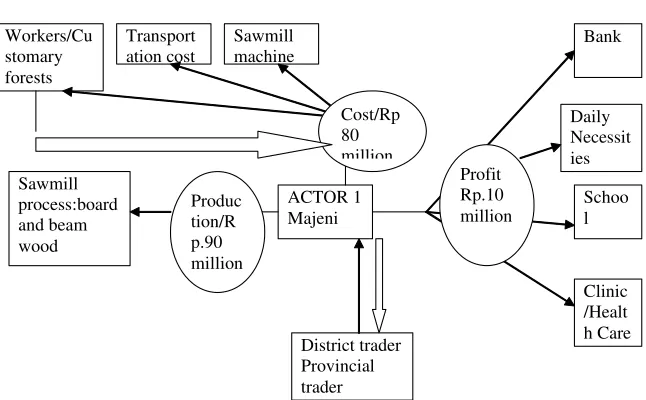
Profit= production – cost
(Wood) (Money)
Actor 1 is Majeni
Production = 200 M3 x Rp. 450,000/per M3 = Rp. 90,000,000,-
His profit is Rp 90 million – Rp. 80 million= Rp. 10 million (per two months).
Figure 1
Figure 1 Wood and Monetary Flow of Timber Traders at Village Level Note: Cost, production and timber trading activities per two months Source: this figure is modified by the author.
Profile of a Contract Chainsaw Worker
The second person is Iyal, who used to be a chainsaw worker. He was born in Muara Kaman, about 3 hours by Ces from Muara Gusik village. He learnt the trade from his brother, Iyan, who has great experience in this type of work. He initially came to Majeni as a timber trader in 2000. He was paid by Majeni almost Rp. 2 million, which he spent on a new chainsaw in Sebulu district worth Rp.2.5 million. He says that his first chainsaw cost Rp. 6 million in Samarinda.
He carries out logging in the forest, usually with a group of 6-7 persons - 3 people from Muara Gusik and 4 from Muara Kaman. They usually stay at the forest for 21 days, where they cut many different species of timber, but the most valuable is Kayu Ulin (hardwood). There is a special group who make Sirap from Kayu Ulin, while the other members make balok (beams) and papan (boards). Every day they cut almost 2 cubic meters per week, and approximately 12 m3 within 3 weeks (21 days). They usually can produce about 36 cubic meters. The village timber trader buys the products at about Rp.300,000 per cubic meter, therefore, in total they receive Rp. 10,800,000. This amount, divided for 6 members, with some extra money for the head of the group, means that each chainsaw worker receives Rp. 1.5 million, while the head of the group usually receives Rp. 1.8 million. The remainder of the money, Rp. 200,000, is used for necessities while they stay in the forest.
In the case of Iyan, half of his income is spent on paying his chainsaw equipment credit and other daily necessities for his family, while the rest he saves in the bank. As a chainsaw worker, he faces many dangers. There is the possibility of getting malaria during the dry season, while in the rainy season, the land is muddy and the trees are wet, creating dangerous conditions for logging.
VI. Conclusions
How do local people survive in their villages as the effect of the logging industry? In Muara Gusik, people survive for paddy rice planting as primary of their subsistence. They also planted rubber, rattan and fruits as secondary sources. There are also some rattan traders. They obtained their capital usually from rattan traders and they usually have strategy to access rattan by opening their shops to lend ‘money’ and goods such as rice, oil, sugar, cakes, soap for local people. In turn, during the harvest time, the local people sell their paddy and rattan to shop keeper, which also act as rattan trader.
independently. They own by their own efforts. Also they employ workers for chainsaw operation, truck drivers, timber carriers (Tukang pikul Kayu), and timber cutting workers based on contract system. In this case, timber production, which owned by timber traders at village level, might be sold to any timber buyers who directly come from the province, district and sub-district. These systems of trading are more open and based on normal price. The socio-economic function of timber traders at the village stimulates the economy for local inhabitants, through capital investment and employment. The role of financial institution such as banking in sub-district level is required to improve the production, management and marketing of timber production in village and sub-district level as well. In contrast, rattan farmers have to sell their productions to village traders, because farmers previously have taken materials and money landing to this trader. Then, the mechanism of rattan trading at the village level depends more upon traders.
The negative implications of logging concessions for local inhabitants living in and around forest areas are that their ‘customary forest rights’ were often annexed by logging concession holders, causing them socio-economic and political marginalization. The transitional time from the Soeharto regime into the Reform era (1998) has improved the political and economic standing of local inhabitants, through the paying of compensation and memorandum of understanding (MOU) between local inhabitants and logging concession holders, as local inhabitants are allowed to use their ‘customary rights forest’ for agriculture and timber utilization.
Bibliography
Gedicks, Al., 1994, The New Resources Wars: Native and Environmental Struggle Against Multinational Corporations, London: Black Rose Books.
Provincial Forestry Agency in Figure, 1999/2000.
Wibisono, Chistianto, 1989, A Profile of Indoesian Forestry Business Featuring Timber and Wood Based Industry, Jakarta: PDBI (Indonesian Business Data Center).
Hidayat and Haba (eds.), 1997, Social Solution on Forest Squatters: A Study of ITCI and Muara Gusik Community, Jakarta: LIPI, PMB. Won Jeong, Ho (eds.), 1999, Conflict Resolution: Dynamics, Process
and Structure, USA: Ashgate Publishing Company.
Inoue, Makoto, 1999/2000 “Republic of Indonesia: Natural Environmental and Economy” in Japan Environmental Council: The State of Environment in Asia, Tokyo.
Mubariq, Ahmad, 1992, Rente Ekonomi dan Eksploitasi Hutan Alam (Economic timber values and exploitation on Natural Forest Indonesia), Jakarta: Report Walhi.
Mogea, J.P., 2000, Rattan Diversity in Indonesia and its Role in development of Rattan Industry, Workshop on Indonesian Rattan Policy Review, Bogor: CIFOR.