santoso2014 by Suryadi Ismadji
Béla Noszál, Dóra Visky, Márta Kraszni. " Population, Acid−Base, and Redox Properties of -Acetylcysteine Conformers ", Journal of Medicinal Chemistry, 2000
1% match (Internet from 25-Jul-2017)
https://www.j3.jstage.jst.go.jp/browse/cpb/64/11/_contents
1% match (Internet from 06-Sep-2017)
https://run.unl.pt/bitstream/10362/6859/1/tese%20PMateus.pdf
1% match (publications)
Taha, M.. "Thermodynamics of the second-stage dissociation of 2-[N-(2-hydroxyethyl)-N-methylaminomethyl]-propenoic acid (HEMPA) in water at different ionic strength and different solvent mixtures", The Journal of Chemical Thermodynamics, 200501
1% match (Internet from 08-Sep-2017)
http://eprints.ucm.es/32815/1/T36285.pdf
1% match (Internet from 06-Sep-2017)
https://ir.nctu.edu.tw/bitstream/11536/23603/1/000329586300032.pdf
1% match (publications)
Santoso, Shella Permatasari, Suryadi Ismadji, Artik Elisa Angkawijaya, Felycia Edi Soetaredjo, Alchris Woo Go, and Yi Hsu Ju. "Complexes of 2,6-dihydroxybenzoic acid with divalent metal ions: Synthesis, crystal structure, spectral studies, and biological activity enhancement", Journal of Molecular Liquids, 2016.
1% match (publications)
Qin, Yaxin, Fahui Song, Zhihui Ai, Pingping Zhang, and Lizhi Zhang. "Protocatechuic Acid Promoted Alachlor Degradation in Fe(III)/H2O2 Fenton System", Environmental Science & Technology
10
Chattopadhyay, Sourav, Sandeep Kumar Dash, Satyajit Tripathy, Balaram Das, Santanu Kar
Mahapatra, Panchanan Pramanik, and Somenath Roy. "Cobalt oxide nanoparticles induced oxidative stress linked to activation of TNF-α/caspase-8/p38-MAPK signaling in human leukemia cells :
Anticancer activity of CoO nanoparticles in vitro and in vivo", Journal of Applied Toxicology, 2015.
1% match (Internet from 30-Aug-2017)
http://open.uct.ac.za/bitstream/handle/11427/15767/thesis_sci_2015_elmagbari_fatin_m_ali.pdf? sequence=1
< 1% match (publications)
Amalia Rodríguez. "Study of the bromide oxidation by bromate in zwitterionic micellar solutions", International Journal of Chemical Kinetics, 2000
< 1% match (publications)
Shella Permatasari Santoso, Livy Laysandra, Jindra Nyoo Putro, Jenni Lie et al. "Preparation of nanocrystalline cellulose-montmorillonite composite via thermal radiation for liquid-phase adsorption", Journal of Molecular Liquids, 2017
< 1% match (publications)
Florian Latteyer. "Vibrational and electronic characterisation of Staphylococcus aureus wall teichoic acids and relevant components in thin films", Analytical and Bioanalytical Chemistry, 05/27/2010
< 1% match (student papers from 02-Jun-2014)
Submitted to Monash University on 2014-06-02
< 1% match (publications)
Shaesta Quyoom. "Potentiometric and UV Spectral Studies of Binary and Ternary Complexes of Some Metal Ions with N-Acetylcysteine and Amino Acids", E-Journal of Chemistry, 2009
< 1% match (student papers from 03-Oct-2012)
Submitted to Kingston University on 2012-10-03
paper text:
Article pubs.acs.org/jced
1Equilibrium Studies of Complexes between N‑Acetylcysteine and Divalent Metal Ions in Aqueous Solutions Shella Permatasari Santoso,† Ivon Kusmijo Chandra,† Felycia Edi Soetaredjo,‡ Artik Elisa Angkawijaya,† and Yi-Hsu Ju*,† †Chemical Engineering
1ABSTRACT: The complex formations of N-acetylcysteine with divalent transition metals Cu2+, Zn2+, Ni2+, Co2+, Mn2+ have been investigated in aqueous solution of 0.15 mol·dm−3 NaCl at 310.15 K by the potentiometric method. The protonation and stability constant of
the complexes were obtained based on nonlinear least-squares curve fitting performed by the HYPER-QUAD2008 program along with an estimation using Bjerrum− Calvin half integral method. Distribution diagrams of complex species at certain pH range were generated by the HySS2009 simulation program. From optimization and thermochemical analysis by using the Gaussian09W program, it showed that the ligand formed a six-membered chelate ring with the investigated metal ions via its sulfur and oxygen donor atoms. ■ INTRODUCTION As is widely known, some heavy metals such as Fe2+, Co2+, Cu2+, Mn2+, Ni2+, and Zn2+ are essential trace elements that act as micronutrients. These play critical roles in human
metabolism, bone structure, brain and nervous system, muscle contraction, nerve transmission, blood clotting, immune function, enzymes activities, and oxygen transport.1−6 Excessive uptake of these metals can be dangerous for one’s health because the human body is not equipped with the mechanism to regulate most of these elements.3,5 These heavy metals are not easily excreted and will be kept in the body for a relatively long time. Accumulation of these metals may lead to the generation of reactive oxygen species (ROS) and depletion of antioxidants such as glutathione. Toxic species such as ROS are well-known to cause oxidative damage to cells. Long-term exposure of these species may result in serious illness of the nervous system and cells.7−10 N-acetylcysteine (Nac) is
9a biologically important organic substance that is known to have metal-chelating properties and can be used for metal poisoning therapy.
7,11−13 Nac is a cysteine derivative with an acetyl group attached to the N- terminus. This converts
zwitterionic cysteine to a monovalent organic anion. The acetyl group of Nac provides a beneficial effect for the generation of glutathione and also may increase the solubility of Nac in water. Nac is a potential
antioxidant chelator agent with its thiol and carboxyl groups as the functional groups. This compound is also capable of inactivating ROS as well as metal ions. It can prevent the toxic effect caused by metals.7,14−16 Nac can attenuate the oxidative damage that is induced by a copper overload and has the cytotoxic effect in cancer cells. Although the interaction between Nac and copper, a strong oxidative metal, may trigger © 2014 American Chemical Society the formation of hydrogen peroxide. Hydrogen peroxide may have a negative effect on the human body. However the Nac− copper interaction may be beneficial to prevent the growth of cancer cell because the formed H2O2 may have a cytotoxic effect on cancer cells.14,17,18 Nac also has been used
1as a mucolytic agent, a neuroprotective agent, for the treatment of paracetamol overdoses and
studies have been conducted to prove the effectiveness of Nac in reducing the effect of heavy metal
poisoning in the human body and preventing the oxidative damage of the cells. Neal et al. reported that Nac has beneficial role in treating lead poisoning.13,19,22 A thorough literature review showed that only a few studies have been done on the complexation between divalent metal ions, especially transition metals and Nac in aqueous solutions. Recent reports on the equilibrium constant of Nac were studied using Ni2+, Co2+, Zn2+, Cd2+, and Hg2+.11,23 In our study, the interaction between divalent metals and Nac were observed in biologic conditions (310.15
3K and ionic strength 0. 15 mol·dm−3
NaCl) and presented as the value of protonation and metal complex stability constants. Determinations of these constants were done by using a potentiometric titration method and data analysis was done by Bjerrum−Calvin half integral method and the HYPER- QUAD2008 program. The structure of complexes species were proposed by using Gaussian09W program.
5Received: February 1, 2014 Accepted: March 25, 2014 Published: April 2, 2014
■ EXPERIMENTAL SECTION Materials and Solutions. All the chemicals were analytical grade and were used without further purification. N- acetylcysteine (Nac, C5H9NO3S, 99% purity), copper chloride dehydrate (CuCl2·2H2O, 99% purity), cobalt nitrate hexahy- drate (Co(NO3)2·6H2O,
1498% purity), and zinc nitrate hexahydrate (Zn(NO3)2·6H2O, 98% purity) were purchased from Sigma-Aldrich
(U.S.A.).
12Sodium chloride (NaCl, 99.5% purity) was obtained from Showa (Japan).
12Sodium hydroxide (NaOH, 99% purity) was purchased from Yakuri
(Japan). Hydrochloric acid (37.6% purity) and manganese chloride tetrahydrate (MnCl2·4H2O, 99.8% purity) were supplied by Fisher Scientific (U.S.A.).
Free- carbonate NaOH and HCl were prepared and standardized before used. All solutions were prepared freshly before experiments using ultra pure water obtained from NANO Pure Ultrapure water 18.3 MΩ·cm−1. Potentiometric Titration. pH−potentiometric titrations were performed using a Metrohm 888 Titrando with a 805 Dosimat equipped with a 802 rod stirrer, a 804 Ti stand, and an Ecotrode Plus pH glass electrode. The electrode response can be read to the third decimal place for pH with a precision of ± 0.001. The device was coupled to a personal computer and the titration software Tiamo version 2.3 was used to control the titration process and record the data.
3Before and after each series of the measurements, the glass electrode was calibrated
at 310.15 K by immersing the electrode in buffer standard solution at pH 4.00, 7.00, and 10.00. The titrations were carried out in a 150 cm3 commercial double walled glass vessel equipped with a refrigerated
circulating bath to maintain the temperature at 310.15 K. For
10determination of the protonation constant of the ligand and the stability constant of
binary complex between metal and ligand,
4the following solutions were prepared each with a total volume 50 cm3:
4(a) 0.003 mol·dm−3 HCl + 0. 15 mol·dm−3 NaCl (b) Solution a + 0. 01 mol·dm−3
Nac (c) Solution a + 0.01 to 0.03
15mol·dm−3 Nac + 0. 01 mol·dm−3 metal ion
The protonation constant of ligand was determined by titrating a solution b potentiometrically against carbonate-free NaOH, whereas
15the stability constants of metal− ligand complexes
metal to ligand (1:1, 1:2, 1:2.5, and 1:3). This fulfilled all possible coordination numbers of the metal ions. Each set of titration was repeated at least three times under controlled experimental conditions with a reproducibility of ± 0.04 in pH units. Data Analysis. To determine the protonation and stability constants of Nac and its metal complexes, HYPERQUAD2008 was used to make nonlinear least-squares curve fitting based on experimental pH-potentiometric titration data.24−28 Various models with possible compositions of complex species were proposed in the program to refine the protonation and stability constants. This program adopted Gauss−Newton−Marquardt algorithm
10to minimize the objective function (U) which is described as
U = ∑iWiri,
16where W is the weight and r is the residual that is equal to the difference between the calculated and the experimental data
of the titration curves. Initial estimations of these constants were needed to prevent errors during
HYPERQUAD2008 refinement. For this estimation purpose, the stability constants of these complexes were calculated by using Bjerrum−Calvin half integral method.29−31 These values were compared to the ones obtained from the HYPERQUAD2008 refinement results. During all refinements, the ionization constant of water at chosen experimental condition was kept constant (pKw = 13.384 at 310.15
3K and ionic strength 0. 15 mol·dm−3 NaCl). To measure the goodness of fit in
a system, sigma (σ) can be obtained from σ= U (m − n) where m is the number of data points that were used during refinement and n is the number of parameters refined.24 In this program, both protonation and
stability constants were presented as log values of the overall formation constant (log βpqr) with
stoichiometric coefficients p, q, and r that represent divalent metal ions, N-acetylcysteine, and hydrogen atoms respectively. The formation constant is a function of complex species concentration [MpNacqHr] and the free reactant concentrations [M], [Nac] and [H] and is expressed by the following equation: pM + qNac + rH ⇌ MpNacqHr β pqr = [MpNacqHr] [M]p [Nac]q [H]r The refined formation constant values of each
complex species then were introduced to HySS2009 program to provide a speciation diagram that can be used to depict the distributions of various complex species that were formed in certain pH ranges.32 Molecular Modeling. Optimization of the complexes structures were carried out using the Gausian09W program with the density functional theory (DFT) calculation and B3LYP hybrid functional and the
6-311++G(d) was used as the basis set.19,33−36 Geometry optimization and frequency analysis was done to obtain the thermochemical properties of the complexes. The modeling was performed by employing some simplifications, such as only considering the complex formation of one metal ion and one ligand (MNac species) and the usage of fully deprotonated ligands and not considering the usage of salt or not considering the addition of an acid/base during pH− potentiometric titration. ■ RESULTS AND DISCUSSION Protonation Constant of N-Acetylcysteine. The proto- nation constant is one of several fundamental properties in
13used to estimate the absorption, distribution, metabolism, and excretion of compounds in biological systems and in the environment.
37 In this study, the protonation
7constants of Nac were presented as the minus logarithm of a stepwise hydrogen dissociation constant (pKa)
which is expressed by the following equations: H2Nac ⇌ H+ + HNac−[H+][HNac−] Ka1[H2Nac] = HNac− ⇌
H+ + Nac2−[H+][Nac2−] Ka2[HNac−] = From the refinement of potentiometric result by HYPER- QUAD2008 program, the protonation constants were obtained as overall formation constants (log β) H+ + Nac2− ⇌
HNac−[HNac−] = β1[H+][Nac2−] 2H+ Nac2− ⇌ H2Nac[H2Nac] β2[H+]2[Nac2−] + = Based on the above
equations, the relation between log β and pKa can be described as log β1 = pKa2 and log β2 = pKa2 + pKa1.
2strength of 0.15 mol·dm−3 NaCl was initially estimated by The protonation constant of
Nac at 310.15 K and an ionic Bjerrum−Calvin half integral method and the actual value was determined by HYPERQUAD2008 program. These values were presented in Table 1 along with values reported in Table 1. Protonation Constant (pKa) of N-Acetylcysteine (T =
2310.15 K and I = 0.15 mol·dm−3 NaCl)
a pKa ± SD reference functional Bjerrum− group Calvin HYPERQUAD σb carboxyl 3.13 ± 0.01 3.18 ± 0.02 1.02 3.08c 3.31d thiol 9.47 ± 0.01 9.48 ± 0.05 9.62c 9.85d aStandard
5uncertainties u are u(T) = 0.1 K, u(
pKa) are represented by standard deviations SD. bSigma (σ) is the goodness of fit in a system with expectation value of 1.00. cRef 11,
11I = 0.12 mol·dm−3 NaClO4, T = 310.15 K.
[Nac]2−. Stability Constant of MNac Complexes. The stability constant of the complex of Nac and metal ions (Cu2+, Ni2+, Co2+, Zn2+, and Mn2+) was determined by titrating solution (c) at a constant ionic strength (0.15 mol·dm−3 NaCl) and temperature (310.15 K) against free-carbonate NaOH. According to typical titration curves (Figure 1) for a metal to ligand ratio of 1:2.5, it can be seen that at a fixed titrant volume there is a shift in pH for MNac curves to lower pH compared to Nac ligand titration curve. The shifts occur due to the formation of complexes between metal ions and Nac. In addition, a close observation at pH 4 to 9 shows that Cu2+ and Zn2+ titration curves overlap and have larger shifts than those of Ni2+, Co2+, and Mn2+. There is a larger shift of the MNac curve than the Nac curve. This indicates a higher stability of the Figure 1. Potentiometric titration curves of N-acetylcysteine (Nac) with divalent metal ions
4at T = 310 .15 K and I = 0. 15 mol·dm−3,
pH versus the amount of NaOH added (x). □, Nac; red ◆, Cu2+-Nac; blue ■, Zn2+-Nac; green ●, Ni2+-Nac; yellow ▼, Co2+-Nac; × , Mn2+- Nac. complex, and the overlapping of curves indicates that they have close stability constant values. The unknown stability constants of MNac species were determined by calculating the stability constants using the Bjerrum−Calvin half integral method, and this value then were introduced as the estimated stability constants into the HYPERQUAD2008. These values then were refined to obtain the best model that yielded a reasonably good curve fit compared to the potentiometry experimental result. The stability constants of these complexes were expressed in log β value and were presented in Table 2. The goodness of fit, sigma (σ), indicates a good fit of the proposed model in a system, with an expectation of a value of 1.00. The σ value range (1.02 to 1.41) obtained for all systems (Tables 1 and 2) is acceptable because there are many species included in the system.38 From the HYPERQUAD2008 program, the model with the best fit of titration data indicates that three species, [MNac], [MNac2]2−, and [MNacH]+, existed in the solutions during titration. As shown in Table 2, the stability constant of Nac with the metal ions
8decreases in the following order Cu2+ > Zn2+ > Ni2+ > Co2+ > Mn2+
for [MNac] and [MNac2]2− species. The order of the stability constant for the divalent metal ions is
appropriate with the order of stability constant suggested by Irving− Williams, where Mn2+ < Co2+ < Ni2+ < Cu2+ > Zn2+.39 There is a difference between the obtained pKa and log β values (Tables 1 and 2) and the values reported in the literature.11,20 The differences in these constants might be due to variance in experimental conditions or the calculation procedure used. In addition to the overall formation constants of complexes used to indicate how tightly ligand is bound to metal ions; the stepwise stability constant (log K) of these complexes were calculated according to (log K1 = log βMNac) and (log K2 = log βMNac2 − log βMNac) and were presented in Table 3. From this table, log K2 is lower than log K1, which indicates that the first Nac binds more tightly to the metal ions than the second Nac. This phenomenon happened due the attachment of second Nac to [MNac] species thus forming a bulkier complex [MNac2]2−. The second Nac ligand’s attachment was weaker than the attachment of the first Nac ligand. There is a decreased positive charge on the complex due to the negatively charged ligands. This lowered positive charge along with the steric Table 2. Overall Stability Constant (log β) of MNac Complexes (T =
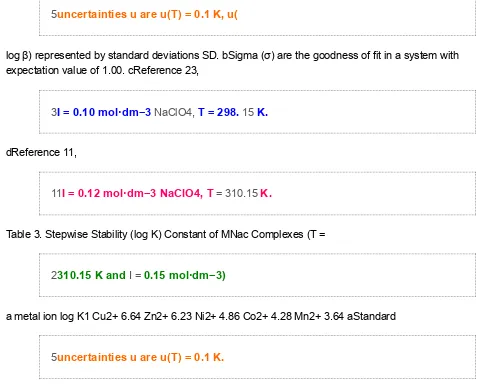
a log βpqr ± SD complex species p q r Bjerrum−Calvin HYPERQUAD σb ref M = Cu2+ [MNac] 1 1 0 6.57 ± 0.02 6.64 ± 0.09 1.30 [MNac2]2− 1 2 0 12.66 ± 0.02 12.70 ± 0.06 [MNacH]+ 1 1 1 13.35 ± 0.09 M = Zn2+ [MNac] 1 1 0 6.34 ± 0.05 6.23 ± 0.08 1.41 4.90c [MNac2]2− 1 2 0 12.05 ± 0.05 11.97 ± 0.08 11.48c M = Ni2+ [MNac] 1 1 0 4.84 ± 0.01 4.86 ± 0.04 1.21 4.84d [MNac2]2− 1 2 0 9.04 ± 0.01 9.22 ± 0.04 9.22d [MNacH]+ 1 1 1 13.15 ± 0.09 M = Co2+ [MNac] 1 1 0 4.12 ± 0.02 4.28 ± 0.08 1.31 4.22d [MNac2]2− 1 2 0 7.87 ± 0.02 7.97 ± 0.09 7.94d [MNacH]+ 1 1 1 12.63 ± 0.07 M = Mn2+ [MNac] 1 1 0 3.67 ± 0.01 3.64 ± 0.05 1.27 [MNac2]2− 1 2 0 7.44 ± 0.02 7.47 ± 0.08 [MNacH]+ 1 1 1 12.66 ± 0.09 aStandard
5uncertainties u are u(T) = 0.1 K, u(
log β) represented by standard deviations SD. bSigma (σ) are the goodness of fit in a system with expectation value of 1.00. cReference 23,
3I = 0.10 mol·dm−3 NaClO4, T = 298. 15 K.
dReference 11,
11I = 0.12 mol·dm−3 NaClO4, T = 310.15 K.
Table 3. Stepwise Stability (log K) Constant of MNac Complexes (T =
2310.15 K and I = 0.15 mol·dm−3)
a metal ion log K1 Cu2+ 6.64 Zn2+ 6.23 Ni2+ 4.86 Co2+ 4.28 Mn2+ 3.64 aStandard
5uncertainties u are u(T) = 0.1 K.
correlation between log β and ΔrG, the more negative the ΔrG is, the larger the formation constant value will be and the complex formed will be more stable. For each metal−ligand combination, Gaussian modeling was done by considering the possible binding site that may contribute in complex formation. The ΔrG for metal ligand formation with their possible binding site of ligands were calculated. The one that gave the most negative value of the ΔrG was chosen as a possible contributing binding site, and the structure of this complex then will be used as the predicted structure of the formed complex. Representative [MNac] models for the Ni2+ and the Nac complex are presented in Figure 3. As depicted in the models A, B, and C, Nac may form a complex with the metal ion through its carboxyl group, the thiol group or form chelate through its carboxyl and thiol groups. It turned out that model C is the most stable complex with the most negative value of ΔrG (−0.0904 hartree/particle) compared to model A (ΔrG = −0.0744 hartree/particle) and model B (ΔrG = −0.0865 hartree/particle). All other metal ions studied (Cu2+, Zn2+, Co2+, and Mn2+) showed the same behavior as Ni2+ in forming [MNac] species. The most negative ΔrG values were found in the interaction of thiol and carboxyl donor atoms with metal ions. Complexes with six-membered chelate ring were formed. In agreement with HYPERQUAD refined result, the negativity of ΔrG (Table 4)
8decreases in the order of Cu2+ > Zn2+ > Ni2+ > Co2+ > Mn2+. ■ CONCLUSION
The interactions of Nac and
metal ions under the biological condition of I =
10.15 mol·dm−3 NaCl and T = 310.15 K have been studied by the pH −potentiometric
technique. Proto- nation constants and complex stability constants as overall formation constants (log βpqr) were obtained by the HYPER- QUAD2008 along with the estimation of unknown stability Figure 2. The species distribution of (a) Cu2+-Nac, (b) Zn2+-Nac, (c) Ni2+-Nac, (f) Co2+-Nac, and (e) Mn2+-Nac at 1:2.5 metal to ligand ratio. Percentages are calculated with respect to the concentration of metal ion. ■ AUTHOR INFORMATION Corresponding Author *Y.-H. Ju. Phone: +886 2 2737 6612. Fax: +886 2 2737 6644.
6E-mail: yhju @mail. ntust .edu.tw. Notes The authors declare no competing financial interest. ■ ACKNOWLEDGMENTS This work was supported by the National Science Council of Taiwan through the project NSC
102-2221-E-011-079. The authors thank Prof. Jiang Jyh-Chiang for his valuable discussion regarding the Gaussian program and Dr. Fred Quarnstrom for Figure 3. Optimized structure of nickel (Ni2+) and N-acetylcysteine help in English writing. (Nac), [NiNac] species, generated from Gaussian09 program.
REFERENCES Table 4. Gibb’s Free Energy of Reaction (ΔrG) of MNac ■ (1) Duffus, J. H. Pure Appl. Chem. 2002, 74, 793−807. Species Obtained by the Gaussian09 Program (2) Fang, Y. Z.; Yang, S.; Wu, G. J. Nutr. 2002, 18, 872−879. (3) Nordberg, G. F.; Fowler, B. A.; Nordberg, M.; Friberg, L. T. In metal ion ΔrG
(6) Sigel, A.; Sigel, H.; Sigel, R. K. O. Metal Ions in Biological Systems; a1 hartree/particle = 2625.5
kJ·mol−1 Taylor & Francis: New York, 2005; Vol. 3. (7) Luczak, M. W.; Zhitkovich, A. Free Radical Biol. Med. 2013, 65, 262−269. (8) Bennett, B. G. IARC Sci. Publ. 1984, 53, 487−495. (9) Szivak, I.; Behra, R.; Sigg, L. J. Phycol. 2009, 45, 427−435. constants value by the Bjerrum−Calvin half integral method. (10) Jozefczak, M.; Remans, T.; Vangronsveld, J.; Cuypers, A. Int. J. The stability constant of the complexes follows the Irving− Mol. Sci. 2013, 13, 3145−3175. Williams order Cu2+ > Zn2+ > Ni2+ > Co2+ > Mn2+. Gaussian (11) Guzeloglu, S.; Yalcin, G.; Pekin, M. J. Organomet. Chem. 1998, geometry optimization and frequency analysis result support 568, 143−147. the hypothesis that Nac ligand forms a six-membered chelate (12) Quyoom, S.; Khan, B.-U.-D. E-J. Chem. 2009, 6, S117−S122. (13) Neal, R.; Yang, P.; Fiechtl, J.; Yildiz, D.; Gurer, H.; Ercal, N. ring with metal ions via its thiol and carboxyl groups. Toxicol. Lett. 1997, 91, 169−178. (14) Ozcelik, D.; Uzun, H.; Naziroglu, M. Biol. Trace Elem. Res. 2012, 147, 292−298. (15) Pombrio, J. M.; Giangreco, A.; Li, L.; Wempe, M. F.; Anders, M. W.; Sweet, D. H.; Pritchard, J. B.; Ballatori, N. Mol.
Pharmacol. 2001, 60, 1091−1099. (16) Samuni, Y.; Goldstein, S.; Dean, O. M.; Berk, M. Biochim. Biophys. Acta 2013, 1830, 4117−4129. (17) Zheng, J.; Lou, J. R.; Zhang, X.-X.; Benbrook, D. M.; Hanigan, M. H.; Lind, S. E.; Ding, W.-Q. Cancer Lett. 2010, 298, 186−194. (18) Penugonda, S.; Ercal, N. Toxicol. Lett. 2011, 201, 1−7. (19) Chen, W.; Ercal, N.; Huynh, T.; Volkov, A.; Chusuei, C. C. J. Colloid Interface Sci. 2012, 171, 144−149. (20) Noszal, B.; Visky, D.; Kraszni, M. J. Med. Chem. 2000, 43, 2176−2182. (21) Geier, D. A.; Geier, M. R. Horm. Res. 2006, 66, 182−188. (22) Gurer, H.; Ercal, N. Free Radical Biol. Med. 2000, 29, 927−945. (23) Pettit, L. D.; Powell, K. J. MiniSCDatabase; Academic Software: Lexington, KY, 2001. (24) Gans, P.; Sabatini, A.; Vacca, A. Talanta 1996, 43, 1739−1753. (25) Angkawijaya, A. E.; Fazary, A. E.; Hernowo, E.; Ismadji, S.; Ju, Y.-H. J. Solution Chem. 2012, 41, 1156−1164. (26) Angkawijaya, A. E.; Fazary, A. E.; Hernowo, E.; Taha, M.; Ju, Y.- H. J. Chem. Eng. Data 2011, 56, 532−540. (27) Aydin, R.; Yirikogullari, A. J. Chem. Eng. Data 2010, 55, 4794− 4800. (28) Angkawijaya, A. E.; Fazary, A. E.; Ismadji, S.; Ju, Y.-H. J. Chem. Eng. Data 2012, 57, 3443−3451. (29) Bjerrum, J. Chem. Abstr. 1941, 35, 6527−6534. (30) Calvin, M.; Wilson, K. W. J. Am. Chem. Soc. 1945, 67, 2003− 2007. (31) Ewais, H. A.; Taha, M.; Salm, H. N. J. Chem. Eng. Data 2010, 55, 754−758. (32) Alderighi, L.; Gans, P.; Ienco, A.; Peters, D.; Sabatini, A.; Vacca, A. Coord. Chem. Rev. 1999, 184, 311−318. (33) Frisch, M. J.; Trucks, G. W.; Schlegel, H. B.; Scuseria, G. E.; Robb, M. A.; Cheeseman, J. R.; Scalmani, G.; Barone, V.; Mennucci, B.; Petersson, G. A.; Nakatsuji, H.; Caricato, M.; Li, X.; Hratchian, H. P.; Izmaylov, A. F.; Bloino, J.; Zheng, G.; Sonnenberg, J. L.; Hada, M.; Ehara, M.; Toyota, K.; Fukuda, R.; Hasegawa, J.; Ishida, M.; Nakajima, T.; Honda, Y.; Kitao, O.; Nakai, H.; Vreven, T.; J. A. Montgomery, J.; Peralta, J. E.; Ogliaro, F.; Bearpark, M.; Heyd, J. J.; Brothers, E.; Kudin, K. N.; Staroverov, V. N.; Kobayashi, R.; Normand, J.; Raghavachari, K.; Rendell, A.; Burant, J. C.; Iyengar, S. S.; Tomasi, J.; Cossi, M.; Rega, N.; Millam, J. M.; Klene, M.; Knox, J. E.; Cross, J. B.; Bakken, V.; Adamo, C.; Jaramillo, J.; Gomperts, R.; Stratmann, R. E.; Yazyev, O.; Austin, A. J.; Cammi, R.; Pomelli, C.; Ochterski, J. W.; Martin, R. L.; Morokuma, K.; Zakrzewski, V. G.; Voth, G. A.; Salvador, P.; Dannenberg, J. J.; Dapprich, S.; Daniels, A. D.; Farkas, O.; Foresman, J. B.; Ortiz, J. V.; Cioslowski, J.; Fox, D. J. Gaussian 09; Gaussian, Inc.: Wallingford, CT, 2009. (34) Becke, A. D. J. Chem. Phys. 1993, 98, 5648−5652. (35) Lee, C.; Yang, W.; Parr, R. G. Phys. Rev. B 1988, 37, 785−789. (36) Abbehausen, C.; Heinrich, T. A.; Abrao, E. P.; Costa-Neto, C. M.; Lustri, W. R.; Formiga, A. L. B.; Corbi, P. P. Polyhedron 2011, 30, 579−583. (37) Poole, S. K.; Patel, S.; Dehring, K.; Workman, H.; Poole, C. F. J. Chromatogr., A 2004, 1037, 445−454. (38) Engelmann, M. D.; Hutcheson, R.; Cheng, I. F. J. Agric. Food Chem. 2005, 53, 2953−2960. (39) Irving, H.; Williams, R. J. P. J. Chem. Soc. 1953, 3192−3210. Journal of Chemical & Engineering Data Article Journal of Chemical & Engineering Data Article Journal of Chemical & Engineering Data Article Journal of Chemical & Engineering Data Article Journal of Chemical & Engineering Data Article 1661