Best of Ruby Quiz
Volume One
James Edward Gray II
B o o k s h e l f
P r a g m a t i c
Many of the designations used by manufacturers and sellers to distinguish their products are claimed as trademarks. Where those designations appear in this book, and The Pragmatic Programmers, LLC was aware of a trademark claim, the designations have been printed in initial capital letters or in all capitals. The Pragmatic Starter Kit, The Pragmatic Programmer, Pragmatic Programming, Pragmatic Bookshelf and the linkingg
device are trademarks of The Pragmatic Programmers, LLC.
Every precaution was taken in the preparation of this book. However, the publisher assumes no responsibility for errors or omissions, or for damages that may result from the use of information (including program listings) contained herein.
Our Pragmatic courses, workshops, and other products can help you and your team create better software and have more fun. For more information, as well as the latest Pragmatic titles, please visit us at
http://www.pragmaticprogrammer.com
Copyright © 2006 The Pragmatic Programmers LLC. All rights reserved.
No part of this publication may be reproduced, stored in a retrieval system, or transmit-ted, in any form, or by any means, electronic, mechanical, photocopying, recording, or otherwise, without the prior consent of the publisher.
Printed in the United States of America.
ISBN 0-9766940-7-7
Printed on acid-free paper with 85% recycled, 30% post-consumer content. First printing, February 2006
Contents
1 Introduction 1
I The Quizzes
5
1. Mad Libs. . . 6
2. LCD Numbers. . . 8
3. GEDCOM Parser . . . 9
4. Animal Quiz. . . 11
5. Scrabble Stems . . . 13
6. Regexp.build(). . . 14
7. HighLine. . . 16
8. Roman Numerals . . . 18
9. Rock Paper Scissors . . . 20
10. Knight’s Travails . . . 25
11. Sokoban . . . 27
12. Crosswords . . . 29
13. 1-800-THE-QUIZ . . . 31
14. Texas Hold’em . . . 33
15. Solitaire Cipher . . . 36
16. English Numerals . . . 41
17. Code Cleaning . . . 42
18. Banned Words . . . 44
19. Secret Santas . . . 46
20. Barrel of Monkeys . . . 48
21. Amazing Mazes . . . 50
22. Learning Tic-Tac-Toe . . . 52
23. Countdown . . . 53
24. Solving Tactics . . . 55
CONTENTS v
II Answers and Discussion
60
1. Mad Libs. . . 61
Custom Templating. . . 62
Mini Libs . . . 66
Additional Exercises . . . 67
2. LCD Numbers. . . 68
Using Templates . . . 68
On and Off Bits . . . 70
Using a State Machine . . . 72
Additional Exercises . . . 75
3. GEDCOM Parser . . . 76
Optimizing the Read and Write Cycles . . . 77
Additional Exercises . . . 80
4. Animal Quiz. . . 81
Arrays Instead of Custom Objects . . . 84
Leaving the Trees . . . 87
Additional Exercises . . . 88
5. Scrabble Stems . . . 89
Eating Less RAM . . . 90
Additional Exercises . . . 92
6. Regexp.build(). . . 93
Shrinking a Regexp . . . 94
Speeding Up the Build . . . 97
Timing the Solutions . . . 99
Additional Exercises . . . 100
7. HighLine. . . 101
A Class-Based Solution. . . 101
Testing I/O . . . 104
The Official HighLine . . . 106
Additional Exercises . . . 111
8. Roman Numerals . . . 112
Saving Some Memory . . . 113
Romanizing Ruby . . . 115
Additional Exercises . . . 120
9. Rock Paper Scissors . . . 121
Outthinking a Random Player . . . 122
Cheat to Win . . . 124
Psychic Players . . . 125
Thinking Outside the Box . . . 126
CONTENTS vi
10. Knight’s Travails . . . 127
Or with Less Abstraction . . . 131
Additional Exercises . . . 132
11. Sokoban . . . 134
Objectified Sokoban . . . 136
Saving Your Fingers . . . 142
Additional Exercises . . . 143
12. Crosswords . . . 145
Passive Building . . . 148
Additional Exercises . . . 152
13. 1-800-THE-QUIZ . . . 153
Word Signatures . . . 153
The Search . . . 155
Cleaning Up and Showing Results . . . 157
Additional Exercises . . . 159
14. Texas Hold’em . . . 160
Ruby’s Sorting Tricks. . . 160
Sorting Cards . . . 161
Name the Hand . . . 162
Additional Exercises . . . 165
15. Solitaire Cipher . . . 166
Testing a Cipher . . . 166
A Deck of Letters . . . 170
A Test Suite and Solution . . . 173
Additional Exercises . . . 175
16. English Numerals . . . 176
Grouping Numbers . . . 176
Coding an Idea . . . 177
Proper Grammar . . . 179
Additional Exercises . . . 182
17. Code Cleaning . . . 183
Instant Web Serving . . . 183
Finding the Hidden Wiki . . . 184
The Other Program . . . 188
Additional Exercises . . . 190
18. Banned Words . . . 191
Doing Even Fewer Checks . . . 193
CONTENTS vii
19. Secret Santas . . . 195
Using a Random Sort . . . 197
A Ring of Players . . . 197
Grouping . . . 198
Climbing a Hill . . . 200
Additional Exercises . . . 201
20. Barrel of Monkeys . . . 203
Fancy Searching . . . 207
Additional Exercises . . . 213
21. Amazing Mazes . . . 214
The Internal Bits . . . 214
Making a Maze . . . 219
Solving a Maze . . . 220
Interface . . . 222
Additional Exercises . . . 223
22. Learning Tic-Tac-Toe . . . 225
The History of MENACE . . . 232
Filling a Matchbox Brain . . . 232
Ruby’s MENACE . . . 236
Additional Exercises . . . 238
23. Countdown . . . 239
Pruning Code . . . 240
Coding Different Strategies . . . 244
Additional Exercises . . . 247
24. Solving Tactics . . . 249
From Playing to Solving . . . 252
Proof through Unit Testing . . . 255
Additional Exercises . . . 258
25. Cryptograms . . . 259
Using Word Signatures . . . 259
Building the Map . . . 261
Assembling a Solution . . . 264
A Look at Limitations . . . 269
Additional Exercises . . . 269
Chapter 1
Introduction
If you stop and think about it, programming knowledge is nearly use-less by itself. What exactly are you going to create with all that expert programming skill, if it’s all you have? The world needs only so many text editors.What makes the craft interesting is how we apply it. Combine program-ming prowess with accounting practices or even just a need to reunite hurricane victims with their scattered family members, and you have the makings of a real, and potentially useful, application.
Practical programming experience can be surprisingly hard to come by. There are classes and books to give us theory and syntax. If you’ve been a programmer for any amount of time, you will have read plenty of those books. Then what? I think most of us inherently know that the next step is to write something, but many of us struggle to find a topic.
I love games. I’m always playing something, and struggling to put together a winning strategy never quite feels like work to me. I use that to make myself a better programmer. I play games with my code.
I assign myself a task I’ve never tried before, perhaps to get more famil-iar with an algorithm or a library. Or sometimes I’ll give myself a com-pletely routine task but add an unusual twist: implement this full-featured trivial program in one hour or less.
This is my form of practice for the big game. I find what works and even what doesn’t.1 I memorize idioms I like, just in case I run into a
CHAPTER1. INTRODUCTION 2
similar problem down the road. All the while, I’m getting more familiar with languages, libraries, and frameworks I may need to work with someday.
The set of weekly programming challenges for the Ruby programming language called Ruby Quiz2 was born out of my desire to share this
with the rest of the world. This book holds some highlights from the first year of its run.
What’s Inside
In these pages, you will find a collection of problems contributed by myself and others to enhance your programming knowledge. The great thing about working with these problems is that they come with dis-cussions on some of their interesting points and sample solutions from other programmers. You can solve the challenges and then compare and contrast your code with the solutions provided.
There is not yet a way to download all of these programming idioms directly into your brain. Let me forewarn you, solving these problems is work.3 We try to have fun with the Ruby Quiz, but it doesn’t come
without the price of a little effort. The problems vary in difficulty, but I believe there’s something to be learned from all of them.
How to Use This Book
This book isn’t meant for passive readers! Get those brain cells moving. You will learn a lot more by giving a quiz your best shot, even if it doesn’t blossom into a solution, and then reading the discussions. It’s the context you gain from the attempt that allows you to internalize what you learn, and that’s the whole point.
May this teach you half of what it has taught me.
Finding Your Way Around
The front of this book is a collection of twenty-five programming chal-lenges. In the back of the book, you can find discussions and solutions
2http://rubyquiz.com
CHAPTER1. INTRODUCTION 3
for these problems. The separation is there to allow you to scan prob-lems and find something you want to try without accidentally running into a spoiler. At the beginning of each quiz, you will find a pointer to the page the relevant discussion begins on.
Along the way you will find:
Live Code
Most of the code snippets shown within come from full-length, running examples, which you can download.4 To help you find
your way, if code can be found in the download, there’ll be a marker line like the one that follows at the top of the listing in the book:
madlibs/parsed_madlib.rb
# Ordinary prose.
class String
# Anything is acceptable.
def self.parse?( token, replacements ) new(token)
end end
If you’re reading the PDF version of this book and if your PDF viewer supports hyperlinks, you can click the marker, and the code should appear in a browser window. Some browsers (such as Safari) might mistakenly try to interpret some of the code as HTML. If this happens, view the source of the page to see the real source code.
Joe Asks...
Joe, the mythical developer, sometimes pops up to ask questions about stuff we talk about in the text. We try to answer these as we go along.
Spring Cleaning
Solutions in this text are just as they were submitted originally, with the following exceptions:
• Tabs have been replaced with the Ruby standard practice of two spaces.
• Method and variable names were adjusted to Ruby’s snake_case
style convention.
CHAPTER1. INTRODUCTION 4
• Obvious minor bugs have been fixed.
• Some class definitions were split up into smaller pieces just to make them easier to present to the reader.
• The text has been edited for grammar and spelling.
Any other changes will be called out in the margin of the code listings as they occur.
Who Really Made All of This
So many people contributed to this book, I can hardly take credit for writing it. I will call out contributions of problems and code as they come up, but that’s such a small part of the story. Ruby Quiz simply wouldn’t exist if it wasn’t for all the wonderful contributors who have shared problems, ideas, and discussions since I started the project. Together, they have created a sensational community resource while I mostly just watched it happen. I am eternally grateful to the entire Ruby Quiz community.
The second side of my support base is the most fantastic bunch of family and friends a guy could have. They truly make me believe I can do anything. Without them I would be merely mortal.
Part I
QUIZ1. MADLIBS 6
Quiz
1
Answer on page61
Mad Libs
This Ruby Quiz is to write a program that presents the user with that favorite childhood game, Mad Libs. Don’t worry if you have never played; it’s an easy game to learn. A Mad Libs is a story with several placeholders. For example:
I had a ((an adjective)) sandwich for lunch today. It dripped all
over my ((a body part)) and ((a noun)).
The reader, the only person who sees the story, will ask another person for each placeholder in turn and record the answers. In this example, they would ask for an adjective, a body part, and a noun. The reader then reads the story, with the answers in place. It might come out something like this:
I had a smelly sandwich for lunch today. It dripped all
over my big toe and bathtub.
Laughter ensues.
The script should play the role of reader, asking the user for a series of words, then replacing placeholders in the story with the user’s answers.
We’ll keep our story format very simple, using a((...)) notation for place-holders. Here’s an example:
Our favorite language is ((a gemstone)).
If your program is fed that template, it should ask you to enter “a gem-stone” and then display your version of the story:
Our favorite language is Ruby.
That covers the simple cases, but in some instances we may want to reuse an answer. For that, we’ll introduce a way to name them:
Our favorite language is ((gem:a gemstone)). We think ((gem)) is
QUIZ1. MADLIBS 7
With the previous story, your program should ask for two gemstones, then substitute the one designated by((gem:...))at((gem)). When there is a colon in the((...)), the part before the colon becomes the pointer to the reusable value, and the part after the colon is the prompt for the value. That would give results like this:
Our favorite language is Ruby. We think Ruby is better than
Emerald.
You can choose any interface you like, as long as a user can interact with the end result. You can play around with a CGI-based solution at the Ruby Quiz site.5 You can find the two Mad Libs files I’m using on
the Ruby Quiz site as well.6
5http://rubyquiz.com/cgi-bin/madlib.cgi
6http://rubyquiz.com/madlibs/Lunch_Hungers.madliband
QUIZ 2. LCD NUMBERS 8
Quiz
2
Answer on page68
LCD Numbers
This quiz is to write a program that displays LCD-style numbers at adjustable sizes.
The digits to be displayed will be passed as an argument to the program. Size should be controlled with the command-line option -sfollowed by a positive integer. The default value for-sis 2.
For example, if your program is called with this:
$ lcd.rb 012345
the correct display is this:
-- -- --
--| | | | | | | |
| | | | | | | |
-- -- --
--| | | | | | |
| | | | | | |
-- -- --
--And for this:
> lcd.rb -s 1 6789
your program should print this:
- - -
-| | | | | |
- -
-| -| | | | |
- -
QUIZ 3. GEDCOM PARSER 9
Quiz
3
Answer on page76
GEDCOM Parser
Posed by Jamis Buck
GEDCOM is the “GEnealogical Data COMmunication” file format. It is a plain-text electronic format used to transfer genealogical data.7 The
purpose of this quiz is to develop a simple parser that can convert a GEDCOM file to XML.
GEDCOM Format
The GEDCOM file format is very straightforward.Each line represents a node in a tree. It looks something like this:
0 @I1@ INDI
1 NAME Jamis Gordon /Buck/ 2 SURN Buck
2 GIVN Jamis Gordon 1 SEX M
...
In general, each line is formatted like this:
LEVEL TAG-OR-ID [DATA]
The LEVEL is an integer, representing the current depth in the tree. If
subsequent lines have greater levels than the current node, they are children of the current node.
TAG-OR-IDis a tag that identifies the type of data in that node, or it is a
unique identifier. Tags are three- or four-letter words in uppercase. The unique identifiers are always text surrounded by @ characters (such as
@I54@). If an ID is given, the DATA is the type of the subtree that is
identified.
par-QUIZ 3. GEDCOM PARSER 10
So, to take apart the example given previously, you have this:
• 0 @I1@ INDI. This starts a new subtree of type INDI (“individual”).
TheIDfor this individual is@I1@.
• 1 NAME Jamis Gordon /Buck/. This starts a NAME subtree with a
value ofJamis Gordon /Buck/.
• 2 SURN Buck. This is a subelement of theNAMEsubtree, of typeSURN
(“surname”).
• 2 GIVN Jamis Gordon. Same asSURNbut specifies the given name of
the individual.
• 1 SEX M. Creates a new sub-element of theINDIelement, of typeSEX
(i.e., “gender”).
And so forth.
Variable whitespace is allowed between the level and the tag. Blank lines are ignored.
The Challenge
The challenge is to create a parser that takes a GEDCOM file as input and converts it to XML. The snippet of GEDCOM given previously would become the following:
<gedcom>
<indi id="@I1@">
<name>
Jamis Gordon /Buck/
<surn>Buck</surn>
<givn>Jamis Gordon</givn>
</name>
<sex>M</sex> ...
</indi> ...
</gedcom>
Sample Input
There is a large GEDCOM file online8 containing the lineage of various
European royalty. This particular file makes generous use of white-space to increase readability.
QUIZ4. ANIMALQUIZ 11
Quiz
4
Answer on page81
Animal Quiz
Posed by Jim Weirich
Here’s an animal quiz program to try as a Ruby Quiz.
It works like this: The program starts by telling the user to think of an animal. It then begins asking a series of yes/no questions about that animal: Does it swim? Does it have hair? And so on.... Eventually, it will narrow down the possibilities to a single animal and guess: is it a mouse?
If the program has guessed correctly, the game is over and may be restarted with a new animal. If the program has guessed incorrectly, it asks the user for the kind of animal they were thinking of and then asks for the user to provide a question that can distinguish between its incorrect guess and the correct answer. It then adds the new question and animal to its “database” and will guess that animal in the future (if appropriate). Your program should remember what it has learned between runs.
Here’s a sample run:
⇒ Think of an animal...
Is it an elephant? (y or n)
⇐ n
⇒ You win. Help me learn from my mistake before you go...
What animal were you thinking of?
⇐ a rabbit
⇒ Give me a question to distinguish a rabbit from an elephant.
⇐ Is it a small animal?
⇒ For a rabbit, what is the answer to your question? (y or n)
⇐ y
⇒ Thanks.
Play again? (y or n)
⇐ y
QUIZ4. ANIMALQUIZ 12
Is it a small animal? (y or n)
⇐ y
⇒ Is it a rabbit? (y or n)
⇐ n
⇒ You win. Help me learn from my mistake before you go...
What animal were you thinking of?
⇐ a Shih Tzu
⇒ Give me a question to distinguish a Shih Tzu from a rabbit.
⇐ Is it a kind of dog?
⇒ For a Shih Tzu, what is the answer to your question? (y or n)
⇐ y
⇒ Thanks.
Play again? (y or n)
⇐ y
⇒ Think of an animal...
Is it a small animal? (y or n)
⇐ y
⇒ Is it a kind of dog? (y or n)
⇐ y
⇒ Is it a Shih Tzu? (y or n)
⇐ y
⇒ I win. Pretty smart, aren't I?
Play again? (y or n)
QUIZ5. SCRABBLESTEMS 13
Quiz
5
Answer on page89
Scrabble Stems
Posed by Martin DeMello
In Scrabble9 parlance, abingo is a play where one gets rid of all seven
letters. A bingo stem is a set of six letters that combine with another letter of the alphabet to make a seven-letter word. Some six-letter stems have more possible combinations than others. For instance, one of the more prolific stems,SATIRE, combines with twenty letters: A,B,C,D,
E,F,G,H,I,K,L,M,N,O,P,R,S,T,V, andW to form words such as
ASTERIA,BAITERS,RACIEST, and so on.
Write a program that, given a word list and a cutoffn, finds all six-letter stems that combine with n or more distinct letters, sorted by greatest number of combinations to least.
If you need a word list to help in developing a solution, you can find Spell Checking Oriented Word Lists (SCOWL) online.10
QUIZ6. REGEXP.BUILD() 14
Quiz
6
Answer on page93
Regexp.build()
This quiz is to build a library that adds a class method called build( ) to
Regexpand that should accept a variable number of arguments, which
can includeIntegers andRanges ofIntegers. Havebuild( ) return aRegexp
object that will match onlyIntegers in the set of passed arguments.
Here are some examples of possible usage:
lucky = Regexp.build(3, 7)
"7" =~ lucky # => true "13" =~ lucky # => false
"3" =~ lucky # => true
month = Regexp.build(1..12)
"0" =~ month # => false "1" =~ month # => true "12" =~ month # => true
day = Regexp.build(1..31)
"6" =~ day # => true
"16" =~ day # => true "Tues" =~ day # => false
year = Regexp.build(98, 99, 2000..2005)
"04" =~ year # => false "2004" =~ year # => true "99" =~ year # => true
num = Regexp.build(0..1_000_000)
"-1" =~ num # => false
You can determine the specifics of the expressions produced by your library. Here are issues you may want to consider:
QUIZ6. REGEXP.BUILD() 15
time11(0 to 23), if hours 0 through 9 may or may not have a single
leading zero?
• Should anything be captured by the returnedRegexp?
• How should anchoring work?
"2004" =~ Regexp.build(4) # => ???
QUIZ7. HIGHLINE 16
Quiz
7
Answer on page101
HighLine
When you stop to think about it, methods such asgets( ), while handy, are still pretty low level. In running Ruby Quiz I’m always seeing solu-tions with helper methods similar to this one from Markus König:
highline/example.rb
def ask(prompt)
loop do
print prompt, ' '
$stdout.flush s = gets
exit if s == nil
s.chomp!
if s == 'y' or s == 'yes'
return true
elsif s == 'n' or s == 'no'
return false else
$stderr.puts "Please answer yes or no."
end end end
Surely we can make something like that better! We don’t always need a web or GUI framework, and there’s no reason writing a command-line application can’t be equally smooth.
This Ruby Quiz is to start a module calledHighLine(for high-level, line -oriented interface). Ideally this module would eventually cover many aspects of terminal interaction, but for this quiz we’ll focus just on getting input.
What I really think we need here is to take a page out of theOptionParser
book.12 Here are some general ideas:
QUIZ7. HIGHLINE 17
age = ask("What is your age?", Integer, :within => 0..105) num = eval "0b#{ ask('Enter a binary number.',
String, :validate => /^[01_]+$/ ) }"
if ask_if("Would you like to continue?") # ...
None of these ideas is etched in stone. Feel free to call your input methodprompt( ) or use a set of classes. Rework the interface any way you like.
The goal is to provide an easy-to-use yet robust method of requesting input. It should free the programmer of common concerns like calls to
QUIZ8. ROMANNUMERALS 18
Quiz
8
Answer on page112
Roman Numerals
This quiz asks you to write a converter to and from Roman numerals.
The script should be a standard Unix filter, reading from files specified on the command line orSTDINand writing to STDOUT. Each line of input will contain one integer (from 1 to 3,99913) expressed as an Arabic or
Roman numeral. There should be one line of output for each line of input, containing the original number in the opposite format.
For example, given the following input:
III 29
38 CCXCI 1999
The correct output is as follows:
3 XXIX
XXXVIII 291
MCMXCIX
If you’re not familiar with or need a refresher on Roman numerals, the rules are simple. First, seven letters are associated with seven values:
I = 1 V = 5
X = 10 L = 50 C = 100
D = 500 M = 1000
QUIZ8. ROMANNUMERALS 19
Second, you can combine letters to add values by listing them largest to smallest from left to right:
II is 2
VIII is 8
XXXI is 31
However, you may list only three consecutive identical letters. That requires a special rule to express numbers like 40 and 900. That rule is that a single lower value may precede a larger value to indicate sub-traction. This rule is used only to build values not reachable by the previous rules. Those numbers are as follows:
IV is 4 IX is 9 XL is 40
QUIZ9. ROCKPAPERSCISSORS 20
Quiz
9
Answer on page121
Rock Paper Scissors
Generals, break out your copies of The Art of War[Tzu05], and let’s get a little competition going!
Your task is to build some AI for playing the game Rock Paper Scissors against all manner of opponents. The challenge is to adapt to an oppo-nent’s strategy and seize the advantage...while he is doing the same to you, of course.
If you’re not familiar with this childhood game, here’s an overview: Two players choose one of three items at the same time: a rock, some paper, or scissors. The winner is determined by the following rules:
• Paper covers a rock. (Paper beats a rock.) • Scissors cut paper. (Scissors beat paper.)
• A rock smashes scissors. (A rock beats scissors.) • Anything else is a draw.
Defining a player is straightforward. I provide a class you can inherit from:
rock_paper_scissors/example_player.rb
class YourPlayer < Player
def initialize( opponent_name )
# (optional) called at the start of a match verses opponent
# opponent_name = String of opponent's class name
#
# Player's constructor sets @opponent_name
end
def choose
# (required) return your choice of :paper, :rock or :scissors
QUIZ9. ROCKPAPERSCISSORS 21
def result( your_choice, opponents_choice, win_lose_or_draw )
# (optional) called after each choice you make to give feedback
# your_choice = your choice
# oppenents_choice = opponent's choice
# win_lose_or_draw = :win, :lose or :draw, your result
end end
We’ll need some rules for defining players to make it easy for all our strategies to play against each other:
• Use one file for each strategy.
• A file should contain exactly one subclass ofPlayer.
• Start the name of your subclass, the name of your files, and the name of any data files you write to disk with your initials.
Those rules should help with testing how different algorithms perform against each other.
Here are two dumbPlayers to practice with:
rock_paper_scissors/jeg_paper_player.rb
#!/usr/biin/env ruby
class JEGPaperPlayer < Player
def choose :paper
end end
rock_paper_scissors/jeg_queue_player.rb
#!/usr/bin/env ruby
class JEGQueuePlayer < Player
QUEUE = [ :rock, :scissors, :scissors ]
def initialize( opponent_name )
super
@index = 0
end
def choose
choice = QUEUE[@index] @index += 1
@index = 0 if @index == QUEUE.size
choice
QUIZ9. ROCKPAPERSCISSORS 22
Here’s how those two do against each other in a 1,000-game match (we will just track wins, since draws affect both players the same):
JEGPaperPlayer vs. JEGQueuePlayer JEGPaperPlayer: 334 JEGQueuePlayer: 666
JEGQueuePlayer Wins
Finally, here’s the game engine that supports the players:
rock_paper_scissors/rock_paper_scissors.rb
#!/usr/bin/env ruby
class Player @@players = [ ]
def self.inherited( player ) @@players << player
end
def self.each_pair
(0...(@@players.size - 1)).each do |i|
((i + 1)...@@players.size).each do |j|
yield @@players[i], @@players[j]
end end end
def initialize( opponent_name )
@opponent_name = opponent_name
end
def choose
raise NoMethodError, "Player subclasses must override choose()."
end
def result( your_choice, opponents_choice, win_lose_or_draw )
# do nothing-subclasses can override as needed
end end
class Game
def initialize( player1, player2 )
@player1_name = player1.to_s
@player2_name = player2.to_s
@player1 = player1.new(@player2_name)
@player2 = player2.new(@player1_name)
@score1 = 0 @score2 = 0
QUIZ9. ROCKPAPERSCISSORS 23
def play( num_matches )
num_matches.times do
hand1 = @player1.choose
hand2 = @player2.choose
[[@player1_name, hand1], [@player2_name, hand2]].each do |player, hand|
unless [:rock, :paper, :scissors].include? hand raise "Invalid choice by #{player}."
end end
hands = {hand1.to_s => @player1, hand2.to_s => @player2}
choices = hands.keys.sort
if choices.size == 1
draw hand1, hand2
elsif choices == %w{paper rock} win hands["paper"], hand1, hand2
elsif choices == %w{rock scissors} win hands["rock"], hand1, hand2
elsif choices == %w{paper scissors} win hands["scissors"], hand1, hand2
end end end
def results
match = "#{@player1_name} vs. #{@player2_name}\n" +
"\t#{@player1_name}: #{@score1}\n" +
"\t#{@player2_name}: #{@score2}\n"
if @score1 == @score2
match + "\tDraw\n"
elsif @score1 > @score2
match + "\t#{@player1_name} Wins\n"
else
match + "\t#{@player2_name} Wins\n"
end end
private
def draw( hand1, hand2 )
@score1 += 0.5 @score2 += 0.5
@player1.result(hand1, hand2, :draw) @player2.result(hand2, hand1, :draw)
end
def win( winner, hand1, hand2 )
if winner == @player1
@score1 += 1
QUIZ9. ROCKPAPERSCISSORS 24
@player2.result(hand2, hand1, :lose)
else
@score2 += 1
@player1.result(hand1, hand2, :lose) @player2.result(hand2, hand1, :win)
end end end
match_game_count = 1000
if ARGV.size > 2 and ARGV[0] == "-m" and ARGV[1] =~ /^[1-9]\d*$/ ARGV.shift
match_game_count = ARGV.shift.to_i
end
ARGV.each do |p|
if test(?d, p)
Dir.foreach(p) do |file|
next if file =~ /^\./
next unless file =~ /\.rb$/
require File.join(p, file)
end else
require p
end end
Player.each_pair do |one, two|
game = Game.new one, two game.play match_game_count
puts game.results
end
You can use the engine with a command like the following:
$ rock_paper_scissors.rb jeg_paper_player.rb jeg_queue_player.rb
Or you can point it at a directory, and it will treat all the .rb files in there asPlayers:
$ rock_paper_scissors.rb players/
You can also change the match game count:
QUIZ10. KNIGHT’STRAVAILS 25
Quiz
10
Answer on page127
Knight’s Travails
Posed by J E Bailey
Given a standard 8×8 chessboard where each position is indicated in algebraic notation (with the lower-left corner being a1), design a script that accepts two or more arguments.
The first argument indicates the starting position of a standard chess knight. The second argument indicates the ending position of the knight. Any additional arguments indicate positions that are forbid-den.
Return an array indicating the shortest path that the knight must travel to get to the end position without landing on one of the forbidden squares. If there is no valid path to the destination, returnnil.
Knights move in an L-shaped pattern. They may move two squares in any of the four cardinal directions and then turn 90 degrees and move an additional square. So a knight on e4 can jump to d2, f2, c3, g3, c5, g5, d6, or f6:
$ knights_travails a8 b7 b6
["c7", "b5", "d6", "b7"]
$ knights_travails a8 g6 b6 c7
nil
QUIZ10. KNIGHT’STRAVAILS 26
B la c k ✕s S t a rt in g L o c a t io n
W h it e ✕s S t a rt in g L o c a t io n A 8 B 8 C 8 D 8 E 8 F 8 G 8 H 8
A 7 B 7 C 7 D 7 E 7 F 7 G 7 H 7
A 6 B 6 C 6 D 6 E 6 F 6 G 6 H 6
A 5 B 5 5 E 5 F 5 G 5 H 5
A 4 B 4 4 E 4 F 4 G 4 H 4
A 3 B 3 3 E 3 F 3 G 3 H 3
A 2 B 2 2 E 2 F 2 G 2 H 2
A 1 B 1 1 E 1 F 1 G 1 H 1
QUIZ11. SOKOBAN 27
Quiz
11
Answer on page134
Sokoban
Ruby isn’t the only good thing to come out of Japan. The computer game Sokoban, invented by Hiroyuki Imabayashi, was introduced by Thinking Rabbit in 1982. This game of logic puzzles was an instant success. It won awards and spawned sequels. Over the years, Sokoban has been ported to a huge number of platforms. Fan support remains strong, and many of those fans still produce new levels for the game.
This quiz is to implement the game of Sokoban with the interface of your choosing and any extra features you would like to have.
Sokoban (which translates toWarehouse Man) has simple rules, which basically amount to this: push crates into their storage spots in the warehouse.
The elements of the levels are simple: there’s a man, some crates and walls, open floor, and storage. Different level designers use various characters to represent these items in level data files. Here’s one pos-sible set of symbols:
@ for the man o for crates
# for walls a space for open floor
. for storage
Now because a man or a crate can also be on a storage space, we need special conditions to represent those setups:
* for a crate on storage
+ for a man on storage
Using this, we can build an extremely simple level:
##### #.o@#
QUIZ11. SOKOBAN 28
This level is completely surrounded by walls, as all Sokoban levels must be. Walls are, of course, impassable. In the center we have from left to right: a storage space, a crate (on open floor), and the man (also on open floor).
The game is played by moving the man up, down, left and right. When the man moves toward a crate, he may push it along in front of him as long as there is no wall or second crate behind the one being pushed. A level is solved when all crates are on storage spaces.
Given those rules, we can solve our level with a single move to the left, yielding the following:
##### #*@ # #####
That simple system can lead to some surprisingly complicated mind benders, but please don’t take my word for it. Build the game, and see for yourself.14 Be warned, Sokoban is extremely addictive!
14You can find some premade levels to test your game engine and your logic skills at
QUIZ 12. CROSSWORDS 29
Quiz
12
Answer on page145
Crosswords
For this quiz let’s tackle a classic problem. I’ve seen it just about every-where in some form or another, but I believe Donald E. Knuth may have first made it a popular challenge.
The quiz is to lay out crossword puzzles. A puzzle layout will be pro-vided in a file, with the file name passed as a command-line argument. The layout will be formatted as such:
X _ _ _ _ X X
_ _ X _ _ _ _ _ _ _ _ X _ _ _ X _ _ X X X
_ _ _ X _ _ _ X _ _ _ _ _ X
Xs denote filled-in squares, and underscores are where a puzzle worker would enter letters. Each row of the puzzle is on a new line. The spaces are a readability tool and should be ignored by your program. In the final layout, squares should look like this:
###### Filled-in square
###### ######
######
###### Letter square
# #
# #
######
Now, when we combine these squares, we don’t want to double up on borders, so this:
_ _ X _
QUIZ 12. CROSSWORDS 30
###########
# # #
# # #
###########
###### #
###### #
###########
As a style point, many crosswords drop filled squares on the outer edges. We wouldn’t want our Ruby-generated crosswords to be unfash-ionable, so we better do that too:
X _ X would render as: ######
_ _ _ # #
# #
################
# # # #
# # # #
################
The final step of laying out a crossword puzzle is to number the squares for word placement. A square is numbered if it is the first square in a word going left to right or top to bottom. A word must be at least two letters long, so don’t number individual squares. Numbers start at 1 and count up left to right, row by row going down.
Putting all that together, here is a sample layout. (This was generated from the layout format at the beginning of this quiz.)
#####################
#1 # #2 #3 #
# # # # #
####################################
#4 # ######5 # #6 #7 #
# # ###### # # # #
####################################
#8 # #9 # # #10 # #
# # # # # # # #
##################### ###########
# ######11 # #
# ###### # #
####################################
#12 #13 # ######14 #15 # #
# # # ###### # # #
####################################
#16 # # # # #
# # # # # #
##########################
QUIZ13. 1-800-THE-QUIZ 31
Quiz
13
Answer on page153
1-800-THE-QUIZ
Companies like to list their phone numbers using the letters printed on telephones. This makes the number easier to remember for customers. A famous example is 1-800-PICK-UPS.
This quiz is to write a program that shows the user possible matches for a list of provided phone numbers. For example, if your program is fed the following number:
873.7829
one possible line of output (according to my dictionary) is this:
USE-RUBY
Your script should behave as a standard Unix filter, reading from files specified as command-line arguments or STDINwhen no files are given. Each line of these files will contain a single phone number, seven digits in length.
For each phone number read, output all possible word replacements from a dictionary. Your script should try to replace every digit of the provided phone number with a letter from a dictionary word; however, if no match can be made, a single digit can be left between two words. No two consecutive digits can remain unchanged, and the program should skip over a number (producing no output) if a match cannot be made.
Your solution should allow the user to select a dictionary with the -d
command-line option, but it’s fine to use a reasonable default for your system. The dictionary is expected to have one word per line.
QUIZ13. 1-800-THE-QUIZ 32
be separated at word boundaries with a single hyphen (-), one possible encoding per line.
The number encoding on my phone is as follows:
2 = A B C
3 = D E F 4 = G H I 5 = J K L
6 = M N O 7 = P Q R S 8 = T U V 9 = W X Y Z
QUIZ 14. TEXASHOLD’EM 33
Quiz
14
Answer on page160
Texas Hold’em
Posed by Matthew D Moss
For this Ruby Quiz, let’s identify and rank poker hands. Say we have the following sample game of the popular Texas hold’em, where you try to make the best five-card hand from a total of seven cards (five shared among all players):
Kc 9s Ks Kd 9d 3c 6d 9c Ah Ks Kd 9d 3c 6d Ac Qc Ks Kd 9d 3c
9h 5s
4d 2d Ks Kd 9d 3c 6d 7s Ts Ks Kd 9d
Each line represents a player’s final hand. The cards of the hand are separated by a space. The first character is the face value of the card, and the second is the suit. Cards have one of four suits: clubs, dia-monds, hearts, or spades. Cards also have a face value that is one of (from highest to lowest) the following: ace, king, queen, jack, ten, nine, eight, seven, six, five, four, three, or two. The ace is almost always high, but watch for the exceptions in the hands.
Some players didn’t make it to seven cards, because they folded before the end of the game, and we can ignore those hands. For the rest, we want to declare the hand they ended up with and indicate a winner, or winners in the event of a tie. We should also rearrange named hands so the five used cards are at the front of the listing. That gives us the following for our sample hand:
Kd Ks Kc 9d 9s 6d 3c Full House (Winner) Ks Kd 9d 9c Ah 6d 3c Two Pair
Ac Qc Ks Kd 9d 3c
9h 5s
QUIZ 14. TEXASHOLD’EM 34
Let’s cover the poker hands as a refresher for anyone who doesn’t have them memorized or has never seen them. The following listing is from best hand to worst:
Royal flush:
This coveted poker hand is easy to spot. A person must have the ace, king, queen, jack, and ten of a single suit. It can be any of the four suits, but all five cards must share it.
Straight flush:
A straight flush is similar to the royal flush, save that the face value of the cards can be anything, as long as they go in order. Again, the suits must match. In a straight flush, the ace is allowed to be the highest card (above the king) or the lowest (below the two).
Four of a kind:
Just as the name suggests, this hand is four of any face value.
Full house:
Three of any face value and two of another.
Flush:
Five cards of the same suit. Face value doesn’t matter.
Straight:
Just like the straight flush, except the suit doesn’t need to match. Remember that the ace can be high or low here.
Three of a kind:
Three of any one face value.
Two pair:
Two cards of one face value and two of another.
Pair:
Two cards with the same face value.
High card:
When you have nothing better, your hand is valued by the highest card in the hand. We might say you have “jack high,” for example.
QUIZ 14. TEXASHOLD’EM 35
If the hands are still a tie, kickers come into play. If the hand doesn’t use all five cards, the remaining cards, orkickersas they are called, are compared one at a time to see whether one player has a higher card. Remember that you can use only your five best cards to make a hand, though. Two are ignored completely.
Here’s a script by Matthew D Moss for generating test games:
texas_holdem/game_gen.rb
FACES = "AKQJT98765432"
SUITS = "cdhs"
deck = [] # build a deck
FACES.each_byte do |f|
SUITS.each_byte do |s|
deck.push(f.chr + s.chr)
end end
3.times do # shuffle deck
shuf = []
deck.each do |c|
loc = rand(shuf.size + 1) shuf.insert(loc, c)
end
deck = shuf.reverse
end
common = Array.new(5) { deck.pop } # deal common cards
# deal player's hole cards
hole = Array.new(8) { Array.new(2) { deck.pop } }
hands = [] # output hands
all_fold = true while all_fold do
hands = []
hole.each do |h|
num_common = [0, 3, 4, 5][rand(4)]
if num_common == 5
all_fold = false
end
if num_common > 0
hand = h + common[0 ... num_common]
else
hand = h
end
hands.push(hand.join(' '))
QUIZ 15. SOLITAIRECIPHER 36
Quiz
15
Answer on page166
Solitaire Cipher
Cryptologist Bruce Schneier designed the hand cipher Solitaire15 for
Neal Stephenson’s book Cryptonomicon[Ste00]. Created to be the first truly secure hand cipher, Solitaire requires only a deck of cards for the encryption and decryption of messages.
While it’s true that Solitaire is easily completed by hand, using a com-puter is much quicker and easier. Because of that, Solitaire conversion routines are available in many programming languages.
The quiz is to write a Ruby script that does the encryption and decryp-tion of messages using the Solitaire cipher.
Encryption
Let’s look at the steps of encrypting a message with Solitaire:
1. Discard any non–A to Z characters, and uppercase all remaining letters. Split the message into five character groups, using Xs to pad the last group, if needed. If we begin with the message “Code in Ruby, live longer!” for example, we would now have:
CODEI NRUBY LIVEL ONGER
2. Use Solitaire to generate a keystream letter for each letter in the message. This step is detailed in Section 15, The Keystream, on page38, but for the sake of example, let’s just say we get this:
DWJXH YRFDG TMSHP UURXJ
3. Convert the message from step 1 into numbers, A = 1, B = 2, and so on:
3 15 4 5 9 14 18 21 2 25 12 9 22 5 12 15 14 7 5 18
QUIZ 15. SOLITAIRECIPHER 37
4. Convert the keystream letters from step 2 using the same method:
4 23 10 24 8 25 18 6 4 7 20 13 19 8 16 21 21 18 24 10
5. Add the message numbers from step 3 to the keystream numbers from step 4 and subtract 26 from the result if it is greater than 26. For example, 6 + 10 = 16 as expected, but 26 + 1 = 1 (27 - 26):
7 12 14 3 17 13 10 1 6 6 6 22 15 13 2 10 9 25 3 2
6. Convert the numbers from step 5 back to letters:
GLNCQ MJAFF FVOMB JIYCB
At this point, we have our hidden message. Now we just need to be able to reverse the process.
Decryption
Decrypting with Solitaire is even easier, so let’s look at those steps now. We’ll work backward with our example now, decrypting GLNCQ MJAFF FVOMB JIYCB:
1. Use Solitaire to generate a keystream letter for each letter in the message to be decoded. Again, I detail this process shortly, but the sender and receiver use the same key and will get the same letters:
DWJXH YRFDG TMSHP UURXJ
2. Convert the message to be decoded to numbers:
7 12 14 3 17 13 10 1 6 6 6 22 15 13 2 10 9 25 3 2
3. Convert the keystream letters from step 1 to numbers:
4 23 10 24 8 25 18 6 4 7 20 13 19 8 16 21 21 18 24 10
4. Subtract the keystream numbers from step 3 from the message numbers from step 2. If the keystream number is less than or equal to the message number, add 26 to the keystream number before subtracting. For example, 22 1 = 21 as expected, but 1 -22 = 5 (27 - -22):
3 15 4 5 9 14 18 21 2 25 12 9 22 5 12 15 14 7 5 18
5. Convert the numbers from step 4 back to letters:
CODEI NRUBY LIVEL ONGER
QUIZ 15. SOLITAIRECIPHER 38
The Keystream
First, let’s talk a little about the deck of cards. Solitaire needs a full deck of 52 cards and the two jokers. The jokers need to be visually distinct. I’ll refer to them here as A and B.
Some steps involve assigning a value to the cards. In those cases, use the cards face value as a base, ace is 1, two is 2, ... ten is 10, jack is 11, queen is 12, and king is 13. Then modify the base by the bridge ordering of suits. Clubs is just the base value, diamonds is the base value + 13, hearts is the base value + 26, and spades is base value + 39. Either joker has a value of 53.
When the cards must represent a letter, club and diamond values are taken to be the number of the letter (1 to 26), as are heart and spade values after subtracting 26 from their value (27 to 52 drops to 1 to 26). Jokers are never used as letters. Now let’s make sense of all that by putting it to use:
1. Key the deck. This is the critical step in the actual operation of the cipher and the heart of its security. There are many methods to go about this, such as shuffling a deck and then arranging the receiving deck in the same order or tracking a bridge column in the paper and using that to order the cards.
Because we want to be able to test our answers, though, we’ll use an unkeyed deck, cards in order of value. That is, from top to bottom, we’ll always start with the following deck:
Ace of clubs ...to... King of clubs
Ace of diamonds ...to...
King of diamonds
Ace of hearts ...to... King of hearts
Ace of spades ...to... King of spades
"A" joker
"B" joker
QUIZ 15. SOLITAIRECIPHER 39
to be circular.) The first time we do this with an unkeyed deck, it will go from this:
1 2 3 ... 52 A B
to this:
1 2 3 ... 52 B A
3. Move the B joker down two cards. If the joker is the bottom card, move it just below the second card. If the joker is the just above the bottom card, move it below the top card. (Again, consider the deck to be circular.) This changes our example deck to the following:
1 B 2 3 4 ... 52 A
4. Perform a triple cut around the two jokers—that is, split the deck into three chunks around the two cards, and then swap the top and bottom chunk. All cards above the top joker move to below the bottom joker, and vice versa. The jokers and the cards between them do not move. This gives us the following:
B 2 3 4 ... 52 A 1
5. Perform a count cut using the value of the bottom card. Count the bottom card’s value in cards off the top of the deck, and move them just above the bottom card. This changes our deck to the following:
2 3 4 ... 52 A B 1 (the 1 tells us to move just the B)
6. Find the output letter. Convert the top card to its value, and count down that many cards from the top of the deck, with the top card itself being card 1. Look at the card immediately after your count, and convert it to a letter. This is the next letter in the keystream. If the output card is a joker, no letter is generated this sequence. This step does not alter the deck. For our example, the output letter is as follows:
D (the 2 tells us to count down to the 4, which is a D)
7. Return to step 2, if more letters are needed.
For the sake of testing, the first ten output letters for an unkeyed deck are as follows:
QUIZ 15. SOLITAIRECIPHER 40
Skip Joker (53) X (24)
H (8)
Y (51) R (44) F (6)
D (4) G (33)
That’s all there is to Solitaire. It’s really longer to explain than it is to code.
Your Script
Solutions to this quiz should accept a message as a command-line argument and encrypt or decrypt it as needed. It should be easy to tell which is needed by the pattern of the message, but you can use a switch if you prefer.
All the examples for this quiz assume an unkeyed deck, but your script can provide a way to key the deck, if desired. (A real script would require this, of course.)
Here are a couple of messages to test your work with. You’ll know when you have them right:
CLEPK HHNIY CFPWH FDFEH
QUIZ16. ENGLISHNUMERALS 41
Quiz
16
Answer on page176
English Numerals
Posed by Timothy Byrd
While we normally write numbers using Arabic numerals, numbers can also be written out as English phrases.
For example:
7 == seven
42 == forty-two
2001 == two thousand and one
1999 == one thousand nine hundred and ninety-nine
Given that, this quiz is a problem from a Pi Mu Epsilon newsletter:16
When the integers 1 to 10,000,000,000 are written in the English language and then sorted as strings, whichoddnumber appears first in the list?
Your task is to do the following:
• Create Ruby code to translate a number to its English-language form. (My sample version works with integers less than1072.)
• Write a program to determine which odd number in between 1 and 10,000,000,000 would sort first if written in English. (Brute force is the obvious solution, but the computer may have to think about the answer....)
QUIZ17. CODECLEANING 42
Quiz
17
Answer on page183
Code Cleaning
I’m always very vocal about how Ruby Quiz isn’t interested in golf17and
obfuscation.18 It’s my own private fight for clean code.
To be fair, though, you can really learn a lot from practices such as golf and obfuscation. It will teach you a surprising number of details about the inner workings of your language of choice.
Here’s my compromise.
This challenge is to utterly clean some famous examples of compressed Ruby code. Refactor the code until it’s as readable as possible, whatever that means to you.
For those who faint at the sight of dense code, I offer an “easier” chal-lenge. Try this code by Mauricio Fernández:
code_cleaning/wiki.cgi
#!/usr/bin/ruby -rcgi
H,B=%w'HomePage w7.cgi?n=%s';c=CGI.new'html4';n,d=c['n']!=' '?c['n']:H,c['d'];t=‘ cat #{n}‘;d!=' '&&‘echo #{t=CGI.escapeHTML(d)} >#{n}‘;c.instance_eval{out{h1{n}+ a(B%H){H}+pre{t.gsub(/([A-Z]\w+){2}/){a(B%$&){$&}}}+form("get"){textarea('d'){t
}+hidden('n',n)+submit}}}
If you prefer a “trickier” challenge, I offer this famous code from Florian Groß. Just take a deep breath before turning the page....
QUIZ17. CODECLEANING 43
code_cleaning/p2p.rb
#!/usr/bin/ruby
# Server: ruby p2p.rb password server public-uri private-uri merge-servers
# Sample: ruby p2p.rb foobar server druby://123.123.123.123:1337
# druby://:1337 druby://foo.bar:1337
# Client: ruby p2p.rb password client server-uri download-pattern [list-only]
# Sample: ruby p2p.rb foobar client druby://localhost:1337 *.rb ################################################################## # You are not allowed to use this application for anything illegal
# unless you live in a sane place. Insane places currently include # California (see link) and might soon include the complete
# USA. People using this software are responsible for themselves. I
# can't prevent them from doing illegal stuff for obvious reasons. So
# have fun and do whatever you can get away with for now. #
# http://info.sen.ca.gov/pub/bill/sen/sb_0051-0100/
# sb_96_bill_20050114_introduced.html
##################################################################
require'drb';F=File;def c(u)DRbObject.new((),u)end;def x(u)[P,u].hash;end;def s( p)F.basename p[/[^|]+/]end;P,M,U,V,*O=$*;M["s"]?(DRb.start_service V,Class.new{
def p(z=O)O.push(*z).uniq;end;new.methods.map{|m|m[/_[_t]/]||private(m)};def y;( p(U)+p).map{|u|u!=U&&c(u).f(x(u),p(U))};self;end;def f(c,a=O,t=2)x(U)==c&&t<1? Dir[s(a)]:t<2?[*open(s(a),"rb")]:p(a)end}.new.y;sleep):c(U).f(x(U)).map{|n|c(n). f(x(n),V,0).map{|f|s f}.map{|f|O[0]?p(f):open(f,"wb")<<c(n).f(x(n),f,1)}}
QUIZ18. BANNEDWORDS 44
Quiz
18
Answer on page191
Banned Words
Posed by Fredrik Jagenheim
At work, we discovered that they installed a spam filter that throws away email that it considers to be spam. Rather than using a Bayesian filter where words contribute to a probability that the message is spam, it simply checks for certain words that it considers banned. One word we discovered wassex, which is a Swedish word for the number six. So the Swedish translation of the phrase “I’ll be home at six o’clock” will be classified as spam, thrown away and never seen.
The Ruby Quiz I propose is to figure out which words are banned. Since the filter is a black box, we can find out which words are banned only by sending email through it. The real problem is to find out how to do it with asfewemails as possible.
Of course, I don’t want the Ruby community to do a denial-of-service attack on my employer’s mail server, so do it as a local filter. Perhaps try something like this:
banned_words/filter.rb
# A filter class for managing a given _banned_words_ list.
class LanguageFilter
# Create a new LanguageFilter object that will
# disallow _banned_words_. #
# Accepts a list of words, arrays of words,
# or a combination of the two.
def initialize( *banned_words )
@banned_words = banned_words.flatten.sort
@clean_calls = 0
end
QUIZ18. BANNEDWORDS 45
attr_reader :clean_calls
# Test if provided _text_ is allowable by this filter.
#
# Returns *false* if _text_ contains _banned_words_, # *true* if it does not.
def clean?( text )
@clean_calls += 1
@banned_words.each do |word|
return false if text =~ /\b#{word}\b/
end true end
# Verify a _suspect_words_ list against the actual # _banned_words_ list.
#
# Returns *false* if the two lists are not identical or # *true* if the lists do match.
#
# Accepts a list of words, arrays of words, # or a combination of the two.
def verify( *suspect_words )
suspect_words.flatten.sort == @banned_words
end end
filter = LanguageFilter.new "six"
filter.clean?("I'll be home at six.") # => false filter.clean?("Do not taunt the happy fun ball!") # => true
filter.verify("ball") # => false filter.verify("six") # => true
filter.clean_calls # => 2
Figure out how to find the hidden words using as few calls to
Language-Filter.clean?( ) as possible.
Which algorithms are effective when many words are blocked (say 10%), and which are effective when very few are blocked (1 in 20,000)?
All solutions should do better than this:
dict = ["foo", "bar", "six", "baz"] filter = LanguageFilter.new "six"
QUIZ19. SECRETSANTAS 46
Quiz
19
Answer on page195
Secret Santas
Honoring a long-standing (and fun) tradition started by my wife’s father, my friends play a Secret Santa game each year around Christmas time.
If you’re not familiar with how a Secret Santa game is played, you really are missing out on some fun. All players write their names on small pieces of paper that are folded up, placed in a hat, and mixed well. Each player then secretly draws a name in turn. Often the draw will have to be repeated a couple of times, until no players draw their own names. Santas then spend days surprising the person they drew with gifts and clues to Santa’s identity. This is a fun way to spread holiday cheer.
Unfortunately, the hat draw can be tedious. The system is prone to “Wait, I got myself...” problems, which can require several draws.
This year, my friends added a rule that further complicated the draw. Since we’re no good at hiding suspicious behavior from our spouses, we now prevent family members from drawing each other. This makes it harder to guess who has who. Unfortunately, we knew the hat would not stand up to the challenge.
The quiz is to replace our hat with a Secret Santa–choosing script.
Your script should accept a list of names onSTDIN. Each line will contain a first name and a family name, separated by a space:
secret_santa/testdata
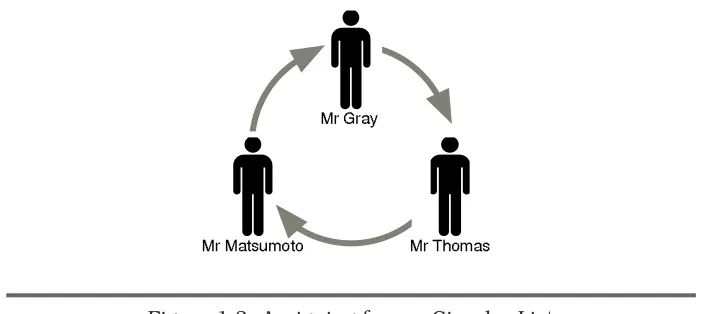
Mr. Gray
Mrs. Gray Mr. Thomas Mrs. Thomas
QUIZ19. SECRETSANTAS 47
We’ll keep things simple and say that people have only two names, so you don’t have to worry about tricky names like Gray II.
Your script must choose a Secret Santa for every name in the list. Play-ers cannot be assigned their own names or anyone else with the same family name.
Your script should output a list of player names. Alongside each name it will show another name—the person receiving that player’s gifts. Thus the following:
Mr. Thomas -> Mr. Gray
QUIZ 20. BARREL OFMONKEYS 48
Quiz
20
Answer on page203
Barrel of Monkeys
Posed by Gavin Kistner
Last week one of the local radio stations was having a “Barrel of Mon-keys” afternoon. While a song was playing, listeners would call in and suggest the next song, which had to begin with the same letter as the playing song ended in.
So, for example, a sample (eclectic) Barrel of Monkeys playlist might be as follows:
1. “Peace Train”
2. “No More ‘I Love You’s”’ 3. “Super Trooper”
4. “Rock Me, Amadeus” 5. “Song of the South” 6. “Hooked on a Feeling” 7. “Go Tell It on the Mountain”
See how each song name begins with the last letter of the name of the song before it?
Just creating any playlist would be too easy, however. We need a worthy problem to solve:
1. Given any starting and ending song, create a playlist that connects the two songs.
2. For extra credit, try to create a playlist of a specific duration (to fill a particular time slot on the radio).
QUIZ 20. BARREL OFMONKEYS 49
You can find an XML file with more than 5,000 song names and play times at http://rubyquiz.com/SongLibrary.xml.gz (100KB compressed). The song durations are in milliseconds.
Finally, because this problem may be enough fun without having to discover trouble yourself, I offer a few things to think about here:
• What do you do with songs with names like “’74-’75” or “Seventy Times 7” or “=:0 :(”?
• How about a song named “Candy Everybody Wants (unplugged)” or “Voulez-Vous [Extended Remix, 1979 US Promo]” or “Speed Racer - Hardcore Mix” or “Breathe Remix Feat Sean Paul”?
QUIZ21. AMAZINGMAZES 50
Quiz
21
Answer on page214
Amazing Mazes
Posed by Matthew Linnell
Why don’t we try our hand at mazes? We can define the two basic components of this problem as follows:
• Generating the maze • Solving the maze
Generating the Maze
The maze is to be rectangular in shape, with the height and width deter-mined at run time. Each node of the maze is a square area surrounded by walls on up to three sides.
All nodes of the maze must be reachable from any point. In other words, if one were to randomly pick a starting point and destination, the maze is always solvable. Furthermore, let us enforce that only one viable solution for the maze exists for any given starting point and destination (you cannot reach the same destination using two different routes).
Your first task is to generate ASCII output representing the maze. Fig-ure1.2, on the following page, shows a sample 10×10 maze.
Solving the Maze
QUIZ21. AMAZINGMAZES 51
+---+---+---+---+---+---+---+---+---+---+
| | | | |
+ +---+ +---+ + +---+---+ + +
| | | | | | |
+ + +---+ +---+---+---+ + + +
| | | | | |
+---+---+ + + +---+---+---+---+---+
| | |
+ +---+---+---+ +---+---+---+---+ +
| | | |
+ +---+ +---+---+---+ +---+---+ +
| | | | | | |
+---+ +---+ + + +---+ +---+ +
| | | | |
+ +---+ +---+---+---+ +---+---+---+
| | | | |
+---+ + + +---+ +---+---+ + +
| | | | | | | | |
+ + +---+---+ + + + + + +
| | | | |
+---+---+---+---+---+---+---+---+---+---+
Figure 1.2: Sample 10×10 maze
Bonus Points
Here are some bonus tasks:
1. Calculate which starting point and destination in the maze give you the longest possible path.
2. Calculate which starting point and destination give the most com-plicated path (involve the most turns).
Here is an example command-line execution:
QUIZ22. LEARNINGTIC-TAC-TOE 52
Quiz
22
Answer on page225
Learning Tic-Tac-Toe
This Ruby Quiz is to implement some AI for playing tic-tac-toe, with a catch: you’re not allowed to embed any knowledge of the game into your creation beyond making legal moves and recognizing that it has won or lost.
Your program is expected to “learn” from the games it plays, until it masters the game and can play flawlessly.
Tic-tac-toe is a very easy game played on a 3×3 board like this:
| |
---+---+---| |
---+---+---| |
Two players take turns filling a single open square with their symbol. The first person to play usesXs, and the other player usesOs. The first player to get a run of three symbols across, down, or diagonally wins. If the board fills without a run, the game is a draw. Here’s what a game won by theX player might end up looking like:
| | X
---+---+---| X ---+---+---|
---+---+---X | O | O
Submissions can have any interface but should be able to play against humans interactively. However, I also suggest making it easy to play against another AI player so you can “teach” the program faster.
QUIZ23. COUNTDOWN 53
Quiz
23
Answer on page239
Countdown
Posed by Brian Candler
One of the longest-running quiz shows on British television is called
Countdown. That show has a “numbers round.” Some cards are laid face down in front of the host. The top row contains large numbers (from the set 25, 50, 75, and 100), and the rest are small (1 to 10). Numbers are duplicated in the cards. Six cards are picked and dis-played: the choice is made by one of the contestants, who typically will ask for one large number and five small ones.
Next, a machine called Cecil picks a target number from 100 to 999 at random. The contestants then have 30 seconds to find a way of combining the source numbers using the normal arithmetic operators (+, -, *, and /) to make the target number or to get as close as possible.
Each source card can be used just once. The same applies to any intermediate results (although of course you don’t have to explicitly show the intermediate results).
For example, if the target number is 522 and the source cards are 100, 5, 5, 2, 6, and 8, a possible solution is as follows:
100 * 5 = 500
5 + 6 = 11
11 * 2 = 22
500 + 22 = 522
or more succinctly, (5 * 100) + ((5 + 6) * 2) = 522. Another solution is (100 + 6) * 5 - 8 = 522.
QUIZ23. COUNTDOWN 54
QUIZ24. SOLVINGTACTICS 55