The 4ndIndonesia Japan Joint Scientific Symposium 2010 Abstract—Two benzalacetones derivatives – i.e. 3-hydroxy-benzalacetone and 4-hydroxy-3-methoxy3-hydroxy-benzalacetone – have been synthesized and its antioxidant activity have also been tested. Synthesize were done through cross aldol condensation reaction under basic condition using ethanol as solvent. Re-crystallization using methanol was used to obtain pure material, which were yielding 50.62% of 3-hydroxy-benzalacetone and 52.38% of 4-hydroxy-3-methoxybenzalacetone. Resulting materials have been characterized by TLC, FTIR, and NMR spectrometer. The activity tested performed with Deoxyribose assay. 3-hydroxi-benzalacetone has higher antioxidant activity than 4-hydroxy-3-methoxybenzalacetone, which 3-hydroxy-benzalacetone more active inhibited 2-Deoxyribose degradation than 4-hydroxy-3-methoxybenzalacetone.
Keywords—antioxidant activity, benzalacetone, deoxyribose assay
I. INTRODUCTION
Currently, cancer is being one of the diseases that caused most human died in the world. Cancer is disease which relating to uncontrolled cell growth, including premature aging [1]. Premature aging is one of physiological functional reduction process that caused by oxidative damage of cellular organ especially mitochondria. Mitochondria oxidative damage could be a major trigger of aging mechanism on aerobic organism, because about 90% of cellular oxygen has been consumed by mitochondria and 3 % of oxygen molecules were reduced by mitochondria. Therefore, mitochondria could be most contributor of oxidative stress.
To overcome premature aging and body functional damage that caused by free radical oxidation, it needs antioxidant i.e. a substantive with ability to delay, prevent or omit the damage causing by oxidative reaction [2]. Antioxidant can also defined as substantive that in small amount can prevent oxidation of cellular organ with minimize damage effect of reactive oxygen species(ROS) and/or oxidative stress [3].
One of ROS important species which is a byproduct of normal cellular metabolism is hydroxyl radical. Cellular organ damage caused by hydroxyl radical or other species of ROS can be measured from malondialdehyde (MDA) levels [4]. Malondialdehyde is a compound that resulted from reaction of 2-deoxyribose with hydroxyl radical. Thus, antioxidant activity of a compound could be simulated using deoxyribose assay.
Natural compound that generally used as antioxidant is vitamin C, curcumine, β-caroten and tocoferol [5], which could trap free radical and ROS, Usually, antioxidant compound have active site that easily oxidized as phenolic compound. One of common synthetic antioxidant is benzalacetone derivatives [6]. It were reporting that benzalacetone has low antioxidant activity, whereas 4-methoxybenzalacetone and 3,4-dimethoxydibenzalacetone have antioxidant activity with IC50of 662.44 and 354.38 μg/ml. The result showed that substituent addition at benzene ring will influence the antioxidant activity of a compound.
This article will report synthesize of benzalacetone derivatives, one of phenolic compound that produced through cross aldol condensation reaction between acetone (1) and benzaldehyde derivatives i.e. 3-hydroxybenzaldehyde (2) and 4-hydroxy-3-methoxybenzaldehyde (3). The influence of substituent to antioxidant activity will measured by its ability to inhibit 2-deoxyribose degradation.
II. METHODOLOGY
General. All materials used from Merck, among other acetone, 3-hydroxybenzaldehyde, 4-hydroxy-3-methoxybenzaldehyde, ethanol, methanol, kloroform, hexane. The 1H, 13C-NMR, HMQC and HMBC Spectra were recorded on 500 MHz Jeol spectrophotometer. IR analysis were conducted using a Shimadzu 8300 FTIR spectrometer.
Synthesize of 3-hydroxybenzalacetone (4). Into a solution of sodium hydroxide (0.025 mol, 1 g) in aquades that was prepared at ice bath environment, acetone (0.01 mol, 0.58 g) and 3-hydroxybenzaldehyde (0.01 mol, 1.22 g) were added drop wise alternately. After additional stirring for 3 hours, 3 mL HCl 37% were added. The mixture was kept under 100C for 24 hours. Then, the mixture was filtered and followed by purification by recrystalization with ethanol-water as solvent. The yield was identified by thin layer chromatography, FTIR and NMR spectrophotometer.
Synthesize of 4-hydroxy-3-methoxybenzalacetone (5). Into a solution of sodium hydroxide (0.025 mol, 1 g) in 12,5 mL aquades, 4-hydroxy-3-methoxybenzaldehyde (0.005 mol, 0.76 g) and excess acetone were added dropwise. The mixture was stirred for 3 hours in icebath and followed by standing over 6 days under 100C. Ethanol-water solvent was used to purification of filtered
Synthesise and 2-Deoxyribose Degradation Inhibition of Two Benzalacetone
Derivatives
S. Handayani
1., S. Matsjeh
2., C. Anwar
2, S. Atun
1.
1Department of Chemistry Education, Yogyakarta State University 2
mixture. Then the yield was identified by TLC, FTIR and NMR spectrophotometer.
Deoxyribose assay.
The method was performed by modification of some deoxyribose assay [7,8,9] All solutions were freshly prepared. Into a solution of 0.2 ml 5 mM 2-deoxyribose was added 0.2 ml 5 mM ascorbic acid; 0.2 ml buffer phosphate (pH 7.2); 0.2 ml 0.5 mM H2O2; 0.2 ml 0.5 mM ferrosulphate and 0.2 ml of various concentration sample (62,5; 125, 250, 500 and 1000 µg/ml) followed by stirring for a few minutes. After an incubation period of 30 minutes at 370C, the reaction was stopped by adding 1 ml of TBA 1% and 1 ml of TCA 25% followed by heated at 1000C for 15 minutes. After the mixture is being cooled, absorbance of the red complex TBA-MDA solution’s was measured at 532 nm against a blank (only contain buffer and 2-deoxyribose). The inhibition percentage was calculated following the formula:
(%)
blank sample100%
blank
A
A
I
x
A
The IC50 value represents the concentration of the compound that caused 50% inhibition. BHT was used as a positive control.
III. RESULTS
A. Synthesis of compound 4 and 5.
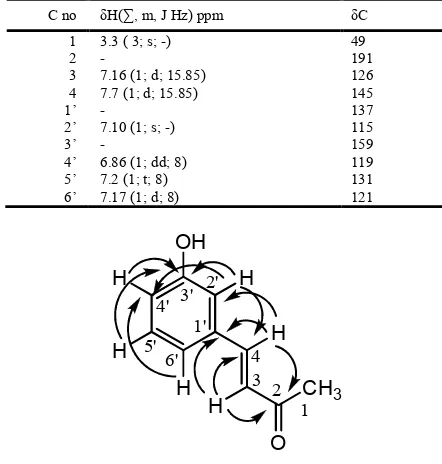
Improved synthesis of 3-hydroxybenzalacetone (4). The preparation of compound 4 was initiated by the mixing of acetone (1) and 3-hydroxybenzaldehyde (2) with sodium hydroxide as catalyst (Figure 1). After stirring for 3 hours followed by filtration, 50.62% (purity : 76.01%) yellow crystalline solid was obtained. The structure of 4 was determined by chromatographic and spectroscopic data. Rf=0.3 (TLC; methanol : chloroform=1:9); FTIR (KBr), NMR spectrometer datas and HMBC for compound 4 are given in Figure 1, TABLE 1 and Figure 2 respectively
Fig. 1. FTIR of 3-hydroxybenzalacetone (4)
TABLE I 1H AND 13C-NMR DATA OF COMPOUND
4(CD3OD)
C no δH(∑, m, J Hz) ppm δC
1 2 3 4 1’ 2’ 3’ 4’ 5’ 6’
3.3 ( 3; s; -)
-7.16 (1; d; 15.85) 7.7 (1; d; 15.85)
-7.10 (1; s; -)
-6.86 (1; dd; 8) 7.2 (1; t; 8) 7.17 (1; d; 8)
49 191 126 145 137 115 159 119 131 121
H
O
H CH3
H OH H
H H
1 2 3 4 1'
2' 3' 4' 5'
6'
Fig. 2. HMBC of 3-hydroxybenzalacetone (4)
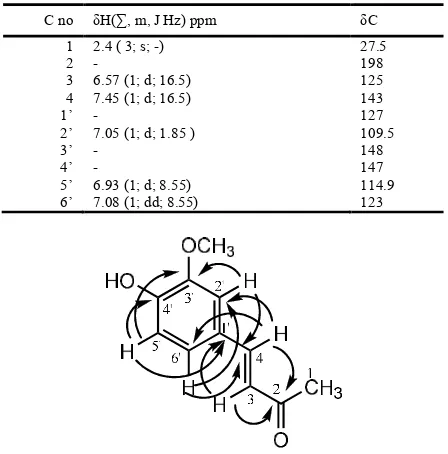
Improved synthesis of 4-hydroxy-3-methoxybenzalacetone (5). Into a solution of sodium hydroxide (0.025 mol, 1 g) in 12,5 mL aquades, 4-hydroxy-3-methoxybenzaldehyde (0.005 mol, 0.76 g) and excess acetone were added dropwise. The mixture was stirred for 3 hours in icebath and followed by standing over 6 days under 100C. After purification, 52.38% (purity :98.03%) a yellow crystalline was produced. Structure elucidation of compound 5was determined by chromatographic and spectroscopic datas. Rf=0.47 (TLC; methanol : chloroform=1:9); FTIR (KBr), NMR spectrometer datas and HMBC for compound 5are given in Figure 3, TABLE 2 and Figure 4 respectively
TABLE 2
1H AND 13C-NMR DATA OF COMPOUND 5(CD 3OD)
C no δH(∑, m, J Hz) ppm δC
1 2 3 4 1’ 2’ 3’ 4’ 5’ 6’
2.4 ( 3; s; -)
-6.57 (1; d; 16.5) 7.45 (1; d; 16.5)
-7.05 (1; d; 1.85 )
-6.93 (1; d; 8.55) 7.08 (1; dd; 8.55)
27.5 198 125 143 127 109.5 148 147 114.9 123
Fig 4. HMBC of 4-hydroxy-3-methoxybenzalacetone (5)
B. Activity test as 2-deoxyribose degradation inhibition of compound 4and 5.
The result of antioxidant activity test using deoxyriboe assay have been showed in Tabel 3.
TABLE 3
Antioxidant activity of compound4and 5
No of Compound IC50(μg/mL)
4 5
2290.28 10391
IV. DISCUSSION
Synthesize of 4 and 5 compounds have been done through cross aldol condensation reaction following the scheme as shown in Figure 5.
Fig 5. Scheme of cross aldol condensation to synthesized of compound 4
and 5
FTIR data of compound 4indicates the existence of OH (3410.15 cm-1), C=O (1620.21 cm-1), aromatic groups (3070.68 and 1581.53 cm-1) and CH (2931.80 and 2877.79 cm-1). From NMR data, 2 singlet peaks appear at 3.3 ppm and 7.10 ppm. The first singlet peak indicates methyl proton and the second singlet peak shows the existence of 1 aromatic proton that is not neighbor. Hα
dan Hβ showed by two doublet peak with J coupling of 15.85 Hz at 7.16 and 7.7 ppm. Another H NMR signal showed the existence of aromatic proton with J coupling of 8 Hz. The FTIR data completed by HMQC and HMBC data showed that compound 4 is 3-hidroxibenzalacetone.
Support spectra data for 5provided by the IR (KBr), which indicates the existence of C=O (1635.64 cm-1), aromatic groups (3001.24 and 1581.63 cm-1), OH stretching (3309.85), C-O-C (1126.43 and 1026.13 cm-1) and CH stretching (2947.23 and 2846.93 cm-1). The multiple bond correlation of HMBC supported the structure. In the 1H-NMR spectrum (500 MHz, CD3OD), appear 3 equivalent proton singlet that indicates methyl group at δ 2.4 ppm. Hα andHβ (H3 and H4) appeared at δ 6.57 and 7.45 ppm reinforced by J coupling data of 16.5 Hz. Aromatic proton, i.e. H2’, H5’ and H6’ appear at δ 7.05; 6.93 and 7.08 ppm. NMR data completed by HMBC and FTIR data proofed that compound 5 is 4-hidroxy-3-metoxybenzalacetone.
0 5 10 15 20 25
0 500 1000 1500
(ug/mL)
%
I
n
h
ib
it
io
n
Compound 5 Compound 4
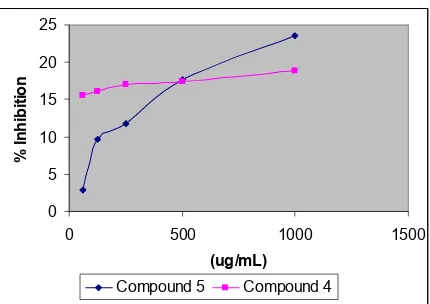
Fig 6. Graphic antioxidant activity of compound 4and 5
From the graphic in Fig 6 between % 2-deoxyribose degradation inhibiton and concentration (µg/mL), the IC50 value of compound 4 and 5 are 2290.28 and 10.391 µg/mL respectively. It could be concluded that compound 4 have low antioxidant activity, whereas compound 5have no antioxidant activity.
Relating to the theory, compound 5should be more active since it’s have methoxy group at benzene ring. The existence methoxy group at phenolic compound should improve antioxidant activity which measured by DPPH method because this method is more sensitive at small concentration so it will easier to detected [10]. Therefore, it’s necessary to test the antioxidant activity using other method as comparative data.
V. CONCLUSION
Synthesize of compound 4 and 5 could be done through cross aldol condensation reaction under basic condition. Compound 4 has been found more active in inhibiting 2-deoxyribose degradation than compound 5.
ACKNOWLEDGMENT
Our gratitude convey to LIPI instrument laboratory on the use of 500MHz NMR spectrometer for the structures elucidation.
REFERENCES
[1] R.W. Ruddon, Cancer Biology, Oxford University Press, 2007, pp. 94–96.
[2] B. Halliwell, Biochemistry of oxidative stress, Biochemical Society Transactions, Vol. 35, part 5, 2007, pp. 1147-1150 [3] K.I. Priyadarsini, Molecular mechanism involving free radical
reactions of antioxidant and radioprotectors, Founders’s Day Special Issue, pp. 1-6, 2005.
[4] H. Huang, and K.G. Manton, The role of antioxidative damage in mitochondria during aging : a review, Center for demographic studies, Duke University, Durham, pp.1100-1102.
[5] H. Itokawa, Q. Shi, T. Akiyama, S.L.M.Natschke and K.H. Lee, Recent advances in the investigation of curcuminoids, Chinese Medicine, 3 ;11, 2008.
[6] S. Handayani and I.S. Arty, Synthesis of Hydroxyl radical scavenger from benzalacetone and its derivatives, Journal of Physical Sciences, vol. 19, no. 2, pp. 61-68, 2008.
[7] T.C.G. Mattos, L.T. Dalvi, R.G. Oliveira, J.S. Ginani, and M.H. Lima, Reevaluation of the 2-deoxyribose assay for determination of free radical formation, Biochimica et Biophysica Acta, 1790, pp. 1636-1642, 2009.
[8] Halliwell, B., Gutteridge, J.M.C., Aruoma, O.I., et al., The Deoxyribose Method : a Simple Test-tube Assay for Determination of Rate Constants for Reaction of Hydroxyl Groups, Analytical Biochemistry,165, pp. 215-219, 1987 [9] R.M.P. Gutierrez, H.H. Luna and S.H. Garrido, Antioxidant
activity of tagetes erecta essential oil, J.Chil.Chem.Soc., vol. 51, no. 2, pp. 883-886, 2006