251 (2000) 103–115
www.elsevier.nl / locate / jembe
Chemical and physical defenses of Singapore gorgonians
(Octocorallia: Gorgonacea)
a ,* b a a
L.L. Koh. , N.K.C. Goh , L.M. Chou , Y.W. Tan
a
Department of Biological Sciences, National University of Singapore, 10 Kent Ridge Crescent, Singapore119260, Singapore
b
Centre for Natural Products Research, 59A Science Park Drive, The Fleming, Singapore Science Park, Singapore118240, Singapore
Received 3 November 1999; received in revised form 16 March 2000; accepted 28 March 2000
Abstract
Gorgonians are abundant in tropical waters and their polyps are seldom predated on. This study investigates how gorgonians defend themselves chemically and physically against fish predation. Gorgonian extracts and sclerites were incorporated into fish feed and tested on reef fishes. Laboratory bioassays using Greyhead wrasses, Halichoeres purpurescens, as well as field bioassays showed five gorgonian species from the family Ellisellidae and three from the family Plexauridae collected from Singapore reefs to be deterrent towards fishes. Bioassays of fractions obtained from subsequent fractionation suggested synergistic or additive effects between com-pounds present in gorgonians. Sclerites incorporated into fish feed in their natural concentrations were also tested for fish deterrence and were positive for only two gorgonian species from the family Ellisellidae. 2000 Elsevier Science B.V. All rights reserved.
Keywords: Chemical defense; Gorgonian; Physical defense; Predation
1. Introduction
Gorgonians are found from the polar seas to tropical equatorial oceans, although more species occur in tropical and sub-tropical waters (Alderslade, 1984). On Singapore reefs, most species of gorgonians occur abundantly at the lower reef slope and reef bottom at depths of 12–15 m (Goh et al., 1997). These depths are less exploited by their main competitors such as hard corals (Goh and Chou, 1994).
*Corresponding author. Tel.: 165-77-87-112; fax: 165-77-96-155. E-mail address: [email protected] (L.L. Koh.).
Unlike hard corals, gorgonians do not have the protection of an extensive calcium carbonate skeleton. Despite this, they appear to have only few predators (Pawlik et al., 1987). Pawlik (1993) correlated this lack of physical protection with high levels of secondary metabolites in their bodies. Secondary metabolites appear to be most common and important among tropical and benthic organisms that are subjected to high rates of attack by consumers (Paul, 1992; Pawlik, 1993; Bolser and Hay, 1996). Tropical benthic invertebrates have been hypothesized to need stronger defenses against consumers due to the perceived increase in consumer activity at lower latitudes (Bolser and Hay, 1996).
2
On tropical coral reefs, fishes may bite the bottom in excess of 150 000 times / m per day and either fishes or urchins alone are capable of removing almost 100% of daily productivity (Carpenter, 1986). Consumer pressure is one of the most important factors contributing to the wide array of secondary metabolites produced by tropical benthic organisms.
Several studies have indicated that chemical and physical defenses commonly co-occur in marine plants and can function either additively or synergistically to reduce susceptibility to consumers (Hay et al., 1994; Schupp and Paul, 1994). Assays conducted using artificial food with sclerites incorporated showed that sclerites reduced feeding in fishes by 95% (Van Alstyne and Paul, 1992). This indicates that structural defenses may play a role in determining an organism’s ability to deter predators. Some sclerites are made up of calcium carbonate. Calcium carbonate may serve as a structural, as well as a chemical deterrence (Hay et al., 1994; Schupp and Paul, 1994). Calcium carbonate would neutralize the low pH of some fish guts and the large amount of carbon dioxide released in the process could function as a chemical feeding deterrence (Hay et al., 1994). Schupp and Paul (1994) suggested using the term mineral defense to distinguish this chemical effect from that of calcium carbonate serving as a hardening agent.
This study examines two hypotheses: (1) chemical compounds from gorgonians offer a defense against fish predation; (2) sclerites from gorgonians play a role in defending the gorgonian colony against fish predation.
2. Materials and methods
2.1. Sample collection
Gorgonians used in this study were hand-collected from the reefs south of Singapore. They were immediately kept in ice for about 4 h and eventually stored in a lab freezer at
2208C. The gorgonians collected were from two families: from the family Ellisellidae,
Junceella (Junceella) sp. A (white morph), Junceella (Dichotella) cf gemmacea (white
morph), Ctenocella pectinata (white morph), Ctenocella pectinata (red morph) and
Ctenocella (Umbracella) sp. A; from the family Plexauridae, Euplexaura cf pinnata, Echinogorgia sp. A and Echinogorgia sp. C.
2.2. Extraction and fractionation
immersed in a known volume of solvent (mixture of dichloromethane (DCM) and methanol 1:1) and left overnight. The volume of gorgonians used was calculated by simple displacement. This solvent extraction was repeated two times with fresh solvent. The solvent from the two extractions were combined and evaporated to yield the crude extract. The resulting crude extract was further partitioned using an equal mixture of DCM and distilled water. The DCM extract and aqueous extract thus obtained were separately incorporated into artificial feed and assayed.
Deterrent DCM extracts were further fractionated using vacuum flash chromatography employing a 3–40% iso-propanol in DCM gradient. The same was done for deterrent aqueous extracts, but with iso-propanol substituted by acetone. The fractions obtained were subjected to thin-layer chromatography. Fractions which showed identical profiles were combined and considered to be one fraction. Each fraction was then incorporated into artificial feed and assayed.
2.3. Sclerite preparation
Three colonies of each gorgonian species were used. Each colony was cut into small pieces. The volume of each colony used was obtained by displacement. The cut pieces were then completely immersed in commercial bleach (sodium hypochlorite) for about an hour until the coenenchyme completely detached from the axis. The axis was then removed. The sclerites were rinsed three times with distilled water to remove any traces of sodium hypochlorite and once in methylated spirit to facilitate drying. The sclerites were then dried under a table lamp for another 10 h. The dry weight of the sclerites for each colony was recorded.
Sclerite concentration of each portion was calculated as dry weight of sclerites divided by the volume of the colony. The mean sclerite concentration of each species was obtained by calculating an average of the sclerite concentration of the three colonies.
Sclerites were observed using scanning electron microscopy (SEM). The types, amount and sizes of sclerites in each field of view were noted. The amount of each type of sclerites was expressed as a percentage. The percentage of each type of sclerites was obtained by dividing the total number of each type of sclerites in three fields of view with the total number of all sclerites present in the three fields, then multiplied by 100. The size of each type of sclerites was measured using an ocular eyepiece scale in the microscope. Nomenclature of sclerites followed that of Bayer (1956) and Bayer et al. (1983). An inter-species comparison between percentages and sizes of sclerites was made.
2.4. Formulation of feed pellets
squeezed into a calcium chloride solution for it to harden into ‘noodles’. The ‘noodles’ were cut into 3-mm long pellets. Control pellets were made without the addition of extracts / fractions.
For studies on the sclerites, feed pellets were prepared using the same method as mentioned above. Sclerites were incorporated into the feed in their natural concentration. Natural concentration was calculated by dividing the dry weight of sclerites by the volume of the colony.
2.5. Laboratory and field bioassays
Ten male Greyhead wrasses, Halichoeres purpurescens, caught from Singapore reefs using hand-nets were maintained individually in opaque tanks with filtered seawater. Commercial fish flakes were given between bioassays to prevent the effect of food deprivation on feeding behaviour (Cronin and Hay, 1996). For each gorgonian species, bioassays were conducted by first dropping a control pellet followed by a treatment pellet. If the treatment pellet was rejected, another control pellet was offered to the wrasse to make sure that it had not reject the treatment pellet due to satiation. This was repeated for all the ten wrasses to obtain one set of ten replicates. Pellets were considered rejected if spat out at least twice, or ignored by more than two fishes, whether or not they were subsequently consumed. Three more sets of bioassays were conducted to confirm the results.
Control and treatment pellets for field bioassays were prepared as for the laboratory bioassays. A suitable site with good visibility and high fish population was chosen. Some prawns were mashed up and released to attract fishes to congregate before starting the bioassay. Pellets were then released one by one alternately and observations were made on whether fishes rejected or accepted the pellets. The criteria used for scoring the rejection or acceptance of pellets is the same as that used for laboratory bioassays. Species of fish which ate the pellets were also noted. Each set of bioassay comprises of 10 control and 10 treatment pellets. To confirm the results, three more sets of bioassays were conducted at different sites some distance away from one another.
At the end of each field and laboratory bioassay, unused treatment pellets (with extracts) were collected and extracted with DCM and each extract was compared against the crude extract using thin-layer chromatography. This was to check if compounds present in the extracts were still present in the pellets (i.e., if there was degradation or leaching).
2.6. Analysis of results
The Fisher one-tailed exact test (P,0.05) (Zar, 1996) was used to analyze the results
3. Results
3.1. Laboratory and field bioassays for crude extract and control pellets
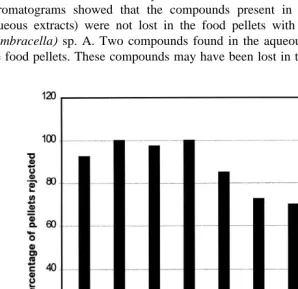
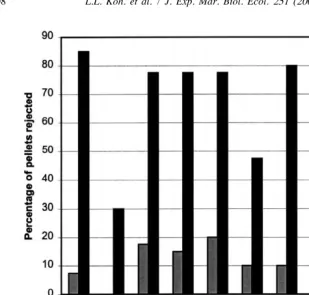
Results of laboratory bioassays of crude extracts from the eight species of gorgonians (Fig. 1) showed all to be deterrent. Control pellets were seldom rejected, with a maximum of two pellets per bioassay rejected. Complete rejection of treatment pellets occurred for Junceella (Dichotella) cf gemmacea and Ctenocella pectinata (red morph). Field bioassays of the crude extract pellets (Fig. 2) showed all eight species to be deterrent except for Echinogorgia sp. C. A thin-layer chromatogram of food pellets incorporated with crude extracts was compared against their respective DCM and aqueous extracts (since the crude extracts had already been partitioned and the combination of DCM and aqueous extracts is essentially the crude extract). The
chromatograms showed that the compounds present in the crude extracts (DCM1
aqueous extracts) were not lost in the food pellets with the exception of Ctenocella (Umbracella) sp. A. Two compounds found in the aqueous fraction were not found in the food pellets. These compounds may have been lost in the pellet preparation process.
Fig. 2. Percentage of crude extract and control pellets rejected in field palatability bioassays.
However, the crude extract of this species was still deterrent towards fishes, making it unlikely the two missing compounds were the ones responsible for the deterrent activity.
3.2. Laboratory bioassays for dichloromethane and aqueous extracts pellets
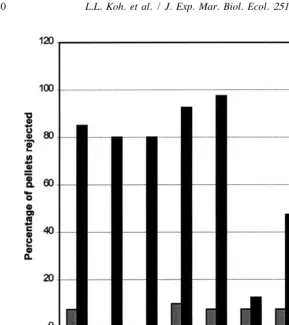
Since crude extracts of all eight species were deterrent, these were partitioned into dichloromethane (DCM) and aqueous fractions. The DCM and aqueous fractions were bioassayed separately in the laboratory. Except for Ctenocella pectinata (white morph), aqueous extracts of all the other seven species were deterrent towards fishes (Fig. 3). Since the Ctenocella pectinata (white morph) crude extract was deterrent, this suggests that compounds causing deterrence in the crude extract of Ctenocella pectinata (white morph) was isolated in the DCM extract. All dichloromethane extracts were also deterrent except for Euplexaura cf pinnata (Fig. 4). For this species, the aqueous fraction was responsible for the deterrent activity shown. With the exception of
Ctenocella pectinata (white morph) and Euplexaura cf pinnata, no significant difference in feeding deterrence was found between the aqueous and DCM extracts for the species
tested (single-factor ANOVA; P,0.05). The statistical approach used to test for
Fig. 3. Percentage of aqueous and control pellets rejected in laboratory palatability bioassays.
determine if the deterrent effect of the crude extract was greater than the effect of either
the aqueous extract or DCM extract alone (Mann–Whitney test; P,0.05). In most cases
the deterrent effect of either the aqueous or DCM extract alone was as great as the deterrent effect of the crude extract. This indicates that no further analysis for synergistic or additive effects was needed.
3.3. Field bioassays for fractions obtained from further partitioning of the DCM and
aqueous extracts
Only deterrent DCM and aqueous extracts from the family Ellisellidae were subjected to further partitioning. All fractions obtained from the partitioning of aqueous extracts were not deterrent. Fractions of each species were then combined and tested again. These combined fractions were also not deterrent towards fishes although the original aqueous extracts were.
Only one fraction from the DCM extract of Junceella sp. A, and Ctenocella pectinata (red morph) shows deterrent activity. Three fractions from the DCM extract of
Fig. 4. Percentage of DCM extract and control pellets rejected in laboratory palatability bioassays.
A were deterrent. In all the these dichloromethane extracts, deterrent activity was isolated in at least one of the fractions. From the chromatograms, it was possible to narrow down to a few compounds causing the activity. However, this was not the case for the fractions from the DCM extract of Junceella (Dichotella) cf gemmacea (beige morph). None of the fractions from the DCM extract of Junceella (Dichotella) cf
gemmacea tested were deterrent towards fishes. The combined fraction was also not
deterrent towards the fishes.
3.4. Sclerites analysis
The mean concentration of sclerites (Table 1) ranged from a minimum value of 0.190
3 3
Table 1
Mean sclerite concentration of eight species of gorgonians
Species Mean conc.
(g / cc) Junceella sp. A (white morph) 0.215 J. cf gemmacea (beige morph) 0.474 C. pectinata (white morph) 0.283 C. pectinata (red morph) 0.458 Ctenocella (Umbracella) sp. A 0.504 Euplexaura cf pinnata 0.493 Echinogorgia sp. A 0.190 Echinogorgia sp. C 0.466
3.5. Field bioassays for pellets with sclerites
Deterrence in feeding was found in treatment pellets containing sclerites from C.
pectinata (red morph), J. cf gemmacea (red morph) and Echinogorgia sp. A (Table 3). Sclerites from all other species did not significantly deter feeding.
4. Discussion
Feed pellets were used in the field instead of the common practice of using food strips
Table 2
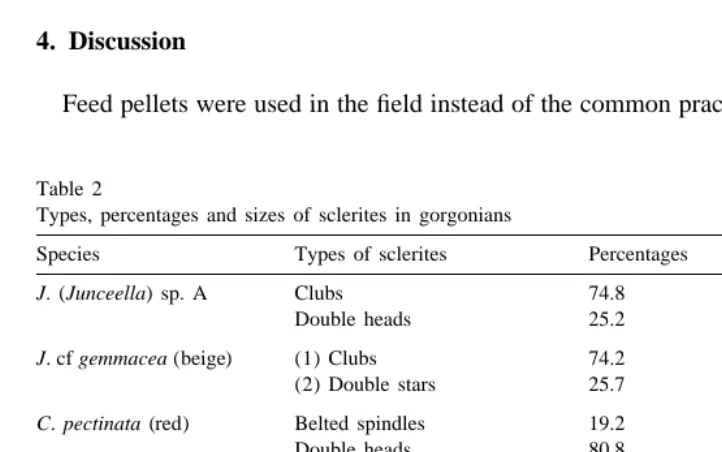
Types, percentages and sizes of sclerites in gorgonians
Species Types of sclerites Percentages Sizes (mm)
J. (Junceella) sp. A Clubs 74.8 0.06–0.08
Double heads 25.2 0.07–0.09
J. cf gemmacea (beige) (1) Clubs 74.2 0.06–0.08
(2) Double stars 25.7 0.07–0.09
C. pectinata (red) Belted spindles 19.2 0.08–0.11
Double heads 80.8 0.05–0.07
C. pectinata (white) (1) Belted spindles 14.9 0.06–0.08
(2) Double heads 85.1 0.06–0.08
C. (Umbracella) sp. A Same as C. pectinata (red)
Euplexaura cf pinnata (1) Coarse ovoids which 90.8 0.13–0.23 resemble stout double
heads
(2) Belted rod-like sclerites 9.2 0.14–0.18 Echinogorgia sp. A (1) Leafy clubs 93.3 0.27–0.30 (2) Belted spindles 6.7 0.25–0.45 Echinogorgia sp. C (1) Leafy clubs 82.0 0.25–0.55
Table 3
Results of field bioassays conducted on pellets incorporated with sclerites obtained from the eight species of gorgonians
Species Sclerites
Junceella sp. A (white morph) 0 Junceella cf gemmacea (beige morph) 0 Ctenocella pectinata (red morph) *
* Treatment pellets were rejected significantly more than control pellets (Fisher-Exact, P,0.05).
(Van Alstyne and Paul, 1992; Chanas and Pawlik, 1995) as it allowed a more accurate scoring of whether a fish eats and swallows a pellet, or eats and spits it out. In the food strips method, the number of bites per area eaten is calculated but this does not account for those spat out.
In the laboratory bioassays, Greyhead wrasses, Halichoeres purpurescens, were chosen as the bioassay subjects and only male wrasses were used to prevent any variation between replicates due to sexual differences. These wrasses were chosen due to their relative abundance in Singapore waters and also because gorgonians are an accessible potential food source for them. In addition, H. purpurescens is a generalist feeder making it appropriate for the objective of this experiment, which is to determine if gorgonian extracts deter predation by fish under natural conditions. A specialist gorgonian predator would have been inappropriate since it might have developed a co-evolved resistance to the extracts. Specialist predators tend to be less susceptible to the effects of chemical and structural defense produced by their prey (Van Alstyne and Paul, 1992).
Field bioassays were necessary to draw ecological inferences from the results. Laboratory conditions cannot simulate nature and it is expected that results of laboratory and field bioassays may not be in complete agreement. For instance, fishes in the field were not deterred by the crude extract of Echinogorgia sp. C while those in the laboratory were. In the laboratory, the pellets were eaten only by wrasses, but in the field, it was noted that a significant proportion of the pellets was eaten by the damselfish
Pomacentrus littoralis and P. cuneatus. Damselfish are noted to be more aggressive and eat most of the pellets (pers. obs.). They are also less discriminating when encountering food, possibly explaining why fewer treatment pellets were rejected. Fishes in the wild might be more opportunistic than those kept in the laboratory because food is scarce and competition intense. They are less likely to discriminate between control and treatment pellets. A higher dosage might show deterrent activity but this would be of no ecological relevance to this experiment. In contrast, fishes in the laboratory are fed regularly. With the abundance of food, they could afford to reject pellets which are marginally distasteful.
concentrations. This may explain why a potential source of food like gorgonians is rarely eaten (Gerhart, 1984; Pawlik et al., 1987; Harvell et al., 1988; Pawlik and Fenical, 1992).
In the second part of the experiment, only deterrent aqueous and dichloromethane extracts from the family Ellisellidae were further partitioned. All fractions from the further partitioning of the DCM extract of J. (Dichotella) cf gemmacea (beige morph) were not deterrent towards fishes. The combined fraction was also not deterrent. The combined fraction in this case refers to the fraction obtained by putting together all the fractions obtained by further partitioning. A thin-layer chromatogram done to compare the original DCM extract with the combined fraction and the combined fraction extracted from the pellet showed that several compounds were lost after incorporation into artificial feed. Hay and Fenical (1988) explained that handling of the organism before and during extraction may result in compound degradation if the compounds are unstable. In addition, most isolation and purification techniques frequently result in the loss of significant quantities of metabolites. McKey (1979) suggested that slight changes in structure of related chemicals may produce compounds with different physiological properties. This may be another explanation for the loss of activity. The same phenomenon was also noticed for fractions from the aqueous extracts of J. (Junceella) sp. A, J. (Dichotella) cf gemmacea (beige morph), C. pectinata (red morph), C. (Umbracella) sp. A. Thin-layer chromatograms also showed the loss of compounds from the extract after incorporation into artificial feed. It is highly possible that these compounds were lost through leaching into the water, since they were aqueous in nature. An interesting observation was made on the two fractions from the DCM extract of C.
pectinata (red morph). These two fractions were obtained using 10% ISP/ DCM and 12%
ISP/ DCM, respectively. When the two fractions were combined, they deterred fishes, However, when this combined fraction was further partitioned using 8, 10 and 12% ISP/ DCM, none of the resulting partitions was deterrent. To ensure that the deterrent activity which was in the original two fractions was not lost, the three partitions were combined together and tested again. Results showed reduced feeding by 70%. These observations indicate that synergistic or additive effects may exist between the compounds. Synergism is defined as ‘‘the joint action of different substances in producing an effect greater than sum of all the substances acting separately’’ (Funk and Wagnalls, 1968). Some substances show no activity on their own, but when combined with others, the combination shows activity. An example is the aqueous extracts of gorgonian species from the family Ellisellidae. The individual fractions were all not deterrent, but when combined (which forms essentially the aqueous extracts), became deterrent. However, further tests were not carried out to determine if this was a case of synergism or additivism.
damselfish in addition to their innate aggressiveness (discussed earlier) could have resulted in data which might differ slightly from results obtained if the bioassay had been conducted earlier. It should not, however, be dismissed as inaccurate data, since bioassays took place under natural ecological conditions.
Sclerites from C. pectinata (red morph) and C. (Umbracella) sp. A when incorporated into pellets significantly deterred feeding, whilst sclerites from other species of gorgonians did not. C. pectinata (red morph) and C. (Umbracella) sp. A have mean
3
sclerite concentrations of 0.458 and 0.504 g / cm , respectively. Gorgonians from the genus Ctenocella also have high percentages of double-head shaped sclerites (80.8– 85.1%). In this case, sclerites of this shape appear to be very effective as a physical defense against fish predation. However, predator deterrence may be due to the combined effect of sclerite shape and a high concentration. This was illustrated by C.
pectinata (white morph) which has the same shape of sclerites as C. pectinata (red morph) and C. (Umbracella) sp. A and in similar percentages. The only difference among the three species is that C. pectinata (white morph) has a significantly lower mean concentration of sclerites than the other two species. This may be the reason why
C. pectinata (white morph) is not deterrent towards fishes. Results of this study suggest
that inter-species variation in the shape and concentration of sclerites do affect fish feeding. However, observed reduction in feeding might not be just due to concentration and morphology of sclerites alone. It might also be due to reduction in food quality, since treatment pellets containing sclerites were likely to be of a lower nutritional quality than control pellets (Duffy and Paul, 1992).
Generally, the species in this study which lack physical protection were protected chemically, except for Echinogorgia sp. C. The field bioassays of Echinogorgia sp. C showed that its extract was not deterrent towards fishes and its sclerites were also not deterrent in laboratory bioassays. Perhaps, if the extract and sclerites were to be combined, fish deterrence will be observed. In this case, other properties of the gorgonian may also play a role in predator defense. For example, low nutritional quality may make this species of gorgonian not a natural choice of food for fishes. It is shown in this study that predator deterrence is a complex interaction between the chemical compounds, sclerites and possibly nutritional quality of the gorgonian and cannot be easily predicted on the basis of any of these factors alone.
Acknowledgements
We would like to thank the Reef Ecology Study Team for assisting in field work. This work was supported by research grant RP960303 /A from the National University of Singapore Academic Research Fund. [RW]
References
Bayer, F.M., 1956. Octocorallia (with section on Trachypsammiacea by E. Montanaro-Gallitelli). In: Moore, R.C. (Ed.), Treatise on Invertebrate Paleontology. Geological Society of America and University of Kansas Press, pp. F167–F231.
Bayer, F.M., Grasshoff, M., Verseveldt, J., 1983. In: Illustrated trilingual glossary of morphological and anatomical terms applied to Octocorallia. E.J. Brill / Dr. W. Backhuys, Leiden, p. 75pp.
Bolser, R.C., Hay, M.E., 1996. Are tropical plants better defended? Palatability and defenses of temperate vs. tropical seaweeds. Ecology 77 (8), 2269–2286.
Carpenter, R.C., 1986. Partitioning herbivory and its effects on coral reef algal communities. Ecol. Monogr. 56, 345–365.
Chanas, B., Pawlik, J.R., 1995. Defenses of Caribbean sponges against predatory reef fish. II. Spicules, tissue toughness, and nutritional quality. Mar. Ecol. Prog. Ser. 127, 195–211.
Cronin, G., Hay, M.E., 1996. Susceptibility to herbivores depend on recent history of both the plant and animal. Ecology 77, 1531–1543.
Duffy, J.E., Paul, V.J., 1992. Prey nutritional quality and the effectiveness of chemical defenses against tropical reef fishes. Oecologia 90, 333–339.
Funk, Wagnalls, 1968. In: Standard College Dictionary, Text Edition. Harcourt Brace and World, New York. Gerhart, D.J., 1984. Prostaglandin A : an agent of chemical defense in the Caribbean gorgonian Plexaura2
homomalla. Mar. Ecol. Prog. Ser. 19, 181–187.
Goh, N.K.C., Chou, L.M., 1994. Distribution and biodiversity of Singapore gorgonians (sub-class Oc-tocorallia)—a preliminary survey. Hydrobiologia 285, 101–109.
Goh, N.K.C., Loo, M.G.K., Chou, L.M., 1997. An analysis of gorgonian (Anthozoa; Octocorallia) zonation on Singapore reefs with respect to depth. Environ. Monit. Assess. 44, 81–89.
Harvell, C.D., Fenical, W., Greene, C.H., 1988. Chemical and structural defenses of Caribbean gorgonians (Pseudoterogorgia spp.). I. Development of an in situ feeding assay. Mar. Ecol. Prog. Ser. 49, 287–294. Hay, M.E., Fenical, W., 1988. Marine plant–herbivore interactions: the ecology of chemical defense. Annu.
Rev. Ecol. Syst. 19, 111–145.
Hay, M.E., Kappel, Q.E., Fenical, W., 1994. Synergisms in plant defenses against herbivores: interactions of chemistry, calcification, and plant quality. Ecology 75, 1714–1726.
Leng, C.B., 1990. Population dynamics of the pomacentrid community on selected reef systems in Singapore. Unpublished B.Sc. (Hons.) thesis, Department of Zoology, National University of Singapore, 60 pp. McKey, D., 1979. The distribution of secondary compounds within plants. In: Rosenthal, G.A., Janzen, D.H.
(Eds.), Herbivores: Their Interaction with Secondary Plant Metabolites. Academic Press, New York, pp. 56–122.
Paul, V.J., 1992. Chemical defenses of benthic marine invertebrates. In: Paul, V.J. (Ed.), Ecological Roles of Marine Natural Products. Cornstock and Publishing Associates, London, pp. 164–188.
Pawlik, J.R., 1993. Marine invertebrate chemical defense. Chem. Rev. 93 (5), 1911–1922.
Pawlik, J.R., Fenical, W., 1992. Chemical defense of Pterogorgia anceps, a Caribbean gorgonian coral. Mar. Ecol. Prog. Ser. 87, 183–188.
Pawlik, J.R., Burch, M.T., Fenical, W., 1987. Patterns of chemical defense among Caribbean gorgonian corals: preliminary survey. J. Exp. Mar. Biol. Ecol. 108, 55–66.
Schupp, P.J., Paul, V.J., 1994. Calcification and secondary metabolites in tropical seaweeds: variable effects on herbivorous fishes. Ecology 75, 1172–1185.
Van Alstyne, K.L., Paul, V.J., 1992. Chemical and structural defenses in the sea fan Gorgonia ventalina: effects against generalist and specialist predators. Coral Reefs 11, 155–159.