*Correspondence address: MaKlardalens hoKgskola, Depart-ment of Business Studies and Informatics, P.O. Box 325, SE-63105 Eskilstuna, Sweden.
Investments and investment processes in professional
service groups
Esbjo
K
rn Segelod
*
Ma(lardalens ho(gskola, Department of Business Studies and Informatics, P.O. Box 325, SE-631 05 Eskilstuna, Sweden Received 26 April 1999; accepted 12 November 1999
Abstract
This article describes and analyses the size and character of investments, the investment criteria, and the investment
processes in some professional service groups. The focus is on means of control used by the corporate level to in#uence
the volume and direction of investments in groups of companies. Comparisons are made with standardized service and manufacturing groups. Professional service groups are of special interest because theirs is a growth industry; moreover many manufacturing groups have become more knowledge-intensive, and have adopted project-based structures similar to those found in professional service groups. The article shows that professional service groups invest just as heavily as
do manufacturing"rms, but concentrate their investments on training and the development of new knowledge. The
principles of investment planning and control are the same as in manufacturing groups, but the means and the weight
attached to them di!er. Investment requests are initiated on the business unit level and major investment requests are
channelled through the executive team system for approval. However, there is no system of de"ning, requesting and
reviewing intangible investments. Rather, review is by projects and units. The focus is on market and social, not
administrative, means of control. ( 2000 Elsevier Science B.V. All rights reserved.
Keywords: Capital budgeting; Investment; Management accounting; Management control; Professional service groups; Planning and
control processes
1. Introduction
Many professional service "rms invest just as heavily as do manufacturing"rms. The di!erence is that professional service "rms invest chie#y in training and the development of new competence, and manufacturing "rms mainly in machines and production equipment. Nevertheless, research on investments has focused primarily on industrial companies and tangible investments. This research
has given us a good picture of investment criteria and investment processes in industrial groups. How service groups allocate resources to their types of investments, in particular how professional service groups such as major consulting groups so do, is still something of a desert in the cognitive land-scape of investment research.
Professional service"rms are of special interest. They have large intangible investments, and account for an increasing proportion of total em-ployment, at the same as time many traditional manufacturing "rms have become more know-ledge-intensive. In recent decades traditional indus-try has come to invest less in buildings and
conventional machinery and equipment, and more in R&D, training, marketing, software, and com-puterized machinery and equipment. Perhaps, part-ly as a consequence of that knowledge-intensive
"rms now devote less attention to formal capital budgeting routines. They have moved away from hierarchical control towards operating as a net-work of small companies, and as in consulting"rms many of the activities are organized as projects [1}5]. Because of these changes it is"tting to con-trast investment processes in the professional ser-vice industry with those of its counterpart, the traditional manufacturing industry.
The purpose of this paper is to describe and analyse the size and character of investments, the investment criteria, and the investment processes in some major service groups. The focus will be on the corporate level use of administrative means of con-trol to in#uence the volume and direction of invest-ments in some major professional service groups, i.e. we shall focus on resource allocation procedures within groups of companies, not resource alloca-tion within individual companies in a group. In addition, comparisons will be made with tradi-tional manufacturing groups. We shall start by describing the investments, and the investment cri-teria used. Then follows an account of the planning and control processes, and the di!erences between professional service and manufacturing groups. The paper begins, however, with some comments on earlier research on investment processes and how the empirical data were collected and analysed.
2. Earlier empirical research on the control of investments
There is a long tradition of research on invest-ments and the formal administrative procedures for investments, but the focus has exclusively been on the manufacturing industry. Reviews of research on service management include no [6] or few refer-ences to management accounting [7], and re-searchers on management accounting in service companies [e.g. 8}10] have in the main studied standardized services and ignored the resource allocation issue. Perhaps Sveiby and Lloyd [11,
p. 56] are right to claim that`the accounting sys-tem of the knowhow company is very simple*too simple to have become the subject of much re-searcha.
Thus, a review of the literature which may be pertinent indicates that there are few studies of service groups, but a great deal of research on various aspects of investments which may be of relevance also to service groups. Starting with the
"rst element*to describe and analyse the size and character of investments*yearly surveys by Stat-istics Sweden [12] show that Swedish industry invests about one-third each in market, R&D, and tangible investments, and that the composition of investments varies widely from industry to indus-try. Eliasson [13] estimates that 10% of the total labour cost goes to knowledge creation in large Swedish"rms, and another 3% to internal know-ledge di!usion. Both studies focus on manufactur-ing "rms, but professional service "rms may be expected to invest to the same extent in the creation of new knowledge.
Turning to the second element, there are many studies of investment criteria in major manufactur-ing corporations. These studies almost invariably examine the extent to which companies use the planning and project evaluation techniques pre-scribed by the textbooks, and it is often implicitly assumed that sophisticated evaluation techniques are better. Most of these investigations are based on postal surveys, some on interviews or case stud-ies. For a bibliography see [14}16]. The over-whelming majority of the literature on capital budgeting criteria describes conditions in manufac-turing companies, but there are exceptions, e.g. Farragher's [17] survey of project evaluation tech-niques in the service industry, and Collier and Gregory's [18] case studies of capital budgeting in some hotel groups. Furthermore, Neale's [19] sur-vey of post-audit practice in the service industry, and Morgan and Tang's [20] case studies of the same issue.
such as the discounted cash #ow technique came into general use only in the 1950}1970s when major companies developed a divisionalized structure and decentralized investment decisions [21,22]. The techniques were initially devised for tangible invest-ments. As the proportion of intangible investments has increased companies have made various at-tempts to use the same techniques to control these [23]. The de"nition has been extended to include the costs inherent in the implementation of the investments which are expensed as they accrue, and companies with signi"cant R&D expenditures have developed special formal routines for investments in R&D. Others have stipulated to little avail that all investments should be treated in the same way as tangible investments. The formal routines which exist in manufacturing companies are, despite all e!orts, still mainly used for machinery and produc-tion equipment.
Finally, we were also interested in the investment processes in major service groups; where invest-ment decisions are made, and which are the levers whereby corporate managers can in#uence the vol-ume and direction of investments?
Let us take Bower's [24] model of the resource allocation process in divisionalized groups as our starting point since it constitutes a landmark in empirical research on investment processes. Invest-ments were initiated by engineers at the business level, screened by middle managers, and if large enough, approved by corporate managers. Corpo-rate managers could in#uence the direction of in-vestments by changing the rules of the capital budgeting game. Capital budgeting was a bottom-up process in a hierarchical administrative system. Bower's approach has been re"ned by Burgel-man [25], Goold and Campbell [26], and Simons [27,28]. Burgelman shows how Bower's original model can be extended to describe also internal venture processes by adding on a process of stra-tegic context determination. Goold and Campbell examined the role of the head o$ce in major groups. They found that the head o$ce tends to become more involved in investment planning when the company's investments are large and discrete, the payback period is long, and invest-ments in di!erent divisions need to be co-ordina-ted. Successful groups which are more "nancially
controlled tend to make mainly small, short-term investments, and their need to co-ordinate divisions and businesses is usually limited. Simons has supplemented this picture by showing that the capi-tal budgeting system is only one of several levers which top management can use to e!ect strategic change. Top management can achieve strategic change also by focusing on other parts of the administrative system and making the system interactive.
The di!erences identi"ed by Goold and Campbell are also re#ected in the formal resource allocation systems of major groups [29]. Groups with mainly small, short-term investments have very simple, written, capital budgeting routines. Thus companies with large investments and a great need to co-ordinate investments * i.e. an invest-ment in one division often generates changes and investments in others*are more centralized with respect to capital budgeting decisions and rely more on face-to-face communication. This distinc-tion between"nancially and strategically oriented
"rms is also re#ected in the choice of capital budgeting criteria [30]. Ross distinguishes between capital rationing "rms, which ration capital to small investments using short payback require-ments, and#exible budgeting"rms which use such requirements with greater#exibility.
Bower writes that strategies are developed in the business planning process, but are concerned only with the capital budgeting process. This simpli"es his model but is not realistic as decisions on stra-tegic investments, such as investments in new prod-ucts, markets, and technologies, in general are made already in the business planning process. Indeed it is di$cult to delimit the resource alloca-tion process at all since it relies on informaalloca-tion from, and overlaps many of, the other more easily de"ned systems such as product costing, marketing and strategic planning. Therefore, in order to understand the way service groups allocate re-sources to investments we must widen our per-spective and search for processes outside the traditional capital budgeting system which may be used to in#uence resource allocation decisions.
capital budgeting process. These centrally deter-mined rules and routines are a part of a much larger system of administrative, or bureaucratic, control measures which rest on formal authority, rules, procedures, and record keeping. Administrative control presupposes that the work process is set and can be planned [31,32], and is an important means of control in both traditional manufactur-ing, and standardized service "rms, especially in large long-established"rms [2].
We shall distinguish between professional ser-vice, and standardized service. Standardized service
"rms, e.g. fast food"rms, exercise control through the centrally determined standardization of prod-ucts, and the employees' knowledge, skills, and work processes. Consulting "rms are good exam-ples of professional service"rms [34,35]. Standard-ization is not possible for a consulting"rm which solves novel problems for clients. As the work can-not be speci"ed in advance and the output cannot be measured, other means of control are necessary [31,32]. There are various models for how a con-sulting"rm operates, such as Ouchi's [31,35] clan, Mintzberg's [1,2] operational adhocracy, Mills et al.'s [36]#exiform, and Alvesson's [37,38] consult-ing"rm which is controlled through a strong cor-porate culture, i.e. various social-integrative means of control such as symbols and gatherings to pro-mote solidarity. In all these models the employees are indoctrinated with certain shared aims, norms, values and beliefs about the organization and how the work should be performed. Once they have accepted these norms they will arrive, unsuper-vised, at predictable solutions of the tasks assigned to them. However, the fact that shared norms are the principal means of control in certain situations does not mean that administrative control does not exist, only that it is of minor importance [2,31,39]. Thus we cannot exclude the possibility that profes-sional service groups possess formal capital budget-ing systems, but we can expect these to be less important for the resource allocation than in stand-ardized service and manufacturing groups.
Observe also that the compliance with the norms of a"rm must not be confused with the collegial, or professional, control. Professional control [40}42] ensues from the adaptation to the norms of certain exclusive professions with long training such as
physicians, various types of engineers, and aca-demic researchers. Socialization into such groups is company-external and in#uences work-related norms independent of the organization in which the person works.
3. Research method
There are few studies of management accounting in professional service groups, and to the know-ledge of the author, none which speci"cally describe the resource allocation process in such"rms. This makes it di$cult to formulate relevant questions for a postal survey, and also to know to what extent conclusions from a case study of one group are representative of professional service groups in gen-eral. Therefore, it was considered best to investigate current practice through a series of interviews.
The interviews focus on large service groups: large because large groups are more likely to have formalized their resource allocation procedures [2]. Furthermore, we are not studying resource allocation within individual companies. We are only interested in resource allocation procedures in groups of companies, and from the perspective of the head o$ce. The focus on large companies re-duces the"eld of choice, as most service groups are relatively small compared with the groups which exist in the traditional manufacturing industry. In practice, therefore, we must choose the largest group on the Swedish market in each industry.
The companies were chosen sequentially. First a few groups in di!erent industries, then a few more, depending on from which types of "rm more in-formation was needed to arrive at a stable image of practice. Thus the number of interviews or groups in which interviews were held was not"xed in advance, but the interviews ceased when additional interviews were not expected signi"cantly to alter the image of the research issues which had emerged during the study. If the"rst interview did not answer all the questions posed, additional interviews were held in the same, or a similar, group. This sampling proced-ure led to 21 interviews in the following 13 groups:
B the Swedish subsidiary of a large multinational accounting"rm with 1500 employees in Sweden C a Swedish accounting "rm associated with a large multinational accounting"rm with 1650 employees in Sweden
D the Scandinavian subsidiary of a European computer software consulting "rm with 4300 employees in Scandinavia
E a Swedish computer software consulting "rm with 7000 employees
F a Swedish computer software consulting "rm with 5300 employees
G a Swedish technical consulting"rm with 1700 employees
H a Swedish technical consulting"rm with 2300 employees
I the Scandinavian subsidiary of a European group supplying health care, cleaning, and catering with 13,500 employees in Scandinavia J a Scandinavian airline "rm with 22,500
em-ployees
K a Swedish-based European security "rm with 63,000 employees
L The Swedish subsidiary of a multinational travel agency "rm with 1500 employees in Sweden
M a Swedish bank group with 10,000 employees
Those listed are among the largest service groups in Sweden. Groups A}H are professional service groups, and I}M are standardized service groups. Groups A}C and L have their head o$ces in the US, and D and I in France. In the latter two the Swedish head o$ce also controls group companies in the other Nordic countries. The other seven groups have their head o$ce in Sweden. Firm K has operations in 16 countries. The other Swedish-based groups operate mainly in Scandinavia. Groups A}C have fewer employees in Sweden than the other professional service"rms, but are parts of or associated with much larger international groups.
The present study was preceded by a study of capital budgeting procedures in major Swedish groups [29] based on interviews and analyses of capital budgeting manuals. It also included seven interviews in standardized service"rms, and pro-vided the basis for the present study, in which three series of interviews were made.
The"rst series of 10 interviews was held during the autumn and winter of 1996. The interviews focused on the size and character of investments, and on investment criteria. The interview protocol was inspired by the aforementioned study of major manufacturing groups. Since little information was available concerning how service groups handled investments, the questions were open-ended and the protocol was only used to ensure that every question had been answered. The interviewees were encouraged to give their opinion of investments and investment criteria.
These"rst interviews showed, inter alia, that at least the professional service"rms studied lacked a formal capital budgeting process. Therefore, in a second step, an additional series of 11 interviews were made in six partly new groups, using a new open-ended protocol, in the autumn and winter of 1997. This time the interviews covered a much wider area and concentrated on the planning and control processes cited by the respondents as a means of in#uencing the volume and direction of investments.
In the third step a description of the investments and the planning processes of the companies was circulated among the interviewees, and their com-ments were obtained by telephone during the autumn of 1998 and the spring of 1999. All of them accepted the general description of the resource allocation process given in the paper. Their com-ments tended to concern conditions speci"c to their
"rm. This second contact also enabled the collec-tion of supplementary data and the submission of new questions which had emerged during the anal-ysis. In two of the cases it led to yet another visit and recorded interview.
inter-Table 2
The size and structure of intangible investments
Types of investment in % Professional service groups Standardized service groups
A B D F G H I J K L
Intangible investments '10 *10 '10 '9 '7 10 3 1}2
whereof
investments in IT )2 2.5 '3 1.5
investments in R&D )2 2 0.5 '3 0.5
investments in markets 0.5
investments in training '7 8 6}8 6 7 '5 1.5
whereof
teacher-controlled training 7 8 3}4 3 '2 1}2 1
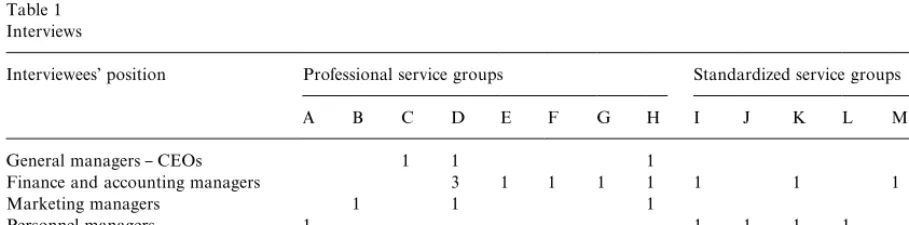
Table 1 Interviews
Interviewees'position Professional service groups Standardized service groups Total
A B C D E F G H I J K L M
General managers}CEOs 1 1 1 3
Finance and accounting managers 3 1 1 1 1 1 1 1 10
Marketing managers 1 1 1 3
Personnel managers 1 1 1 1 1 5
Total 1 1 1 5 1 1 1 3 2 1 2 1 1 21
views were held not only with "nancial directors and corporate controllers, but also with directors of personnel, and of marketing and business develop-ment. See Table 1.
Each interview took between 1 and 2 hours, and all were recorded on tape and transcribed. In a few cases the same respondent was interviewed twice. The interviews were spread over a long period. This allowed time to formulate ideas about investments and investment processes in service groups, to test these ideas in the next interview, and to re-interpret the data collected on several occasions. When the interviews had been completed and transcribed, the answers and statements therein were sorted into the categories of the themes and issues which had emerged. Then the classi"cation of the answers was gradually changed and re"ned as the analysis pro-ceeded.
Comparisons were also made with earlier studies of capital budgeting procedures in major Swedish
groups [29], and later interviews on planning and control processes in two multinational engineering groups: one of them a producer of white goods, the other a knowledge-intensive engineering group.
4. The size and character of the investments
Table 2 gives an idea of the size of the intangible investments in some of the companies. The esti-mates are based on the accounts of the companies and the calculations thereof made by the inter-viewees. According to the estimates, consulting companies invest about 10% of sales in intangible investments; large multinational groups somewhat more. Add to this one or two per cent of "xed investments, which brings the level of total invest-ments up to that of many manufacturing com-panies. The interviewees in the standardized service
their intangible investments, but the information available indicates that they invest considerably less in intangible assets, than do professional ser-vice companies.
It is not easy to estimate the size of investments in service"rms. Tangible investments consist main-ly of premises, o$ce equipment, computers, and cars, i.e. the types of assets which many companies lease. Thus, if, like "rm D, which formerly rented o$ce space, and leased cars, and computers, a com-pany makes a policy decision to buy more and lease less, this will of course lead to an apparently but not really increased volume of investments in the accounts.
Investments in R&D are similarly a!ected by the decision to buy or develop. For instance,"rm F for-merly spent more than its competitors on develop-ing its own software, since it was responsible for some large public sector systems. However, a deci-sion has now been made to reduce costs by buying and implementing standard systems when this is possible, and this will of course reduce their R&D volume.
Market investments are di$cult to estimate in consulting companies as the selling process is han-dled by the consultants themselves. Standardized service groups may have a central marketing func-tion to recruit new customers and maintain the company's brand name. However, the cost of these marketing functions is small compared with com-panies selling consumer goods. The reason may be that service companies of the type studied often have long-term customer relations. They supply security equipment and services, cleaning, health care, catering, software, etc. to large companies year after year.
The cost of training and competence develop-ment amounts to 7}10% in Swedish-based consult-ing groups. The multinationals invest to the same extent in Sweden, but their total investments are higher as they also run training and development centres in Europe and the US. Two to eight per cent of sales is teacher-controlled tuition, and the large groups rely more on centrally planned, teacher-controlled training. The small Swedish groups rely more on self-tuition. This may depend on the scale advantages inherent in training. One reason why large groups can allocate more funds to training
may be that they often work with large customers whose contracts they can more easily charge for the training. This roughly 10% cost of training includes compulsory introduction of new employees, in-company training, and the cost of retraining employees taken over through acquisitions and outsourcing agreements. The training may be int-ended to develop new types of competence, to give employees new knowledge and skills, to make it possible to retain employees, to retain knowledge, and to strengthen corporate culture and the indoc-trination of employees. A substantial part of total investments in training should probably be seen rather as costs of socialization, i.e. investments in social capital. Figures of 20}50% have been put forward by the respondents, but these are of course only highly subjective estimates.
Observe that investments in training are lower in the two technical consulting"rms, than in the com-puter software and management consultants. The reason may be that the need for investments in socialization is less among technical consultants. While computer software and management consul-tants have their work place at their customers'
o$ces, technical consultants work from their own o$ces. As Mintzberg [2, p. 41] writes: `In-house indoctrination programs are particularly impor-tant where jobs are sensitive or remotea.
their income from current accounts, while the tech-nical consultants have been forced to accept more and more"xed price contracts.
It is of course di$cult to evaluate investments in training and the development of new knowledge. Much of the in-house training is on-the-job-training during paid hours, and much of the new knowledge developed in projects is paid for by customers. As consultants are grouped into di!erent billing classes according to their experience, also new-comers can be charged when in fact they are still learning the job. When putting a team together a company will aim at a suitable mix of experienced consultants and those who are participating in their
"rst project mainly to learn. It is of course also an advantage to work with companies in the front-line which are willing to pay for the development of new knowledge, knowledge which can later be documented, re-used, and sold to other customers. Companies working with such customers may in-vest considerably more, and charge their customers for more training and knowledge development.
Another approach to estimating the size of investments starts with the billing rate. An ordinary billing rate for consultants seems to be 80%, although it may vary between 60% and 90% de-pending on the character of the business. Then the question may be asked, what these 20% free time is composed of. Do the consultants speak to cus-tomers, document assignments, perform adminis-trative duties, participate in meetings, sort papers, learn a new computer program or have problems with their computer, play on the Internet, have a co!ee break and chat with their colleagues, or do they do unpaid work on customer projects? Even if there is an account for training one can never know how reliable is the recording of time. Such would involve time studies.
Several researchers have recommended that companies allocate intangible investments to the right periods to make it easier for the stock market to assess their value [43,44]. None of the com-panies studied do so, and those interviewed have expressed a preference for expensing as much as possible. It is alleged, for instance, that since the volume of intangible investments varies little over time, it is unnecessary to depreciate such invest-ments in order to even out the result. Annual
surveys by Statistic Sweden [12] show that invest-ments in intangibles do not vary over the business cycle as do tangible investments. One contributory factor is that intangible investments consist of a#ow of smaller investments, and few investments are so large as to distort the result.
Another reason is that the competence of consul-tants declines when they are unemployed, so that assignments are sometimes taken below costs in times of recession to avoid loss of competence. Still another is that investments must be de"ned before they can be capitalized and depreciated according to some plan, but, as we shall see, professional service companies do not have a system for identi-fying and de"ning investments.
5. Project evaluation techniques
Manufacturing groups usually have a capital budgeting manual which stipulates how capital in-vestments should be evaluated, investment requests designed and reviewed, and investment projects implemented and followed up, and who is respon-sible for what in the capital budgeting process. Such investment manuals do not in general exist in the service groups studied. One exception is group F; it has a very simple manual, which however was said to be a sediment from an earlier owner, a manufacturing group, rather than an important means of control. Another exception is group L. L does not use an investment manual, but its American owner does. This manual is far more comprehensive than those found in Swedish manufacturing groups [29], but it is only used for investment requests sent from the Swedish to the European head o$ce. Although there are no limits of authorization between these two head o$ces, in 1997 "ve important investment requests were submitted to the European head o$ce for approval.
of goods and services, and on decisions to make tenders and commitments to customers.
The general principle is that investment requests must be made for all investments above a certain expenditure limit, and an investment appraisal be attached to the form on which the request is sum-marized. Investments which may alter the strategy of a company must be approved by the group board. However, not all companies have limits of authorization. Company E is one example of this. Instead, such companies can try to create a consen-sus on which investments are to be referred upwards. This often leads to more #exible limits inasmuch as smaller investments which might lead to a change in the strategy of a company are refer-red upwards for approval at the same time as large investments in line with already approved strat-egies can be approved by lower levels [29].
If the request contains a pro"tability assessment the payback criterion is used. More seldom the expected cash#ow is discounted and a net present value or internal rate of return is calculated. The payback periods are short, compared with those in manufacturing companies. Manufacturing com-panies in general accept a payback period of two to three years [29]; some service companies no more than one year, and seldom more than two years.
One measure of the time horizon is to ask for the maximum time for which a company is willing to accept a negative cash #ow when entering a new market. The answer has ranged between one and
"ve years, with an average of two to three years. These periods too are considerably shorter than that found in manufacturing companies. In a study of 59 major Swedish groups [45] it varied between 1 and 10 years, with an average of 4.0 years.
6. Planning processes
6.1. General principles of investment planning
Although professional service"rms invest mainly in intangible investments such as training and the development of new business concepts and know-ledge, the principles on which investment issues are handled are the same as in manufacturing "rms. Investments are initiated mainly from below, and
through customer contacts. One exception is ac-quisitions which can be initiated by the companies, by top management, and by the board. At the same time corporate level may occasionally sponsor a strategic initiative which will give rise to invest-ments. Corporate managers may also approve frames for the total volume of investments in e.g. training, order all employees of a certain category to undergo a training program, decide on a certain IT-standard; furthermore that investments should be made in certain markets and new business con-cepts shall be developed; strategic decisions which will automatically generate investments in the companies. The need for training and competence development is mapped through, inter alia, recur-rent career planning talks and surveys of training needs, viz. from below. This makes it possible to organize and procure training centrally and thereby save money. Larger groups have more compulsory training which all employee have to undergo, i.e. from above.
As in manufacturing companies an investment request is needed before an investment is approved. One tries to distinguish strategic investments, i.e. large investments, and investments in new markets, customers, technologies, and business concepts, and to refer these upwards in the hierarchy for approval. Requests are channelled through execu-tive teams, and there is usually also a document specifying responsibilities and limits of authoriz-ation. Similarly, the company"rst tries to de"ne the needs in the business planning process, before the investments and budget frames are incorpor-ated in the budget.
and the system per se plays a central role in the socialization of managers.
Companies are normally relatively independent. As long as they ful"l the pro"tability requirements corporate management does not interfere in how much and which investments they prefer to make; this applies also to those of the companies which are subsidiaries to foreign groups. If they do inter-vene they are more interested in the direction, than the volume, of investments.
Professional service groups lack the administra-tive superstructure of manufacturing groups. There are no sta!units who help out with invest-ments, review investment requests and ongoing in-vestment projects. Capital budgeting procedures are simpler, and investment requests are processed more informally.
Most of the activities in professional service com-panies are organized as projects. Consequently, there is also a system to implement and control projects, but there is no system to identify, de"ne and control investments. There is also a system to document experience from earlier projects, i.e. cus-tomer assignments, and to make this available to all parts of the group. Intranet, executive teams, and di!erent networks, groups, and meetings connecting employees in all parts of the group, all serve as fora for disseminating knowledge from completed projects.
Let us take a closer look at the administrative means of control mentioned above: central func-tions, planning processes, executive teams, sociali-zation, investment reviews, and knowledge transfer.
6.2. Central functions
Professional service groups have a much smaller administrative superstructure than do manufactur-ing groups. Group E, for instance, has a policy of not accepting more than 10% non-billable person-nel*i.e. managers, sta!, administrators, secretar-ies, and messengers*and controls that lower units do not exceed this norm. The "gure is similar for other Swedish consulting companies, and a little higher for the multinationals as they have central functions for training and business development. Moreover, note that the Swedish-based consult-ing groups are not divisionalized. In the largest of
them * group E * all 35 companies or so in a group of 7000 employees report directly to the head o$ce.
The standardized service groups too may have relatively small central functions. For example, company I has no more than 11% not working directly with customers. The"gure is con-siderably higher e.g. L which has about 1500 em-ployees in Sweden and a head o$ce with 150 individuals.
As regards central functions it is possible to dis-tinguish between those who are assigned to develop new concepts, the equivalent to the R&D function in manufacturing companies, and sta!who mainly try to identify the needs of the companies and coordinate the production to meet these. It can be the need for training or information techno-logy support. Observe that professional service groups in general do not have a personnel depart-ment. Human resource management is an issue for general managers. Standardized service companies, on the other hand, have a central function for purchasing and marketing, the latter mainly to recruit new customers. This feature separates standardized service from professional service groups [33] in which marketing is decentralized and therefore di$cult to measure and control from the head o$ce.
In the Swedish-based professional service groups it is, in general, the companies which pay for all central functions. Only those who want to use the services provided by the central functions pay for them. The same applies to training. Re-quests for training come from below and are trans-formed into centrally organized or purchased training courses, and development projects, where the companies share the costs. The multinationals are more centralized in the way in which the major-ity of these overheads are allocated among the companies, and they also have more organized training which is imposed and planned from above. The respondent in company A, which seems to be the most centralized, estimated that about 50% of their expenses for training could be tied to requests from below, and about 50% to needs identi"ed from above.
interest in this respect are E and G which have twice as large executive teams at corporate level as the other groups. Within the framework of these teams of 17}20 people sub-teams are constantly formed and function as an ad hoc replacement for the central sta! groups. In addition, there are also various types of committee and imaginary group within and between companies, some of them formed to solve a speci"c task and later dissolved; these perform the same functions as sta! groups on di!erent levels in manufacturing groups.
6.3. Planning processes
The formal planning system varies considerably between the groups. A few examples can illustrate the di!erent types of processes. Observe that we shall disregard the multinational professional service groups since strategy therein partly is developed outside Sweden.
Group E has a three-year strategic plan which has been developed by the board and corporate management and which is not updated during this period. There is no business planning process, and the so-called strategic plan should perhaps be termed a three-year vision. The company has a pre-liminary annual budget process, a detailed budget, and a revised budget, which has today developed into a practice of budgeting three times a year. For more than 10 years now the group has had a very well-developed performance measurement system which distinguishes between control and "nancial performance indicators. These latter indicators are "nancial. They are followed up quarterly and reported in the quarterly statement to shareholders. It is through the control indicators that the busi-nesses are controlled and the "nancial indicators can be in#uenced. The control indicators consist of 12 non-"nancial measures and are followed up monthly. These measures are not aggregated. Instead they are broken down step-by-step into lower units and the development of each unit is compared through a benchmarking system. Which indicators are important to a business depends on the character of the business; the indicators are gradually replaced to avoid consequent systematic mis-allocation.
Group G has abolished the annual budgetary control process, since this was perceived as an extrapolation of historical data. Instead they have an annual business plan, which is detailed for the
"rst year and a vision for next two. The business plan is developed by the corporate executive team, and those company executives who so prefer can break chosen parts of the plan down on lower units so that it becomes a top-down strategic process; however, not all companies do this. The group has a relatively well-developed performance measure-ment system in which both"nancial and non-" nan-cial indicators are monitored against the business plan, which, if thought necessary, is updated 3}4 times a year.
Group H has a business plan, which is detailed for the "rst year. The annual planning process starts when the executive teams of the companies and units develop their plans, which are later approved at corporate level. The business plan is updated when this is thought necessary by the executive teams on company and unit levels, which in practice means 2}4 times a year. There is also a traditional annual budgeting process. Corporate level which formerly only monitored "nancial measures recently supplemented these indicators with a few non-"nancial indicators. At least one unit has a well-developed system of non-"nancial indicators. The group per se seems to be more decentralized than the other in the study in that the head o$ce rarely interferes in the running of the businesses.
levels all the way down to the foreman level, and discussions are held as to how the goals can best be achieved and the strategy implemented. Then the process is reversed and the amended plan and sug-gestions are aggregated upwards to corporate level. Next follows the annual budgeting process. Corpo-rate level monthly reviews a set of "nancial indi-cators, marketing performs customer surveys, and the personnel department recently introduced a system of monitoring a set of non-"nancial hu-man resource measurement indicators.
We can observe that business planning is the responsibility of the executive teams and that all professional service groups in one way or another update their plans several times during the course of the year, at the same time as they all have a three-year written vision. The reason given for the frequent updating is that the pace of change is so fast that even a one-year plan can soon become obsolete. As to the rest, the di!erences are considerable.
Strategic planning is more centralized in some of the groups, partly due to the preferences of the owners. For instance, professional service group E is the most centralized of the groups, and H the most decentralized. Both have strong owners, but only in the E does the owner directly interfere in the development of business strategies.
Professional service groups seem to have more dissimilar planning systems than do manufacturing groups. One reason may perhaps be found in the fact that the manufacturing industry has strong trade associations which have a long tradition of arranging courses and disseminating information about new administrative procedures. Such in# uen-tial institutions for standardization do not exist within the Swedish service sector.
6.4. The executive team system
The executive teams play a key role in both professional and standardized service groups, and operate at corporate, company, and unit levels. At corporate level they include representatives from corporate level and the divisions, or the larger companies. They have 7}10 members and meet 11 times a year; 11 due to the summer holidays. Two of the groups use larger teams of 17}20 members, of which one meets each month, the other 2}3 times
a year. These larger groups form sub-teams which meet more frequently. In addition, in many of the groups, a small group of executives holds weekly meetings.
The members of the corporate executive team are represented on the boards of the companies. They have responsibility for both a line and a function, e.g. a company and IT-issues. There is often also a mentor system in which a member of one team is the mentor for 3}4 team members on the next level down. It is through this system of executive teams and mentors that investment requests are channel-led to the top, the business plan is developed, and strategies and major investments are discussed and approved. Important tasks are to see to that the group does not split its resources on too many areas, the dissemination of information, co-ordina-tion, con#ict resolution, the socialization of executive team members, and the investigation and preparation of decisions.
The system of forming sub-teams to investigate and solve the di!erent problems which arise partly replaces the sta! system, which does not exist in professional service groups. This system is best developed in the two groups with large corpo-rate executive teams. The task can be to decide on IT-standard, to evaluate entry into a new market, to supervise the development of a new business concept, and to appraise a major investment. Executive teams exist also in manufac-turing companies, but their importance is less marked, perhaps because executive teams have a more narrow role as forum for decisions and co-ordination.
6.5. The socialization of managers
in the managerial ranks, since the managers are, after all, the guardians of the organization's ideology.a
Professional service"rms invest large sums in the socialization of their employees. They have com-prehensive employee recruitment procedures and compulsory courses for newcomers, and sponsor social gatherings and informal networks. For instance, the management consulting company Bohling and StroKmberg [47] invests about 0.5% of sales in the recruitment of new consultants. Many individuals will be reluctant to abide by strong cultural norms which they do not fully compre-hend. Great e!orts are therefore made to recruit individuals that"t the organization [48], partly to diminish the risk that those who are engaged will later leave the company, i.e. to reduce employee turnover. In all probability a relatively large part of the cost of training in a professional service com-pany should therefore be labelled as costs of sociali-zation rather than costs of knowledge creation. This is clear from the fact that consultant com-panies invest relatively large sums in compulsory training of the personnel whom they take over through acquisitions.
Technical consultants invest less than do com-puter software and management consultants in socialization. One reason may be that technical consultants work in their o$ces to a greater extent, and thereby have more opportunities to meet their colleagues. Another that they recruit their consul-tants from a more homogeneous group of appli-cants; people with a master's degree in engineering who have been socialized through a long formal education to the norms of their profession, so-called professional control [40]. A comparison can here be made with other groups with a long formal training such as doctors and researchers. Perhaps this is also a major reason why technical consultants invest less in training, and the di! er-ence in spending would then be a measure of the cost of socialization.
The executive team system can be seen as a means of socialization, intended to make team members think and act according to common norms and in a predictable way. The majority of the members of the corporate executive teams in the study have worked for the company for a long
time, even in the groups which have grown through acquisitions. Managers are recruited internally, and become acquainted with each other and with the group norms through frequent meetings. Some of the groups also have compulsory courses for man-agers, mentor systems and job-rotation systems.
One disadvantage of social control seems to be that such a management philosophy is di$cult to apply outside the cultural area in which it is de-veloped. With the exception of company A, all the foreign-owned groups allow their Nordic subsidi-ary to be run independently and according to Scan-dinavian management principles. They share information and business concepts, but seldom transfer consultants from one cultural area to an-other except for training and knowledge exchange. The exception*company A*works mainly with large multinational companies, and is regarded as an archetype of a "rm with a strong corporate culture. Perhaps this`disadvantageaexplains why the more externally socialized technical consultants are more successful in selling their services abroad, than are computer software consultants.
6.6. Performance measurement systems
All but one of the groups monitor certain" nan-cial and non-"nancial indicators every month, and several of them also use these measures for internal benchmarking. Apart from such"nancial measures as pro"t margin and return on equity a consulting company might also monitor e.g. the number of employees, the billing rate, average wage cost, and average billing price, and use these measures to analyse the development of companies and units. Furthermore, they also regularly attempt to measure employee satisfaction, and customer satis-faction, including service quality and market devel-opment.
During the last decade the professional service groups have started to measure how their employees use their non-billable time. The group which has the most well-developed system of so doing is group E. They distinguish between control and"nancial in-dicators. The former are 12 in number and are reviewed monthly, the latter only quarterly.
From a general point of view the consulting
standardized service companies there are no central functions for purchasing, marketing, or personnel. Decisions on employment, pricing, and invest-ments, are decentralized. Provided that a division, a company, or a unit, shows good results it is to a great extent allowed to manage its own busi-ness and to decide which investments should be made, and how much should be invested. Some groups have, and others have had, standards for e.g. for the time allocated to training, but pro"table companies are allowed to deviate. The volume of investment is not regarded as a signi"cant indi-cator, and is therefore not recorded. Corporate management take little interest in the volume of investment. The direction of investments is more important.
When it comes to the actual use of non-"nancial measures there is no standard. Some companies like F, aggregate the measures, and others like E, do not do so but use them primarily for internal benchmarking. Then there are the standardized service groups in which"nancial and non-"nancial measures are decoupled; the "nancial function monitors certain"nancial measures, the personnel function measures certain personnel-related fac-tors, and the marketing function measures cus-tomer satisfaction and market development. None of them use the type of balanced scorecard recom-mended by Kaplan and Norton [49,50] to imple-ment strategy. Group I has discussed to impleimple-ment such a scorecard. According to American writers the American owner of company L uses a balanced scorecard, but those responsible for administrative routines at the Swedish head o$ce had never heard of it.
6.7. Investment review and knowledge transfer
Empirical studies of investment review [19,51, 52] have identi"ed two main reasons for it: control and learning. While both are regarded as impor-tant, corporate managers in Swedish companies emphasize learning. One reason is that Swedish groups have decentralized or wound up their cor-porate sta!resources. A study of 19 major Swedish groups [29] showed that all had decentralized the responsibility for conducting reviews. According to a 10 years older postal survey [53,54] of major UK
and US corporations only about 50% had decen-tralized this responsibility.
Major manufacturing corporations in general have a capital budgeting manual which states that all investments must be post-audited, but such reviews are not always made. Before obtaining the funds to invest, an investment request has to be submitted "rst, but there is no similar carrot to produce a post-audit. Therefore, the extent to which post-audits are made varies from company to company.
The review in service groups is focused on units and projects. Investments are only sporadically reviewed, and the extent to which reviews are done varies between companies. Inasmuch as profes-sional service companies run most of their opera-tions as projects, they also have a well-developed project management system. Consequently, they also possess the means of performing post-audits, but corporate management lays more emphasis on monitoring projects as they develop since this gives them more control over the end result, than does a post-audit. All the head o$ces studied have, at one time or another, reviewed major investments in new information technology, strategies, or business areas, but such reviews have been sporadic. More-over, some companies like company C, may have a system of de"ning and reviewing individual com-mitments by all employees. However, intangible investments are not monitored or post-audited. One problem is that it is di$cult to separate invest-ments from projects, and before an investment can be reviewed it must be de"ned to produce a plan with which the review can be compared, and this is not done.
and cross-company teams. Formally through for-mal structures such as executive teams, and Intranet, informally through informal networks, seminars, social gatherings and other meetings.
Comparison of the corporations studied shows that the larger groups have a more well-developed system of knowledge transfer, and were the"rst to build up an Intranet. In standardized service much of the knowledge transfer is channelled through central media. In professional service groups all types of media are used, although several of the interviewees cited the informal channels as the most important, and those that were most successful for the majority of the operations.
7. Professional service versus manufacturing groups
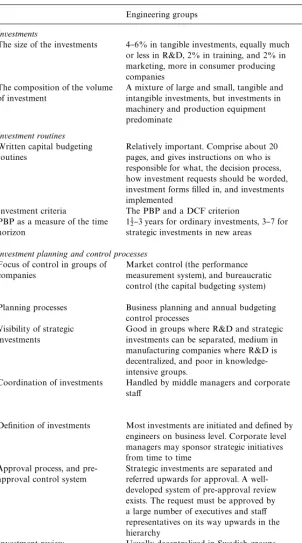
The professional service group can be seen both as the opposite to the traditional manufacturing group, and as a model for manufacturing com-panies, which has become more and more know-ledge-intensive and therefore needs to modernize its capital budgeting system. Let us therefore com-pare the handling of investments in these two types of group. See Table 3 which summarizes the prin-ciple di!erences. Observe that the traditional group is represented by a large modern engineering group, and not by its counterpart 20 or 30 years ago. Thirty years ago an engineering group would have had fewer intangible investments, and a less well-developed pre and post-approval review sys-tem for investments; furthermore, it would have relied less on decentralized coordination and more on administrative control.
The total sums invested can be of almost equal size, but in the professional service company invest-ments in training and competence development predominate. Divisionalized manufacturing com-panies have both a system with which to monitor the companies, and a capital budgeting system. The latter type of system is developed primarily to per-mit vertical information exchange on, and the rationing of capital to investments. Service com-panies instead focus on their performance measure-ment system which incorporates both"nancial and non-"nancial measures. The time horizon is shor-ter, the executive team system plays a more central
role and performs tasks which are assigned to sta!
units in manufacturing groups; moreover, the for-mal administrative routines vary widely from one company to another. In knowledge-intensive or-ganizations much of the coordination is decentra-lized. There is no parallel to the administrative superstructure found in manufacturing groups with its sta!groups that review investment requests.
However, manufacturing and service companies are by no means homogeneous groups [29]. Know-ledge-intensive manufacturing companies such as ABB and Ericsson have also developed #at, pro-ject-based organizations with decentralized know-ledge transfer. The traditional capital budgeting system still exists but less signi"cance is attached to it since intangible investments have increased in importance. Instead, a strategic process has been implemented to separate strategic investments from the budgeting process.
Standardized service companies incorporate features of both professional service and manufac-turing companies. The executive teams are essen-tial, non-"nancial measures are used within the personnel and marketing functions, and the time horizons are short. However, the capital budgeting system is very simple, if indeed it exists, at the same time there may be central functions for personnel, purchasing, marketing, product development, planning, and coordination.
8. Intangibles and the concept of investment
The term investment is used slightly di!erently by economists and accountants. The investment decision, in economics and "nance, concerns how much to consume in the present and how much to invest to increase future consumption and invest-ment [55]. According to this de"nition all activities which are intended to increase the return in a future period can be viewed as investments.
The de"nition used by accountants is more pre-cise. To an accountant, investment is the sum of
"xed assets plus working capital [56]. The term
`"xed asseta, which is also a term used in
Table 3
Investments and investment processes in engineering versus professional service groups
Engineering groups Professional service groups
Investments
The size of the investments 4}6% in tangible investments, equally much or less in R&D, 2% in training, and 2% in marketing, more in consumer producing companies
2% in tangible investments, 7}10% in training and competence development, marketing di$cult to estimate
The composition of the volume of investment
A mixture of large and small, tangible and intangible investments, but investments in machinery and production equipment predominate
Investment in people, training and competence development, predominates. Investments in marketing di$cult to measure
Investment routines Written capital budgeting routines
Relatively important. Comprise about 20 pages, and gives instructions on who is responsible for what, the decision process, how investment requests should be worded, investment forms"lled in, and investments implemented
Does not exist. The only written instructions that exist are a speci"cation of responsibilities and an investment form to"ll in.
Investment criteria The PBP and a DCF criterion The PBP
PBP as a measure of the time horizon
112}3 years for ordinary investments, 3}7 for strategic investments in new areas
Usually less than 1 year for ordinary investments, 2}4 years for strategic investments in new areas
Investment planning and control processes
Focus of control in groups of companies
Market control (the performance measurement system), and bureaucratic control (the capital budgeting system)
Market control (the performance measurement system, supplemented by non-"nancial key performance indicators), and social means of control
Planning processes Business planning and annual budgeting control processes
Varies widely from group to group Visibility of strategic
investments
Good in groups where R&D and strategic investments can be separated, medium in manufacturing companies where R&D is decentralized, and poor in knowledge-intensive groups.
Relatively good in standardized service, and relatively poor in professional service groups
Coordination of investments Handled by middle managers and corporate sta!
Handled both centralized by executive teams, and decentralized through formal and informal groups and contacts; centralized in standardized service groups
De"nition of investments Most investments are initiated and de"ned by engineers on business level. Corporate level managers may sponsor strategic initiatives from time to time
Most investments are initiated and de"ned by consultants on business level. Corporate level managers may sponsor strategic initiatives from time to time
Approval process, and pre-approval control system
Strategic investments are separated and referred upwards for approval. A well-developed system of pre-approval review exists. The request must be approved by a large number of executives and sta! representatives on its way upwards in the hierarchy
Strategic investments are separated and referred upwards for approval. There are no sta!units scrutinizing the request. All requests pass through and are discussed and approved by the executive teams that exist on all levels of professional service groups
Investment review Usually decentralized in Swedish groups. Capital investment projects of a certain size are monitored and sometimes also post-audited. Corporate level sometimes reviews investments as a part of strategies
plant and equipment. These are assets, which are capitalized and depreciated according to a plan which of course also renders crucial the calculation of depreciation.
The accountant's de"nition of an investment has strongly in#uenced the use of the concept in indus-try. Early studies of capital budgeting in the US [57] and Sweden [58] show that major companies in the late 1950s and early 1960s de"ned investments as assets which were capitalized and depreciated. All other payments associated with investments were considered as costs. Later studies from the 1970s [59] and early 1990s [29] show that all major Swedish companies have gradually widened the concept of an investment to include all payments necessary to implement the project, such as market-ing, trainmarket-ing, testing and running-in, which also means that they have had to incorporate sections for these expenses in their investment budget.
As intangible investments have increased, some major companies have tried to extend their control of such investments by issuing instructions that also intangible investments should be appraised and appropriated as if they were tangible. Some have also developed written routines or supple-ments to their investment manual for the appraisal of certain types of intangible investments. However, as corporate controllers have received few requests for intangible investments, other means have been tried to control the allocation of funds to such investments, e.g. investment committees for invest-ments in marketing, information technology, or training. Furthermore, attempts have been made to make a clearer distinction between strategic and operative investments. One means of so doing has been to let the capital budgeting process be preced-ed by a strategic planning process. Tangible and intangible strategic investments are discussed and decided in the meetings forming the strategic pro-cess, and the decisions then made become input to the traditional capital budgeting process in which operative investments can be evaluated against strategic and"nancial criteria. This is reported to lessen the emphasis on investments and goals which are easy to quantify and measure, and to bring strategy into focus.
It has been shown that intangible investments are not treated as investment. Still, the interviewees
had no di$culty in regarding training and market-ing as investments. Some of those responsible for accounting and"nance also said that this is the way they try to make the whole organization view such activities. However, investments in training and marketing are di$cult to delimit and measure. They are not de"ned, there is no system of quantify-ing such investments, and managers"nd it di$cult to decide what should be classi"ed as an investment and what return might be expected from an intan-gible investment, such as the investment in a brand name or in the knowledge of employees.
The idea of investments as a yield not consumed in the present but set aside to increase future con-sumption and investments is an approach which easily can be applied to all activities where payments are separated in time, or in an even wider context, to all activities where actions and rewards are separated in time. It is easy to visualize invest-ments in e.g. machines, R&D, and also new knowledge, but more di$cult perhaps to see the cost of socialization as an investment. However, the goal of socialization is to create a narrowing of norms and a common way of thinking. Such invest-ments in social capital are a precondition for indi-vidual actors to be able to work in a group and contribute to the whole. A common way of think-ing, a charter, can be compared with investments in the infrastructure of roads, service stations, and tra$c regulations, which makes investments in cars and trucks pro"table. Such infrastructure invest-ments are not pro"table per se, but they enable the pro"table investments which can utilise the infrastructure. The investment concept is easily communicated, but awkward to apply when invest-ments and their consequences become di$cult to measure.
9. Concluding remarks
who is responsible for what, how an investment should be appraised, requested, controlled, and implemented, is an example of a bureaucratic means of control. The divisionalized group uses market control when it monitors the output of its divisions and companies as if these are actors on a market. Social forms of control are used when the output cannot be measured, nor work process preplanned.
Consulting groups do not have a capital budget-ing system. On the whole they lay more emphasis on market and social control, than on administra-tive means of control. This is obvious from the signi"cance they attach to, on the one hand, the performance measurement system, and on the other, socialization and the executive team system. The traditional divisionalized manufacturing group instead combines administrative means of control such as e.g. the capital budgeting system, with market types of control of divisions and other units. The more knowledge-intensive the"rms, the more they stress market and social means of con-trol [5]. It is not a matter of one type of concon-trol or another, but where the main emphasis is. The major consulting groups too have certain elements of bureaucratic control.
Studies of manufacturing companies have shown that the larger the organization, the larger the aver-age size of its units [1,2]. This does not always apply to professional service groups which strongly emphasize market control. Consulting groups are divided into many small, relatively independent units. For instance group E, which has 7000 employees, follows a policy of limiting units to 50 employees, and this is no extreme. There are some small Swedish computer consulting groups which do not allow units larger than 10}12 employees.
It may be of interest to compare with manufac-turing groups, since some of them put more empha-sis on market, than administrative means of control. Goold and Campbell [26] identi"ed three main strategic management styles in a study of 16 major UK corporations: strategic planning, strategic control, and "nancial control. Financial control groups focus on short-term "nancial results. Responsibility is well de"ned, and pro"t centres are strictly monitored. The criteria used
to evaluate pro"t centres and investments are similar to those applied on the capital market. This is possible as investments are usually short term, there are few large investments and invest-ments in one company do not a!ect other parts of the group.
Financial control groups resemble professional service groups insofar as both stress market con-trol, but the social control is weak. One can also say that the larger the group the greater the importance attached by the head o$ce to market control; furthermore, the greater the number of units, and the more diverse the group, the more di$cult it becomes to hold it together with administrative and social means of control alone.
To lay a heavy emphasis on market control is generally thought to cause companies to be unduly concerned with short-term pro"t. However, both service groups and "nancial control groups mostly concentrate on short-term investments. According to Goold and Campbell [26] there are no examples of successful"nancial control groups in industries where investments are large and long term.
There are several models of professional service
Acknowledgements
This research was made possible by a grant from the Swedish Council for Research in the Human-ities and Social Sciences.
References
[1] H. Mintzberg, The Structure of Organizations, Prentice-Hall, Englewood Cli!s, NJ, 1979.
[2] H. Mintzberg, Structure in Fives: Designing E!ective Or-ganizations, Prentice-Hall, Englewood Cli!s, NJ, 1983; 2nd Edition, 1993.
[3] C. Hedlund, The hypermodern MNC *a heterarchy? Human Resource Management 25 (1) (1986) 9}35. [4] I. Nonaka, A dynamic theory of organizational knowledge
creation, Organization Science 5 (1) (1994) 14}37. [5] M.H. Boisot, Knowledge Assets: Securing Competitive
Advantage in the Information Economy, Oxford Univer-sity Press, Oxford, 1998.
[6] C. GroKnroos, From scienti"c management to service man-agement: A management perspective for the age of service competition, International Journal of Service Industry Management 5 (1) (1994) 5}20.
[7] E. Gummesson, Service management: An evaluation and the future, International Journal of Service Industry Man-agement 5 (1) (1994) 77}96.
[8] L. Fitzgerald, R. Johnston, S. Brignall, R. Silvestro, C. Voss, Performance Measurement in Service Business, The Chartered Institute of Management Accountants, London, 1991.
[9] H. KullveHn, Ekonomisk styrning ur ett tjaKnsteperspektiv, Forskningsrapport 94:15, HoKgskolan i Karlstad, 1994. [10] S. Modell, Management accounting and control in
servi-ces: Structural and behavioural perspective, International Journal of Service Industry Management 7 (2) (1996) 57}80.
[11] K.E. Sveiby, T. Lloyd, Managing Knowhow, Bloomsbury, London, 1987.
[12] Statistics Sweden, Statistiska meddelanden, F 13 SM 9502, 1988.
[13] G. Eliasson, The "rm as a competent team, Journal of Economic Behavior and Organization 13 (3) (1990) 275}298.
[14] C. Gurnani, Capital budgeting: Theory and practice, The Engineering Economist 30 (1) (1984) 19}46.
[15] T.K. Mukherjee, Capital-budgeting survey: The past and the future, Review of Business and Economic Research 22 (2) (1987) 37}56.
[16] T.K. Mukherjee, G.V. Henderson, The capital budgeting process: Theory and practice, Interfaces 17 (2) (1987) 78}90. [17] E.J. Farragher, Capital budgeting practices of non-indus-trial "rms, The Engineering Economist 31 (4) (1986) 293}302.
[18] P. Collier, A. Gregory, Investment appraisal in service industries: A"eld study analysis of the U.K. hotels sector, Management Accounting Research 6 (1) (1995) 33}57. [19] C.W. Neale, Investment post-auditing practices: A
com-parision of manufacturing and service sector companies, The Service Industries Journal 11 (1) (1991) 75}92. [20] E.J. Morgan, Y.L. Tang, Post-implementation reviews of
investment: Evidence from a two-stage study, International Journal of Production Economics 30}31 (1993) 477}488. [21] S.P. Dulman, The development of discounted cash#ow
techniques in U.S. industry, Business History Review 63 (1989) 555}587.
[22] C.Y. Baldwin, K.B. Clark, Capital-budgeting systems and capabilities investments in U.S. companies after the Sec-ond World War, Business History Review 68 (1) (1994) 73}109.
[23] E. Segelod, Capital budgeting in a fast-changing world, Long Range Planning 31 (4) (1988) 529}541.
[24] J.L. Bower, Managing the Resource Allocation Process, Division of Research, Graduate School of Business Ad-ministration, Harvard University, Boston, 1970. [25] R.A. Burgelman, A process model of internal corporate
venturing in the diversi"ed major "rm, Administrative Science Quarterly (1983) 223}244.
[26] M. Goold, A. Campbell, Strategies and Styles: The Role of the Centre in Managing Diversi"ed Corporations, Basil Blackwell, Oxford, 1987.
[27] R. Simons, How new top managers use strategic systems as levers of strategic renewal, Strategic Management Journal 15 (1994) 169}189.
[28] R. Simons, Levers of Control, Harvard Business School Press, Boston, 1995.
[29] E. Segelod, Resource Allocation in Divisionalized Groups, Avebury, Aldershot, 1996.
[30] M. Ross, Capital budgeting practices of twelve large manufacturers, Financial Management (1986) 15}22. [31] W. Ouchi, A conceptual framework for the design of
or-ganization control mechanisms, Management Science 22 (1979) 833}848.
[32] W. Ouchi, Markets, bureaucracies and clans, Administra-tive Science Quarterly (1980) 129}141.
[33] D. Maister, Managing the Professional Service Firm, Free Press, New York, 1993.
[34] T. Morris, L. Empson, Organisation and expertise: an exploration of knowledge bases and the management of accounting and consulting"rms, Accounting, Organiza-tions and Society 23 (5/6) (1998) 609}624.
[35] W. Ouchi, The relationship between organizational struc-ture and organizational control, Administrative Science Quarterly 22 (1977) 95}113.
[36] P.K. Mills, J.L. Hall, J.K. Leidecker, N. Margulies, Flexi-form: a model for professional service organizations, Acad-emy of Management Review 8 (1) (1983) 118}131. [37] M. Alvesson, Ledning av KunskapsfoKretag - Exemplet
Enator, Norstedts, Stockholm, 1989 (2nd Edition, 1992). [38] M. Alvesson, Management of Knowledge-Intensive