Products of Orange II biodegradation by Enterococcus faecalis ID6017 and Chryseobacterium indologenes ID6016
V.I. Meitiniarti*1,2), E.S. Soetarto1), K.H. Timotius2), and E. Sugiharto3) 1) Biology Faculty, Gadjah Mada University, Yogyakarta 2) Biology Faculty, Satya Wacana Christian University, Salatiga 3) Department of Chemistry, Gadjah Mada University, Yogyakarta
Chryseobacterium indologenes and Enterococcus faecalis were isolated from activated sludge of textile wastewater treatment plant. These bacteria had the ability to decolorize several azo-dyes. Degradation of azo dyes was initiated by decolorization (reduction of azo bond) which occurred in anaerobic condition. In this study, we focussed on biodegradation of Orange II by pure culture of C. indologenes ID6016 and E. faecalis ID6017, and to determine the metabolite products of Orange II degradation. The degradation of Orange II by both bacteria was carried out in batch experiments using liquid medium containing 80 mg/l Orange II, under sequential static agitated incubation. During the bacterial growth under static incubation (6 hours), 66.1 mg/l Orange IIwere decolorized by 35.54 mg/l biomass of E. faecalis ID6017, but no decolorization found with C. indologenes ID6016. Based on HPLC results, the decolorized Orange II products were identified as Sulfanilic acid and Amino-naphthol. These metabolites were probably used or degraded by C. indologenes ID6016 under agitated incubation.
Key words: E. faecalis ID6017, C. indologenes ID6016, Orange II, biodegradation.
* Correspondence: Biology Faculty, Satya Wacana Christian University, Jl. Diponegoro 52-60, Salatiga. Phone +62-0298-321212, ext. 305. E-mail: [email protected], [email protected]
Orange II is one of synthetic azo dyes, the largest chemical class of dyes with the greatest variety of colors, which has been widely used for textile, food, and cosmetics. The compound has an azo bond (R1-N=N-R2), where R1 and R2 are aromatic groups, which in some cases, can be substituted by sulphonated groups (Zollinger 1987). OrangeII is synthesized by diazotized reaction of sulfanilic acid with amino naphthol. Several others of azo dyes are either toxic, mutagenic or carcinogenic, and have a potential health hazard (Chung et al. 1981; Gottlieb et al. 2003).
In the dyeing process, approximately 10-15% of the dyes are released into the environment through effluent of industry. The azo dyes are generally unaffected by conventional activated sludge process under aerobic condition and usually they are found in the effluent of wastewater treatment (WWT) (Supaka et al. 2004). In several cases, conventional waste water treatment of azodyes containing wastewater combined with physical or chemical treatment, such as biosorption, chemical coagulation, and electrochemical method, could produce decolorized effluent (Lin & Peng 1996; Lin & Chen 1997; Kargi & Ozmihei 2004). However, those approaches often have problems, caused by chemical sludge which produced from these treatments. Therefore, there is still a demand to develop alternative means of dye decolorization, such as innovative biological methods that able to provide a more natural and complete clean-up of the pollutants in a more economical way (Coughlin et al.
2003).
1996), and coculture of Hydrogenophaga palleronii and Agrobacterium radiobacter (Dangmann et al. 1996; Blümel et al. 1998) have been reported to have the ability to decolorize azodyes. The
bacterial ability to decolorize azo dyes varies from 20 to 200 mg/l azodye concentration.
Sphingomonas sp. strain 1CX has an ability to decolorize 20 mg/l Orange II, Acid Orange 8, Acid Orange 10, Acid Red 4, or Acid Red (Coughlin et al. 1997). Whereas, Pseudomonas luteola has an ability to decolorize Reactive Red up to concentration of 200 mg/l (Chang et al. 2001).
Chryseobacterium indologenes and Enterococcus faecalis were used as bacterial models for dye decolorization. Those bacteria were isolated from activated sludge of textile wastewater treatment plant (Liem 1997; Setiabudi 1997). The bacteria have the ability to decolorize several dyes such as Amaranth, Reactive Red, Yellow and Blue (Meitiniarti & Timotius 2003).
In the mixed culture of C. indologenes and E. faecalis, various kinds of azodyes were decolorized faster than in a single bacterial culture. C. indologenes was not able to decolorize these dyes (Timotius et al. 2002). There is no information of the roles of both bacteria on the azodyes degradation. Orange II was used as a model substrate of azodye degradation. Coughlin et al. (1999) reported that Orange II can be degraded into Sulfanilic acid, which can easily be detected chromatographically, and 1-Amino-2-naphthol, which undergoes rapid auto oxidation. Chemical structure of Orange II and products of Orange II decolorization by Orange II reductase were shown in Fig.1.
In this study, we focussed on biodegradation of Orange II by pure culture of C. indologenes
ID6016 and E. faecalis ID6017, grown on a semi-synthetic medium. The aims of this research were to investigate degradation ability of both bacteria and determine the metabolite products of Orange II degradation.
E. faecalis ID6017 and C. indologenes ID6016 were obtained from Laboratory of Microbiology, Faculty of Biology, Satya Wacana Christian University, Salatiga, Central Java, Indonesia. Both bacterial culture were maintained and cultivated on slant media of Trypticase Soy Agar (TSA) at room temperature and sub-cultured every two weeks.
The bacteria were grown on liquid basal media consists of (g/l): glucose 0.90 (glucose was omitted for C. indologenes culture), MgSO4.7H2O 0.25, (NH4)2SO4 1.98, K2HPO4 5.55, KH2PO4 2.13, and yeast extract 0.25. Orange II (Merck, CI Acid Orange 7, CI 15510, MW= 440.41) was used in concentration of 80 mg/l.
Bacterial Cultivation for Dye Degradation Assay
Each of 48 hours TSA slant culture E. faecalis ID6017 and C. indologenes ID6016 was inoculated in basal medium without Orange II in 500 ml Erlenmeyer flasks. Cultures were incubated 24 hours on shaker with 150 rpm agitation to reach OD600nm = 0.3. These cultures were called as pre-cultures.
The growing vessels contained of basal medium with Orange II were inoculated with 10% (v/v) of each pre-culture separately and closed with rubber stopper. Cultures were incubated at room temperature, under static condition for 6 hours, followed by 150 rpm agitation for 12 hours. Before agitation, 80 ml of the E. faecalis culture was filtered using membrane filter in 2 m diameter and then inoculated aseptically using 20 ml of C. indologenes ID6016 48 hours pre-culture.
Samples were harvested every two hours followed by centrifugation at 3326 g for 30 min to separate supernatant and cell mass (biomass). The supernatant was used for determining the dye concentration. The dye concentration was determined by spectrophotometric method at max (482 nm). The cell mass after twice washing, was re-suspended into initial volume and measured by
turbidimetric method at 600nm. The dye concentration was determined by a standard curve of
optical density against biomass concentration (cell dry weight). Both measurements of absorbance and optical density were done in a Shimadzu UV–Vis 1201 Spectrophotometer. The ability of both bacterial strains to decolorize Orange II was determined by subtracting the initial dye concentration with the lowest concentration from samplings. The growth of E. faecalis ID6017 and C. indologenes
ID6016 was determined by calculating its specific growth rate and biomass production.
In the initial time of culture, after decolorization (t=6 hours), and at the end of culture (t=12 hours), the culture supernatant were analyzed to detect product degradation of Orange II by HPLC. HPLC Analysis of Degraded Metabolites (Modification of Supaka et al. 2004)
The degraded metabolites were analyzed with HPLC Shimadzu model LC-3A chromatograph, equipped with UV-detector and ODS column (150 mm x 8 mm). The supernatant culture of E. faecalis ID61017 and C. indologenes ID61016 were injected to HPLC. The mobile phase composed of methanol and acetic acid 0.6% (v/v) = 60 : 40 with the flow rate of 0.7 ml/min were applied. The eluent were monitored by UV absorption at 276 nm.
RESULTS
The Growth of E. faecalis ID61017 and C. indologenes ID61016 and Their Ability to Degrade
Orange II
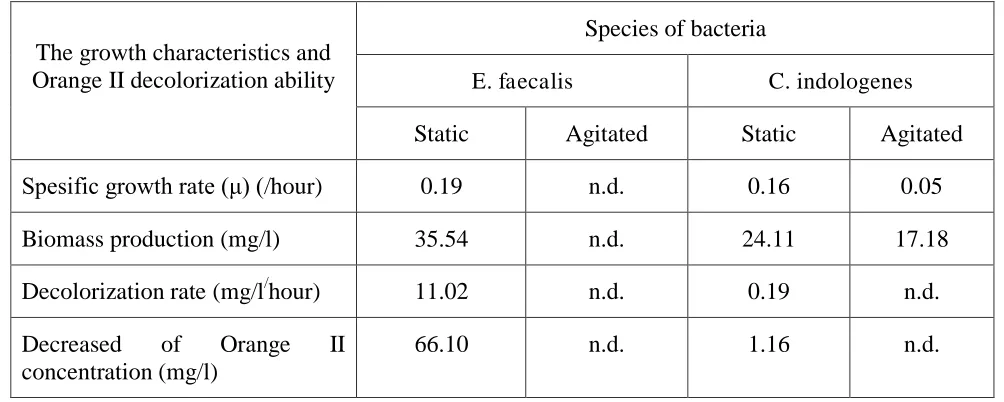
E. faecalis ID6017 and C. indologenes ID6016 could grew in Orange II containing media, under static incubation. As shown in Table 1, E. faecalis grown faster ( = 0.1λ) and produced more biomass (35.54 mg) than C indologenes ( = 0.16 and produced 24.11 mg biomass). After static incubation and agitation, the growth curve of E. faecalis decreased. On the contrary, the growth curve of C. indologenes was constant with specific growth rate of 0.05 (Fig.2 and 3). Surprisingly,
During static condition (6 hours), E. faecalis and C. indologenes was able to reduce Orange II from 75.64 mg/l to 9.54 mg/l and 77.20 mg/l to 76.04 mg/l, respectively (Fig. 2 and 3). On the other words, as shown in Table 1, E. faecalis was able to reduce 66.1 mg/l Orange II higher than C. indologenes which only reduced 1.16 mg/l Orange II. Under agitated condition, C. indologenes did not decolorize Orange II. This result is similar with the latest decolorization test of both bacteria reported by Meitiniarti et al. 2005a.
Metabolite Products of Orange II Degradation
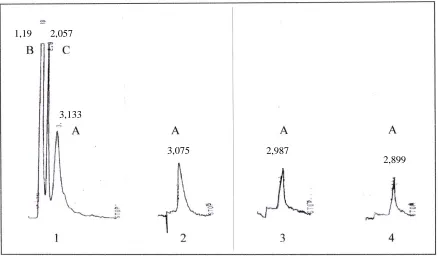
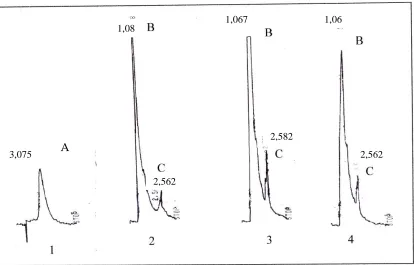
In order to explain the degradation of Orange II, supernatant of E. faecalis and C. indologenes cultures, and non-inoculated Orange II containing medium were analyzed using HPLC. The HPLC analysis of the initial time of culture of E. faecalis and C. indologenes showed that a peak (A) appeared at a retention time of ca. 3 min., which represents the retention time of Orange II, as essentially decolorization did not occur at the early state of static incubation (Fig. 4 & 5). The HPLC analysis for the sample taken from C. indologenes culture after static and agitated incubation, shown that peak A (Fig. 4) rose at the same high as at the beginning of static incubation. On the other hand, as decolorization proceeded in E. faecalis culture, the HPLC analysis shows that peak A disappeared, while peak B (retention time of ca. 1.1 min.) and peak C (retention time of ca. 2.5 min.) appeared (Fig. 5). The retention time of peak B and C were similar with retention time of Sulfanilic acid (ca. 1.18 min.) and 1-Amino-2-naphthol (ca. 2.6 min.), respectively.
DISCUSSION
The existing of Orange II in growing media do not inhibit E. faecalis ID6017 and C. indologenes ID6016 growth under static incubation. However, the growth of E. faecalis in this media was slower than that in the medium without Orange II (data not shown), which might due to co-substrate (glucose) competition. In this condition, glucose was used as electron donor (NADH) source, either for oxidative phosphorylation or azo bond reduction (Zimmermann et al. 1982).
In the Orange II containing media, E. faecalis produced more biomass than C indologenes, this might due to the ability of E. faecalis to use glucose and yeast extract as carbon and energy sources. On the contrary, C. indologenes was only able to use yeast extract as carbon and energy sources (Meitiniarti et al. 2005a). C. indologenes was not decolorizing Orange II during static incubation, as there was limited carbon and energy sources. After E. faecalis culture condition was changed from static to agitation, the growth rate of E. faecalis decreased, which might due to substrate limitation or metabolites product decolorization.
When static incubation of C. indologenes culture was changed into agitation, the HPLC analysis (Fig. 4) showed relatively no decreasing intensity of Orange II peak and new peak was not found. From this result, it seems that C. indologenes could not decolorize Orange II.
growth of E. faecalis, which cause growth rate decreasing during agitated incubation. Sweeney et al.
(1994) reported that aromatic amines produced from azo dyes reduction may be toxic or genotoxic. In contrast with E. faecalis, metabolites product of decolorization did not inhibit the C. indologenes growth, indicated by the increase of C. indologenes density (Fig. 2). Since the height of Sulfanilic peak at the end of C. indologenes growth under agitated incubation was lower than at the beginning, it indicates that the metabolite is used as carbon and energy sources. Meitiniarti et al. (2005b) also reported that C. indologenes ID6016 was able to grow in the Sulfanilic acid and Aniline containing media, and could decrease the concentration of both aromatic amines in the medium.
REFERENCES
Blümel S, Contzen M, Lutz M, Stolz A, Knackmuss HJ. 1998. Isolation of bacterial strain with the
ability to utilize the sulfonated azo compound 4-carboxy-4’-sulfoazobenzene as the sole source of carbon and energy. Appl Environ Microbiol 64:2315-2317.
Chang JS, Chou C, Lin YC, Lin PJ, Ho JY, Hu TL. 2001. Kinetic characteristics of bacterial azo-dye decolorization by Pseudomonas luteola. Water Res 35:2841-2850.
Chung KT, Fulk GE, Andrews AW. 1981. Mutagenicity testing of some commonly used dyes. Appl Environ Microbiol 42: 641-648.
Coughlin MF, Kinkle BK, Tepper A, Bishop PL. 1997. Characterization of aerobic azo dye-degradating bacteria and their activity in biofilms. Water Sci Technol 36:215-220.
Coughlin MF, Kinkle BK, Bishop PL. 1999. Degradation of azo dyes containing aminonaphthol by
Sphingomonas sp. strain 1CX. J Ind Microbiol Biotechnol 23:341-346.
Dangmann E, Stolz A, Kuhm AE, Hammer A, Feigel B, Noisommit-Rizzi N, Rizzi M, Reus M, Knackmuss HJ. 1996. Degradation of 4-aminobenzenesulfonate by a two species bacterial co-culture. Physiological interactions between Hydrogenophaga palleronii S1 and
Agrobacterium radiobacter S2. Biodegradation 7:223-229.
Gottlieb A, Shaw C, Smith A, Wheatley A, Forsythe S. 2003. The toxicity of textile reactive azo dyes after hydrolysis and decolorisation. J Biotechnol 101:49-56.
Hu TL. 2001. Kinetic of azoreductase and assessment of toxicity of metabolic products from azo dyes by Pseudomonas luteola. Water Sci Tech 43: 261-269.
Kargi F, Ozmihei S. 2004. Biosorption performance of powdered activated sludge for removal of different dyestuffs. Enzyme Microb Technol 35:267-271.
Keck A, Klein J, Kudlich M, Stolz A, Knackmuss HJ, Mattes R. 1997. Reduction of azo dyes by redox mediators originating in the naphthalenesulfonic acid degradation pathway of
Sphingomonas sp. strain BN6. Appl Environ Microbiol 63:3684-3690.
Kudlich M, Bishop PL, Knackmuss HJ, Stolz A. 1996. Simultaneous anaerobic and aerobic degradation of the sulfonated azo dye Mordant Yellow 3 by immobilized cells from a naphthalenesulfonated-degrading mixed culture. Appl Microbiol Biotechnol 46:597-603. Liem DL. 1997. Identifikasi dan karakterisasi isolat-isolat bakteri pereduksi Amaranth yang diisolasi
dari limbah industri tekstil. [Skripsi]. Salatiga: Fakultas Biologi, Universitas Kristen Satya Wacana.
Lin SH, Chen ML. 1997. Textile wastewater treatment by enhanced electrochemical method and ion exchange. Environ Technol 18:739-746.
Meitiniarti VI, Timotius KH. 2003. Kemampuan dekolorisasi beberapa pewana oleh kultur campur bakteri SWCU 96-I03 dan identifikasi penyusunnya. Prosiding Simposium Nasional Hasil-hasil Penelitian, Lemlit Unika Soegijopranata. Semarang, 22 Mar 2003. B.3.5.1.p.1-7.
Meitiniarti VI, Soetarto ES, Timotius KH, Hendrawan JT. 2005a. Dekolorisasi pewarna azo Orange II oleh Enterococcus faecalis ID6017 dan Chryseobacterium indologenes ID6016. Berkala Ilmiah Biol 4:303-313.
Meitiniarti VI, Soetarto ES, Timotius KH, Juliana C, Vifian N, Subarkah DA. 2005b. Kultivasi curah Chryseobacterium Indologenes ID6016 pada media yang mengandung Asam Sulfanilat dan Anilin. Berkala Ilmiah Biol 4:373-384.
Russ R, Rau J, Stolz A. 2000. The function of cytoplasmic flavin reductases in the reduction azo dyes by bacteria. Appl Environ Microbiol 66:1429-1434.
Supaka N, Juntongjin K, Damronglerd S, Delia ML, Strehaiano P. 2004. Microbial decolorization of reactive azo dyes in a sequential anaerobic-aerobic system. Chem Eng J 99:169-176.
Setiabudi B. 1997. Isolasi bakteri yang mampu menurunkan kekeruhan warna Amaranth dengan cepat dalam media yang mengandung Amaranth dan Kromium dalam konsentrasi tinggi pada suhu antara 35-45°C. [Skripsi]. Salatiga: Fakultas Biologi, Universitas Kristen Satya Wacana.
Stolz A. 2001. Basic and applied aspects in the microbial degradation of azo dyes. Appl Microbiol Biotechnol 56:69-80.
Sweeney EA, Chipman JK, Forsythe SJ. 1994. Evidence for direct-acting oxidative genotoxicity by reduction products of azo dyes. Environ Health Perspect 102:119-122.
Zimmermann T, Kulla HG, Leisinger T. 1982. Properties of purified Orange II azoreductase, the enzyme initiating azo dye degradation by Pseudomonas KF46. Eur J Biochem 129:197-203. Zissi U, Lyberatos G. 1996. Azo-dye biodegradation under anoxic conditions. Water Sci Technol
34:495-500.
List of figures
Figure 1. Chemical reaction of Orange II decolorization by Orange II reductase (Zimmermann et al.,
1982)
Figure 2. Biomass concentration of E. faecalis ID6017 (■) and Orange II (OII) concentration () during static and agitated incubation. The growth of C. indologenes ID 6016 (▲) on filtrate of E. faecalis ID6017 culture after Orange II decolorization was also shown in these figure. 0 20 40 60 80 100
0 2 4 6 8 10 12 14 16 18
Incubation time (hour)
B io m a s s a n d O II c o n c e n tr a ti o n (m g /l )
[image:12.612.89.377.337.537.2]Figure 3. Biomass concentration of C. indologenes ID 6016 (♦), and Orange II (OII) concentration (■) during static and agitated incubation.
Figure 4. The HPLC analysis on mixed filtrate of standard Orange II (A), Sulfanilic acid (B), 1-Amino-2-naphthol (C) containing medium (1) and metabolites resulting from filtrate culture of C. indologenes (2) at the beginning of static incubation, (3) after 6 hours static
incubation (5 l sample), and (4) after 12 hours agitated incubation.
0 20 40 60 80 100
0 2 4 6 8 10 12 14 16 18
incubation tim e (hour)
B io m a s s a n d O II c o n c e n tr a ti o n (m g /l )
Static Agitated
1,19 2,057
3,133
3,075 2,987
[image:13.612.73.512.362.619.2]Figure 5. The HPLC analysis on metabolites resulting from decolorization of Orange II by E. faecalis (1) at the beginning of static incubation, (2) after 6 hours static incubation (5 l sample), (3) after 12 hours agitated incubation (10 l sample), and (4) after 12 hours agitated incubation by C. indologenes (10 l sample). A represented as Orange II, B represented as Sulfanilic acid, and C represented as 1-Amino-2-naphthol.
1 3 4
3,075
1,08
2,562
2,582
1,067 1,06
2,562
[image:14.612.78.492.97.362.2]List of table
Table 1. The growth characteristic and Orange II decolorization ability of E. faecalis and C. indologenes on Orange II containing media under static and agitated incubation
The growth characteristics and Orange II decolorization ability
Species of bacteria
E. faecalis C. indologenes
Static Agitated Static Agitated
Spesific growth rate ( ) (/hour) 0.19 n.d. 0.16 0.05
Biomass production (mg/l) 35.54 n.d. 24.11 17.18
Decolorization rate (mg/l/hour) 11.02 n.d. 0.19 n.d.
Decreased of Orange II concentration (mg/l)
66.10 n.d. 1.16 n.d.
[image:15.612.60.562.153.354.2]