e-
Security
N a t i o n a l I C T S e c u r i t y a n d E m e r g e n c y R e s p o n s e C e n t r e
From the Editor’s Desk
Welcome 2006 and goodbye to 2005! Another new year and more good articles are packed in this issue. More IT Security professionals from within NISER and from the industry have brought together informative and useful articles.
In 2006, we saw the launch of Infosec.my, our local interest group which will see discussions, forums, sharing of ideas and knowledge for IT Security professionals. We have had close to 80 members now and growing. We would like to invite more IT Security professionals to come on board and use this platform to meet, share, exchange ideas and discuss with fellow professionals.
Coming up this July is our Information Security conference, SecureMalaysia 2006 which is jointly organized by NISER and (ISC)2. This year we have brought together some very prominent and globally recognized speakers such as, Howard Schimt, Ralf Moulton, Dr. Corey Schou, kang Meng Chow, Lt Col (R) Husin Jazri, John Meakin, Steve Orlowski, Anil Mahtani and many others. This year we will see very interesting topics being presented and will definitely be exciting. So book your seat early.
Another event we have coming up in May is our CISSP CBK Review Smeinar which will be held from the 21st till 26th May 2006 at the Hilton, PJ. We have received good response for this class and have a few more seats left. The course will be conducted by a certified (ISC)2 instructor from the US and will be taught using the latest updated CISSP materials for 2006 exams. Email to [email protected] for details.
Once again, we invite more security professionals to contribute to our newsletter and remember that you can view our newsletter online from our website at http://www.niser.org.my.
Philip Victor
[email protected] Contributors :
~ BEWARETHE HIDDEN DANGER - By Ahmad Nasir & Zahri Yunos
~ TACKLING THE CONFUSION BETWEEN IDS & IPS
- By Ken Low CISSP GSLC 3Com South Asia Ltd
6
~ HACKING!!! UNDERSTANDING THE LEGAL ISSUES
- By Zaid Hamzah & Juanda Zeng [email protected]
8
~ INTRODUCTION TO AUDIO FORENSICS - By Zabri Talib
~ ETHICALHACKER-THEICT SIDE OF ACCOUNT AUDITOR
- By Aswami Fadillah
~ WEB SECURITY EDUCATIONAL TOOLS - By Suhairi Mohd Jawi
~ THE EMERGINGTREND OF IT OUTSOURCING
- By Alan See
~ NETWORK SECURITY POLICY: BEST PRACTICES
- By CISCO 18
~ WEATHERING A CRISIS - By Maslina Daud
~ SECURE SOFTWARE? FIRST, BACK TO THE DRAWINGBOARD
- By KC Lam
~ IMPLEMENTING ASSET MANAGEMENT IN ORGANIZATION
- By Rafidah Abdul Hamid
~ COMPLETING THE EQUATION: THE PEOPLE FACTOR-MAKING AWARENESS YOUR SECURITY TOOL
- By Philip Victor
• • • • • • • • • • • • • • • • • • • • • • • • • • • • • • • • • • • • • • • • • • • • Editor
Philip Victor
Training & Outreach Unit, NISER
• • • • • • • • • • • • • • • • • • • • • • • • • • • • • • • • • • • • • • • • • • • • • • • • • • • • • • • • • • • • • • • • • • • • • • •
Reader Enquiry
Training & Outreach Unit
National ICT Security & Emergency Response Centre MIMOS Berhad
Technology Park Malaysia, 57000 Kuala Lumpur, Malaysia Tel: 60 3 8657 7042
Fax : 60 3 8996 0827
Email: [email protected]
Volume 6 ( Q1/2006 )
NISER’s Quarterly Bulletin
MS-105.042006: MyCERT Quarterly Summary (Q1) 2006
Original Issue Date: 10th April 2006
The MyCERT Quarterly Summary is a report which includes some brief descriptions and analysis of major incidents observed during this quarter. This report also feature s highlights on the statistics of attacks or incidents reported, as well as other noteworthy incidents and new vulnerability information.
Additionally this summary also directs to resources in dealing with problems related to security incidents, including patches, service packs, upgrades and hardenings.
Recent Activities
The first quarter 2006 was more hectic compared to the previous quarter. There was no significant outbreak reported in this quarter, but we saw a tremendous surge in intrusions, mainly web defacements of .MY domains and the increase in Forgery incidents. Generally, there was a 26.73% increase in the number of incidents reported in this quarter compared to the previous quarter. The number of incidents reported for this quarter is 4276 with a majority of incidents contributed by reports on spam.
Surge in Intrusion Incidents
The first quarter of 2006 saw a surge on intrusion incidents with a total of 97 cases, which is more than 100% higher than the previous quarter. Mainly, intrusions reported to us involved web defacements of various domains belonging to our constituency. In this quarter, we observed more websites running on Linux platforms fall victim to web defacement and IIS servers, still remains the main victim of web defacement.
Though the number of defaced sites in this quarter is not alarming, MyCERT's concern is if the number increases over the time and year. Thus, MyCERT would like to urge all System Administrators and owners of websites to upgrade and patch the software, services or applications they are currently running on. In addition, it is also recommended to disable unnecessary default services supplied by vendors. M y C E RT encourages system administrators to consult MyCERT for further advises and assistance, if they have difficulties in proper securing and hardening of their servers.
MyCERT produced an alert on the recent mass defacement of Malaysian websites, which is made available at:
h t t p : / / w w w. m y c e r t . o r g . m y / a d v i s o r y / M A - 1 0 3 . 0 2 2 0 0 6 . h t m l (Released on 21st February 2006)
MyCERT believes majority of web defacements were due to poorly secured and unpatched machines. Apart from that, running vulnerable PHP scripts that could be easily exploited by defacers to deface websites could also be named the main culprit. Some of the exploits used by the defacers are SQL Injection and Unicode vulnerability.
Our analysis shows that majority of previous intrusions such
as web defacements were due to vulnerable and unpatched services running on the server. Web defacements involving Linux machines are due to running of older versions of the Apache servers, PHP scripts and OpenSSL. As for IIS web servers, web defacements were commonly due to Microsoft IIS extended Unicode directory traversal vulnerability, M i c rosoft Frontpage Server Extension vulnerability and WEBDAV vulnerability.
Details of the vulnerabilities and solutions are available at: 1. Apache Web Server Chunk Handling Vulnerability
http://www.cert.org/advisories/CA-2002-17.html 2. Vulnerabilities in PHP File upload
http://www.cert.org/advisories/CA-2002-05.html 3. Vulnerabilities in SSL/TLS Implementation
http://www.cert.org/advisories/CA-2003-26.html 4. WEBDAV Vulnerability
http://www.cert.org/advisories/CA-2003-09.html 5. Microsoft IIS extended Unicode directory traversal
vulnerability
http://www.mycert.org.my/advisory/MA-024.042001.html
Web servers running Windows IIS servers, may use the IIS Lockdown tool to harden their server.
IIS Lockdown Wizard version 2.1 works by turning off unnecessary features, thus reducing attack surface available to attackers.
The IIS Lockdown tool can be downloaded at:
h t t p : / / w w w. m i c ro s o f t . c o m / d o w n l o a d s / d e t a i l s . a s p x ? F a m i l y I D =dde9efc0-bb30-47eb-9a61-fd755d23cdec&DisplayLang=en
Web server running on Linux, may use the TCP filtering mechanism such as TCP Wrappers at the server or gateway level. TCP Wrappers is a tool commonly used on UNIX systems to monitor and filter connections to network services. TCP Wrapper can be downloaded free at:
h t t p : / / w w w . c e r t . o r g / s e c u r i t y -improvement/implementations/i041.07.html
Reports on Forgery Increases
were compromised due to some unpatched vulnerability. M y C E RT strongly urges users who receive emails purportedly from financial institutions requesting to change their logon and password to ignore and delete such emails immediately. Users are also advised to refer and verify such emails with their ISPs, CERTs or with the particular financial institutions mentioned.
In addition, MyCERT also advises organizations to secure and harden their servers to prevent the servers from being compromised and used for malicious purposes, such as running phishing sites.
Besides phishing reports, MyCERT also received few reports from our constituency regarding Internet scams, which is worth highlighting in this issue. Some of the Internet scams reported to MyCERT are:
a) Nigerian Scams
b) Benin Import Scams, which targets manufacturers c) Advance Fee Scams, which targets foreigners looking
for jobs in Malaysia d) Lottery Scams e) Get Rich Scams
Number of victims and monetary loss to the above scams reported to us are low and not alarming. The mode of operation of the above scams is almost similar, which is to cheat users.
Some scams have manipulated names of some local law enforcement agencies to convince the users. These scams also resort to using invalid company addresses and valid contact numbers to run their activities. Based on our analysis, the websites used to run the scams are mostly registered and hosted in foreign countries, thus tracing the operators are difficult. However, we believe some of the operators could be foreigners based in Malaysia. We came to the conclusion by looking at the nature and modus operandi of the scams. Most of the Internet scam cases are referred to the local law enforcement agencies, such as the police and the Bank Negara Malaysia for further investigation.
MyCERT advises users not to deposit or pay any amount of money to a third party except to licensed financial institutions. Users are advise to ignore suspicious emails that request users to bank in certain amount of money to an account. Users may also verify such emails with their ISPs, CERTs or with Bank Negara Malaysia.
Harassment on Continuous
Incidents on harassment are still on the continuous and remain the same with a total of 14 reports in this quarter. Majority of harassment incidents received in this quarter, involved those committed via emails, chat forums and web forums. Websites are being misused as platforms to harass a nation, by putting up misleading and false information about a nation. Most of harassment reports were referred to the law enforcement agencies for further investigation. MyCERT has also assisted the police in analysing some reported cases.
MyCERT advise users who are harassed via Internet or any individuals who observed any kind of harassments via web forums, which has religious, social, political or economic implications to report to MyCERT for further analysis. In addition, we also advise users to be more careful while communicating either via emails, chat forums or web forums.
They should never reveal or upload their personal information such as their contact numbers, home or office a d d resses, photos or pictures on the net or to non-trustworthy parties as this information could be abused by a third for malicious purposes.
Drop in Malicious Code Incidents
Incidents on malicious code had dropped to 17 for this quarter from 30 in the previous quarter. It represents a 43.3% decrease. Majority of worm reports received in this quarter are the W32.Nyxem/Blackmal and W32.Brontok worms. Overall, no significant worm outbreak in the constituency was reported in this quarter, though there were some organizations that were affected by the above worms. However, the situation was contained and the recovery process was successful, due to MyCERT’s advises and guides.
M y C E RT has released the following alerts related the W32.Nyxem and W32.Brontok worms:
W 3 2 . B rontok Worm ( Released on 22nd March 2006) http://www.mycert.org.my/advisory/MA-104.032006.html W32.Nyxem.D ( Released on 24th January 2006) http://www.mycert.org.my/advisory/MA-101.012006.html W32.Nyxem.E ( Released on 3rd February 2006) http://www.mycert.org.my/advisory/MA-102.022006.html MyCERT advise users and organizations to take precautions always against worm incidents, even though there are no worm outbreaks observed within our constituency. Some of the precautions that can be taken are:
• Email Gateway Filtering
Sites are encouraged to apply filters at email gateways to block any attachments associated to the worm. Sites are also encouraged to close all ports except http ports to prevent against worms that exploit open ports,
• System/Host
i. Users must make sure that their PCs are installed with anti-virus software and are updated continuously with the latest signature files. Users who do not have an anti-virus installed on their PCs may download an anti-virus from the following site:
http://www.mycert.org.my/anti-virus.htm
ii. Users need to make sure that their PCs or machines are always updated with the latest service packs and patches, as some worms propagate by exploiting unpatched programs present in PCs or machines.
iii.Enable a personal firewall on your computers. • Safe Email Practices
the following guidelines on safe email practices: http://www.mycert.org.my/faq-safe_email_practices.htm
Decrease in Hack Attempts
Incidents on hacking attempts showed a decrease of 53.8% in this quarter. A total of 6 reports were received on hacking attempts for this quarter compared to 13 in the previous quarter. Hack threats targets mainly on organizations' systems and networks. Home users PCs are also becoming the attackers target on port scanning.
MyCERT's findings for this quarter showed that the top targeted ports for scanning are SSH (TCP/ 22), FTP (TCP/21), HTTP (TCP/ 80), MS SQL (TCP/1433), which could be possibly due to newly discovered vulnerability on these services. Port scanning is actively carried out, using automated or non-automated tools once a new bug or exploit is released to the public.
Besides scanning for open ports, scanning are also actively done to detect any machines running vulnerable programs and scripts, such as scanning for Unicode vulnerability on IIS web servers and scanning machines running vulnerable PHP scripts.
MyCERT recommends the following good practices:
a) Close all ports or unneeded services except http service and other required ports or services should be filtered and patched accordingly.
b) All machines or systems are properly patched and upgraded with the latest patches, service packs and upgrades to fix any vulnerability that may be present in the machines or systems.
c) Organizations can install network based or host based IDS to alert scanning and other malicious attempts to their hosts. d) It is recommended that home users install personal firewalls in order to alert the owner of any unauthorized scanning to their machine and to block any penetration into their system. More information on home PC security is available at: http://www.mycert.org.my/homepcsecurity.html Other Activities
Spam
Spam incidents still remain on top with a total of 4088 reports, which represents a more than 25.9% increase compared to previous quarter. The main reason for this significant increase may be because of the increased of sophisticated techniques being applied by spammers to carry out their activities. Some spam techniques can even bypass spam filters. The spammers have learned to combine many techniques to i m p rove their activities, often called blended techniques, which are more effective.
Spam has developed from a mere nuisance into an epidemic that threatens all enterprise messaging. There is no perfect technique and tool to eradicate spams totally but there are techniques that can be used to minimize spam emails. Organizations are advised to install anti-spam filters at their email gateways to minimize spam emails and end users are
also advised to apply appropriate filters at their PCs to minimize spam emails.
Denial of Service
In this quarter, we did not receive any reports on denial of service as was in previous quarter.
Conclusion
Overall, the number of incidents reported to us has increased to about 26.7% compared to the previous quarter. In this q u a r t e r, we also observed increase in most of security incidents. Forg e r y, intrusion, spam incidents continue to increase. Malicious code and hack threat incidents have decreased compared to previous quarter. As for harassment and denial-of-service, the number remains as was in previous quarter.
Generally, no crisis or significant attacks and incidents were observed for this quarter that caused severe impact to the constituency. Nevertheless, we advise users and organizations to take precautious measures to protect their systems and networks from security incidents. MyCERT also encourages users and organizations to report and seek assistance from us on security incidents.
Complete figures and statistics graph on the Abuse Statistic released by MyCERT monthly is as below:
Jan Feb Mar Apr May Jun Jul Aug Sep Oct Nov Dec Harassment 3 7 4
Forgery 9 23 22 Hack Threat 3 1 2 Malicious
Code 1 6 10
Denial of
Service 0 0 0 Intrusion 26 36 35 TOTAL 42 73 73
BEWARE THE HIDDEN DANGER
Introduction
Incidents of espionage as a way of getting military, political or economic secrets have been well documented throughout history, while the method of using a “Trojan” (the Trojan horse) to penetrate the enemy defensive position is a well known exploit in Greek mythology, known as the Trojan war.
The end of the Cold War has resulted the espionage activities been diverted to industrial espionage. Industry players seek competitive advantage by obtaining or stealing its competitor’s trade secrets and logistics. The attacks are highly targeted to gain the specific information sought. Companies will devote the necessary resources towards industrial espionage to achieve an acceptable return on investment.
Corporate espionage is a threat to any businesses whose livelihood depends on information.1 It can also be defined as the theft of trade secrets through illegal means such as wiretaps, bribery and cyber intrusion.2 In year 1999, Price Waterhouse Coopers reported that U.S. firms lose US$45 billion to espionage, nearly twice the estimate given a few years earlier by the FBI.3
Recent development shows that corporate espionage using Trojan is on the rise. With rapid advancement of ICT, espionage activities have been carried out using ICT technologies. These types of cyber attacks are targeted at specific recipients to get past firewalls and gather sensitive data.
1 Robinson, S., Corporate Espionage 101,version 1.3, SANS Institute 2003
http://www.sans.org/rr/whitepapers/engineering/512.php, last visited 10 February 2006.
2 Business Week Online, The Case of the Corporate Spy, In recession,
competitive intelligence can pay off big, 26 Nov 2001,
http://www.businessweek.com/magazine/content/01_48/b3759083.htm, last visited 13 February 2006.
3 Sullivan, B., Israel espionage case points to new Net threat, Experts: Targeted
spy attacks could be soon be common, MSNBC, 9 June 2005, http://www.msnbc.com/id/8145520/page/2, last visited 10 February 2006.
Trojan “hide malicious code” inside a host program that seems to do something useful. Once these programs are executed, the virus, worm or other types of malicious code hidden in the Trojan program is released to attack the workstation, server, or network, or to allow unauthorised access to those devices. Trojans are common tools used to create backdoors into the network for later exploitation by hackers.4 By cre a t i n g backdoors of the corporate networks, the hackers could steal corporate secrets or use the compromised computers to send spam and viruses.
Below are some cases of industrial espionage as reported in the media.
Case 1: Myfib
Myfib Trojan first appeared in August 2004. This Trojan is sent by spam and can navigate a computer network once the attachment is clicked. A US security firm, Lurhq has reversed engineered Myfib codes for clients and discovered that the Trojan was sending stolen data to an Internet user in Tianjin, China.5 The program appears to have originally developed to steal student exam papers and later expanded to copy many types of documents such as computer assisted drawing and Microsoft Word files. It has been reported that the code has been used to steal sensitive documents such as mechanical designs and circuit board layouts.
In another case, it was reported that a group of Chinese hackers were suspected of launching intelligence-gathering attacks against the U.S government. The hackers, believed to be based in the Chinese province of Guangdong, were believed to have stolen U.S. military secrets, including aviation specifications and flight-planning software.
Case 2: Britain Attacked
In June 2005, the United Kingdom’s National Infrastructure Security Coordination Centre (NISCC) provided advice and issued a briefing pertaining to targeted Trojan email attacks against the UK Government and companies.6 NISCC believed that the principal goal of the attacks is covert gathering and transmitting of privileged information which are commercially or economically viable. These attacks used open source Trojans such as Nethief, MoFei, GWBoy, Grey Pigeon, Magic Link and Bespoke, which were being altered to avoid anti-virus detection. Once installed, the Trojan can collect usernames and p a s s w o rds of email accounts, collect system information, upload documents and data to a remote computer, downloading of further programs, which can be more sophisticated Trojans, and relay further attacks against other computers and networks. NISCC discovered 17 Trojans or remote monitoring programs between April and May 2005.
Case 3: Trojan-gate
This case came to light when a husband and wife book writing team, Amnon Jackont and Varda Raziel-Jackont found out that passage from their book, which was not yet published then, was posted on the Internet. They suspected that someone has hacked into their computer system and stolen files. Police investigation traced the alleged theft to Varda Raziel-Jackont’s former son-in-law, Michael Haepharati, a computer consultant. This case is dubbed the “Trojan Affair” and some are calling it “Trojan-gate”. In May 2005, Michael Haepharati was detained in London together with his wife, Roth Brier-Haepharati.7 Both
4 Krutz, R.L., and Vines, R.D., The CISSP Prep Guide, Second Edition: Mastering
the CISSP and ISSEP Exams, Wiley Publishing, Indiana, 2004.
5 Vardi, N., Chinese Take Out, Forbes.com, 25 July 2005,
http://www.forbes.com/home_asia/free_forbs/2005/0725/054.html , last visited 15 November 2005.
6 National Infrastructure Security Co-ordination Centre (NISCC), Targeted Trojan Email Attacks, NISCC Briefing 8/2005, issued 16 June 2005,
http://www.egovmonitor.com/reports/rep11599.pdf, last visited 13 February 2006.
8 Israel holds couple in corporate espionage case, Reuters, in Yahoo! News,31January 2006,
http://news.yahoo.com/s/nm/20060131/tc_nm/crime_israel_spyware_dc, last visited 13 February 2006.
were repatriated to Israel on 31 January 2006 8 , soon after the appeal court in London approved their extradition on 13 January 2005, for allegedly selling rogue computer program to Israeli private investigators who use it to spy on their clients’ competitors.
The Tel Aviv Magistrate’s Court has remanded several people from some of Israel’s leading companies and private investigators suspected of commissioning and carrying out industrial espionage against their competitors. It has been reported that at least 18 Israeli firms have been implicated in this case.9 The act was allegedly carried out by planting Trojan in their competitors’ computers. It was discovered that Mr Haepharati had sold the rogue computer program to three private investigation agencies.
How Can You Prevent The Trojan From Installing On Your Computer?
To avoid unintentionally installing Trojans on your computer, below are some suggestions you can practice:
• Do not downloadable free software from untrustworthy source. There are many sites that offer exciting programs or software. You may be exposing your computer to Trojans by downloading some of these programs.
• Choose "no" when you received unexpected questions from unexpected dialog boxes. Be wary of unexpected dialog boxes asking whether you want to run a particular program or perform another type of task. By clicking the dialog boxes questions may install Trojans on your computer.
• Do not click an email attachment that is suspicious. Trojans can bypass most anti-virus software and entice the recipient to believe the e-mail transmitting the Trojans is legitimate. Instead of installing the intended document, you are actually installing Trojans.
• Run a legitimate product specifically designed to scan and remove Trojans in your computer. The Trojans probably undetectable by using normal anti-virus software and could remain hidden on the compromised computers for years.
Conclusion
Home computers and corporate networks are alre a d y bombarded by unwanted contents such as spam, phishing, viruses and worms. Perpetrators are continuously conducting in-depth research on network security and find ways on how to penetrate big corporation’s network and critical infrastructure organisations without being suspicious. The sophistication levels of attacks are increasing and it is expected that those attacks will grow more slick and secretive in the future.
TACKLING THE CONFUSION BETWEEN IDS & IPS
Are Intrusion Detection Systems (IDS) becoming a dying breed to be killed off by the evolving superiority of Intrusion Prevention Solutions (IPS)?
Users are still confused whether to bank on IDS or IPS. And while the debate rages on, malicious code gets into the network, disrupts the business, and cost big money to remediate.
Companies today have invested millions of dollars on perimeter security devices like firewalls, packet filtering routers, and anti-virus gateways, and yet still suffer at the hands of malicious code like Nachi, Blaster, and SoBig.
Sometimes attacks pass by the firewall successfully while others are carried in on the laptop of a mobile employee. CISOs recognize that this is an unacceptable problem and plan to respond with major changes to their network security technology portfolio.
Information security should be based on a layering effect of technologies throughout an organization to provide an umbrella that mitigates risk and thereby reduces threat.
For the last two decades, security technologies have been segregated to the different worlds of IDS, firewalls, routers, switches and more. Each operates in a separate segment of the company network, while together providing thre a t mitigation and risk reduction through the collection of logs, rules, policy and configurations.
The arrival of IPS now offers one more guarded layer of defense.
Two Different Animals
Gartner’s prediction that IDS will soon be dead and that IPS are the answer to most security issues has no doubt thrown the industry into a further state of confusion. IT personnel continue to argue over a philosophical security question: intrusion detection or intrusion prevention?
Comparing the two technologies assumes that they are competitive solutions but a more thorough investigation demonstrates that they are actually quite complementary.
IDS and IPS share a common heritage as each evolved from network analysis or “sniffer” technologies. From these roots the systems split into dissimilar architectures for different purposes.
Think of IDS devices as motion detectors that monitor movement within houses. For example, should a thief penetrate outer defenses like locked doors and windows, motion detectors will act as a defense-in-depth safety net. To put it simply, IDS systems are passive monitoring devices
that were never designed for prevention. When digital bad guys (aka malicious code) gets by active devices like firewalls and anti-virus gateways, IDS systems provide a last line of defense.
But herein lies the problem: IDS systems tends to produce tons of false positive messages. The noise of false positives is a fundamental part of IDS design. One assumes that security personnel will be on hand to analyze IDS alerts, examine individual attacks, and track history to get a better picture of their security profile and network behavior.
Over the past few years, leading IDS vendors have done a good job at reducing IDS chattiness and systems can always be tuned for individual environments, which further reduces false positives. Nevertheless, the ultimate responsibility for IDS systems is in identifying suspicious behavior.
If IDSs are like motion detectors, IPSs are like another layer of locked doors within the house. Both types of systems may watch the network for fishy behavior but this is where the similarity ends. IPS devices live in-band on the network, filtering packets in real-time. A typical architecture would place IPS protection in front of the firewall, in the DMZ and on the corporate backbone. As such, IPS devices join an active, defense-in-depth infrastructure team along with technologies like firewalls, anti-virus software, spam filtering and content security. Each member of this group is tasked with actively blocking specific types of malicious attacks. The IPS’s job is to backup these other technologies g u a rding against worms, viruses, DOS attacks and behavioral anomalies that
could lead to a minor annoyance, an operational fire drill, or a severe business interruption.
Naysayers criticize IPS devices claiming that they represent a single point of failure, impact network performance, and may block legitimate traffic. In the big picture, each of these issues is valid but IPS vendors have gone to great lengths to overcome these objections. First, IPSs tend to be built out of the same type of solid-state components as the networking devices that companies have relied on for years. IPS systems can be clustered for failover and load balancing to guarantee critical network availability. To maintain performance, IPS devices rely on lightning fast ASICs, FPGAs, processors, and memory easily capable of keeping up with the 1Gb backbones in most enterprise LANs. Finally, to make sure that malicious code is blocked while passing along legitimate packets, IPS devices can be tuned over time. Even without tuning however, a standard out-of-box configuration can block a large percentage of the worms and viruses that tend to wreak havoc when they get through the door.
Going for an intergrated approach
One should understand that IDS and IPS serve fundamentally diff e rent roles. The best strategy is to integrate both technologies into a defense-in-depth security architecture. Here are the key benefits:
1.Proactive filtering
Preventing the spread of Internet malware is not just marketing hype; IPS signatures and network anomaly heuristics deliver real results to real customers today. They are not 100 percent effective but by filtering a majority of attacks, corporate assets are protected and security staff is spared from fighting fires on additional fronts.
2.Better resource utilization
By blocking malicious code, IPS devices offload processor cycles from other filtering devices like firewalls and anti-virus gateways. This improves overall network performance and helps companies avoid capital spending on equipment upgrades and additional bandwidth.
3.Increased ability to detect unseen security problems Very often, security issues are caused by
misconfigurations and human error, not just viruses and worms. Working together, the IDS/IPS combination can cut down on false positive IDS noise freeing security staff to discover and fix these types of process problems.
4.Historical data trends
While the IPS device filters bad packets, the IDS can continue to capture and store data for network and security analysis. This should help get security staff out of ‘panic mode’ and give them more time for careful and proactive examination of trends and lingering problems.
While an IDS/IPS solution is ideal, some companies may balk at spending precious
security dollars on two technologies. Since IPS devices can be expensive, companies can justify them based upon ROI metrics like improved network uptime, superior utilization of security equipment, and more efficient use of headcount. Savings in these areas will pay for IPS costs within a relatively short time frame.
Best of both worlds
What does the future hold for intrusion detection and prevention? IDS vs. IPS is a technology war akin to industry debates like Ethernet or Token Ring and Linux or Windows. In the security world, the key requirements are maximum protection of corporate assets, operating efficiency, and reasonable capital expenditure.
comprehensive security infrastructure that combines IDS and IPS. IDS and IPS devices actually work best in tandem. The IPS device blocks known hostile code, while the IDS provides another pair of eyes into real-time and historical security events. In other words, implementing both IDS and IPS devices offers the highest level of security protection.
HACKING!!! UNDERSTANDING THE LEGAL ISSUES
In this article you will learn: • The nature of hacking
• Why lawyers need to understand the nature of hacking before they can provide legal advice
• How to do legal analysis based on an actual hacking incident
Key Points 7.1 Introduction
7.2 The Hacking Process
7.2.1 Section 3 of the CCA: Unauthorized Access to Computer Materials
7.2.2 Section 5 of the CCA: Unauthorized
Modification of the contents of any computer 7.2.3 Deletion of the log files & its implications 7.3 Conclusion
KEY POINTS
(1) Hacking is a technical process and a lawyer must understand the mechanics of the hacking process to understand the meaning of unauthorized intrusion or unauthorized modification
(2) When analyzing legal issues, lawyers need to understand the nature of digital evidence before they are able to address the legal implications arising out of the hacking incident such as the burden of proof
7.1 INTRODUCTION
This article seeks to provide a basic understanding of the process of hacking, the most common form of computer crime so that lawyers and other non-technical readers would be able to better able to put the act of hacking in its proper legal context. Before lawyers can do any legal analysis of any fact situation in a hacking incident, they need to understand the processes involved. This article seeks to outline the hacking process, its legal implications and the techniques of legal analysis.
There are two types of scenarios in computer crimes. First where the computer is the target and second where the computer is used as a tool to commit a crime. In situation where the computer is the target, such a crime typically relates to unauthorized access or entry (that is, the typical hacking) and secondly the act of making unauthorized
modification of programs or data once the hacker is in the network system or in the computer. An example of a situation where the computer is used as a tool to commit a crime would be someone who breaks into the system of a bank to withdraw money illegally.
In order to understand the hacking process, consider the following event that actually took place in the US10 :
British National Charged with Hacking Into N.J. Naval Weapons Station Computers, Disabling Network After Sept. 11; Indictment Also Filed in Virginia for Other Military Instructions
An unemployed United Kingdom computer system a d m i n i s t r a t o r, McKinnon was charged for allegedly breaking into the computer network at the Earle Naval Weapons Station in the US, stealing computer passwords, and shutting down the network in the immediate aftermath of the September 11 terrorist attacks.
McKinnon was charged with intentional damage to a p rotected computer for intrusions into 92 computer systems belonging to the U.S. Army, Navy, Air Force, Department of Defense and NASA. As a result of the intrusions into the U.S. military networks, McKinnon rendered the network for the Military District of Washington inoperable. McKinnon is also charged with intrusions into two computers located at the Pentagon. The indictment also charges McKinnon for intrusions into six private companies’ networks. McKinnon is charged with causing approximately $900,000 in damages to computers located in 14 states.
According to the charge, on April 7, 2001, McKinnon hacked into the NWS Earle computer network through the Port Services computer, the primary computer used by NWS Earle for monitoring the identity, location, physical condition, staffing, battle readiness and resupply of Navy ships in and near the NWS Earle Pier Complex. At that time, he is alleged to have installed the software pro g r a m RemotelyAnywhere on the Port Services computer and on other computers connected to the NWS Earle network. RemotelyAnywhere is a commercially available software program that allows an individual to remotely control a computer from any other computer via an Intern e t connection.
The Indictment further charges that during the period of June 18, 2001 through June 21, 2001, McKinnon obtained unauthorized access to the Port Services computer on several occasions via an Internet connection and, through use of the previously-installed RemotelyAnywhere software, stole approximately 950 passwords stored on server computers connected to the NWS Earle network.
In addition, according to the charge, on Sept. 23, 2001, McKinnon again broke into the NWS Earle computer network by accessing the pre v i o u s l y - i n s t a l l e d
R e m o t e l y A n y w h e re software and using the stolen p a s s w o rds. During this intrusion into the network, McKinnon allegedly caused approximately $290,431 in damage to NWS Earle by deleting computer files needed to power up some of the computers on the network, deleting computer logs that documented his intrusion into the network, and compromising the security of the network by leaving it vulnerable to him and other intruders via the RemotelyAnywhere software.
7.2 THE HACKING PROCESS
In the above scenario, McKinnon’s action that amount to hacking & unauthorized modification is when he:
(1) hacked into the computer network at the Earle Naval Weapons Station
(2) installed the software ‘RemotelyAnywhere’ into the computer system of the station
(3) stole computer passwords; (4) deleted files & computer logs; and (5) shut down the network.
In a typical hacking scenario, the first thing that a hacker such as McKinnnon would do is to decide what he wants to achieve for example:
(1) breaking into the system of a defence agency (just for the thrill of it)
(2) deface the site and leave his ‘marks’ to boast of his ability to break into secured systems
(3) deny service to users of the system simply to frustrate others
(4) go into the system to obtain confidential data and publicly publish it on the web; or
(5) paralyzed the system as an act of cyber-terrorism
The hacking technique would vary depending on the objectives. For instance, if the hacker simply wants to deny services to users of the system, the hacker need not necessarily have to break into the secured system but he may simply flood the system for example by directing millions of email or simply flooding the system with junk data. One of the most common techniques to do this is called the Ping of Death, where the hacker sends endless ‘probing’ commands to the server until the server is unable to cope. By doing so, the system gets clogged and the hacker would achieve his goals.
But hackers often break into IT systems and this will be the example that we shall review now. An easy way to understand this for a non-technical person is to imagine a secured system to be like a gated residential area with high security wall or fence. The hacker would be like the thief who wants to steal precious things which may be in one of the exclusive house in the gated residential area.
For the hacker, one of the first things he must do is to plan his entry into the target system just as a thief would have to
decide how he would penetrate the security wall in the residential area. Planning an entry into a secured system would require a hacker first to determine what the operating system the intended target system is running on. This would be like determining how the gated residential unit security system is controlled and managed.
Once the hacker has identified the operating system, the hacker will next determine how he can hack into the system in such a way that he is able to gain the greatest control with the greatest ease. He would do this by determining known vulnerabilities of this operating system. In our gated residential unit example, the thief would try to obtain any information about the weakness of the security system that is being used by the company operating the security system.
Next the hacker would need to test the system’s vulnerabilities. He does this by sending out commands and seeing how the IT security system responds. A particular type of response will require a certain type of break-in strategy and the hacker would continue to test until he finds the best way to break in. Different vulnerabilities have different risk exposures and the hacker would typically understand the range of possibilities and would plan his illegal entry accordingly. Just as the thief breaking into the fenced area would require tools to commit his crime, the hacker would require tools (usually software programs) to break into the IT system. With the known vulnerabilities, he would exploit it using whatever tools he has at his disposal.
The next step that a hacker might do is to try to send some instructions to the server should the vulnerability that is being exploited allows this. A very common way to accomplish this is to send some data to the server that has been designed in such a way that once the server receives the data, the data will turn into certain instructions allowing him either to control the system or to automatically instruct the system to act in a certain manner. The hacker may then probe the system to obtain a list of programs that are available for him to carry out his attacks.
therefore, hackers can penetrate into systems easily simply because the IT administrator in charge of security secures the site poorly. In our gated residential area, this would be equivalent to the Head of security simply not following instructions to ensure that his security system works thus making it easier for someone to break into the housing estate.
Once the hacker has successfully entered the system through either the known vulnerabilities or through brute force approach or through any other means, the hacker might need to enable file transfer service in order to allow him to send and install a list of programs that he requires if these programs are not available in the target system. In our case, Mckinnon installed the software RemotelyAnywhere into the target system.
After a hacking attempt has been successfully carried out, a good hacker would typically erase all his tracks by deleting the programs that he has uploaded or any system logs that might have been created.
A more sophisticated hacker would not target the system directly from his computer, but he might hack into another weaker system first and then use this compromised system to hack into the target system. This would make it more difficult for other people to trace his tracks.
Lawyers need to understand the hacking process in order to do a proper legal analysis. An IT professional must in turn understand how the law works in order for cyber criminals to be successfully prosecuted. Let us now look at how this fact situation can be analyzed from the legal perspective in the context of the Malaysian Computer Crimes Act (CCA).
7.2.1 Section 3 of the CCA: Unauthorized Access to Computer Materials
Under Section 3 of the Computer Crimes Act, in order for the hacker to have committed an offence, the following three elements must be fulfilled:
(1) The hacker must ‘cause a computer11 to perform any function’12 with intent to secure access to any program13or data14 held in any computer;
(2) The access he intends to secure is unauthorized; and (3) The hacker ‘knows at the time when he causes the
computer to perform the function that that is the case’
Unauthorized access15 is in turn defined under Section 2(5) of the CCA (Interpretation Section), as follows:
‘…Access of any kind by any person to any program or data held in a computer is unauthorized if (a) he is not himself entitled to control access of the kind in question to the
program or data’ AND ‘he does not have consent or exceeds any right or consent to access by him of the kind in question to the program or data from any person who is so entitled’
In this case, by hacking into the system, the Defendant had intended to secure access to a system in which he is not authorized to access and he knew that that was the case. The hacking into the system itself is an act that ‘causes a computer to perform any function with intent to secure access to any program or data held in any computer.
Section 3(2) of the Computer Crimes Act also makes it clear that:
‘The intent a person has to have to commit an offence under this section need not be directed at –
(a) any particular program or data;
(b) a program or data of any particular kind; or (c) a program or data held in any particular computer Thus in this case it is not relevant whether the Defendant’s intention was directed at any particular program or data (for example the computer system in NWS Earle network) or data such as the password that he stole.
Section 4 of the Computer Crimes Act in turn provides: (1) a person should be guilty of an offence under this
section if he commits an offence referred to in Section 3 with intent –
(a) to commit an offence involving fraud or dishonesty or which causes injury as defined in penal code; or (b) to facilitate the commission of such an offence
whether by himself or by any other person. (2) For the purposes of this section, it is immaterial
whether the offence to which this section applies is to be committed at the same time when the
unauthorized access is secured or on any future occasion.
To constitute an offence under this section which is a more serious crime, the elements of Section 3 must first be p roved. Under Section 4, the person must have the intention to commit an offence involving fraud or dishonesty or which causes injury as defined in Penal Code. It is, h o w e v e r, immaterial whether the offence of fraud or dishonesty has actually been committed. The section further provides that it is still an offence though it is to facilitate the commission of an offence by the third party.
7.2.2 Section 5 of the CCA: Unauthorized Modification of the contents of any computer
‘Unauthorized modification’ in turn is defined in the interpretation provisions in Section 2(7) and Section 2(8). Under this section, ‘a modification of the contents of any computer takes place, if, by the operation of any function of the computer concerned or any other computer –
(1) Any program or data held in the computer concerned is altered or erased;
(2) Any program or data is introduced or added to its contents; or
(3) Any event occurs which impairs the normal operation of any computer,
and any act that contributes towards causing such a modification shall be regarded as causing it’
Under Section 2(8), such a modification is unauthorized if – (1) The person whose act causes it is not himself entitled
to determine whether the modification should be made; and
(2) He does not have the consent to the modification from any person who is so entitled.
In this case the Defendant McKinnon had modified the contents of the computer system of NWS Earle network by i n t roducing the software RemotelyAnywhere and one element under this provision has been fulfilled, that is, he has introduced a program into the system.
The deletion of the files also falls within Section 2(7)(a) as it is an erasure of a program or data. The act of stealing the password in turn can be regarded as a modification too as it could be a form of ‘alteration’ or ‘erasure’ to the data in the computer system although the defendant’s lawyer could possibly raise the argument that when the passwords are ‘stolen’ there has been no alteration or erasure as only a copy was made. The fact, however, that a hacker enters into a system and have access to the password by whatever means such as copying is by itself an act of alteration of the data in the computer system.
The shutting down of the system in turn would fall under the definition of an event which ‘impairs the normal operation of any computer’
7.2.3 Deletion of the log files & its implications
The deletion of the log files may make it difficult for the prosecution to prove its case beyond reasonable doubt. Log files provide evidence of the crime and it is one of the most important evidence that has to be produced in court by the prosecution.
Under Section 90A(1)16 of the Malaysian Evidence Act 1950:
‘In any criminal or civil proceeding a document produced by
a computer or a statement contained in such document, shall be admissible as evidence of any fact stated therein if the document was produced by a computer in the course of its ordinary use, whether or not the person tendering the same is the maker of such document or statement.’
Section 90A(2) of the Evidence Act 1950 further provides that it may be proved that a document was produced ‘in the course of its ordinary use’ by tendering to court a certificate signed by a person responsible for either:
(i) the management of the operation of that computer; or (ii) the conduct of the activities for which the computer
was used;
whether before or after the production of the document. That certificate may be stated to the best of the knowledge or belief of the person stating it. Once there is a certificate, it shall be accepted as ‘prima facie proof’ of all matters stated in it without proof of the signature on it, and there shall arise a presumption that the computer in question was in good working order and was working properly in all respects throughout the material part of the period during which the document was produced.’
So if there were log files or such other forms of digital evidence in the form of a document produced by a computer, such evidence would be admissible. In this case the fact that the log files were deleted and this would mean that that prosecution would need to tender other supporting evidence, failing which the prosecution would not be able to prove its case beyond reasonable doubt.
7.3 CONCLUSION
The above example demonstrates the need for both IT professionals to understand how the law works and for the lawyers, they also need to understand how the system works in order for them to do a proper legal analysis. One cannot do a proper legal analysis without understanding how the act of hacking is done.
11 ‘Computer’ under the CCA means ‘an electronic, magnetic, optical, electrochemical, or other data processing device, or a group of such interconnected or related device, performing logical arithmetic, storage and display functions, and includes any data storage facility or communications facility directly related to or operating in conjunction with such device or group of such interconnected or related devices, but does not include an automated typewriter or typesetter, or a portable handheld calculator or other similar device which is non-programmable or which does not contain any data storage facility’ In subsection 2(10), any reference to a computer ‘includes a reference to a computer network’.
12Function is defined in Section 2(1) as including ‘logic, control, arithmetic, deletion, storage and retrieval and communication or telecommunication to, from or within a computer’.
13Program is defined in Section 2(1) as ‘data representing instructions or statements that, when executed in a computer, causes the computer to perform a function’. Under Section 2(10), a reference to a program includes ‘a reference to part of a program’.
14 ‘Data’ is defined in Section 2(1) as ‘representations of information or of concepts that are being prepared or have been prepared in the form suitable for use in a computer’.
15 The word ‘access’ itself is not defined in the interpretation section of the CCA although what amounts to unauthorized access is defined in Section 2(5).
INTRODUCTION TO AUDIO FORENSICS
Audio forensics started in 1941when it was used by the acoustic scientists during World War II as an attempt to identify enemies’ voices recorded through telephone and radio.
The identification process was done using a Time-F requency-Amplitude (TTime-FA) spectrograph developed by Bell Telephone laboratory.
The application of audio forensics technologies and methodologies are:
1. Voice identification 2. Listenability analysis 3. Audio enhancement 4. Authentication analysis 5. Sound identification 6. Event sequence analysis 7. Dialogue encoding 8. Other signal analysis
1) Voice identification
Voice identification is the process of comparing a known voice with an unknown voice. The process is to identify the unknown voice or as an attempt to eliminate the known voice as the suspect.
It involves audio signal analysis using the TFA spectrographic and computer. Each individual voice has unique phonetic characteristics that can be identified, analyzed, separated and compared during the identification process.
2) Listenability analysis
The process involves reconstruction of the acoustic event e n v i ronment if the event can be heard within normal individual listen ability or subject in question. It is crucial to identify whether the acoustic event is listenable or it was produced by other signal (more dominant acoustic event).
3) Audio enhancement
It is a technique used to enhance the listenability or intelligibility of a sound source.
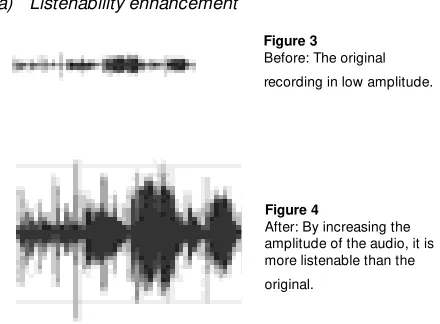
a) Listenability enhancement
It is a simple pro c e d u re by applying equalization, c o m p ression or maybe by increasing or limiting the amplitude of an audio recording to make it more listenable.
b) Intelligibility enhancement
It involves more complex process and needs audio engineering tasks. Sometimes it is needed to process a small section of a recording with certain specification and these small sections will be combined back together in exact sequential mirror as the original recording.
It can produce a spectacular result where it reveals an acoustic event, which is not listenable before the analysis procedure done.
4) Authentication analysis
This analysis used to identify whether a recording has basic similarities with the original acoustic event. Suspicious recording might need authentication through several audio forensics processes and examinations to ensure that it is coming from the same source.
5) Sound identification
Sound identification is a comparison a known sound with an unknown sound in order to identify the unknown sound or an attempt to eliminate the known sound as a suspect. This technique is similar to voice identification. (Please refer figure 2.)
For this type of comparison the original recoding device is needed. Sound identification technique is important
Figure 1
A Time-Frequency-Amplitude
spectrograph
Figure 2
The same pattern revealed in the spectrograph for voice identification
Figure 3
Before: The original
recording in low amplitude.
Figure 4
After: By increasing the amplitude of the audio, it is more listenable than the
original.
Figure 5
Before: The original recording full with hums and buzzes.
especially during voice or acoustic illusion identification produced from a recording device or an extraneous sound source.
6) Event sequence analysis
This is an analysis on a sequential acoustic event to prove re c o rding components such as timing, frequency and amplitude. This technique can be used to identify the time gap between two gunshots incident were tampered or otherwise. The process can analyse whether the second gunshot is the echo of the first gunshot or whether it was deleted from the re c o rding (tampered re c o rding). The spectrograph analysis will reveal the original when acoustic event took place.
Event sequence analysis also can be use to identify the authenticity of a re c o rding. For example in an event between A and B recorded inside a tape will be compared to a similar reconstructed event between C and D based on the timing, amplitude, frequency and other relevant factors. This statistical comparison will identify whether the recording has been tampered or vice versa.
Unfortunately, the probability for an acoustic event being duplicated is infinitesimal.
7) Dialogue decoding
It is a process of identifying what was said in a recording. Speech components have patterns, which can be displayed through a spectrograph. Audio forensics analyst can use this technique as to aid them in deciding on word contents and speech.
Vocal chord movement exists inside a voice. Audio forensics analyst can predict the high frequency speech sound such as ‘s’ and also low frequency speech sound such as ‘a’ using spectrograph analysis.
Unfortunately, dialogue decoding is not within the realm of audio forensics but towards speech scientist. It is always the best way for an audio forensics analyst to conduct dialogue-decoding analysis with the presence of speech scientist.
8) Other signal analysis
Audio forensics also can be used to evaluate ‘other’ acoustic event re c o rding that might reveal important information from the investigation such as conversation backgrounds, gunshots, machine and vehicle sounds etc.
Conclusion
Audio forensics can assist an investigation by revealing the information that was uncovered before. It also can assist investigative officers to produce more solid audio evidence
from an original recording. However, the audio forensics field remains controversial and faces great opposition in the court of law.
ETHICAL HACKER - THE ICT SIDE OF ACCOUNT AUDITOR
Introduction
Nowadays, we must accept that Information Communication Technology (ICT) has become an essential mechanism in our daily activities. Its evolution has spread not only from the young to the adult but also from social to p rofessional usage. A good example is the personal computer (PC).
There is a PC in almost every home. It has become the equipment a family must have next to the television. The growth on the usage of the PC is phenomenal. Apart from using the spreadsheet software, the PC is being utilized for I n t e rnet connectivity. Next, the emails and Intern e t browsers is required to optimize the usage of the PC.
Not only home users are affected by the ICT, but commercial banking are in dire need to have these PCs and networking gadgets. The scenario is especially true with the foreign banks, as their presence in the local arena are controlled by the government. Therefore, virtual banking is introduced to overcome this limitation.
ICT Attacks
The PC is able to do wonderful things such as software p rogramming, silicon chip designing and other useful product development. On top of this, casual PC use such as for instant messaging, gaming and information gathering via the Internet are the most popular.
However, there are always two sides of a coin. Virus attacks can destroy your PC important files and the worms outbreak may congest you network bandwidth. It is most annoying when it happens.
Network intrusion is another feared term where your system can be compromised. Imagine your virtual banking account is hacked and all the funds are siphoned to another offshore account. This is a serious issue and the users are in a dilemma.
On one hand the ICT is extremely useful and on the other hand it is vulnerable to attacks. How is it mitigated? Perhaps the ICT security topic could at least answer this important question.
Ethical Hacker
What is a hacker? Hacker is a class of people who creates and modifies computer software and computer hardware. The definition also refers to people skilled in computer programming, administration and security.
A black hat hacker, according to Wikipedia, it is a cracker or a dark side of a hacker and is seldom used outside of the security industry.
On the other hand, ethical hacker is a computer and
network expert who attacks a security system on behalf of its owners, seeking vulnerabilities a malicious hacker could exploit. Ethical hackers use the same methods as their less principled counterparts to test the system, but report the problems instead of taking advantage of them. Ethical hacking is also known as penetration testing, intrusion testing or red teaming.
An ethical hacker is sometimes called a white hat, a term that comes from old Western movies, where the "good guy" wore a white hat and the "bad guy" wore a black hat. Ethical hacking has continued to grow in an otherwise lackluster IT industry, and is becoming increasingly common outside the g o v e rnment and technological sectors. Many larg e companies, such as IBM, maintain employee teams of ethical hackers.
ICT Security
ICT has become the most important tool of any business sectors and social activities. It seems without ICT, these identified sectors would become ineffective and inefficient. Even, almost every Critical Infrastructure (CI) has already integrated with ICT. For example, the power grid has taken Supervisory Control And Data Acquisition (SCADA) system as their core monitoring system and it could be susceptible to black hat attack when connected to Internet.
As a result, many companies are now hiring Security Assurance Analyst to design, monitor and response for any ICT security attacks. From time to time they would be conducting an audit that involves application, network, host, virus management and also the latest wireless. It is m o re of technical aspects compared to Information Security Management System (ISMS) audit.
Summary
Nowadays, it is common when organization hires an ethical hacker (third party ICT security auditor) to assess its ICT system’s security. As a result, the ethical hacker job has become more prevalent. It is comparable to its counterpart that is the accounting auditor. The accounting auditor task is to check whether there is an imbalance in the financial statement. While the ICT auditor is to find if there is any vulnerability in the ICT system’s security. It does have some similarities.
ICT forensic is another emerging service in the ICT security. This service involves tracking and identifying the origin of the attacker in an organization’s ICT system, which was compromised. Others would include data recovery.
It also important to take note that product evaluation, commonly executed according to Common Criteria (CC) s t a n d a rd is another important area to have some information. It is a technique to proof the concept that the product or system security features are being formally tested for conformance. Procuring a CC evaluated product is a first step to ensure your ICT system’s security is going through a thorough setup process.
All of the above mentioned services do involves ICT security experts. During the work some confidential data can either be discovered or required. It is just like account auditor whereby every financial figures of a company is made known or discovered. Therefore, it is important to be ethical when performing this type of work and from this job
nature, ethical hacker is most suitable description.
WEB SECURITY EDUCATIONAL TOOLS
Another field of computer security comes to light when the advent of the Internet brings along a technology called the World Wide Web (WWW). At the early presence, this technology seems to be innocent since the protocol it uses called HTTP is stateless in nature. It caters each request independently from previous or upcoming re q u e s t s . Furthermore, HTTP traffics pass through the network on port 80 are always considered clean by the firewall.
As the time goes by, some advancement on the web technology is added at a regular interval. Online applications are written using some pro g r a m m i n g languages such as Perl, PHP or VB on top of a web server to cater dynamic contents to the Internet users. These applications may sit on the same server or running from independent application server.
P roblems related to web application arise when poor designs, software bugs and poor programming practices often plague applications. It then becomes a target for hackers who may want to do extra damages beside the network by seeking information or doing damages to the data that resides in an application or database.
Educational tools for web security can be used to demonstrate the real threats, which may occur during life p roduction. They can become a playground for web security enthusiasts to exploit known vulnerabilities safely on the mockup application. Amongst those applications, there are three well-demonstrated example applications called WebGoat from OWASP and; Hacme Bank and Hacme Book from Foundstone. They provide easy-to-use l e a rning orientation, credible scenario illustrations and realistic attack lessons with viable solutions.
WebGoat
This application has evolved from a project by OWASP. This group consists of very competent team members and producing real world results for administrators, developers, and security testers. They are also famous with the list of “OWASP Top 10 Web Security Vulnerabilities”.
WebGoat is a J2EE web application arranged in a number of security lessons. It is based on Tomcat and JDK 1.5. The package can be downloaded from URL http://www.owasp.org/software/webgoat.html.
Amongst the attacks and solutions provided are cross-site-scripting, SQL injection attacks, thread safety, field and parameter manipulation, session hijacking and management; and weak authentication mechanisms.
Hacme Bank
unauthorized access.
This application is built on top of ASP.NET framework and requires Microsoft IIS coupled with Microsoft SQL. Usage of the application requires users to have Internet Explorer 6. The installation file can be downloaded from URL http://www.foundstone.com/s3i.
Hacme Book
Another educational tool from Foundstone is Hacme Book, which is a J2EE application. It is a suitable tool to manipulate Java vulnerabilities plus the source code is made available. The application is running from Apache Tomcat web server with Apache Derby as the embedded RDBMS.
Some of the bugs found will be SQL injection, cross-site-scripting, broken authorization, weak passwords and improper use of crypto. For example, there is an exercise for users to deduce the algorithm for discount codes, which uses the method of substitutions.
Support Tools
In order to maximize the use of above tools, users may need some web tools to analyze and manipulate weaknesses in the application. They can be a web vulnerability scanner such as Nikto; interception proxy such as Achilles, Odysseus or Paros; web spider such as Burp Spider and command line web browser such as Curl.
Conclusion
The web security educational tools can be great tools to manipulate web vulnerability without having to attack the life system on the Internet. Therefore, the amateur security enthusiasts can have some experiences on real life threats that can be exploited through the confined of a local system.
THE EMERGING TREND OF IT OUTSOURCING
IT outsourcing and security
RECENT research from the Gartner Group predicts that while less than 3% of global IT services spending was outsourced in 2004, that figure would jump to 7% by 2008. Such changes in the way businesses operate have brought about new practices in managing IT services.
In recent years, a booming trend of transformation in information technology management has taken place, from in-house HR investments to outsourced services that are accessed when and if needed.
Many corporations outsource their IT functions onshore or o ff s h o re. Where the focus was initially on mainframe management and data processing services, it has evolved to cover a broad range of services ranging from software development to network management and information security.
Over the past decade, multinationals that outsourced their IT functions enjoyed substantial cost savings by taking
advantage of the skills and lower labour rates in countries such as China and India.
A recent benchmarking study on outsourcing locations in the Asia Pacific region has placed Kuala Lumpur as a “clear favourite” for locating offshore shared service operations. The study, by Deloitte Consulting, also described Malaysia as a “ credible challenger” to traditional off s h o re o u t s o u rcing locations such as India, China and the Philippines.
Business transformation outsourcing, however, has not only endowed corporations with greater flexibility in managing projects and an improved cost structure in maneuvering internal IT Services, but also exposed outsourced services to risks by involving intermediaries in the processing of information and applications.
As such, baseline controls and measures are heavily used these days to evaluate the performance of the outsourced IT services. In many cases, a service level agreement (SLA) is used to define the type, value and conditions of outsourcing services to be provided.
This brings about an interactive outsourcing practice, which drives providers to develop and enhance vertical solutions to meet the same quality and performance standards as in-house applications; and at the same time allowing buyers to seek benchmarking services through outsourcing.
While there is a remodeling of the outsourcing process and standards now and then, many prominent international security vendors aim to capture a larger market share and expand their scope of business by offering expertise in o u t s o u rcing management services, predominantly to multinational companies.
In Malaysia, security outsourcing like Managed Security Service (MSS) has been adopted chiefly by the financial services sector for the past four years. The objectives are:
• BNM JPI26 and GPIS-1 compliance
• Check and balance between the IT/IS team and MSS provider
• Risk mitigation via proactive intrusion detection and escalation via the MSS provider
• Proactive countermeasure against any cyber threats • Risk and trend analysis
Generally speaking, outsourcing helps organizations reduce costs. On the other hand, it gives rise to potential problems that should not be overlooked.