A TRIMER OLIGOSTILBENOID FROM INDONESIAN
VATICA PAUCIFLORA BLUME (DIPTEROCARPACEAE)
Sri Atuna, Sjamsul Arifin Achmada, Euis H. Hakima, Yana M. Syaha, Koichi Takeyaa, Lukman Makmura, Didin Mujahidina, Lia Dewi Ja.
a. Department of Chemistry Institut Teknologi Bandung Jl. Ganesa 10 Bandung 40132. Bandung
b. Tokyo University of Pharmacy and life Science Horinouri 1432-1 Hachioji, Tokyo 192-0392, Japan
Abstract
A trimer oligostilbenoid, named Stenophyllol B has been isolated from the ethyl acetate extract of the stem bark of Vatica pauciflora Blume. The structure was elucidated based on spectroscopic data including UV, IR, MS, NMR ( 1H & 13C ), HMQC, HMBC,
and COSY. This compound showed medium activity ( IC : 8,5 l/ml) with P388 murine leucaemia cell. The isolation and structure elucidation of this compound will be described.
Key words : Stenophyllol, Vatica pauciflora Blume, Trimer oligostilbenoid
Introduction
Dipterocarpaceae is one of the largest families found in the tropical forest Indonesia. The plants are distributed from the west of Indonesia until Papua (Irian Jaya) and the mostly in Kalimantan, there fore the timber of these plants are ussually called “ meranti” or “ Kayu Kalimantan”. Dipterocarpaceae consists of about 16 genus and 600
secies 1,2 and until now only few species have been investigated.
Some chemical constituents that can be found from this plants include arilpropanoid, benzofuran, flavanoid, polyphenol, oligostilbenoids, and terpenoid 2,3. The oligostilbenoids from Dipterocarpaceae plants have various structure from simple structure as like resveratrol monomer, resveratrol dimer, resveratrol trimer, until resveratrol hexamer 4. These structure are very interesting and showed interesting biological activity, such as antibacterial, anticancer, antihepatotoxic, and anti-HIV. Thus Dipterocarpaceae plants are very potential for chemical research in natural product and pharmaceutical industry. Recently a number of novel had been reported such as resveratrol-12C- -glucopyranoside (1) from Shorea hemsleyana5, -viniferin (2) from V.
affinis 6, -viniferin (3) from S. hemsleyana5, hopeaphenol (5) from S. hemsleyana 5, and vaticanol D (5)from V. rassak4.
The aims of this research is to isolate, determine structure and biological activity of these compounds from V. pauciflora. Until now these species never have been investigated by other researches. Thus in the present work we report on the isolation, structure determination, and biological activity of a trimer oligostilbenoid. Stenophyllol B
6
Experimental Section
General Experimental Procedures
Melting points were determined on a micro melting point apparatus and are uncorrected. Optical rotation was measured in MeOH on a JASCO DIP-370 digital polarimeter. UV and IR spectra were obtained using varian Cary 100 Conc and one Perl\kin Elmer Spectrophotometers. 1H and 13 C NMR spectra were recorded with JNM A 6000 spectrometer operating at 500 MHZ (1H ) and 500 MHZ (13 C) using TMS as an internal standart. FAB-MS were obtained with Jeol JMS- AM 20 mass spectrometer using the EI mode. VLC was carried out using Merk Si-gel 60 GF254, flash
chromatography with Merk Si-gel 60 (230 – 400 mesh), and TLC analysis on precoated Si-gel plates (Merk kieselgel 60 F254 0,25 mm ).
Plant Material
Sample of the steam bark of V. pauciflora were collected in September 2000 from the research garden Dramaga Bogor , Indonesia. The plant was identified by the staff at the Herbarium Bogorienses, Bogor, Indonesia.
A1
A2 B2
B1
C2 C1
O OH
OH
OH OH
OH H
H H H
H
OH H
OH
Bioactivity Test
The sitotoxycity of the compound was eva;luated with P388 Murine leucaemia cells.
Extraction and Isolation
The milled dried steam bark (5 Kg) was extracted exhaustively with MeOH ( 3 x 15 L) for 24 hours. The combined extracts were evaporated under reduced pressure to small volume. The extract was fractionated with hexane ( 3 x 500 ml), methylena chloride ( 3 x 500 ml) and then with ethyl acetate. A part of the ethyl acetate fraction (35 gr) was preabsorbed on silica gel and chromatographed over a colum of silica gel with amounts of hexane in ethyl acetate as eluent with increased gradient polarity. Fraction which gave the same Rf on TLC were combined and rechromatographed in the same way. The less polar fraction yielded material which was purified by repeated chromatography to give S-1 (6) as amorf pale yellow (42 mg). Stenophyllol B was obtained as amorf pale yellow, m.p 230 oC (decompous), [ ]D : -20 (in 0,1 MeOH), UV
(MeOH) max : 205; 230 (sh); 285 nm, IR (KBr) max : 3393 (OH); 1613; 1462; (C=C aromatik); 1337; 1231;1171; 1124; and 831 Cm-1. 1H- NMR ( AC2O, 500 MHZ) and 13C
– NMR see Table 1. FAB-MS m/z (relative intensity) [M+
Discussion
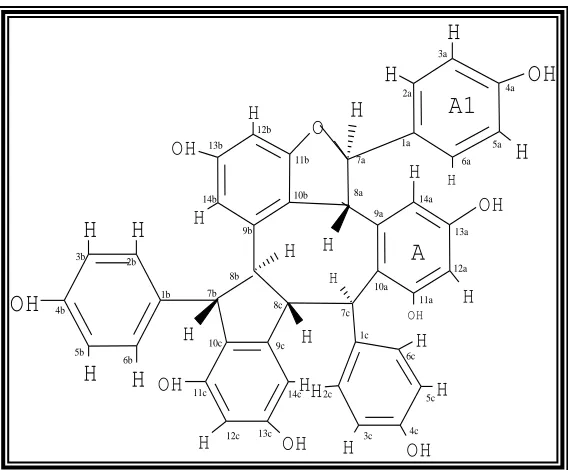
The FABMS of stenophyllol B (6) gave an [M]+ ion at m/z 680 consistent with a molecular formula of C42H32O9 and is regarded as a stilbene trimer. The IR spectrum of
compound 6 showed absorbtions broads typical of hydroxyl (3393 Cm-1), aromatic ring ( 1613; 1462; 1337 Cm-1) and a prominent band at 831 Cm-1 indicative of 1, 4 disubstituted aromatic ring. The predicted structure of 6 was further confirmed by the NMR data ( 1H and 13C) (Table 1) including HMQC, H-H COSY, and HMBC and compared with those reported in literature 7.
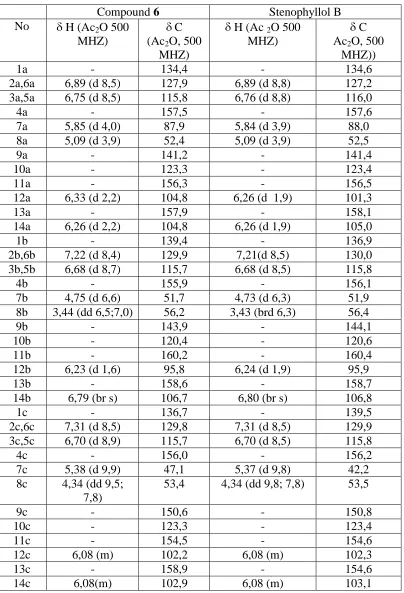
It can be seen from the NMR ( 1H and 13C) spectral data of 6 (Table 1). The 1H –
NMR spectrum showed the presence of three sets of NMR coupled aromatic protons
assignable to three 4 – hidroxyphenyl groups [ 6,89 (2 H, d. J : 8,5 Hz, H 2a, 6a); 6,75
( 2 H, d, J : 8,5 Hz, H 3a, 5a); 7,22 ( 2H, d, J : 8,5 Hz, H 2c, 6c); 6,70 ( 2 H, d, 8,9, H 3c,
5c)], three sets of proton assignable to 1,2,3,5-tetra substituted benzene rings [ 6,33 ( 1
H, d, J : 2,2 Hz, H 12a); 6,26 ( 1 H, d, 2,2 Hz, H 14a); 6,23 ( 1H, d 1,6 Hz, H 12b); 6,79
( 1 H, br s ), H 14b); 6,08 ( 1 H, m, H 12c and 14 c ), a set mutually coupled aliphatic
methines [ 5,85 ( 1 H, d, J : 4,0 Hz, H 7a); 5,09 ( 1 H, d, J : 3,9 Hz, H 8a)], a sequence
of aliphatic methine protons coupled succesively in this order [ 4,75 ( 1 H, d, J: 6,6, H
7b), 3,44 ( 1 H, dd, J : 6,5; 7,0 Hz, H 8b); 4,34 (1H dd, J : 9,5; 7,8 Hz, H 8c); 5,38 ( 1H,
Table 1. The NMR ( 1H and 13C ) spectral data of compound 6 and stenophyllol B
Compound 6 Stenophyllol B
All protonated carbon signals in the 13C-NMR spectrum were assigned completely
by the HMQC spectrum and are listed in Table 1. The 13C- NMR spectrum of 6 exhibited
fourty two signals corresponded to six methine alifatic carbon at [ 47,1; 51,7; 52,4; 53,4;
56,2; 87,9], eighteen methine aromatic carbon at [ 2 x 127,9; 2 x 115,8; 101,2; 104,8; 2
x 129,9; 2 x 115,7; 95,8; 106,7; 2 x 129,8; 2 x 115,7; 102,2, 102,9] and nine quarternary
carbon at [ 134,4; 141,2; 123,3; 139,4; 143,9; 120,4; 136,7; 150,6; 123,3], lowfield
signals at [ 157,5; 156,3; 157,9; 155,9; 160,2; 158,6; 156,0; 154,5; 158,9 ] were
assigned to nine oxyaryl carbons.
Assignment for all the fuctional groups in compound 6 we achieved by
heteronuclear multiple quantum coherence (HMQC) and heteronuclear multiple bond
connectivity (HMBC) experiment. In the HMBC spectrum of 6 showed 13C – 1H long
range correlations were observed between C-2a(6a) / H – 7a, C-8a/ H-14a; C-9b/ H-8a;
C-9b/ H-14 b; and C-7c/ H-2c(6c); C-8c / H-7b; C-7b/ H-2b(6b) (Fig. 1). In the 1H – 1H
long range COSY spectrum, the mutually coupled methine protons ( H-7a and H-8a)
were correlated with H-2a (6a) and H-14a respectively. The long range correlation were
observed to between H-7c / H-8c; H-8c/ H-8b; H-7b / H-2b(6b) (fig 2). These result
indicated that a resveratrol unit formed a 2,3- aryldihydrobenzofuran skeleton through
ring B2. These spectroscopic evidence were in agreement with the proposed structur
assigned to stenophyllol B (6) came from comparison of the NMR ( 1H and 13C) to those
Fig. Significant HMBC Correlation of Stenophyllol B
Fig 2. Significant H-H Cosy Correlations of Stenophyllol B
These compound showed medium activity ( IC 8,5 g/ml) with P388 murine
leuceimia cells. A trimer oligostilbenoids type have been isolated from several other
Dipterocarpaceae and Leguminace species 7,8,9.
Acknowledgment
The authors are grateful to rearch garden at Dramaga Bogor and Staff at the
Refference
1. Hegnaeur R. (1966) Chemotaxonomic Der Pflanzen, Birkauser Verlag Based,
Stuttgard, 31-39
2. Cronquist A, (1981) An Integrated System of Classification of Flowering Plants,
Columbia Univ. Press, New York, 316 – 318.
3. Tanaka T, T. Ito, Y Ido, T.K. Son, K. Nakaya, M. Linuma, M. Ohyama (2000)
Oligostilbenoids in Stem bark of Vatica rassak, Phytochemistry, 53, 1015- 1019.
4. Tanaka T, T. Ito, K. Nakaya, M. Iimuna, Y. Takashi, H. Naganawa, N. Matsura, M.
Ubukata (2000) Vaticanol D, a Novel Resveratrol hexamer Isolated from Vatica
Rassak, Tetrahedron Letter, 41, 7929 –7932.
5. Ito Tetsuro, T. Tanaka, Y. Ido, K. Nakaya, M. Iinuma, S. Riswan (2000) Stilbenoids
isolated from Stem Bark of Shorea hemleyana, Chem. Pharm. Bull, 48 (7), 1001 –
1005.
6. Sotheeswaran S, M.U.S. Sultanbawa, S. Surendrakumar, S. Balasubramaniam, P.
Bladon (1985) Polyphenols from Dipterocarphaceae Species Vaticaffinol and
-viniferin, J. Chem. Soc. Perkin. Trans , 159 – 162.
7. Ohyama M., T. Tanaka, M. Iinuma, C.l. Burandt Jr (1998) Phenolic Compounds
Isolated from The Roots of Sophora Stenophylla, Pharm. Soc. Of Japan, 46 (4),
663-668.
8. Sultanbawa M.U.S, S. Surendrakumar, P. Bladon (1987) Distichol an Antibacterial
Polyphenol from Shorea Disticha, Phytochemistry, 26 (23), 799 –801.
9. Tanaka T, T. Ito, M. Iinuma, M. Ohyama, M. Ichise, Y. Tateishi (2000) Stilbene