CYTOTOXICITY EFFECT OF RESVERATROL OLIGOMERS AND THEIR
DERIVATIVES AGAINST HUMAN CANCER CELL LINES
Sri Atun
a, Nurfina Aznam
a, Retno Arianingrum
a, Takaya Yoshiaki.
b,
Niwa Masatake
ba
Department Chemistry education, Universitas Negeri Yogyakarta, Karangmalang, Depok, Sleman, Yogyakarta, 55281, Indonesia b
Faculty of Pharmacy, Meijo University, Tempaku, Nagoya, Japan E-mail : [email protected].
Abstract: Eleven resveratrol oligomers isolated from Hopea (Dipterocarpaceae) and their derivatives were evaluated for in vitro cytotoxicity against a panel of human tumor cell lines. Among them, two compounds ampelopsin H (6) and vaticanol B (4) show the activity of cytotoxicity againt cell Hela-S3, Raji, and Myeloma
Introduction
In our continuing phytochemical study of the Dipterocarpaceae family occurring in Indonesia, we have examined the resveratrol derivatives constituents of Hopea mengarawan, H. odorata, and H. nigra. Hopea is a relatively large genus belonging to the family Dipterocarpaceae and is distributed mainly in Southeast Asia [1;2]. This family has proven to be a rich source of oligostilbene compounds derived from the resveratrol (4, 3’, 5’-trihydroxystilbene) [3-11].
Materials and Methods
Samples of the stem bark of H. Mengarawan, H. odorata, and H. nigra were collected in December 2003 from the Experimental Garden in Carita, Banten, Indonesia. The plant was identified by the staff at the Herbarium Bogoriense, Kebun Raya Bogor, Bogor, and a voucher specimen is still deposited at the Herbarium.
The stem bark of H. mengarawan (5 kg) which had been milled and dried was extracted exhaustively with acetone. The acetone extract on removal of the solvent under reduced pressure gave a brown residue (400 g). A portion (40 g) of the total acetone extract was fractionated by vacuum liquid chromatography (VLC) and purified by repeated column chromatography on silica gel eluted with various solvent systems. From this method we obtained four oligostilbenes, namely balanocarpol (1) (300 mg), heimiol A (2) (200 mg), vaticanol G (3) (70 mg), and vaticanol B (4) (200 mg). The structures of these compounds (1 – 4) were established on the basis of their spectral data, including UV, IR, and NMR spectra in comparison with the previously reported data [6-12] and by direct comparison with the authentic samples. From the dried and milled stem bark of H. odorata (3.8 kg) was isolated four componds, namely balanocarpol (1) (300 mg), hopeaphenol (5) (1500 mg), ampelopsin H (6) (250 mg), and hemlesyanol C (7) (120 mg), whereas from the dried and milled stem bark of H. nigra (4,6 kg) to give vaticanol G (1) (200 mg) (Fig. 1). The isolation procedure and
spectroscopic data of all compounds were described in previous papers [11]. We synthesize the derivates of the compounds by using methylation and acethylation of balanocarpol and hopeaphenol. Methylation of these compounds was allowed to react with K2CO3 and Me2SO4 in dry acetone under reflux for 6 h. The crude product was purified by chromatographic method. Acetylating of these compounds was allowed to react with anh. Acetic acid in pyridine under reflux for 24 h. The crude product was purified by chromatographic method and was identified by spectroscopy UV, IR, NMR From this reaction, we found deca-methyl-O-hopeaphenol (8), and deca-acethyl-hopeaphenol (9), penta-methyl-O-balanocarpol (10), hexa-acethyl-balanocarpol (11).
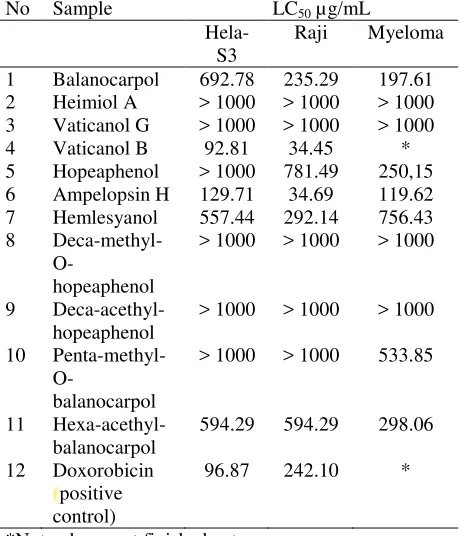
All of compounds we evaluated for in vitro cytotoxicity against a panel of human tumor cell lines Hela S3, Raji, and Myeloma. The in-vitro cytotoxicity test was investigated using plate with 96 wells, with cell density 2x10⁴ cells per ml. Into each well was added 100 µl cells in culture medium (87.5% RPMI 10.4 g/L; 2% penstrep; and 10% FBS) which was then incubated in CO2 incubator for 12-24 hours at 370C. Each sample was dissolved in culture medium containing 0.05% DMSO, and 100 l of each sample in different concentrations was added into each well in triplicate and was then incubated in CO2 incubator for 12-24 hours at 37oC. MTT solution (10 l per 100 l medium) was added to all wells of an assay, and plates were incubated for 4 hours at 37oC in CO2 incubator. As much as 100 l formazan (10% SDS and 0.01 N hydrochloric acid) was added into each well and mixed on a shaker for 5 minutes. The wells were incubated in the dark room for 12-24 hours at room temperature. The absorbance was measured using multiwall scanning spectrophotometers (ELISA reader) at wavelength 595 nm. The absorbance is directly proportional to the number of living cells. So the dead cell could be calculated to determine LC50. Doxorubicin, a medicine for lymphoma, leukemia and acute tumor, was also measured its cytotoxic activity as positive control comparison. The cytotoxic activity of the samples against Hela-S3 cell measured as LC50 were provided in Table 1. Hela-S3, a continuous cell
line that lived as adherent cell, is a cell derivate of ephythell cell of human cervix cancer. Further investigation of cytotoxic activity of the samples was held against Raji cell (Table 1). The cell that resembles lymphoblast cell found by R.J.V Pulvertaft (1963) from Burkitt’s lymphoma
at the left of the upper jaw of a 11 year old negro boy.
Myeloma cell, the first from Merwin Plasma Sel Tumor-11
385
(MPC-11) which isolated from mice Balb/c and were collected by J. Fahey on 1967.
Results and Discussion Fig. 1 Isolated compounds from Hopea structure
The cytotoxic activity of the samples against Hela-S3, Raji, and Myeloma cell measured as LC50 were provided in Table 1. Table 1 showed that the highest cytotoxic activity against Hela-S3 and Raji are vaticanol B (4) and ampelopsin H (6). This compound is more active than doxorubicin. Among these resveratrol oligomers tested, two compounds vaticanol B (4) and ampelopsin H (6) showed LC50 less than the other compounds. Two compounds displayed significant cytotoxic effect on Hela S3 and raji cell lines. There is an interesting result from this research that all of derivative reveratrol, methyl and acethyl balanocarpol and hopheaphenol showed very high LC50 (> 1000 µg/mL) in all the cell lines tested. This might suggest that the phenolic unite have important ability in cytotoxic effect of resveratrol in all the cell lines tested.
Table 1. The cytotoxic effects of resveratrol oligomers and their derivatives in human cancer cell lines
No Sample LC50 µg/mL
*Note : have not finished yet
It is necessary to held further investigation about the relationship between the structure and their activities of these compounds. Some studies of curcumin that has been known as anticancer indicated that the existence of hydroxyl group at ortho position and β-diketon gave a big contribution as inducer of enzymes in phase two that their function as protector from carcinogenesis as epoxy hydrolyse, glutathione S-transferase (GST), and NAD(P)H quinone reductase (QR). The relationship between structure and their activity in curcumin have been reported by Majeed [14] due to functional group of this compound, For example : (1) the antioxidant activity was determined by
hydroxyl group at aromatic core. This matter also was proven in the research about antioxidant character of curcumin and their analogue using some approach that proved the role of hydroxyl group for reduction character and radical capturer in curcumin and their derivates; (2) β- dicarbonil group and double bound play a role in biological activity as antiinflamation, anticancer, and antimutagenic. Even though in this paper, it has not yet investigated the relationship between structure and activity of these compounds, but it has indicated that isolated compound from steam bark of H. mengarawan, H.odorata and H. nigra are very potential to be developed as cancer medicine.
Conclusions
In this paper we conclude that isolated compound from steam bark of H. mengarawan, H.odorata and H. nigra have cytotoxic effect against Raji, HeLa-S3, and Myeloma lines cell. Vaticanol B (4) and mpelopsin H (6) give the highest cytotoxic effect against HeLa-S3 and Raji, while the derivative resveratrol, methyl and acethyl balanocarpol and hopheaphenol are not active.
Acknowledgements
This work was supported by Basic Research 2006-2007, Directorate General Higher Education, Republic of Indonesia; competitive grant (Insentif Riset Dasar, Ristek- 2008), Ministry Research and Technology, Republic of Indonesia The authors are grateful to the experimental Garden in Carita, Pandeglang, Banten, Indonesia and Herbarium Bogoriensis for supported the sample and identification of the plant specimen.
References
[1] Cronquist A.. An Integrated System of Classification of Flowering Plants, Columbia In Press, New York, (1981) pp. 316 – 318
[2] Soerianegara I., R.H.M.J. Lemmens. Plant resources of South East Asia, 5 (1), timber trees : major
commercial timbers, Prosea, Bogor, Indonesia, (1994)
pp. 166- 193
[3] Langcake P. and Pryce, R.J., Phytochemistry, 16, (1977) pp. 1193 –1196
[4] Jang M., Lining Cai, G.O. Udeani, K.V. Slowing, C. F. Thomas, C.W.W. Beecher, H.S. Fong, N.R. Farnsworth, A. D. Kinghorn, R.G. Mehta, R.C. Moon, J.M. Pezzuto. Science. 275, (1997) pp. 218- 220 [5] Sotheeswaran S.,and Pasuphaty, V., Phytochemistry,
32 (5), (1993) pp. 1083-1092
[6] Tanaka T., T. Ito, K. Nakaya, M. Iinuma, Y. Takashi, H. Naganawa, N. Matsuura, M. Ubukata., Tetrahedron Letters, 41, (2000) pp. 7929 – 7932
[7] Ito T., T. Tanaka, K. Nakaya, M. Iinuma, Y. Takahashi, H. Naganawa, M. Ohyama, Y. Nakanishi, K.F. Bastow, Kuo-Hsing Lee., Tetrahedron Letters,
42, (2001a) pp. 5909-5912
[8] Ito T., T. Tanaka, Y. Ido; K. Nakaya, M. Iinuma, Y. Takashi, H. Naganawa, M. Ohyama, Y. Nakanishi, K.F. Bastow, K.H. Lee., Tetrahedron, 57, (2001) pp. 7309-7314
[9] Seo E.K., H. Chai ,H.L. Constant, V.R. Santisuk, R. Vichai, W.W. Christopher , N.R. Farnsworth , G.A. Cordell, J.M. Pezzuto, A.D. Kinghron ., J. Org. Chem. , 64, (1999) pp. 6976-6983
[10] Dai, J.R., Y.F Hallock., J.H. Cardellina , M.R. Boyd (1998). J. Nat. Prod., 61, (1998) pp.351-353 [11] Atun S, Arianingrum, R., Aznam, N., Indonesian
Jornal of Chemsitry, Vol. 6, No. 3., (2006) pp. 3007-311.
[12] Anonim. Raji Cell, http://www.Biotech. ist.unigue (2003)
[13] Dinkova-Kostova, A.T., and Talalay, P.
Carcinogenesis.20(5), (1999) pp. 911-914
[14] Majeed, M., Badmaev, V., Shirakumar U., and Rajendran, R. Curcuminoids antioxidant phytonutrients, 3-80, NutriScience Publisher Inc., PisCataway, New Jersey (1995).
387