22 !
! " ! !
Mochammad Syamsul HADI*, Toto HIMAWAN, Luqman Qurata AINI
(Received 23 Juni 2013; Accepted 31 July 2013)
#$
This study was conducted to examine the effect of and insect growth regulator lufenuron on the fecundity and reproductivity decline of fruit fly adults. The study was conducted at the Laboratory of Entomology, Department of Plant Pests and Diseases, Faculty of Agriculture, University of Brawijaya from March 2012 until December 2012. The density of . spores used in this study was 108spores/ml and the lufenuron concentrations used are 0.5, 1, and 1.5 ml/l. The results showed that the application of . spores at density of 108 spores/ml combined with lufenuron at the concentration of 1.5 ml/l significantly reduced the fecundity, egg fertility and reproduction of . up to 95.69%.
Keywords: , , Lufenuron.
*
% $ $ # $$ !&% " %$ ' #( (
) * )
Fruit fly is one of the harmful pests which affects both quantity and quality of fruits and vegetables. This pest is a key pest on fruit in all over the world, including in Indonesia (Kuswadi ., 1997). The genus of Bactrocera has various types of destructive fruit flies in Indonesia, one of them is
Drew and Hancock (Diptera: Tephritidae).
is one of 52 species on the complex group of (Hendel) and could attack a wide range of fruits including papaya and star fruit. This fly has been reported attacked 75% of fruit trees and become second major pest of fruit crops after
(Malavasi ., 2000 in Rachmawati, 2006).
Damage caused by was
usually seen from the puncture marks found on fruit skin. Ovipositor punctures of
females are easily recognized by discoloration of skin fruit around the puncture marks and the fruit will decay quickly.
The damage caused by fruit flies can be prevented and reduced by preventive efforts. The control measure for fruit
fly can be done either by physical, chemical and biological. The control of fruit flies was commonly done by using chemical insecticides. However, insecticides application causing a lot of problems such as increasing the insect resistance, environmental pollution, poisoning, and death of nonBtarget animals.
An alternative control of fruit fly could be done by using natural enemies either of parasitoids, predators, or microbial pathogens. The most vulnerable life stage of fruit flies which frequently attacked by natural enemies are at the stage of final instar of larva, pupa, and adult. Eggs and early instar of larva are tend to be protected from the attack of natural enemies because they were exist inside the fruits. However, the eggs and early instar of larva could also be attacked by parasitoids, mites and pathogenic microorganisms (Artayasa, 1999). The control of eggs and early instar of larva of
will be more effective because it can prevent the formation of pupa and adult led to reduce the spread rate of .
The control of early instar of
23 !
environmental friendly and does not cause resistance. One of beneficial pathogenic microorganisms that can be used to control the larva is the fungus
(Bals) Vuill. This fungus has been widely used in various types of pest control on a wide range of plant species. has been proved effective in controlling a variety of pests. Unfortunately, when it is applied in the field, the pathogenicity is not consistent due to the influence of unfavorable environmental conditions, especially temperature, humidity, and solar radiation (Inglish, ., 1995). To increase the pathogenicity of , the formulation of isolates as well as adding a carrier that can improve the performance of the fungus must be done. One of compatible carrier which could increase the pathogenicity of
is the addition of Insect Growth Regulator (IGR) (Krysan, 2010).
IGR is an insecticide belongs to the new group which has high selectivity towards the target insect that is in accordance with the principles of integrated pest management (IPM). IGR can interfere or inhibit the life cycle of also interfere the reproductive system of target insect pests (Hoffman, 1998). The combination of with IGR is expected to be a new Diseases, Faculty of Agriculture, University of
Brawijaya. Pupa of which
almost ready to be adult were placed in a Petri dish and put in a maintenance cage (Figure 3a). Maintenance cage with 45 cm long, 35 cm wide and 50 cm high walls are made of polywood and the other side is made of gauze for aeration and the entry of light into the cage. The back wall is made shaped door to enter the pupa and food for adult . The front wall consist of waterBsaturated sponge pieces. In the culture cage, 20Bwatt fluorescent lamp at 20 cm above the surface of the cage was mounted to add lighting maintenance (Kuswadi ., 1997).
Feed used for maintenance adult was a mixture of sugar and protein hydrolysate with a ratio of 4:1. After weighed, the feed is placed on a Petri dish and put in the culture cage (Kuswadi 2000). Feeding on the insects affect the growth, fecundity and survival of insects. Sugar or sucrose is a form of carbohydrate that is needed by the female fruit flies to produce eggs, while the protein was required for sexual maturity and egg production (Crown, 1997).
Figure 3. (a) Culture cage of adult; (b) The adult glass egg for laying female fruit flies
24 !
Female will lay eggs on nesting glasses after the age of 10 days. Egg harvesting was done by placing a glass nesting in holes that already exist in the cage wall. Before being installed, nesting cups filled with pieces of waterBsaturated sponge to retain moisture in the glass so that the laid eggs were not dry. Laying glass installed for 24 hours starting at 08.00 am. Eggs laid on the inside of nesting glass wall were collected by washed and filtered using a black fabric so that the egg could be seen and then the egg were ready to be infested or used for the treatment (Kuswadi
., 1997).
Treatment cages of adult were transparent plastic cups and covered with gauze (Figure 2). In the cage wall was made a hole for installed tube with a diameter of 3 cm as a place for adult to lay the eggs. Inside of the tube was perforated using a needle with a diameter of 0.5 mm as a place for fruit fly
oviposition.
The fungus used in this study is a collection of Plant Pest and Disease Laboratory Faculty of Agriculture, University of Brawijaya Malang. Isolates were propagated using Potato Dextrose liquid medium, in a fermenter. Fermenter is tank or container which contain media for the entire cell (microbial) to transform raw material into biochemical products with or without byproducts. The first step for fermentation was incorporation of pure into the fermenter containing Potato Dextrose liquid media (200 g potato, 20 g dextrose, in 1 liter of distilled water) and aerated
using aerators for 3B4 days then the conidia were collected and calculated using haemocytometer.
$ (
Adult used in this study were male and female adult emerging from pupa and old alike. In order to obtain the adult of the
same age, pupa of were
harvested on the same day, hence the adults which came out on the same day is calculated as the adult of the same age. Male and female adult of which came out of the pupa were immediately taken out using the respirator and put in treatment cage. adult fed a sugar and protein hydrolysis with 4: 1 ratio.
Males and females adult are treated in a separate cage. Each cage was inserted with 10 adult. Adult separation have to be done because there was a difference treatment between male and female adult. male and female adults are treated with and Lufenuron with different concentrations. Lufenuron was dissolved on water and then used for application onto adult. Administration of was done by using a saturated sponge placed in the treatment cage. The difference treatments for male and female adults were conducted to determine the effect of and Lufenuron with various concentrations on the death and sterility of . The concentration of
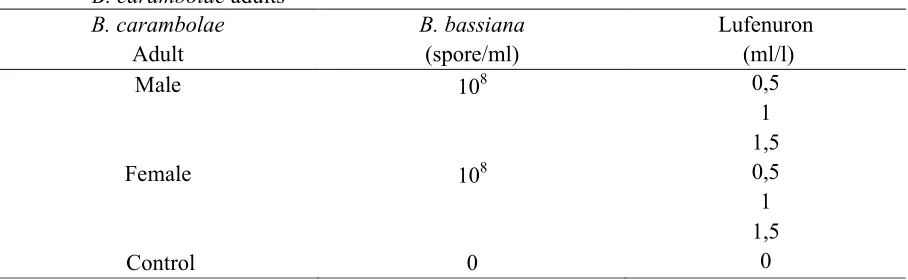
and Lufenuron used in each treatment are presented in Table 3.
Figure 2. Treatment cage of adult. (a) Saturated sponge for drinking of . adult; (b) Nesting place tube of female adult.
a
25 !
Table 3. Administration of with various concentration level of Lufenuron on adults
Lufenuron
Adult (spore/ml) (ml/l)
Male 108 0,5
1 1,5
Female 108 0,5
1 1,5
Control 0 0
The treatment used in this experiment was completely randomized design (CRD) consisting of three treatments on either female or male adults and one treatment using aquadest as a control, the whole treatment was repeated three times.
adults used as controls were 10 pairs of adult without administration of
and Lufenuron. On a separate cage, 30 male adults and 30 normal female adults (without administration of and lufenuron) were also maintained. The adults will be administered with combined and lufenuron. At 2 days old, male and female adults paired were also copulated by placed 10 pairs of adults in each cage. Male adults administered with and lufenuron were paired with normal female adults, in contrast the female adults administered with
and lufenuron were paired with normal male adults. adults used as controls were male and female adults both without administration of and lufenuron.
The variable observed in this study were the fecundity of and egg fertility of
fruit fly . Fecundity
was determined by counting the number of eggs laid by the female adults during her lifetime and the number of eggs in the ovaries. Number of eggs of
female adults laid was calculated and recorded daily. The eggs which were still in the ovary were counted by dissecting the abdominal of
dead adult females. To obtain eggs produced by female adults (female fecundity) the eggs laid by adult females were summed with the eggs in the ovaries
egg fertility was determined by calculating the percentage of the number of eggs that can hatch into larvae. Eggs obtained were placed on a Petri dish which was lined with black fabric to facilitate observation and added with water saturated cotton to retain the moisture. The number of eggs that hatched at 48 hours after treatment was then observed with a magnifying glass and then calculated. The eggs that have hatched will be showed more transparent than eggs that have not hatched. Eggs that did not hatch were showed white in colour.
The formula used to calculate the percentage of hatching eggs is as followed.
Description:
P: Percentage of egg hatching a: The number of eggs that hatch b: The number of eggs laid
The fecundity of were
calculated to determine the percentage of reduction in fecundity of resulted from the administering of and
26 !
The formula used to calculate the reduction percentage in fecundity of is as followed.
Fecundity reduction (%) = MFC – MFT x 100% MFC
Description:
MFC : Mean fecundity of in Control
MFT : Mean fecundity of in Treatment
!,* , ) , *,, )
! (
(
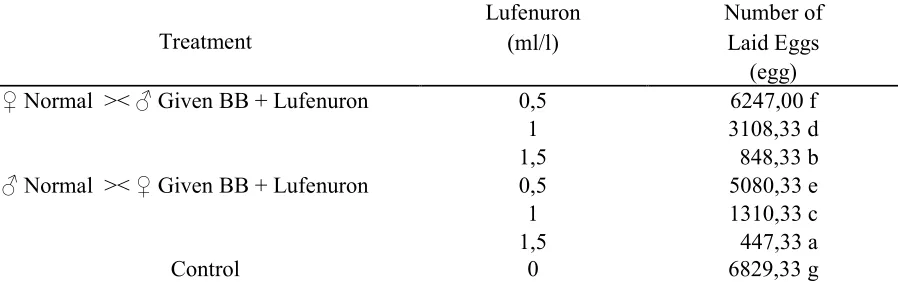
The effectiveness of admnistration of combined with lufenuron on fecundity could be known from the number of eggs laid by adult . The results showed that the number of eggs laid
by adult administered with
combined and lufenuron is less than the number of eggs laid by adult
without administered with combined and lufenuron (Table 5). This result
suggests that combined with lufenuron could reduce the number of eggs laid
by adult .
Data on Table 5 showed that the administering of combined with lufenuron at the concentration of 1.5 ml/l revealed the lowest number of eggs produced by both adult females without being administered with and lufenuron paired with adult males administered with and lufenuron, as well as adult females administered with and lufenuron paired with adult males without being administered with
and lufenuron compared with those at lower concentration of and lufenuron. This result suggests that the increase of the lufenuron concentration could reduce the number of eggs laid by the adult female
.
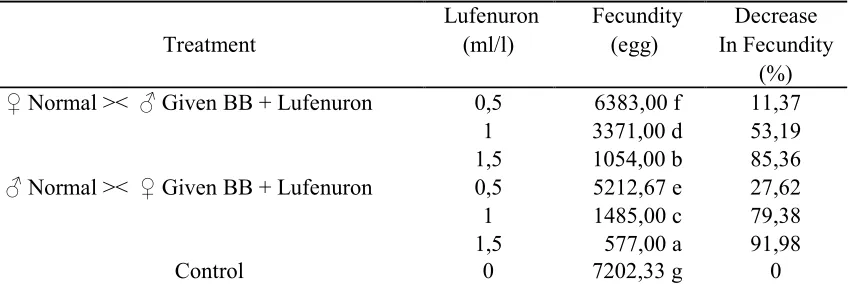
The administering of combined with lufenuron on the adult also affected fecundity (Table 6). Fecundity of could be known by counting the eggs laid and the number of eggs in the ovaries of adult female .
Table 5. The Average Number of Eggs Laid by administered with combined 108 spores / ml and Lufenuron at different concentrations
Treatment
Lufenuron Number of
(ml/l) Laid Eggs
(egg)
♀ Normal >< ♂ Given BB + Lufenuron 0,5 6247,00 f
1 3108,33 d
1,5 848,33 b
♂ Normal >< ♀ Given BB + Lufenuron 0,5 5080,33 e
1 1310,33 c
1,5 447,33 a
Control 0 6829,33 g
27 !
Table 6. The mean and decrease in fecundity Fruit Flies given drink 108 spores / ml and Lufenuron at Different Concentrations
Treatment different at 5% error level by DMRT.
Table 6 showed that the fruit fly administered with combination
of and lufenuron revealed lower fecundity compared with that of
without administered with and lufenuron. The combination of with lufenuron administered at a concentration of 1.5 ml/l showed the highest in reducing the fecundity of .The percentage of the reduction of the fecundity of
was also seen the highest reaching 91.98% at affect the reproductive system and reduce fertility of . Budiwati (1997) stated that Lufenuron could influence the reproduction of insect may be by inhibition of oocyte development or egg maturation in the ovaries. Inhibition of primary oocyte can affect the formation of adult females which led to have no follicle cells. Follicle cell function in the process of ovulation and oocyte transportation, serve as endocrine glands as well as the corpus luteum at postBovulation. Post ovulation corpus luteum produces estrogen and progesterone which are essential for controlling the reproductive cycle, sexual appearance and sexual behavior (Budiwati, 1997). lufenuron (Table 7). Increased concentrations of lufenuron combined with showed
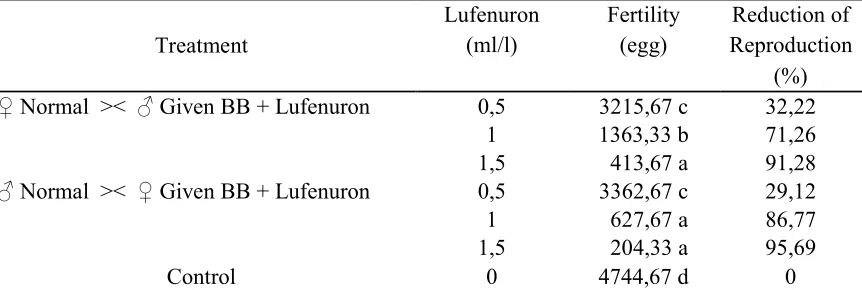
more reduction of eggs fertility of .
Male or female administered with of lufenuron at the concentration of 1.5 ml/l showed consistently able to reduce the eggs fertility of . This suggests that
combined with lufenuron at a concentration of 1.5 ml/l is effective in lowering the egg fertility or increasing the sterility of
.
The reduction of egg
fertility indicates the decline on the
reproduction resulted on the
reduction of the number of
offspring. Lufenuron has been known not only inhibits the formation of chitin but also capable of interfering the formation of egg cells led to the reduction of the egg fertility of
. Lufenuron inhibits the presence of chitin in the ovary which is an important structural component of the egg and is involved in oogenesis. Lufenuron could inhibits the production of chitin in the insects since at the egg stage when the larvae are still developing. There is a possibility that the decrease in egg hatchability is also caused by a defect in the differentiation of oocytes and sperm (Nehad
28 !
Table 7. The mean of Eggs Fertility and The Reduction of Reproduction of Fruit Flies
Administered with at 108 Spores/ml Combined with Lufenuron at Different Concentrations
Treatment
Lufenuron Fertility Reduction of
(ml/l) (egg) Reproduction
(%)
♀ Normal >< ♂ Given BB + Lufenuron 0,5 3215,67 c 32,22
1 1363,33 b 71,26
1,5 413,67 a 91,28
♂ Normal >< ♀ Given BB + Lufenuron 0,5 3362,67 c 29,12
1 627,67 a 86,77
1,5 204,33 a 95,69
Control 0 4744,67 d 0
Description: The numbers followed by same letter in the same column indicate no significantly different at 5% error level by DMRT.
Other report showed that was able to damage the haemocoel tissues, such as the gastrointestinal tract, muscles, nervous system and respiratory system lead to sterility of insects (Robert and Yendol, 1982).
In the previous study (Puspitasari, 2012), showed that the application of lufenuron solely on adult females mated with normal adult males of fruit flies could reduce the reproduction by 42.82%. Mahmoud (2009) showed that the application of on adult
could reduce the reproduction by 60.8%. In this study, the combination of and lufenuron applied to adult could reduce the reproduction up to 95.65%, indicating that the combination of
and lufenuron is more effective than a single application or lufenuron in controlling pest fruit fly .
) *, )
The application of at
concentration of 108 spores/ml combined with lufenuron at the concentration of 1.5 ml/l on adult was significantly effective in reducing the fecundity and the reproduction of fruit fly up to 95.69%. It can be suggested that those combination can be used as an alternative and environmental friendly pest control for fruit fly .
! ! !) !, Artayasa, I.P. 1999.
!
" # $ % &
' ( )
Tesis Magister Program Studi Biologi. Pasca Sarjana ITB. Bandung. Hoffman, K.H., Lorenz, M.W. 1998. *
$ +
, . Phytoparasitica 26:4. Diunduh dari http://www.beyondpesticides.
org/infoservices/pesticidefactsheets/toxic/ins ectgrowthregulators.htm. pada tanggal 18 Februari 2010.
Inglis, G.D., M.S. Goettel, and D.L. Johnson. 1995. +
. Biol Contr 5: 581B590.
Kuswadi, A.N. 2001. .
Diunduh dari http://www.deptan.go.id /ditlinhorti /makalah /lalat_buah.html. pada tanggal 18 Februari 2010.
Kuswadi, A. N. , Darmawi., M. Indarwatmi. 1997.
%
- % . Seminar
29 !
Krysan, J. L., J. Dunley. 2010. + . * . The Fruit Research and Extension Center Orchard Pest
Management. Diunduh dari
http://jenny.tfrec.wsu.edu/opm/displayIPM? pn=60. pada tanggal 18 Februari 2010.
Mahmoud, M. F., 2009. /
, 0
- 1
2
!. " ! 3 / "
. Plant Protection Science. Vol. 45, 2009, No. 3: 98–102. Diunduh pada tanggal 15 Juni 2013.
Malavasi, A., D. Midgarden, V. Kelmann. 2000.
( / *
. ,
. Carambolae Fruit Fly Programme in North of South America Georgetown. Guyana. Hal: 1 – 22.
Nehad, M. E. B., A. E. Amer., A. M. Kandeel. 2009. 2
0 * $ 4
0 %
!( " ! 3
. ". Egypt Acad. J. biolog. Sci., 2 (1):23 – 36. Diunduh dari http://entomology.eajbs.eg.net/pdf/vol2B num1/4.pdf pada tanggal 16 Agustus 2011. Puspitasari, B. 2012. 0 %
(
1 * %
!
$ %" ! 3 / ".
Skripsi. Jurusan Hama dan Penyakit Tumbuhan, Universitas Brawijaya. Malang. 41 hlm.
Putra, N. S. 1997. $
. Kanisius. Yogyakarta. 64 hlm.
Robert, D. W. and M.G. Yendol. 1982.
- , + . Hal