Kanedi et al. European Journal of Biomedical and Pharmaceutical Sciences
HERBAL GEL CONTAINING CORM EXTRACT OF PISANG KEPOK (
MUSA
BALBISIANA
) PROMOTE HAIR GROWTH OF RABBIT
Mashuri Yusuf1, Qurota Aini1, Isbiyantoro1, Rr Prita Permatasari1, Yulianty2, Mohammad Kanedi2*
1
Department of Pharmacy, Faculty of Mathematics and Sciences, Tulang Bawang University, Bandar Lampung, Indonesia.
2
Department of Biology, Faculty of Mathematics and Sciences, University of Lampung, Bandar Lampung, Indonesia.
Article Received on 25/01/2017 Article Revised on 15/02/2017 Article Accepted on 08/03/2017
3
INTRODUCTION
Although new technologies and hair disorders therapy already widely introduced, many people still suffer from distress condition due to hair loss, thinning and baldness. That is why hair care practitioners all over the world still continues to develop new therapies to stop hair loss and to enhance hair growth, including seeking for alternative or traditional medicine.[1,2]Traditionally, there are many types of method to treat hair loss (alopecia) in different system of medicine including herbal medicine.[3]
Referring to pharmacological works in the last five years, there were various herbs reported to show hair growth promoting activities in test animals. Among the examples are as follows. Formulation containing extract of Hibiscus rosa sinensi, Calotropis gigantea and the combination of both plant sextracts showed better hair growth acitivities in stressinduced alopecia animal model by using minoxidil as positive control.[4] Fresh leaf extracts of Naringi crenulata showed hair growth promoting effects in rats.[5]
The petroleum ether extract of G.glabra showed a higher proportion of anagenic hair follicles, vis-a-vis telogenic hair follicles, in female rats.[6] Next, pea sprouts extract[7], Eclipta alba extract[8], alcoholic and aqueous extract of Centella asiatica, Cyperus rotundus and
Emblica officinalis, also showed hair growth promoting activities in laboratory animal.[9]
In addition to the above mentioned plants, bananas (Musa spp.) are also known to be utilized in many folk medicine system for hair care. Among the examples, extract of the trunk's juice can be used to massage scalp to promote healthy growth of hair and preventing hair loss. Other benefits including preventing split ends and breakage, help in softening the hair and protects the hair's natural elasticity and repairing dry and sun-damaged hairs. The benefits allegedly because bananas are rich in potassium, natural oils, carbohydrates and vitamins, mainly vitamin B.[10]
Despite many herbs and chemicals allegedly may be attributed to the hair growth, many reports relating to the effect of some substances on hair improvement seem to
European Journal of Biomedical
AND Pharmaceutical sciences
http://www.ejbps.com
Volume: 4 Issue: 04
27-32 Year: 2017
*Corresponding Author:Mohammad Kanedi
Department of Biology, Faculty of Mathematics and Sciences, University of Lampung, Bandar Lampung, Indonesia.
ABSTRACT
Current technologies and therapies of hair disorders are not yet satisfying people suffer from hair loss, so that efforts in seeking effective medicine for promoting hair growth are still continues. This study intended to investigate and confirms the effects of crude corms extract of pisang kepok (Musa balbisiana) given topically on rabbit hairs growth. Four healty, male rabbits, aged 4-5 months, weighing 1.5 kg – 2 kg were used for the study. Six areas (2 cm x 2 cm each) on the dorsal aspects of animals were shaved. The first shaved area treated topically with nothing (normal control). The second and third areas treated consecutively with gel without banana corms extract (as negative control) and reference formulations (as positive control). The last three areas treated with gel containing corms extract of pisang kepok with the concentration of 2%, 4% and 8% respectively. All treatments were given once daily for 21 days. The length of hairs were assessed on day 7, 14 and 21, while the hair mass was measured on day 22. The results showed herbal topical gel containing crude corms extract of pisang kepok significantly increase the animal hairs length and mass in comparison to the normal and negative control. Therefore it can be suggested that herbal gel containing corms extract of M. balbisiana is potent to be use as the topical formulations for hair growth.
anecdotal, that in clinical practice, the results obtained are still disappointing when we are confronted to problems.[11]. Moreover, in the context of a banana, there are still many questions need to be verified including the types, plant parts, and substances that actually possess positive activities and affect hair growth. This study was intended to investigate and confirms the effects of crude corms extract of pisang kepok (Musa balbisiana) given topically on rabbit hairs growth.
MATERIALS AND METHODS Plant Sample and Extraction
Banana corms used in the study were collected from a farmer in Gunung Terang, sub-district of Rajabasa, the city of Bandar Lampung, Lampung province, Indonesia. The corms were washed with aquadest, sliced into small pieces, and were shade dried. About 720 gram of the symplicia were macerated using 70% ethanol for 24 hours. After being macerated for four times, the macerate evaporated using rotary evaporator until 720 ml of extract was obtained and labelled as stock solution.
Animals and Experimental Design
Four healty, adult, male New Zealand rabbits, aged 4-5 months, weighing 1.5 kg – 2 kg were used for the study. Both during the acclimation period and throughout the treatment, the animals were individually housed in a room with natural light cycle with the temperature range of 25 oC – 30 oC and fed with normal diet and water ad libitum.
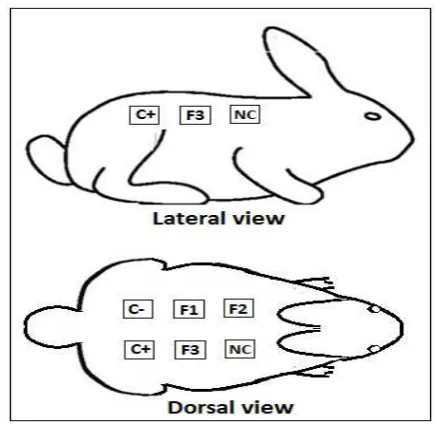
The dorsal aspects of rabbits were divided into six areas, with a size of 2 cm x 2 cm each, on where the test formulation were applied. The hairs on each area were shaved using a razor. These areas are then marked as depicted in Fig.1 as follows: NC, C-, C+, F1, F2, F3 and F4. Area NC is the shaved skin given nothing as the normal control. Area C- and C+ are the shaved skin treated consecutively with gel without banana extracts (as negative control) and reference formulations (as positive control). Area F1, F2 and F3 are the shaved skin
treated with gel containing corms extract of pisang kepok 2% (v/v), 4% (v/v) and 8% (v/v) respectively.
Fig.1 The dorsal aspect of rabbits where the position of treatment area are depicted. NC (normal control): untreated shaved area; C- (negative control): shaved area treated with gel without plant extracts; C+ (positive control): shaved skin given reference formulations; F1, F2 and F3 are the shaved area treated with gel containing extracts 2%, 4% and 8% respectively.
Formulations Ingredients of Topical Gel
The topical herbal gel was prepared using crude corms extracts of M. balbisiana, ethanol (96 %), carbopol-934 (1%), butylated hydroxytoluene, triethanol amine (q.s), methyl paraben (0.5%), propylene glycol 400 (5%), and distilled water in a quantitiy sufficient to prepare 100 g of gel in the case of blank gel. The amounts of ingredients (plant extract and gelling agents) used in the formulations are presented in Table 1.
Table 1. Amounts of ingredients per 100 ml of solution used in topical gel formulations
Ingredients C- F1 F2 F3
Banana Corms Extract 0 2 ml 4 ml 8 ml Ethanol (96 %) 0,5 ml 0,5 ml 0,5 ml 0,5 ml Carbopol 934 (1%) 0,5 g 0,5 g 0,5 g 0,5 g Butylated hydroxytoluene 0,01g 0,01g 0,01g 0,01g Triethanol Amine (q.s) 0,3 ml 0,3 ml 0,3 ml 0,3 ml Methyl Paraben (0.5%) 0,1 g 0,1 g 0,1 g 0,1 g Propylene glycol 400 (5%) 5 ml 5 ml 5 ml 5 ml Aquadest (up to) 100 ml 100 ml 100 ml 100 ml
Formulations Ingredients of Reference
The hair growth promoting gel used as positive control in the study was a product that has been widely marketed in Indonesia. The formulations was containing Aloe barbadenesis leaf extract (92%), alcohol, glyceryl polyacylate, dipropulene glycol, butylene glycol, glycerin, propylene glycol, 1,2-hexanediol, polyglutamic
acid, betaine, sodium hyaluronate, calendula officinalis flower extract, mentha viridis (spearmint) extract,
Melissa officinalis extract, carbomer, peg-60
Gel Administrations and Observation
The gel (0.1 g/shaved area) was administered topically on the animal shaved skin, once daily, for 21 days. On day 7, 14, and 21 from each treated area was taken randomly 10 hairs and the length of each hair was measured using caliper and expressed in centimeter. On day 22 all hairs in treated area were taken and weighed using a digital microbalance and expressed as milligram.
Statistical Analysis
The data were described as mean ± standard error (SE). One-way ANOVA and Least Significant Diference (LSD) test was used to determine the statistical significance (p < 0.05) of the differences between values of various experimental and control groups.
RESULTS
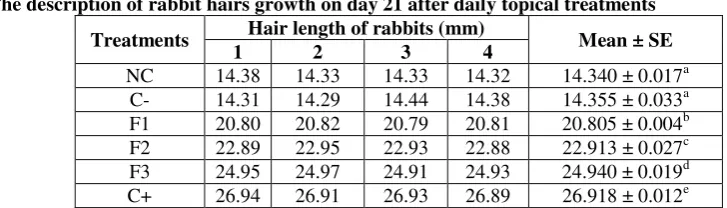
The descriptive and analytical data of the effects of six different topical gel on rabbit hairs growth after daily treatments on day 7, 14 and 21 are presented, respectively, in Table 2, 3 and 4. The results of one-way Anova for the data in Table 2 are F = 3801.251 and P < 0.001; for the data in Table 3 are F = 526.482 and P < 0.001; and for the data in Table 3 are F = 64839.600, and P < 0.001. Referring the results of LSD test on the mean values between the treatments which were shown in Table 2, 3 and 4, it is clear that herbal topical gel containing crude corms extract of pisang kepok (Musa balbisiana) significantly increase the animal hairs length in comparison to the normal and negative control. When compared to the positive control, the effect of the gel containing crude corms extracts of the plants, even at the highest concentration (8%), statistically lower.
Table 2 The description of rabbit hairs growth on day 7 after daily topical treatments
Treatments Hair length of rabbits (mm) Mean ± SE
1 2 3 4
NC 5.11 5.19 5.21 5.20 5.180 ± 0.024a C- 5.08 5.12 5.12 5.17 5.118 ± 0.019a F1 6.84 6.76 6.77 6.76 6.793 ± 0.018b F2 7.52 7.50 7.44 7.57 7.508 ± 0.027c F3 8.38 8.24 8.21 8.33 8.280 ± 0.045d C+ 9.03 9.00 8.99 8.99 9.003 ± 0.010e
Mean±SE values that shared the same superscript are not significantly different at α =0.05. NC (normal control): untreated shaved area; C- (negative control): shaved skin treated with gel without plant extracts; C+ (positive control): skin given reference formulations; F1, F2 and F3 are the shaved skin treated with gel containing banana corms extracts 2%, 4% and 8% respectively.
Table 3 The description of rabbit hairs growth on day 14 after daily topical treatments
Treatments Hair length of rabbits (mm) Mean ± SE
1 2 3 4
NC 9.53 9.52 9.30 9.31 9.415 ± 0.061a C- 9.47 9.27 9.37 9.45 9.390 ± 0.039a F1 13.88 13.82 13.81 13.82 13.833 ± 0.018b F2 15.05 14.92 15.07 15.04 15.020 ± 0.039c F3 16.29 16.46 16.52 16.51 16.445 ± 0.055d C+ 17.87 17.86 17.90 17.88 17.878 ± 0.008e
Mean±SE values that shared the same superscript are not significantly different at α = 0.05. NC (normal control): untreated shaved area; C- (negative control): shaved skin treated with gel without plant extracts; C+ (positive control): skin given reference formulations; F1, F2 and F3 are the shaved area treated with gel containing banana corms extracts 2%, 4% and 8% respectively.
Table 4 The description of rabbit hairs growth on day 21 after daily topical treatments
Treatments Hair length of rabbits (mm) Mean ± SE
1 2 3 4
NC 14.38 14.33 14.33 14.32 14.340 ± 0.017a C- 14.31 14.29 14.44 14.38 14.355 ± 0.033a F1 20.80 20.82 20.79 20.81 20.805 ± 0.004b F2 22.89 22.95 22.93 22.88 22.913 ± 0.027c F3 24.95 24.97 24.91 24.93 24.940 ± 0.019d C+ 26.94 26.91 26.93 26.89 26.918 ± 0.012e
Table 5 presents effects of topical gel on the rabbit hair mass after 21 days of treatment. The one-way Anova results in F = 415.621 and P < 0.001. Based on the results of LSD test it is markedly that herbal topical gel
containing crude corms extract of pisang kepok (Musa balbisiana) significantly increase the animal hair mass in comparison to the normal and negative control, although still lower than the positive control.
Table 5: The description of rabbit hairs mass in shaved skin area after 21 days treatments
Treatments Hair mass of rabbits (mg) Mean ± SE untreated shaved area; C- (negative control): shaved skin treated with gel without plant extracts; C+ (positive control): skin given reference formulations; F1, F2 and F3 are the shaved skin treated with gel containing banana corms extracts 2%, 4% and 8% respectively.
DISCUSSION
Inspite of the efficacy of the crude corms extract of pisang kepok (M. balbisiana) does not exceed the reference formulations (positive control), but the data of the study provide a significant contribution to the pharmaceutical science, particularly in the field of hair care. First, the study opens the insight that in nature there are too many plants which could potentially be used as alternative ingredients for enhancing hair growth, including bananas. Second, the results of this study make clear that the banana is a versatile crop[12], even the parts (the corms) that are considered waste by the farmers, still have economic and health values. testosterone (T) and its derivative dihydrotestosterone (DHT). However, recently, authors have argued against the use of the term AGA in women, as the role of androgens in female pattern hair loss is debatable.[13]
Beyond the debate on the cause of the androgenetic-related hair loss between male and female, researches on seeking the effective medicine for promoting hair growth either in vitro or in vivo using animal models still example, containing citric acid, malic acid, resin, tannin,
sugar1, flavonoids, anthocyanin arabinosides, anthocyanin glucosides, kaempferol, quercetin, myricetin 3-o-glucoside, myricetin 3, 3-di-o-galactoside, myricetin 3 rutinoside, aesculin, scopoletin, caffeic acid, myricetin 3-o-rhamnoside or myricitrin, esculetin-6-oglucoside or esculin, hesperetin 7-o-rhamnoglucoside or hesperidin, hesperetin-2-o-methylchalcone-4-orhamnoglucoside. The essential oil content including 1, 8-cineole, α-pinene, methyl eugenol, terpineole, trans-carveole,cis-carveole,
geraniol, methyl geranate, α-terpinyl acetate, neryl
acetate, β-caryophyllene, myrcene, sabinene, myrcene,
p-cymene, c-terpinene, linalyl acetate, car-3-ene, phellandrene, methyl eugenol,methyl butyrate, methyl benzoate, benzyl alcohol, isobutyl butyrate,
myrtenylacetate, limonene, α-terpineol, linalool,
eucalyptol, p-cymol, β-pinene, geraniol, camphene, butyl butyrate and myrtenol.[18]
This study enidently showed positive promotion effects of crude extract of the banana corms on the hair growth in rabbits. Banana plant extracts, as indicated by many authors, contained majority or at least some of the phytochemicals that were found to show hair growth promoting activities. The extracted substances were
ß-carotene and α-carotene, lutein, stigmasterol,
campesterol, cycloeucalenol, cycloartenol, and 24-methylene cycloartanol and many types of vitamins including vitamin A, vitamin B, vitamin C, and vitamin E.[19,20,21,22]
Other specific research to address the androgenetic-related hair loss indicated that hair growth can be promoted by treating the subject with substances, including herbal extracts, that potent inhibitory effect on the activity of 5α-reductase, an enzyme responsible for transformation of testosterone into dihydrotestosterone.[23,24] The octaphlorethol A, an isolated component from the Ishige sinicola extract,
proliferation of dermal papilla cells (DPCs).[25] Other botanicals that commonly used for treatment of AGA, that allegedly able to reduce free testosterone are lauric and myristic acid.[26] Overall, from a variety of literature review, Semwal et al. [3] stated there are dozens of substances suspected effect on hair growth, including saponin, alkaloids, ecliptine, wedelic acid, luteolin,
triterpine, glycosides, β- sitosterol, hentriacontanol,
vitamin A, vitamin C, iron calcium oxalic, malic acid, α pinene, β pinene, fatty acid, sterol compounds,
polyphenols, steroids, volatile oil and essential oil.
Again, plant extract of banana revealed to contain almost of all the substances which were reported to possess promotion activities against the hair growth.27] The last and most important is it has already reported that the ethanol extract of banana peel can inhibit 5alpha-reductase in mice.[28]
CONCLUSION
Given the topical herbal gel containing ethanolic corms extract of M.balbisiana of all concentration levels, showed higher length of rabbit growing hair, it can be concluded that crude corms extract of pisang kepok is potent to be used as alternative herbal for the hair growth promotion.
REFERENCES
1. Awe E.O. and Makinde J.M. The hair growth promoting effect of Russelia equisetiformis
(Schclect & Chan). Journal of Natural Products, 2009; 2: 70-73.
2. Koparal A.T. and Bostancıoğlu R.B.2 016. Promotion of Hair Growth by Traditionally Used
Delphinium Staphisagria Seeds through Induction of Angiogenesis. Iranian Journal of Pharmaceutical Research, 2016; 15(2): 551-560.
3. Semwal B.C., Agrawal K.K., Singh K., Tandon S. and Sharma S. 2011. Alopecia: Switch To Herbal Medicine. Journal of Pharmaceutical Research And Opinion, 2011; 1(4): 101–104.
4. Pathan A., Pathan M., Garud N. and Garud A.2012. Effect of Some Novel Medicinal Plants and Polyherbal Formulation on Stress Induced Alopecia. Pharmacology OnLine, 2012; 3: 150 -157.
5. Allayie SA, Hemalatha S, Elanchezhiyan C, Manoharan V, Balasubramanian K, et al. In vivo
Evaluation of Hair Growth Potential of Fresh Leaf Extracts of Naringi Crenulata. J Clin Exp Dermatol Res., 2012; 3: 148. doi:10.4172/2155-9554.1000148 6. Upadhyay S., Ghosh A.K. and Singh V. Hair
Growth Promotant Activity of Petroleum Ether Root Extract of Glycyrrhiza Glabra L (Fabaceae) in Female Rats. Tropical Journal of Pharmaceutical Research, 2012; 11(5): 753-758 (Foxn1nu) Mice. BioMed Research International, 2014, Article ID 319795, 9 pages http://dx.doi.org/10.1155/2014/319795
9. Jain P.K. and Dass D.J. 2015. Evaluating Hair Growth Potential of Some Traditional Herbs. Asian J Pharm Clin Res., 2015; 8(6): 150-152.
10. Kumar K.P;.S., Bh:wmik D., Duraivel S. and Nutrition for healthy skin: Strategies for Clinical and Cosmetic Practice, Volume 2, Springer Berlin Heidelberg, 2011; 149-163.
12. Samsuar, Viogenta P., Susanti L., Trimulyani Y.W., Sutriyani and Kanedi M. 2016. Burns Inoculated with Staphylococcus aureus Healed by Leaf Sheath Extract of Pisang Ambon (Musa acuminata). Journal of Herbal Medicine Research, 2016; 1(2): 0040-0046.
13. Ghanaat M. 2010. Types of Hair Loss and Treatment Options, Including the Novel Low-Level Light Therapy and Its Proposed Mechanism. Southern Medical Journal, 2010; 103(9): 917-921.
14. Suraj R., Rejitha G., Sunilsona J.A.J., Anandarajagopal K. and Promwichit P. In vivo hair growth activity of Prunus dulcis seeds in rats. Biology and Medicine, 2009; 1(4): 34-38.
15. Yoon J.I., Al-Reza S.M.and Kang S.C. 2010. Hair growth promoting effect of Zizyphus jujuba essential oil. Food and Chemical Toxicology, 2010; 48(2010): 1350–1354
16. Yadav N., Yadav R. and Kharya M.D. 2014. Development and Evaluation of Polyherbal Formulations for Hair Growth-Promoting Activity. International Journal of Research in Applied, Natural and Social Sciences., 2014; 2(6): 5-12 17. Khidhir K.G. and Mahmood K.I. 2016. The Effects
of Traditional Kurdistan Plant Extracts on Rat Hair Growth in vivo International Journal of Scientific and Research Publications, 2016; 6(1): 450-454. 18. Sumbul S., Ahmad M.A., Asif M. and Akhtar M. Morphological Structure of Banana Pseudo-Stem. Bioresources, 2010; 5(2): 576-585.
Market in Nigeria. International Journal of Chemical Engineering and Applications, 2015; 6(6): 440-443. 22. Onyema C.T., Ofor C.E., Okudo V.C. and Ogbuagu
A.S. 2016. Phytochemical and Antimicrobial Analysis of Banana Pseudo Stem (Musa acuminata). British Journal of Pharmaceutical Research, 2016; 10(1): 1-9
23. Dawid-Pać R., Urbańska M., Dębosz I. and Nowak G. 2014. Plants as potential active components in treatment of androgenetic alopecia. Herba Polonica, 2014; 60(1): 49-56.
24. Huang B., Kang B.G., Wang Z. and Lim S.S. Effect of ethanol extract of plant mixture on hair regeneration in human dermal papilla cells and C57BL/6J mice. Journal of Medicinal PlantsResearch, 2015; 9(45): 1103-1110.
25. Kang J.I., Kim E.I., Kim M.K., Jeon Y.J., Kang S.M., Koh Y.S., Yoo E.S. and Kang H.K. 2013. The Promoting Effect of Ishige sinicola on Hair Growth.
Mar. Drugs, 2013; 11: 1783-1799
26. Mccoy M. and Ziering C. Botanical Extracts for the Tr;eatment of Androgenetic Alopecia. International Journal of Life Science and Pharma Research, 2012; 2(4): 31-38.
27. Waghmare J.S. and Kurhade A.H. 2014. GC-MS analysis of bioactive components from banana peel (Musa sapientum peel). Euro. J. Exp. Bio., 2014; 4(5): 10-15.