1
Cash Waqf Performance In Indonesia:
Empirical Analyses on Islamic Social Entrepreneurship Model
Mufid Suryani
Accounting Department, Economic Faculty Gunadarma University
Jakarta, Indonesia
Abstrack-This paper discusses the potential role of Cash Waqf in Economic Development in Indonesia, particularly a country with a biggest moslem population in the world. It also raises awareness of the role of Cash Waqf and attempts to define a new approach to address poverty issues and suggests a fresh approach to socio-economic development. A survey was counducted on several cash waqf institutions. All the informations, data and resources are acquired directly through personal discussions and observations. The lack of awareness about endowments (waqf) is a barrier to harnessing the potentials of Waqf in redressing socio-economic inequalities and for enhancing the quality of life of the poor. Scholars, institutions and civil society organizations, as well as Islamic banking and financing institutions will be awakened to the need to cooperate in employing the institution of waqf for reducing poverty through the provision of quality education, better health care and employment opportunities.
Keywords: islamic social entrepreneurship, poverty alleviation, cash waqf..
I. INTRODUCTION
Lately, the term social entrepreneur or social entrepreneurship more widely heard. Someone pushed become social entrepreneur is not as attracted by the profits
Nida Nusaibatul Adawiyah
Accounting Department, Economic Faculty Gunadarma University
Jakarta, Indonesia
that will be generated, but want to change a situation in the society for the better, indeed welfare of humankind. About profit, it matters later. There are several prominent social entrepreneurs who can serve as an example of how the call of their hearts changed the face of the world.
Indonesia is a country located in the southeast Asian continent. Although much of the country of origin of Islam, but the people who embraced Islam in Indonesia is enormous, which is about 12.7 percent of the total Muslim world. In 2010, followers of Islam in Indonesia around 205 million people or 88.1 percent of the population (The Pew Forum on Religion & Public Life, 2010). In recent years, Muslims’ wealth has grown rapidly and some portion of the wealth has been redirected for philanthropy purposes. According to Ministry of Religion Data, the magnitude of Islamic philanthropy in Muslim communities In Indonesia is estimated around more than IDR 20 trillion annually (Ministry of Religion, 2015).
2 where giving index score 51% consist of
66% of giving money, 40% of volunteering time and 48% of helping stranger. In term of giving money, Myanmar is a top country for this giving behavior at 91% of scores (World Giving Index, 2014).
This paper is commonly described and find out the potency of cash waqf is managed by philantrophyc social entrepreneurials institution, to alleviate the poverty in Indonesia. Thus it is also important to know the motive of people donating a waqf. According to preliminary study, in Indonesia the motives for creating waqf are simple. Most specific purpose waqf are created for mosques, suraus, cemeteries and religious schools to promote the religions. Despite the Holly Al-Quran exhorting that endowments should be of in Indonesia to contribute/donate in form of cash waqf.
II. LITERATURE REVIEW A. ISLAMIC PHILANTHROPY
Islamic Philanthropy defined as an institutionalized pooling and distribution of private resources with the goal of building capacity, sustainable financing and expertise for long term socio-economic benefit. Islamic Philanthropy is linked to the concept of Islamic solidarity [takaful]. Islamic giving includes but not limited to Zakat, Sadaqa, and Waqf (Gaudiosi, 1988).
Waqf is one of the oldest charitable institutions in the world. It is also one of the economic backbones of Islam that existed since the time of Prophet Muhammad (SAW) that catalyzes economic development of Muslims from various aspects of life1. Waqf is sadaqah jariyyah
(running charity). It is distinct from ordinary sadaqah, the difference being the repeatability of the benefits that flow out of it. In Shariah, unlike zakah, a waqf is a voluntary, permanent, irrevocable dedication of a portion of one’s wealth (in cash or kind) to Allah (SWT). Like ordinary sadaqah, waqf is flexible in the sense that its beneficiaries need not be restricted to Muslims and the fruits of the waqf must be utilized for Shari’ah compliant purposes2.
During the Ottoman Empire, the waqf institution would lend money to households and merchants in order to earn income. mosques and religious schools.
2. Philanthropic waqf: in humanitarian waqf, benefits are allocated to support the society and promote social activities. 3. Family waqf: waqf from parents to
children and heirs.
In some countries, waqf fund management has reduced poverty effectively and enhanced people’s welfare,
2 Ibn ‘Umar reported: ‘Umar acquired land in
Khaibar. He came to the Prophet Muhammad (SAW) and sought his advice in regard to it. He said; “Allah’s Messenger, I have acquired a land in Khaibar. I have never acquired more valuable for me than this, so what do you command I do
with it?” Thereupon the Prophet (SAW) said: “If you like, you may keep the corpus intact and give its produce as Sadaqah declaring that the property must not be sold or inherited or given away as a gift”. And ‘Umar devoted it to the poor, to the nearest of kin, to the emancipation of
slaves, to wayfarers or guests, and in the way of Allah (Sahih Muslim).
3 In another Hadith, Muhammad (SAW) said,
3 by providing additional fund for education
& health development programs, cheap houses & public facilities development programs, and so forth.
The most important and tangible dimensions of poverty are:
1. Hunger or Nutrition (Shortage of food leading to ill-health)
2. Ill Health (in-adequate levels of health due to less food, lack of medicine and sanitation)
3. Lack of Education and (literacy, knowledge) education opportunities 4. Lack of Shelter, Clothing and
Empowerment
5. Lack of Economic opportunities & Economic resources and Lack of Income,
6. Non availability of Water (for drinking and sanitation and irrigation),
7. Deficient social relations, poor social and cultural life
III.METHODOLOGY
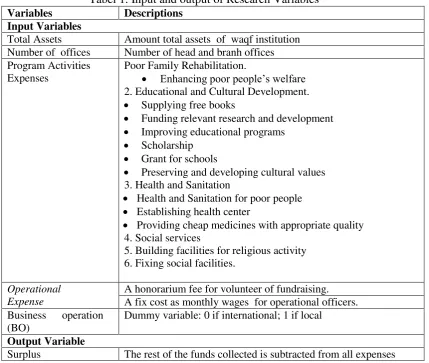
Data are collected by survey to Dompet Dhuafa, Zakat House, Orphaned House, Indonesia Waqf Agency, Tazkia Institute, Pirac, Ministry of Religion. Data used are at entity level into a waqf institutional. The input and output variables are explained on Table 1.
Tabel 1. Input and output of Research Variables
Variables Descriptions
Input Variables
Total Assets Amount total assets of waqf institution Number of offices Number of head and branh offices Program Activities
Expenses
Poor Family Rehabilitation.
• Enhancing poor people’s welfare 2. Educational and Cultural Development.
• Supplying free books
• Funding relevant research and development
• Improving educational programs
• Scholarship
• Grant for schools
• Preserving and developing cultural values 3. Health and Sanitation
• Health and Sanitation for poor people
• Establishing health center
• Providing cheap medicines with appropriate quality 4. Social services
5. Building facilities for religious activity 6. Fixing social facilities.
Operational Expense
A honorarium fee for volunteer of fundraising. A fix cost as monthly wages for operational officers. Business operation
(BO)
Dummy variable: 0 if international; 1 if local
Output Variable
Surplus The rest of the funds collected is subtracted from all expenses
Data are analysed by using Stochastic Frontier Analysis (SFA).This study will follow Battese and Coelli (1995) formulation, in which the efficiency
4 period, and the vector of input quantity of the ith firm. is the random variables, which is assumed to be independent and identically distributed normal random errors with zero mean and unknown variance. Ui is a non-negative random variable, called technical inefficiency effects. This random error variable captures the effect of external factors of production that are beyond the establishment’s control, such as unpredictable variations in machine and labor performance, or the effect of the parameter to be estimated.
The attractiveness of this method is it measures firm’s technical efficiency while enabling the measurement of the contribution of explanatory variables to the firm’s technical inefficiency. Botti (2009) utilize DEA and SFA to investigate performance comparation among retail with hotel franchise in France. The result shows that hotel franchises are most efficient than others.
IV. DATA AND DISCUSSION Cash institution is a legal entity and therefore should fulfil some requirements, which are called rukun waqf. The rules can be explained as follows:
a. Al-waqif is a person who donates waqf fund.
b. Assets or fund donated as waqf are technically called al-mawquf in fiqh (Islamic law).
c. Those who are entitled to benefit from return of waqf fund management are
al-mawquf ‘alaih.
d. The way of a waqif stating his/her asset or fund as waqf is called sighah.
Explains conditions that should be satisfied in managing cash waqf. They are as follows:
1. Nadzir is a person/entity that is assigned to manage waqf fund.
2. As a matter of fact, waqif has the right to determine person or institution that will manage his/her waqf fund.
3. Fiqh experts determine flexible requirements for being a Nadzir.
4. Nadzir’s responsibilities include:
Maintaining waqf asset, preparing waqf asset for rent, managing waqf fund, collecting waqf investment returns and distributing them to al-mawquf ‘alaih. 5. Nadzir’s division of work. A waqif can
appoint more than one nadzir to handle his/her waqf fund. If a waqif does so, each nadzir will conduct a more specific job. Asset maintenance, investment management, and investment return distribution will be carried out by investment return of cash waqf fund:
1. Invest cash waqf fund in various domestic or global syariah portfolios with good prospect.
2. Invest cash waqf fund in real sectors or businesses whose sources, process, and outputs are in line with syariah.
5 a. Transparency. Nadzir has to manage
cash waqf fund transparently and regularly make financial and performance reports, which are accessible by waqif.
b. Productivity. Nadzir has to be able to manage the fund productively, so that disadvantaged people can benefit form cash waqf fund continuously.
c. Trustable. Integrity of a nadzir is crucial. It has to avoid any business opportunity and process that can lead to moral hazard.
Waqf Management Institution should manage waqf fund in such a way that the collected fund become more and more productive. The more the waqf investment return, the more mawquf ‘alaih benefit from waqf fund. According to fiqh, nadzir, as a waqf fund manager, is obliged to handle the fund productively. Nadzir is responsible for maintaining, expanding, and developing waqf assets in order that they can provide some income such as investment return, rent fee, agricultural products, etc.
Waqif has a right to settle on particular requirements related to his/her waqf. Such
a requirement is classified in two groups, i.e. (1) requirement that goes in line with syariah, and (2) condition that does not align with syariah. Nadzir does not have to obey the latter, even if waqif has agreed to donate his fund as waqf. Any rule or requirement should not violate Islamic law. Fiqh experts affirm that power of waqif’s requirement status should not contravene Allah the Almighty’s rule.
Cash waqf certificate will be issued in various denominations, e.g. IDR (Rupiah)-100-million, IDR-50-million, 10-million, 5-million, and IDR-1-million, in order that more prospective donors can afford them. Name of the donor (it can be on behalf of dead individual) and specific purpose of the donation (e.g. for educational services, health assistance, or other welfare enhancement efforts) will be stated on the certificate.
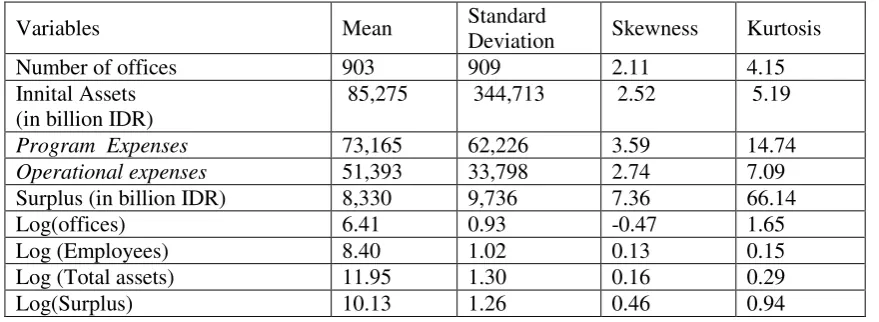
Table 2 below presents relevan data of descriptive statistics for continuing analyse of imput and output variables.
Table 2. Summary of Descriptive Statistics
Variables Mean Standard
Deviation Skewness Kurtosis Number of offices 903 909 2.11 4.15 Innital Assets
(in billion IDR)
85,275 344,713 2.52 5.19
Program Expenses 73,165 62,226 3.59 14.74
Operational expenses 51,393 33,798 2.74 7.09
Surplus (in billion IDR) 8,330 9,736 7.36 66.14 Log(offices) 6.41 0.93 -0.47 1.65 Log (Employees) 8.40 1.02 0.13 0.15 Log (Total assets) 11.95 1.30 0.16 0.29 Log(Surplus) 10.13 1.26 0.46 0.94
Source: Elaboration Data An Audited Financial Statement of Instituions, 2015
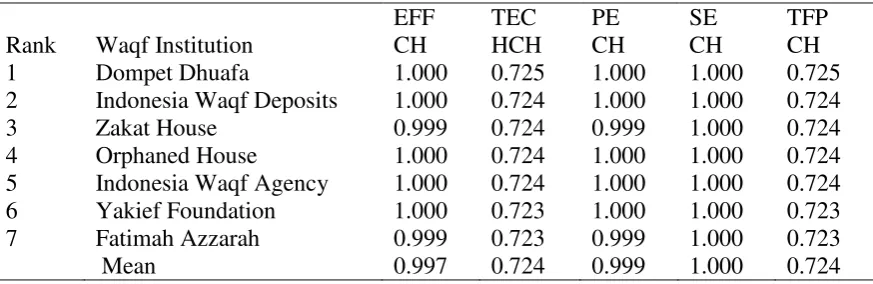
Table 3 presents ranking of Productivity efficiency over the seven waqf instituions based on total factor productivity changes. It shows that the most productive waqf instituions is
6 their productivity during the observation
periods, however, they can manage to be more productive compare with other domestic entities.
Since the waqf instituion efficiency vary among the sample, we need to identify input and output variables that influence its technical efficiency. We apply the stochastic frontier analysis (SFA) approach to identify which input has more contribution on the waqf institution efficiency.
Findings on the potential of waqf institutions (WI) to allevae poverty from this study try to explain that the WI establishment as an Islamic social entrepneurship entity to develop nation’s economy, especially to income distribution, create jobs and increase welfare that build themselves as not to profit body as well as social vehicles with a global economic vision.
Tabel 3. Stochastic Frontier Analysis
Rank Waqf Institution
EFF CH
TEC HCH
PE CH
SE CH
TFP CH
1 Dompet Dhuafa 1.000 0.725 1.000 1.000 0.725
2 Indonesia Waqf Deposits 1.000 0.724 1.000 1.000 0.724
3 Zakat House 0.999 0.724 0.999 1.000 0.724
4 Orphaned House 1.000 0.724 1.000 1.000 0.724
5 Indonesia Waqf Agency 1.000 0.724 1.000 1.000 0.724 6 Yakief Foundation 1.000 0.723 1.000 1.000 0.723
7 Fatimah Azzarah 0.999 0.723 0.999 1.000 0.723
Mean 0.997 0.724 0.999 1.000 0.724
Source: Data Processed, 2015
Contribution of cash waqf to sosio-economic development in developing countries is significant. Fund collected through cash waqf certificate program can be allocated to social-related development areas (e.g., agriculture, education, health, and infrastructure), urban poverty alleviation program, and other public service development. This opportunity in turn will reduce poverty level and will allow people help themselves.
Therefore, the WI needs to have a new agenda in order to enhance WI efficiency. Since the total assets have a significant role in enhancing WI efficiency, therefore the WI need not to rely on fundraising, but to collect more financial support from all moslem Indonesia citizen. In addition, it is also need to increase the technical efficiency
of the franchise firms, especially thosewith BO localy system by creating more innovative products and services to attract more buyerrs and at the end, to increase net profit.
7 either mismanaged or misappropriated
(Alam 2010). As such, the discussion in this paper will center in the ways of ensuring sustainability and continuous growth of the assets which are subjected to waqf. The potential of venture philanthropy will be discussed as an approach to enhance waqf.
V. CONCLUSSION
When the government is unable to prosper the people through their program, volunteer sector can be seen as an alternative way out. Indonesia as world muslim largerst population has huge potential of cash waqf which could reach IDR 20 trillyun. However, this opportunity still not result significant output. Indonesian Waqf Deposit (IWD) as cash waqf insitituion in Indonesia strives to get optimum result of this potential and maximize their performance specifically cash waqf., attempt has made by Indonesia in establishment of cash waqf development. In fact rulings has made by FATWA MUI (Majelis Ulama Indonesi) has agreed to allow the practices of cash waqf and followed by several states that has implemented cash waqf in their respective Islamic council.
Cash waqf has a variety of benefits due to its flexibility. The minimum price offered could involve many Muslims contributing to the cash waqf. Through cash waqf fund, the abandoned assets which lack financial support could be developed for the sake of the Islamic economy. The cash waqf fund could also support Islamic religious schools and institutions of education that are experiencing liquidity as well as maintain other Islamic assets.
Therefore, future research is conducted to study the motivation factors of the waqif or donor in contributing their money to the respective council as the donor or waqif is not allowed to manage their own waqf in Indonesia. Hence, the determinants of cash waqf giving among people particularly in Indonesia is considered significant to be identified in order to recognized which factor most influence public of Indonesia to
contribute or to donate in cash waqf. Consequently, all necessary action would be taken to enhance the institutions of waqf generally and to increase the amount of cash waqf collection specifically and eventually improve the socio economic of ummah in general and in the state in particular.
REFERENCES 1) Al-Quran
2) Alam, N. 2010.Islamic venture philanthropy: A tool for sustainable community development.Available at
http://dx.doi.org/10.2139/ssrn.15658 59.
3) Almarri, J., Meewella, J. & Mainela, T. 2012. Social entrepreneurship and Islamic philanthropy. International Conference on Excellence in Business, University of Sharjah. United Arad Emirates.
4) Asmak Ab Rahman. 2009. Peranan wakaf dalam pembangunan ekonomi umat Islam dan aplikasinya di Indonesia. ShariahJournal 17(1): 113-152.
5) Battese, G.E., Coelli, T.J. (1995), "A model for technical inefficiency effects in a stochastic frontier production function for panel data", Empirical Economics, Vol. 20 No.2, pp.325-32.
6) Botti, Laurent., Walter Briec and Gérard Cliquet. 2009. Plural forms versus franchise and company-owned systems: A DEA approach of hotel chain performance. Omega. Volume 37, Issue 3, June 2009, pp. 566-578
8 Kluwer Academic Publishers,
Boston, MA, .
10)Coelli, T.J et al (2005). An Introduction to Efficiency and Productivity Analysis, 2nd edition.
New York: Springer
Science+Business Media
11)Cizakza, M. 2004. Cash waqf as an alternative to NBFIs bank. Proceeing the International Seminar on Nonbank Financial Institutions: Islamic Alternatives. Jointly organized by Islamic Research and Training Institute, Islamic Development Bank and Islamic Banking and Finance Institute Indonesia. Kuala Lumpur, March, 1-3.
12)Elgari, M. A. 2004. The Qardhassan Bank. Proceeding at the International Seminar on Nonbank Financial Institutions: Islamic Alternatives. Jointly organized by Islamic Research and Training Institute, Islamic Development Bank and Islamic Banking and Finance Institute Indonesia. Kuala Lumpur, March, 1-3.
13)Gaudiosi, M. M. 1988.The influence of the Islamic law of waqf on the development of the trust in England: The case of Merton College. University of Pennsylvania Law Review 136(4): 1231-1261.
14)Habibollah, S., Hamed, A. & Davoud, N. 2010. Waqf as a social entrepreneurship model in Islam. International Journal of Business and Management 5(7): 179-186. 15)Hassan, A. & Abdus Shahid, M.
2010. Management and development of the awqaf assets.Seventh International Conference – The Tawhidi Epistemology: Zakat and Waqf Economy. Bangi.
16)Mannan, M.A.Abdul. 1999. Cash Waqf Certificate- an Innovation in Islamic Financial Instrument: Global Opportunities for Developing
Social Capital Market in the
21stCentury Voluntary Sector Banking”, Proceeding Third Harvard University Forum on Islamic Finance, October 1.
17)Mannan, M.A.Abdul, Global Mobilization and Creation of Cash Waqf Fund for Human and Social Capital Infrastrukture for the Islamic Ummah, Social Investment Bank Publication Series no. 5, 1999. 18)Mannan, M.A.Abdul, Lesson of Experience of Social Investment Bank in Family Empowerment Micro-credit for Poverty Allevation: A Paradigm shift in Micro-financ”, Social Investment Bank Publication Series no. 10, 1999.
19)Masyita, Dian, Muhammad Tasrif, and Abdi Suryadinata Telaga 2005. “ A Dynamic Model for Cash Waqf Management as One of The Alternative Instruments for the Poverty Alleviation in Indonesia”. Proceeding the 23rd International Conference of The System Dynamics Society, MIT, Boston, July 17-21, 2005.
20)Mulyawan, Dadang and Masyita, Dian et al. “The Pilot Project of Linkage Program for Sharia Financial Institution in Indonesia”. Bank of Indonesia report, 2006. 21)Jennifer, B. 2004. Islamic
philanthropy: Reviving traditional forms for building social justice. CSID Fifth Annual Conference: Defining and Establishing Justice in Muslim Societies. Washington D.C. 22)Sadeq, A. M. 2002. Waqf, perpetual
charity and poverty alleviation. International Journal of Social Economics 29(1/2): 135-151.
9 24)Zakaria., Azliza A. M.and Samad.,