JURNAL ILMU KESEHATAN & SAINS
ISSN : 2442-2509
JILID II, NOMOR I, JANUARI 2016
Terbit dua kali setahun pada bulan Januari dan Juli . Berisi tulisan yang diangkat dari hasil penelitian di bidang Ilmu Kesehatan dan Sains. Berbahasa Indonesia atau
Berbahasa Inggris.
Ketua Dewan Penyunting Ni Wayan Deswinyanti, S.Si., M.Si.
Anggota Dewan Penyunting
Nyoman Ngurah Adisanjaya, S.Si.,M.Si.
Ni Luh Gde Ari Natalia Yudha, SKM.,MPH. AAAK.
Ni Kadek Dwipayani Lestari, S.Si., M.Si Pelaksana Tata Usaha
Ni Putu Widya Astuti, S.Si. M.Si Ni Made Diaris, S.Stsains.
Alamat Redaksi :
Fakultas Ilmu Kesehatan, Sains, dan Teknologi - Universitas Dhyana Pura Jalan Raya Padang Luwih, Dalung, Kuta Utara, Badung, Bali.
Alamat E-mail : [email protected]
Diterbitkan oleh:
Lembaga Penelitian dan Pengabdian Masyarakat (LP2M) Universitas Dhyana Pura - Bali
Dewan Redaksi Jurnal Virgin menerima sumbangan tulisan yang belum pernah diterbitkan dalam media lain. Naskah diketik diatas kertas HVS A4 spasi 1,5 sepanjang lebih kurang 20 halaman, dengan format seperti yang tercantum pada halaman belakang (“Petunjuk Bagi Penulisan Naskah Jurnal Virgin”). Naskah yang masuk dievaluasi dan disunting untuk keseragaman format, dan tata cara lainnya.
JURNAL ILMU KESEHATAN & SAINS
JILID II, NOMOR I, JANUARI 2016, HAL 01-102
DAFTAR ISI
Determinan Karies Gigi Pada Anak Sekolah Dasar Di Pulau Nusa Penida,
Klungkung,Bali ...01-13
Luh Pitriyanti, Ni Wayan Septarini
Ragam Alel Mikrosatelit Burung Kakatua Kecil Jambul Kuning (Cacatua sulphurea) ...14-19
I Gede Widhiantara, A.A.A Putri Permatasari, I Wayan Rosiana
The Implementation of Kader Desa Peduli Aids Program in Denpasar : What Lessons Can Be Learned? ...20-31
Ni Made Sri Nopiyani
Survei Indikator Kesehatan Ibu Dan Balita Di Empat Kelompok Terpencil
Banjar Dinas Muntigunung Tianyar Barat, Kabupaten Karangasem Bali ....32-45
Novia Galih Pramesti, Ni Wayan Septarini
Usulan Tarif Paket Persalinan Normal Pemberi Pelayanan Kesehatan
Primer Di Kabupaten Jembrana ...46-58
Ni Luh Gde Ari Natalia Yudha
Beda Pengaruh Latihan Fleksi William Dengan Gapping Segmental Setelah Pemberian Transcutaneus Electrical Nerve Stimulation (Tens)Terhadap
Pengurangan Nyeri Punggung Bawah Akibat Spondilosis ...59-72
Agung Wahyu Permadi, Mudastir Syatibi, Heru Purbo
Pengaruh Sarapan Pagi Dan Status Gizi Terhadap Prestasi Belajar Siswa Sekolah Dasar Di Kabupaten Buleleng ...73-80
I Gede Ariyasa, Aulia Iefan Datya
Pengaruh Dosis Fermentor dan Waktu Fermentasi Terhadap Kadar Etanol Dalam Produksi Bioetanol dari Sekam Padi ...81-88
Putu Suarya, I Made Wisnu Adhi Putra
Prevalence And Determinants Of Anaemia In Children In Developing Countries, Southeast Asia: A Review ... 89-102
Ni Wayan Septarini
89
PREVALENCE AND DETERMINANTS OF ANAEMIA IN CHILDREN IN DEVELOPING COUNTRIES, SOUTHEAST ASIA:
A REVIEW
Ni Wayan Septarini
School of Public Health, Faculty of Medicine, Udayana University Email : [email protected]
ABSTRACT
Anaemia is one of the most usual and perverse nutritional troubles in the world today. Anaemia gives negative results on cognitive and physical development particularly when it occurs among children. Many causes and determinants of anaemia have already known worldwide. This paper is reviewing the prevalence of anaemia among children together with its determinants in developing countries in Southeast Asia. Three lists were searched and reference lists of relevant articles were checked. Studies that stated data on anaemia or haemoglobin levels in children in Southeast Asia countries were selected and grouped according to the location. Eighteen studies from 8 developing countries in Southeast Asia published on the period of 2001 to 2011 were met the inclusion criteria. All of the studies were cross- sectional without considering aged group, threshold used, year of publication, tools use in measuring the Hb level, the rough prevalence of anaemia were between 12.1% and 71%. Based on WHO categorization, the prevalence of anaemia in Southeast Asia region is categorized to have mild to severe public health problem. Several determinants have been found to have association with anaemia in this region which are nutrition deficiencies, infections, haemoglobinophaties, socioeconomic factors, parent’s related factors and other factors including age and gender. Anaemia is very common among children in developing countries in Southeast Asia region with many factors were found to have association with this condition. Further research is very crucial especially to obtain the best methods in order to overcome anaemia in this population.
Keywords: anaemia, children, determinants, haemoglobin concentration, iron- deficiency
INTRODUCTION
Anemia is one of the biggest public health issues that affects several groups in the population. Children, women and pregnant women are the vulnerable groups who affected by anaemia. Several causes of anaemia are already known worldwide. Though the main cause is particularly due to iron deficiency, it is a seldom-present separation. More often it co-occurs with a
90 number of other reasons, such as haemoglobinophaties, infections including malaria, tuberculosis, parasitic infections, and other nutritional deficiencies including vitamin A and B12, copper, riboflavin, and folate (1). Based on WHO (1), anaemia is an indicator of deprived health and nutrition which give many adverse effects for population including the increased possibility of maternal and child death. Moreover, anaemia especially IDA gives bad effects on physical and cognitive growth particularly when it occurs among children. The estimated anaemia worldwide is 24.8% which one-quarter of the world’s population (2). From that estimation, 47.4% occurs in pre-school age children or approximately about 293 million children affected by this problem. The greatest number affected by anaemia is in Southeast Asia where 115.3 millions preschool-age children (65.5%) are affected (1). The prevalence of anaemia is a significant health indicator, which can stipulate information about the difficulty of iron deficiency that later on any strategies can be used to overcome the problem. The objective of this is to review of the prevalence of anaemia among children, together with its determinants based on surveys publised between 2001 and 2011 in 8 developing countries in Southeast Asia.
MATERIAL AND METHODS
Search strategy and selection criteria
The references of this review were searched using the electronic databases PubMed, Medline, and Science Direct which focused original research articles on publications from 2000 to 2011. The search terms were
“anaemia”, “anemia”, “iron status”, “iron-deficiency” and in combination with “ Southeast Asia”, “children”, “developing countries”, “Indonesia” , “Malaysia”,
“Thailand”, “Timor-Leste”, “Philippines”, “Vietnam”, “Burma”, “ Laos”, and
“Cambodia”. The search was limited to English language research articles and those which available in full text (PDF). The dates of search were from 19th of September to 18th of October 2011. Besides the primary studies, this review is also including publications and reports World Health Organisation (WHO). The references list of publication and reports were reviewed and selected based on those which considered relevant to this Review.
91 All original research articles that met the following criteria were included:
presented data on prevalence or incidence of anaemia either iron-deficiency anaemia (IDA) nor non-iron deficiency anaemia (NIDA) in children from 0-17 years old; the sample size was more than 100; and had a well defined definition for anaemia. There was no emphasis given to the study design. Besides, this review is also included research in which other micronutrients deficiencies were simultaneously studied.
Definitions and subgroup analysis
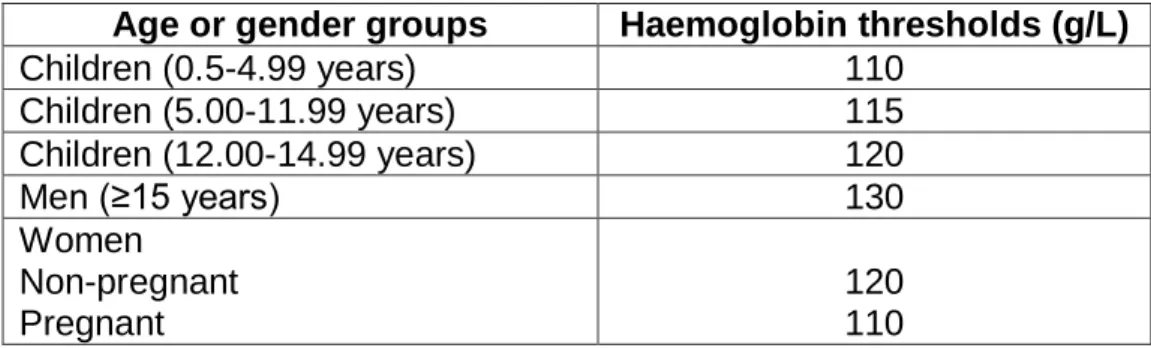
Anaemia in clinical terms is an insufficient mass of RBCs circulating in the blood, while in public health expressions anaemia is defined as a haemoglobin level below the limits given by WHO (3). Six Hb thresholds or cut of points are used by WHO (1) to define anaemia based age or gender group.
These thresholds are presented in the following table.
Table 1. Haemoglobin limits used to define anaemia in different subpopulations, at sea level
Age or gender groups Haemoglobin thresholds (g/L)
Children (0.5-4.99 years) 110
Children (5.00-11.99 years) 115
Children (12.00-14.99 years) 120
Men (≥15 years) 130
Women - Non-pregnant - Pregnant
120 110 Source: adapted from WHO (1).
Table 1 shows different cut of point are given to different aged or gender groups and there is no threshold used to define anaemia for children who’s aged less than 0.5 years old (less than 6 months). Normal haemoglobin (Hb) levels vary with age, sex, smoking status, altitude, and physiological status including pregnancy. Besides the haemoglobin thresholds, WHO (1, 4) was used prevalence of anaemia to categorize countries by the level of public health problem which shows in Table 2.
92 Table 2. Classification of anaemia as a drawback of public health significance
Prevalence of anaemia (%) Category of public health significance
≤4.9 No public health problem 5.0-19.9 Mild public health problem 20.0-39.9 Moderate public health problem
≥40.0 Severe public health problem (1, 4)
Eighteen original research articles that found were grouped based on countries, aged groups of the studies’ participants or population and the threshold used to define anaemia.
RESULTS
Selection of articles
The combined search retrieved 44 original research articles. The duplication of the search results leaving only 30 primary studies which only 18 original research articles were eligible to be contained in this review. No research article on anaemia in children in Laos was found. Therefore, this review only included research articles regarding anaemia in children in 8 developing countries in Southeast Asia which are Indonesia, Thailand, Malaysia, Burma, Vietnam, Cambodia, Philippines, and Timor-Leste. All of the original research articles found were cross sectional studies or surveys which were done in certain population groups or area in each country; none of them were longitudinal study.
The prevalence of anaemia
The prevalence of anaemia in children of 8 developing countries is presented on the Table 3.
93 Table 3. Prevalence of anaemia in children in 8 countries in Southeast Asia
from 2001-2011
No. Country Studies Participant s (aged group)
Threshol d of anaemia used (g/L)
Prevalence of anaemia (%)
Tools used to measure Hb level
1 Indonesia (5) 2.4-10.5 mo
110 57 Cyan
methaemoglobin method
(6) 12-15 yo 120 Girls: 25.8 Pre-pubertal boys: 24.5 Pubertal boys:
12.1
HemoCue
(7) 3-5 mo 110
100 90
71 37 13.4
HemoCue
(8) Girls: 10-12 yo
120 21.8 Cyan
methaemoglobin method
(9) 0-59 mo 110 56.1 HemoCue
(10) 6-59 mo 110 15.5
18.3
HemoCue
2 Malaysia (11) 2-15 yo 110 41.5 HemoCue
(12) 7-12 yo 120 48.5 HemoCue
3 Philippines (13) 7-12 yo 12-14 yo
>15 yo
115 120 130
36.9 38 38
Haematology analyser (14) 12-59 mo
60-71 mo
110 115
16.1 HemoCue
(15) 7-12 yo 12-14 yo
>15 yo
115 120 130
35.1 Haematology
analyser
4 Thailand (16) 6-11 yo 11.1-12.9 yo
115 120
31 Electronic
Coulter Counter 5 Cambodia (17) Stunted
children aged 6-36 mo
110 71 Electronic
Coulter Counter
6 Vietnam (18) 5-8 yo 115 25 Cyan
methaemoglobin method
(19) 6-9 yo 110 45 Cyan
methaemoglobin method
(20) 12-60 mo 60-72 mo
110 115
53.7 Cyan
methaemoglobin method
94
7 Burma (21) 6-59 mo 110 64.9 HemoCue
8 Timor- Leste
(22) 6-59 mo 110 28.4 HemoCue
Overall, without considering aged group, threshold used, year of publication, tools use in measuring the Hb level, the rough prevalence of anaemia in 8 developing countries in Southeast Asia on the period of 2001 to 2011 were between 12.1% and 71%. This prevalence of anaemia means that these countries are classified to have mild to severe public health problem (1).
Even though six studies were done in Indonesia, these studies cannot be compared each other since they have different aged groups as participants, with different cut of point used. However, studies which included older children (10-15 years old) tend to obtain lower prevalence compared to studies on younger age group. Most of studies used Hb thresholds given by WHO and adjusted with the age of subject who participated in the study. However, some studies was not using WHO cut of point to define the prevalence of anaemia, for example study done by Van Nhien et al (19), was Hb level <110 g/L to define anaemia in children aged 6 to 9 years old which supposed to used Hb level at 115 g/L as the thresholds. Furthermore, WHO do not provide Hb level threshold for children under 6 months old, therefore a study done in Indonesia by de Pee et al (7) used three cut of points to define anaemia, which were 90 g/L, 100 g/L, and 110 g/L among the participants whose aged were 3 to 5 months old. When he used 110 g/L as the cut of point, the prevalence of anaemia among the participants become very high (71%) compared to if used 90g/L and 100 g/L which the prevalence were only 13.4% and 37%
respectively. Howard et al (9) and Dijkhuizen et al (5) used 110 g/L , the lowest threshold to obtain the prevalence of anaemia among children age less than 6 months old in their studies. Most of the studies used HemoCue to measure the Hb level. Few studies used cyan methaemoglobin methods, haematology analyser, and electronic coulter counter.
95 Determinants of anaemia in children in 8 developing countries in Southeast Asia
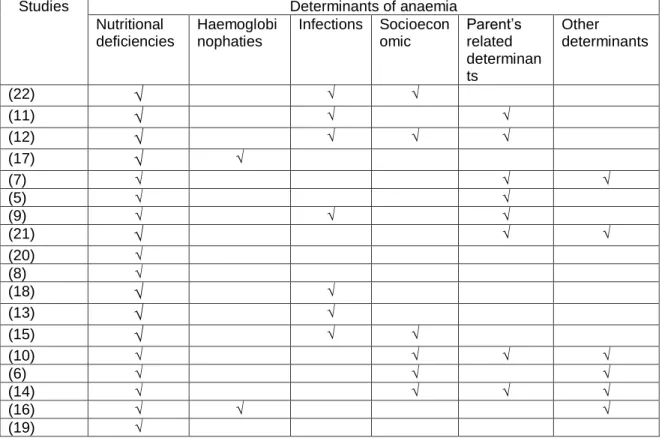
As mentioned in WHO (1), many other factors determine and contribute to anaemia in children. Studies done in 8 developing countries in Southeast Asia were also revealed several determinants which can be seen in the Table 4.
Table 4. Determinants of anaemia in children based on 18 studies in Southeast Asia
Studies Determinants of anaemia
Nutritional deficiencies
Haemoglobi nophaties
Infections Socioecon omic
Parent’s related determinan ts
Other determinants
(22) √ √ √
(11) √ √ √
(12) √ √ √ √
(17) √ √
(7) √ √ √
(5) √ √
(9) √ √ √
(21) √ √ √
(20) √
(8) √
(18) √ √
(13) √ √
(15) √ √ √
(10) √ √ √ √
(6) √ √ √
(14) √ √ √ √
(16) √ √ √
(19) √
Since all the studies were cross sectional, temporal or cause-effect relationship between anaemia and other factors cannot be establised, however, most of these studies assessing and analysing the data using anova and regression function from certain statistical software to obtain the significant predictors of anaemia.
Nutritional deficiencies
All studies were mentioned at least one nutritional deficiencies as an association with anaemia which is iron deficiency. Several studies also
96 mentioned that anaemia including iron deficiency anaemia is influenced by other nutritional deficiency such as underweight, wasted, thinness, stunted (9, 10, 16, 21, 22), vitamin A deficiency (6, 20), vitamin C deficiency (14), and associated with low serum selenium (19).
Haemoglobinopathies
Two studies revealed the relationship between anaemia and haemoglobinopathies in the target population (16, 17). Haemoglobinopathies are inherited disorders including thalasemias and sickle-cell anaemia.
Infections
Several infectious diseases already determined have association with anaemia worldwide. Seven references in this review studied the association between infectious diseases and the prevalence of anaemia. The infections that were studied such as intestinal parasitic infections including trichuriasis, schistosomiasis, and hookworm infections (11, 13, 15, 18) . Leenstra (13) found that children with high-intensity contamination had a larger risk of iron deficiency anemia (adjusted prevalence odds ratio: 6.6; 95% CI: 2.9, 14.7). Diarrheal diseases (9, 22) which occurs in the previous two week had a lower Hb concentration compared to children who did not suffer from diarrhoea. Agho et al (22) also suggested that children who had lower average of HB level were fro, low land urban region where malaria is common.
Socioeconomic factors
Low socioeconomic factors have identified have association with increase risk in getting anaemia. This revealed in study done by Soekarjo et al (6) which mentioned that girls and boys who had higher socioeconomic status had a lower venture of being anaemic. A similar result was determined in a study undergone in rural Peninsular Malaysia which revealed that the prevalence of IDA was meaningfully higher in schoolchildren who come from from low household income (12). Low socioeconomic status was also a predictor of anaemia in Philippines together with schistosomiasis and hookworm
97 infections (15). In contrast with those three studies, result from a cross sectional study done by Agho et al (22) in Timor-Leste which found that children from wealthiest and conventional households had a significant lower average Hb level compared to those who from poorest household (117g/L vs 120g/L, p<0.001). The researcher mentioned the possible explanation for this results was because children from lower socioeconomic status households were from country area while those families which were from the wealthiest and middle- class were generally from the low land urban area where malaria is usual (22).
Parents’ related determinants
Parents’ related determinants in this review are included all mothers’ and fathers’ factors that found to be an association with anaemia in their children.
Eight research which included in this review were studied these determinants.
Mothers’ Hb level was found to have relationship with Hb level of their children particularly among infants (5, 7, 22). Mothers’ and fathers’ educational level were also associated with Hb level of the children (7, 9, 10, 12, 14, 21, 22). Only one study which done by Agho et al (22) in Timor-Leste had a opposite result than other research that study this determinant. Working mother was also found to be a risk factor of anaemia among their children (OR=2.2; 95% CI=1.1-4.1) (11)
Other determinants
The other determinants that found to be significant as predictor of anaemia in these 18 studies were included age of the children, gender, and low- birth-weight. Younger age seem to be a predictor of anaemia in several studies (9, 16, 21, 22). Despite, gender had different influenced for predicting Hb level in children. Research done in Indonesia and Burma found that male children had a higher chance to be anaemic than girls (6, 9, 10, 21). However, research undergone in Malaysia revealed that the prevalence of IDA was considerably lower in males than females (12). One study noticed that low-birth-weight infant had a higher chance to be anaemic compared to the normal-birth-weight ones (OR= 1.81; 95%CI= 1.34-2.34) (7).
98 DISCUSSION
The prevalence of anaemia in children in 8 developing countries in Southeast Asia over the period 2001 and 2011 were lies between 12.1% and 71%. Overall, the range of the prevalence was quite wide which might be due to the differences between aged group of the participants or population, countries and time when the data collected. The least prevalence (12.1%) was obtained by study done in Indonesia in 2001 which might be because the research was done among pubertal boys with higher socioeconomic status, were older and taller (6). The highest prevalence (71%) was found among infants aged 3-5 months old and stunted children among 6-36 months old (7, 17). Despite of different aged groups were studied and several limitation of several studies as mentioned above, the range of the prevalence of anaemia in children gained from all studies done has giving an illustration about how big is the problem in children in 8 developing countries in Southeast Asia and make these countries fall into mild through severe category of anaemia as a public health significant.
Since diagnostic limits for iron deficiency and anaemia in infants are not comprehensively agreed, it was quite difficult to choose cut of point of anaemia for children under 6 months old. Using different cut of points for the same population or participants is one solution to overcome the problem as research done by de Pee in Indonesia (7). Most of the Hb measurement in these studies was done using HemoCue. The measurement of haemoglobin level and other red blood cell indicators is good standardized. Laboratories that use particle including and sizing kit have access to professional technical support and quality control processes such as haematology analyser and electronic coulter counter.
99 Figure 1. Determinants of Anaemia among children in Southeast Asia
Anaemia is normally used as an meter of iron deficiency in population- based surveys, but iron deficiency is not the only reason of anaemia (3).
However, all studies in this review are found that at least one nutritional deficiency has related to anaemia. A high cases of anaemia is frequently found in unindustrialized countries, including in Southeast Asia and particularly where diseases such as malaria or hookworm are usual. Four of the studies included in this review were determined intestinal parasitic infection as a predictor of anaemia (11, 13, 15, 18). Hookworm infection happens once the blood loss exceeds the nutritional supplies of the host, thus developing iron deficiency anaemia (25). Moderate and severe anaemia arising from hookworm infection is often related to impaired cognitive ability and effects on school attendance among children (25, 26). Two studies (16, 17) in this review found that haemoglobinophaties was a risk factor for anaemia . Other determinants which can be classify into intrinsic and extrinsic factors were also found related to the prevalence of anaemia. All of these determinants can be illustrated as the following figure 1.
Intrinsic factors:
Physiological vulnerability of children
Low-birth-weight Age
Gender
Genetic haemoglobin disorder (haemoglobinophaties) Extrinsic factors:
Parents’ education Socioeconomic status Mothers’ Hb level Exposure to infectious disease
ANAEMIA Nutritional deficiencies
100 LIMITATIONS
As mentioned before, the study design of all the studies included in this review was cross sectional which only give description about the epidemiology of anaemia in only a certain point of time. The cause-effect or temporal relationship between dependant variable which was anaemia and independent variables or determinants studied cannot be established. Therefore, using appropriate statistical analysis weighted these studies to be able to determine the predictors of anaemia in children. Furthermore for some population groups that classified by WHO in the threshold table.
CONCLUSION AND RECOMMENDATION
Anaemia is very prevalent in children in Southeast Asia territory. The prevalence of anaemia in developing countries in this region based on this review was laid between 12.1% and 71% which categorised Southeast Asia has mild to severe public health problem regarding anaemia. Many factors were found to have association with anaemia. These factors can be categorised as extrinsic and intrinsic factors. Since all studies in this review were cross- sectional, no temporal relationship can be obtained between anaemia and the other variables studied. However, many literatures and studies have revealed this cause-effect relationship. To overcome and reduce the prevalence of anaemia among children in this region, further research or review about public health approach is very crucial especially in order to obtain the best methods or strategy that can be used, accepted, and afforded by people in Southeast Asia region.
REFERENCES
Aini UN, Al-Mekhlafi MS, Azlin M, Shaik A, Sa'iah A, Fatmah MS, et al. Serum iron status in Orang Asli children living in endemic areas of soil- transmitted helminths. Asia Pac J Clin Nutr. 2007;16(4):724-30. Epub 2007/11/29.
Al-Mekhlafi MH, Surin J, Atiya AS, Ariffin WA, Mahdy AK, Abdullah HC.
Anaemia and iron deficiency anaemia among aboriginal schoolchildren in rural Peninsular Malaysia: an update on a continuing problem. Trans R Soc Trop Med Hyg. 2008;102(10):1046-52. Epub 2008/07/12.
101 Agho KE, Dibley MJ, D'Este C, Gibberd R. Factors associated with haemoglobin concentration among Timor-Leste children aged 6-59 months. J Health Popul Nutr. 2008;26(2):200-9. Epub 2008/08/09.
Anderson VP, Jack S, Monchy D, Hem N, Hok P, Bailey KB, et al. Co-existing micronutrient deficiencies among stunted Cambodian infants and toddlers. Asia Pac J Clin Nutr. 2008;17(1):72-9. Epub 2008/03/28.
Dijkhuizen MA, Wieringa FT, West CE, Muherdiyantiningsih, Muhilal.
Concurrent micronutrient deficiencies in lactating mothers and their infants in Indonesia. The American Journal of Clinical Nutrition.
2001;73(4):786-91.
De Pee S, Bloem MW, Sari M, Kiess L, Yip R, Kosen S. The High Prevalence of Low Hemoglobin Concentration among Indonesian Infants Aged 3-5 Months Is Related to Maternal Anemia. The Journal of Nutrition.
2002;132(8):2215-21.
De Silva NR, Brooker S, Hotez PJ, Montresor A, Engels D, Savioli L. Soil- transmitted helminth infections: updating the global picture. Trends Parasitol. 2003;19(12):547-51. Epub 2003/12/03.
Bethony J, Brooker S, Albonico M, Geiger SM, Loukas A, Diemert D, et al. Soil- transmitted helminth infections: ascariasis, trichuriasis, and hookworm.
Lancet. 2006;367(9521):1521-32. Epub 2006/05/09.
Howard CT, de Pee S, Sari M, Bloem MW, Semba RD. Association of diarrhea with anemia among children under age five living in rural areas of Indonesia. J Trop Pediatr. 2007;53(4):238-44. Epub 2007/04/28.
Khan NC, Huan PV, Nhien NV, Tuyen le D, de Pee S, Semba RD. Relationship of serum carotenoids and retinol with anaemia among pre-school children in the northern mountainous region of Vietnam. Public Health Nutr.
2010;13(11):1863-9. Epub 2010/07/01.
Kemmer TM, Bovill ME, Kongsomboon W, Hansch SJ, Geisler KL, Cheney C, et al. Iron deficiency is unacceptably high in refugee children from Burma.
J Nutr. 2003;133(12):4143-9. Epub 2003/12/04.
Kurniawan YA, Muslimatun S, Achadi EL, Sastroamidjojo S. Anaemia and iron deficiency anaemia among young adolescent girls from the peri urban coastal area of Indonesia. Asia Pac J Clin Nutr. 2006;15(3):350-6. Epub 2006/07/14.
Leenstra T, Acosta LP, Langdon GC, Manalo DL, Su L, Olveda RM, et al.
Schistosomiasis japonica, anemia, and iron status in children, adolescents, and young adults in Leyte, Philippines 1. Am J Clin Nutr.
2006;83(2):371-9. Epub 2006/02/14.
Le HT, Brouwer ID, Verhoef H, Nguyen KC, Kok FJ. Anemia and intestinal parasite infection in school children in rural Vietnam. Asia Pac J Clin Nutr.
2007;16(4):716-23. Epub 2007/11/29.
McLean E, Cogswell M, Egli I, Wojdyla D, de Benoist B. Worldwide prevalence of anaemia, WHO Vitamin and Mineral Nutrition Information System, 1993-2005. Public Health Nutr. 2009;12(4):444-54. Epub 2008/05/24.
Nkrumah B, Nguah S, Sarpong N, Dekker D, Idriss A, May J, et al. Hemoglobin estimation by the HemoCue(R) portable hemoglobin photometer in a resource poor setting. BMC Clinical Pathology. 2011;11(1):5.
102 Olson CL, Acosta LP, Hochberg NS, Olveda RM, Jiz M, McGarvey ST, et al.
Anemia of inflammation is related to cognitive impairment among children in Leyte, the Philippines. PLoS Negl Trop Dis. 2009;3(10):e533. Epub 2009/10/23.
Soekarjo DD, de Pee S, Bloem MW, Tjiong R, Yip R, Schreurs WH, et al. Socio- economic status and puberty are the main factors determining anaemia in adolescent girls and boys in East Java, Indonesia. Eur J Clin Nutr.
2001;55(11):932-9. Epub 2001/10/20.
Semba RD, Moench-Pfanner R, Sun K, de Pee S, Akhter N, Rah JH, et al. Iron- fortified milk and noodle consumption is associated with lower risk of anemia among children aged 6-59 mo in Indonesia. Am J Clin Nutr.
2010;92(1):170-6. Epub 2010/05/07.
Tengco LW, Rayco-Solon P, Solon JA, Sarol JN, Jr., Solon FS. Determinants of anemia among preschool children in the Philippines. J Am Coll Nutr.
2008;27(2):229-43. Epub 2008/08/12.
Thurlow RA, Winichagoon P, Green T, Wasantwisut E, Pongcharoen T, Bailey KB, et al. Only a small proportion of anemia in northeast Thai schoolchildren is associated with iron deficiency. The American Journal of Clinical Nutrition. 2005;82(2):380-7.
Van Nhien N, Khan NC, Ninh NX, Van Huan P, Hop le T, Lam NT, et al.
Micronutrient deficiencies and anemia among preschool children in rural Vietnam. Asia Pac J Clin Nutr. 2008;17(1):48-55. Epub 2008/03/28.
World Health Organization.2001. Iron Deficiency Anaemia Assessment, Prevention and Control; A guide for programme managers. Geneva:
World Health Organization,Contract No.: WHO/NHD/01.3.
World Health Organization. 2006. Thalassaemia and other haemoglobinopathie Available from: http://apps.who.int/gb/ebwha/pdf_files /EB118/B118_5- en.pdf.
World Health Organization. 2007. Centers for Disease Control and Prevention.
Assessing the Iron Status of Population Geneva: World Health Organization.Availablefrom:http://www.who.int/nutrition/publications/micro nutrients/anaemia_iron_deficiency/9789241596107.pdf.
World Health Organization. 2008. Worldwide Prevalence of Anaemia 1993–
2005; WHO Global Database on Anaemia. Geneva.