CHAPTER II LITERATURE REVIEW
A. Grammar
1. The Definition of Grammar
There are some definitions about grammar. Hornby (2000: 586) states that grammar is the rules in a language for changing the form of words and joining them into sentences. Moreover, Cook and Sutter (1987: 132) define grammar as a written description of the rules of a language. Grammar in a language is the rules of arranging sentence.
The description of grammar is not basically the same. For example, grammar is a description of how the elements of language are systematically combined. Grammar allows people to use their language easily by forming and combining words. For the most part, grammar can be defined as a study of how words and their component parts combine to form sentences.
2. The Importance of Grammar
Grammar, as one of three essential aspects in learning English, is considered important to be learnt. Wilkins in Nunan (1991: 152) points out that:
Moreover, Swain in Nunan (1991: 153) has added empirical weight to this claim, showing that:
…exposure to the target language in meaningful contexts is insufficient for most learners to develop a sophisticated working knowledge of grammar. Such working knowledge is important because learners’ ability to express themselves is constrained by the extent to which they can encode their meanings grammatically.
In other words, grammar exists to enable language learners to mean, and without grammar, it is impossible to communicate beyond a very rudimentary level. It helps them to understand every word they read and listen as well as speak and write sentences of their own.
It can be concluded that learning grammar is very important for the language learners because they will find many difficulties if they do not learn grammar. For instance, when they are reading English text but they do not understand its grammar, they can misunderstand in getting the content of the reading text. When they have conversation with native speaker, grammar also takes part here. Take for example, they may produce Where you coming? What are you think about Indonesia? When you come? As Richards (1974: 8) says:
B. Absolute Construction
1. The Definition of Absolute Construction
The term of absolute means “independent” or “not related” etc.
(http://profrajappansblog.blogspot.com/20/10/10participial-construction-absolute.html). It refers to the subjects of absolute construction is always different from those of their main clauses. The absolute construction is a secondary clause in a sentence that modifies the whole meaning of the main clause. It can form the first or last part of the sentence. The main clauses contain the essential information of the sentence. The secondary clauses, either placed at the beginning or end of the sentence, add additional information, but do not interact grammatically with the main clause. It does not contain finite verb, so-called as non-finite clause. Its function usually expresses an idea that might have been expressed by a subordinate clause modifying the main verb.
2. The Types of Absolute Construction
There are three main types of absolute construction, a. Absolute Construction with Participles
This construction usually appears at the beginning or end of a sentence with a comma.
Types of absolute construction with participles are: 1) General Form (Active, Passive)
The general forms express the same time as that of the main verb. The italicized sentences below show the form of absolute construction.
a) subject + verb-ing , subject + verb
The noise beginning to make me uncomfortable, I decided to continue studying later.
b) subject + verb 3 , subject + verb
The labor dispute finally settled, the pilots began to fly the planes again.
c) subject + being + verb 3 , subject + verb
The computer being repaired, he couldn’t type the letter.
d) subject + verb 3 + by object , subject + verb
Their home ruined by the fire, they had to ask their neighbors for shelters.
2) Perfect Form (Active, Passive)
The perfect forms refer to time completed before that of the main verb. If there is no desire to stress the completion of one time before another, the general forms may also be used. The italicized sentences below show the form of absolute construction.
a) subject + having + verb 3 , subject + verb
His motorcycle having stopped suddenly in the midst of heavy traffic, he became panic and did not know what to do.
b) subject + having been verb 3 , subject + verb
His reservation having been made two hours before, he was annoyed to find that the karaoke officer had no record of it.
Example a refers to the perfect form with active participle. Example b refers to the perfect form with passive participle.
Infinitives may also function as the verbs in absolute construction. These infinitives might be viewed as the second part of the idiom be to, used in the sense of part of a future plan, arrangement, or requirement.
He is leaving for the conference next week, all expenses to be paid by his company.
All his money was left to his children, each to receive an equal share.
The infinitives in such absolute construction may alternate with –ing participles if there is no desire to stress future actions. For example in sentence They decided to row all night, all the men taking turns.
b. Absolute Construction without Participles
Being is implied in such absolute construction. The chief of word in the predicate of the absolute may be:
1) a noun
subject + noun , subject + verb
His former palatial home now a summer resort, he reflected on the sad turn of events which had brought this about.
2) an adjective
subject + adjective , subject + verb
The once busy factories now completely idle, many people left the town to find work elsewhere.
3) a prepositional phrase
subject + prepositional phrase , subject + verb
4) an adverb
subject + adverb , subject + verb
His terrible ordeal over, he did nothing but sleep for several days.
The participial forms of be −being and having been− tend to be omitted in absolute construction that gives descriptive details.
The bus late, he missed his meeting.
The candidate for mayor addressed the audience, his tone confident, forceful, cajoling.
c. Absolute Construction Preceded by With
The word with (or its negative without) may initiate an absolute construction, making the construction technically a prepositional phrase and thereby relating it grammatically to the rest of the sentence. Such with absolutes generally have the same kinds of predicates as absolutes without with.
1) With verb
with + noun + verb, subject + verb
With our money spent and our heads spinning, we made the track back home to Bandung.
2) Without verb
with + noun, subject + complement
These following with absolutes sometimes differ from simple prepositional phrase merely by the position of the participle.
The ocean looks very beautiful with the moonlight glimmering on its surface.
With the police on all sides of them and ready to shoot, the bank robbers finally surrendered.
With half the work still unfinished, she became frantic about the lack of time.
With Absolute Construction Prepositional Phrase
with arms outstretched with outstretched arms
with a sneer barely suppressed with a barely suppressed sneer 3. The Subjects in Absolute Construction
Personal pronoun “subjects” of absolute construction are more likely to occur in conversational English than in formal English.
We divided the work, she taking one half and I the rest.
He being sick, we’ll have to do this work.
In popular speech, the object form of the “subject” of an absolute construction is sometimes heard –Him being sick, we’ll have to do his work. This object form reflects an older usage which we still find in poetry of an earlier period –Him destroyed for whom all this was made, all this will soon follow.
If a personal pronoun “subject” is used informally in a with absolute construction, the pronoun must be in object form –With him being sick, we’ll have to do his work.
The expletives it and there may fill subject position in an absolute construction.
It being Sunday, the stores were not open.
There having been some questions about the bookkeeper’s honesty, the company asked him to resign.
4. The Possible Meanings of Absolute Construction
inferred from the context. Some of the meanings given below may be intermingled with others.
a. Time
1) in the sense of after
Dinner (being) ready, the hostess asked her guests to be seated.
Day finally breaking, we resumed our long automobile trip across the country.
2) in the sense of while
The anthropologist questioned many of the natives in that remote area, his host acting as interpreter.
Cleopatra sat resplendent on her throne, her ladies-in-waiting grouped all around her.
b. Cause
The table not having been constructed properly, one of the legs became loose.
His wife sick in the hospital, he is taking care of the children alone.
Often an absolute construction, like a participial phrase, may signify both time (in the sense of after) and cause at once.
The children having been fed, their mother put them to bed.
c. Condition
A riot once begun, our small police force will be unable to handle it.
Some stereotyped phrases in absolute form have conditional meaning –weather permitting, God willing, everything considered, all things being equal, present company excepted.
Absolute construction may also convey some shade of the meaning of having.
He entered the room quickly, a smile on his lips and a handshake to everyone.
This meaning of having is signaled even more strongly in with constructions.
Today’s students, with many opportunities to support themselves through college, are far more fortunate than the students of a hundred years ago.
5. The Position and Punctuation of Absolute Construction
Absolute construction may appear in all three of the adverbial positions, but more often they occur in initial or final position. Initial position is preferred for absolute construction that indicates cause. Final positions for constructions that are logically coordinate with the main clause.
construction in final position, which may be written without a preceding comma. Occasionally dashes or parentheses are used with absolute construction.
Absolute constructions that appear in mid-position are often equivalents of nonrestrictive adjective clauses.
The children, many of them only infants (=many of them were only infants), were left without nothing to eat.
A few of the committee members−among them the chairman−(=among whom was the chairman), wanted to investigate the matter immediately.
The old house−its roof sagging and its windows broken−(=whose roof was sagging and whose windows were broken) was finally put up for sale.
A common error in the punctuation of absolute construction in final position is the use of a period instead of a comma:
The members of the jury could not come to a unanimous decision about the guilt of the accused. The reason being that the evidence against the defendant was inconclusive.
Since the absolute construction does not contain a finite verb, it should not be cut off from the rest of the sentence. A colon or semicolon is generally also inappropriate before an absolute construction in final position.
6. The Stylistic Matters Related to Absolute Construction
sentence that might otherwise be written separately. Such a coordinate absolute usually appears in final position, but sometimes it occurs at the beginning of the sentence.
A second coordinate sentence might be changed to an absolute construction in the following circumstances.
a. The second sentence gives a further explanation of the first sentence.
She looks almost like her twin sister, the only difference being that she is little taller.
b. The second sentence represents a “partitioning” of one of the reference of the first sentence. This type of absolute construction appears only in final position, and frequently has two or more parts. It may be used in both formal and informal English.
The men work in two shifts, the first starting at 8.00 a.m., the second at 4.00 p.m.
The students walked into the classroom, some in pairs, others alone.
He left his wife well provided for, with half her income to come (or coming) from stocks, the other half from mutual funds.
The “subjects” in these absolute construction are usually words of quantity, often indefinite; sometimes, however, other types of words may function as “subjects” in such absolutes−As
c. The second sentence gives descriptive details that represent one or more aspects or component elements of a broader subject mentioned in the main clause. Although this type of coordinate absolute may be found in informal English, it is particularly characteristic of literary or formal style.
We could see the mountain from our hotel, its steep slopes bare of vegetation, its snow-capped peak disappearing into the clouds.
Her face white and drawn, and her hands trembling, the patient could barely tell the doctor what was ailing her.
d. The second sentence refers to events that occur simultaneously with the events denoted in the main clause. Some degree of the meaning of while is therefore included without them. Such absolutes are often also used for descriptive details.
For a long time he lay ill in bed, the days blending into the nights in one mass of oblivion.
The commander arranged to move his men to the next town, (with) his scouts going on ahead to warn them of any danger.
7. The Discourse Function of Absolute Construction
well-known quotation illustrates the use of absolutes to give a series of pictures.
After all these years I can still picture that old time to myself now, just as it was then: the town drowsing in the sunshine on a Mississippi, the majestic, the magnificent Mississippi, rolling its mile-wide tide along, shining in the sun; the dense forest away on the other side; the point above the town and the point below, bounding the river-glimpse and burning it into a sort of sea, and withal a very still and brilliant and lonely one.
c. Absolute Construction Preceded by With 1) With Verb
2) Without Verb
C. Error Analysis
1. The Definition of Error
In learning English as a foreign language, the students often use mother tongue structure, refers to items produced by the learner which reflect the structure of it. Sentences in the target language may exhibit interference from the mother tongue (Richards, 1974: 5).
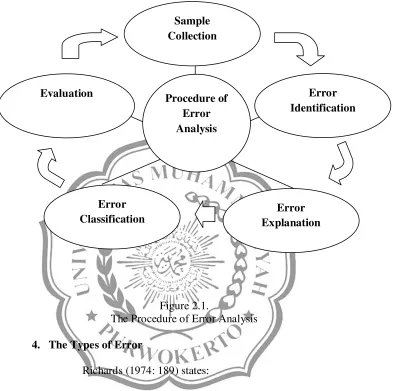
While Ellis in Tarigan (1995: 68) defines an error analysis as a work procedure, usually used by the researchers and language teachers, includes collecting samples, error analyzing, error explanation, error classification, and also error evaluation.
2. Error and Mistake
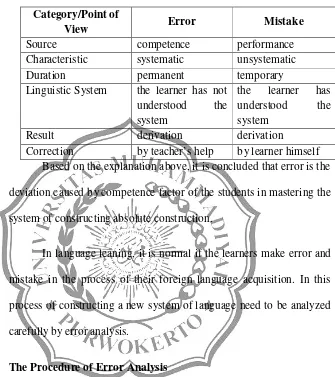
Mistake and error look similar, but they are very different phenomena. According to Tarigan (1995: 75-76), error and mistake are defined as follows:
a. Error is caused by competence factor, which means the students do not know the linguistic system used. It usually occurs systematically and will be durable. Correcting can be done by teacher through remedial, practices, training, etc. but it can not be corrected soon.
b. Mistake is caused by performance factor. Restrictiveness in remembering something (forgetfulness) causes mistake in pronouncing a certain sound, word, spelling, or stress of word, or sentence, etc. Those are unsystematically, and self-correction can be done automatically because this mistake will not be long. In this case, they basically know the linguistic system.
Table 2.1.
The Comparison between Error and Mistake
Category/Point of
View Error Mistake
Source competence performance
Characteristic systematic unsystematic
Correction by teacher’s help by learner himself Based on the explanation above, it is concluded that error is the deviation caused by competence factor of the students in mastering the system of constructing absolute construction.
In language leaning, it is normal if the learners make error and mistake in the process of their foreign language acquisition. In this process of constructing a new system of language need to be analyzed carefully by error analysis.
3. The Procedure of Error Analysis
Tarigan (1995: 67-68) says that there are some experts of language teaching who found that error analysis has some steps:
a. sample collection
b. error identification
After collecting sample, the researcher identifies the errors in sample collection.
c. error explanation
The researcher explains the errors which are made by the students. d. error classification
The researcher classifies the errors based on the causes. e. evaluation
The researcher evaluates the level of errors.
Figure 2.1.
The Procedure of Error Analysis 4. The Types of Error
Richards (1974: 189) states:
…the realization that the second language learner’s errors are potentially important for the understanding of the process of second language acquisition, and consequently the planning of courses incorporating the psychology of second language learning.
Sample Collection
Error Explanation Error
Classification
Error Identification
Evaluation Procedure of
According to Dulay and Burt in Arikunto (1995: 145), there are four classifications of error:
a. Error Type Based on Linguistic Taxonomy
Many error taxonomies have been based on the linguistic items which are affected by an error. These linguistic category taxonomies classify errors according to both the language component and the particular linguistic constituent. Language component includes phonology (pronunciation), syntax and morphology (grammar), semantics and lexicons (meaning and vocabulary), and discourse (style).
Some advantages of using such linguistic taxonomy, especially for:
1) Curriculum developers, to arrange language lessons into reference and exercise books.
2) Researchers, to organize some errors that have been analyzed. 3) Teachers and students, to reflect their teaching and learning in
class.
b. Error Type Based on Surface Strategy Taxonomy
1) Omission
Omission error is characterized by the absence of an item that must appear in a well-formed utterance. It might be the omission of noun, verb, adjective, or adverb within a sentence.
a) Healthy Land a medical center.
The sentence above omits the auxiliary verb “is”, it should be Healthy Land is a medical center.
b) I go play
The sentence above omits “to”, it should be I go to play. 2) Addition
Addition error is the opposite of omission error. It usually occurs at the end of stages of the second language acquisition, when a learner has got some rules of the target language. This error can be in the form of double markings and regularization.
a) Double markings
Double markings are accurately described as the failure to delete certain items which are required in some linguistic constructions but not in others.
The example above presents double marking of past sentence. The sentence should be We didn’t go there (the marker of past form is “did”).
b) Regularization
Every language has its rule. The rule is usually applied in a linguistic element, such as morphology rule, syntax rule, so do the verb and so forth. However, still, there is an exception within a rule. For instance adding the “s” for the plural noun, like mans, childs, mouses, and so on, and adding “ed” to the past participle, such as eated, goed, comed, and etc. The correct ones are men, children,
mice, and ate, went, came, respectively.
3) Malformation
Malformation error is characterized by the use of the false form of the morpheme or structure. While in omission error the item is not provided at all, in malformation error, the learner provides something although it is incorrect. For example in the sentence the snake eated the chicken, the past participle marker provided by the learner is just the incorrect one. It should be ate.
4) Disordering
utterance. For example, He is all the time late. Because of the interference of their first language the learners may not put the word or the group of words in the right place. So they make disordering errors.
c. Error Type Based on Comparative Analysis
The classification of errors in a comparative taxonomy is based on the comparison between the structure of L2 errors and certain other types of constructions. In this case, L2 errors have been compared to errors made by the children learning the target language as the first language and to the equivalent phrases or sentences in the learners’ mother tongue. It can be divided into developmental errors, interlingual errors, ambiguous errors, and unique errors.
1) Developmental Errors
Developmental errors are errors similar to those made by the children learning the target language as their first language. For example I not crying.
2) Interlingual Errors
structure regarded of the internal process or external condition that spawned them. For example if the learner produces “Dog eat it”, then the researcher would translate the grammatical form: “The dog ate it”.
3) Ambiguous Errors
Ambiguous errors are those that could be classified equally well as developmental error and interlingual error. That is because these errors reflect the learners’ native language structure. For example “I no have car”.
4) Unique Errors
Unique errors that are complete without a grab bag for items that do not fit into any other category. For example, the utterance “She do hungry”. The speaker uses neither her mother tongue nor the L2. Dulay and Burt in Tarigan (1995: 163), in making error comparative analysis, call this as unique errors.
d. Error Type Based on Communicative Effect
there are two kinds of errors, namely global errors and local errors.
1) Global Errors
Global errors are errors that affect overall sentence organization and cause misunderstanding or miscommunication. The most systematic global errors include: a) wrong order of major constituents
example: English language use many people. (Many people use English language)
b) missing or wrong sentence connector
example: Not take this bus, we late for school. (If we do not take this bus, we will be late for school) c) missing passive sentence characteristic
example: The students’ proposal looked into the principal.
(The students proposal was looked into the principal. 2) Local Errors
Example: Why like we each other?
(Why do we like each other?)
5. The Source of Errors
There are many error categories that refer to sources of origin of the learners’ errors. These include a number of environment factors (training, procedures, communication situations, and socio-cultural factors), and a number of internal processing factors (first language “transfer”, “simplication”, generation of “false hypothesis” by the learner and other).
Brown (2000: 224) proposes four sources of errors: interlingual transfer, intralingual transfer, context of learning, and communication strategies.
a. Interlingual Transfer
learners have mastered. English learners say “sack” for “shark”. Indonesians get difficulties in saying “shark” because in Indonesian pronunciation there is no word contains of consonant cluster just like in “shark”. English learners tend to say “the book of John” instead of “John’s book”.
b. Intralingual Transfer
It is organized from the structure of English itself. These errors are made by the learners who have begun to acquire parts of the target language but still lack of competence. Since the complexity of English structure encourages such learning problems, all learners regardless of language background tend to commit similar errors. It is illustrated in such utterances as “He goed”, “I don’t know what time is it”, and “Does John can sing?”
c. Context of Learning
presentation of structure in textbook. For instance, the word “was” may be interpreted as a marker of past tense, One day it was happened and “is” may be understood to be the corresponding marker of present tense; He is speaks French.
d. Communication Strategies
Communication strategies are defined and related to learning styles. The learners’ technique in learning second language can become a source of error. The error happens when the conscious employments of verbal or non-verbal mechanism for communicating an idea when precise linguistic forms are not readily available. For instance “I drove my bicycle”, “How do you say?”
6. The Possible Causes of Error
Richards (1974: 173) focuses on several types of errors:
Interlanguage error, that is, error caused by the interference of the learners’ mother tongue, and intralingual error, that is, error that reflects the learners’ competence at a particular stage, and illustrates some of the general characteristics of language acquisition.
a. The Interference of the Learner’s Mother Tongue
Learning activities that produce the patterns in the second language are influenced by the first language. Sometimes, learner makes mistakes due to the difference of grammatical system between first language and second language. A different class of errors is represented by sentences such as did he comed, what you are doing, he coming from London, make him to do it, I can to
speak Javanese. Errors of this nature are frequent, regardless of the
learner’s language background. b. Over-generalization
Jakobovitz in Richards (1974: 174) defines generalization or transfer as:
…the use of previously available strategies in new situations. . . In second language learning . . . some of these strategies will prove helpful in organizing the facts about the second language, but others, perhaps due to superficial similarities, will be misleading and inapplicable’.
Over-generalization covers instances where the learner creates a deviant structure on the basis of his experience of other structures in the target language. For example, he can sings, it is occurs, he come from.
c. The Ignorance of Rule Restrictions
application of rules to contexts where they do not apply. For instance, The man who I saw him, I made him to do it.
d. Incomplete Application of Rules
This category notes the occurrence of structure whose deviancy represents the degree of development of the rules required to produce acceptable utterances. The foreign language learners can achieve quite efficient communication without the need for mastering more than the elementary ruler of question usage.
The use of questions is a common teaching device. Typically they are used, not to find out something, but as a means of eliciting sentences. Alternatively, the statement form may be used as a means of eliciting questions through a transform exercise. Here are some examples:
Table 2.2.
The Illustration of the Use of Question
Teacher’s Question Student’s Response Do you read much? Yes, I read much.
Ask her what the last film she saw was called.
What was called the last film you saw?
What is he doing? He opening the book.
Will they soon be ready? Yes, they soon be ready.
As the above sample illustrates, when a question is used to elicit sentences, the answer often has to be corrected by the teacher to counteract the influence of his question. Some course-books proceed almost entirely through the use of questions by utilizing signals to indicate the type of sentence required. This may reduce the total number of deviant sentence produced.
e. False Concepts Hypothesized