PENJELASAN HASIL CEK PLAGIARISME
1. NAMA JURNAL : JURNAL MANAJEMEN & KEWIRAUSAHAAN VOL. 18 NO. 2
TAHUN 2016
2. JUDUL
: ANTECEDENT VARIABLES OF EMPLOYEES LOYALTY
3. HASIL CEK
: 90%
4. PENJELASAN
:
90% SAMA DENGAN ARTIKEL SENDIRI YANG TERDAPAT DALAM REPOSITORI
UNIVERSITAS KRISTEN PETRA TEMPAT PENULIS BEKERJA.
Word Count: 5146
Plagiarism Percentage
90%
sources:
1 90% match (Internet from 18-Jul-2017)
http://repository.petra.ac.id/17599/1/Publikasi1_91022_3296.pdf
paper text:
JMK, VOL. 18, NO. 2, SEPTEMBER 2016, 111–118 1
DOI: 10.9744/jmk.18.2
.111–118 ISSN 1411-1438 print / ISSN 2338-8234 online 1
ANTECEDENTS VARIABLE OF EMPLOYEES LOYALTY Eddy Madiono 1
Sutanto1*,Meiliana
Perdana1 1Business
Mangagement Department University Kristen Petra Siwalankerto 121– 1
131 Surabaya 60236, Indonesia *Corresponding author; Email:
[email protected] Abstract Employees who have high loyalty will be
motivated to work and do their best for the company. This research aims to
analyze the influence on satisfaction to the leader, compensation and the
work environment against the loyalties of PT. ISS employees in Surabaya.
Type of this research is quantitative explanatory. Primary data was obtained
from questionnaires which distributed to 150 respondents. Valid
questionnaires are up to 95, by type of work, cleaning services and parking,
while the rest of employees are not qualified. The Result of this research
present that satisfaction to the leader, compensation and the working
environment have a positive and significant effect in partially and
leader, compensation, working environment and employee loyalties.
Introduction Employees are an important aspects of a busi- ness and have a
substantial influence on the success of a company. Employees with a high
level of loyalty are essential for the progress of the company. Marti- wi, dkk
(2012) mentioned that loyalty is an important aspect that must be owned by
the employee in the work (Fajariani & Surya, 2015). Employees who have
high loyalty will be motivated to work and do their best for the company. On
the other side, leader is an important aspect. According to Thoha (2004), the
success or failure of an organization depends on the leadership (in
Mon-diani, 2012). A good leader should pay attention to the employee prosperity.
Therefore employees will work well and have a high loyalty to the company.
One of the benefits is often used to develop employ- yees loyalty is
compensated (Dwipayoga & Adyani, 2013). Employee’s loyalty to the
company or organi- zation depends on the salary provided, if it
satisfacto-ry, the employee will be loyal to the company, other- wise, if the benefit
awarded is not feasible then the employee’s performance will be decline or
even dra- matically decreased. The compensation given by the company to
employees can influence employee loyal- ty (Purwaningsih & Noermijati,
2015). Febriani and Indrawati (2013) and Situngkir (2013) mentioned that
comfort and cleanliness within working environments is an important factor
which can affects employee in completing working assignments (in
Suwondo & Su- tanto, 2015). A comfortable and appropriate working
environment will encourage employees to work as best as possible, it will
smooth the company pro- duction process (Daulay, Maineldi, & Hendriani,
2014). Uncomfortable working environment will cause passiveness on
employees. Employee’s loyalty of PT. ISS Surabaya is re- latively low. Based
on the early interview with several employees, there are quite many
employees resign from the company and attending work late. It was also
found that the relationship between leaders and employees are not
harmonious, due to incompatibility among supervisors. Those matters
made employees dissatisfied with their leader and choose to resign from the
company. Compensation provided by PT. ISS, specifical salaries are already
meet the standard of the city minimum wage (UMK), but still, many
employees complain regarding the salary received, it turn out smaller due to
some deduction such BPJS health and employment and others. Employees
also admit the importance of the work environment, when the working area
occurred was the conflict between colleagues that causes discomfort in the
work. According to Robbins and Judge (2011), there are four factors that
will increase employee satisfac- tion: 1) Mentality challenging Profession
Worker prefers the type of profession that able to give an opportunity to use
skills and ability in completing varieties assignment also freedom and
feedback on workers performance. Those charac- teristics are able to make
the job mentally more challenging. 2) Decent rewards The satisfaction of
employees will potentially ap- pear when both reward and promotion policy
are fair, no hidden intentions and in accordance with employee
expectations, based on the job require- ment, individual skills, and the
applicable salary standard. 111
3) Comfortable working environment Employes are concerned with a 1
comfortable working environment to facilitate good perfor- mance. Many
researchers found that employees like a safe environment. Some other
things that are preferred by employees are short distance between
residences and working place in clean and modern facilities also
well-equipped devices. 4) Supporting Colleague Many people resigned from a job
are not because of money or a real achievement. For most people working
is another way to fulfill a necessity of social interaction, therefore it is not
surprising when colleague behave friendly each other and mutual support in
job satisfaction. Job satisfaction is also determined by the superior
behavior, em- ployee satisfaction can be increased when the lea- der is
friendly, understandable, giving compliment for good performance, good
listener and demon- strate personal interest to employees. Satisfaction
against the leader is the pleasant fee- ling that arises through the
relationship between the leader and employees in the process of influence,
giving instructions and supervision. The following are indicators of
employee satis- faction toward its leader (Robbins & Judge, 2011;
Ha-sibuan, 2016) 1. An obedience The ability of an employee to accepting and
execute leader instructions, when employees are satisfied, they will
accepting and execute the leader instructions. 2. The relationship with the
leader Any actions were taken by employees having an impact on the
relationship with its leader. Accord- ing to Hasibuan (2016) the highest level
of satis- faction is when a relationship between both parties is positive. 3.
with the leader will be motivated to work. Satisfaction is the pleasure
feelings that arise due to compensation received, it can be money or stuff,
both directly and indirectly by the employees as a re- turn of services which
are given to the company. Ac- cording to Mondy (2008), the form of
compensations given by the company to employees, divided into two parts,
financial compensation and non-financial com- pensation (in Purwaningsih
& Noermijati, 2015): 1. Financial Compensation Compensation awarded to
certain employees in the format of money 2. Non-financial Compensation
Compensation awarded to employees as a return of retribution in the format
of facilities. This type of compensation distinguished into two, non- financial
the job (compensation which related to the job) and non-financial job
environment. The following are indicators of employee satis- faction toward
compensation (Hasibuan, 2016; Mangkunegara, 2013; Simamora, 2004): 1.
Satisfaction on the salary The pleasant feeling due to income earned in the
format of money as a return of the services pro- vided to the company. It is
expected that emplo- yees will be satisfied when earned a larger salary. 2.
Satisfaction on the religious holiday allowance The pleasant feelings caused
by the existence of workers rights along with the amount that must be paid
by the company before the religious holiday 3. Satisfaction on the pension
allowance The pleasant feeling is caused by an existence of the life
insurance program and the amount of it. The program aims to provide the
assurance fund for the insured or participants when they reach the pension
age and the family or when the insured or participants died. 4. Satisfaction
on the health allowance The pleasant feeling caused by an existence of
health benefit also the amount of it, which given by the company to
employees. Satisfaction on the work environment is a plea- sant feeling that
is created due to the condition of everything in the work environment. Many
resear- chers show that employee’s preferred a safe and com- fortable
working environment. According to Se- darmayanti (2009) and Nitisemito
(2013), working environment satisfaction indicators are as follows (in
Norianggono, Hamid, & Ruhana, 2014) 1. Satisfaction on the cleanliness of
the working environment The cleanliness of the working environment will
create employee’s satisfaction when it clean they will be happy to do their
job 2. Satisfaction on the convenience of the working environment
Employees who feel comfort in the workplace, then they will also feel the
satisfaction of doing their job 3. Satisfaction on work environment safety
working environment will feel peace and happy to do their job 4. A good
relationship between employees It employees will create a comfort and
satisfaction on the workplace.
Tjiptono (2006) opined that employee’s loyalty to the company may 1
develop responsibility in the work (in Hermawan and Riana, 2014).
According to Saydam (in Daulay, Maineldi, & Hendriani, 2014) the indicators
of employee’s loyalty is as follows: 1. Obedience is the ability of employees
to obey all regulations valid, to execute all duty given by the superior in
charge and does not violate the pro- hibition that has been determined. 2.
Responsibility is employees’ capability in comple- ting assignment properly,
on time and dare to endure the consequences of a decision or action taken.
3. Dedication is a contribution of idea and energy to the company sincerely.
4. Integrity is employees’ ability to admit, speak or provide the appropriate
information in accordance with reality and truth. Picture 1. The research
framework Sources: Sedarmayanti, 2007 and Nitisemito, 2013 (in
Norianggono, Hamid, & Ruhana, 2014); Simamora, 2009; Saydam, 2004 (in
Daulay, Maineldi, & Hendriani, 2014); Hasibuan, 2016; Mangkunegara, 2013;
Robbins and Judge, 2011. Research Method The population in this study
were employees of PT. ISS Surabaya who worked on the cleaning ser- vice
and parking, total employees are 200 people. Since the subject of this
research is loyalty, the used samples are permanent staffs only. The
sampling technique used was purposive sampling with criteria three years
of service at PT. ISS Surabaya and obtained 95 people only as the total of
sample mea- surement.
Sutanto: Antecedents Variable of Employees Loyalty 113
The technique or method used for data collection is through 1
questionnaire distribution, it consists of questions and statement for
respondent to be answer- ed (Sugiyono, 2011). The answered is in Likert
scale. Likert scale is a scale to measure attitudes, opinion, and perceptions
of a person toward an object or phe- nomenon that occurs in the company
(Siregar, 2014). Data Processing Techniques Below is the data processing
which executed through some test: 1. Validity test Validity test is to find out
validity of the measuring instrument used in this research is determined in
accordance rational analysis on test or questionnaire, which the apprai- sal
referes to the theoretical considerations and the measuring intstruments
itself (Ghozali, 2013). 2. Reliability test Reliability refers to the consistency
of an instru- ment to measure things from time to time. Re- liability is to
discover the result of a measurement. The measurement result is accurate
and reliable when there is no difference in the results obtained although it
has done twice or more measurements on an object by using the same
measuring device (Ghozali, 2013). 3. The classical assumption test Classic
assumption test was done with three test, specifically the normality test,
Multicollinearity and Heteroskedasticity test. The normality test is to
determine whether the distribution of the variables is normal or close to
normal. The Multi- collinearity test aims to test whether the regression
model is found in the correlation between inde- pendent variables and The
Heteroskedasticity test is to discover the difference of variance of residual
inequality from one observation to another. Data analysis techniques in this
research are: 1. Descriptive Analysis of Variables Research This analysis
used two types of measurements. There are Mean and Interval Scale. Mean
is used to discover the average frequency of respondents’ feedbacks
against each question. Interval scale is the scale of the scores awarding on
the object which has the quality of ordinal and same distance or interval. 2.
Multiple Linear Regression Analysis The analysis is used to discover the
influence of the independent variables with the same de- pendent variable.
3. Hypothesis test
Consisted of t-test to indicate the influence of an independent variable 1
individually, f-test is to indi- cate the influence of an independent variable
against dependent variable simultaneously. Coeffi- cient determination
test is beneficial to measuring the ability of the model to explain the
independent variable variations. The Definition of Operational Variable
Satisfaction on the Supervisor (X₁) is a pleasant feeling in the
process of influencing and providing guidance and supervision that arise
from the relation- ship between the leader and employees. This variable is
measured through by several indicators: 1. The obedience to the leader 2.
Relationship with the leader 3. Collaboration with the leader Satisfaction on
compen- sation received, it can be money or stuff, both directly and
indirectly by the employees as a return of services which are given to the
company. The indicators used to measure satisfaction on compensation are
as fol- lows: 1. Satisfaction on the salary/income 2. Satisfaction on the
religious holiday allowance 3. Satisfaction on the pension allowance 4.
Satisfaction on the health allowance Satisfaction on the working
environment (X₃) is a pleasant feeling due to the condition of everything in
the work environment. The indicators used to mea- sure satisfaction on the
work environment are as fol- lows: 1. Satisfaction on the cleanliness of the
working environment 2. Satisfaction on the convenience of the working
environment 3. Satisfaction on the work environment safety 4. A good
relationship between employees Employee loyalty (Y) is when the facilities
earned by employees are satisfied, fulfilled, and com- fortable. Then the
employee will work their best and loyal to the company. The indicators used
to measure satisfaction on the work environment are as follows: 1.
Obedience 2. Responsibility 3. Dedication 4. Integrity Result and
Discussions Descriptive Analysis of the Research Variables The data
obtained from the scale number 1 to 5, will be used to measure or to
observe the reaction of respondents about the satisfaction of leader,
com-pensation, the work environment, and employee lo- yalties. The reaction of
respondents about each varia- ble will be measured by using the following
formula: Interval Kelas= (5 - 1) / 3 = 1.3 Class interval 1.3 means 1.00–2.30
classified as a low category; 2.31–3.60 classified as a medium category;
3.61–5.00 classified as a high category. The average value for the leader
satisfaction is 3.10 and it classified as a medium category. This can be
hap-pened because of the way of the leader is too harsh in giving assignments,
many rules or captious, all these things trigger the employees being
passive. The high- est mean score is 3.20 indicates a good communica- tion
with superiors, which means there are good com- munications between
employees and the leader. The lowest mean value is 2.95, indicates that
employees are obeying orders given by the leader, which means low
satisfaction on the leader. The medium score for the satisfaction on salary
variable is 3.06. It classified in a medium category. This is caused by low
salary received by employees. The highest mean score is 3.24, indicates
employees satisfaction on religion holiday allowance awarded by the
company. The lowest mean value is 2.87, indi- cates the salary awarded by
environment is 3.38 classified as a medium category. This is caused by
employees sense of bored on the work environment. Employees working as
a cleaning service will always work indoor, while park- ing management
always works in the parking lot or basement, it makes employees feel
uncomfortable. The highest mean value is 3.87 indicates that em- ployees
have a good relationship with colleagues. The lowest mean value is the
variable of employee feel comfortable working for the company is 2.93
which means that employees dissatisfied and uncomfortable with the
working environment. The average score on the working environment is
3.02 classified as a medium category. The highest mean value is 3.17
indicates that employees complete the work as the leader instructions. The
lowest mean value is 2.92 indicates that employees reporting if there is any
damage to the facilities in the workplace because of the employees and
inform the supervisor when absent. Validity Test Validity test used to
measure the validity of a questionnaire made. The method used is a
compari- son between r counts (value of Pearson correlation) with r table,
when r counts positive and r counts > r table, it means a point or a variable
valid. Sutanto: Antecedents Variable of Employees Loyalty 115 Tabel 1 in
thestatement of satisfaction on the work environ-The
Validity Test Result on Satisfaction towards the Leader 1
ment (X3)
is greater thanrtable value (0.202). It can be concluded that the entirety 1
statement of satisfaction on Variable
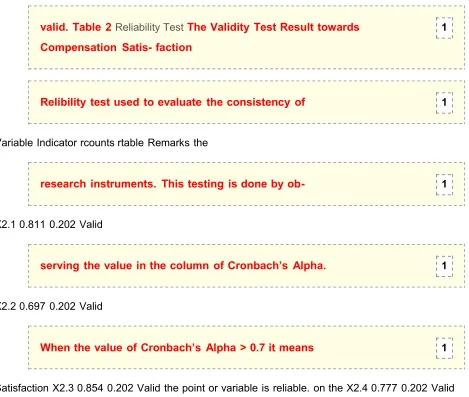
Indicator rcounts rtable Remarks the work environment variable (X3) are valid. Further- Satisfaction X1.1 0.866 0.202 Valid more, each statement on employee loyalties variable on X1.2 0.851 0.202 Valid
(Y) is greater thanrtable value (0.202) as seen in Table 1
The Leader X1.3 0.714 0.202 Valid
(X1) X1.4 0.878 0.202 Valid employee loyalties variable (Y) is
valid. Table 2Reliability TestThe Validity Test Result towards 1
Compensation Satis- faction
Relibility test used to evaluate the consistency of 1
Variable Indicator rcounts rtable Remarks the
research instruments. This testing is done by ob- 1
X2.1 0.811 0.202 Valid
serving the value in the column of Cronbach’s Alpha. 1
X2.2 0.697 0.202 Valid
When the value of Cronbach’s Alpha > 0.7 it means 1
Satisfaction X2.3 0.854 0.202 Valid the point or variable is reliable. on the X2.4 0.777 0.202 Valid Compentation X2.5 0.896 0.202 Valid Tabel 5 (X2) X2.6 0.848 0.202 Valid Reliability Test X2.7 0.890 0.202 Valid Variable Crisis Cronbach's Point Alpha Remarks
Tabel 3 The Validity Test Result towards Satisfaction on the 1
Satisfaction on he Leader Work Environment (X1) 0.7 0.844 Reliable Satisfaction on the Variable Indicator rcounts rtable Remarks Compensation (X2) 0.7 0.922 Reliable X3.1 0.929 0.202 Valid Satisfaction on the Work Satisfaction X3.2 0.889 0.202 Valid Environment (X3)
0.7 0.958 Reliable on theX3 .3 0.934 0.202 ValidEmployee Loyalties (Y) 1
0.7 0.855 Reliable
Work X3.4 0.961 0.202 Valid Environment X3.5 0.741 0.202 Valid
(X3) X3.6 0.852 0.202 Valid
naire which consists of four variable which is satis- 1
X3.7 0.961 0.202 Valid
faction on the leader, satisfaction on the compensa- tion, satisfaction 1
on the work environment and emplo-Table 4yee loyalties are reliable
since Cronbach’s alpha
va-The Validty Test Result towards Employee Loyalties lue is greater than 0.7. Variable Indicator rcounts rtable Remarks Y1.1 0.706 0.202 Valid Normality Test Y1.2 0.762 0.202 Valid Y1.3 0.839 0.202 Valid Normality test aims to determine the normality Employees Y1.4 0.740 0.202 Valid
of each variable distribution. Normality test is re- 1
loyalty Y1.5 0.804 0.202 Valid
quired to test other variables by assuming that the 1
(Y) Y1.6 0.506 0.202 Valid
value of the residual follows a normal distribution 1
Y1.7 0.509 0.202 Valid
(Ghozali 2013). Testing is done with a graphical ana- 1
Y1.8 0.559 0.202 Valid
lysis (scatterplot) by looking at the normal probability plots comparing 1
to the cumulative distribution with a
From Table 1, it can be seen in the statement of normal distribution.The 1
a
satisfaction on the leader (X₁) is greater than 1
rtable
straight diagonal line and residual plotting data will be 1
value (0.202). It can be concluded that the entirety 1
compared with diagonal lines, when the residual data 1
statement on the leader satisfaction variables (X₁) are 1
distribution in normal, then the line that represents the 1
valid. From Table 2 it can be seen in the statement of 1
actual data will follow a diagonal line. The data resi- 1
compensation satisfaction (X2) is greater than rtable
dual dissemination has followed the pattern of a nor- 1
value (0.202). It can be concluded that the entirety 1
mal distribution,
it can be concluded that theregres- statement on the compensation 1
sion model used in this research has been meeting the 1
(X2)
are valid. Meanwhile,from Table it can be seen assumptionsof 1
normality.
Picture 2. Normality test on p-plot graphic Multicollinearity Test 1
Multicollinearity test aims to find the perfection of correlation between
independent variable. Mul- ticollinearity test results based on the value of
Tole- rance dan Variance Infating Factor (VIF), when the value of tolerance >
0.1 and VIF <10. This means that multicollinearity does not happen in a
regression model (Santoso, 2002). Table 6 Multicollinearity TestCollinearity
Variable
Statistics Remarks Tolerance VIF Satisfaction on the 0.430 2.328 Non Leader (X1) Multicollinearity Satisfaction on the 0.375 2.667 Non compensation (X2) Multicollinearity Satisfaction on work 0
.558 1.791 Non environment (X3)Multicollinearity From Table 6, it is 1
known that VIF value from the three variables is smaller than 10. It can
be con- cluded that there is no correlation between variable satisfactions on
the leader (X1), satisfaction on com- pensation(X2)and satisfaction on the
work environ- ment (X3).Heteroskedasticity Test Heteroskedasticity test
aims to find the equiva- lence or nonequivalence of a variance from one
obser- vation residue to another, if there is no equality, it means no
problem. Heteroskedasticity Test is per- formed by observing to the dots
spread with no pat- tern, above and below the zero on the Y axis on a
scatterplot, there is no heterokedastistas in linear re- gression. Picture 3.
Heteroskedasticity test On the scatterplot graph shows that data is spread
above and below 0 (zero) number on the Y axis and there is no abvious
pattern in a spread of the data. This means there are no heterroskedastisitas
on regression equation model. The Analysis of Multiple Linear Regression
Multiple linear regression model was used to describe the influence of
linear re- gression line equation. Multiple linear regression analysis in this
research is to find the influence bet- ween the satisfaction on the leader,
compensation and work environment against employee loyalties. Based on
the result SPSS Program (Statistical Package for Social Science) version
22.0, the pattern of a regres- sion model is as follows: Y = 0,691 + 0,
356X1 + 0,288X2 + 0,104X3
Notes: Y = Employee loyalties Variable X1 =Satisfaction on the Leader 1
Variable X2 =Satisfaction on Compensation Variable X3 =Satisfaction
on the Work Environment Varia- ble Table 7 Regresion Model Model
Regression Coeficient Constants Satisfaction on the Leader Satisfaction on
Compensation Satisfaction on Work Environment 0.
691 0.356 0.288 0.104
Based on Table 7, found that satisfaction on the leader (X1)variable, 1
satisfaction on compensation (X2)variable and satisfaction on the
work environment (X3)variable has a positive influence toward
employ-yee’s loyalty (Y). In this case when satisfaction on the leader (X1) 1
variable is high, then employees will be loyal to the company. When
satisfaction on compen- sation (X2)variable is suitable as employee’s
expecta- tion, then employees will be loyal to the company. When
satisfaction on the work environment (X3)va- riable is high, it means
employees are comfortable in working and do not consider to move to
others com- pany. Result of t-test t-test is used to find the influence of one
indivi- dually independent variable in explaining variation in the dependent
variable, in this case is to find whether satisfaction on the leader (X1),
satisfaction on compen- sation (X2)and satisfaction on the work
environment (X3),partially effect significantly to employee’s loyal- ty (Y).
Based on the result SPSS Program (Statistical Package for Social Science)
version 22.0, the result of a partial test is as follows: Table 8 t-test
Independent Vaiable B Std. Error Beta t Sig. Satisfaciton on the Leader
Satisfaction on the work nvironment 0.3560.082 0.288 0.084 0. 1
104 0.045 0.397 4.339 0.000 0.336 3.426 0.001 0.188 2.340 0.021
It is shown in Table 8, the significant value of tcountson satisfaction on 1
the leader, compensation and work environment showed significant
value, is below 0.05. It can be concluded that satisfaction on the lea- der,
compensation and work environment has a signi- ficant influence on
employee’s loyalty (Y). This result supports the previous research by Safitri
(2015) that suggested employees’ satisfaction on compensation affected
their loyalty. Result of F-test F-test aims to find the satisfaction on the
leader (X1),satisfaction on compensation (X2),and satisfac- tion on the work
environment (X3)have a positive in- fluence simultaneously on employee
loyalty. Based on the result SPSS Program (Statistical Package for Social
Science) version 22.0, the result of a partial test is shown in Table 9. Based
on Table 9, it is found that the signifi- cance value of Fcountsis 0.000, this
value is smaller than 0.05. The hypothesis results show thatH0-3is
Sutanto: Antecedents Variable of Employees Loyalty 117 rejected and Ha
-3 is accepted. It can be concluded that the satisfaction on the leader 1
(X1),satisfaction on compensation (X2)and satisfaction on the work
envi- ronment (X3)have significant influence simultaneous- ly on employee
loyalty (Y). Table 9 F-test FcountsSignificance Remarks 62.290 0.000
Influence Coeficient Determination Test(R2)Based on Table 10, it can be
seen that the re- gression result produce a multiple correlation values (R) of
0.820, which means there is a close connection between satisfaction on the
leader (X1),satisfaction on compensation (X2)and satisfaction on the work
envi- ronment (X3)to employee loyalty. The regression re- sult indicate that
the coefficient of multiple determi- nation (R2) is equal to 0.673, this means
that employ- yee loyalty is influenced by satisfaction on the leader,
compensation and work environment is 67.3%, mean- while the rest of
32.7% is influenced by others factor out of the research such as discipline,
work motiva- tion, etc. Table 10 The Result of Coeficient Determination Test
2 0.820 0.673 According to employees, the most satisfactory 1
compensation is the holiday religion allowance, in ad- dition to the
amount that is satisfactory and acceptable in every year, also due to the
employees needed for Eid, while the most unsatisfactory are pension
allow-ance since it can be withdrawn after the age of 56 years. Conclussions and
Implications Satisfaction on the leader, compensation, the work
environment have a significant influence on em- ployee loyalty, besides
satisfaction on the leader, compensation and work environment variable are
si- multaneously affect significantly on employee loyal- ty. The majority of
employees have a respectable as- sessment on satisfaction to the leader,
satisfaction on compensation and work environment variable. Based on an
assessment of the employee, it is important for companies to continue to
ensure that employees can continue to be motivated to improve their
perform-ance by providing the facilities, fulfill their needs, pay attention to their 1
future security and provide opportu- nities, those will support the
company to grow and be- come better in the future. Employee compensation
should be increased, especially salaries. It can satisfy employees and raise
the spirited at work, for example coming to work on time, willing to work
overtime and finish every as- signment on time. The result of this research
showed that satisfac- tion on the work environment has the smalles
influ-ence on employee loyalty. The company should pro- vide comfort to
employees, for example by keeping the work environment clean because it
influence em- ployee to work well, creating a comfortable atmos- phere in
the workplace, establish a team that aims on collaboration and interaction
between employees.
sumber daya manusia. Edisi revisi kesembilan belas, Bumi Aksara Group, Bandung. Hermawan, I. K. A. & Riana, I. G. (2014). Analisis faktor-faktor yang menentukan loyalitas karyawan pada PT. Inti Buana Permai Denpasar Bali. E- Jurnal Manajemen Universitas Udayana, 3(3), 624–643. Mangkunegara, A. P. (2013). Manajemen sum- ber daya manusia perusahaan. Bandung, PT. Remaja Rosdakarya. Mondiani, T. (2012). Pengaruh kepemimpinan trans- formasional dan kompensasi terhadap kinerja karyawan PT. PLN
(PERSERO) UPJ Sema- rang. Jurnal Administrasi Bisnis, 1(1), 46–54. Norianggono, P., Hamid, D., & Ruhana, I. (2014). Pengaruh lingkungan kerja fisik dan non fisik terhadap kinerja karyawan (Studi pada karyawan PT. Telkomsel Area III Jawa-Bali Nusra di Surabaya). Jurnal Administrasi Bisnis (JAB), 8(2), 1– 10. Purwaningsih, U. & Noermijati. (2015). Pengaruh kompensasi finansial dan non finansial terhadap kepuasan kerja dan loyalitas kerja karyawan (Studi pada karyawan Hotel Pelangi Malang, Jawa Timur). Jurnal Ilmiah FEB Universitas Brawijaya, 3(2), 1–15. Robbins, S. P. & Judge, T.A. (2011). Organizational Behavior, Edisi Keempat Belas. New Jersey, Prentice Hall Inc. Safitri, R. (2015). Pengaruh kompensasi terhadap loyalitas karyawan PT. Putera Lautan Kumala Lines Samarinda. E-Journal Administrasi Bisnis, 3(3), 650–660. Simamora, H. (2004). Manajemen sumber daya manu- sia, Edisi Ketiga. Yogyakarta: STIE YKPN. Santoso, S. (2002). Buku latihan spss statistik multi- variate. Jakarta: Elex Media Camputindo. Siregar, S. (2014). Statistik parametrik untuk pene- litian kuantitatif. Jakarta: Bumi Aksara. Sugiyono (2011). Metode penelitian pendidikan pen- dekatan kuantitatif, kualitatif, r&d. Bandung: Alfabeta. Suwondo, D. I. & Sutanto, E. M. (2015). Hubungan lingkungan kerja, disiplin kerja, dan kinerja kar- yawan. Jurnal Manajemen dan Kewirausahaan, 17(2), 135–144. 112
JURNAL MANAJEMEN DAN KEWIRAUSAHAAN, VOL.18, NO. 2, 1
SEPTEMBER 2016: 111–118
114 JURNAL MANAJEMEN DAN KEWIRAUSAHAAN, VOL.18, NO. 2, 1
SEPTEMBER 2016: 111–118
116 JURNAL MANAJEMEN DAN KEWIRAUSAHAAN, VOL.18, NO. 2, 1
SEPTEMBER 2016: 111–118
118 JURNAL MANAJEMEN DAN KEWIRAUSAHAAN, VOL.18, NO. 2, 1