Wahyu C. Adinugroho1,2, Kade Sidiyasa1, Tati Rostiwati3 and Dida Syamsuwida4
ABSTRACT
he aim of this study was to determine the ecological conditions and distribution of gemor bark producing tree species at Tuanan village in Kapuas District, Central Kalimantan Province and Long Daliq village in Kutai Barat, East Kalimantan Province. In order to collect adequate vegetation data, several observation plots were laid out by using purposive sampling. Primary and secondary data were collected from the plot areas by observing directly the habitat and its ecological condition of vegetation. It was revealed that the gemor tree species tended to grow well on the habitats which have a thin layer of peat (< 2 m), pH 3 – 4 and in a humid climatic condition. Two gemor bark producing tree species were identidied in the study areas, namely
Nothaphoebe coriacea (Kosterm.) Kosterm. and N. umbellilora Blume. he similarity level of vegetation composition at both sites (Kapuas and Kutai Barat Districts) was low. he tree species richness in the plot areas of Tuanan in Kapuas District, Central Kalimantan (82 species, 57 genera and 28 families) was higher than that found in Long Daliq, Kutai Barat District, East Kalimantan (38 species, 26 genera and 19 families).
Keywords: habitat, Nothaphoebe coriacea, Nothaphoebe umbellilora, trees species composition,
vegetation
I. INTRODUCTION
Gemor is a vernacular or trade name of gemor-bark-producing tree species (or gemor tree), which belongs to genus Nothaphoebe of the family Lauraceae. he species has been commonly identiied as belonging to the genus Alseodaphne in the same family (Efendi et al., 1997; Efendi, 2001; Zulnely and Martono, 2003). Locally they are called as gemor, menuk (Kutai, Dayak Tunjung) or tempuloh (Dayak Bahau), which cover Nothaphoebe coriacea and N. umbellilora. According to Sosef et al. (1998), Nothaphoebe coriacea occurs in Peninsular Malaysia, Singapore and Indonesia (Sumatra and Kalimantan); while Nothaphoebe umbellilora occurs in Indo-China, hailand, Peninsular Malaysia, Singapore, Indonesia (Sumatra, Java, Kalimantan) and Papua New Guinea. In Indonesia,
1 Samboja Research Institute for Natural Resource Conservation Technology
Jl. Soekarno-Hatta, Km 38, Samboja, Balikpapan, East Kalimantan
the two species are found naturally in swampy forests of Sumatra and Kalimantan. Unfortunately, so far there is no attempt to cultivate these species.
he bark of gemor is used as material for insecticide, hio (a stick used for budha’s ritual) and glue (Arsad and Suroto, 1992; Rahmanto et al., 2001; Zulnely and Martono, 2003). In Central Kalimantan, gemor bark has been exploited since 1970’s. he areas where abundant gemor trees occured are: (1) Pangkoh village, sub-district of Maliku in Kapuas District, (2) Bantanan village, sub-district of Sebangau in Palangkaraya District, (3) Tumbang Nusa village, sub-district of Jabiren Raya in Pulang Pisau District, (4) Taruna village, also in sub-district of Jabirin Raya, Pulang Pisau District, and (5) Kahayan village, sub-district of Kurun in Gunung Mas District.
he production of gemor bark is commonly estimated based on the size of stem diameter. Based on interview with gemor bark collectors at Taruna village ( Jabirin Raya sub-district, Pulang Pisau District, Central Kalimantan Province) proportion of stem diameter to bark is as follows: (1) trees with 8 cm in diameter produced 10 kg barks in wet condition, (2) trees with 9 - 12 cm in diameter produced 25 kg barks in wet condition, and (3) trees with > 12 cm in diameter produced 10 sacks (sack size of 25 kg) (Rostiwati, 2008).
here are two varieties of N.coriacea producing gemor- barks, i.e. (1) trees having rather dark color barks, which are easy to be peelled of, thick and produce more abundant of sticky-jelly like sap, and (2) trees having yelowish red barks, which are diicult to be peelled of, thiner and produce less sticky-jelly like sap. he population of trees having yellowish red bark is only 20% of the total number of gemor trees observed in Central Kalimantan Province (Rostiwati, 2008). In most cases, local communities prefer to collect bark of N. coriacea rather than N. umbellilora.
According to the Provincial Forestry Service of Central Kalimantan, in 2002 the total production of gemor bark was 39.12 tons and decreased to 4.44 tons in 2003. he price of dry bark was Rp 4000,-kg-1 (10 kg of dry bark is equal to 20 kg of wet bark). Nowadays, to get the trees with diameter above 12 cm in the forest is almost impossible. he dry barks are transported and sold to bigger companies in Banjarmasin (South Kalimantan) and Palangkaraya (Central Kalimantan) and then to Surabaya (East Java) where the inal products are processed.
52
of this study was to examine the ecological conditions and distribution of the gemor species.
II. MATERIALS AND METHODS
A. Site Description
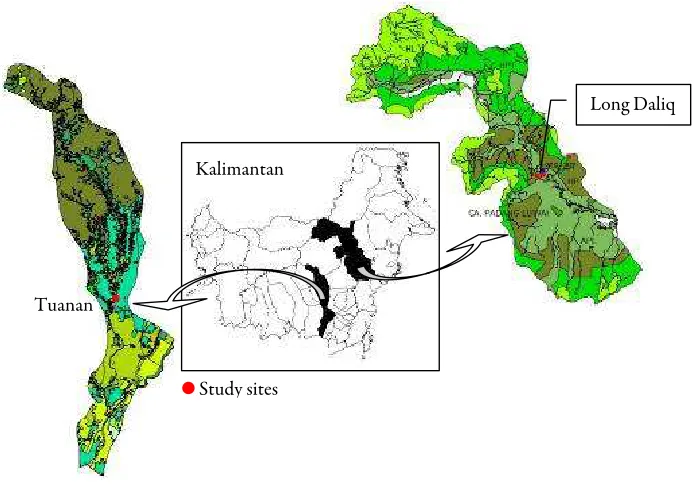
his study was conducted at two sites, i.e. Long Daliq, Kutai Barat District (East Kalimantan Province) and Tuanan, Kapuas District (Central Kalimantan Province), from March to December 2008. hese two sites are considered as habitats of gemor in Kalimantan. Forests at Long Daliq are public forests managed by the Dayak Bahau tribe, located at 00o00’37.7” N latitude and 115o37’34.7” E longitude. In 1997/1998, gemor trees were oten found around the Long Daliq and so many people collected gemor bark at that time. he gemor bark collection stopped by itself due to the harvesting technique by felling. he Tuanan forest is located at 020 09’ 09.0’’ S latitude and 1140 26’ 48.0” E longitute. Tuanan research station was not far from the Kapuas river low. his area was formerly a logging concession and was later converted into a conservation area for research activities. he forest type in this area is a secondary peat swamp forest.
Tuanan
Long Daliq
[image:3.454.43.390.312.557.2]Study sites Kalimantan
B. Methods
Data were collected by observing the forest areas directly and establishing observation sample plots to obtain quantitative data of the two species as well as their habitats and ecology. he sample plots were designed purposively at the areas where the gemor trees occurred.
he data collection consisted of: 1. Primary Data
hese include data on habitat and vegetation (forest community types), forest coverage (open, slightly open, dense forest), micro climate (temperature, humidity), light intensity.
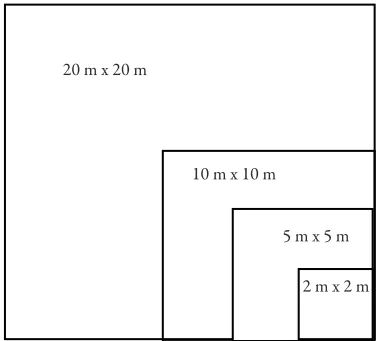
he vegetation analysis was conducted in June and August 2008. A total of 11 square plots (5 in Long Daliq and 6 in Tuanan) were laid out randomly. he plot size varies from 20 m x 20 m for trees, 10 m x 10 m for poles, 5 m x 5 m for saplings and 2 m x 2 m for seedlings. Figure 2 shows the distribution of subplots in each plot. All plants in each square plot were counted and identiied to the species level. Diameter at breast height (DBH) and height were measured and recorded. hese data were used for computation of vegetation parameters including density, frequency, basal area and Important Value Index (IVI).
2mx2m 5 m x 5 m
[image:4.454.142.331.335.506.2]10 m x 10 m 20 m x 20 m
Figure 2. Design of the study plot for vegetation analysis
Herbarium specimens were collected in the ield following an international standard for fertile sample. he sterilized sample was also collected as voucher for identiication. Identiication was done in the Wanariset Herbarium at Samboja, Balikpapan Indonesia.
20 m x 20 m
10 m x 10 m
5 m x 5 m
he horizontal and vertical vegetation proile were made in a 20 m x 40 m plot for Long Daliq site.
Destruetive sampling method was used to take soil sample. Soil samples were taken in two depth levels, i.e., top soil (0-20 cm) and sub soil (20-40 cm). Five points of soil samplings were composited in each plot, a total of 6 soil sampling plots (3 in Long Daliq and 3 in Tuanan) were established.
2. Secondary Data
hese includes site biophysics (topography, geographical position, soil condtion type, texture and soil fertility). Information following some literature studies were also compiled to support the indings.
C. Data Analysis
he IVI for the species was determined as the sum of the relative density, relative frequency and relative dominance (Soerianegara and Indrawan, 1998). he species diversity index (H’) was determined using Shannon-Wiener index (Shannon and Weaver, 1949). he species richness index (R) was determined using Margalef formula (Margalef, 1958). Concentration of dominance was measured by Simpson’s index (Simpson, 1949; Misra, 1980). Association of gemor with other species was analized by Ochiai index formula (Misra, 1980; Ludwig and Reynolds, 1988). Jaccard index was calculated for indicating similarity of vegetation composition within the habitat of gemor at Long Daliq and Tuanan.
Species richness index:
... (1)
where R is species richness index, S is number of species and NO is total number of indi-vidual
Species diversity index:
... (2)
... (3)
where C is species dominance index, ni is IVI spesies-1, and N is tatal IVI
Ochiai index:
... (4)
... (5)
where a is sum of plot discovered species A and B, b is sum of plot discovered species A but not species B, and c is sum of plot discovered species B but not species A
Primary and secondary data were tabulated, classiied and analyzed. Soil samples were analyzed at the Soil Laboratory, Soil Research Institute of the Ministry of Agriculture, Bogor.
III. RESULTS AND DISCUSSION
A. Botanical Description
c
b d
a e f
[image:7.454.46.389.75.237.2](photo : W.C. Adinugroho, line drawings : Priyono)
Figure 3. Pictures of Nothaphoebe coriacea (Kosterm.) Kosterm : (a) trees, (b) bark, (c) low-ers, (d) leaves, (e) & (f ) leaves with buds
B. Vegetation
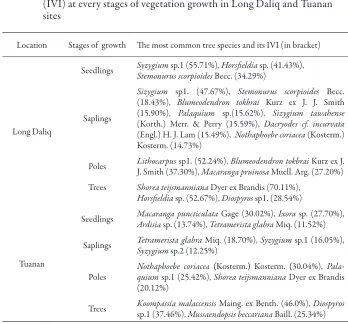
Survey of vegetation in the natural habitat of gemor tree species at Long Daliq (East Kalimantan) and Tuanan (Central Kalimantan) found that there were 38 tree species in the sample quadrats (0.2 Ha), which belong to 26 genera and 19 families, and 82 species which belong to 57 genera and 28 families (0.24 Ha), respectively. he IVI of the most common trees species at every level of growth (seedlings, saplings, poles and trees) within the forest vegetation at both locations are shown in Table 1.
Table 1. he most common trees species based on the Importan Value Index (IVI) at every stages of vegetation growth in Long Daliq and Tuanan sites
Location Stages of growth he most common tree species and its IVI (in bracket)
Long Daliq
Seedlings Syzygium sp.1 (55.71%), Horsieldia sp. (41.43%),
Stemonurus scorpioides Becc. (34.29%)
Saplings
Sizygium sp1. (47.67%), Stemonurus scorpioides Becc. (18.43%), Blumeodendron tokbrai Kurz ex J. J. Smith (15.90%), Palaquium sp.(15.62%), Sizygium tawahense
(Korth.) Merr. & Perry (15.59%), Dacryodes cf. incurvata
(Engl.) H. J. Lam (15.49%), Nothaphoebe coriacea(Kosterm.) Kosterm. (14.73%)
Poles Lithocarpus sp1. (52.24%), Blumeodendron tokbrai Kurz ex J. J. Smith (37.30%), Macaranga pruinosa Muell. Arg. (27.20%) Trees Shorea teijsmanniana Dyer ex Brandis(70.11%),
Horsieldia sp. (52.67%), Diospyros sp1. (28.54%)
Tuanan
Seedlings Macaranga puncticulata Gage (30.02%), Ixora sp. (27.70%),
Ardisia sp. (13.74%), Tetramerista glabra Miq. (11.52%)
Saplings Tetramerista glabra Miq. (18.70%), Syzygium sp.1 (16.05%),
Syzygium sp.2 (12.25%)
Poles
Nothaphoebe coriacea (Kosterm.) Kosterm. (30.04%), Pala-quium sp.1 (25.42%), Shorea teijsmanniana Dyer ex Brandis (20.12%)
Trees Koompassia malaccensis Maing. ex Benth. (46.0%), Diospyros sp.1 (37.46%), Mussaendopsis beccariana Baill. (25.34%)
Table 2. Species richness (R), diversity (H’) and dominance (C) index at various levels of vegetation growth as habitat of gemor trees in Long Daliq and Tuanan sites
Growth stages
Location
Long Daliq Tuanan
R H’ C R H’ C
Seedlings 2.27 0.79 0.18 4.79 1.22 0.07
Saplings 6.50 1.37 0.06 11.72 1.71 0.02
Poles 4.30 1.12 0.09 7.20 1.39 0.05
[image:8.454.62.410.90.414.2] [image:8.454.65.412.483.604.2]Ochiai index (Oi) formula (Misra, 1980; Ludwig and Reynolds, 1988), revealed that gemor trees in Long Daliq, East Kalimantan were associated mainly with Horsieldia sp. (Oi=1), Mezzettia parvilora Becc. (Oi=1), Shorea teysmanniana Dyer ex Brandis (Oi=1), Sizygium sp.1 (Oi=1), Stemonurus scorpioides Becc. (Oi=1), Dacryodes cf. incurvata (Engl.) H. J. Lam (Oi=0.80), Lithocarpus sp.1 (Oi=0.80), Litsea angulata Blume (Oi=0.80) and Palaquium sp. (Oi=0.80). Meanwhile, in Tuanan, Central Kalimantan, gemor trees were associated well with Diospyros sp.1 (Oi=1), Ilex sp. (Oi=0.83), Koompassia malaccensis Maing. ex Benth. (Oi=0.83), Neoscortechinia kingii (Hook.f.) Pax & K.Hofm. (Oi=0.83), Tetramerista glabra Miq. (Oi=0.83), Calophyllum sp. (Oi=0.67), Canarium sp.1 (Oi=0.67), Elaeocarpus sp.2 (Oi=0.67), Gonystylus bancanus (Miq.) Kurz (Oi=0.67), Palaquium sp.1 (Oi=0.67), Payena lerii (Tejsm. & Binn.) Kurz (Oi=0.67), Shorea teysmanniana Dyer ex Brandis (Oi=0.67), Syzygium sp.1 (Oi=0.67) and Timonius sp. (Oi=0.67).
he similarity of vegetation composition within the habitat of gemor at Long Daliq and Tuanan based on Jaccard formula was 15.53%. his value indicated the low similarity of vegetation composition at both locations, which might be attributed to the diferences of type and depth of peat in both sites.
C. Forest Structures
11 PROFILE DIAGRAM Forest structure of Gemor’s Habitat Long Daliq Village, East Kalimantan Reference :
(1,2,12,30,46,52) Blumeodendron tokbrai Kurz ex J. J. Smith (3) Diospyros sp1. (4,5,6,13,14,16,18,19, 20,23,24,45,57) Gemor (7,54) Palaquium sp. (8) Sindora wallichii Benth. (9,50) Mezzettia parviflora Becc. (10,11,26,39) Shorea parvifolia
Dyer.
(15) Gluta renghas (Sphalm, Benghas) Linn. (17) Sandoricum koetjape Merrill (21,43) Stemonurus scorpioides Becc. (22,25) Litsea angulata Blume (27) Dacryodes rostrata (Blume) H.J. Lam
(28) Sterculia rubiginosa Vent. (29) Nephelium lappaceum Linn (31) Xylopia glauca Boerl. (32,44) Macaranga puncticulata
Gage (33) Chionanthus sp. (34,47,48) Lithocarpus sp1. (35,37,42,53,55,56) Horsfieldia sp. (36,38) Lithocarpus sp2. 40 : Diospyros sp. 41 : Lithocarpus gracilis (Korth.) Soepadmo
49 : Macaranga pruinosa Muell. Arg. 51 : Sizygium sp1.
200
[image:10.454.66.409.78.486.2](Line drawing by: Priyono)
Figure 4. Vegetation proile at the gemor habitat in Long Daliq, East Kalimantan
Note :
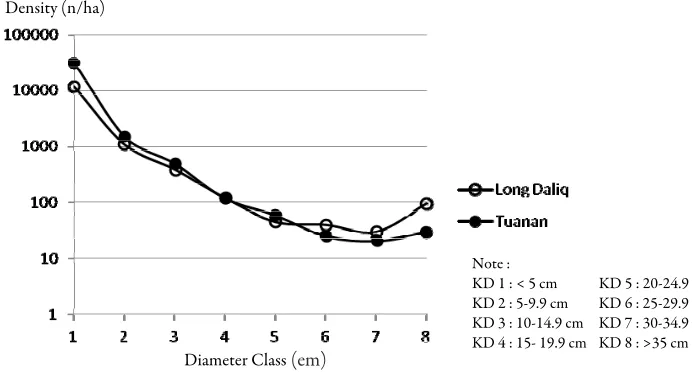
KD 1 : < 5 cm KD 5 : 20-24.9 KD 2 : 5-9.9 cm KD 6 : 25-29.9 KD 3 : 10-14.9 cm KD 7 : 30-34.9 KD 4 : 15- 19.9 cm KD 8 : >35 cm Density (n/ha)
[image:11.454.44.390.79.268.2]Diameter Class (em)
Figure 5. Density (N/ha) by diameter class
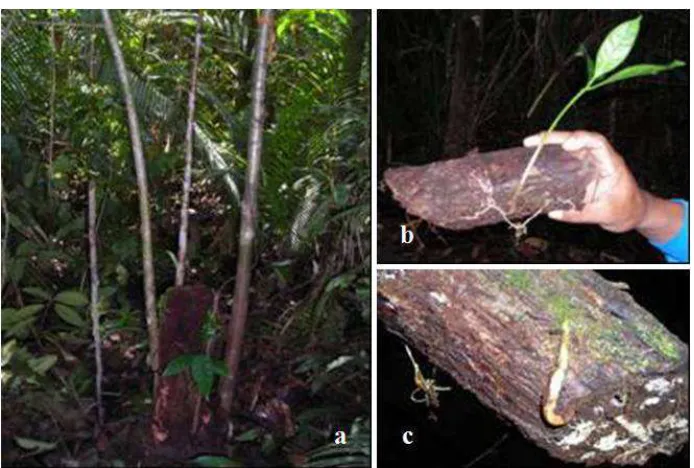
D. Natural Regeneration of Gemor
(photo : W.C. Adinugroho)
Figure 6. Sprouted coppices in gemor tree : (a) Long Daliq, (b) and (c) Tuanan
E. Distribution of Gemor
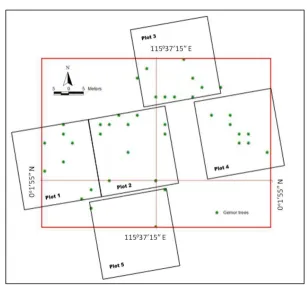
here were no gemor trees with large diameter found in the observed areas, mostly only coppices from trees that have been harvested were found. he tend to grow in cluster at certain points (Figure 7).
F. Ecological Condition
1. Microclimate
and August (Kecamatan Long Iram dalam angka 2006) Observation results for the environmental condition of the area is presented in Table 3.
Table 3. Environmental condition of gemor’s habitat at Long Daliq, East Kali-mantan
Parameter Condition
Topography Flat, occasional water logging
Temperature 21.3 – 32 oC
Humidity 88% - 99%
Light Intensity 3% – 5% (540 lux – 980 lux ; open area :
20000 lux)
[image:13.454.43.392.154.275.2] [image:13.454.63.371.298.584.2]2. Soil Condition
Soil condition similar to the original habitat is one of the supporting factor for succesfull planting. Soil type of gemor’s habitat found in the observation plots was peat soil with the pH of 3 – 4 and peat depth of 1– 2 m, although Whitmore et al.(1990) described that gemor trees grow well in peat swamps with the depth of 2.5 m. Gemor can grow well in a peat soil with the content of alkalie (e.g. Ca, Mg, K, Na) and saturated alkalie were low. he content of Al was mostly low to medium and became fewer following the decrease of soil pH, diferent to the content of H+ which was being increased. As peat soil, gemor’s habitat has a high content of C and N total; however, most of them were unavailable to plants due to a high ratio of C/N. he thicker peat, lower content of K2O and P2O5 ashes, Ca and Mg contents decreased and soil reaction became more acid. he acid peat soil (low pH) was not always followed by the high Al2+ content (changeable Aluminum) as it happens in mineral soils. his might occur once the source of Al or soil minerals in an organic soil were present in a small amount. he cation exchange capacity (CEC) in peat soil was greater than in mineral soils. CEC value of peat soils was generally higher than in mineral soils and much greater in line with the increasing organic matter content. he value of CEC plays an important role in soil management and could be acted as indicator of soil fertility. he condition of chemical properties of the soils can be seen in Table 4.
Table 4. Chemical properties of the soils at two locations of gemor habitats in Long Daliq and Tuanan
Location Horizon layer Ex-tract 1:5 PH
Dry Sample 105oC
Organic Matter
Bray 1 Mor-gan
Cation Changes Value
(NH4-Acetat 1N, pH 7) KCL 1N
Above-Below H2O
Walk& Black
Kjel-dahl C/N Ca Mg K Na Total CEC Al3+ H+
C N P2O5 K2O
cm --- % --- ---ppm --- --- cmol(+)/kg --- cmol(+)/kg
Tuanan 0-20 3.1 54.48 1.22 45 13.4 292 3.56 2.69 0.58 0.13 6.96 178.83 0.89 16.65
Village 20-40 3.1 56.83 1.12 51 9.9 231 4.35 1.15 0.46 0 5.96 104.76 0.95 17.89
Long Daliq 0-20 3.3 49.44 1.24 40 8.6 351 3.34 0.64 0.69 0 4.67 50.52 2.48 8.09
Village 20-40 3.2 64.72 0.99 65 15.3 243 7.98 0.76 0.48 0 9.22 38.92 3.6 10.05
IV. CONCLUSION
[image:14.454.64.412.376.523.2]Diferent conditions of the Nothapoebe coriacea’s habitat in the two research sites (in term of vegetation, soil fertility and the important value index) should unplug diferent strategies in the conservation and management program. In Long Daliq, it is required to focus on sapling improvement through in-situ conservation activities. Meanwhile, at Tuanan the focus should be on species preservation by collection Nothapoebe coriacea seedlings to be planted through ex-situ conservation program.
REFERENCES
Arsad, E. and Suroto. 1992. Pengolahan kulit gemor sebagai bahan pemberantas nyamuk jenis bakar. Laporan Balai Penelitian dan Pengembangan Industri Banjarbaru. Balai Penelitian dan Pengembangan Industri Banjarbaru. Banjarbaru. (unpublished report)
Badan Pusat Statistik. 2006. Kecamatan Long Iram dalam angka 2006. Badan Pusat Statistik Kabupaten Kutai Barat, Kalimantan Timur. (unpublished report) Efendi, R. 2001. Pengaruh pengambilan kulit gemor (Alseodaphne spp.) terhadap
kelestarian di Teluk Umpan, Kalimantan Tengah. Duta Rimba 247:10-12. Efendi, R., M. Amblani, and T. Wahyuni. 1997. Kajian ekonomi produksi kulit kayu
pohon gemor (Alseodaphne spp.). Buletin Penelitian Kehutanan 11 (1):7-17. Ludwig, J.A. and J. F. Reynolds. 1988. Statistical Ecology: A primer on methods and
computing. John Willey and Sons. New York.
Margalef, R. 1958. Information theory in ecology. General Systematic 3: 36-71. Misra, K.C. 1980. Manual of Plant Ecology. Oxford and IBH Publishing Co. New
Dehli.
Rahmanto, R.G.H., D.I. Fauzi. and A. Iskandar. 2001. Gemor, hasil hutan bukan kayu dari Kalimantan Timur. Tajuk Tropika I (2): 10-11.
Rostiwati, T. 2008. Laporan hasil penelitian silvikultur tanaman penghasil hasil hutan bukan kayu. Pusat Litbang Hutan Tanaman (unpublished report).
Shannon, C.E. and W. Weaver. 1949. he Mathematical heory of communication, University Illinois Press, Urbana, Illinois.
Simpson, E.M. 1949. Measurement of diversity. Nature 163: 688.
Smith, D.M. 1962. he Practice of Silviculture. John Wiley & Son. New York.
Soerianegara, I. and A. Indrawan. 1998. Ekologi hutan. Diktat kuliah. Fakultas Kehutanan – IPB. Bogor
Whitmore, T.C., I. G.M. Tantra, U. Sutisna, and K. Sidiyasa. 1990. Tree Flora of Indonesia: Cheklist for Kalimantan. Pusat Penelitian dan Pengembangan Hutan. Bogor.