• Tidak ada hasil yang ditemukan

A Study of Contract Broiler Production in Lombok, NTB: An Opportunity of Introducing Syariah Partnership

N/A
N/A
Protected

Academic year: 2018

Membagikan "A Study of Contract Broiler Production in Lombok, NTB: An Opportunity of Introducing Syariah Partnership"

Copied!
7
0
0

Teks penuh

(1)

A Study of Contract Broiler Production in Lombok, NTB: An Opportunity of

Introducing Syariah Partnership

B. Indarsih*, M. H. Tamsil, & M. P. Nugroho

Department of Animal Production, Faculty of Animal Science, Mataram University Jln. Majapahit No. 62 Mataram, Lombok, Nusa Tenggara Barat

(Received 12-01-2010; accepted 04-08-2010)

ABSTRACT

A study to evaluate the implementation of integrated poultry production through contract farming system in Lombok, NTB was carried out from June to November 2009. The descriptive methods were used whilst the data was collected using survey methods. Fi y contract farmers were selected to measure the business performance with references on management, performance production index, FCR, and percentage of mortality. The results of this study indicated that the contract broiler production was chosen due to: (1) risk sharing (27.6%), fi nancial credits (25.8%), and

the guarantee of marketing (23.3 %). Dissatisfaction particularly in aspects of incentive determination, the quota, and margins. The margin ratios between farmers and integrators, 30%: 70%; 40%: 60% or 50%: 50% with no clear reasons. Performance parameter was as an expectation, suggesting feed quality and management aspects were well implemented. In respect to Syariah bank, its outstanding was well understood but it have not been a ractive to the contract farmers. The capital is not the main reason to work with the integrators. The government involvement was needed to encourage poultry industry growth and looking for the new potential region and legislation on maintaining environment. New investors should be encouraged to overcome instability price.

Key words: contract system, farmers, effi ciency index, margin ratios

ISSN 0126-0472

Terakreditasi B SK Dikti No: 43/DIKTI/Kep/2008

* Corresponding author:

Department of Animal Production, Faculty of Animal Science, Mataram University

Jln. Majapahit No. 62 Mataram, Lombok, Nusa Tenggara Barat e-mail: [email protected]

INTRODUCTION

Commercial poultry sectors, which started in 1980s, have not met the need for animal protein in the province of Nusa Tenggara Barat (NTB). This can be shown by the fact that the protein consumption in this province was approximately 56.5 g/cap/d, which was most from non animal protein (BKP, 2008). This means that eff orts need to be done to support the growth of animal protein sources.

The dominance of small farmers in Indonesian Agriculture business has resulted in various risks and uncertainties at the marketing stage. A er economic crisis in 1998, there was a signifi cant change in the model farming from non-contract to contract farmers in eff orts to solve the uncertainties and marketing power which the individual farmer have no this power. The number of scientifi c works relating to an analysis of the contract farming has revealed that contract farmers were advantageous over the non-contract (independent)

and /or contract poultry shop (Tatlidil & Aktũrk, 2004; Begum, 2005; Goodwin et al., 2005; Simmons et al., 2005). A study in Deli Serdang by Siagian (2001) suggested that contract farming–PIR (Pola Inti Rakyat), off ers several potential advantages such as able to increase the poultry production and reduce feed cost which leads to increase the farmer income. Also reported by Priyono et al. (2004) that there was positive relationship between farmer’s net incomes with farm size.

However, in many cases, farmers highlighted the condition where they received unexpected hopes. Low quality feed and the day-old-chicks (doc), uncertainty in marketing time and unfair bonus payments are fre-quently met. In other words, there is the inequality of the relationship and the stronger position of integrators with respect to that of farmers. Contract farming is viewed as essentially benefi ting integrators by enabling them to obtain cheap labor and to transfer risks to farm-ers (Eaton & Shepherd, 2001). Thus, it could be possible to introduce a new concept of partnership “Syariah” as suggested by Sutawi (2006).

(2)

in density in 1.0 bird/m2 resulted in worse FCR and

carcass yield (CY), in 0.03 units and 0.81 g, respectively. Reduced average fl ock weight (AFW), daily weight gain (DWG), and PEI in 17.5 g, 0.70 g, and 5.8 units, respec-tively were recorded due to high density housing.Data of A ab (2009) suggested that high metabolizable en-ergy (2850 kcal) with balanced protein (206 g/kg CP and 10.2 g lysine expressed as standardized ileal digestibility lysine per kg) resulted in higher BW at 35 d of age (1694 g) than 2750 kcal or 2650 kcal (1665 or 1612 g). Thus, the quality feed will be refl ected in e cient performance and together with other management aspects such as housing capacity aff ected the fi nal bird performance.

Although there is a confl ict in its implementation, poultry agribusiness is still regarded as a potential regional income for the government and protein sup-ply for low income people. In encouraging the poultry development in Lombok, NTB, the current study aims to give a picture of the reality on the implementation of the contract farmers from the farmer’s point of view with references on performance parameters, margin and motivating factors. Therefore, an appropriate strategy for the further development in this region can clearly be proposed and Syariah partnership as a new concept is also introduced as a possible alternative to solve the relevant problems.

METHODS

The primary data was collected from broiler grow-ing farms by contract farmgrow-ing model through interviews to farmer’s representatives of West, Central and East Lombok covering from June to November 2009 produc-tion period. A sample size of 50 farms was chosen for the study.

The profi tability level of the production activity at marketing age (MA) of broilers was proposed as the de-terminant of success in broiler production. Performance effi ciency index (PEI) was calculated as the determinant of success in management operation by considering mortality rate (M), body weight (BW) and FCR. SWOT analysis was also used to give the possibility to defi ne prerequisites and directions for the future development (Çinar et al., 2003).

Performance parameters such as FCR, PEI, and M, were measured with the following calculation:

FCR : FI/BW

PEI : (100%-M x BW x 100)/ MA x FCR M : (TD - TB)/TD x 100%

where TD is total doc (day old chicks) whilst TB is total bird at marketing age. Other relevant parameters were bird density and rearing period. Samples of commercial feed used by the farmers were taken for chemical analysis. The gross income was calculated on the basis of the total income from selling the live birds deducted by variable costs (feed, doc, medication, labor, and operational). Tabular analysis was also adopted to analyze the cost and revenue variability of broiler farming.

RESULTS AND DISCUSSION

General View of Contract Implementation of Broiler Operations

There were two main integrators as representa-tive of large fi rms in West Nusa Tenggara dominating the poultry business: PT Ciomas Adisatwa (PT. Japfa Comfeed Indonesia) and PT. Mitra Sinar Jaya (PT. Charoen Pokphand Indonesia). Both fi rms had their own role and designed contract even though the objectives were similar.

Some criteria’s were imposed to the farmers: (1) the availability of land for housing which technically meeting the acceptable design, (2) have access to the main road for car/trucks as a transporting vehicle and electricity also available, (3) farmers able to show the valid identity (KTP), and (4) Farmers should have a map showing the farm location. The signifi cant di erence between the two fi rms in implementing the contracts was that there was no support provided to farmers apart from the provision of foundation by PT. Mitra Sinar Jaya whereas PT. Ciomas Adisatwa also provided a credit to purchase operational inputs such as a li er or fuel. In other words, the costs for some items can be the respon-sibility of either party or they can be shared.

There were two payment schemes consisting of a fi xed base payment per kg of live weight and the variable bonus payment based on the farmer’s relative performance. The bonus payment is determined as a percentage of the diff erence between group –average se lement costs and producer’s individual se lement costs. However, the fi xed base payment is implemented, and the second scheme was neglected. Most of farmers did not know much about the scheme. Responses of the farmers on the implementation of the contract farmer were quite good, although integrators have a superior ability over the farmers.

Contract Farmers

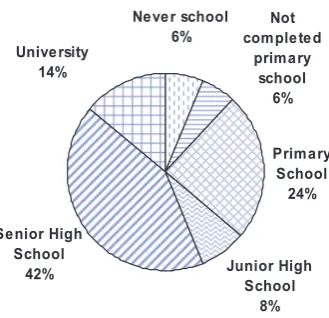
Summary information on characteristics of contract farmers is shown in Table 1, whilst average broiler con-tract operation characteristics are presented in Table 2. In general, farmers chosen as a sample were 20-70 years of age with average 44.2+10.5 years. About 48.0% of the respondent was dominated by the age between 41-50 years. Experience in broiler farming was 6.2+3.2 years. Educational background of respondents was occupied by high school most (Figure 1).

(3)

Junior High School

8% Senior High

School 42%

Not comple te d

prima ry school

6%

Primary School

24% Neve r school

6% Unive rsity

14%

Figure 1. Educational background of broiler contract respon-dents in Lombok, NTB, June-November 2009 (n=50)

Table 3. Performance variables of the broiler contract farming system in Lombok, NTB, June-November 2009 (n=50)

Variables Performance

Feed conversion rasio 1.65± 0.91 Performance index 349.80± 51.00

Mortality (%) 5.10± 2.60 Body weight at marketing (g) 2300.00±330.00 Period of rearing (day) 40.20± 3.30

Bird density (m2/bird) 0.13± 0.05

Source: Primary data analysis Source: Primary data analysis

Description No of

respondent %

Housing capacity (bird)

<2500 17 34

2,500-5,000 21 42

>5,000 12 24

Liveability > 95 % 36 72

Average period of rearing <5

(cycle/year) 40 80

Gross income (Rp.)

Low(< 25 million) 17 34

Medium( 25-50 million) 21 42

High (>50 million) 12 24

Table 2. Average broiler contract operation characteristic in Lombok, NTB, June-November 2009 (n=50)

who studied contract farming in Indonesia. It was found that the contracts in Lombok resulted in improved re-turns to capital and le participants be er off . However, in Bali the contract did not increase returns to capital but did confer other benefi ts.

Performance Variables

Performance variables shown in Table 3 ex-plained that contract farmers have been successful in implementing the farm management provided by the integrator. Relatively low mortality (5.10±2.6), higher body weight (2.300±330 g) and low FCR (1.652±0.91) at relatively shorther marketing age (40.2±3.3) as expected, demonstrated that the integrators are responsible for all production inputs and “on-farm” processes. PEI shown in this study was also higher than achieved by Schmidt (2008). Broilers at 44 d of age had 271 and 250 PEI with fl ock weight 2306 and 2229 g when reared on 12 and

15 birds/m2 respectively. These present performance

refl ected as a response to the reasonable quality of the commercial feed (Table 4). The chemical composition of both starter and fi nisher diets delivered and used by the contract farmers were parallel with the nutrient require-ment particularly crude protein for broilers according to some literatures (Corzo et al., 2005; Nadeem et al, 2005; Gutierrez et al., 2008; Hosseini et al., 2009).

Another important contributing factor for the per-formance reported in this study is that the availability of the technical service provided by the integrators. This helps the beginner farmers in handling technical factors which can improve their skills gradually. According to Wicker (2001), the poultry industry has been successful in adopting new technology to improve its effi ciency in order to meet consumer demand. Conversely, in many developing countries such as in Indonesia, extension activities for small farmers can play a vital role in im-proving the poultry farming practices particularly but this service is lacking (Mohsin et al., 2008).

SWOT Analysis

Strength of Contract Farming. Contract in broiler pro-duction means agreement between farmers and integra-tors that specify conditions of producing and marketing (Begum, 2005). This present study showed that contract

Entry respondent No of %

Age (years)

20-30 6 12

31-40 12 24

41-50 24 48

>50 8 16

Main occupation as farmer 35 70

Secondary occupation 15 30

Experience in broiler farming (years)

0-5.0 26 52

5.1-10 19 38

>10 5 10

Source: Primary data analysis

(4)

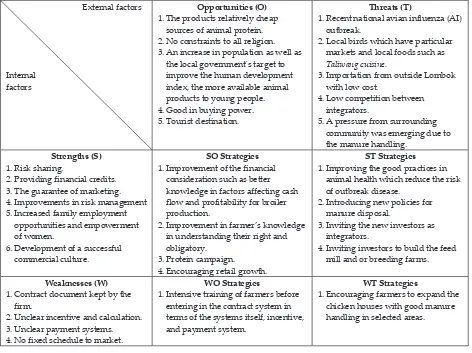
Figure 2. Matrix SWOT of broiler contract farming in Lombok, NTB, 2009 External factors

Internal factors

Opportunities (O) 1. The products relatively cheap

sources of animal protein. 2. No constraints to all religion. 3. An increase in population as well as

the local government’s target to improve the human development index, the more available animal products to young people. 4. Good in buying power. 5. Tourist destination.

Threats (T)

1. Recent national avian influenza (AI) outbreak.

2. Local birds which have particular markets and local foods such as Taliwangcuisine.

3. Importation from outside Lombok with low cost.

4. Low competition between integrators.

5. A pressure from surrounding community was emerging due to the manure handling.

Strengths (S) 1. Risk sharing.

2. Providing financial credits. 3. The guarantee of marketing. 4. Improvements in risk management 5. Increased family employment

opportunities and empowerment of women.

6. Development of a successful commercial culture.

SO Strategies 1. Improvement of the financial

consideration such as better knowledge in factors affecting cash flow and profitability for broiler production.

2. Improvement in farmer’s knowledge in understanding their right and obligatory.

3. Protein campaign. 4. Encouraging retail growth.

ST Strategies 1. Improving the good practices in

animal health which reduce the risk of outbreak disease.

2. Introducing new policies for manure disposal.

3. Inviting the new investors as integrators.

4. Inviting investors to build the feed mill and or breeding farms.

Weaknesses (W) 1. Contract document kept by the

firm.

2. Unclear incentive and calculation. 3. Unclear payment systems. 4. No fixed schedule to market.

WO Strategies

1. Intensive training of farmers before entering in the contract system in terms of the systems itself, incentive, and payment system.

WT Strategies

1. Encouraging farmers to expand the chicken houses with good manure handling in selected areas.

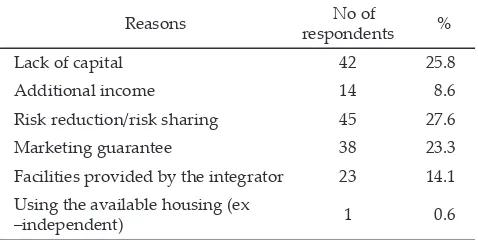
farmers have merits and it was as a choice by almost all potential farmers due to (1) risk sharing (27.6%), fi nancial credits (25.8%), and the guarantee of marketing

(23.3%) (Table 5). Many studies of contract farming have emphasized on risk reduction as a main incentive for farmers to enter into contracts or lack of capital (Begum, 2005). Price risk is one important contributor to revenue variability. In case of price risk, broilers are perishable when farmer failed to sell at proper time, great losses are faced. Therefore, the biological nature of broilers is the main factors encouraging the instability in price.

Moreover, broilers as agricultural products need proper handling and storage facilities. For these reasons, farm-ers want to sell out the products immediately to avoid the losses and price fl uctuation in the poultry market.

Last experiences (economic crisis in 1998) are good lesson for independent farmers who decided to go to the contract system. Independent farmers with limited capital were unable to compete with the larger company due to no market for independent farmers, less effi cient and high risk. As mentioned that the primary reason to joint with the contract system was risk sharing and some farmers studied here were the former self funding farmers. According to FAO (2005), vertical integration in developing countries emerged due to the development of demand in poultry and pigs. Industry orientation its self needs intensive investment (FAO, 2005) and need good organization system (Çinar et al., 2003). Another benefi t of the contract farmer is that it can also provide improvements in risk management, increased family em-ployment opportunities and, indirectly, empowerment of women and development of a successful commercial culture (Patrick, 2004).

Weaknesses of Contract Farming. In the present study found some weaknesses of the contract farming system (Figure 2). When looking at the contract payment, con-tract document, and some clausal agreement, it seemed

Note: Analysed according to AOAC (1976)

Nutrient Diet

Starter Finisher

Crude protein 20.78±2.87 16.72±1.31 Crude fi ber 3.42±0.21 3.73±0.27

Crude fat 3.69±0.74 5.50±0.61

Water 12.19±0.58 11.60±0.50

Ash 10.73±5.76 8.96±1.04

(5)

Table 5. Motivating factors of broiler farmers to enter the con-tract scheme in Lombok, NTB, June-November 2009 (n=50)

Note: Multiple answer Source: Primary data analysis

Reasons No of

respondents %

Lack of capital 42 25.8

Additional income 14 8.6

Risk reduction/risk sharing 45 27.6

Marketing guarantee 38 23.3

Facilities provided by the integrator 23 14.1

Using the available housing (ex

–independent) 1 0.6

that farmers were on a weak position. For instance, the contract document was kept by the fi rm, the costs of in-puts were known when payments are made, farmers did not know how to calculate the incentive when available, and sometimes there is no fi xed schedule to market the products. According to Saptana (2006), contract farming in poultry commodities in factual operation, farmers are labor who is paid in monthly basis even though there is right on shed. This is due to diff erences in ‘sharing’ in contributing on production costs. There is evidence, however, that contract farming may have a negative ef-fect on the welfare of smallholders. A number of authors express concern that contractors favor larger farmers and hence poorer farmers may be le out of the devel-opment process (Singh, 2002). Other hazards of contract farming are the potential for ‘capture’ of smallholders within contracts (Patrick, 2004), negative social eff ects of the ‘cash economy’, narrowing of local markets as con-tracted production squeezes out local food production, deteriorating contract terms as contracts mature and general concerns about how multi-national corporations behave in developing countries (Singh, 2002).

Opportunities. Demand of poultry products is pre-dicted to increase as a result of higher income,relatively cheap sources of animal protein, and no constraints to all religion. In addition, an increase in population as well as the local government’s target to improve the human development index, the more available animal products to young people was needed. In the province of NTB, human development index was the second lowest of 33 provinces in Indonesia which relates to the health and education. However, buying power of people was higher (60.99) than the national level (60.39) recoded in 2006 (Journal Lombok, 2008). Thus, this contradictive condi-tion could be something misleading on understanding the importance of animal protein sources. Therefore, protein campaign, disseminasion or socialization on aspects relating to improve the health level in particular would absorb the animal products, which is a good way to endorse the poultry development in this region. As a tourist destination a er Bali, Lombok-NTB will be more a ractive to travelers both local and foreign people to come. The growth of modem retail such as supermarket

seems continued which had positive eff ects on increas-ing growth in the poultry industry.

Threats. There are some threats for poultry develop-ments. Recent national avian infl uenza (AI) outbreak which killed thousands birds and leads to a reduction in demand of poultry products as one of some conse-quences. This issue also infl uenced the demand of the poultry products in Lombok in 2007, even though this outbreak happened nationally. Local birds which have particular markets and local foods such as Taliwang cuisine (Lombok food) are other challenges. The demand on local birds to fulfi ll this sort of food has not been met. Unfortunately, the alternative substitution of this poul-try meat for Taliwang was male layers not the broilers. Also importation from outside Lombok with low cost producers sometimes happens and when this continues, is predicted to impair the further development. In ad-dition, low competition between integrators due to the sponsors is dominated only by two integrators, will easily aff ect the price stability for both the production factors and the live products or carcass. For particular months such as Ramadhan and Maulud in 2009, as com-parison, the price for carcass in West Lombok was Rp. 34.000,-/kg whereas in Java at the same time was only Rp. 24.000,-.

In regard to the negative impact on environment, a pressure from surrounding community was emerging due to the manure handling. Both odor and fl ies are the main cause of complains. These problems seemed more serious in West Lombok than Central Lombok and East Lombok due to diff erent population between regions.

Strategies. Although contract farmers are currently sat-isfi ed with the income and the company’s role, no ma er some of the term and condition were not met, there is still need for improvement through developing under-standing in various risks which would aff ect income and margin. Improvement of the fi nancial consideration such as be er knowledge in factors aff ecting cash fl ow and profi tability for broiler production are important. At the same time, farmer’s knowledge in their right and obligatory should be more reasonable.

Improving the good practices in animal health which reduce the risk of outbreak disease to the farm-ers by both the local government and the fi rms would minimize the loss.

Disposal of manure from poultry production may be not applicable as adopted in manure from ruminants which produce biofuel. Thus, it would be worthwhile to introduce new policies for manure disposal. This will be relevant on developing region for increasing quota of production (Çinar et al., 2003) to fulfi ll the increasing demand in years to come. .

(6)

Perception of Contract Poultry Farmers to Syariah Bank

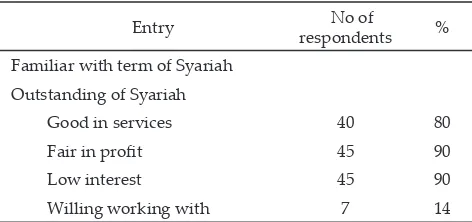
The term of Syariah, in general, have been well-known by the farmers even though they were not Moslem. As shown in Table 6, fair in profi t and low interest were dominant meaning of Syariah Bank. However, the contract farmers seemed reluctant to work with Syariah. Thus, partnership as introduced by Sutawi (2006) as a capital provider in developing the business have not been considered as a new structure of broiler production contract that may be much benefi cial to them. Although no clear reasons, it could be due to the current contract system have off ered improved returns as reported by Patrick (2004). As mentioned that the fi rst important reason for joining in the contract system is risk sharing not capital needs.

determination, communication, and a number of other operational issues. Risk sharing was the dominant rea-son to join the system. The diff erent ratio on margins be-tween the contract farmers and creditors were apparent without clear reasons. Performance parameter measured was as an expectation, suggesting feed quality and man-agement aspects were well implemented. In respect to Syariah bank, its outstanding was well understood but it has not been a ractive to the contract farmers.

Encouraging the growth of poultry industry for incoming years is needed to provide the animal protein sources by involvement of the local government and looking for the new potential region and legislation on maintaining environment. New investors should be encouraged to overcome instability price that sometimes happen.

ACKNOWLEDGEMENT

This work was supported by Competitive Grant of Nasional Strategy - DIPA University of Mataram Year 2009 under the contract number: 0234.0/023-04.2/XXI/2009, 31 December 2008. We thank Research Centre of Unram for arranging the proposal and report. We would like also to thank Supeno, Kasri and Ade Majaputra for data collection.

REFERENCES

AOAC. 1970. Offi cial Methods of Analysis, 11 th Ed. Association

of Offi cial Analysis Chemist, Washington, DC.

A ab, U. 2009. Response of broiler to practical diets with

diff erent metabolizable energy and balanced protein

concentration. Rev. Bras. Cienc Avic. 11:169-173. doi: 10.1590/S1516-635X2009000300005

Badan Ketahanan Pangan (BKP). 2008. Situasi konsumsi

pangan Provinsi NTB 2008. h p://bkp.ntbprov.go.id/web/ content/blogcategory/43/53/in/ (15 December 2008) Begum , I.A. 2005. An assessment of vertically contract poultry

farming: A case study in Bangladesh. Intern. J. Poult. Sci.

4:167-176.

Çinar, H., A. Demir, Ş. Kalanlar, B. Taskaya, & S. Berkum.

2003. Turkish Poultry Meat Sector Analysis. www.lei.

wur.nl/NR/rdonlyres/.../TurkishPoultryMeatSectorAnalys is.pdf (15April 2010)

Corzo, A. M. T. Kidd, D. J. Burnham, E. R. Miller, S. L. Branton, & R. Gonzalez-Esquerra. 2005. Dietary amino acid density eff ects on growth and carcass of broilers dif-fering in strain cross and sex.J. Appl. Poult. Res. 14:1–9. Dozier, W. A., M. T. Kidd, A. Corzo, P. R. Owensc, & S. L.

Branton. 2008. Live performance and environmental im-pact of broiler chickens fed diets varying in amino acids and phytase. Anim. Feed Sci. Technol. 141: 92–103. Eaton, C. & A. W. Shepherd. 2001. Contract farming

partner-ships for growth. FAO Agricultural Service Bulletin No. 145.

FAO. 2005. Some issue associated with the livestock industries

of the Asia-Pacifi c region. h p://www.fao.org/docrep/005/

AC448E/ac448e05.htm (5 December 2009)

Gutierrez, O., N. Surbakti, A. Haq, J. B. Carey, & C. A. Bailey. 2008. Eff ect of continuous multiphase feeding schedules on nitrogen excretion and broiler performance. J. Appl. Poult. Res. 17:463–470. doi:10.3382/japr.2008-00015 Goodwin, Jr. H. L. , B. L. Ahrendsen, T. L. Barton, & J. H.

Denton. 2005. Estimated returns for contract broiler pro-duction in Arkansas, Missouri, and Oklahoma: Historical

Source: Primary data analysis

Table 6. Perception on Syariah Bank by the broiler contract farmers in Lombok, NTB, June-November 2009 (n=50)

Entry No of

respondents % Familiar with term of Syariah

Outstanding of Syariah

Good in services 40 80

Fair in profit 45 90

Low interest 45 90

Willing working with 7 14

Government Involvement for Further Development

As mentioned that most contract farmers satisfi ed by the scheme, therefore a government regulations is needed to specifi cally focus on factors used in rank-ing farmers and determinrank-ing performance payments. In fact, there were three payments of margin by the integrator, 30%: 70%; 40%: 60% or 50%: 50%, the ratio between farmers and integrators. However, the reasons for these diff erent payments were unclear. No concrete regulatory actions have been taken so far by the govern-ment. Although no literature addressing the theoretical rationale for government regulation of poultry contracts it was argued that by requiring farmers to make large specifi c investments in chicken houses in selected areas, integrators can increase farmer incentives without increasing farmer compensation since the risk of los-ing the investment will increase a farmer’s fear of low performance (Vukina, 2001). Another involvement, if possible, of the local government is to off er intensive training in order to understand correctly how does the system work ?.

CONCLUSION

(7)

and Future Perspectives. J. Appl. Poult. Res. 14:106–115. Hosseini, S. M., S. M. Akbary, N. Maheri-Sis, & A. M.

Aghsaghali. 2009. The eff ect of using excess lysine on the performance and slaughter characteristics of broiler chickens. Res. J. Biol. Sci. 4:143-147.

Jurnal Lombok. 2008. Daya beli tinggi, tapi pendidikan dan kesehatan NTB rendah. www.beritadaerah.com/news. php?pg=berita_bali&id...sub (20 October 2008).

Mohsin, A. Q., R. Riaz, S. Asad, & A. Mushtaq. 2008.

Profi tability analysis of broiler production in Rawalpindi

District. Pakist. J. Agri. Sci. 45: 514-519.

Nadeem, M. A., A. H. Gilani, A. G. Khan, & M. U. Nisa. 2005. Assessment of dietary requirement of broiler chicks for available lysine during summer. Int. J. Agri. Biol. 7:995-998.

Patrick, I. 2004. Contract farming in Indonesia: Smallholders and agribusiness working together. Australian Centre for International Agricultural Research, Canberra. h p://

aciar.gov.au/system/fi les/node/533/tr54.pdf (20 November

2009)

Priyono, B. S., N. Nufus, & K. Dessy. 2004. Performan pelak-sanaan kemitraan PT.Primatama Karya Persada dengan peternak ayam ras pedaging di kota Bengkulu. J. Ilmu-ilmu Pert. Ind. 6:111-115.

Saptana. 2006. Keunggulan komparatif –kompetitif dan stra-tegi kemitraan. Dampak Krisis. www.akademik.unsri.

co.id/download/journal/fi les/udejournal/(5) (20 November

2008)

Schmidt, G. S. 2008. Evaluation of the technical and eco-nomic impacts of high-density broiler production in an integrated system. Rev. Bras. Cienc Avic.10:149-152. doi: 10.1590/S1516-635X2008000300002

Siagian, S. H. 2001. Peranan usaha peternakan dalam

pengembangan wilayah. Tesis. Program Pasca Sarjana Universitas Sumatera Utara, Medan.

Simmons, P., P. Winters, & I. Patrick. 2005. An analysis of

con-tract farming in East Java, Bali and Lombok, Indonesia.

Agricultural Economics, 33, Suppl.513-525

Singh, S. 2002. Contracting out solution: Political economy of contract farming at the Indian Punjab: World Dev. 30:1621-1638.

Sutawi. 2006. Model agribisnis Syariah. Poultry Indonesia, September page 45.

Tatlidil, F. F. & D. Aktũrk. 2004. Comparative analysis of

con-tract and non concon-tract farmingmodel in tomato

produc-tion. J. Agronom. 3:305-310.

Vukina, T. 2001. Vertical integration and contracting in the U.S. poultry sector. J. Food Distr. Res. July: 29-38. ageconsearch. umn.edu/bitstream/27819/1/32020029.pdf

Gambar

Table 2. Average broiler contract operation characteristic in Lombok, NTB, June-November 2009 (n=50)
Table 4. Chemical composition (%) of starter and fi nisher com-mercial diet used by the broiler contract farmers in Lombok, NTB, June-November 2009 (n=50)
Table 5. Motivating factors of broiler farmers to enter the con-tract scheme in Lombok, NTB, June-November 2009 (n=50)
Table 6. Perception on Syariah Bank by the broiler contract farmers in Lombok, NTB, June-November 2009 (n=50)

Referensi

Dokumen terkait

Dampak Perilaku Seksual Bebas Remaja Perilaku seksual bebas yang dilakukan remaja akan berdampak pada masalah kesehatan yang akan dihadapi, seperti: kehamilan yang tidak

Pada tabel diatas dapat kita lihat bahwa nilai kalor tertinggi pada temperatur karbonisasi 550 o C pada komposisi 75% BK : 15% PP dengan nilai kalor sebesar 7036

Berdasarkan pemaparan tersebut maka penulis tertarik untuk mengangkat penelitian tentang “Pengaruh Penyajian Laporan Keuangan Berdasarkan PSAK Nomor 45

Kekerasan dan kandungan total asam buah naga merah super menurun dengan bertambahnya umur panen, sedangkan kandungan total gula dan total padatan terlarut meningkat.. Hal

Prof.dr.Diana Nasution,Sp.KK(K) sebagai Guru Besar Ilmu Kesehatan Kulit dan Kelamin Fakultas Kedokteran Universitas Sumatera Utara yang telah banyak mengajarkan

Seperti contoh, apabila DPR sebagai lembaga negara yang anggotanya berasal dari partai politik mempunyai kepentingan politik yang baik maka bisa diharapkan hasil hakim

Puji syukur kehadirat Tuhan yang Maha Kuasa, karena berkat restuNya makalah ini dapat diselesaikan tepat pada waktunya. Budaya sebagai benih identitas suatu bangsa

Organofosfat adalah insektisida yang paling toksik diantara jenis pestisida lainnya dan sering menyebabkan keracunan pada orang. Termakan hanya dalam jumlah sedikit saja dapat