
Department of Social Research University of Helsinki
Finland
URBAN TOURISM IN ISTANBUL: URBAN
REGENERATION, MEGA-EVENTS AND CITY
MARKETING AND BRANDING
Ülke Evrim Uysal
Department of Social Research
ACADEMIC DISSERTATION
To be presented, with the permission of the Faculty of Social Sciences of the University of Helsinki, for public examination in lecture room 8, University main building,
© Ülke Evrim Uysal
Cover: Jere Kasanen
Photo: Özgür Pektaş
Distribution and Sales: Unigrafia Bookstore
http://kirjakauppa.unigrafia.fi/ [email protected]
PL 4 (Vuorikatu 3 A) 00014 Helsingin yliopisto
ISSN-L 1798-9140 ISSN 1798-9132 (Online) ISSN 1798-9140 (Print)
ISBN 978-952-10-9151-3 (Print) ISBN 978-952-10-9152-0 (Online)
ABSTRACT
This thesis analyses urban tourism in Istanbul from the point of view of urban studies. Urban tourism is analysed by examining urban regeneration, mega-events and city marketing and branding and the impacts of these in the city of Istanbul between 2007 and 2011. The main argument of the thesis is the following: urban tourism is a complex phenomenon that is not limited to the business of providing services for people on holiday. Several aspects of urban tourism are closely connected to urban development, thus calling for an urban studies point of view. Case studies on Istanbul and a comparation between tourism promotion strategies in Helsinki and Istanbul give empirical evidence to support this argument.
This study was carried out at the Urban Studies Unit of the Department of Social Research, Faculty of Social Sciences, University of Helsinki. I am grateful to the Department of Social Research for providing the facilities for this research. I thank most gratefully my supervisor, Professor Anne Haila for guiding me through this process. This thesis would never be complete without her patience and assistance. Whenever I was disappointed or demoralised, she was there to support me by all means. She encouraged, inspired and pushed me forward when necessary. I am deeply indebted to her.
I am also thankful to our small research community at the Department of Social Research. I would like to thank Dr. Annika Teppo, Dr. Gioccoma Botta, Dr. Maros Krivy and Dr. Marc Schalenberg for their valuable comments during our weekly seminars. I cannot but thank Prof. Adalet Alada, Dr. Pelin Pınar Özden and Dr. Sevim Budak for their support and constructive suggestions concerning my research. I am also grateful to my students both in Finland and Turkey, for inspiring me in various subjects.
My sincere thanks go to Kevin Drain, Melih Kavukçu, Nathan Breznau and Daniel Horn for their thorough reviews and feedbacks. They also encouraged me with their critical suggestions and comments.
I am also thankful to Dr. Jani Vuolteenaho and Dr. Tolga Islam who critically evaluated this thesis. Without their meticulous reviews and feedbacks, this study would not be complete.
I would like to thank Özgür Pektaş, Abdullah Agah Öncül and Jonathan Lewis for their beautiful photographs.
University of Helsinki, the Istanbul Chamber of Commerce and Department of Public Administration, University of Istanbul are all gratefully acknowledged for their financial support, travel grants and research facilities.
I would not do justice if I were not to thank my dear friends Cemil Okan Benli, Melül Keskin, Özgün Ulusoy, Emir Yener, Erdem Karabostan, Kevin Nagel, Adil Tunçbaş, Alp Aslan, Metin Kodalak, Kestutis Januskevicius, Nicoletta Perri, Mikko Heliöla, Murat Kara, Arzu Güre, Umut Okumuş, Dünya Yavaş, Bilinç Sezgin, Fatih Sert and Murat Işıldak who provided me good company during my studies.
CONTENTS
ABSTRACT ...3
ACKNOwLEDGEMENTS ...4
LIST OF ORIGINAL PUBLICATIONS ...7
ABBREvIATIONS ...8
1 INTRODUCTION ...9
1.1 Aims and Research Questions ...10
1.2 Brief Summary of the Articles ...11
2 URBAN TOURISM RESEARCH: THEORETICAL FRAMEwORK ... 12
2.1 Defining Urban Tourism ...14
2.2 Urban Tourism: Strategies and Impacts ... 15
2.2.1 Urban Regeneration ... 15
2.2.2 Mega-events...16
2.2.3 City Marketing and Branding ...18
2.2.4 Impacts of Urban Tourism ... 20
3 URBAN TOURISM IN ISTANBUL: FROM A TRANSFER POINT TO A POPULAR DESTINATION ...23
4 ARGUMENTS AND RESULTS ...27
4.1 Urban Regeneration as a Tool for Urban Tourism Development ...27
4.2 European Capital of Culture as a Mega-event ... 31
4.3 City Marketing and City Branding ...32
5.1 A Mixed Approach ... 38
5.2 Data and Methods ...39
6 THE ARGUMENT OF THE THESIS ...43
7 CONCLUSION AND SUggESTIONS FOR FURTHER RESEARCH ...45
LIST OF ORIGINAL PUBLICATIONS
This thesis is based on the following publications:
I Uysal, Ü. E. & Özden, P. (2012) Cultural Tourism as a Tool for Urban Regeneration in Istanbul, Sustainability Today, in Brebbia C.A. (Ed.)
pp. 389-400 Southampton: Wessex Institute of Technology Press
II Uysal, Ü. E. (2012) An Urban Social Movement Challenging Urban Regeneration: The Case of Sulukule, Istanbul, Cities, 29 (1), 12-22.
III Uysal, Ü. E. (2013) Urban Tourism Promotion: What makes the difference? Current Research Journal of Social Sciences 5(1), 17-27.
Iv Uysal, Ü. E. (2013) Branding Istanbul: Representation of Religion in Tourism Promotion. Place Branding and Public Diplomacy 9(4), 223-235.
EC The European Commission ECOC European Capital of Culture
EU The European Union
FIFA Fédération Internationale de Football Association
g-8 The group of Eight
gNP gross National Product
NATO The North Atlantic Treaty Organisation NgO Non-governmental Organisation TOKI Mass Housing Administration (Turkey)
UNESCO The United Nations Educational, Scientific and Cultural Organization
1 INTRODUCTION
Over the last few decades, the role of international tourism in cities has increased remarkably. Tourism, one of the world’s fastest growing industries, has become a new revenue generator for cities and a significant sector in urban economies. This new industry has compensated the older manufacturing industry and changed urban policies from giving sites for locating industries into attempts to attract mobile tourists. Development of tourism sites has accelerated urban regeneration and provided opportunity and legitimisation for flagship development projects. Competition among cities has been increased as city officials attempt to market their cultural heritage and compete in regional and global tourism markets.
Profits made through tourism and the economic, spatial, social and cultural impacts of the tourism industry have caught the interest of scholars. Urban tourism as a complex research area is studied from the point of view of several disciplines: sociology, economics, history, political science, public administration, urban studies, literature, cultural studies, anthropology and ethnography, in addition to hospitality research, architecture, city planning, management and marketing, environment studies and geography.
Istanbul, a rapidly developing metropolis and the financial and cultural centre of Turkey, is a popular tourist destination. In order to attract tourist, the city of Istanbul has formulated policies and initiated redevelopment projects. Although the city has always enjoyed a fair share of national tourism revenue, until recently it lacked an urban marketing strategy designed particularly to attract tourists. Turkey is famous for its warm climate, sandy beaches, clean bays, ancient cities and historical heritage and the earlier tourism campaigns focused on these. In tourism promotion, cities received secondary attention compared to non-urban features such as nature, antiquity and resorts. However, increasing numbers of tourists in Istanbul have called for new tourism promotion strategies and ‘urban culture’ has recently become a dominant element in tourism marketing and promotion. Consequently, for the first time in Turkey, a city developed its own urban tourism strategies, focusing on urban cultural heritage rather than national heritage related to ruins and beaches.
in former industrial zones, central business districts, waterfronts and particularly in the city centre. Although some of these projects helped to conserve urban heritage in Istanbul, they also caused evictions and displacement that generated protests. Eventually, protests evolved into neighbourhood-based urban social movements resisting tourism-led urban regeneration.
This thesis analyses urban tourism from multiple perspectives. The case is Istanbul between the years 2007 and 2011. This introduction presents the aims, research questions and a brief summary of articles. After this, the theoretical framework of this urban tourism study is introduced. The third chapter surveys, urban tourism in Istanbul from the point of this theoretical framework. In the fourth chapter, key arguments and findings of the case studies are presented. The methods used and data collected are introduced in the fifth chapter. The main argument of the thesis is explained in the sixth chapter. The conclusion discesses the limitations of the study and suggests some topics for research.
1.1
AIMS AND RESEARCH QUESTIONS
The overall aim of this thesis is to analyse urban tourism from several perspectives, with Istanbul as a main case. The perspectives and research questions are:
1- Analysing urban tourism as an economic, social, spatial and cultural phenomenon.
2- Developing a multidisciplinary framework for urban tourism studies consisting of analysis on urban regeneration, mega-events, city marketing and city branding and impacts of urban tourism, and combining urban studies and tourism studies.
3- Analysing both positive and negative effects of urban tourism and examining the tourist city profile of Istanbul.
4- Comparing tourism promotion strategies of two peripheral cities of Europe (Helsinki and Istanbul).
1.2 BRIEF SUMMARY OF THE ARTICLES
The thesis consists of four scientific articles: a paper published in a conference compilation (article I) and three articles published in peer-reviewed international journals. The article I, which is co-authored, is relatively short and rather descriptive (unlike the three analytical articles). It deals with the impacts of European Capital of Culture (ECOC) on urban tourism and urban regeneration projects in Istanbul and the effects of these projects on the city’s intangible cultural heritage. It also explores some of the basic concepts of this study such as tourism-led urban regeneration, bulldozer renewals of urban space, mega-events and city branding, which are used in other three articles. The questions and results of the articles are summarized in the following:
The article I, “Cultural Tourism as a Tool for Urban Regeneration in Istanbul,” introduces the rise of cultural tourism and analyses tourism-led urban regeneration process in Istanbul. The article asks whether sustainability and profitability are compatible with aims of urban regeneration and cultural policies. Furthermore, the article critically examines the role of the European Capital of Culture event in physical transformation of Istanbul.
The article II, “An Urban Social Movement Challenging Urban Regeneration: The Case of Sulukule, Istanbul,” examines resistance against tourism-led urban regeneration in a Romani neighbourhood, located in the historical centre of Istanbul. The article analyses how an urban social movement was organized and mobilized to stop evictions, prevent displacement, alleviate poverty and decrease stigmatization of neighbourhoods.
The article III, “Urban Tourism Promotion: what Makes the Difference?,” compares tourism promotion in two peripheral cities of Europe, Helsinki and Istanbul. The article studies what kinds of selling points were used in their tourism promotion materials. The article analyses the meaning of these selling points and also discusses how Helsinki and Istanbul are marketed through various representations.
2 URBAN TOURISM RESEARCH: THEORETICAL
FRAMEWORK
Urban tourism research is a young field of study. Since the late 1980s, when Ashworth (1989) first analysed the urban tourism phenomenon as a distinct research field, several scholars have added new dimensions and theoretical contributions to this vast area of research. For example, Ashworth and Voogd (1990) introduced the concept of the “tourist-historic city,” and for the first time developed a framework for urban tourism ranging from a city’s cultural heritage to planning and management, and from conservation to marketing. Burtenshaw et. al. (1991) discussed how residents and users (tourists) treated cities in a different and sometimes contradictory manner. Similarly, Urry (1990) and Featherstone (1991) focused on tourist consumption and tensions between the locals and visitors. Later studies in the 1990s expanded the scope of urban tourism research. Law (1992), Teo and Huang (1995) and Fainstein and gladstone (1999) established links between urban tourism and urban regeneration/conservation, while Urry (1995) and Judd (1999) concentrated on the change in the physical environment and the creation of spaces for tourism purposes. Furthermore, Parlett et. al. (1995) analysed impacts of urban tourism, while Roche (1992) first mentioned the connection between urban tourism and mega-events. Paddison (1993) and Bramwell and Rawding (1996) associated city marketing and city branding with the development of urban tourism. The literature on urban tourism continued to grow in the 2000s and gained several new dimensions. For example, gotham (2005) discussed how urban tourism has become a catalyst for gentrification, while vanolo (2008a) and Richards (2011) analysed the urban tourism phenomenon in the context of creativity and the concept of the ‘creative class’.
Several processes have coincided with the growth of urban tourism. These are the processes of globalisation, deindustrialisation and urbanisation. First, the free movement of capital, labour, goods and services has led to the increasing importance of cities as financial, services and entertaining centres. These centres with various facilities and amenities have not only attracted business people and expatriates, but also visitors. As tourist flows to cities increased, cities began developing cultural and convention centres, building fancy shopping malls and arranging mega-events to attract even more tourists. In addition to these global trends, regional developments and the integration of separate markets have a roleto play. In the case of Europe, the establishment of the Schengen Area facilitated easy border crossings. It is no wonder to see the increase of the number of low-cost airlines and cruise trips taking advantage of this mass movement of people and thus further enhancing the frequency of travels (see Bottà, 2010).
Second, deindustrialisation created conditions for urban tourism. Decline of industrial production not only influenced the nature of employment, investments and the ‘urban way of life’, but also left behind former industrial landscapes with factories, docks and, railway tracks. These abandoned spaces were redeveloped to serve new flourishing culture and tourism industries. Former industrial areas were converted into spaces for housing, shopping and entertaining all of which contribute to urban tourism (Law, 1992; Sassen and Roost, 1999; Urry, 1995). Deindustrialisation changed the use of buildings (e.g. Battersea, London), gentrified neighbourhoods (e.g. the French Quarter in New Orleans, see gotham, 2005) or influenced the whole city (e.g. Edinburgh, see Prentice and Andersen, 2003).
2.1 DEFINING URBAN TOURISM
The United Nations World Tourism Organization (UNwTO, 2013) defines tourism as “an economic and social phenomenon driving people (tourists) who travel to and stay in places outside their usual environment for not more than one consecutive year for leisure, business and other purposes not related to the exercise of an activity remunerated from within the place visited”. This brief definition specifies the nature, purpose, time period, actors and activities of tourism. What is urban tourism? Researchers agree that urban tourism is a complex phenomenon consisting of diverse set of activities and depending on many factors (see Ashworth and Page, 2011; Pearce, 2001¸ Daskalopoulou and Petrou, 2009). The European Commission (EC) defines urban tourism as “the set of tourist resources or activities located in towns and cities and offered to visitors from elsewhere” (EC, 2000: 21). Several scholars pay attention to ‘the location’ and analyse urban tourism as tourism in cities (see Law, 1993; Page, 1995; Selby, 2004). Nevertheless, one aspect of the tourism phenomenon indicates that urban tourism needs more than location-based definition. As Ashworth and Page (2011: 2) state, “adding the adjective urban to the noun tourism locates an activity in a spatial context but does not in itself define or delimit that activity.” Tourists in cities may visit museums, admire architecture, but also enjoy spas and well-being services that are the kind of activities we do not find only in cities. . Accordingly, what Gilbert and Clarke (1997: 345) write deserves mention:
“… it may also be said that ‘urban’ can be interpreted as a type, or related types of activity, typifying the holiday rather than its spatial setting only. In fact the focus of ‘urban tourism’ is the study of the interrelationships between tourism, in its many shapes and guises, and the urban environment”.
Paradoxically, urban tourism activities can be observed even in non-urban areas. According to Edwards et al. (2008:1033), “[u]rban tourism is distinguishable from other forms of tourism by a number of features which, while they are not applicable to all urban destinations and may be applicable to some non-urban destinations, characterize urban tourism destinations as a whole”.
urban regeneration, mega-events, city marketing and branding, and the impacts of these strategies. The next section introduces these strategies and their impacts.
2.2 URBAN TOURISM: STRATEGIES AND IMPACTS
As discussed in the previous section, urban tourism is a multifaceted phenomenon. Ashworth and Page (2011) introduce a framework to analyse this complex phenomenon. In their framework, urban tourism research covers several ‘sub-themes’ (transport and infrastructure, management and planning, cultural agendas, sustainability, typologies of tourist cities, urban regeneration, visitor perception and satisfaction etc.). They argue that understanding urban tourism demands a wider social science approach, particularly in the field of urban studies. Scholars have usually focused on one or two aspects urban tourism and analysed, for example, mega events designed to attract tourists. In order to avoid a narrow understanding of a complex phenomenon and following the advice of Ashworth and Page, I analyse urban tourism by investigating four topics: urban regeneration, mega-events, city marketing and branding, and the impacts of these. My point of view is that of urban studies (rather than analysing hospitality industry or tourism management) and I analyse urban tourism as a socio-economical and cultural phenomenon. In my analysis, I also draw from tourism research, thus this study explores the links between tourism research and urban studies.
2.2.1 URBAN REGENERATION
Urban regeneration can be traced back to the mid 19th century, to the urban
development programs of Baron Haussmann in Paris. Urban regeneration (the terms urban renewal, urban transformation, urban revitalization, urban redevelopment are used interchangeably) can be defined as reconstruction or rehabilitation of impoverished neighbourhoods or districts. The objectives of urban regeneration can range from building new centres (for business) to conservation, from reuse of former industrial areas to ‘cleaning up’ slums or deteriorated neighbourhoods. The impacts of urban regeneration are equally varied and consist of different consequences for different groups of people. For example, an urban regeneration project may consolidate the neighbourhood’s economy by boasting commercial activities and increasing property values for the benefit of the property owners, whereas the poor may face voluntary (due to the increasing rents) or involuntary displacement (due to the ‘accumulation by dispossession’).
revenue has incited decision makers to conserve ‘heritage’buildings and districts and market these for tourists (see Law, 1993; Page, 1995). In recent years tourism has become one of the main motivations for urban regeneration, particularly in the inner city areas abandoned by industries and left behind an obsolete built environment (see Harvey, 1989; Law, 1993, Karski, 1990). In Europe, several cities such as Barcelona, Glasgow and Bilbao have become models showing how a city can turn to a tourist magnet by following urban regeneration strategies. Consequently, more and more cities have begun to invest in building hospitality facilities, cultural and convention centres, museums, landmarks, entertainment and sports facilities in order to attract tourists and to please ‘the tourist gaze’ (see Urry, 1990). This can be called tourism-led regeneration.
Urban regeneration also paves the way for the development of tourist zones (e.g. ‘old towns’ in Europe or ethnic neighbourhoods such as Chinatowns in the North America). The creation of such zones is expected to contribute to the urban economy and become financially beneficial for locals.
Tourism-led urban regeneration projects, however, have their dark side. They may increase urban segregation and divisions in cities. For instance, while tourist areas are kept clean, secure and free from ‘undesirables’, physical decay, anomie or criminal activities in other parts of the city may prevail (Fainstein and gladstone 1999). Tourism-led urban regeneration projects may also cause displacement and eviction of locals, particularly in inner-city areas with historical and architectural value. Displacement may occur when tenants cannot afford rising rents, or by force when the local government expropriates the land. Urban regeneration projects can also cause anxiety and fear among local residents and trigger protests and lead to rise of urban social movements.
2.2.2 MEGA-EVENTS
Mega-events or hallmark events are large scale temporary events consisting of a single major activity (e.g. World Fairs) or series of activities (e.g. Olympics). Several activities of high reputation such as forums and summits (e.g. NATO Summits, g-8 Summits), sports activities (e.g. Summer and Winter Olympics, FIFA World Cup, Formula 1 Races), exhibitions and fairs (e.g. Frankfurt Book Fair), festivals (e.g. Cannes Film festival, Edinburgh Music Festival) and series of cultural activities (e.g. European Capital of Culture) are also considered mega-events.
Today mega-events transform cities and are used as opportunities to facilitate and legitimize urban regeneration, to redevelop the built environment and to build new facilities and amenities such as stadiums and other sports facilities, theatres, museums, new means or routes of transportation, community centres, accommodation facilities, culture and convention halls, and congress centres (Roche, 1994; Sanders, 1992; Bailey and Robertson, 1997). Mega-events are expected to contribute to the urban economy by generating revenue and new opportunities of investment, as well as employment (Hall and Hodges 1996; getz, 1997).
Previous studies have demonstrated that mega-events not only generate revenue but also contribute to city branding, identity building and city’s image (Hall, 1992; Paddison, 1993; Holcomb, 1999; Richards and Wilson, 2004; Smith, 2005; Zhang and Zhao, 2009; Kolamo and Vuolteenaho, 2013). Particularly, Olympics and World Fairs are considered as a key to global recognition and consequently tourist attraction (Burton, 2003). More importantly, mega-events can pave the way for combining and unifying previous city marketing efforts under a coherent city branding policy and a single city brand.
According to Richards and Palmer (2012), success of mega-events depends on several factors such as an urban coalition consisting of wide network of stakeholders, public and private bodies, NgOs and participating citizens, adequate funding, presence of a group of experts, alongside careful planning and management of events, selecting the ‘right’ audience, effective use of marketing tools and the use of media in promotion. Although only a few cities have the capacity to organize events of large scale, every city can use its assets and create its own events. An interesting case is the village of Bunol in Spain, which is famous for its annual ‘tomato throwing festival’. Europe’s tourist magnets like Barcelona, Amsterdam or venice invest to create their particular events. For example, according to Pablo (1998), less than 15% of the current events in Barcelona are more than 25 years old; the rest are either ‘invented’ or ‘revitalized’ former events (e.g. the city’s La Merce Festival).
2.2.3 CITY MARKETING AND BRANDING
City marketing is among the most significant instruments used to boost urban tourism. The research on city marketing is also one of the most studied urban strategies in the urban tourism literature. Many urban and tourism researchers are interested in how cities are promoting themselves to attract tourists. It is interesting to note that tourism scholars use concepts like destination marketing (Richie and
Richie, 2002; Connell, 2005, Pike, 2012) and destination branding (Hall, 1999;
Ooi, 2004; Henderson, 2007), whereas urban studies scholars use concepts such as city branding (Kavaratzis, 2004; Zhang and Zhao, 2009; Dinnie, 2011), urban branding (greenberg, 2000; Vanolo, 2008b; grodach, 2009)and image building
(Paddison, 1993, Francaviglia, 1996; Hauben et. al., 2002).Tourism scholars often
adopt a demand-side approach and focus on perceptions and satisfactions of tourists and locals whereas urban studies scholars use both demand-side and supply-side approaches; they analyse not only people’s perceptions and satisfaction but also study how tourism strategies are produced and implemented. Both approaches often confuse two connected but different terms: city marketing and city branding.
City marketing, in the widest sense, is the sum of activities aiming at the promotion of a particular place. Early research on urban tourism demonstrated that creating positive images for cities is a significant step to attract tourists (Ashworth and voogd, 1990; Law, 1993, Kotler et. al. 1993). In the 1990s, city marketing became a common urban policy tool for promotion of tourism. Adopting ‘entrepreneural city’ strategies has provided new tools of management and marketing for city officials to market their cities. Declining industrial cities (Liverpool, Manchester, Barcelona, Berlin, Bilbao, Turin etc.) have marketed themselves using the ‘positive’ images of vibrant urban life, culture and creativity to replace ‘negative’ associations connected to industrial cities. Because “the application of place marketing is largely dependent on the construction, communication and management of the city’s image” (Kavaratzis and Ashworth, 2005: 507), cities either exploit their distinctive features (e.g. Beatles for Liverpool or Manchester United Football Team for Manchester) or they invest in art, culture and sports (e.g. Guggenheim Museum in Bilbao, 1990 European Capital of Culture, Glasgow, 1992 Summer Olympics in Barcelona). Some cities invest in city marketing to overcome other type of negative images stemming from, for example, civil wars (e.g. Beirut), ongoing conflicts and tensions (e.g. Jerusalem or Belfast) or natural disasters (e.g. New Orleans). In doing so, features such as safety, cleanness, quality of services, culinary scenes and city symbols are repetitively used in promotional campaigns.
market and understand the preferences of consumers Cova (1997: 20) suggests that the aims of city marketing are to identify the cultural meanings and images; whereas “branding endows a product with a specific and more distinctive identity”. Thus, city branding provides “a base for identifying and uniting a wide range of images intended for the city and meanings attributed to the city in one marketing message, the city’s brand (Kavaratzis, 2004: 63). Branding not only provides a starting point for city marketing but also a framework and a practical approach to manage the city’s image (Kotler et. al. 1993). More importantly, city branding policies, unlike city marketing, not only deal with attracting inbound investment and visitors, but also influence community development and city’s identity perceived by locals.
Given these differences, city branding can be defined as a particular city marketing strategy designed to achieve a competitive edge over other cities and to create a coherent city brand for both visitors and locals. City branding strategy is to represent distinctive and unique, ‘interesting’, ‘attractive’ and ‘interesting’ features of cities (see grodach, 2009; Hospers, 2009; Kavaratzis and Ashworth, 2005; 2007; Ooi, 2011). City branding campaigns often use designed logos, catchy slogans and captivating phrases emphasize the city’s economy, socio-cultural features, history, and architecte in order to mould people’s perceptions of the city (see Kavaratzis and Ashworth, 2005; 2007; Smidt-Jensen, 2006; Zhang and Zhao, 2009). Some scholars claim that the significance of the logo is overestimated and argue that it is useful only when it is connected with the branding strategy (see Ashworth and Kavaratzis, 2009; Hospers, 2011).
2.2.4 IMPACTS OF URBAN TOURISM
The fourth topic of this study concerns the impacts of urban tourism. Before classifying and briefly discussing impacts of urban tourism, three points deserve mention. First, impacts of tourism upon cities are often overestimated. Even in the world’s most visited cities such as Paris, London or New York; tourism revenue remain marginal and relatively less important to other urban industries (see Ashworth and Page, 2011). Second, tourist activities and tourism development often occur in areas that become contested (Fainstein and gladstone, 1999) or only in few districts. Third, urban tourists visit places with multiple purposes such as heritage sites, residential areas and retail/entertainment precincts (Edwards et. al, 2008). Therefore it is difficult to separate the use of these places by tourists and locals. In most cases, even contested tourist areas can serve non-tourist interests. Although main tourist activities can concentrate on particular districts, the city remains multi-functional, hosting overlapping uses of tourists and locals (see Ashworth and Tunbridge, 2000). It is also difficult to distinguish between “tourist, day-tripper and resident” (Ashworth and Page, 2011: 13).
This thesis analyses three major impacts of urban tourism: economic, spatial and socio-cultural impacts. These impacts are not necessarily exclusive but they are interrelated phases of tourism developments.
First, urban tourism has economic impacts. According to Ashworth and Page (2011: 9) “economic impacts of tourism upon the city, whether positive or negative, still dominate other more recently considered, social, political or environmental impacts”. Therefore it is not surprising that much of tourism research has focused on studying economic impacts. Optimistically, urban tourism is hoped to generate revenue and to create new opportunities of investment and employment (see Law, 1993: 601-606; Davidson and Maitland, 1997; Swarbrooke, 1999, 2000). However, economic impacts are not always positive. Tourism-led investments may cause increase in land and property values (see gilbert and Clark, 1997) and consequently trigger a struggle for land ownership. Increases in the costs of housing, services and goods (first in tourist zones, later city-wide) are other negative outcomes for locals. Tourism policies may damage economic activities that are crucial for local residents.
Second, urban tourism has significant spatial impacts. Urban regeneration projects carried out to please tourists can change neighbourhoods, streets, and building blocks. City officials and developers can even use tourism as excuse and legitimation to transform the cityscape. According to Edwards et. al. (2008) tourism provides incentives for conservation of the cultural heritage, encourages higher standards of planning, improves the quality of public spaces and helps to develop more recreational areas for both tourists and locals. Yet, spatial impacts of urban tourism are also not always to the benefit of locals and they can contest the changes produced by tourism-led urban regeration. Tourism activities are unevenly distributed in cities; city centres and particular districts often get the lion’s share. Within the geographic proximity of tourist areas, the quality of public services is of higher standards, streets and buildings are better-ordered and better maintained. These spaces can be historical places with cultural and architectural significance; they may be centres of culture or genuine life styles of particular ethnic groups (Teo and Huang, 1995; Yeoh and Huang, 1996) or sacred-religious places (Pearce, 2001; gelbman and Ron, 2009). Different from the other parts of the city, such areas may enjoy private police and video surveillance to keep the security level high, but perhaps also “to keep undesirables out of touristic compounds and reserves” (Fainstein and gladstone, 1999: 31). The establishment of such intra-urban borders may require a ‘cleaning up’ process if there are ‘undesirable’ elements within the designed tourist space. The cleaning up is acted out through gentrification policies and urban regeneration projects (see Thorns, 2002; gotham 2005). Tourism-led regeneration projects can cause displacement of people and resettling them in the neighbourhoods where economically and socially vulnerable dwellers live (Harvey, 2008).
Third, urban tourism has socio-cultural impacts. According to Pizam and Milman (1984: 11) socio-cultural impacts of tourism are “the ways in which tourism is contributing to changes in value systems, individual behaviour, family relationships, collective lifestyles, moral conduct, creative expressions, traditional ceremonies and community organization”. The research on socio-cultural impacts employs demand-side analysis to understand tourist-host relationships and perceptions and attitudes of the locals towards the tourism development. Despite a few exceptional studies on how tourism contributes community development, civic pride and quality of life in cities (see Law, 1993; Belisle and Hoy 1980), the majority of studies focus on negative aspects of socio-cultural impacts (see Haley et al., 2005 for literature review) such as alcoholism, drug addiction, vandalism, sexual harassment and brawls (see Haralambopoulos and Pizam, 1996; gilbert and Clark, 1997; Tosun, 2002). The findings of these studies remain case-specific because of the specific nature of the culture and place.
and socio-cultural clashes between the host community and tourists. In some cases, promoting tourism activities in a particular zone may cause social problems such as uncontrolled migration (as a consequence of the boom in tourism-oriented employment and opportunities) and congestion and strain on urban infrastructure (see Newcomb, 2006). Tourism development policies may also cause gentrification, which paves the way for displacement, homelessness and poverty. Such problems can lead to urban protests and eventually organized social movements challenging tourism-led regeneration projects.
Urban scholars have analysed urban social movements by focusing on a particular stake (a tourism-led urban regeneration project is a good case) causing the movement, on mobilisation of people to protect their neighbourhood or identity, on the social base and social force of activists and on the type of action (see Castells, 1983; Pickvance, 1986; Nicholls, 2008). The demands of urban social movements are presented through various means of action. In addition to traditional means of demonstrations and writing petitions to authorities, activists can also protest by arranging cultural events and festivities. Despite the extensive literature on urban social movements and urban tourism, relatively a few studies on the links between urban tourism and urban social movements (see Kousis, 2000; Forsyth, 2004; Lin and Hsing, 2009). In order to have a better understanding of the urban tourism phenomenon, this thesis analyses also protests against to tourism-led urban regeneration. The article II investigates protests against economic, spatial and socio-cultural impacts of urban tourism in the Sulukule neighbourhood in Istanbul. This case is a good example in demonstrating the extensive effects of urban tourism.
3 URBAN TOURISM IN ISTANBUL: FROM A
TRANSFER POINT TO A POPULAR DESTINATION
Although Turkey’s international reputation as a ‘tourism country’ is widely recognised, the history of tourism in Turkey is relatively short. The so called ‘tourist boom’ (in Turkish turizm patlaması) was likely uncommon in daily language until the early 1990s. Primarily, there was no particular tourism policy in Turkey until the early 1960s. Between 1963 and 1977, tourism promotion was mostly considered as a minor policy in three consecutive “Five-Year Development Plans” due to lack of financial means and infrastructural investments (Sözen, 2007). However, the fourth “Five-Year Development Plan” (1977-1982) prepared in the eve of Neo-liberal structural adjustment policies, also included encouragement of tourism investments. The year 1982 was a turning point for tourism development in Turkey. The Tourism Encouragement Law, issued in 1982, regulated tourism-oriented regional development, the use of natural resources and historical/architectural heritage for tourism purposes. The law also introduced new incentives to the private sector and provided a legal basis for the development of tourist facilities. Consequently from the early 1980s, the private sector-led tourism industry in Turkey benefited from financial priorities such as tax deductions, exemptions and subsidies. Public lands were rented by entrepreneurs with favourable terms (Aykaç, 2009; Yüksel et. al, 2005; Kocabaş, 2006).
According to the World Tourism Organization (UNWTO, 2013), Istanbul ranked as the 6th (after Bangkok, London, Paris, Singapore and New York) most popular
tourism destination in the world (the 3th in Europe) for foreign tourists. The number
Castle in Antalya) and sea resorts around coastal cities (Çeşme in İzmir, Bodrum and Marmaris in Muğla, Kemer and Alanya in Antalya). In 2000, 45% of the foreign visitors used The Istanbul Ataturk Airport to access these destinations, while only 23% visited and stayed in Istanbul (Turkish Statistical Institute, 2013). Before the mid-2000s, there was no particular city marketing policy for Istanbul. The information about the tourist attractions in the city could be found only in national tourism brochures which were prepared by the central tourism authority, the Ministry of Culture and Tourism (see Figures 1 and 2). Figure 1 indicates that the central tourism authority still does not consider Istanbul as a primary tourist destination and focuses on other forms of tourism (e.g. beach tourism, sun tourism and ancient sites) rather than urban tourism. However, the Istanbul Metropolitan Municipality and the Istanbul 2010 European Capital of Culture Agency increasingly took part in tourism policies.
Figure 2 Since the mid-2000s, tourism promotion materials have been mainly produced by the local tourism authorities: the 2010 European Capital of Culture Agency and the Istanbul Metropolitan Municipality (Source: the Istanbul Metropolitan Municipality, 2010).
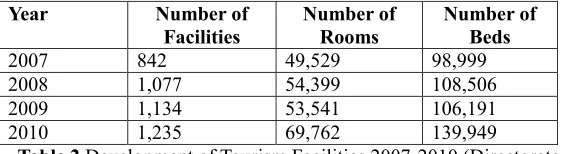
However, recent efforts to boost urban tourism in Istanbul have challenged the city’s role as a transfer point. The city of Istanbul has invested in tourism in order to promote its ‘urban’ assets. As a result, there have been significant improvements in the tourism industry. For example, in 2007 there were 842 tourism facilities with about 99,000 beds in Istanbul. In the eve of the European Capital of Culture event in 2010, this number rose to 1,235 facilities with approximately 140,000 beds (The Directorate of Culture and Tourism of Istanbul, 2011). Several tourism-led urban regeneration projects were implemented to facilitate tourist access and provide accommodation in the city centre. Waterfronts and harbours were developed for cruise ships. New terminals were added to the current airports due to the increasing number of charter and low-cost flights (perhaps it is not a coincidence that the national airline corporation of Turkey has recently become one of the leading flight companies in the world). Furthermore, between 2000 and 2010, several congress and convention centres were built to attract professionals. Consequently, according to the International Congress and Convention Association (2012), Istanbul ranked as the 9th most popular destination globally in terms of international meetings in
These developments were accompanied by several urban tourism policies and institutions. The Istanbul 2010 European Capital of Culture Agency was established in 2007. The agency worked in collaboration with the Istanbul Metropolitan Municipality and the Ministry of Culture and Tourism in order to build an international ‘image’ for the city of Istanbul to promote tourism. These policies also developed strategies on ‘mega-event’ hosting. During this period, mega-events were regarded as opportunities to present Istanbul’s historical and architectural heritage. Consequently, Istanbul has become one of the most popular tourist destinations in the world, with over 9 million visitors in 2012. The city’s share in national tourism rose to about 30% in 2012.
4 ARGUMENTS AND RESULTS
The main results of the thesis are the following: First, tourism-led urban regeneration has unequal effects. In some areas regeneration projects encouraged revitalisation of urban culture whereas in other areas they lead to displacement and evictions. Second, the European Capital of Culture event in 2010 was used as an instrument to transform the physical environment, revive cultural life and boost tourism; the projects undertaken in the year of ‘culture’ however threatened ‘local subcultures’. Third, it was found that different cities may use similar looking selling points and slogans in their tourism promotion strategies even though the meaning of such slogans could be completely different. Fourth, one of the main themes used in Istanbul’s brand is ‘religion’. Relative to current industry trends, it is unusual and surprising to find such a broadly applied one theme used for branding a destination. Finally, urban tourism strategies may cause economic, spatial and socio-cultural impacts. These impacts show that urban tourism can influence several aspects of urban development. In the following, these results are discussed in detail.
4.1 URBAN REGENERATION AS A TOOL FOR URBAN TOURISM
DEVELOPMENT
This thesis analyses urban regeneration as a tool for promoting urban tourism. The case is the city of Istanbul and its European Capital of Culture year in 2010. The ‘boom of urban regeneration projects’ of the last two decades was culminated in that year.
the city’s cultural life. The second type of urban regeneration projects aiming to transform residential neighbourhoods in or nearby the city centre received criticism. These projects were accused of only transforming physical structures but ignoring or underestimating local cultural characteristics. Regeneration projects took place either through series of renovations (e.g. in the Fener and Balat neighbourhoods) or through waves of bulldozer renewal (e.g. in the Sulukule neighbourhood). Also these transformations were carried out to serve the needs of tourists causing economic problems and cultural stigmatization in the regenerated neighbourhoods. The thesis criticises the projects that do not take social, cultural and environmental sustainability into consideration and gives a voice to local people.
As a case, the thesis studies Istanbul’s historical Romani neighbourhood called Sulukule. The neighbourhood is located in the city centre, where an urban regeneration for the needs of tourists recently took place. Although the main focus of my study was the Sulukule Platform (an urban social movement challenging the regeneration in the neighbourhood), the rhetoric and outcomes of the Sulukule Urban Regeneration Project was also analysed. The objectives of the Sulukule Urban Regeneration Project were:
“to preserve national and world heritage, particularly historical tis-sue in Sulukule including ancient walls, to stop physical decay and to secure the sustainability of the neighbourhood, to maintain economic development, to promote urban integration, to increase standards of living in Sulukule and to encourage dwellers to participate in urban policies, to reinvigorate the neighbourhood’s stagnant economy, to protect cultural dynamics and to promote tourism” (The Fatih Municipality, 2010).
4.2 EUROPEAN CAPITAL OF CULTURE AS A MEGA-EVENT
The European Capital of Culture (ECOC) event in 2010 was a significant opportunity for Istanbul to present itself as a vibrant city of culture. Undoubtedly, the wide range of activities organised in 2010 revitalized culture and art scenes in Istanbul. The most remarkable contribution of this event is the restoration of several churches and mosques in the historical city centre. Several museums, along with cultural and art centres, were opened as well.
On the other hand, ECOC caused a rush to ‘remove unpleasant elements’ and to introduce ‘a better environment’ to foreign visitors. Urban regeneration projects that were conceived to reach these goals threatened neighbourhoods and communities in the historical city centre. When demolitions began in Sulukule, ECOC was used as legitimation to serve the interests of contractors and developers who made considerable profits from the property and land through what David Harvey (2008) has called ‘accumulation by dispossession’. Ironically, the year of culture witnessed a campaign to stigmatize a unique and neighbourhood-based Romani subculture. Sulukule’s Romani subculture was accused of threatening the cultural sustainability of the city and large-scale demolitions and evictions destroyed lively culture that was replaced by ‘legitimate’ urban culture.
time only one of them was about Istanbul. In 2007, ECCA and the Municipality of Istanbul did not publish any tourism promotion materials, yet by 2011 the total number of materials published by these two agencies reached 16. Thus, it is clear that this cultural title influenced tourism promotion and management in Turkey and Istanbul.
Second, the ECOC title triggered city branding efforts in Istanbul. The event simply was a driving force for unifying less systematic and nation-scaled city marketing practices under a single city brand. En route to ECOC, the main local tourism authorities, ECCA and the Metropolitan Municipality of Istanbul, jointly developed a city brand for Istanbul step by step. Initially, several public campaigns were launched in order to inform the public about potential benefits of this title. A common discourse was created by these authorities, and politicians including the Prime Minister, the Minister of Culture and Tourism and the Mayor of Istanbul concurred ECOC as an important “opportunity” or “stage” to present Istanbul’s urban heritage to the international audiences. Public campaigns were followed by Tv advertisements and an official introductory film for the city. By 2009, in the eve of ECOC, the cityscape was decorated with the new logo and slogans. Another link between the ECOC title and city branding efforts were the activities that took place in 2010. Tourism authorities used the ‘themes’ of city branding during the ECOC-related activities and events (e.g. festivals, movie screenings, concerts, exhibitions, conferences, forums, workshops and sports activities). It is not surprising to find out that these themes (religion, capital of civilizations, the city between the East and the West, tolerance, multicultural diversity and Orientalism) were associated with the city’s urban culture in the year of ECOC. In fact, we can also find these themes in tourism materials prepared for ECOC between 2007 and 2011. The next section addresses this issue.
4.3 CITY MARKETING AND CITY BRANDING
In order to analyse the city branding, the thesis compares tourism promotion materials in Helsinki and Istanbul. Surprisingly, these cities used three similar slogans to attract tourists. Both Helsinki and Istanbul introduced themselves as ‘the city between the East and West’, as ‘the city of tolerance’ and refered to the ‘city size’ in their marketing materials. Despite the similar appearance, the meaning, however, is radically different.
and West have ‘religious’ meaning, East representing Islam and West standing for Christianity. Second, also tolerance in the slogan Helsinki and Istanbul as ‘tolerant cities’ means different things. In Helsinki, it is tolerance of individual lifestyles, liberties and multicultural diversity, whereas in Istanbul tolerance is interpreted in a religious sense. Finally, both cities introduce their ‘size’ as an advantage although for Helsinki it is the smallness of the city and for Istanbul it is the vast city size.
Interestingly, in all these three categories of between the East and West, tolerance and size, both Helsinki and Istanbul present themselves unique and original. Previous research on tourism promotion shows that cities, in their aspirations to imitate strategies of other cities, also copy the phrases and slogans of other cities. In single city case studies or just by regarding the similar ideas as travelling ideas, different meanings of similar words may remain unnoticed. Although occasionally repeated phrases can be clichés, they are not necessarily empty slogans but tell something real and interesting about the city’s identity, history and social life.
ages of the city, and sometimes to Istanbul as a religious centre today. Fourth, when tourism materials refered to famous personalities, the emphasis was again on religion. Istanbul’s religious diversity and tolerance, even its ‘mystical ambience’, were seen to have nurtured culture and inspired art works. Istanbul’s religious identity was associated with non-religious activities in the fields of culture and art. Finally, as it was discussed in the previous section, more than half of the events organized in the year of the ECOC adopted religion as a theme. In accordance with representations in tourism promotion, religious diversity and tolerance dominated major events that took place in 2010.
In summary, the Istanbul case with religion as a dominant theme in branding the city shows that tourism promotion materials may give a key to understand the city, that, cities can either use universal ideas or trust on local features in boosting themselves. Furthermore, the Istanbul case suggests that also cities, which are not places to pilgrimage, may exploit their religious heritage to promote urban tourism. Perhaps religion, after all, is not completely separate from activities in othe fields, such as politics, culture and art.
4.4 LESSONS FROM A CASE STUDY: ECONOMIC, SPATIAL AND
SOCIO-CULTURAL IMPACTS OF URBAN TOURISM
This thesis includes an analysis of an urban social movement, the Sulukule Platform, challenging a tourism-led urban regeneration, the Sulukule Urban Regeration Project that took place in a historical Romani neighbourhood, Sulukule. At first glance, The Sulukule Urban Regeneration Project, may seem just a housing project. Regeneration processes, however, even as simple housing projects are complex processes. They often lead to demolitions and forced evictions, some times make use of ambiguous property rights, occasionally mobilise resistance, engage various actors, may treat enthnic groups differently and may exploit stigmatisation of neighbourhoods. What is important is that some of the effects of regeneration projects may foil the initial goals of the regeneration project.
which became manifest during and after the demolition processes, included a creation of ‘clean, vibrant and safe’ area cleaned from ‘unpleasant elements’ in order to attract tourists. The authorities explicitly blamed activists and accused them of jeopardising the neighbourhood’s ‘tourism potentials’. Third, an attempt to pomote urban tourism has been an important motivation for passing the Law 5366 for Renovation, Protection, Cherishing and Use of Worn Historical and Cultural Immovable Properties (Yıpranan Tarihi ve Kültürel Taşınmaz Varlıkların Yenilenerek Korunması ve Yaşatılarak Kullanılması Hakkında Kanun, 2005) that has been the main legal instrument for urban regeneration projects, particularly in deteriorated historic areas. The law and its interpretation of conservation was criticised by the activists.
Second, spatial impacts of the Sulukule Urban Regeneration Project were equally devastating. Due to a series of demolitions, the neighbourhood became a construction zone by 2010. Houses, even with historical value, and other tangible assets were demolished. The Romani identity of the area was wiped out with the demolishing of the area. Four hundred and eighty ‘Ottoman style’ wooden houses, new shops and hotels were built in the area erasing Sulukule’s 1000 year-old history (see Figure 4).
Figure 4 Sulukule’s new ‘traditional style’ buildings could not save the Romani identity. (Source: the Fatih Municipality)
Third, socio-cultural impacts of tourism-led regeneration in Sulukule were also remarkable. A solidarity-based, music and entertainment oriented ethnic subculture has disappeared due to the displacement of Sulukule’s Romani inhabitants. This displacement not only brought an end to the Romani tradition in the area, but also caused disturbance in other parts of the city. Displaced Romani families could not adapt to ‘regular’ and ‘ordered’ daily life in Taşoluk, which has a very different socio-cultural profile. without their traditional source of living, evicted Romani became poor and unemployed. Some are ‘reputedly’ engaged in robbery, illicit drug trafficking and prostitution. This has led to stigmatization of Romani people by the other locals of Taşoluk.
5 DATA AND METHODS
5.1 A MIXED APPROACH
Urban tourism research is a vast field employing several approaches from various disciplines. Hence this thesis uses different perspectives and approaches as well. The articles I, III and Iv benefit from a supply-side approach. This approach is concerned with tourism strategies by cities, tourism authorities and departments to supply facilities and means of promotion for tourists (see Selby, 2004). Accordingly, these three articles analyse urban policies and urban regeration projects that have made cities attractive for tourists. The data for the analysis consists of policy documents, reports and tourism materials. The article II analyses the demand-side that is the demand of tourism faciliticies by visitors. In this approach, the main analysis is based on people’s perceptions and opinions towards urban tourism strategies and their impacts. The article II evaluates locals’ perception about tourism-led urban regeneration.
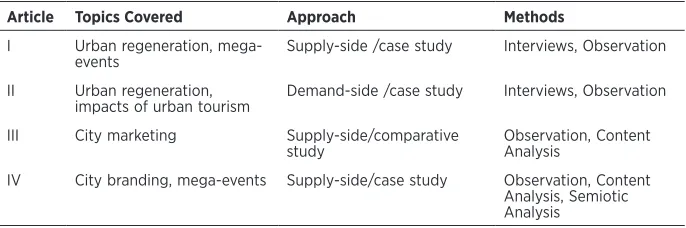
In addition to analysing urban tourism from the perspectives of supply and demand, the thesis includes case studies and a comparative research. The articles I, II and IV study urban tourism in Istanbul and portray a detailed tourist city profile, whereas the article III compares tourism promotion strategies of Helsinki and Istanbul. With awareness of the complexity of urban tourism, the thesis studies urban regeneration, mega-events, city marketing and city branding and impacts of urban tourism. Each article deals with one or two topics by employing different approaches and methods (table 1).
Table 1 Articles, Topics and Approaches
Article Topics Covered Approach Methods
I Urban regeneration,
mega-events Supply-side /case study Interviews, Observation
II Urban regeneration,
impacts of urban tourism Demand-side /case study Interviews, Observation
III City marketing Supply-side/comparative
study Observation, Content Analysis
IV City branding, mega-events Supply-side/case study Observation, Content
Most tourism and urban studies deal with one or two strategies or impacts of urban tourism. For example, Short et. al. (1993) discussed how urban regeneration contributed to the new image of an industrial city; Richards and Wilson (2004) evaluated the impact of mega-events on city’s image and Hiller (2000) analysed how mega-events triggered urban regeneration. However, studies on strategies and their impacts often ignore analysing the interaction of various strategies and impacts. In analysing various aspects of urban tourism, this thesis has tried to capture a full picture of urban tourism, including the following aspects of it: tourism-led urban regeneration, mega-events arranged to attract tourists, city marketing and city branding to please the visitors, and the economic, spatial and social impacts of urban tourism.
The research of these aspects is intertwined. To analyse urban regeneration like the Sulukule Regeneration Project is to analyse economic, spatial and social impacts. To anaylse mega-events like Olympics is to analyse the strategies of cities to compete with other cities to win the bidding competition. To analyse city marketing and branding is to ask to whom these are targeted to.
5.2 DATA AND METHODS
interviews also focused on the agency’s structure, functions and capacities in terms of tourism promotion. It is interesting that all three interviewees agreed on the point that ECOC was a valuable opportunity to boost urban tourism in Istanbul while they mostly remained silent on controversial issues concerning urban regeneration in residential areas and its devastating effects. In addition, observation and long-term enquires made at currently regenerated neighbourhoods and industrial areas helped me to develop a comparative perspective while evaluating urban regeneration in residential and non-residential urban areas.
Similarly in the second phase, data were collected through semi structured interviews, in-depth interviews and long-term observation. The interviews (eight in total) conducted for the article II were grouped into three categories: the interviews with activists/professionals, with the dwellers of the Romani neighbourhood Sulukule, and with inhabitants who live and work in the adjacent neighbourhood Çarşamba, which is ethnically and culturally different from the Romani one. Firstly, activists or professionals, who do not live in Sulukule, expressed their concerns about the Sulukule Urban Regeneration Project. They all agreed that Sulukule desperately needs ‘regeneration’ instead of large scale demolitions. In this context, they advocated alternative suggestions/plans to ‘save’ Sulukule and criticised the municipality’s irreconcilable approach. The second group of interviewees consisted of locals (some are activists, some are not). It is interesting that former property owners in Sulukule were generally reluctant to talk to me because they were concerned to express their identities and property values. However, tenants who had experienced displacement due to lack of their tenancy documents were eager to be interviewed. In these long conversations, locals told their stories concerning demolitions, evictions and their lives after these. In this part, I focused on how ambiguous property rights in the neighbourhood caused problems and how displacement affected Sulukule’s Romani dwellers. Interviews with the residents of Çarşamba helped to document the prejudices towards the Roma and their lifestyles and pointed out the ‘ethno-cultural dimension’ of this project. Both interviewees affirmed ‘bulldozer renewal’ in Sulukule. In general, all three groups provided data for the formation and activities of the urban social movement (the Sulukule Platform) in Sulukule. Further, during my frequent visits to the neighbourhood before and after demolitions, I had the chance to observe Romani lifestyles, conditions that the locals were forced to live in and their reactions to authorities.
above-mentioned tourism authorities. These documents included tourism guides, booklets, guidebooks, brochures, maps, advertisements, campaign texts and slogans, movies, pictures and illustrations. The materials substantially vary by length (from a single page brochure to a 96-page newsletter). All these tourism materials were in English, not only to avoid misunderstandings stemming from translation differences, but also to understand and interpret the external images of the cities. The data also included tourism statistics, domestic and international tourism reports, and surveys that support empirical findings. In addition, I acted as a tourist in both Istanbul and Helsinki; participated in tours, frequently visited main tourist attractions, followed tourist itineraries, attended tourist events and took research notes. Being a former resident of Istanbul and a foreign student in Helsinki helped me to develop a comparative perspective in analysing urban tourism in both cities. Two major methods were used in this phase: content analysis (the articles III and IV) and semiotic analysis (the article IV). Content analysis (the articles III and IV) has become popular among tourism researchers due to the increasing amount of easily accessible tourism promotion materials, also available on internet. Content analysis provides “convincing readings of cultural texts; it helps to draw various conclusions from them, by looking at the texts themselves rather than at the ways in which people actually consume the texts’ (Slater, 1998: 234). Thus, content analysis enables the analysis of the content, which ‘refers to words, meanings, pictures, symbols, ideas, themes, or any message that can be communicated’ (Neumann, 2003: 219). In the thesis, texts on tourism promotion materials are grouped into content categories in order to find out the ‘themes’ used in city branding (the article IV) and to compare tourism strategies of Helsinki and Istanbul (the article III). Words with similar meanings that refer to the same themes were categorized, and the frequency of key words was identified.
Semiotic analysis is used only in the article IV as a secondary method in a relatively brief fashion, particularly to analyse logo and banners and rethink over multiple meaning of slogans. The study benefited in general from aspects of social semiotics (Van Leuween, 2005) and the cultural reading of texts (Lehonen, 2000), and in particular from the literature on city branding, in which several urban tourism scholars applied semiotic analysis. These studies covered analysis of symbolic expressions in tourist brochures (Jenkins, 2003), encoding brands in semiotic modes of language and images (Koller, 2008), and the analysis of ‘recurrent’ and ‘interesting’ words and phrases, capital letters, fonts and colours, quotation marks, titles and subtitles (Vanolo, 2008b). Semiotic analysis helped to understand semiotic expressions in tourist brochures, the language preferred for tourism promotion, and to discover and interpret ‘meanings’ in different contexts.
6 THE ARGUMENT OF THE THESIS
This thesis analyses urban tourism from several perspectives. The backbone of the thesis is the analysis of urban regeneration, mega-events, city marketing and branding, and the impacts of urban tourism. First, the thesis identifies connections between three processes of urban tourism: urban regeneration, mega-events and city marketing and branding. The Istanbul case provides empirical data to understand regeneration of the industrial landscape in order to provide facilities for mega-events (e.g. the European Capital of Culture). ECOC as a mega-event provided an extensive budget for the implementation of urban regeneration projects. Regeneration of historical neighbourhoods influenced the city’s branding efforts. New tourist zones were created in line with the recent branding policy. More importantly, religious buildings and landmarks, which have a central position in Istanbul’s brand, were renovated. Furthermore, the close connection between mega-events and city marketing and branding can be clearly observed in the Istanbul case. ECOC was an opportunity for building and presenting Istanbul’s brand. The event also provided a motivation to unify all the previous city marketing efforts under a single and coherent city brand. The themes that were used in Istanbul’s city brand were also observed at the activities which were organized in the year of ECOC. It is also expected that this mega-event will contribute to Istanbul’s international status and make the city’s image memorable in the minds of tourists and visitors. A city with a well-known image can have more chances to host even larger scale of mega-events (e.g. Istanbul’s recent Summer Olympics bid for 2020).
displacement of the locals, and unemployment and poverty in the long run. The case study in Sulukule showed the dark side of tourism policies, negative economic, spatial and socio-cultural impacts over the urban population. It is ironic that the local Romani subculture was stigmatized at the time when the city was celebrating its title of ECOC. Many of these positive and negative impacts of urban tourism strategies and policies can be unintended the remedy of which may not even be in the domain of tourism policy. The Sulukule case also demonstrated some possibilities for urban social movements that to oppose tourism-led regeneration projects.
Third, the single case study on Istanbul and the comparative case study about Helsinki and Istanbul demonstrate that tourism promotion materials can be significant tools in understanding and analysing city marketing and branding policies. The aims and methods of tourism policies on the one hand and city marketing and branding strategies can be the same: to make the city known in the world by exploiting local distinctive features or imitating strategies applied in other cities. One of the findings of the thesis was that similar symbols and slogans used in different cities’ tourism promotion materials may have different meaning and refer to different urban, cultural, social and historical assets.
Fourth, urban tourism strategies may lead to changes in urban policies, challenging the belief that urban policy is made for local people by local people. The thesis demonstrates how mega events and city marketing strategies designed for outsiders can affect urban administration as a whole. As a case, the thesis discusses a recent change in Turkey’s tourism administration. As the city of Istanbul has become a popular tourist destination, tourism policies are increasingly decentralised. Although the central government’s influence on tourism strategies is still strong, the Minister of Culture and Tourism’s monopoly over tourism promotion has ended. Local authorities such as the Istanbul Metropolitan Municipality and the Istanbul 2010 European Capital Agency have recently become the dominant policy makers regarding tourism. In the past decade, the Istanbul Metropolitan Municipality has become the main actor for tourism-led regeneration projects thus intervening the domain of urban planning. Similarly, the Istanbul 2010 European Capital Agency became responsible for producing tourism promotion materials as the development of urban tourism in Istanbul required new urban representations.
7 CONCLUSION AND SUGGESTIONS FOR
FURTHER RESEARCH
The thesis studies urban tourism and introduces a theoretical framework for analysing this complex phenomenon. The focus is on the city of Istanbul and one aim is to draw a tourist city profile of Istanbul. The thesis analyses urban regeneration, mega-events, city marketing and city branding and economic, spatial and social impacts of urban tourism, city marketing and city branding.
REFERENCES
Anholt, S. (2006) The Anholt-GMI City Brands Index: how the world sees the world’s cities. Place Branding and Public Diplomacy 2.1, 18-31.
Anholt, S. (2007) Competitive identity: The new brand management for nations, cities and regions. Palgrave Macmillan.
Anholt, S. (2008) Place branding: Is it marketing, or isn’t it? Place Branding and Public Diplomacy, 4.1 1-6.
Ashworth, g. J. (1989) Urban tourism: an imbalance in attention. Progress in tourism, recreation and hospitality management 1, 33-54.
Ashworth, g. J. (2009). The instruments of place branding: how is it done?.
European spatial research and policy, 16(1), 9-22.
Ashworth, G. J. and Kavaratzis, M. (2009). Beyond the logo: Brand management for cities. Journal of Brand Management, 16(8), 520-531.
Ashworth, g. J. and Page, S. J. (2011) Urban tourism research: Recent progress and current paradoxes. Tourism Management 32.1, 1-15.
Ashworth, g. J. and Tunbridge, J. E. (2000) The tourist-historic city: Retrospect and prospect of managing the heritage city. Routledge.
Ashworth, g. J. and Voogd, H. (1990) Selling the city: marketing approaches in public sector urban planning. Belhaven Press.
Aykaç, A. (2009) Yeni işler, yeni işçiler: turizm sektöründe emek [The New Works and The New Laborers: Labour in the Tourism Sector]. İletişim, Istanbul. Bailey, N. and Robertson, D. (1997) Housing renewal, urban policy and
gentrification. Urban Studies, 34.4, 561-578.
Belisle, F. J. and Hoy, D. R. (1980). The perceived impact of tourism by residents a case study in Santa Marta, Colombia. Annals of tourism research, 7.1, 83-101. Bottà, G. (2010) Language and the Scientific Imagination: Proceedings of the 11th
Conference of the International Society for the Study of European Ideas (ISSEI), 28 July – 2 August 2008 at the Language Centre, University of Helsinki, Finland. Online at: https://helda.helsinki.fi/bitstream/ handle/10138/15311/60_Botta.pdf?sequence=1
Bramwell, B. and Rawding, L. (1996) Tourism marketing images of industrial cities. Annals of Tourism research 23.1, 201-221.


![Figure 1 Number of tourists in Turkey 2000-2009 (Turkish Statistical Institute, 2009) [24]](https://thumb-ap.123doks.com/thumbv2/123dok/3938966.1882386/59.499.106.387.209.301/figure-number-tourists-turkey-turkish-statistical-institute.webp)
![Figure 4 Function Centers of Istanbul (Istanbul Municipality, 2009) [32]](https://thumb-ap.123doks.com/thumbv2/123dok/3938966.1882386/62.499.111.389.358.508/figure-function-centers-istanbul-istanbul-municipality.webp)
![Figure 5 Cultural Tourism led urban regeneration in Istanbul, 1980-2009 (Mutlukent, 2011) [33]](https://thumb-ap.123doks.com/thumbv2/123dok/3938966.1882386/63.499.134.356.129.321/figure-cultural-tourism-led-urban-regeneration-istanbul-mutlukent.webp)
![Table 4 The Istanbul 2010 European Capital of Culture Agency’s Budget (The Istanbul 2010 European Capital of Culture Agency, 2010) [35]](https://thumb-ap.123doks.com/thumbv2/123dok/3938966.1882386/65.499.106.371.128.170/istanbul-european-capital-culture-istanbul-european-capital-culture.webp)
